








SUSE Cloud Observability is SUSE’s Kubernetes-first observability platform for platform engineers, DevOps teams, SREs, developers, and Kubernetes operators. It brings metrics, logs, traces, topology, dashboards, alerts, and guided remediation into one platform so teams can monitor cloud-native environments and speed up root cause analysis.
Pricing matters because SUSE Cloud Observability uses a mix of host-based and telemetry-based billing. Public pricing on SUSE’s cloud observability page lists $9.99 per host/month for 10–100 hosts, $8.99 per host/month above 100 hosts, 5GB free each for logs, metrics, and traces, and $0.15/GB for additional usage. That makes cost depend on both infrastructure size and telemetry volume.
In this guide, we’ll verify SUSE Cloud Observability pricing, what is included, what drives cost, how it fits Kubernetes and Rancher environments, what users say in reviews, and how it compares with alternatives such as Datadog, Dynatrace, New Relic, Grafana Cloud, Elastic, and CubeAPM.
What Is SUSE Cloud Observability?
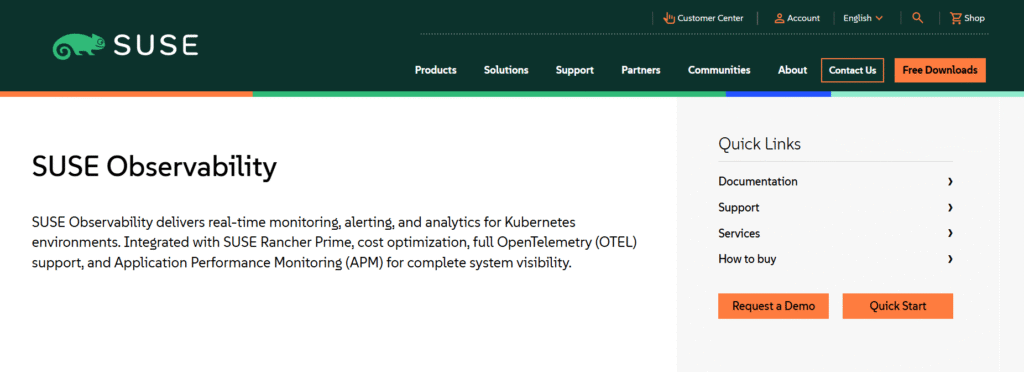
SUSE Cloud Observability is the SaaS version of SUSE’s observability product. SUSE also offers SUSE Observability as part of Rancher Prime for on-prem deployments, while SUSE Cloud Observability is the fully managed SaaS option. SUSE says both deliver advanced dashboarding, time-travel analysis, and OpenTelemetry integration.
The product is built for Kubernetes and cloud-native environments. SUSE says it unifies metrics, logs, traces, and topology in one interface, with more than 40 prebuilt dashboards and time-travel debugging to help teams detect, analyze, and resolve incidents faster across clouds and clusters.
The product came into SUSE’s portfolio through StackState. SUSE acquired StackState in 2024 to accelerate cloud-native observability and integrate StackState’s observability technology into Rancher Prime, SUSE’s premium Kubernetes management platform.
Who Is SUSE Cloud Observability For?
SUSE Cloud Observability is mainly for teams running Kubernetes-heavy environments. SUSE’s own FAQ lists platform engineers, DevOps teams, SREs, developers, and professional Kubernetes operators as the target users.
It is especially relevant for teams that need visibility across Kubernetes clusters, Amazon EKS, Rancher-managed environments, and cloud-native workloads. SUSE’s AWS Marketplace listing describes the product as providing a unified view across Kubernetes and IT infrastructure, with insights into application performance, health, and dependencies.
This focus is timely because cloud-native adoption keeps growing. CNCF’s 2024 Cloud Native Survey found that cloud-native adoption reached 89% among surveyed organizations, while 93% of organizations were using, piloting, or evaluating Kubernetes.
Key Features of SUSE Cloud Observability
SUSE Cloud Observability is strongest in Kubernetes environments. It provides monitoring across clusters and workloads, with visibility into services, pods, deployments, stateful sets, daemon sets, and related Kubernetes resources.
SUSE’s documentation says the SUSE Observability agent is installed on downstream worker nodes and collects metrics, events, traces, and logs. It also uses eBPF to monitor workloads and communication, and can decode RED signals such as rate, errors, and duration for common protocols.
SUSE Observability combines the main telemetry types in one platform. SUSE says the observability server stores topology, metrics, traces, and logs using services such as StackGraph, VictoriaMetrics, ClickHouse, and Elasticsearch.
That topology layer is important. It helps teams understand how applications, services, infrastructure, and dependencies relate to each other instead of looking at disconnected dashboards.
SUSE Observability supports OpenTelemetry. SUSE documentation explains that OpenTelemetry can collect, transform, and ship traces, metrics, and logs, and that SUSE Observability supports metrics and traces through the OpenTelemetry collector and stackpack.
This matters for teams trying to reduce vendor lock-in. OpenTelemetry allows teams to instrument applications using open standards rather than proprietary-only agents.
SUSE highlights time-travel debugging as a key feature. This helps teams look back at the state of the environment before, during, and after an incident. In user reviews, time travel is also mentioned as useful for analyzing what changed before an incident.
This is useful in Kubernetes because cluster topology changes constantly. Autoscaling, deployments, restarts, config changes, and dependency shifts can make incidents hard to reconstruct after the fact.
SUSE says the platform includes more than 40 prebuilt dashboards. G2’s product profile also describes dashboards for EKS, EC2, Kubernetes, and more.
Guided remediation is another key part of the product’s positioning. SUSE’s cloud observability page describes the product as offering metrics, logs, traces, and guided remediation in one SaaS solution.
SUSE Observability is tightly connected to Rancher Prime. SUSE says it is OpenTelemetry-native and integrated with Rancher Prime, and that the SaaS version is available through SUSE Cloud Observability.
On AWS, SUSE provides a Cloud Observability Agent for Amazon EKS through AWS Marketplace. The listing says the delivery method is a Helm chart and that it supports Amazon EKS and Amazon EKS Anywhere.
SUSE Cloud Observability Pricing in 2026
SUSE Cloud Observability publishes public pricing for its AWS-based SaaS offering. The pricing model has two main parts: host pricing and telemetry usage.
| Pricing item | Public price |
| 10–100 hosts | $9.99 per host/month |
| Over 100 hosts | $8.99 per host/month |
| Minimum base fee | $99/month for 10 hosts |
| Free telemetry | 5GB logs, 5GB metrics, 5GB traces |
| Additional telemetry | $0.15/GB |
SUSE states that billing is hourly, with a minimum of 10 hosts for the 10–100 host tier and a minimum of 100 hosts for the over-100-host tier. SUSE also defines a host as 4 vCPU and 16GB RAM, and notes that larger configurations are billed as multiples.
What Is Included in the Base Price?
The $99/month base fee includes 10 hosts. Each host is defined as up to 4 vCPU and 16GB RAM. The base plan also includes 5GB of logs, 5GB of metrics, and 5GB of traces. SUSE says free data is allocated at 7MB/hour per data type, and additional usage costs $0.15/GB.
This means the listed base price is not the same as an unlimited observability plan. Teams with high log, metrics, or trace volume should model telemetry usage carefully before assuming the $99/month entry price reflects production cost.
How SUSE Cloud Observability Billing Works
SUSE Cloud Observability has three important billing dimensions.
First, it charges by host. For 10–100 hosts, the listed rate is $9.99 per host/month. Above 100 hosts, the listed rate is $8.99 per host/month.
Second, it charges for telemetry beyond the included allowance. SUSE includes 5GB each for logs, metrics, and traces, then charges $0.15/GB for additional usage.
Third, host sizing matters. SUSE defines a host as 4 vCPU and 16GB RAM, and larger configurations are billed as multiples. This means a large node may count as more than one host for billing purposes.
What Does SUSE Cloud Observability Really Cost?
⚠️ Disclaimer
The scenarios below are directional editorial estimates, not official SUSE quotes. SUSE publishes public pricing for SUSE Cloud Observability, but final cost can change based on host count, host size, telemetry volume, AWS Marketplace terms, private offers, support requirements, discounts, and whether the team buys SUSE Observability through SUSE Cloud Observability, Rancher Prime, or another SUSE package.
SUSE Cloud Observability pricing is based on both monitored hosts and telemetry usage. SUSE lists a base fee of $99/month for 10 hosts, $9.99/host/month for 10–100 hosts, and $8.99/host/month above 100 hosts. SUSE also includes 5GB each of logs, metrics, and traces, then charges $0.15/GB for additional usage. A host is defined as 4 vCPU and 16GB RAM, and larger configurations are billed as multiples.
SUSE Cloud Observability is not priced like a pure ingest-only observability tool. A team producing 5 TB/month of telemetry does not only pay for 5 TB of ingestion. The main public cost drivers are the number of billing-adjusted hosts, the size of those hosts, and telemetry volume above the included free allowance.
Pricing Assumptions Used in These Scenarios
These scenarios use the workload profiles from the CubeAPM calculator, but map the SUSE estimate to SUSE Cloud Observability’s public pricing model.
| Scenario | SUSE pricing anchor | SUSE estimate | CubeAPM estimate |
| Small team | 10 billing-adjusted hosts + ~1.1 TB telemetry | ~$266/month | ~$522/month |
| Growing team | 50 billing-adjusted hosts + ~5.4 TB telemetry | ~$1,327/month | ~$919/month |
| Mid-market team | 250 billing-adjusted hosts + ~27 TB telemetry | ~$6,392/month | ~$4,594/month |
These estimates do not include premium support, professional services, AWS Marketplace private offers, custom SUSE contract terms, enterprise discounts, or telemetry-retention changes.
Workload Assumptions Used for SUSE Estimates
| Team size | Infrastructure context | Telemetry context | SUSE usage assumption | Estimated SUSE cost |
| Small team | 10 hosts | ~1.1 TB/month | 10 hosts + paid telemetry above 15GB free | ~$266/month |
| Growing team | 50 hosts | ~5.4 TB/month | 50 hosts + paid telemetry above 15GB free | ~$1,327/month |
| Mid-market team | 250 hosts | ~27 TB/month | 250 hosts + paid telemetry above 15GB free | ~$6,392/month |
The telemetry volume is included because SUSE Cloud Observability charges $0.15/GB after the included 5GB each for logs, metrics, and traces. For SUSE, host count still matters because the product also has a per-host monthly fee.
Scenario 1: Small Team, ~10 Hosts
Situation
A small Kubernetes team runs around 10 billing-adjusted hosts and produces roughly 1.1 TB of monthly telemetry across logs, metrics, and traces. The team needs Kubernetes visibility, topology, dashboards, alerts, OpenTelemetry support, and faster root cause analysis.
For SUSE Cloud Observability, both the 10 monitored hosts and telemetry volume affect the bill. The host fee sets the base cost, while telemetry above the included 15GB total allowance adds usage-based charges.
Why teams at this stage consider SUSE Cloud Observability
Teams at this stage may consider SUSE Cloud Observability because they want Kubernetes-first monitoring without building their own observability stack from Prometheus, Grafana, Loki, Tempo, and tracing tools. SUSE also gives them topology, time-travel debugging, dashboards, and guided troubleshooting in one managed platform.
Estimated profile
| Configuration | Detail |
| Infrastructure context | 10 billing-adjusted hosts |
| Telemetry context | ~1.1 TB/month |
| Base SUSE package | SUSE Cloud Observability |
| Included telemetry | 5GB logs + 5GB metrics + 5GB traces |
| Paid telemetry assumption | ~1,111GB after 15GB free |
| Pricing basis | Host fee + telemetry usage |
Estimated monthly cost
Disclaimer: This estimate uses SUSE’s public pricing model as a planning anchor. It assumes the 10 hosts fit SUSE’s host definition of 4 vCPU and 16GB RAM. Larger hosts may be billed as multiples, which would increase cost.
| Component | Assumption | Monthly cost |
| Host fee | 10 hosts × $9.99/host | ~$99.90 |
| Included telemetry | 15GB total | $0 |
| Paid telemetry | ~1,111GB × $0.15/GB | ~$166.65 |
| Estimated total | Host + telemetry | ~$266/month |
CubeAPM cost comparison
| Platform | Pricing basis | Estimated monthly cost |
| SUSE Cloud Observability | 10 hosts + ~1.1 TB telemetry | ~$266/month |
| CubeAPM | ~1.1 TB/month ingestion estimate | ~$522/month |
| Difference vs SUSE | CubeAPM is higher in this small scenario | ~$256/month higher |
| Percentage difference | $256 ÷ $266 | ~96% higher |
What this scenario shows
For a small team, SUSE Cloud Observability can look cheaper because its host count is low and its telemetry rate matches CubeAPM’s $0.15/GB usage rate after the free allowance. CubeAPM is not cheaper in this specific scenario. The trade-off is scope: SUSE is strongest for Kubernetes-first observability, while CubeAPM is broader for full-stack APM, logs, traces, infrastructure monitoring, RUM, synthetics, SLOs, and error tracking.
Scenario 2: Growing Team, ~50 Hosts
Situation
A growing platform team runs around 50 billing-adjusted hosts and produces roughly 5.4 TB of monthly telemetry. The environment includes several Kubernetes clusters, customer-facing services, APIs, background jobs, and production workloads.
For SUSE Cloud Observability, the 50-host count creates a larger base fee, while telemetry volume adds a second cost layer. The 15GB included allowance becomes small compared with production-scale logs, metrics, and traces.
Why teams at this stage consider SUSE Cloud Observability
At this stage, teams usually need stronger Kubernetes troubleshooting, dependency visibility, topology, incident context, and OpenTelemetry support. SUSE Cloud Observability is attractive for teams that want Kubernetes-first RCA and a managed SaaS model instead of stitching together several open-source tools.
Estimated profile
| Configuration | Detail |
| Infrastructure context | 50 billing-adjusted hosts |
| Telemetry context | ~5.4 TB/month |
| Base SUSE package | SUSE Cloud Observability |
| Included telemetry | 5GB logs + 5GB metrics + 5GB traces |
| Paid telemetry assumption | ~5,514GB after 15GB free |
| Pricing basis | Host fee + telemetry usage |
Estimated monthly cost
Disclaimer: This estimate uses SUSE’s public pricing page as a planning model. Actual cost can rise if Kubernetes nodes exceed SUSE’s 4 vCPU / 16GB RAM host definition and are billed as multiples.
| Component | Assumption | Monthly cost |
| Host fee | 50 hosts × $9.99/host | ~$499.50 |
| Included telemetry | 15GB total | $0 |
| Paid telemetry | ~5,514GB × $0.15/GB | ~$827.10 |
| Estimated total | Host + telemetry | ~$1,327/month |
CubeAPM cost comparison
| Platform | Pricing basis | Estimated monthly cost |
| SUSE Cloud Observability | 50 hosts + ~5.4 TB telemetry | ~$1,327/month |
| CubeAPM | ~5.4 TB/month ingestion estimate | ~$919/month |
| Estimated savings with CubeAPM | Difference vs SUSE | ~$408/month |
| Percentage savings | $408 ÷ $1,327 | ~31% lower |
What this scenario shows
This is where CubeAPM starts to become more cost-effective. SUSE Cloud Observability charges for both hosts and telemetry, while CubeAPM charges only by ingested telemetry volume. For a growing team adding more nodes, services, and Kubernetes workloads, the per-host layer can make SUSE’s cost rise faster.
Scenario 3: Mid-Market Team, ~250 Hosts
Situation
A mid-market team runs around 250 billing-adjusted hosts and produces roughly 27 TB of monthly telemetry. The environment includes multiple Kubernetes clusters, customer-facing applications, APIs, queues, databases, internal services, and platform workloads.
At this scale, the team needs more than basic Kubernetes dashboards. It needs topology, traces, logs, metrics, dependency views, RCA workflows, alerting, and operational context across a large cloud-native estate.
Why teams at this stage consider SUSE Cloud Observability
At mid-market scale, SUSE Cloud Observability is attractive for teams that want Kubernetes-first troubleshooting, topology-driven incident analysis, OpenTelemetry support, guided remediation, and closer alignment with the SUSE/Rancher ecosystem. It can be especially relevant if the team already uses Rancher or wants a SUSE-supported observability path for Kubernetes.
Estimated profile
| Configuration | Detail |
| Infrastructure context | 250 billing-adjusted hosts |
| Telemetry context | ~27 TB/month |
| Base SUSE package | SUSE Cloud Observability |
| Included telemetry | 5GB logs + 5GB metrics + 5GB traces |
| Paid telemetry assumption | ~27,633GB after 15GB free |
| Pricing basis | Discounted host tier + telemetry usage |
Estimated monthly cost
Disclaimer: This estimate uses SUSE’s public over-100-host price of $8.99/host/month. It assumes 250 billing-adjusted hosts. If large Kubernetes nodes count as multiple hosts, the final bill can be higher.
| Component | Assumption | Monthly cost |
| Host fee | 250 hosts × $8.99/host | ~$2,247.50 |
| Included telemetry | 15GB total | $0 |
| Paid telemetry | ~27,633GB × $0.15/GB | ~$4,144.95 |
| Estimated total | Host + telemetry | ~$6,392/month |
CubeAPM cost comparison
| Platform | Pricing basis | Estimated monthly cost |
| SUSE Cloud Observability | 250 hosts + ~27 TB telemetry | ~$6,392/month |
| CubeAPM | ~27 TB/month ingestion estimate | ~$4,594/month |
| Estimated savings with CubeAPM | Difference vs SUSE | ~$1,798/month |
| Percentage savings | $1,798 ÷ $6,392 | ~28% lower |
What this scenario shows
At mid-market scale, SUSE Cloud Observability’s host layer becomes a meaningful cost driver. Even though SUSE’s $0.15/GB telemetry rate is straightforward, the additional per-host charge makes the total higher than a pure ingest-based model. CubeAPM becomes cheaper here because it does not add per-host fees on top of ingestion.
Summary: SUSE Cloud Observability vs CubeAPM Estimated Monthly Cost
Disclaimer: These are directional planning estimates, not official quotes. SUSE Cloud Observability’s final cost can change with billing-adjusted host count, node size, private offers, telemetry volume, support requirements, and contract terms. CubeAPM’s value is strongest for teams that want full-stack observability without per-host fees, per-user fees, or separate pricing for every signal.
| Team profile | SUSE Cloud Observability estimate | CubeAPM estimate | Monthly savings with CubeAPM | Percentage savings |
| Small team | ~$266/month | ~$522/month | SUSE is ~$256 lower | CubeAPM higher |
| Growing team | ~$1,327/month | ~$919/month | ~$408/month | ~31% |
| Mid-market team | ~$6,392/month | ~$4,594/month | ~$1,798/month | ~28% |
For small Kubernetes estates, SUSE Cloud Observability can be cheaper because the host count is low. As host count and telemetry volume grow, CubeAPM becomes more cost-effective because it avoids the extra host-based pricing layer.
What Drives SUSE Cloud Observability Cost?
Host count is the main cost driver. SUSE charges $9.99 per host/month for 10–100 hosts and $8.99 per host/month above 100 hosts. The base fee starts at $99/month for 10 hosts.
SUSE defines a host as 4 vCPU and 16GB RAM. Larger configurations are billed as multiples. This is important for Kubernetes teams running larger nodes, because one physical or cloud node may count as more than one billed host.
SUSE includes 5GB free each for logs, metrics, and traces. Additional usage costs $0.15/GB. This makes telemetry control important, especially for teams with verbose logs, high-cardinality metrics, or unsampled traces.
More clusters, namespaces, services, pods, and workloads increase the amount of telemetry and topology data the platform needs to ingest and correlate. SUSE’s product is built for Kubernetes visibility, but larger estates still need careful telemetry planning.
SUSE Cloud Observability is available through AWS Marketplace, and the AWS listing describes the agent for Amazon EKS as a Helm chart supporting Amazon EKS and EKS Anywhere. Marketplace procurement may simplify buying for AWS-heavy teams, but private offers can change final pricing.
SUSE Cloud Observability User Reviews
SUSE Cloud Observability has public review visibility on G2 and AWS Marketplace. G2 lists SUSE Cloud Observability at 4.5/5 across 30 reviews. AWS Marketplace shows 4.5/5 across 30 ratings, with external reviews coming from G2.
| Review source | Rating shown publicly | Review count |
| G2 | 4.5 / 5 | 30 reviews |
| AWS Marketplace | 4.5 / 5 | 30 ratings |
G2’s rating distribution shows 22 five-star reviews and 8 four-star reviews, with no three-, two-, or one-star reviews shown on the page at the time checked.
What Users Like
Users repeatedly praise SUSE Cloud Observability for Kubernetes visibility. One G2 review says the strongest part is its deep integration with Kubernetes and cloud-native environments. Another review says it supports managed Kubernetes services by giving teams valuable Kubernetes insights.
Users like the ability to see topology, relationships, metrics, anomalies, and dependencies in one interface. AWS Marketplace review content says the product collects monitoring data from multiple sources and shows topology, relations, metrics, and anomalies in a single graphical interface.
Several reviews connect the product to faster troubleshooting. G2 review content mentions reducing RCA time, using time travel, and creating observability across Kubernetes container platform solutions such as AKS and Tanzu.
G2’s review summary says users praise ease of use, deep Kubernetes integration, an intuitive interface, and responsive support. Some reviews also mention out-of-the-box monitors, remediation guides, and fast time-to-value for regular engineers.
Users also praise support. One G2 review says the StackState team’s support level and responsiveness are remarkable, while an AWS Marketplace review says customer support is great and feels present when needed.
What Users Criticize
⚠️ Disclaimer
These points reflect public user-review themes. They should be treated as user feedback, not universal product limitations.
One G2 review warns that the pay-as-you-go model may create unexpected expenses for high-volume usage. This matches the pricing model because cost can rise with both host count and telemetry volume.
Users note that the product can require familiarity with Kubernetes and OpenTelemetry. G2’s review summary also mentions a learning curve around advanced features.
One G2 review says RED signals such as errors and duration were not available out of the box in that user’s experience and required additional setup. SUSE documentation says the agent can decode RED signals for many common protocols, so this should be framed as a user setup experience rather than a universal missing feature.
An AWS Marketplace review says the pricing model can be challenging when there are many configuration items and that scope is important. Another review notes that very large environments may require selecting the right set for anomaly detection.
SUSE Cloud Observability vs Alternatives: How it Compares to Competitors
SUSE Cloud Observability vs CubeAPM
CubeAPM is a full-stack observability platform with APM, logs, metrics, traces, infrastructure monitoring, RUM, synthetics, dashboards, SLOs, RBAC, SSO, MFA, and audit logs. CubeAPM publishes pricing at $0.15/GB ingested. SUSE Cloud Observability uses host pricing plus additional telemetry usage.
| Category | SUSE Cloud Observability | CubeAPM |
| Primary focus | Kubernetes-first observability | Full-stack observability and APM |
| Pricing model | Host + telemetry usage | $0.15/GB ingested |
| Deployment | SaaS / Rancher-connected options | Self-hosted, vendor-managed |
| Best for | Kubernetes and Rancher estates | Teams needing broad MELT + APM |
| Main cost driver | Hosts and telemetry | Data ingested |
CubeAPM is not a replacement for Rancher or SUSE’s Kubernetes platform. It is an alternative for teams that want broader full-stack observability with predictable per-GB pricing.
SUSE Cloud Observability vs Datadog
Datadog is a broad SaaS observability platform covering infrastructure monitoring, APM, logs, RUM, synthetics, security, cloud cost, and many integrations. SUSE Cloud Observability is more Kubernetes-first, with strong focus on topology, Rancher alignment, OpenTelemetry, and cloud-native troubleshooting.
| Category | SUSE Cloud Observability | Datadog |
| Primary focus | Kubernetes-first observability | Broad SaaS observability |
| Strength | Topology, Kubernetes, RCA | APM, infra, logs, RUM, synthetics |
| Pricing model | Host + telemetry usage | Modular usage-based pricing |
| Best fit | Rancher, EKS, Kubernetes estates | Broad multi-cloud environments |
| Limitation | Less broad outside Kubernetes | Can become expensive across modules |
Datadog is the broader option for teams that need one SaaS platform across many observability and security use cases. SUSE Cloud Observability fits better when the main problem is Kubernetes visibility, topology, and RCA.
SUSE Cloud Observability vs Dynatrace
Dynatrace is an enterprise observability platform known for AIOps, automatic discovery, application dependency mapping, infrastructure monitoring, and business-impact analysis. SUSE Cloud Observability is more narrowly aligned with Kubernetes and Rancher environments.
| Category | SUSE Cloud Observability | Dynatrace |
| Primary focus | Kubernetes observability | Enterprise full-stack observability |
| Automation | Guided remediation, topology | Davis AI, automatic discovery |
| Deployment fit | Kubernetes, EKS, Rancher | Hybrid enterprise environments |
| Pricing | Host + telemetry usage | Platform and usage-based |
| Best for | Kubernetes platform teams | Large enterprise observability |
Dynatrace is stronger for enterprises that want deep automatic instrumentation across applications, infrastructure, and business services. SUSE Cloud Observability is more focused for Kubernetes-centric teams.
SUSE Cloud Observability vs New Relic
New Relic is a broad observability platform covering APM, infrastructure, logs, errors, browser monitoring, synthetics, mobile, dashboards, and applied intelligence. SUSE Cloud Observability is more specialized around Kubernetes, topology, traces, logs, and guided troubleshooting.
| Category | SUSE Cloud Observability | New Relic |
| Primary focus | Kubernetes-first observability | Full-stack observability |
| Pricing | Host + telemetry usage | Data ingest + user model |
| Kubernetes | Strong focus | Strong support |
| Best for | Platform and SRE teams | App and engineering teams |
| Scope | Kubernetes/cloud-native | Broad app and infra coverage |
New Relic is usually stronger when the buyer wants application performance monitoring across many app types. SUSE Cloud Observability is stronger when Kubernetes topology and cluster operations are the primary pain point.
SUSE Cloud Observability vs Grafana Cloud
Grafana Cloud is built around metrics, logs, traces, profiles, dashboards, and alerting using Grafana, Prometheus, Loki, Tempo, and related tooling. SUSE Cloud Observability focuses more on Kubernetes topology, guided remediation, and Rancher-connected observability.
| Category | SUSE Cloud Observability | Grafana Cloud |
| Primary focus | Kubernetes troubleshooting | Open observability stack |
| Strength | Topology and RCA | Dashboards and open-source ecosystem |
| Pricing | Host + telemetry usage | Usage-based by telemetry type |
| Best for | Kubernetes platform teams | Teams standardized on Grafana |
| Learning curve | Kubernetes/OpenTelemetry | Prometheus/Loki/Grafana stack |
Grafana Cloud is attractive for teams already using Prometheus and Grafana. SUSE Cloud Observability is more opinionated around Kubernetes topology and guided troubleshooting.
Where SUSE Cloud Observability Fits Best
SUSE Cloud Observability fits best when Kubernetes is the core environment. Its strongest features are Kubernetes visibility, topology, logs, metrics, traces, and guided troubleshooting.
SUSE provides an AWS Marketplace path and an EKS agent delivered through Helm. That makes it especially relevant for AWS teams that want to start from EKS and use marketplace procurement.
Platform teams can use SUSE Cloud Observability to give application teams better visibility into cluster health, workload dependencies, incidents, and remediation paths.
SUSE Observability is tightly integrated with Rancher Prime, and SUSE says it is available as part of Rancher Prime for on-prem deployments. That makes it a natural fit for teams already standardized on the SUSE/Rancher ecosystem.
Where SUSE Cloud Observability May Not Be the Right Fit
If your environment is mostly traditional VMs, bare metal, monoliths, or non-containerized applications, SUSE Cloud Observability may not be the best first-choice observability tool. Its strongest fit is Kubernetes and cloud-native environments.
SUSE Cloud Observability is focused on Kubernetes observability. Teams that need mature RUM, browser monitoring, mobile monitoring, synthetic checks, and digital experience monitoring should compare it with broader observability platforms.
The $0.15/GB additional usage rate is straightforward, but high-volume logs, metrics, and traces can still increase cost quickly. Teams should model telemetry volume before committing.
SUSE Cloud Observability can support Kubernetes, hybrid, and on-premise visibility, but its clearest product fit is Kubernetes-first. For mixed environments, compare it with Datadog, Dynatrace, New Relic, Elastic, Grafana Cloud, and CubeAPM.
Conclusion
SUSE Cloud Observability is a real observability platform, but it should be positioned correctly. It is not a general SUSE Linux pricing topic, and it is not mainly about SLES, SAP, SLED, or SUSE Multi-Linux Manager. It is SUSE’s Kubernetes-first observability product for metrics, logs, traces, events, topology, dashboards, alerts, OpenTelemetry, and guided troubleshooting.
The public pricing is clearer than many enterprise observability tools. SUSE lists $9.99 per host/month for 10–100 hosts, $8.99 per host/month above 100 hosts, a $99/month base fee for 10 hosts, 5GB free each for logs, metrics, and traces, and $0.15/GB for additional usage. The main detail to watch is host sizing, because SUSE defines a host as 4 vCPU and 16GB RAM.
SUSE Cloud Observability is best for Kubernetes, Rancher, EKS, and platform engineering teams that want topology-driven troubleshooting and faster root cause analysis. Teams that need broader APM, RUM, synthetics, infrastructure monitoring, or multi-environment observability should compare it with Datadog, Dynatrace, New Relic, Grafana Cloud, Elastic, and CubeAPM before choosing.
Disclaimer: Pricing, packaging, usage limits, support terms, marketplace availability, included telemetry, and product names can change. This article reflects publicly available SUSE, AWS Marketplace, G2, Gartner Peer Insights, and CNCF information checked in June 2026. Always confirm final pricing and contract terms directly with SUSE, AWS Marketplace, or an authorized reseller before purchase.
FAQs
1. Is SUSE Cloud Observability an observability platform?
Yes. SUSE Cloud Observability is a Kubernetes-first observability platform that includes metrics, logs, traces, topology, and guided remediation in an enterprise SaaS solution.
2. Is SUSE Cloud Observability the same as SUSE Linux?
No. SUSE Linux Enterprise Server is SUSE’s enterprise Linux OS. SUSE Cloud Observability is the observability product focused on Kubernetes and cloud-native environments.
3. How much does SUSE Cloud Observability cost?
Public pricing lists $9.99 per host/month for 10–100 hosts, $8.99 per host/month above 100 hosts, a $99/month base fee for 10 hosts, and $0.15/GB for additional telemetry beyond the free allowance.
4. What telemetry is included?
SUSE includes 5GB of logs, 5GB of metrics, and 5GB of traces. Additional usage costs $0.15/GB.
5. What counts as a host?
SUSE defines a host as 4 vCPU and 16GB RAM. Larger configurations are billed as multiples.
6. Does SUSE Cloud Observability support OpenTelemetry?
Yes. SUSE Observability supports OpenTelemetry, including metrics and traces through the OpenTelemetry collector and related stackpack.
7. Does SUSE Cloud Observability work with Amazon EKS?
Yes. SUSE provides a Cloud Observability Agent for Amazon EKS through AWS Marketplace, delivered as a Helm chart.
8. How is SUSE Cloud Observability rated by users?
G2 lists SUSE Cloud Observability at 4.5 out of 5 across 30 reviews. AWS Marketplace also shows 4.5 across 30 ratings, with external reviews from G2.
9. What do users like about SUSE Cloud Observability?
Users praise Kubernetes integration, topology visibility, time travel, faster RCA, ease of adoption, and responsive support.
10. What are the best SUSE Cloud Observability alternatives?
The closest alternatives are Datadog, Dynatrace, New Relic, Grafana Cloud, Elastic Observability, and CubeAPM. The right choice depends on whether the team needs Kubernetes-first observability or broader full-stack APM across many environments.