










Grafana Cloud is Grafana Labs’ managed observability platform for metrics, logs, traces, profiles, dashboards, synthetic monitoring, frontend monitoring, application observability, incident response, and performance testing. It is built around the Grafana ecosystem and the LGTM stack: Loki for logs, Grafana for dashboards, Tempo for traces, and Mimir for metrics.
Grafana Cloud pricing and review matters because Grafana Cloud uses several billing meters across metrics, logs, traces, profiles, synthetics, frontend sessions, users, and AI usage. For teams using Prometheus, OpenTelemetry, Kubernetes, and Grafana dashboards, the platform can be powerful, but the final monthly cost depends heavily on active series, telemetry volume, retention, and optional managed observability features.
This review explains Grafana Cloud pricing, what each plan includes, how Grafana measures usage, what drives real-world cost, what users like and dislike, and how it compares with alternatives such as CubeAPM, Datadog, New Relic, and SigNoz.
What Is Grafana Cloud?
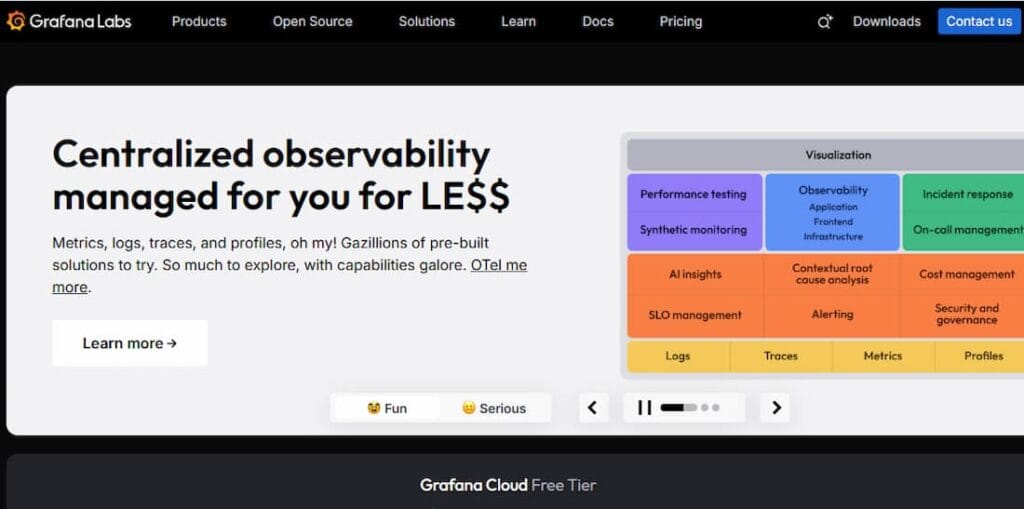
Grafana Cloud is the fully managed cloud version of Grafana Labs’ observability platform. It helps engineering teams collect, store, visualize, query, and alert on telemetry data without running the full backend stack themselves.
The platform includes managed services for metrics, logs, traces, profiles, dashboards, frontend monitoring, application observability, Kubernetes monitoring, database observability, synthetic monitoring, k6 performance testing, incident response, and Grafana Assistant. Grafana’s pricing page also describes the platform as OpenTelemetry-native and built to avoid custom metrics or vendor lock-in.
The biggest thing to understand is that Grafana Cloud is not priced as one flat observability bundle. Each major product has its own meter. Metrics are billed by billable series, logs and traces are billed by GB process/write/retain components, frontend observability is billed by sessions, synthetics are billed by test executions, k6 is billed by virtual user hours, and some curated observability products use host-hour pricing.
Supported Languages, Integrations, and Data Sources
Grafana Cloud works best in environments already using open standards such as Prometheus and OpenTelemetry. It can ingest telemetry from cloud-native systems, Kubernetes, applications, infrastructure, databases, browsers, and synthetic checks.
| Area | Grafana Cloud Support |
| Metrics | Prometheus-compatible metrics through Grafana Mimir |
| Logs | Loki-based log aggregation |
| Traces | Tempo-based distributed tracing |
| Profiles | Pyroscope-based continuous profiling |
| Collection | OpenTelemetry, Prometheus, Grafana Alloy, integrations, and plugins |
Grafana Cloud is especially strong for teams that want flexible dashboards and open telemetry pipelines. It is less plug-and-play than some proprietary APM tools because teams still need to understand labels, queries, dashboard design, and telemetry volume.
Key Features of Grafana Cloud
Grafana Cloud Metrics is a managed metrics service powered by Grafana Mimir. The Free tier includes 10,000 active series with 14-day retention. On Pro, metrics are priced at $6.50 per 1,000 billable series above the free allowance, with 13-month retention included. Enterprise pricing can go as low as $3 per 1,000 series with annual commit and volume discounts.
This is one of the most important Grafana Cloud pricing meters because active series can grow quickly in Kubernetes and Prometheus environments.
Grafana Cloud Logs is powered by Loki. The Free tier includes 50 GB of logs per month with 14-day retention. On Pro, Grafana lists logs at $0.05/GB process, $0.40/GB write, and $0.10/GB retain.
Grafana’s invoice documentation explains that process is charged when Grafana receives and optimizes signals, write is charged for GB written after the 50 GB free allowance, and extra retention beyond the paid-plan default can add retention charges.
Grafana Cloud Traces is powered by Tempo. The Free tier includes 50 GB of traces per month with 14-day retention. On Pro, traces use the same process, write, and retain pricing structure as logs: $0.05/GB process, $0.40/GB write, and $0.10/GB retain.
For high-throughput applications, trace sampling is important. Without sampling, trace volume can grow quickly and become a major cost driver.
Grafana Cloud Profiles is powered by Pyroscope. It gives teams continuous profiling visibility into CPU, memory, and code-level resource usage. The Free tier includes 50 GB per month, and Pro uses the same $0.05/GB process, $0.40/GB write, and $0.10/GB retain structure.
Profiles are valuable for performance optimization, but they should be planned separately because they add another telemetry stream to the bill.
Grafana Cloud Kubernetes Monitoring gives teams a curated Kubernetes observability experience. The Free tier includes 2,232 host hours and 37,944 container hours per month. Pro pricing is $0.01 per host hour, or about $7.20 per host, plus $0.0007 per container hour, or about $0.50 per container.
Grafana says host-hour billing applies when teams opt into the curated experience built on raw telemetry data. Teams can also opt out and be billed only on telemetry storage.
Grafana Cloud Application Observability provides application performance visibility with OpenTelemetry and Prometheus support. The Free tier includes 2,232 host hours. Pro pricing is $0.025 per host hour, or about $18 per host.
Grafana’s documentation says new customers are billed at $0.025 per host hour, with separate telemetry charges for metrics, traces, logs, and profiles. Existing customers before February 13, 2026 may have a different legacy model.
Grafana Cloud Frontend Observability is Grafana’s real user monitoring product for web applications. The Free tier includes 50,000 sessions per month. Pro pricing is $0.75 per 1,000 sessions above the free allowance. Grafana defines a session as user activity in a frontend application, ending after a maximum lifetime of four hours or after 15 minutes of inactivity.
Grafana Cloud Synthetic Monitoring is priced separately for API and browser test executions. The Free tier includes 100,000 API test executions and 10,000 browser test executions per month. Pro pricing is $5 per 10,000 API test executions and $50 per 10,000 browser test executions.
Grafana defines a test execution as a synthetic test running in a probe location per minute of runtime. The formula uses probes, tests, rounded test duration, and test frequency.
Grafana Cloud k6 is priced by virtual user hours. The Free tier includes 500 VUh per month. Pro pricing starts at $0.15 per virtual user hour, while Enterprise can go as low as $0.05 per virtual user hour with annual commit.
Grafana Assistant is Grafana’s AI copilot. The Free tier includes 3 active AI users per month, with 40M tokens per user and 25M tokens per month for service account usage. Pro pricing is $20 per active AI user, including 40M tokens per user, with additional tokens priced at $2 per 1M tokens.
This is a correction from older drafts that listed Grafana Assistant at $8 per user. Grafana’s current pricing page lists $20 per active AI user.
Grafana Cloud Pricing in 2026
Grafana Cloud has three main plans: Free, Pro, and Enterprise.
| Plan | Starting Price | Main Use Case |
| Free | $0 | Personal projects, early-stage startups, testing |
| Pro | From $19/month + usage | Teams that need more retention and pay-as-you-go usage |
| Enterprise | From $25,000/year spend commit | Larger teams with security, compliance, support, and deployment needs |
Grafana Cloud Pro starts at $19/month plus usage. It includes 8×5 email support, pay-as-you-go usage above the Free tier, 13-month retention for metrics, and 30-day retention for logs, traces, profiles, and k6 performance tests. Grafana Cloud Enterprise starts at a $25,000/year spend commit and adds premium support, custom retention, Observability Architect support, and deployment flexibility.
Grafana Cloud Pricing by Product
| Product | Free Tier | Pro Pricing |
| Metrics | 10K active series | $6.50 per 1K billable series |
| Logs | 50 GB/month | $0.05/GB process + $0.40/GB write + retain charges when applicable |
| Traces | 50 GB/month | $0.05/GB process + $0.40/GB write + retain charges when applicable |
| Profiles | 50 GB/month | $0.05/GB process + $0.40/GB write + retain charges when applicable |
| k6 | 500 VUh/month | Starts at $0.15/VUh |
Additional Grafana Cloud Pricing Meters
| Product | Free Tier | Pro Pricing |
| Frontend Observability | 50K sessions | $0.75 per 1K sessions |
| Synthetic API Testing | 100K executions | $5 per 10K executions |
| Synthetic Browser Testing | 10K executions | $50 per 10K executions |
| Application Observability | 2,232 host hours | $0.025 per host hour |
| Kubernetes Monitoring | 2,232 host hours + 37,944 container hours | $0.01/host hour + $0.0007/container hour |
Is There a Free Tier in Grafana Cloud?
Yes. Grafana Cloud has an always-free tier. It includes limited usage across Grafana Cloud services, community support, and 14-day retention for metrics, logs, traces, profiles, and k6 performance tests.
The Free tier is useful for evaluation, side projects, small workloads, and early-stage teams. However, production teams may outgrow it because of the 14-day retention limit, the 10K active series limit, and the 50 GB monthly limits for logs, traces, and profiles.
For Kubernetes teams, the 10K active series limit is often the first constraint. A few exporters, labels, and short-lived pods can create many active series quickly.
How Grafana Cloud Measures Usage
Grafana Cloud measures usage differently depending on the product.
| Usage Area | How Grafana Measures It |
| Metrics | Billable series, based on active series and data points per minute |
| Logs, traces, profiles | GB processed, GB written, and retention |
| Frontend Observability | Monthly sessions |
| Synthetic Monitoring | API and browser test executions |
| k6 | Virtual user hours |
| Application Observability | Host hours plus telemetry charges for new customers |
| Kubernetes Monitoring | Host hours and container hours when using curated monitoring |
Grafana defines an active Kubernetes or application host as a physical or virtual OS instance that has sent signals within the last 15 minutes. Host-hour billing is based on active hours across the month, so teams do not pay for hosts that are spun down during off-hours.
What Does Grafana Cloud Really Cost?
⚠️ Disclaimer
The scenarios below are directional editorial estimates, not official Grafana quotes. They use Grafana Cloud public Pro pricing as a planning anchor. Final cost can change based on metric cardinality, data points per minute, logs, traces, profiles, retention, frontend sessions, synthetic test setup, k6 usage, AI usage, discounts, and contract terms.
Grafana Cloud pricing is not mainly host-based. The biggest cost drivers are active metric series and telemetry volume. Host hours only apply when teams enable curated experiences such as Application Observability or Kubernetes Monitoring.
These scenarios model a common logs + traces + metrics + synthetics setup using default paid retention. Extended retention can add more cost.
Pricing Assumptions Used in These Scenarios
These scenarios use the workload profiles from the CubeAPM calculator, but map Grafana Cloud estimates to Grafana’s public Pro pricing model.
| Scenario | Grafana Pricing Anchor | Grafana Estimate | CubeAPM Estimate |
| Small team | Metrics + logs + traces | ~$720/month | ~$522/month |
| Growing team | Metrics + logs + traces + synthetics | ~$4,215/month | ~$919/month |
| Mid-market team | Higher series + telemetry + synthetics | ~$18,347/month | ~$4,594/month |
These estimates do not include Enterprise discounts, premium support, professional services, custom retention, k6 load testing, Grafana Assistant overages, profiles, database observability, or curated Kubernetes/Application Observability host-hour charges.
Workload Assumptions Used for Grafana Estimates
| Team Size | Infrastructure Context | Telemetry Context | Grafana Usage Assumption | Estimated Grafana Cost |
| Small team | 10 hosts | ~1.1 TB/month | 50K active series, logs, traces, light synthetics | ~$720/month |
| Growing team | 50 hosts | ~5.4 TB/month | 250K active series, logs, traces, RUM, synthetics | ~$4,215/month |
| Mid-market team | 250 hosts | ~27 TB/month | 750K active series, logs, traces, RUM, synthetics | ~$18,347/month |
The host count is included for workload context. For Grafana Cloud, the main public estimate is driven by active series, GB volume, sessions, and synthetic executions.
Scenario 1: Small Team, ~10 Hosts
Situation
A small production team runs around 10 hosts and produces roughly 1.1 TB/month of telemetry across logs, traces, and metrics. The team needs infrastructure visibility, application troubleshooting, basic frontend visibility, and light synthetic monitoring.
For Grafana Cloud, the host count is not the main pricing unit unless the team enables curated host-hour products. The stronger cost drivers are active metric series, log volume, and trace volume.
Why Teams at This Stage Consider Grafana Cloud
Small teams consider Grafana Cloud because it gives them managed Grafana, metrics, logs, traces, dashboards, alerts, and synthetics without operating Loki, Tempo, Mimir, and Grafana themselves.
It is also attractive if the team already uses Prometheus or OpenTelemetry and wants to keep open telemetry pipelines instead of adopting a proprietary agent-first tool.
Estimated Profile
| Configuration | Detail |
| Infrastructure context | 10 hosts |
| Telemetry context | ~1.1 TB/month |
| Active metric series | 50K |
| Logs | 720 GB/month |
| Traces | 360 GB/month |
| Frontend sessions | 5,000/month |
| Synthetic activity | 50,000 API runs + 2,000 browser runs/month |
| Pricing basis | Metrics series + logs + traces |
Estimated Monthly Cost
Disclaimer: This estimate uses Grafana Cloud Pro list pricing as a planning model. It assumes default paid retention and does not include profiles, k6, AI usage, database observability, or curated host-hour products.
| Component | Assumption | Monthly Cost |
| Platform fee | Fixed Pro fee | $19 |
| Metrics | 40K billable series × $6.50/1K | $260 |
| Logs | 670 billable GB × $0.45 process/write | ~$302 |
| Traces | 310 billable GB × $0.45 process/write | ~$140 |
| Estimated total | Production metrics + logs + traces | ~$720/month |
The API and browser synthetic usage stays inside the Free tier allowance in this scenario, so it is not added separately.
CubeAPM Cost Comparison
| Platform | Pricing Basis | Estimated Monthly Cost |
| Grafana Cloud | 50K active series + logs + traces | ~$720/month |
| CubeAPM | ~1.1 TB/month ingestion estimate | ~$522/month |
| Estimated savings with CubeAPM | Difference vs Grafana | ~$198/month |
| Percentage savings | ~28% lower |
What This Scenario Shows
For a small team, Grafana Cloud is not wildly expensive, but it is already more than the $19/month Pro fee. The real bill comes from active metric series, logs, and traces. CubeAPM is lower in this scenario because it uses predictable ingestion-based pricing instead of separate metrics-series and telemetry meters.
Scenario 2: Growing Team, ~50 Hosts
Situation
A growing SaaS team runs around 50 hosts and produces roughly 5.4 TB/month of telemetry. The team has more services, more customer traffic, more deployments, and more production workflows.
At this stage, Grafana Cloud pricing is usually driven by active series, log volume, trace volume, and synthetic monitoring. RUM may also matter if frontend traffic grows beyond the free session allowance.
Why Teams at This Stage Consider Grafana Cloud
Growing teams consider Grafana Cloud because they want managed observability without running the LGTM stack internally. Grafana Cloud also works well when platform teams already use Prometheus, Grafana dashboards, and OpenTelemetry collectors.
The risk is cost predictability. More services and Kubernetes workloads often mean more labels, more series, more traces, and more logs.
Estimated Profile
| Configuration | Detail |
| Infrastructure context | 50 hosts |
| Telemetry context | ~5.4 TB/month |
| Active metric series | 250K |
| Logs | 3,600 GB/month |
| Traces | 1,800 GB/month |
| Frontend sessions | 50,000/month |
| Synthetic activity | 500,000 API runs + 20,000 browser runs/month |
| Pricing basis | Metrics series + logs + traces + synthetic overages |
Estimated Monthly Cost
Disclaimer: This estimate uses Grafana Cloud public Pro list pricing. Synthetic Monitoring cost depends on test type, number of probes, duration, and frequency, so buyers should model their checks in Grafana before purchase.
| Component | Assumption | Monthly Cost |
| Platform fee | Fixed Pro fee | $19 |
| Metrics | 240K billable series × $6.50/1K | $1,560 |
| Logs | 3,550 billable GB × $0.45 process/write | ~$1,598 |
| Traces | 1,750 billable GB × $0.45 process/write | ~$788 |
| Synthetics | API + browser overages | ~$250 |
| Estimated total | Growing app + infra setup | ~$4,215/month |
Frontend sessions are assumed to stay within the 50K free allowance in this scenario.
CubeAPM Cost Comparison
| Platform | Pricing Basis | Estimated Monthly Cost |
| Grafana Cloud | 250K active series + logs + traces + synthetics | ~$4,215/month |
| CubeAPM | ~5.4 TB/month ingestion estimate | ~$919/month |
| Estimated savings with CubeAPM | Difference vs Grafana | ~$3,296/month |
| Percentage savings | ~78% lower |
What This Scenario Shows
This is where Grafana Cloud becomes more sensitive to telemetry design. A 50-host team can still control cost, but only if it manages metric labels, trace sampling, logging levels, and synthetic check frequency. CubeAPM becomes much cheaper here because it does not charge per active metric series or per separate observability module.
Scenario 3: Mid-Market Team, ~250 Hosts
Situation
A mid-market team runs around 250 hosts and produces roughly 27 TB/month of telemetry. The environment may include multiple Kubernetes clusters, frontend apps, backend services, queues, databases, APIs, and customer-facing workloads.
At this scale, Grafana Cloud should be treated as an enterprise observability budget item, even if the team starts on Pro. The organization should model active series, logs, traces, frontend sessions, synthetic checks, profiles, and retention before committing.
Why Teams at This Stage Consider Grafana Cloud
Mid-market teams consider Grafana Cloud because it can standardize observability around Grafana dashboards, Prometheus-compatible metrics, Loki logs, Tempo traces, and OpenTelemetry pipelines.
For teams with strong platform engineering practices, Grafana Cloud can be powerful. For teams without cardinality controls, the bill can grow quickly.
Estimated Profile
| Configuration | Detail |
| Infrastructure context | 250 hosts |
| Telemetry context | ~27 TB/month |
| Active metric series | 750K |
| Logs | 18,000 GB/month |
| Traces | 9,000 GB/month |
| Frontend sessions | 200,000/month |
| Synthetic activity | 2,000,000 API runs + 80,000 browser runs/month |
| Pricing basis | Metrics series + logs + traces + RUM + synthetics |
Estimated Monthly Cost
Disclaimer: This estimate uses Grafana Cloud Pro public list pricing as a planning anchor. At this scale, many teams would negotiate Enterprise pricing. The estimate does not include Enterprise discounts, custom retention, profiles, k6, AI usage, database observability, or host-hour products.
| Component | Assumption | Monthly Cost |
| Platform fee | Fixed Pro fee | $19 |
| Metrics | 740K billable series × $6.50/1K | $4,810 |
| Logs | 17,950 billable GB × $0.45 process/write | ~$8,078 |
| Traces | 8,950 billable GB × $0.45 process/write | ~$4,028 |
| Frontend Observability | 150K billable sessions × $0.75/1K | ~$113 |
| Synthetics | API + browser overages | ~$1,300 |
| Estimated total | Mid-market setup | ~$18,347/month |
CubeAPM Cost Comparison
| Platform | Pricing Basis | Estimated Monthly Cost |
| Grafana Cloud | 750K active series + logs + traces + RUM + synthetics | ~$18,347/month |
| CubeAPM | ~27 TB/month ingestion estimate | ~$4,594/month |
| Estimated savings with CubeAPM | Difference vs Grafana | ~$13,753/month |
| Percentage savings | $13,753 ÷ $18,347 | ~75% lower |
What This Scenario Shows
At mid-market scale, the cost gap becomes much clearer. Grafana Cloud costs rise because active series, logs, traces, and synthetic checks all scale separately. CubeAPM stays lower because it uses one predictable ingestion-based model and does not add separate per-series, per-host, or per-user charges.
Summary: Grafana Cloud vs CubeAPM Estimated Monthly Cost
Disclaimer: These are directional planning estimates, not official quotes. Grafana Cloud final pricing can change with usage, retention, Enterprise discounts, support, and contract terms. CubeAPM’s value is strongest for teams that want full-stack observability without per-host fees, per-series fees, per-user fees, or separate pricing for each signal.
| Team Profile | Grafana Estimate | CubeAPM Estimate | Monthly Savings with CubeAPM | Percentage Savings |
| Small team | ~$720/month | ~$522/month | ~$198/month | ~28% |
| Growing team | ~$4,215/month | ~$919/month | ~$3,296/month | ~78% |
| Mid-market team | ~$18,347/month | ~$4,594/month | ~$13,753/month | ~75% |
To estimate your own cost, try the CubeAPM Grafana Cloud Pricing Calculator. You can enter your Grafana Cloud usage across metrics, logs, traces, profiles, synthetics, frontend sessions, users, and k6, then compare the projected monthly cost with CubeAPM’s $0.15/GB pricing.
What Drives Grafana Cloud Costs?
Active metric series are one of the biggest Grafana Cloud cost drivers. Grafana charges Pro users $6.50 per 1,000 billable series above the Free tier. A series is affected by metric names, labels, and data points per minute.
High-cardinality labels such as pod names, container IDs, user IDs, request paths, and session IDs can multiply series count quickly.
Logs are billed by process, write, and retain components. Grafana’s pricing page lists $0.05/GB process, $0.40/GB write, and $0.10/GB retain. Grafana’s invoice docs also explain that query activity can matter if it exceeds the fair-use query policy.
Traces use the same process, write, and retain structure as logs. High-throughput systems should use sampling so trace volume stays proportional to troubleshooting value.
Grafana Cloud Pro includes 13-month retention for metrics and 30-day retention for logs, traces, profiles, and k6 performance tests. Longer retention can require custom retention or Enterprise terms.
Synthetic Monitoring cost depends on test executions. Test executions are affected by the number of probe locations, test duration, number of tests, and frequency. A simple one-location API check is much cheaper than a browser journey running from many locations every minute.
Frontend Observability starts charging above 50K sessions per month at $0.75 per 1,000 sessions. This matters for SaaS dashboards, ecommerce sites, and consumer apps with high traffic.
Application Observability, Kubernetes Monitoring, and Database Observability can add host-hour pricing. Teams should confirm whether they are using only raw telemetry storage or also enabling curated managed experiences.
Grafana Assistant adds another meter. Pro pricing is $20 per active AI user, with additional token usage charged at $2 per 1M tokens.
Grafana Cloud User Reviews
Grafana Cloud has strong review visibility across major review platforms. Gartner Peer Insights lists Grafana Cloud at 4.6/5 based on 435 ratings.
| Review Source | Public Rating Shown |
| Gartner Peer Insights | 4.6/5 |
| G2 | Review themes available for Grafana Labs |
| Capterra | Review themes available for Grafana |
What Users Like
Users frequently praise Grafana for dashboard flexibility, visualization options, and the ability to bring different data sources into one view. Capterra reviews highlight Grafana’s dashboarding, monitoring, and visualization strengths.
Grafana is commonly used for infrastructure utilization, server monitoring, application visibility, and event analysis. Capterra review snippets mention server utilization, graphs, log collection, and monitoring workflows.
Teams like Grafana because it works with open-source and open standards tooling. This is especially useful for teams already using Prometheus, OpenTelemetry, Loki, and Kubernetes.
Grafana Cloud works well for DevOps, SRE, and platform teams that are comfortable with Prometheus-style metrics, queries, labels, and custom dashboards.
What Users Criticize
Disclaimer: The following points reflect public user-review themes from review platforms. They should be treated as user feedback, not universal limitations of Grafana Cloud.
G2 review summaries mention a steep learning curve, especially for new users building advanced dashboards or setting up alerting. G2’s pros-and-cons summary also highlights learning curve and setup complexity as repeated themes.
Grafana is powerful, but setup can be complex when teams need to configure data sources, dashboards, variables, alerts, queries, and integrations. This is common in flexible observability platforms.
Some review snippets mention performance concerns when dashboards are not optimized or when very large datasets are used.
Grafana’s public pricing is transparent, but forecasting can still be hard because several meters run at the same time. Teams must track active series, logs, traces, profiles, sessions, tests, users, and optional host-hour products.
Grafana Cloud Alternatives: How It Compares to Competitors
Grafana Cloud vs CubeAPM
Grafana Cloud is a managed SaaS observability platform with separate pricing meters for metrics, logs, traces, profiles, sessions, synthetics, AI usage, k6, and optional host-hour products. CubeAPM is a self-hosted, vendor-managed observability platform priced at $0.15/GB ingested. CubeAPM’s public pricing page lists $0.15/GB for data ingestion.
| Category | Grafana Cloud | CubeAPM |
| Deployment | SaaS, with Enterprise deployment options | Self-hosted, vendor-managed |
| Pricing model | Multi-meter usage pricing | $0.15/GB ingestion |
| Metrics billing | Per billable series | No per-series fee |
| Data control | Grafana-hosted by default | Runs in customer environment |
| Best for | Grafana/Prometheus-native teams | Teams needing predictable self-hosted observability |
CubeAPM is stronger for teams that want full-stack observability with predictable pricing, data staying inside their own cloud, and no per-host or per-series billing. Grafana Cloud is stronger for teams already standardized on Grafana dashboards and Prometheus-style workflows.
Grafana Cloud vs Datadog
Datadog is a broad SaaS observability platform with infrastructure monitoring, APM, logs, RUM, synthetics, security, and many integrations. Datadog’s public pricing list shows Infrastructure Pro at $15 per host per month when billed annually, while APM starts at $31 per APM host per month.
| Category | Grafana Cloud | Datadog |
| Pricing model | Series + GB + sessions + tests | Host + product/module pricing |
| Infrastructure pricing | Metrics-based unless curated products are used | Starts at $15/host/month |
| APM pricing | Trace volume and optional App Observability | Starts at $31/APM host/month |
| Dashboarding | Very flexible | Strong packaged dashboards |
| Best for | Grafana/Prometheus teams | Teams wanting full SaaS observability with strong APM |
Datadog may be easier for teams that want packaged APM and native logs in one SaaS platform. Grafana Cloud may be better for teams that already use Grafana, Prometheus, and OpenTelemetry.
Grafana Cloud vs New Relic
New Relic uses a data-ingest and user-based pricing model. Its public pricing page lists 100 GB/month free and $0.40/GB for Original Data beyond the free 100 GB limit on Standard, Pro, and Enterprise, with Data Plus priced at $0.60/GB.
| Category | Grafana Cloud | New Relic |
| Pricing model | Multi-meter usage pricing | Data ingest + users |
| Free tier | 10K series, 50 GB logs/traces/profiles | 100 GB/month free ingest |
| Metrics risk | Cardinality-sensitive | Ingest-volume-sensitive |
| APM | OTel/Grafana ecosystem | Strong guided APM |
| Best for | Grafana-native teams | Teams wanting simpler commercial APM pricing |
New Relic can be easier to estimate for teams that think mainly in GB/month. Grafana Cloud can be more cost-effective for teams with disciplined metrics and logs, but it requires more active cost governance.
Grafana Cloud vs SigNoz
SigNoz is an OpenTelemetry-native observability platform available as self-hosted software and SigNoz Cloud. SigNoz Cloud pricing starts at $49/month and includes usage worth $49, such as 163 GB of logs/traces or 490 million metric samples. It also supports unlimited teammates and any number of hosts on the cloud plan.
| Category | Grafana Cloud | SigNoz |
| OpenTelemetry | Strong support | OTel-native |
| Cloud starting price | $19/month + usage | $49/month including usage credits |
| Logs/traces pricing | Process/write/retain model | Usage-based GB model |
| Metrics pricing | Billable series | Metric samples |
| Best for | Grafana ecosystem teams | OTel-first teams wanting simpler pricing |
SigNoz is worth considering for teams that want OpenTelemetry-native observability with a simpler pricing model. Grafana Cloud is stronger for teams that need Grafana’s dashboard ecosystem and mature managed LGTM services.
Is Grafana Cloud the Right Choice?
Grafana Cloud Works Best For
Grafana Cloud is a natural fit for teams already running Grafana dashboards and Prometheus metrics. It reduces backend operations while keeping familiar workflows.
Grafana Cloud works well for Kubernetes teams that understand labels, exporters, and cardinality. It is especially useful when teams want managed metrics, logs, and traces without operating Mimir, Loki, and Tempo themselves.
Grafana Cloud supports OpenTelemetry-native ingestion and fits teams that want vendor-neutral instrumentation.
Platform teams that want flexible dashboards, shared telemetry pipelines, and standardized observability workflows can get strong value from Grafana Cloud.
Grafana remains one of the strongest dashboarding platforms. Teams that need highly customizable dashboards often prefer Grafana over more opinionated APM tools.
Grafana Cloud May Not Be the Right Fit For
Grafana Cloud pricing is transparent, but not simple. Teams must manage several separate usage meters.
High-cardinality labels can make metrics expensive. Teams using Prometheus exporters without label controls should audit their setup before moving large workloads into Grafana Cloud.
Grafana Cloud can support APM workflows, but some teams may prefer Datadog, New Relic, or Dynatrace if they want more packaged auto-instrumentation and guided troubleshooting.
Grafana Cloud is managed SaaS by default. Teams that need telemetry to remain inside their own cloud may prefer a self-hosted, vendor-managed option such as CubeAPM.
At higher scale, Grafana Cloud can become expensive if logs, traces, synthetics, frontend sessions, and metric series grow at the same time.
Conclusion
Grafana Cloud is a strong observability platform for teams that already understand Grafana, Prometheus, OpenTelemetry, and cloud-native telemetry. Its Free tier is useful, Pro starts at a low $19/month platform fee, and Enterprise gives larger teams custom retention, premium support, and deployment flexibility.
The main trade-off is billing complexity. Grafana Cloud pricing is spread across metrics, logs, traces, profiles, frontend sessions, synthetic test executions, k6 virtual user hours, AI users, and optional host-hour products. A team can start cheaply, but costs can rise quickly if active series, logs, traces, or synthetic checks are not controlled.
For teams that want managed Grafana and are comfortable with telemetry governance, Grafana Cloud is a strong choice. For teams that want predictable pricing, self-hosted deployment, and full-stack observability without per-series or per-host fees, CubeAPM is a strong alternative to evaluate alongside Grafana Cloud.
Disclaimer: Pricing, packaging, included entitlements, support terms, and product limits can change. The cost examples in this article are editorial estimates based on publicly available pricing as of June 2026. Always confirm final pricing, usage limits, discounts, retention rules, and contract terms directly with Grafana before purchase.
FAQs
1. How much does Grafana Cloud cost?
Grafana Cloud has a Free tier at $0, a Pro tier from $19/month plus usage, and an Enterprise tier starting at a $25,000/year spend commitment.
2. Is Grafana Cloud free?
Yes. Grafana Cloud has an always-free tier with limited usage across Grafana Cloud services and 14-day retention for metrics, logs, traces, profiles, and k6 performance tests.
3. How does Grafana Cloud charge for metrics?
Grafana Cloud charges for metrics by billable series. The Free tier includes 10,000 active series, and Pro pricing is $6.50 per 1,000 billable series above the free allowance.
4. How does Grafana Cloud charge for logs and traces?
Grafana Cloud lists logs, traces, and profiles using process, write, and retain pricing. Pro rates are $0.05/GB process, $0.40/GB write, and $0.10/GB retain where applicable.
5. What drives Grafana Cloud cost the most?
The biggest cost drivers are active metric series, log volume, trace volume, retention, synthetic test executions, frontend sessions, k6 virtual user hours, AI users, and optional curated host-hour products.
6. Is Grafana Cloud priced per host?
Not mainly. Core metrics, logs, traces, and profiles are not priced per host. However, curated products such as Application Observability, Kubernetes Monitoring, and Database Observability can use host-hour pricing.
7. What are the best Grafana Cloud alternatives?
The strongest alternatives are CubeAPM, Datadog, New Relic, and SigNoz. CubeAPM is best for self-hosted, vendor-managed observability with predictable per-GB pricing. Datadog is best for broad SaaS observability and packaged APM. New Relic is best for teams that prefer ingest-based pricing. SigNoz is best for OpenTelemetry-native teams that want open-source and cloud options.