









Pyroscope is a continuous profiling tool built for production environments. Instead of profiling an application only after something breaks, it collects profile data over time so engineers can compare CPU, memory, allocation, lock, and runtime behavior across services, versions, deployments, and time windows. Grafana describes Pyroscope as a multi-tenant continuous profiling aggregation system that integrates profiling data with metrics, logs, and traces in Grafana.
A useful scale signal is Grafana Pyroscope 2.0. Grafana said its hosted Grafana Cloud Profiles service had already been running the Pyroscope 2.0 architecture in production since April 2025, had rolled it out to all regions by September 2025, and had processed 19.5 PB of profiling data after that rollout.
This Pyroscope pricing and review guide explains what Grafana Pyroscope does, how Grafana Cloud Profiles pricing works, what self-hosted Pyroscope really costs, what teams should watch before rollout, and how Pyroscope compares with CubeAPM, Datadog, New Relic, Sentry, Dynatrace, and Elastic Universal Profiling.
What Is Pyroscope?
Platform Overview
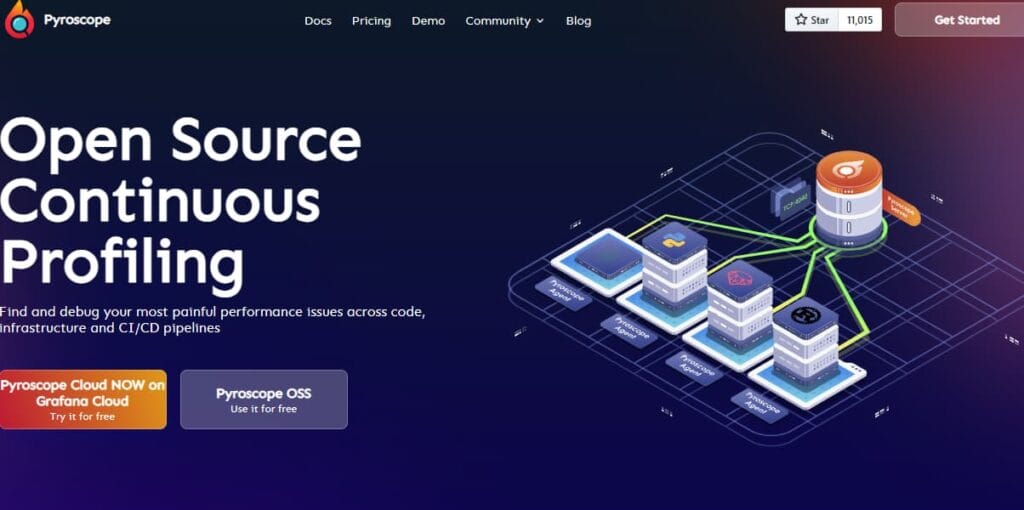
Grafana Pyroscope is an open source continuous profiling database. It helps teams collect, store, query, and analyze production profiling data so they can find expensive code paths, CPU-heavy functions, memory allocation issues, lock contention, runtime bottlenecks, and performance regressions. Grafana’s OSS page describes Pyroscope as an open source continuous profiling database for scalable, highly available, efficient storage and querying, with visibility down to the line number.
In simple terms, Pyroscope shows where application resources are being used inside the code. Metrics may show that CPU is high. Traces may show that a request is slow. Logs may show an error. Pyroscope helps answer the next question: which functions or runtime paths are actually consuming the resources?
How Pyroscope Relates to Grafana
Pyroscope started as an independent open source continuous profiling project. Grafana Labs acquired Pyroscope in March 2023 and announced that Pyroscope and Grafana Phlare would be merged under the Grafana Pyroscope name.
Today, Pyroscope is the profiles signal in the Grafana ecosystem. Grafana is used for visualization, Mimir for metrics, Loki for logs, Tempo for traces, and Pyroscope for profiles. That relationship matters for pricing because teams can either run Grafana Pyroscope as open source software or use Grafana Cloud Profiles, the managed service powered by Pyroscope.
What Pyroscope Covers
| Area | What it helps with |
| Continuous profiling | Collecting profiling data from production systems over time |
| CPU profiling | Finding CPU-heavy functions and hot code paths |
| Memory profiling | Investigating heap, allocation, and memory usage patterns |
| Lock and contention profiling | Understanding mutex, block, goroutine, and lock behavior where supported |
| Flame graphs | Visualizing expensive call stacks and runtime behavior |
| Profile comparison | Comparing before-and-after deployments or time windows |
| Kubernetes workflows | Profiling services, pods, and processes in cloud-native environments |
| Grafana correlation | Viewing profiles alongside metrics, logs, and traces |
| Managed deployment | Using Grafana Cloud Profiles instead of self-hosting |
Grafana’s documentation lists supported profile types such as CPU, memory allocation, heap, in-use objects, goroutines, mutex, block, lock, and exceptions. Exact support depends on language, runtime, instrumentation method, and setup.
Key Features of Pyroscope
Pyroscope collects profiling data continuously, which makes it useful for long-running performance analysis. Instead of relying only on one-time profiler captures, teams can compare performance across versions, deployments, incidents, and traffic patterns.
Pyroscope uses flame graphs to show where CPU time, memory, or other runtime resources are being spent. This helps engineers move from “the service is expensive” to “this function or code path is expensive.”
Grafana Pyroscope integrates with Grafana, so profiles can be correlated with metrics, logs, and traces. This matters because profiling is most useful when it is connected to the rest of the incident workflow.
Pyroscope 2.0 includes native OTLP profiling support, according to Grafana’s Pyroscope 2.0 announcement. That is important because profiling is increasingly treated as another observability signal alongside logs, metrics, and traces.
Grafana Alloy-based profiling supports several high-level languages, including Java, .NET, Python, Ruby, PHP, Node.js, and Perl through eBPF configuration. Pyroscope also has SDK and runtime support across common application stacks, but exact profile types vary by language and instrumentation path.
Pyroscope 2.0 made the v2 storage architecture the default for open source users. The release notes say v2 writes profiles directly to object storage and removes the need for in-memory ingesters, which simplifies operations and reduces resource usage at scale.
Grafana’s release announcement also says Pyroscope 2.0 removes write-path replication, stores each profile once in object storage, makes the read path stateless, and reduces the operational surface area compared with the earlier architecture.
What Are Pyroscope’s Pricing Options?
Pyroscope pricing depends on deployment model.
Self-hosted Grafana Pyroscope OSS has no standalone software license fee, but it is not “free” in the operational sense. Teams still pay for compute, memory, object storage, networking, monitoring, upgrades, maintenance, access control, backups, and engineering time.
The managed route is Grafana Cloud Profiles. Grafana’s pricing page lists Profiles under Free, Pro, and Enterprise. Profiles pricing is based on process, write, and retain dimensions. The Free plan includes 50 GB ingested per month, 14-day retention, and community support. Pro starts at $19/month plus usage and includes 50 GB ingested per month, 30-day retention, and 8×5 email support. Enterprise starts at a $25,000/year spend commit with custom retention, premium support, an Observability Architect, and deployment flexibility.
Pyroscope Pricing Options in 2026
| Option | Pricing Model | Best For | Key Details |
| Grafana Pyroscope OSS | Free software, self-managed costs apply | Teams that want open source control | No standalone software fee, but infrastructure and operations are your responsibility |
| Grafana Cloud Profiles Free | $0 | Trials, small tests, early profiling | 50 GB profiles ingested per month, 14-day retention, community support |
| Grafana Cloud Profiles Pro | From $19/month plus usage | Teams scaling profiling without self-hosting | 50 GB included per month, then pay as you go; 30-day retention; 8×5 email support |
| Grafana Cloud Profiles Enterprise | Starts at $25,000/year spend commit | Larger teams with support, compliance, and procurement needs | Custom retention, premium support, Observability Architect, deployment flexibility |
Grafana Cloud Profiles Usage Rates
| Usage Dimension | Published Rate | What It Means |
| Process | $0.05/GB | Work to receive, process, and optimize profile data |
| Write | $0.40/GB | Work to write useful profile data after the free 50 GB allotment |
| Retain | $0.10/GB per month retention | Additional retention cost beyond the included retention window |
Grafana’s billing documentation says process cost applies when Grafana Cloud receives and optimizes signals, write cost applies after the free 50 GB allotment, and additional retention beyond 30 days is charged at $0.10/GB for each additional 30-day increment.
What Is Included in Each Pyroscope Pricing Path?
| Feature Area | OSS / Self-Managed | Cloud Free | Cloud Pro | Cloud Enterprise |
| Software access | Open source Pyroscope | Managed Grafana Cloud Profiles | Managed Grafana Cloud Profiles | Managed Grafana Cloud Profiles with enterprise terms |
| Monthly platform price | No standalone license fee | $0 | From $19/month plus usage | Starts at $25,000/year spend commit |
| Included profile ingest | Depends on your infrastructure | 50 GB/month | 50 GB/month, then pay as you go | Custom terms |
| Retention | You control it | 14 days | 30 days | Custom retention |
| Support | Community and internal team ownership | Community support | 8×5 email support | Premium support and Observability Architect |
| Deployment control | Full self-hosted control | Grafana Cloud | Grafana Cloud | Public Cloud, Federal Cloud, or Bring Your Own Cloud options |
What Does Pyroscope Really Cost?
Disclaimer
The scenarios below are directional editorial estimates based on Grafana Cloud Profiles public pricing and billing documentation. They are not official Grafana quotes. Pyroscope OSS can be self-hosted without a standalone license fee, but this section focuses on the managed Grafana Cloud Profiles path because it has public usage-based pricing.
Grafana Cloud Profiles pricing has three usage parts: Process at $0.05/GB, Write at $0.40/GB, and Retain at $0.10/GB per month. Grafana Cloud Pro also has a $19/month platform fee and includes 50 GB ingested per month before pay-as-you-go usage starts. The Free tier includes 50 GB/month with 14-day retention, while Pro includes 30-day retention and 8×5 email support.
Actual costs can change based on profile volume, retained data, adaptive telemetry settings, enterprise discounts, contract terms, region, retention needs, and whether teams also use Grafana Cloud metrics, logs, traces, Kubernetes monitoring, or application observability.
Pricing Assumptions
For these estimates, we use Grafana Cloud Profiles Pro because the usage volumes are above the Free tier.
| Pricing Item | Assumption |
| Grafana Cloud Pro platform fee | $19/month |
| Included profile usage | 50 GB/month |
| Process cost | $0.05/GB |
| Write cost | $0.40/GB after the first 50 GB |
| Retain cost | $0.10/GB/month |
| Retention modeled | 30 days |
The working formula used here is:
| Formula Item | Calculation |
| Process cost | Total profile GB × $0.05 |
| Write cost | (Total profile GB – 50 GB included) × $0.40 |
| Retain cost | Total profile GB × $0.10 |
| Estimated monthly cost | $19 platform fee + process + write + retain |
Grafana’s billing documentation explains that Process is the work done to receive and optimize signals, Write is the work done to write useful data after the 50 GB free allotment, and Retain is the work done to retain stored data over time.
Workload Assumptions
| Team Size | Profile Volume Assumption | Retention Assumption | Add-ons Included? |
| Small team | ~1.1 TB/month | 30 days | No |
| Growing team | ~5.4 TB/month | 30 days | No |
| Mid-market team | ~27 TB/month | 30 days | No |
Scenario 1: Small Team, ~1.1 TB Profiles/Month
A small engineering team profiles a few production services and wants code-level visibility into CPU usage, memory allocation, and runtime bottlenecks. The team uses Grafana Cloud Profiles instead of self-hosting Pyroscope because it wants a managed profiling backend with less operational work.
Teams at this stage may consider Pyroscope because it gives deep code-level performance visibility without requiring them to run a full profiling database themselves. However, Pyroscope is still focused on profiles only. It does not replace logs, traces, infrastructure monitoring, RUM, synthetics, or error tracking by itself.
| Component | Calculation | Monthly Cost |
| Grafana Cloud Pro platform fee | Fixed fee | $19 |
| Profile processing | 1,100 GB × $0.05 | $55 |
| Included write allowance | First 50 GB | $0 |
| Profile write cost | 1,050 GB × $0.40 | $420 |
| Profile retention | 1,100 GB × $0.10 | $110 |
| Total estimated Pyroscope cost | $19 + $55 + $420 + $110 | ~$604/month |
CubeAPM comparison:
| Platform | Estimated Monthly Cost | What It Covers |
| Grafana Cloud Profiles / Pyroscope | ~$604/month | Profiles only |
| CubeAPM | ~$522/month | Logs, traces, metrics, and broader observability ingestion |
| Estimated CubeAPM savings | ~$82/month | About 14% lower |
At small-team scale, Pyroscope can be affordable for profiling alone, but CubeAPM gives broader telemetry coverage at a lower estimated monthly cost in this example. That matters because most teams do not only need profiles during incidents. They also need logs, traces, metrics, dashboards, alerts, and infrastructure context.
Scenario 2: Growing Team, ~5.4 TB Profiles/Month
A growing SaaS team profiles more services, APIs, workers, and customer-facing workloads. The team wants to compare performance across deployments and investigate expensive code paths before they turn into infrastructure waste.
At this stage, Pyroscope can be valuable because continuous profiling helps engineers find CPU-heavy functions and memory-heavy runtime behavior. But the cost starts moving with profile volume, so teams need to control which services and profile types they enable.
| Component | Calculation | Monthly Cost |
| Grafana Cloud Pro platform fee | Fixed fee | $19 |
| Profile processing | 5,400 GB × $0.05 | $270 |
| Included write allowance | First 50 GB | $0 |
| Profile write cost | 5,350 GB × $0.40 | $2,140 |
| Profile retention | 5,400 GB × $0.10 | $540 |
| Total estimated Pyroscope cost | $19 + $270 + $2,140 + $540 | ~$2,969/month |
CubeAPM Comparison
| Platform | Estimated Monthly Cost | What It Covers |
| Grafana Cloud Profiles / Pyroscope | ~$2,969/month | Profiles only |
| CubeAPM | ~$919/month | Logs, traces, metrics, and broader observability ingestion |
| Estimated CubeAPM savings | ~$2,050/month | About 69% lower |
At growing-team scale, the difference becomes much clearer. Pyroscope is still strong for continuous profiling, but it is not a full observability platform by itself. CubeAPM becomes more cost-effective for teams that want broader visibility across logs, traces, metrics, infrastructure, and application performance without adding separate tools for every signal.
Scenario 3: Mid-Market Team, ~27 TB Profiles/Month
A mid-market engineering team runs many production services, APIs, workers, queues, and Kubernetes workloads. The team wants profiling data across a larger estate so it can reduce CPU waste, detect performance regressions, and understand which code paths are driving infrastructure cost.
At this scale, Pyroscope’s value can be strong for code-level optimization, but the profile volume needs careful planning. Teams should define which services matter most, which profile types are needed, and how much retention is actually useful.
| Component | Calculation | Monthly Cost |
| Grafana Cloud Pro platform fee | Fixed fee | $19 |
| Profile processing | 27,000 GB × $0.05 | $1,350 |
| Included write allowance | First 50 GB | $0 |
| Profile write cost | 26,950 GB × $0.40 | $10,780 |
| Profile retention | 27,000 GB × $0.10 | $2,700 |
| Total estimated Pyroscope cost | $19 + $1,350 + $10,780 + $2,700 | ~$14,849/month |
CubeAPM Comparison
| Platform | Estimated Monthly Cost | What It Covers |
| Grafana Cloud Profiles / Pyroscope | ~$14,849/month | Profiles only |
| CubeAPM | ~$4,594/month | Logs, traces, metrics, and broader observability ingestion |
| Estimated CubeAPM savings | ~$10,255/month | About 69% lower |
At mid-market scale, Pyroscope’s managed pricing can become significant if profile volume grows into tens of terabytes per month. CubeAPM is easier to position here because it gives teams broader observability coverage at a much lower estimated cost in this workload model. For teams that want one platform for troubleshooting, performance monitoring, logs, traces, metrics, and infrastructure visibility, CubeAPM can reduce both cost and tool sprawl.
What These Cost Scenarios Show
| Scenario | Pyroscope Estimated Cost | CubeAPM Estimated Cost | Estimated Savings with CubeAPM |
| Small team, ~1.1 TB/month | ~$604/month | ~$522/month | ~$82/month |
| Growing team, ~5.4 TB/month | ~$2,969/month | ~$919/month | ~$2,050/month |
| Mid-market team, ~27 TB/month | ~$14,849/month | ~$4,594/month | ~$10,255/month |
These estimates show the main pricing difference clearly. Pyroscope is a focused continuous profiling tool, while CubeAPM is a broader observability platform. If a team only needs profiling inside Grafana, Pyroscope can make sense. But if the team also needs logs, traces, metrics, infrastructure monitoring, dashboards, alerts, RUM, synthetics, and error tracking, CubeAPM can give broader coverage with lower estimated cost in these scenarios.
What Actually Drives Pyroscope Costs?
| Cost Driver | Why It Matters | How to Control It |
| Profile data volume | More services, pods, and profile types create more data to process, write, and retain | Start with critical services, then expand gradually |
| Profile types | CPU, heap, memory, mutex, block, and other profiles can multiply data volume | Start with CPU, then add memory and contention profiles only where needed |
| Label metadata | Too many labels can increase complexity and make cost attribution harder | Keep labels useful and controlled |
| Retention | Longer retention helps with regression analysis but can increase cost | Match retention to incident review and capacity planning needs |
| Self-hosted infrastructure | OSS deployments still need compute, memory, storage, upgrades, and monitoring | Estimate infrastructure and engineering effort before choosing self-hosting |
| Profiling expertise | Flame graphs and profile diffs require interpretation skills | Train engineers and document workflows |
Grafana’s cost management documentation for Profiles says teams can control profiling costs by managing which services they profile, which profile types they collect, and how much label metadata they attach to profiling data.
Additional Costs and Operational Overhead Buyers Should Plan For
Open source does not mean zero cost. Self-hosted Pyroscope still needs deployment, object storage configuration, upgrades, scaling, monitoring, backups, and access management. Pyroscope 2.0 reduces some operational complexity, but teams still own the environment when they self-host.
Profile volume can grow quickly when teams enable profiling across many services, pods, languages, and profile types. A safer rollout is to begin with critical services, validate value, then expand.
Grafana Cloud Pro includes 30-day retention for profiles. Additional retention beyond 30 days may add cost, and Grafana says retention customization should be handled through support.
Too much label metadata can make profile data harder to manage and can increase cost-control complexity. Labels should help engineers filter services, versions, environments, and teams without becoming noisy.
Pyroscope is most useful when engineers understand profiling concepts, flame graphs, sampling, runtime behavior, and profile comparison. Teams without that experience may need training before they get full value.
Pyroscope is focused on profiling. It does not replace a full observability platform by itself. Teams may still need logs, metrics, traces, infrastructure monitoring, dashboards, alerting, RUM, synthetics, error tracking, and incident workflows.
Pyroscope User Reviews in 2026
Public Pyroscope-only review volume is limited compared with broader observability platforms. F6S lists Pyroscope as an open source continuous profiling platform for optimizing infrastructure spend, simplifying debugging, and improving application performance. SourceForge also has a Grafana Pyroscope listing, but its page identifies the listing as an exact mirror of the GitHub project and is not the same as a large verified-review dataset.
Because of that, buyers should not treat Pyroscope the same way they treat products with hundreds of verified reviews on G2, Gartner Peer Insights, Capterra, or TrustRadius. The stronger evidence for Pyroscope comes from Grafana documentation, open source activity, Grafana Cloud production usage, technical writeups, and hands-on proof of concept work.
Review and Adoption Signal Summary
| Source or Signal | What It Shows | Verification Notes |
| Grafana documentation | Pyroscope is a multi-tenant continuous profiling aggregation system | Strong primary source |
| Grafana Cloud Profiles | Hosted continuous profiling tool powered by Pyroscope | Strong primary source |
| Pyroscope 2.0 production signal | 19.5 PB processed after Grafana Cloud rollout | Strong primary source |
| F6S listing | Public product listing for Pyroscope | Useful, but not a deep verified-review base |
| SourceForge listing | Product/mirror listing for Grafana Pyroscope | Useful for discovery, but limited as user-review evidence |
| GitHub project | Open source activity and community signal | Useful for technical validation, not buyer satisfaction scoring |
What Users and Evaluators Praise
Pyroscope is useful because it connects performance problems to code-level behavior. Metrics can show high CPU. Traces can show slow requests. Pyroscope helps identify the functions, call stacks, or runtime paths responsible for the resource usage.
Continuous profiling is valuable because it collects performance data over time. That makes it easier to compare performance across deployments, traffic changes, and incidents rather than trying to reproduce a problem after the fact.
Pyroscope fits naturally for teams already using Grafana. Profiles can be viewed alongside metrics, logs, and traces, which makes profiling part of the broader incident workflow instead of a separate debugging activity.
Teams that want control over profiling infrastructure can self-host Grafana Pyroscope. This is useful for organizations with data control, security, or internal platform requirements.
Grafana’s Pyroscope 2.0 release gives a strong production-scale signal. The hosted service processed 19.5 PB of profiling data after the architecture rollout across Grafana Cloud regions.
Pyroscope 2.0 was designed to reduce operational complexity. It writes profiles directly to object storage, removes in-memory ingesters from the v2 architecture, and simplifies resource usage at scale.
What Users and Buyers Should Watch
⚠️ Disclaimer
The following points are planning considerations based on public product documentation, pricing pages, and available product listings. They should not be treated as universal limitations for every Pyroscope deployment.
Pyroscope can surface detailed performance data, but engineers still need to understand flame graphs, sampling, profile types, runtime behavior, and profile comparisons.
Self-hosted Pyroscope gives more control, but it also adds infrastructure responsibility. Teams need to own deployment, object storage, upgrades, monitoring, access control, and reliability.
Pyroscope focuses on profiling. It does not replace full-stack observability, log management, distributed tracing, infrastructure monitoring, RUM, synthetics, error tracking, or incident management.
Grafana’s own guidance points to service selection, profile type selection, and label metadata as cost-control levers. Teams should avoid enabling every profile type everywhere without a rollout plan.
Grafana Cloud Profiles pricing sits inside the broader Grafana Cloud model. Buyers should evaluate profile costs alongside logs, metrics, traces, application observability, synthetics, users, retention, and enterprise terms.
Pyroscope Alternatives: How It Compares to Competitors
Pyroscope vs CubeAPM
Pyroscope and CubeAPM solve related but different problems. Pyroscope is focused on continuous profiling. CubeAPM is a broader observability and APM platform that covers APM, logs, metrics, traces, infrastructure monitoring, RUM, synthetics, and error tracking. CubeAPM’s site lists pricing at $0.15/GB ingestion and describes its model as self-hosted in the customer environment with vendor-managed operations support.
CubeAPM should not be framed as a direct one-to-one replacement for every Pyroscope deployment. It is better positioned for teams that want profiling and performance troubleshooting to sit inside a broader observability platform instead of running profiling as a separate specialized system.
| Category | Pyroscope | CubeAPM |
| Primary role | Continuous profiling | Full-stack observability and APM |
| Best for | Code-level CPU, memory, and runtime analysis | Logs, metrics, traces, APM, infra, RUM, synthetics, and error tracking |
| Pricing model | OSS self-managed or Grafana Cloud Profiles usage pricing | Usage-based ingestion pricing |
| Deployment | Self-hosted or Grafana Cloud Profiles | Self-hosted in customer-controlled environments with managed support positioning |
| Best fit | Grafana-native teams needing focused profiling | Teams wanting broader observability with predictable ingestion-based pricing |
Pyroscope vs Datadog Continuous Profiler
Datadog Continuous Profiler is part of Datadog’s broader SaaS observability platform. Datadog’s billing documentation says APM Enterprise includes Data Streams Monitoring and Continuous Profiler and is priced at $40 per underlying APM host, with four profiled containers per host per month included.
| Category | Pyroscope | Datadog Continuous Profiler |
| Deployment | OSS self-hosted or Grafana Cloud | SaaS |
| Ecosystem | Grafana | Datadog |
| Best fit | Grafana-native and open source teams | Teams already using Datadog APM |
| Pricing | Grafana Cloud Profiles usage or self-managed costs | Host-based Datadog APM Enterprise pricing |
| Tradeoff | More control, more setup if self-hosted | Less infrastructure work, stronger SaaS dependency |
Pyroscope vs New Relic
New Relic is a broader SaaS observability platform, not just a profiling database. New Relic’s pricing page highlights a perpetual free tier with 100 GB/month of data ingest included and broad platform capabilities.
| Category | Pyroscope | New Relic |
| Primary role | Continuous profiling database | Full-stack SaaS observability |
| Deployment | OSS or Grafana Cloud | SaaS |
| Best fit | Code-level profiling with Grafana | Teams wanting broad observability from one vendor |
| Tradeoff | Narrower but deeper profiling focus | Broader platform with different pricing model |
Pyroscope vs Sentry Profiling
Sentry Profiling is closer to developer workflows around error tracking and application performance. Sentry describes its profiling product as a way to profile backend and mobile app code continuously and find bottlenecks down to the function and line of code.
| Category | Pyroscope | Sentry Profiling |
| Primary focus | Continuous profiling database | Error tracking, performance, and profiling |
| Best fit | Infrastructure and backend performance profiling | Application teams already using Sentry |
| Ecosystem | Grafana | Sentry |
| Tradeoff | Strong profiling infrastructure | Strong developer error and performance workflow |
Pyroscope vs Elastic Universal Profiling
Elastic Universal Profiling is Elastic’s always-on profiling solution. Elastic describes it as a whole-system continuous profiling solution that uses eBPF and does not require code instrumentation, recompilation, on-host debug symbols, or service restarts.
| Category | Pyroscope | Elastic Universal Profiling |
| Ecosystem | Grafana | Elastic |
| Best fit | Grafana users | Elastic Stack users |
| Core use | Continuous profiling | Whole-system always-on profiling |
| Tradeoff | Strong Grafana integration | Strong Elastic observability integration |
Is Pyroscope the Right Choice?
Pyroscope Works Best For
| Best Fit | Why It Makes Sense |
| Teams already using Grafana | Pyroscope fits naturally into Grafana workflows for profiles, metrics, logs, and traces |
| Engineering teams optimizing CPU and memory | It helps identify expensive functions and runtime behavior |
| SRE teams adding profiling as another signal | Profiles add code-level context to incidents |
| Teams investigating regressions | Continuous profiles make before-and-after comparison easier |
| Organizations comfortable with open source | Self-hosted Pyroscope gives more control |
| Grafana Cloud users | Grafana Cloud Profiles removes much of the self-hosting burden |
Pyroscope May Not Be the Right Fit For
| May Not Fit | Why Buyers Should Be Careful |
| Teams needing complete observability in one product | Pyroscope is focused on profiling, not full MELT, RUM, synthetics, and incident workflows |
| Small teams without profiling expertise | Flame graphs and profile types require interpretation |
| Buyers who need many independent user reviews | Pyroscope-only public review volume is limited |
| Organizations not using Grafana | The strongest workflow advantage comes inside the Grafana ecosystem |
| Teams avoiding self-hosting and Grafana Cloud | Those teams may prefer a broader managed observability platform |
| Buyers needing predictable all-in observability cost | Pyroscope pricing is only one part of the broader observability bill |
Practical Buying Advice
Before choosing Pyroscope, answer these questions:
| Question | Why It Matters |
| Are we already using Grafana? | Pyroscope is strongest when paired with the Grafana stack |
| Do we need profiling specifically or full-stack observability? | Profiling is not a full APM replacement |
| Do we want self-hosted control or managed Grafana Cloud? | This changes cost and operational ownership |
| How many services will we profile first? | Rollout size directly affects volume |
| Which profile types do we actually need? | CPU-only rollout is simpler than enabling every profile type |
| How much profile data will we generate monthly? | Grafana Cloud Profiles is usage-based |
| Do we need retention beyond 30 days? | Longer retention can add cost |
| Who can interpret flame graphs? | Profiling value depends on engineering skill |
| Do we need correlation with logs, metrics, and traces? | That may require broader Grafana Cloud usage or another platform |
| Would CubeAPM, Datadog, New Relic, Dynatrace, Sentry, or Elastic reduce tool sprawl? | Broader platforms may be easier for teams that do not want specialized profiling tools |
Conclusion
Pyroscope is one of the strongest options for teams that want continuous profiling, especially if they already use Grafana. It helps engineering teams move beyond service-level symptoms and identify which code paths consume CPU, memory, and runtime resources over time.
The pricing story is simple at the top level but needs planning in practice. Self-managed Grafana Pyroscope has no standalone software license fee, but teams still pay through infrastructure and engineering ownership. Grafana Cloud Profiles provides the managed route, with Free, Pro, and Enterprise options, plus usage pricing based on processed, written, and retained profile data.
The real decision is not whether Pyroscope is good. It is whether your team needs a focused continuous profiling database, a managed Grafana Cloud Profiles workflow, or a broader observability platform where profiling is part of the larger stack.
Disclaimer: This is an independent editorial review based on public Grafana documentation, Grafana pricing pages, product materials, public product listings, and vendor documentation available at the time of writing. Pricing, features, retention, and plan terms can change. Always verify current details directly with Grafana and relevant vendors before making purchasing or production decisions.
FAQs
1. What is Pyroscope?
Pyroscope is an open source continuous profiling database now developed as Grafana Pyroscope. It helps teams collect and analyze profiling data to understand application resource usage at the code level.
2. Is Pyroscope free?
Grafana Pyroscope OSS can be self-hosted without a standalone software license fee. However, teams still pay for infrastructure, object storage, upgrades, monitoring, and engineering time.
3. How much does Grafana Cloud Profiles cost?
Grafana Cloud Profiles has a free tier with 50 GB ingested per month and 14-day retention. Pro starts at $19/month plus usage, with Profiles usage listed at $0.05/GB process, $0.40/GB write, and $0.10/GB retain.
4. What is the difference between Pyroscope and Grafana Cloud Profiles?
Pyroscope is the open source continuous profiling database. Grafana Cloud Profiles is the hosted Grafana Cloud service powered by Pyroscope.
5. What are the biggest Pyroscope cost drivers?
The biggest cost drivers are profile volume, number of profiled services, profile types, label metadata, retention, self-hosted infrastructure, and operational effort.
6. How does Pyroscope compare with CubeAPM?
Pyroscope focuses on continuous profiling. CubeAPM is a broader observability and APM platform covering logs, metrics, traces, infrastructure monitoring, RUM, synthetics, and error tracking. They can be complementary, or buyers may choose one depending on whether they need focused profiling or broader observability.