








Sumo Logic is one of the most established cloud-native platforms in the log management and security analytics market, a SaaS-delivered service used by DevOps, SRE, and security operations teams to centralize machine data across AWS, Azure, and Google Cloud Platform. Its combination of log analytics, Cloud SIEM, infrastructure monitoring, and its newer multi-agent AI platform Dojo AI has kept it relevant in a rapidly consolidating observability market.
In this review, we cover Sumo Logic’s 2026 pricing plans in full detail, walk through three real-world cost scenarios to show what the platform actually costs at different scales, break down verified user pros and cons, and compare Sumo Logic against its main competitors, including CubeAPM, Splunk, ELK Stack, Datadog, and New Relic.
| 💡 Quick Answer: Sumo Logic lists Essentials and Enterprise Suite on its current pricing page, with Essentials available through a free trial and sales-led pricing. Its Cloud Flex Credit pricing schedule also lists four eligible service plans: Essentials, Enterprise Operations, Enterprise Security, and Enterprise Suite. Under the Cloud Flex Credit model, the list price per credit starts at 0.15000 cents for Essentials and rises to 0.25000 cents for Enterprise Suite for US deployment with annual payment terms. |
What Is Sumo Logic?
Platform Overview
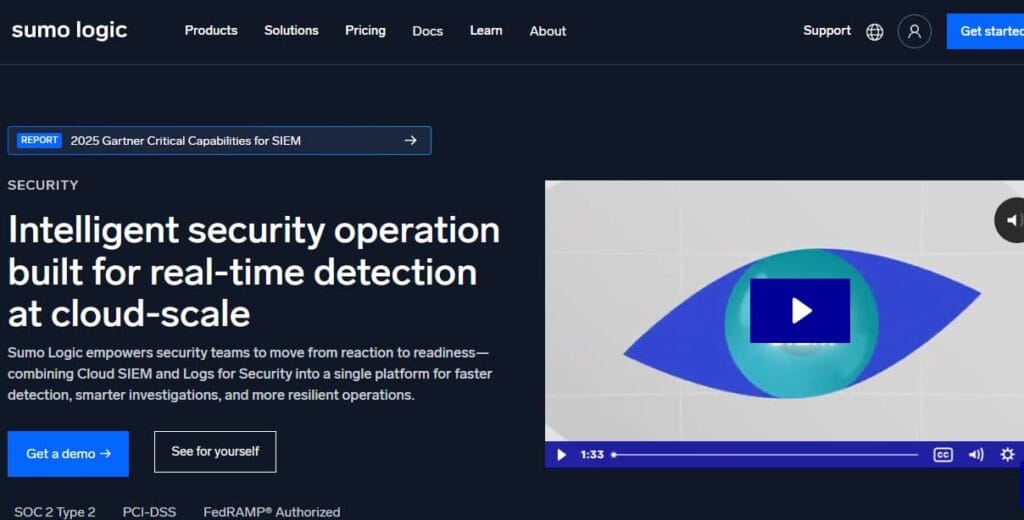
Sumo Logic is a cloud-native SaaS analytics platform for log management, observability, security analytics, and Cloud SIEM. It helps teams collect and analyze logs, metrics, events, and security data from cloud-native applications, infrastructure, and security systems.
Unlike self-managed tools such as ELK Stack or Splunk Enterprise, Sumo Logic is mainly delivered as a cloud-native SaaS platform. This means teams use Sumo Logic’s managed cloud service instead of running and maintaining the full analytics backend themselves.
The platform serves three primary audiences:
- DevOps and SRE teams: Centralized log search, real-time dashboards, Kubernetes monitoring, alerting, and infrastructure visibility across major cloud providers.
- Security operations teams: Cloud SIEM, UEBA behavioral models, MITRE ATT&CK coverage, threat intelligence feeds, and Cloud SOAR for automated response playbooks.
- Engineering leaders at scale: APM, distributed tracing, and application observability alongside log management, with Dojo AI providing multi-agent AI capabilities for automated investigation and response.
Sumo Logic is listed and reviewed on G2 (4.3/5, 391 reviews), TrustRadius (8.8/10, 77 reviews), and Gartner Peer Insights (4.2/5, 81 reviews in the Observability Platforms market) as of April 2026.
Sumo Logic’s Market Positioning in 2026
The log management and cloud SIEM market in 2026 has two rough tiers:
At the top end are premium full-stack platforms such as Splunk, Datadog, Dynatrace, New Relic, and IBM QRadar. These tools offer broad feature sets and deep enterprise integrations, but costs can rise quickly once SIEM ingestion, extended log retention, APM, and user access are fully enabled. Splunk in particular commands high list pricing, typically higher per GB than Sumo Logic, and carries significant operational complexity for on-premises deployments.
At the other end are open-source and self-managed tools such as the ELK Stack (Elasticsearch, Logstash, Kibana), Prometheus, and OpenTelemetry-based stacks. These give teams full control and the lowest possible per-GB cost but require meaningful ongoing engineering effort to deploy, scale, and maintain.
CubeAPM sits between these two ends of the market. It gives engineering teams full-stack APM and observability within their own infrastructure, removing the per-GB SaaS billing of platforms like Sumo Logic while also removing the day-to-day operational burden of self-managing an open-source stack. Because CubeAPM runs in the customer’s own cloud or on-premises environment, teams maintain full control over data location and avoid the compliance complexity associated with routing telemetry through third-party SaaS infrastructure.
Sumo Logic occupies a position as a commercially supported, SaaS-delivered platform that consolidates log management and Cloud SIEM under a single contract. It is particularly well-suited for:
- Teams that want a managed SaaS platform combining log analytics and security operations without running separate tools for each.
- Organizations migrating away from on-premises Splunk Enterprise who want to eliminate infrastructure overhead while retaining SIEM capability.
- Cloud-native teams running AWS, Azure, or GCP workloads who benefit from Sumo Logic’s native integrations with CloudTrail, VPC Flow Logs, Kubernetes, and cloud audit log sources.
- Security and compliance teams requiring Cloud SIEM, PCI DSS, HIPAA, or SOC 2 compliance reporting without a separate point solution.
Key Features of Sumo Logic
Sumo Logic’s core platform includes centralized log search, dashboards, scheduled searches, alerts, and real-time troubleshooting tools. LogReduce uses fuzzy logic to group similar log messages, helping teams spot repeated patterns faster during incident review. LogCompare lets teams compare log data across different time periods to find major changes or anomalies, which is useful after deployments or failures. Live Tail provides a real-time feed of log events from a Source or Collector for development and troubleshooting.
Sumo Logic Cloud SIEM supports security detection, investigation, and response using logs and security data. It includes Insight workflows, rule tuning support through Insight Trainer, entity-focused investigation views, UEBA-style behavioral analytics, and MITRE ATT&CK-aligned detection use cases. Insight Trainer helps teams improve rule quality by suggesting tuning expressions and severity changes so rules produce more meaningful insights.
Dojo AI is Sumo Logic’s agentic AI platform for security operations. Sumo Logic describes it as a multi-agent system that combines automation, machine learning, generative AI, and Model Context Protocol governance. Its current agents include Summary Agent, Query Agent, and Mobot, which help analysts summarize insights, write queries in natural language, and move faster through investigation workflows.
Sumo Logic supports monitoring across cloud infrastructure, containers, Kubernetes, and major cloud services. Its AWS documentation covers integrations such as CloudTrail, CloudWatch Logs, VPC Flow Logs, GuardDuty, S3 Audit, RDS, Lambda, AWS WAF, Security Hub, and many others. Kubernetes tracing can be collected through the Sumo Logic Kubernetes Collection, which uses Helm and OpenTelemetry Collector components to send telemetry to Sumo Logic.
Sumo Logic supports distributed tracing and application observability through OpenTelemetry. Its tracing setup supports OTLP gRPC on port 4317 and OTLP HTTP on port 4318, with telemetry exported to a Sumo Logic OTLP/HTTP Source. For Kubernetes, Sumo Logic supports OpenTelemetry-based traces and can enrich traces with Kubernetes metadata, similar to logs and metrics collected by the collector.
Sumo Logic Cloud SOAR automates security triage, investigation, and remediation. Sumo Logic describes it as a platform for full incident response lifecycle management, with machine learning, threat hunting, open integrations, and playbook-based automation. Its Cloud SOAR product page also highlights progressive security automation and incident response automation from alert detection to playbook activation.
Sumo Logic supports a broad integration ecosystem across AWS, cloud services, Kubernetes, security tools, and developer workflows. It also supports OpenTelemetry-based ingestion for traces through OTLP HTTP and OTLP gRPC, helping teams send telemetry using open standards instead of relying only on proprietary agents.
How Sumo Logic Works: Architecture and Deployment
Collection Methods
Sumo Logic supports several ways to collect telemetry. Installed Collectors and OpenTelemetry Collectors are commonly used to collect logs, metrics, and traces from hosts, applications, and infrastructure. Hosted Collectors allow teams to send data to Sumo Logic without installing an agent locally, with sources for cloud services, HTTP endpoints, S3 buckets, syslog, and other systems. Sumo Logic also supports OTLP/HTTP Sources for receiving OpenTelemetry-formatted logs, metrics, and traces, giving teams a standards-based path for sending telemetry into the platform.
All of these collection paths send data to the Sumo Logic service for processing, storage, search, and analysis. In the OpenTelemetry Collector flow, Sumo Logic states that the collector compresses and encrypts data before sending it to the Sumo service over HTTPS.
Deployment Model
Sumo Logic is delivered as a cloud-native SaaS platform rather than a customer-managed analytics backend. Teams collect telemetry from their own environments, but they do not run the Sumo Logic search, storage, or analytics infrastructure themselves. This makes it different from self-managed log and analytics stacks such as ELK Stack or self-hosted Splunk Enterprise.
Under the Cloud Flex Credit pricing schedule, Sumo Logic lists deployment regions including United States, United States Federal, Dublin, Montreal, Tokyo, Seoul, Sydney, Frankfurt, Zurich, and Global. The US region has no listed uplift, while US Federal, Dublin, and Montreal have a 10% uplift. Tokyo, Seoul, Sydney, Frankfurt, Zurich, and Global have a 20% uplift.
Pricing Architecture: Tiers vs. Cloud Flex Credits
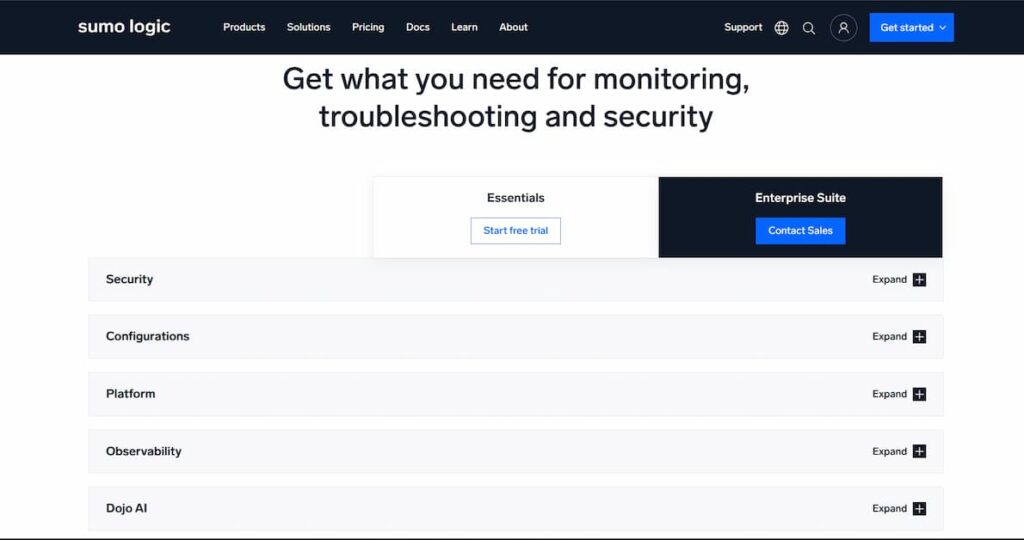
Sumo Logic pricing is organized around account tiers and a credit-based consumption model. Its Credits packaging includes Free, Trial, Essentials, Enterprise Operations, Enterprise Security, and Enterprise Suite accounts. Credits are used to track platform usage across data ingestion, storage, metrics, tracing, and other product variables. For paid service plans, Sumo Logic’s Cloud Flex Credit schedule lists eligible plans including Essentials, Enterprise Operations, Enterprise Security, and Enterprise Suite.
What Are Sumo Logic’s Plan Tiers?
Sumo Logic’s plan structure includes Free, Trial, Essentials, Enterprise Operations, Enterprise Security, and Enterprise Suite accounts. Pricing is mainly driven by the account tier, deployment region, payment terms, and credit usage across product variables such as ingest, storage, metrics, tracing, and Cloud SIEM. Sumo Logic does not publish a simple public monthly price list for paid tiers on its main pricing page. Essentials and Enterprise Suite are shown as sales-led plans on the pricing page, while the docs also describe Essentials as a paid credits-based option for small to mid-sized teams.
Plan Tiers Overview
Disclaimer: Plan details are based on Sumo Logic’s public pricing page, Sumo Logic Credits account documentation, and the Cloud Flex Credit pricing schedule updated February 16, 2026. Sumo Logic does not publish a simple public monthly price table for all paid tiers. Verify current pricing, packaging, and contract terms directly with Sumo Logic before making a purchase decision.
Free Tier
Starting price: $0/month. No credit card required. Positioned for individual developers and small teams evaluating the platform.
| Price | $0 / month |
| Best For | Individual developers, very small teams, proof-of-concept deployments |
| Daily usage | 20 daily credits for logs, metrics, and traces |
| Retention | 7-day log retention |
| Users | Free accounts do not support Data Management |
Essentials
Starting price: Contact Sales / self-service paid upgrade. Sumo Logic describes Essentials as a paid, credits-based subscription for small to mid-sized teams that need essential log analytics and monitoring. Sumo’s docs also say Free or Trial users can upgrade to Essentials through self-service checkout using a credit card, without contacting sales.
| Price | Contact Sales on the public pricing page / paid credits-based subscription in Sumo Logic docs |
| Best for | Small to mid-sized teams needing essential log analytics, monitoring, troubleshooting, and foundational observability |
| Billing model | Credits-based subscription |
| Upgrade path | Free or Trial accounts can upgrade to Essentials through self-service checkout |
| Billing cycle | Monthly or annual subscription options are available during upgrade |
| Payment method | Credit card payment is used in the self-service upgrade flow |
| Usage model | Usage such as data ingestion, storage, and queries consumes credits from a purchased pool |
| Cloud Flex Credit rate | 0.15000 cents per credit for Essentials under US deployment and annual payment terms |
| Enterprise upgrade path | Teams that need Enterprise Suite or additional services should contact Sumo Logic sales |
Enterprise Operations
Price: Custom quote. Sumo Logic describes Enterprise Operations accounts as optimized for best-practice operational monitoring at any ingest volume.
| Price | Custom quote / Contact Sales |
| Best for | DevOps, SRE, and operations teams that need enterprise-scale operational monitoring |
| Positioning | Optimized for best-practice operational monitoring at any ingest volume |
| Ingest controls | Ingest Budgets are available across Enterprise plans to control daily log ingestion volume |
| Included features | Enterprise operational monitoring capabilities, with access to enterprise-level controls such as Ingest Budgets |
| Cloud Flex Credit rate | 0.21250 cents per credit for US deployment with annual payment terms |
| Exclusions | Security PCI and security-specific application frameworks, Cloud SIEM Enterprise, Cloud SOAR, and Global Intelligence |
Enterprise Security
| Price | Custom quote / Contact Sales |
| Best for | SOC teams needing Cloud SIEM, threat detection, UEBA, and security investigation |
| Included features | Cloud SIEM, 900+ out-of-the-box rules, MITRE ATT&CK-mapped detection, UEBA, Entity Timeline, Entity Relationship Graph, PCI Compliance App, threat detection |
| Cloud Flex Credit rate | 0.22500 cents per credit, US deployment, annual payment terms |
| CSE ingest note | CSE GB Ingest is available as an additional purchase to Enterprise Security and Enterprise Suite |
| Exclusions | Tracing, Cloud SOAR, Global Intelligence |
Enterprise Suite
Price: Custom; contact Sumo Logic sales. Combines Operations and Security into a single package, including Cloud SOAR.
| Price | Custom quote / Contact Sales |
| Best for | Teams consolidating observability, security analytics, Cloud SIEM, and advanced investigation |
| Included features | Cloud SIEM, MITRE ATT&CK-mapped detection, UEBA-driven coverage, premium threat intelligence feeds, automation service, complex multi-org support, and 24/7 support |
| Cloud SOAR | Available as an additional purchase to Enterprise Suite |
| Cloud Flex Credit rate | 0.25000 cents per credit, US deployment, annual payment terms |
| Global/quarterly example | $0.00360 per credit, based on Enterprise Suite Global deployment with quarterly payment terms |
| Pricing note | Sumo Logic describes Enterprise Suite as its most advanced account type, built for advanced data insight challenges and Tiered Analytics |
Cloud Flex Credit Model
Price: Custom; credits purchased in advance and consumed across product variables. Available for all paid tiers.
| Price | Custom |
| Model | Prepaid credits |
| Eligible plans | Essentials, Enterprise Operations, Enterprise Security, Enterprise Suite |
| Billing unit | Credits consumed by ingest, storage, metrics, tracing, search, and Cloud SIEM |
| Product variables | Continuous GB Ingest, GB Storage, Metrics, Tracing, Frequent GB Ingest, Infrequent GB Ingest, Infrequent GB Storage, Infrequent Search, Cloud SIEM Enterprise |
| Deployment uplift | US: 0%. US Federal, Dublin, Montreal: +10%. Tokyo, Seoul, Sydney, Frankfurt, Zurich, Global: +20% |
| Payment uplift | Annual is base. Other payment terms may add up to 30% |
| Renewal policy | Annual subscription fees rise 10% at renewal unless agreed otherwise |
| Best for | Teams that want flexible credit use across Sumo Logic products |
How Much Does Sumo Logic Really Cost?
Sumo Logic does not publish a simple monthly price table for all paid plans. Its current pricing is built around account types and credits. Sumo Logic lists Free, Trial, Essentials, Enterprise Operations, Enterprise Security, and Enterprise Suite as its credits account types. A credit is used to track usage such as data ingestion, storage, metrics, and other product activity during a contract period.
The public pricing page lists Essentials and Enterprise Suite, but Essentials is shown as “Contact Sales.” Sumo’s docs also say Free or Trial users can upgrade to Essentials through self-service checkout with monthly or annual billing.
Assumptions Used in the Cost Scenarios
- These are directional estimates, not official Sumo Logic quotes.
- Sumo Logic pricing is credit-based, not a simple fixed monthly price.
- Costs can vary by usage, product mix, region, payment terms, and contract structure.
- The scenarios focus on log analytics and observability usage, not Cloud SIEM or Cloud SOAR.
- Discounts, professional services, and custom contract terms are not included.
Scenario 1: Early-stage startup — 5 services, small team
Situation: Consider a 4-person engineering team at an early-stage SaaS startup. They run five backend microservices on AWS, a PostgreSQL database, an Nginx load balancer, and a React frontend. They need basic log search, production error alerts, and dashboard visibility during deployments. They have been using free tools but want one searchable log platform without taking on a large contract.
Why teams at this stage consider Sumo Logic
- Free accounts support small-scale testing with 20 daily credits for logs, metrics, and traces.
- Free accounts include 7-day log retention and up to 3 users.
- Trial accounts give full access to Sumo Logic features for 30 days.
- Trial accounts support 1 GB/day, 30-day retention, and up to 20 users.
- Sumo Logic supports AWS integrations and hundreds of integrations.
- Essentials is the likely next step when the team needs higher usage limits, longer retention, or broader feature access.
Estimated ingest profile
Disclaimer: These figures are directional estimates for editorial comparison only. They are not official Sumo Logic quotes. Actual usage depends on log verbosity, traffic, AWS activity, retention needs, and query volume. Use Sumo Logic’s free trial to validate real ingest before moving to a paid plan.
| Telemetry source | Monthly estimate | Est. GB/day | Notes |
| 5 microservice logs | ~250K log lines/day | ~0.25 GB/day | INFO + ERROR logs from low-traffic services |
| PostgreSQL + Nginx logs | ~50K lines/day | ~0.05 GB/day | Slow query logs + access logs |
| AWS CloudTrail | ~30K events/day | ~0.03 GB/day | API activity from a small AWS account |
| Infrastructure metrics | 3–5 hosts | ~0.02 GB/day | Basic CPU, memory, and disk metrics |
| Total estimated usage | — | ~0.35 GB/day | ~10.5 GB/month |
Estimated monthly cost
| Plan | Fit for this scenario | Estimated cost |
| Free account | Possible for testing, but limited to 3 users and 7-day log retention | $0 |
| Trial account | Best way to test full Sumo Logic features for 30 days | $0 during trial |
| Essentials | Likely upgrade path after trial or when Free limits are too tight | Contact Sales / self-service paid upgrade |
What this scenario shows
- Sumo Logic is better treated as a free or trial evaluation path at this stage, not as a fixed low-cost monthly plan.
- The old 500 MB/day Free tier assumption should not be used for current pricing. Sumo’s current docs describe Free accounts as 20 daily credits, 7-day log retention, and up to 3 users.
- The Trial account is a stronger fit for this team because it allows full feature access, 1 GB/day, 30-day retention, and up to 20 users for 30 days.
- The 3-user limit on the Free account is the first major constraint for a 4-person engineering team.
- Essentials becomes the likely next step after the trial if the team wants to keep using Sumo Logic or needs higher limits.
- Sumo Logic does not publish a fixed Essentials monthly price, so the cost should be shown as Contact Sales or self-service paid upgrade, not ~$90/month.
Scenario 2: Growing SaaS team — 50 hosts, 5.4 TB/month
Situation: Consider a growing SaaS company with a 15-person engineering team. They run 12 services on AWS, around 50 hosts, Kubernetes workloads, PostgreSQL, Redis, and a React frontend. They need log analytics, Kubernetes visibility, dashboards, alerting, and light tracing for production issues.
Estimated ingest profile
| Input | Assumption |
| Total monthly ingest | 5.4 TB/month |
| Daily ingest | ~180 GB/day |
| Hosts | 50 |
| High-priority logs | ~35 GB/day |
| Lower-priority logs | ~145 GB/day |
| Light tracing estimate | ~5 GB/day |
| Retention assumption | 30 days |
| Region/payment assumption | US deployment, annual payment |
Estimated monthly cost calculation
| Cost component | Calculation | Est. monthly cost |
| High-priority logs | 35 GB/day × mixed credit rate | ~$1,900 |
| Lower-priority logs | 145 GB/day × lower-cost credit path | ~$2,500 |
| 30-day storage | 5.4 TB stored for review period | ~$700 |
| Light tracing | ~5 GB/day sampled traces | ~$700 |
| Estimated total | Logs + storage + light tracing | ~$5,800/month |
Estimated monthly cost summary
| Plan | Fit for this scenario | Est. monthly cost |
| Trial account | Too small for 5.4 TB/month | $0 during trial |
| Essentials-style setup | Fit for log analytics and basic monitoring | ~$5,000–$5,500/month |
| Enterprise Operations-style setup | Better fit for logs, light tracing, and ops monitoring | ~$5,500–$6,000/month |
What this scenario shows
- 5.4 TB/month is about 180 GB/day.
- Sumo Logic is not priced directly by host count.
- The 50 hosts add context, but ingest volume drives the bill.
- A mixed ingest model keeps costs lower than pricing all data as Continuous ingest.
- Light tracing adds cost, but it should be sampled.
- At this scale, Sumo Logic is more likely a low-to-mid four-figure monthly spend, not a $20k–$30k/month bill.
- Final pricing depends on credit terms, product mix, region, and contract structure.
Scenario 3: Mid-sized enterprise — 250 hosts, 27 TB/month
Situation: Consider a mid-sized fintech company with a 75-person engineering and security team. They run 40 services across AWS and Azure, around 250 hosts, Kubernetes workloads, PostgreSQL, MongoDB, Redis, and a customer-facing web app. They need log analytics, infrastructure visibility, sampled tracing, Cloud SIEM, and longer retention for audit use cases.
Why teams at this stage consider Sumo Logic
- Enterprise Suite combines observability and security workflows.
- Sumo Logic supports logs, metrics, traces, and Cloud SIEM.
- Cloud SIEM supports threat detection and investigation.
- CSE GB Ingest is modeled as a separate product variable.
- Cloud SOAR is available as an add-on to Enterprise Suite.
- Credits can apply across ingest, storage, metrics, tracing, search, and Cloud SIEM.
- Sumo Logic is SaaS-based, so teams do not manage the backend.
Estimated ingest profile
| Input | Assumption |
| Total monthly ingest | 27 TB/month |
| Daily ingest | ~900 GB/day |
| Hosts | 250 |
| High-priority operational logs | ~120 GB/day |
| Lower-priority logs | ~680 GB/day |
| Security / SIEM logs | ~75 GB/day |
| Sampled tracing | ~25 GB/day |
| Retention assumption | 30 days active search |
| Region/payment assumption | US deployment, annual payment |
Estimated monthly cost calculation
| Cost component | Assumption | Est. monthly cost |
| High-priority logs | Frequent / higher-value ingest | ~$5,000 |
| Lower-priority logs | Infrequent / lower-cost ingest path | ~$8,000 |
| Security / SIEM ingest | CSE GB Ingest product variable | ~$4,000 |
| 30-day storage | Active searchable storage | ~$1,500 |
| Sampled tracing | Light sampled tracing | ~$1,500 |
| Estimated total | Logs + SIEM + storage + tracing | ~$20,000/month |
Estimated monthly cost summary
| Plan | Fit for this scenario | Est. monthly cost |
| Trial account | Not suitable for 27 TB/month | $0 during trial |
| Essentials | Too limited for this scope | Not ideal |
| Enterprise Operations | Good for operational monitoring, but not full SIEM scope | Custom quote |
| Enterprise Security | Good for Cloud SIEM needs | Custom quote |
| Enterprise Suite | Best fit for combined observability + security | ~$20,000/month directional |
What this scenario shows
- 27 TB/month equals about 900 GB/day.
- Sumo Logic is not priced directly by host count.
- 250 hosts give scale context, but ingest volume drives cost.
- A mixed ingest model keeps the estimate closer to $20k/month.
- Cloud SIEM should be modeled as its own cost area.
- Tracing should be sampled to avoid unnecessary cost growth.
- Cloud SOAR should be treated as an add-on, not included by default.
- Final pricing depends on credit terms, region, payment terms, and the customer order form.
What Actually Drives Sumo Logic Costs
Understanding Sumo Logic pricing means looking at the usage variables that consume credits. The biggest drivers are ingest, storage, tracing, Cloud SIEM usage, region, payment terms, and renewal terms.
| Cost driver | Impact level | Verified note |
| Data ingestion volume | Primary | Continuous GB Ingest, Frequent GB Ingest, and Infrequent GB Ingest consume credits at different burn rates. |
| Storage / retention | Significant | GB Storage consumes credits separately from ingest. Longer retention increases stored GB. |
| Product tier | Major | Credit price changes by plan, from Essentials to Enterprise Suite. |
| Tracing | Significant | Tracing is a separate product variable with its own credit burn rate. |
| Cloud SIEM ingestion | Significant | CSE GB Ingest is a separate product variable. |
| Cloud SOAR | Add-on cost | Cloud SOAR is available as an additional purchase to Enterprise Suite. |
| Search usage | Variable | Infrequent Search consumes credits based on scanned GB. |
| Deployment region | Moderate | Some regions carry a 10% or 20% uplift. |
| Payment terms | Moderate | Non-standard payment terms may add uplift charges up to 30%. |
| Renewal policy | Long-term risk | Net annual subscription fees increase by 10% at renewal unless agreed otherwise. |
Hidden Costs Buyers Should Plan For
Sumo Logic pricing is mainly driven by credits, usage variables, region, payment terms, and contract terms. Buyers should model these items before signing an Enterprise quote.
| Hidden cost area | What to plan for |
| Ingest mix | Continuous, Frequent, and Infrequent ingest use different credit burn rates. |
| Storage / retention | GB Storage consumes credits separately from ingest. |
| Tracing | Tracing has its own credit burn rate. |
| Cloud SIEM ingest | CSE GB Ingest is a separate product variable. |
| Cloud SOAR | Available as an additional purchase to Enterprise Suite. |
| Infrequent Search | Searches against Infrequent Log Storage consume credits. |
| Deployment region | US has no uplift. Some regions add 10% or 20%. |
| Payment terms | Non-standard payment terms may add uplift charges up to 30%. |
| Renewal pricing | Net annual subscription fees increase 10% at renewal unless agreed otherwise. |
| Data management controls | Ingest Budgets and Scan Budgets can help manage usage. |
| Migration work | Dashboards, alerts, collectors, and queries may need setup or rewriting. |
Sumo Logic User Reviews (2026)
Sumo Logic holds consistent, above-average ratings across the major B2B software review platforms. The following is a balanced synthesis of verified user feedback from G2, TrustRadius, and Gartner Peer Insights as of April 2026.
- Centralised log management: The most consistently cited strength across all review platforms. Users at companies including uPerform, MindTickle, and ThoughtWorks (per TrustRadius) describe bringing all logs into one searchable platform as a fundamental change to how engineering teams debug and respond to incidents. The ability to track a user-facing event from frontend to backend across a shared timeline is specifically highlighted as valuable.
- SaaS simplicity and zero operational overhead: Users migrating from self-hosted Splunk or ELK consistently cite the elimination of infrastructure management as a primary reason for staying. No Elasticsearch clusters to operate, no version upgrade cycles, no storage capacity planning.
- Native cloud integrations: AWS integrations (CloudTrail, CloudWatch, VPC Flow Logs, GuardDuty) and Kubernetes monitoring are praised as comprehensive and setup-efficient. Users describe getting cloud audit data into dashboards in minutes via the Hosted Collector, without manual log shipping configuration.
- Query language capability: Users familiar with Splunk describe Sumo Logic’s query language as ‘very similar to SPL’ and highlight scheduled queries, webhook-based alerting, and programmatic dashboard updates as operationally useful (r/devops community feedback).
- Cloud SIEM for security-forward teams: Security reviewers on TrustRadius cite Sumo Logic’s SIEM capabilities, threat detection, log correlation, and compliance dashboards as genuinely functional and competitive with dedicated SIEM tools for teams that want unified log management and security in one platform.
- Dashboard sharing across the organisation: Sharing dashboards via links across engineering, customer success, and product teams without per-seat costs is frequently cited as operationally useful, particularly for teams that have outgrown Datadog’s dashboard access pricing.
- Pricing at scale: Some reviewers say Sumo Logic pricing can rise as usage grows, especially when teams scale log volume or need broader platform features.
- Query language learning curve: Users often like Sumo Logic’s search power, but some note that advanced queries and dashboard building take time to learn.
- Search performance at high volume: Some reviewers mention slower searches when working with large data volumes or older/historical data.
- Enterprise comparison with Splunk: Some users still see Splunk as stronger for certain large enterprise use cases, especially around search depth and mature workflows.
- UI and onboarding: Some reviewers say the interface and advanced features can take time for new users to understand.
- G2 reviewers praise Sumo Logic for cloud-native log monitoring, scalability, dashboards, APIs, real-time monitoring, threat detection, and SOAR support. One pricing-page reviewer also notes that pricing can get high when scaling up.
- G2 review summaries repeatedly mention a learning curve around Sumo Logic’s query language, especially for users building advanced queries and dashboards.
- TrustRadius reviews also mention a learning curve for queries, while still praising log control, dashboards, alerts, and production infrastructure monitoring.
- Some marketplace and review listings mention slower performance when querying large amounts of historical or archived data, so performance should be evaluated with the buyer’s real data volume and retention needs.
Summary Rating Breakdown
| Platform | Overall rating | Review count | Key theme |
| G2 | 4.3 / 5 | Check before publishing | Strong for log centralization, dashboards, cloud integrations, and alerting. Pricing concerns appear in some reviews. |
| TrustRadius | 8.8 / 10 | 77 reviews | Praised for log search, dashboards, alerts, and production troubleshooting. Some users note a query learning curve. |
| Gartner Peer Insights | 4.2 / 5 | 81 reviews | Well-rated in Observability Platforms, but below Elastic’s 4.5 / 5 from 284 reviews in the same category. |
Sumo Logic Pricing Comparison: All Major Tools (2026)
| Tool / platform | Pricing model | Starting price | Free tier / trial |
| Sumo Logic | Credit-based usage across ingest, storage, metrics, tracing, search, and Cloud SIEM | Essentials is Contact Sales; Cloud Flex rates start at $0.15000/credit for Essentials, US annual terms | Free account with 20 daily credits, 7-day log retention, and up to 3 users; Trial supports 1 GB/day for 30 days |
| CubeAPM | Per GB ingested; deployed in the customer’s environment | $0.15/GB ingested | No standard SaaS free tier; runs in the customer’s own environment |
| Splunk Cloud | Ingest pricing or workload pricing | Custom quote; ingest pricing is based on GB/day | 14-day free trial; up to 5 GB/day |
| Datadog | Per host, per user, and usage-based by product | Infrastructure Pro starts at $15/host/month; APM starts at $31/host/month | 14-day free trial |
| Elastic | Resource-based Elastic Cloud or self-managed Elastic Stack | Self-managed stack is free to start; Elastic Cloud is usage/resource-based | Self-managed Elastic Stack is free to start; Elastic Cloud trial available |
| New Relic | Ingest-based plus user pricing | 100 GB/month free ingest, then $0.40/GB beyond; user pricing varies by user type | Free tier includes 100 GB/month ingest |
| Dynatrace | Host, GiB-hour, and usage-based pricing by capability | Infrastructure Monitoring starts at $0.04/hour per host; Full-Stack Monitoring starts at $58/month per 8 GiB host | Free trial available |
| Grafana Cloud | Usage-based across metrics, logs, traces, users, and other meters | Free tier available; paid usage scales by telemetry and users | Free tier includes usage limits for metrics, logs, and traces |
Sumo Logic Alternatives: Detailed Comparisons
Sumo Logic vs CubeAPM
Sumo Logic is a SaaS-first platform for log analytics, observability, and Cloud SIEM. CubeAPM is stronger when teams need observability data to stay inside their own cloud or data center, with simpler per-GB pricing.
| Pricing component | Sumo Logic | CubeAPM |
| Pricing model | Credit-based usage across ingest, storage, metrics, tracing, search, and Cloud SIEM | Per GB ingested of $0.15/GB ingested |
| Data residency | Data is processed in Sumo Logic’s SaaS environment | Runs in the customer’s environment; no log data leaves the customer’s cloud |
| Deployment | SaaS only | Self-hosted (vendor-managed) |
| Cloud SIEM | Cloud SIEM available through security-focused plans | Not a primary SIEM platform; focused on observability |
| OTel support | Supports OpenTelemetry-based collection and OTLP ingestion | OTel native |
| Best for | Teams wanting SaaS log analytics, observability, and Cloud SIEM without managing backend infrastructure | Teams needing data control, customer-environment deployment, and predictable per-GB observability pricing |
Sumo Logic vs Splunk
Sumo Logic is a SaaS-first option for cloud-native log analytics, observability, and Cloud SIEM. Splunk is broader and more mature for teams that need self-managed deployment, deep SPL workflows, and complex enterprise-scale security operations.
| Pricing component | Sumo Logic | Splunk |
| Pricing model | Credit-based usage across ingest, storage, metrics, tracing, search, and Cloud SIEM | Ingest pricing, workload pricing, entity pricing, and activity-based pricing |
| Cloud vs. on-premise | Cloud-native SaaS platform | Splunk Cloud is SaaS; Splunk Enterprise can be self-managed |
| Data residency | Data is processed in Sumo Logic’s SaaS environment | Splunk Enterprise can run in the customer’s own environment |
| SIEM capability | Cloud SIEM with 900+ rules, UEBA, MITRE ATT&CK mapping, Entity Timeline, and Entity Relationship Graph | Splunk Enterprise Security is a mature SIEM built on the Splunk platform |
| Query language | Sumo Logic query language | SPL, widely used for complex search and investigation |
| Best for | Cloud-native teams that want SaaS log analytics, observability, and Cloud SIEM without managing backend infrastructure | Teams that need self-managed deployment, deep SPL workflows, and complex enterprise-scale log or security operations |
Sumo Logic vs Datadog
Sumo Logic is stronger when the main need is SaaS log analytics plus Cloud SIEM. Datadog is stronger when teams want broad observability, mature APM, infrastructure monitoring, RUM, synthetics, and many product modules in one platform.
| Pricing component | Sumo Logic | Datadog |
| Pricing model | Credit-based usage across ingest, storage, metrics, tracing, search, and Cloud SIEM | Per host, per user, and usage-based meters by product |
| Cost predictability | Depends on credit usage, region, payment terms, and order form | Can become harder to predict as more modules and meters are added |
| Cloud SIEM | Cloud SIEM available through security-focused plans and CSE GB Ingest | Cloud SIEM is a separate Datadog security product |
| On-premise option | No | No |
| Best for | Teams prioritizing log analytics, security analytics, and Cloud SIEM in a SaaS platform | Teams wanting broad cloud observability, APM depth, infrastructure monitoring, a |
Sumo Logic vs Elastic
Elastic is stronger for teams that want self-managed control, Elastic Stack flexibility, and deep ingestion pipeline customization. Sumo Logic is stronger for teams that want a SaaS-first log analytics and security platform without managing Elasticsearch clusters.
| Pricing component | Sumo Logic | Elastic |
| Pricing model | Credit-based usage across ingest, storage, metrics, tracing, search, and Cloud SIEM | Elastic Cloud is usage/resource-based; self-managed Elastic Stack is free to start |
| Managed option cost | Essentials is Contact Sales; Cloud Flex rates start at $0.15000/credit for Essentials, US annual terms | Elastic Cloud pricing is flexible and usage-based; some third-party references cite hosted plans from around $95/month |
| Self-hosted option | No self-managed Sumo Logic backend | Yes, Elastic Stack can be self-managed |
| Cloud SIEM | Cloud SIEM available through security-focused plans | Elastic Security provides SIEM, endpoint, and cloud security capabilities |
| Gartner Peer Insights | 4.2/5 from 81 reviews | 4.5/5 from 284 reviews |
| Best for | Teams that want SaaS log analytics, Cloud SIEM, and less backend operations work | Teams that want self-managed control, Elastic ecosystem flexibility, and deep pipeline customization |
Sumo Logic vs Grafana Cloud
Grafana Cloud is a managed observability platform built around Grafana’s LGTM stack: Loki for logs, Grafana for dashboards, Tempo for traces, and Mimir/Prometheus-style metrics. Sumo Logic is more log analytics and security oriented, with Cloud SIEM available in its security-focused plans.
| Pricing component | Sumo Logic | Grafana Cloud |
| Pricing model | Credit-based usage across | Usage-based pricing |
| Starting price | Essentials is Contact Sales; Cloud Flex rates start at $0.15000/credit for Essentials, US annual terms | Free tier available; paid usage depends on telemetry volume and plan |
| Multi-meter billing | Yes, credits are consumed across several product variables | Yes, separate meters for logs, metrics, traces, profiles, users, and more |
| Cloud SIEM | Cloud SIEM available through security-focused plans | No native full Cloud SIEM equivalent |
| Self-hosted option | No self-managed Sumo Logic backend | Yes (Grafana OSS) |
| Best for | Teams that want SaaS log analytics, Cloud SIEM, and less backend management | Teams with Grafana expertise that want open-source-based observability flexibility |
Sumo Logic vs New Relic
New Relic is stronger for APM, browser monitoring, infrastructure, and broad full-stack observability. Sumo Logic is stronger when the main need is SaaS log analytics plus Cloud SIEM.
| Pricing component | Sumo Logic | New Relic |
| Pricing model | Credit-based usage across ingest, storage, metrics, tracing, search, and Cloud SIEM | Ingest-based pricing plus user access tiers |
| Trial | 1 GB/day for 30 days, up to 20 users | Free account / free tier available |
| Starting price | Essentials is Contact Sales; Cloud Flex rates start at $0.15000/credit for Essentials, US annual terms | 100 GB/month free ingest, then $0.40/GB beyond |
| User pricing | Do not state as unlimited unless tied to a current Sumo plan source | Basic users are free; Core and Full Platform users vary by edition |
| Main billing driver | Credit usage across ingest, storage, tracing, search, Cloud SIEM, region, and payment terms | Data ingest, user type, edition, and advanced compute |
| Cloud SIEM | Available through security-focused Sumo Logic plans | No native SIEM equivalent |
| APM depth | Supports tracing and observability, but is more log/SIEM-centered | Strong APM, browser monitoring, infrastructure, logs, and 780+ integrations |
| Best for | Teams prioritizing log analytics, security analytics, and Cloud SIEM | Teams needing mature APM and broad full-stack observability |
Sumo Logic vs Dynatrace
Dynatrace is stronger for deep APM, infrastructure monitoring, Kubernetes monitoring, digital experience, and AI-assisted root cause analysis. Sumo Logic is stronger when the main need is SaaS log analytics, Cloud SIEM, and security-focused investigation.
| Pricing component | Sumo Logic | Dynatrace |
| Pricing model | Credit-based usage across ingest, storage, metrics, tracing, search, and Cloud SIEM | Usage-based pricing by capability |
| Starting price | Essentials is Contact Sales; Cloud Flex rates start at $0.15000/credit for Essentials, US annual terms | Infrastructure Monitoring starts at $0.04/hour per host; Full-Stack Monitoring starts at $58/month per 8 GiB host |
| Main billing driver | Credit usage across product variables | Host hours, memory GiB-hours, logs, events, sessions, and selected modules |
| APM depth | Supports tracing and observability, but is more log/SIEM-centered | Strong full-stack APM, distributed tracing, infrastructure, Kubernetes, and Davis AI |
| Cloud SIEM | Available through security-focused plans | Security features exist, but Dynatrace is not primarily a Cloud SIEM platform |
| On-premise option | No self-managed Sumo Logic backend | SaaS-first platform with managed deployment options |
| Best for | Teams prioritizing log analytics, security analytics, and Cloud SIEM | Teams needing deep APM, infrastructure monitoring, Kubernetes visibility, and AI-driven root cause analysis |
When to Use Sumo Logic: A Decision Framework
- You need log analytics and Cloud SIEM in one SaaS platform: Sumo Logic Cloud SIEM supports 900+ out-of-the-box rules, UEBA-driven coverage, MITRE ATT&CK mapping, Entity Timeline, and Entity Relationship Graph. Cloud SOAR is available as an additional purchase to Enterprise Suite.
- You want to reduce self-managed logging infrastructure: Sumo Logic is SaaS-based, so teams do not run their own indexing, search, or storage backend.
- Your stack is AWS-heavy: Sumo Logic supports AWS integrations such as CloudTrail, CloudWatch, VPC Flow Logs, GuardDuty, S3, Security Hub, WAF, and other AWS services.
- You want credit-based pricing across observability and security usage: Sumo Logic account types include Free, Trial, Essentials, Enterprise Operations, Enterprise Security, and Enterprise Suite. Credits track usage across data ingest, storage, metrics, and other activity.
- You need SaaS security and compliance support: Sumo Logic lists compliance certifications for its SaaS Log Analytics Platform and Cloud SIEM. Keep retention and audit requirements as quote-level items rather than fixed plan claims.
- You need strict on-premise data control: Sumo Logic is SaaS-based. If telemetry cannot route through a third-party SaaS backend, a customer-environment option such as CubeAPM is a better fit.
- You have very high telemetry volume: Sumo Logic can work at scale, but high ingest, storage, tracing, and Cloud SIEM usage can raise credit consumption quickly.
- Deep APM is the main buying reason: Datadog and Dynatrace are usually stronger choices when code-level APM, profiling, RUM, and deep application tracing are the main requirements.
- You prefer open-source control: Teams with strong Grafana, Prometheus, Loki, Elastic, or Logstash skills may prefer a more DIY stack, accepting higher setup and maintenance work.
- You need Cloud SOAR included by default: Under Sumo Logic’s Cloud Flex schedule, Cloud SOAR is an additional purchase to Enterprise Suite, not a default inclusion.
Conclusion
Sumo Logic is a mature SaaS platform for log analytics, Cloud SIEM, and cloud-native monitoring. It fits teams that want managed infrastructure, security analytics, and support for logs, metrics, traces, and Cloud SIEM without running their own backend.
The cost picture is not a simple per-GB price. Sumo Logic uses credits across ingest, storage, metrics, tracing, search, and Cloud SIEM. In our scenarios, a small team may start with Free or Trial, a 5.4 TB/month team may land around $5,000–$6,000/month; and a 27 TB/month enterprise case may move closer to $20,000/month.
The main caveat is that Sumo Logic is SaaS-first. Teams with strict data-residency needs may need a customer-environment option such as CubeAPM. Before signing, validate real ingest during the trial; separate log, trace, storage, and Cloud SIEM costs in the quote; and negotiate renewal terms upfront.
FAQs
1. What is Sumo Logic?
Sumo Logic is a cloud-native SaaS platform for log analytics, infrastructure monitoring, observability, and Cloud SIEM. It supports logs, metrics, traces, security analytics, AWS integrations, and AI-assisted SOC workflows through Dojo AI.
2. How much does Sumo Logic cost in 2026?
Sumo Logic does not publish a simple monthly price table for paid plans. Its pricing is credit-based, with plans such as Essentials, Enterprise Operations, Enterprise Security, and Enterprise Suite. Cloud Flex rates start at $0.15000 per credit for Essentials under US annual terms and rise to $0.25000 per credit for Enterprise Suite.
3. What are the main hidden costs of Sumo Logic?
The main cost drivers are ingest volume, storage, tracing, Cloud SIEM usage, Infrequent Search, region uplift, payment terms, and renewals. Sumo’s Cloud Flex schedule also states that annual subscription fees increase by 10% at renewal unless agreed otherwise.
4. Is Sumo Logic good for SIEM?
Yes. Sumo Logic Cloud SIEM includes threat detection, MITRE ATT&CK mapping, UEBA-driven coverage, Entity Timeline, Entity Relationship Graph, and 900+ out-of-the-box rules on its pricing page.
5. What are the best alternatives to Sumo Logic?
Common alternatives include Splunk, Datadog, Elastic, New Relic, Dynatrace, Grafana Cloud, and CubeAPM. CubeAPM is especially relevant for teams that need customer-environment deployment and predictable per-GB observability pricing.
6. Does Sumo Logic support OpenTelemetry?
Yes. Sumo Logic supports OpenTelemetry-based collection and OTLP ingestion for telemetry such as logs, metrics, and traces.
7. How does Sumo Logic handle data retention?
Free accounts include 7-day log retention. Trial accounts include 30-day retention. For paid plans, retention should be confirmed in the quote because storage and retention can affect credit usage.