









SigNoz has become one of the most-discussed open-source observability platforms, offering an OpenTelemetry-native, full-stack alternative to Datadog, New Relic, and Grafana. Its $0.30/GB usage-based cloud pricing and free self-hosted Community Edition make it appealing for developers, startups, and cost-conscious engineering teams.
According to the DORA 2024 State of DevOps Report, elite DevOps teams restore service from incidents 182 times faster than low-performing teams. Observability tooling is a direct input to that capability gap, yet many teams overspend on complex per-host or per-seat pricing models when simpler, usage-based alternatives deliver equivalent results. SigNoz is one of the strongest such alternatives available in 2026.
In this review, we cover SigNoz’s 2026 pricing plans in full detail, break down verified user pros and cons, and compare SigNoz against its main competitors, including Datadog, New Relic, Grafana Cloud, Loggly, and CubeAPM.
💡 Quick Answer: SigNoz offers a free Community Edition (self-hosted, no data caps, no license fee); a Teams cloud plan from $49/month ($0.30/GB logs & traces; $0.10/million metric samples after the $49 base credit); and an Enterprise plan that starts at $4,000/month and is also custom.
What Is SigNoz?
Platform Overview
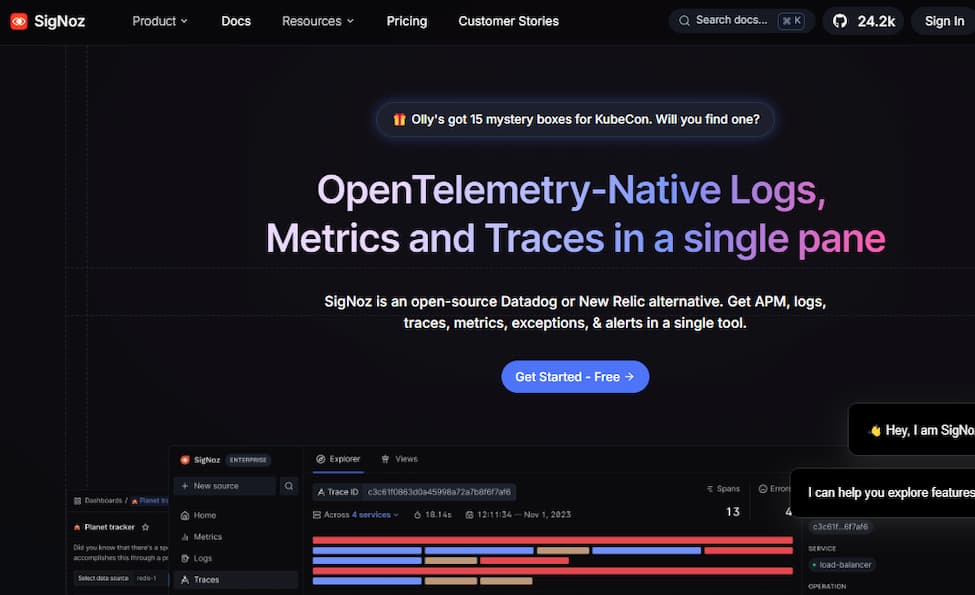
SigNoz is an open-source, full-stack observability platform designed to give developers and DevOps/SRE teams unified, real-time visibility into the health and performance of their applications and infrastructure. Its core value proposition is the consolidation of APM, distributed traces, logs, metrics, exceptions, and alerts into a single interface.
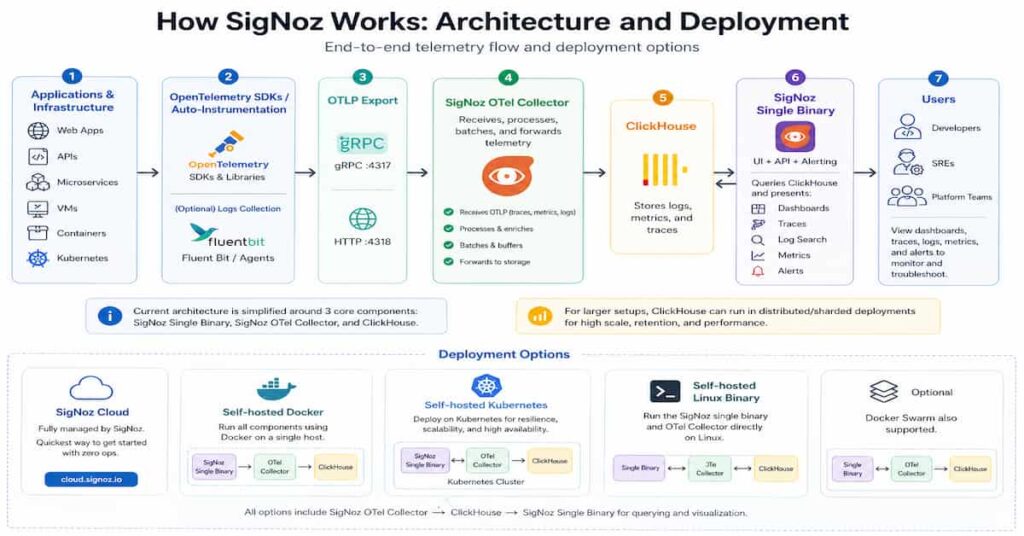
The platform is built on two foundational technologies: OpenTelemetry (OTel) for telemetry collection and instrumentation, and ClickHouse as the storage engine. ClickHouse is a high-performance columnar database that enables fast full-text log search and high-cardinality trace queries at scale. The Kubernetes Helm chart deployment sets up two OTel collectors, one dedicated to metrics and one handling logs and traces, both writing to ClickHouse.
SigNoz is built for three primary audiences:
- Startups and individual developers: Solo developers and early-stage teams that want full-stack observability with zero license cost using the Community Edition.
- Growing engineering teams: Fast-scaling teams that need managed cloud observability without per-host or per-seat pricing, covered by the Teams plan.
- Enterprise organizations: Larger organizations with compliance, data residency, and SLA requirements served by the Enterprise plan.
SigNoz’s Market Positioning in 2026
The observability market in 2026 has two rough tiers.
1. Premium enterprise observability platforms
At the premium end are platforms such as Datadog, Dynatrace, Splunk Observability Cloud, and New Relic. These tools are built for large teams that need broad feature coverage, mature integrations, and enterprise support.
Common strengths include:
- Deep APM, infrastructure, log, and user monitoring features
- Large integration ecosystems
- Enterprise-grade dashboards, alerting, and automation
- Strong support for large, distributed environments
- Advanced security, compliance, and governance options
The main trade-off is cost. Bills can rise quickly when teams enable APM, logs, custom metrics, longer retention, and wider user access. Pricing often spreads across multiple units, such as hosts, users, indexed data, custom metrics, and retention add-ons.
2. Open-source and self-managed observability stacks
At the other end are open-source stacks such as Prometheus, Grafana, Loki, Jaeger, and Tempo. These tools give teams strong control and avoid large license fees, but they usually require more engineering effort to deploy and maintain.
Common strengths include:
- Lower software licensing cost
- Strong control over telemetry pipelines and storage
- Flexible deployment in cloud, on-premises, or hybrid environments
- Good fit for teams with strong DevOps or platform engineering skills
- Less vendor lock-in compared with proprietary platforms
The main trade-off is operational complexity. Teams often need to manage storage, scaling, upgrades, security, dashboards, alert rules, and long-term reliability on their own.
Where SigNoz fits
SigNoz occupies a practical middle ground. It is an open-source-first, OpenTelemetry-native observability platform that gives teams unified full-stack observability without the same pricing complexity as many premium tools.
It is especially useful for:
- Teams that want unified observability across modern cloud environments without building and maintaining a multi-tool setup
- Organizations that need a cost-effective alternative with no per-host or per-seat pricing
- Engineering teams where unlimited user access to dashboards is important
- Companies that need flexible deployment options, including managed cloud, BYOC, or self-hosted setups
- Teams that want OpenTelemetry-native observability without giving up control over their data pipeline
CubeAPM fits between these same market layers, but with a stronger focus on vendor-managed self-hosted deployment. It gives teams the control of self-hosted observability, data residency, and on-premises deployment while reducing the day-to-day burden of operating the platform themselves.
Key Features of SigNoz
SigNoz brings together APM metrics, distributed traces, logs, infrastructure metrics, and exceptions in a single interface with correlated signals. Engineers can move from APM metrics to traces, traces to logs, and infrastructure metrics to logs with a few clicks without switching between tools.
SigNoz provides out-of-the-box APM charts for p99 latency, error rate, Apdex, and operations per second. Distributed tracing surfaces end-to-end request flows with flame graphs and supports monitoring of database calls and external API calls from your application.
SigNoz centralizes logs from all services with fast full-text search powered by ClickHouse. Engineers can instantly search through all logs using quick filters and a powerful query builder, create charts on log data, and monitor them through customized dashboards. Live tail logging is supported. Logs are correlated with traces and infrastructure metrics on the same timeline.
SigNoz supports infrastructure and cloud monitoring across hosts, Kubernetes, containers, and major cloud platforms. Its docs include monitoring support for AWS services such as EC2, ECS, EKS, Lambda, and RDS, as well as Azure VMs, AKS, App Services, and GCP services such as GCE, GKE, and Cloud Run.
Threshold-based and anomaly-detection alerts can be set on metrics, logs, traces, and exceptions. Anomaly detection for metrics catches unexpected deviations from historical patterns. Alert channels include Slack, PagerDuty, OpsGenie, MS Teams, and webhooks. Alerts can be created directly from dashboards.
SigNoz automatically monitors exceptions in Python, Java, Ruby, and JavaScript applications. For other languages, exceptions can be tracked with a few lines of code. Each exception shows a detailed stack trace with trace correlation, allowing engineers to link a user-facing error directly to the request that caused it.
SigNoz is built natively for OpenTelemetry from day one. OTel auto-instrumentation SDKs are available for Java, Python, Go, JavaScript, Ruby, PHP, .NET, and other runtimes. Because SigNoz uses standard OTLP ingestion, teams are not locked into proprietary agents; their instrumentation remains portable to any OTel-compatible backend.
How SigNoz Works: Architecture and Deployment
OpenTelemetry-Native Collection
SigNoz uses OpenTelemetry Collectors as the data pipeline between application instrumentation and storage. The Kubernetes Helm chart deploys two collector instances: one dedicated to metrics, one handling logs and traces. Both collectors write to ClickHouse. Telemetry is received via OTLP endpoints (gRPC or HTTP), making any OTel-instrumented service immediately compatible without custom configuration.
ClickHouse as the Storage Engine
All logs, traces, and metrics are stored in ClickHouse. Its columnar storage model enables efficient analytics queries across large datasets, which underpins SigNoz’s query performance advantage over Elasticsearch-based alternatives at high ingest volumes. TTL policies in ClickHouse control retention per signal type, configurable in self-hosted deployments and set by plan tier in the cloud.
Deployment Models
- Community Edition (Self-Hosted): The full SigNoz stack (OTel Collectors, ClickHouse, query service, frontend, and alert manager) is deployed via Docker Compose or Kubernetes Helm chart in your own infrastructure. No license fee. No data caps. No data leaves your environment. Documented at
- SigNoz Cloud (Teams/Enterprise):Telemetry is collected from your environment and sent to SigNoz’s managed backend via OTLP. SigNoz manages all infrastructure. Data centers are available in the US, EU, and India for regional compliance. Includes a 30-day free trial.
- Enterprise Deployment Options: Options include: dedicated SigNoz cloud environment, Bring Your Own Cloud (BYOC, managed by SigNoz in your own cloud), or a self-hosted deployment with an Enterprise support contract.
What Are SigNoz’s Plan Tiers?
SigNoz follows a usage-based pricing model, with ingestion-based billing for logs and traces and sample-based billing for metrics. on its cloud offering, charging by data volume rather than by host or user seat. The Community Edition is entirely free.
What Is the Billing Unit?
On SigNoz Cloud, the primary billing units are:
- Logs: $0.30 per GB ingested
- Traces: $0.30 per GB ingested
- Metrics: $0.10 per million samples
The $49/month Teams base fee includes usage worth $49, equivalent to approximately 163 GB of logs or traces, or 490 million metric samples. There is no per-host pricing, no user-based pricing, and no special pricing for custom metrics. All metrics, including those sent via OpenTelemetry, are billed at the same $0.10/million sample rate.
Disclaimer: Plan feature lists and pricing are based on SigNoz’s publicly available pricing page as of April 2026. Verify current pricing before making purchasing decisions.
Community Edition — Free (Self-Hosted)
Starting price: $0. No licence fee. No data cap. No credit card required. You install and manage SigNoz in your own infrastructure. Although this adds operational overhead since it demands DevOps expertise.
| Price | $0, no license fee, no data cap, no credit card required |
| Best For | Solo developers, startups, and teams that want full data control and have the infrastructure expertise to self-host |
| Logs/Traces/Metrics | Unlimited, constrained only by your own ClickHouse storage capacity |
| Users | Unlimited |
| Retention | Fully configurable via ClickHouse TTL policies |
| Deployment | Docker Compose or Kubernetes (Helm chart) |
| SSO | Google OAuth available in Community Edition (added in release v0.85.0); |
| Support | Community support via Slack and GitHub Discussions |
Teams Plan — From $49/month (SigNoz Cloud)
Starting price: $49/month. The base fee includes usage worth $49 (approximately 163 GB logs/traces or 490 million metric samples). After the base credit is consumed, usage is billed at the per-unit rates below.
| Price | $49/month base + usage above credit: Logs $0.30/GB, Traces $0.30/GB, Metrics $0.10/mn samples |
| Best For | Fast-scaling teams and growing companies that want managed cloud observability without per-host or per-seat pricing |
| Logs/Traces/Metrics | $0.30/GB, 15-day default retention |
| Users | Unlimited teammates, no per-seat charges on any plan |
| Hosts | Monitor any number of hosts, no per-host charges |
| Data Centres | US, EU, and India regions available for data residency |
| Compliance | SOC2 Type II and HIPAA compliant |
| Support | In-product chat, email, and Slack support |
| Trial | 30-day free trial available; no credit card required to start |
Enterprise Plan: From $4,000/month
Starting price: Custom pricing starts at $4,000/month. Contact SigNoz sales. Available as a dedicated cloud environment, Bring Your Own Cloud (BYOC), or self-hosted with a support contract.
| Price | Custom, starts at $4,000/month; includes monthly ingestion usage up to $4,000 |
| Best For | Organisations with compliance, and security requirements |
| Deployment Options | Cloud & Self-hosted |
| Data Residency | BYOC keeps telemetry inside your own cloud account; self-hosted keeps all data on your own infrastructure |
| Retention | Custom retention periods available across all signal types |
| Support | Dedicated Slack, email, and in-product support |
| SLA | SLA with downtime developer pairing |
| Contracts | Volume discounts and annual contracts available |
| Compliance | HIPAA BAA agreement; additional certifications available on request |
How Much Does SigNoz Really Cost?
SigNoz’s public pricing of $0.30/GB for logs and traces and $0.10/million metric samples is transparent, but the real cost depends on your actual ingest volumes, metric sample counts, retention choices, and whether you self-host or use the managed cloud. The sections below walk through realistic assumptions and three scenarios at different team sizes.
Assumptions Used in the Cost Scenarios
- All figures are directional list-price estimates based on SigNoz’s publicly available pricing as of April 2026. They are not official quotes.
- Cloud scenarios use the Teams plan. The Community Edition has no license cost, only the infrastructure cost of running ClickHouse and the OTel Collector.
- Scenarios do not include negotiated discounts, Enterprise contract terms, professional services costs, or custom retention pricing.
- Log and trace volumes are estimated using common industry benchmarks for log verbosity and trace sampling rates. Metric sample counts assume a 60-second scrape interval unless stated.
- Default retention (15-day logs/traces, 1-month metrics) is assumed throughout. Longer retention increases costs proportionally.
Scenario 1: Early-Stage Startup — 3 Services, Small Team
Situation: Consider a 3-person engineering team at an early-stage SaaS startup. They run three backend services on AWS, a PostgreSQL database, and a React frontend. They need distributed tracing, log centralization, and basic infrastructure monitoring. They have been piecing together free tiers of separate tools and want a single unified platform without a significant monthly spend.
Why teams at this stage consider SigNoz
- The Community Edition is free with no data cap, removing the cost barrier entirely for teams with basic Docker or Kubernetes experience.
- On SigNoz Cloud, the $49/month Teams base credit covers early-stage ingest volumes in full for most small services, approximately 163 GB of logs or traces.
- Unlimited users means all engineers and on-call responders access dashboards without per-seat charges that would add cost on Datadog or New Relic.
- OTel auto-instrumentation is available for all major languages with no proprietary agents, keeping instrumentation portable and future-proof.
- A unified interface for logs, traces, and metrics removes the need to maintain Prometheus, Grafana, Loki, and Jaeger as separate systems.
Estimated ingest profile
Disclaimer: These figures are directional estimates for editorial comparison only. They are not official quotes. Actual costs will vary based on log verbosity, trace sampling rates, metric cardinality, and retention. Use SigNoz’s pricing calculator at signoz.io/pricing for a personalised estimate.
| Telemetry Source | Monthly Estimate | Est. GB/month | Notes |
| 3 backend service logs | ~400K log lines/day | ~30 GB | INFO + ERROR, moderate traffic |
| Infrastructure metrics | 3 services + DB, 60s scrape | ~150 mn samples | Host, container, and DB metrics |
| Distributed traces (APM) | ~60K spans/day | ~14 GB | Standard OTel trace volume for 3 services |
| Total estimated ingest | — | ~44 GB logs/traces + ~150 mn metric samples | — |
Estimated monthly cost
| Option | Rate | Monthly Cost | Annual Cost |
| Community Edition (self-hosted) | $0 licence + infra cost | $0 licence; ~$100–$300/mo infra (ClickHouse + collector) | $0 licence; ~$1,200–$3,600/yr infra |
| SigNoz Cloud — Teams | $49 base (163 GB credit) | $49 base covers 44 GB logs/traces; + $15 metric samples = ~$64/mo | ~$768/yr |
What this scenario shows
- At 44 GB/month of log and trace ingest, usage sits well within the $49 base credit. The only additional cost on SigNoz Cloud is metric samples (~$15/month at 150 mn samples), keeping the total bill around $64/month.
- The Community Edition eliminates all license costs. For a team already running Kubernetes, the additional infrastructure for SigNoz (ClickHouse + OTel Collector) typically adds $100–$300/month depending on instance sizing.
- The unlimited-users policy removes a cost category that would be significant on seat-based platforms. A single Full Platform user on New Relic costs approximately $549/month more than the entire SigNoz Teams bill in this scenario.
- The practical comparison here is not SigNoz vs a competitor’s free tier. It is SigNoz’s unified platform vs the engineering time cost of maintaining Prometheus + Grafana + Loki + Jaeger as separate systems, at a stage where that time is the scarcest resource.
Scenario 2: Growing SaaS team, 5.4 TB/month of logs and traces
Situation: Consider a growing SaaS company sending about 5.4 TB/month of logs and traces to SigNoz Cloud. The workload includes roughly 3.6 TB/month of logs, 1.8 TB/month of traces, and about 450 million metric samples from applications, Kubernetes, containers, and infrastructure. The team needs APM, log management, distributed tracing, infrastructure monitoring, dashboards, and alerts in one place.
Why teams at this stage consider SigNoz
- Usage-based pricing is easier to map to telemetry volume: SigNoz pricing is tied mainly to the amount of observability data a team sends. Logs and traces are billed at $0.30/GB, while metrics are billed at $0.10 per million samples. This makes the bill easier to estimate when the team already knows its monthly log, trace, and metric volume.
- No per-host pricing: SigNoz does not charge separately for every host or Kubernetes node. That matters for growing SaaS teams because infrastructure can expand quickly as traffic grows, especially in containerized environments.
- Unlimited users: SigNoz includes unlimited users on its cloud plans. This helps teams give dashboard access to engineers, product managers, support teams, and incident responders without adding seat-based costs.
- OpenTelemetry-native setup: SigNoz is built around OpenTelemetry and supports OTLP ingestion. For teams already using OpenTelemetry, migration can be simpler because they may only need to update the OpenTelemetry Collector exporter endpoint instead of re-instrumenting applications.
- Clearer cost levers: The main cost drivers are logs, traces, metric samples, retention, and data spikes. That makes the pricing easier to explain internally compared with platforms where host count, user seats, custom metrics, indexed spans, and add-ons all affect the bill.
Estimated usage profile
Disclaimer: These figures are directional estimates for editorial comparison only. Actual costs will vary based on log verbosity, trace sampling, retention, scrape interval, metric cardinality, and production traffic patterns. Use the SigNoz pricing calculator for a personalized estimate.
| Telemetry source | Monthly estimate | Pricing basis | Notes |
| Logs | 3.6 TB/month | $0.30/GB | Application logs, Kubernetes logs, service logs |
| Traces | 1.8 TB/month | $0.30/GB | APM traces from microservices and backend services |
| Metrics | 450 million samples/month | $0.10/million samples | Host, pod, container, and service metrics |
| Total | 5.4 TB logs + traces, plus 450 million metric samples | Usage-based | No per-host or per-user charge |
Estimated monthly cost calculation
Disclaimer: These figures are directional estimates based on SigNoz’s public pricing and the usage assumptions above. The Datadog reference is illustrative and should not be treated as a vendor quote. Actual costs vary by plan, retention, sampling, log volume, infrastructure size, and feature mix.
| Charge component | Calculation | Monthly cost | Annual cost |
| Logs | 3,600 GB × $0.30/GB | $1,080 | $12,960 |
| Traces | 1,800 GB × $0.30/GB | $540 | $6,480 |
| Metrics | 450 million samples × $0.10/million samples | $45 | $540 |
| Included Teams usage credit | $49 included usage | -$49 | -$588 |
| Total estimated SigNoz Cloud cost | $1,665 usage minus $49 credit | ~$1,616/month | ~$19,392/year |
What this scenario shows
- SigNoz is not “almost free” at this scale: At 5.4 TB/month, SigNoz is no longer a tiny sub-$100/month setup. The bill becomes meaningful because logs and traces are charged directly by ingestion volume.
- The pricing is still much easier to model: In this example, the core math is simple: logs, traces, and metric samples drive the bill. That makes it easier for teams to forecast cost before scaling telemetry volume.
- Telemetry control still matters: Usage-based pricing does not mean unlimited usage. Teams still need to manage log verbosity, trace sampling, scrape intervals, retention, and metric cardinality.
- Growth is easier to calculate: If logs increase from 3.6 TB to 5 TB, the extra 1.4 TB adds about $420/month. If traces double from 1.8 TB to 3.6 TB, the added 1.8 TB costs about $540/month. This makes growth easier to model before the bill arrives.
Scenario 3: Mid-market team, 27 TB/month of logs and traces
Situation: Consider a mid-market engineering team sending about 27 TB/month of logs and traces to SigNoz Cloud. The workload includes roughly 18 TB/month of logs, 9 TB/month of traces, and about 1.2 billion metric samples from applications, Kubernetes, containers, cloud services, and infrastructure. The team needs APM, log management, distributed tracing, infrastructure monitoring, dashboards, alerts, and enough access for engineers, SREs, and on-call responders.
Why teams at this stage consider SigNoz
- Pricing follows telemetry volume: SigNoz Cloud pricing is mainly tied to usage. Logs and traces are billed at $0.30/GB, while metrics are billed at $0.10 per million samples. The Teams plan starts at $49/month and includes $49 worth of usage, with no per-host or per-user pricing.
- No per-host or per-node charge: For mid-market teams running Kubernetes, host count can change quickly as workloads scale. SigNoz does not add a separate charge for every host, node, or container. That makes the pricing less tied to infrastructure shape and more tied to actual telemetry volume.
- Unlimited teammates: SigNoz includes unlimited teammates on its Teams plan. That matters when dashboards need to be shared with engineers, SREs, product teams, support teams, and incident responders.
- OpenTelemetry-native migration path: SigNoz is built around OpenTelemetry, so teams already sending OTLP data can often migrate by updating their collector exporter endpoint.
- Self-hosting remains an option: For teams with strict compliance, security, or data-control needs, SigNoz also has a self-hosted path. This can keep telemetry inside the company’s own environment, but it shifts operational work to the internal team.
At this scale, the key tradeoff is simple: SigNoz Cloud is easier to operate, while self-hosted SigNoz gives more control but requires ClickHouse and observability backend expertise.
Estimated usage profile
Disclaimer: These figures are directional estimates for editorial comparison only. Actual costs will vary based on log verbosity, trace sampling, retention, scrape interval, metric cardinality, production traffic, and incident spikes. Use the SigNoz pricing calculator for a personalized estimate.
| Telemetry source | Monthly estimate | Pricing basis | Notes |
| Logs | 18 TB/month | $0.30/GB | Application logs, Kubernetes logs, service logs, cloud logs |
| Traces | 9 TB/month | $0.30/GB | APM traces from backend services and high-traffic paths |
| Metrics | 1.2 billion samples/month | $0.10/million samples | Host, pod, container, service, and infrastructure metrics |
| Total | 27 TB logs + traces, plus 1.2 billion metric samples | Usage-based | No per-host or per-user charge |
Estimated monthly cost calculation
Disclaimer: These figures are directional estimates based on SigNoz’s public pricing and the usage assumptions above. Actual costs vary by retention, sampling, log volume, infrastructure size, feature mix, and contract terms.
| Charge component | Calculation | Monthly cost | Annual cost |
| Logs | 18,000 GB × $0.30/GB | $5,400 | $64,800 |
| Traces | 9,000 GB × $0.30/GB | $2,700 | $32,400 |
| Metrics | 1,200 million samples × $0.10/million samples | $120 | $1,440 |
| Included Teams usage credit | $49 included usage | -$49 | -$588 |
| Total estimated SigNoz Cloud cost | $8,220 usage minus $49 credit | ~$8,171/month | ~$98,052/year |
What this scenario shows
- SigNoz becomes a serious monthly cost at 27 TB: At 27 TB/month, SigNoz Cloud is no longer a low-cost small-team setup. Logs and traces become the main cost drivers because both are billed directly by ingested GB.
- Logs dominate the bill: Logs alone cost about $5,400/month in this scenario. Traces add another $2,700/month, while metric samples add only about $120/month.
- Trace sampling has a direct cost impact: At 9 TB/month of traces, trace ingest costs about $2,700/month. If trace volume doubles to 18 TB/month, the trace bill doubles to about $5,400/month.
- Self-hosted SigNoz changes the cost model: Self-hosted SigNoz can remove SigNoz Cloud ingestion charges, but it does not make observability free. The team still pays for cloud infrastructure, storage, compute, backups, upgrades, and ClickHouse operations.
At this scale, self-hosting only makes sense if the team has the internal skill to run the backend reliably.
What Actually Drives SigNoz Costs
Understanding SigNoz pricing requires understanding the levers that move your bill both upward and downward.
| Cost Driver | Impact Level | Direction | Notes |
| Log + trace ingest (GB/month) | Primary | Upward | Every GB above base credit at $0.30/GB. The single largest cost lever on Cloud. |
| Metric sample volume (mn/month) | Moderate to high | Upward | $0.10/mn samples. High-cardinality tags multiply samples rapidly. |
| Log verbosity / trace sampling | Primary | Cost-saving | Reducing log noise and trace sampling rate directly reduces GB billed. |
| Retention period | Moderate | Upward | Extending beyond defaults adds proportional cost on Cloud. |
| Self-hosted vs Cloud | Major | Cost-saving | Self-hosting removes all license costs and replaces them with infra costs. |
| Plan tier (Teams vs Enterprise) | Major | Upward | Enterprise adds dedicated environments, 24/7 SLA, custom pricing. |
| Multi-year contract (Enterprise) | Moderate | Cost-saving | Volume discounts available on annual contracts. |
| Renewal escalators | Moderate | Upward | 3–5% annual increases are common; negotiate caps at signing. |
Hidden costs buyers should plan for
SigNoz has one of the more transparent pricing models in the observability market, but the full cost of adoption is not limited to the monthly subscription. Teams should also plan for self-hosting operations, OpenTelemetry migration work, dashboard rebuilding, retention needs, and enterprise support requirements.
SigNoz Community Edition is free to use, but running it in production is not free from an operational point of view. Self-hosted SigNoz uses ClickHouse as a core backend, and production deployments require planning around storage, retention, replication, query performance, upgrades, and scaling.
SigNoz is OpenTelemetry-native, so teams already using OpenTelemetry usually have an easier migration path. In many cases, they can update the OTLP exporter endpoint in the OpenTelemetry Collector instead of rewriting application instrumentation.
For teams coming from Datadog, New Relic, or another proprietary agent setup, the work can be heavier. They may need to add OpenTelemetry SDKs, update instrumentation, validate spans and metrics, and check whether service names, attributes, and trace context are mapped correctly.
Teams may also need to recreate dashboards, rebuild alert rules, validate data parity, retrain users, and update incident workflows.
SigNoz Teams includes support via in-product chat, email, and Slack. For production-critical systems, buyers should confirm what level of support they need before choosing a plan. The important questions are response time, escalation path, support hours, Slack access, migration help, and whether the deployment is Cloud, BYOC, or self-hosted Enterprise.
SigNoz docs list default retention as 15 days for logs and traces and 30 days for metrics. That may be enough for normal incident response, but it may not be enough for regulated teams. Financial services, healthcare, and government-adjacent teams may need 90-day, 180-day, or 1-year retention depending on internal policy and compliance needs.
SigNoz does not charge a separate custom-metric surcharge in the same way some vendors do, but metrics are still billed by sample volume. The public pricing page lists metrics at $0.10 per million samples.
Teams should watch scrape intervals, number of time series, Kubernetes labels, and high-cardinality attributes. A metric setup that looks cheap at small scale can grow quickly when every service, pod, container, and environment adds more samples.
SigNoz User Reviews (2026)
The following is a balanced synthesis of verified user feedback from Product Hunt, Reddit (r/kubernetes), GitHub Discussions, and independent tech review publications.
What Users Like (Pros)
- Unified platform: The single interface consolidating APM, logs, traces, and exceptions is the most consistently cited strength. Users who previously ran separate Prometheus, Grafana, Loki, and Jaeger installations describe SigNoz as eliminating cross-tool context-switching during incidents.
- Query performance: ClickHouse-powered log search and trace queries are cited as noticeably faster than Elasticsearch-based alternatives at high data volumes. Independent reviews describe SigNoz as offering “fast ClickHouse-powered queries” as a key differentiator. (Source: Listiculer independent review, March 2026.)
- Cost savings: Independent reviews describe SigNoz as “up to 9x cheaper than Datadog.” SigNoz’s own published analysis documents that teams save up to 80% by migrating from Datadog. (Source: signoz.io/pricing; Listiculer review, 2026.)
- No vendor lock-in: SigNoz’s OTel-native design means no proprietary agents are required. Instrumentation is portable. As confirmed on the AWS Marketplace listing: “once your application is instrumented with OTel, you can send your telemetry data to any OTel-compatible backend.”
- Community responsiveness: The SigNoz team is noted across GitHub Discussions and r/kubernetes as directly engaging with community feedback. When SSO was raised as a gap, the team publicly confirmed Google OAuth was added in Community Edition release v0.85.0 and that additional providers were in progress. (Source: r/kubernetes thread, response by ankit01-oss, verified SigNoz team member.)
What Users Criticise (Cons)
- Self-hosted ClickHouse complexity: A recurring concern in Reddit discussions is that self-hosting SigNoz depends heavily on ClickHouse sizing and operational skill. In one Reddit thread, a user said SigNoz can work well if teams can “wrangle ClickHouse” and give it enough resources for the workload.
- Production readiness depends on deployment quality: Recent Reddit feedback is mixed. One r/kubernetes commenter described SigNoz as production-ready if deployed properly, but also noted that reliability depends on correct ClickHouse sizing, high availability setup, and strong alert rules.
- Dashboard depth may need extra work: In a Kubernetes monitoring discussion, one user said SigNoz felt more plug-and-play than some alternatives, but they still had to import dashboards and did not find the level of depth they wanted out of the box.
- Self-hosting can still carry hidden operational cost: Another Reddit discussion questioned why SigNoz is not more popular, with users pointing to the operational burden of self-hosting and the cost of running the backend stack correctly. This does not mean SigNoz is weak, but it shows that “open source” does not automatically mean “low effort.”
Summary Rating Breakdown (April 2026)
| Product Hunt rating | 5.0 / 5 (April 2026; source: producthunt.com/products/signoz) |
| GitHub stars | 26,700+ (April 2026) |
| Ease of setup | High for Cloud (30-day trial, same-day setup); moderate for self-hosted (ClickHouse expertise required at production scale) |
| Query performance | High, ClickHouse consistently cited as faster than Elasticsearch-based alternatives for log and trace search |
| Value for money | High, the most consistent competitive advantage cited across all review sources reviewed |
| Integration ecosystem | 200+ via OTel; pre-built for AWS, Azure, GCP, Kubernetes, PostgreSQL, MongoDB, Redis, NGINX, and others |
| UI / UX | Functional and improving; independent reviews note it is still catching up to Datadog in visual polish |
| Community support | Active GitHub Discussions and Slack; SigNoz team directly engages with community concerns |
SigNoz Pricing Comparison: All Major Tools (2026)
The table below compares current publicly available pricing across major observability platforms. All pricing is sourced from vendor pricing pages as of April 2026.
| Tool / platform | Pricing model | Starting price | Free tier |
| SigNoz | Logs/traces by GB + metrics by million samples | $0 Community Edition; Teams Cloud from $49/month | Yes, free self-hosted Community Edition |
| CubeAPM | Per GB ingested, deployed in customer infrastructure | From $0.15/GB ingested | Yes, self-hosted option |
| Datadog | Per host plus usage-based add-ons by product/SKU | Infra Pro from about $15/host/month; APM from about $31/host/month | Limited free infrastructure tier; 14-day trial for paid plans |
| New Relic | Ingest-based pricing plus user tiers | 100 GB/month free, then about $0.30/GB; Full Platform Pro user $349/user/month | Yes, 100 GB/month free ingest |
| Dynatrace | Usage-based by capability, including memory-GiB-hour for full-stack monitoring | Full-Stack Monitoring about $58/month per 8 GiB host | 15-day trial |
| Grafana Cloud | Usage-based per signal, with host-hour pricing for application observability | Logs/traces/profiles about $0.50/GB | Yes, free tier with per-signal limits |
| Splunk Observability Cloud | Entity-based host pricing plus activity-based options | Infrastructure from $15/host/month; App & Infra from $60/host/month; End-to-End from $75/host/month | Free trial available |
Note: Pricing sourced from publicly available vendor pricing pages as of April 2026. Enterprise negotiations and volume discounts may result in significantly different pricing. Always request current quotes directly from vendors before making purchasing decisions.
Feature Comparison: SigNoz vs Key Competitors
| Feature / Criteria | SigNoz | New Relic | CubeAPM |
| Pricing model | Per GB + per mn metric samples | Ingest + user seat tiers | Per GB (on-premises-first) |
| Infrastructure monitoring | Yes | Yes | Yes |
| APM / Distributed tracing | Yes | Yes | Yes |
| Log management | Yes (ClickHouse-backed) | Yes | Yes |
| Exceptions monitoring | Yes | Yes | Yes |
| On-premises deployment | Yes (self-managed) | No | Yes (vendor-managed) |
| Full data residency | Yes (self-hosted or BYOC Enterprise) | No | Yes, fully on-premises |
| OTel-native | Yes, first-class OTel | Strong | Yes, fully OTel-native |
SigNoz Alternatives: Detailed Comparisons
Signoz vs CubeAPM
SigNoz and CubeAPM are both OpenTelemetry-friendly observability platforms, but they are built for slightly different buying needs. SigNoz is a strong fit for teams that want open-source flexibility, managed cloud, or BYOC options. CubeAPM is stronger for teams that want observability to run inside their own infrastructure with predictable per-GB pricing and no telemetry leaving their cloud. SigNoz lists logs and traces at $0.30/GB, while CubeAPM commonly positions pricing from $0.15/GB.
| Pricing component | SigNoz | CubeAPM |
| Pricing model | Logs/traces by GB + metrics by million samples | Per GB ingested |
| Data residency | Cloud regions, BYOC, or self-hosted options | Runs inside customer infrastructure |
| Deployment | Managed cloud, BYOC, or self-hosted | Self-hosted (vendor-managed) |
| OpenTelemetry support | Yes, OTLP-native | Yes, OTel-native |
| Migration effort | Low if already using OTel | Low if already using OTel |
| Best fit | Teams wanting open-source flexibility, SaaS ease, or BYOC | Regulated teams that want full data control and lower per-GB pricing |
SigNoz vs Datadog
Datadog is a broad cloud observability platform with strong APM, infrastructure monitoring, logs, security, RUM, synthetics, and a large integration ecosystem. Its pricing is modular: Infrastructure Pro starts at about $15/host/month, while APM starts at about $31/host/month. SigNoz takes a simpler usage-based approach, charging for logs, traces, and metric samples rather than hosts or seats.
| Pricing component | SigNoz | Datadog |
| Pricing model | Usage-based | Per host plus usage-based add-ons |
| Starting price | $0 Community Edition; Teams Cloud from $49/month | Infrastructure Pro from $15/host/month; APM from $31/host/month |
| OpenTelemetry fit | Built around OTLP ingestion | Supports OpenTelemetry, but Datadog billing rules still apply |
| Custom metric risk | No separate custom-metric surcharge | Custom metric overages can apply |
| Self-hosted option | Yes, Community Edition | No full self-hosted Datadog platform |
| Best fit | OTel-first teams that want simpler usage-based pricing | Large teams that need Datadog’s broad platform, integrations, and enterprise ecosystem |
SigNoz vs New Relic
New Relic and SigNoz both use usage-based pricing, but the billing structure is different. SigNoz charges for logs, traces, and metric samples, with unlimited teammates included. New Relic gives 100 GB/month of free data ingest, then charges by GB ingested, with separate user tiers for deeper platform access.
| Pricing component | SigNoz | New Relic |
| Pricing model | Usage-based logs, traces, and metrics | Data ingest plus user tiers |
| Free tier | Free self-hosted Community Edition; Teams Cloud includes $49 usage credit | 100 GB/month free ingest, unlimited basic users, and one free full platform user |
| Data pricing | Logs and traces at $0.30/GB; metrics at $0.10/million samples | Original data ingest at $0.40/GB after free 100 GB; Data Plus at $0.60/GB |
| Self-hosted option | Yes, Community Edition and Enterprise self-hosted options | No full self-hosted New Relic platform |
| Main cost driver | Log volume, trace volume, and metric samples | Data ingest, user access level, and optional add-ons |
| Best fit | Teams that want OTel-native observability with unlimited user access | Teams that want a mature SaaS observability platform with a broad feature set and user-tiered access |
SIgNoz vs Grafana Cloud
SigNoz and Grafana Cloud both support open observability stacks, but they package pricing differently. SigNoz uses a simpler model for logs, traces, and metric samples, while Grafana Cloud prices each signal separately across metrics, logs, traces, profiles, Kubernetes monitoring, and other products.
| Pricing component | SigNoz | Grafana Cloud |
| Pricing model | Logs/traces by GB plus metrics by million samples | Separate usage meters by signal type |
| Log pricing | $0.30/GB | $0.50/GB ingested |
| Trace pricing | $0.30/GB | $0.50/GB ingested |
| Metric pricing | $0.10/million samples | $6.50 per 1,000 active series on Pro |
| Free tier | Free self-hosted Community Edition; $49 included usage on Teams Cloud | Free tier with 10k active series and 50 GB each for logs, traces, and profiles |
| Configuration effort | More opinionated single-platform experience | More flexible, but usually needs more Grafana/LGTM setup knowledge |
| Self-hosted option | Yes, SigNoz Community Edition | Yes, Grafana OSS with Loki, Tempo, Mimir, and related components |
| Best fit | Teams that want faster OTel-native setup with simpler pricing | Teams already invested in Grafana dashboards and the LGTM ecosystem |
When to Use SigNoz: A Decision Framework
- You need unified full-stack observability at transparent cost: APM, logs, traces, metrics, exceptions, LLM monitoring, and alerts in one platform without per-host or per-seat pricing.
- Cost efficiency is the priority: Teams migrating from Datadog or New Relic who want comparable coverage at a significantly lower cost—particularly when already on OpenTelemetry instrumentation.
- You need fast time-to-value: SigNoz Cloud is operational within hours via the 30-day trial; the self-hosted Docker Compose quickstart runs in minutes.
- Your team is scaling: All engineers, product managers, and on-call responders access dashboards without per-seat charges as the team grows.
- You want OTel-native portable instrumentation: OTel-based instrumentation means no proprietary agent dependency and fully portable telemetry collection.
- Strict data sovereignty with no third-party transit: SigNoz offers Cloud, BYOC, and self-hosted options, so it can support different data-control needs. But if a team requires all observability telemetry to stay fully inside its own infrastructure with no third-party SaaS routing at all, CubeAPM may be a stronger fit. CubeAPM is positioned around customer-managed infrastructure and published pricing from $0.15/GB.
- Broadest enterprise integration catalog needed: SigNoz is strong for OpenTelemetry-first environments, but some enterprises still depend on many legacy, proprietary, or vendor-specific integrations. In those cases, Datadog’s larger integration ecosystem may justify the higher cost for teams that need broad plug-and-play coverage.
- No ClickHouse expertise for self-hosting: Self-hosted SigNoz can lower license costs, but it shifts backend operations to your team. Running ClickHouse-backed observability in production means planning for storage, retention, scaling, backups, upgrades, and query performance. Teams without that skill should either budget for the learning curve or choose SigNoz Cloud/BYOC instead.
Conclusion
SigNoz is a strong cost-conscious alternative to Datadog, New Relic, and Grafana Cloud, especially for teams already moving toward OpenTelemetry. Its pricing is transparent: logs and traces are billed at $0.30/GB, metrics at $0.10 per million samples, and the Teams plan starts at $49/month with unlimited teammates. It also offers a free self-hosted Community Edition for teams that want more control.
The main caveat is scale. SigNoz Cloud can stay cost-effective, but large log and trace volumes still create a real monthly bill. Self-hosting can reduce license costs, but it adds ClickHouse operations, storage planning, upgrades, and backend maintenance. Teams that need strict data control should compare SigNoz self-hosted or BYOC with fully on-premises options such as CubeAPM.
Disclaimer: The information in this article reflects the latest details available at the time of publication and may change as technologies and products evolve.
FAQs
1. What is SigNoz?
SigNoz is an open-source, full-stack observability platform that brings APM, distributed tracing, logs, infrastructure monitoring, exceptions, LLM observability, dashboards, and alerts into one interface. It is built around OpenTelemetry for telemetry collection and uses ClickHouse for storage. Teams can use the free self-hosted Community Edition or the managed SigNoz Cloud service.
2. How much does SigNoz cost in 2026?
SigNoz has three main options: a free self-hosted Community Edition, a Teams Cloud plan starting at $49/month, and an Enterprise plan starting at $4,000/month. The Teams plan charges $0.30/GB for logs and traces, and $0.10 per million metric samples after the $49 included usage credit. Enterprise offers dedicated cloud, BYOC, and self-hosted options with support contracts.
3. Is SigNoz free?
Yes. SigNoz Community Edition is free to self-host and does not charge a license fee. You deploy and manage it yourself using Docker Compose or Kubernetes. SigNoz Cloud also offers a Teams plan starting at $49/month, with usage credit equal to about 163 GB of logs or traces, or 490 million metric samples.
4. Does SigNoz support OpenTelemetry?
Yes. SigNoz is OpenTelemetry-native and supports traces, logs, and metrics through OTLP ingestion. Its AWS Marketplace listing also states that SigNoz was built on OpenTelemetry from day one and supports OTel-native use cases such as messaging queue monitoring, external API monitoring, and trace funnels.
5. What are the main alternatives to SigNoz?
The main alternatives include Datadog, New Relic, Grafana Cloud, Loggly, and CubeAPM. Datadog has the broadest enterprise feature set but can become expensive. New Relic has strong full-stack observability but adds user-based pricing at scale. Grafana Cloud is flexible but can require more setup. Loggly is mainly log-focused. CubeAPM is a strong fit for teams that want OpenTelemetry-native observability, self-hosted deployment, data sovereignty, and predictable $0.15/GB pricing.
6. Does SigNoz have a free trial?
Yes. SigNoz Cloud offers a free trial, and the Community Edition can be deployed without a licence fee. This lets teams test SigNoz with real telemetry before moving to a paid plan.
7. How does SigNoz handle self-hosted data retention?
In the Community Edition, retention depends on how you configure and manage ClickHouse. There is no SaaS-style platform retention limit because you control the backend. On SigNoz Cloud, default retention is 15 days for logs and traces and 1 month for metrics, with paid retention options up to 1 year for logs and traces and 13 months for metrics.