







The main difference between Azure Monitor, Splunk AppDynamics, and CubeAPM is how they approach architecture, pricing, and control over your observability data.
Azure Monitor is tightly integrated into the Microsoft Azure ecosystem and optimized for Azure-native workloads. Splunk AppDynamics follows a traditional enterprise APM model built around proprietary agents and host-based licensing. CubeAPM is an OpenTelemetry-native, self-hosted observability platform designed for predictable per-GB pricing, unlimited data retention, and full-stack visibility across metrics, logs, events, and traces.
This Azure Monitor vs Splunk AppDynamics vs CubeAPM comparison examines architecture, cost behavior, sampling strategy, data retention, and real-world use cases.
Azure Monitor vs Splunk AppDynamics vs CubeAPM Comparison
The information presented in this comparison is derived from official product documentation, published pricing pages, and commonly observed production deployment patterns. Actual costs, data retention limits, sampling behavior, and feature availability can vary based on region, licensing agreements, workload volume, and configuration choices within each platform.
| Feature | CubeAPM | Azure Monitor | Splunk AppDynamics |
| Known for | Unified MELT, native OTEL, self-hosting, cost predictability | Yes (AppDynamics agents, OTel collector, or dual-signal agents) | Enterprise APM with business transaction monitoring & dependency mapping |
| Multi-Agent Support | Yes (OTel, New Relic, Datadog, Elastic, etc.) | Limited (Azure Monitor Agent, OTel) | Yes (AppDynamics agents, OTel collector or dual-signal agents) |
| MELT Support | Full MELT coverage | Full MELT coverage | Full MELT coverage |
| Deployment | Self-hosted with vendor-managed | SaaS (Fully managed AWS service) | SaaS & self-hosted |
| Pricing | Ingestion-based: $0.15/GB | Logs: $0.50/GBMetrics: $0.16/10 million samples ingested | Infra: $6/vCPU/ month;APM+infra:$33/vCPU/month; Enterprise: $50/vCPU /month |
| Sampling Strategy | Smart sampling, automated, context-aware | Fixed-percentage, rate-limited sampling | Agent-based with configurable rules; head- & tail-based (via OTel) |
| Data Retention | Unlimited Retention | Basic Logs: 30dMetrics: 93d | Events: 8d; Metrics: 8d-13m (SaaS); 4h-13m (on-prem) |
| Support Channel & TAT | Slack, WhatsApp; response in minutes | Email, chat, phone; TAT: 8 hr to 15 min (plan-based) | Support portal (paid); TAT: 2d to 30 min based on tier (P1-P4) |
Azure Monitor vs Splunk AppDynamics vs CubeAPM: Feature Breakdown
Known For
CubeAPM: An OpenTelemetry-native full-stack observability platform that unifies metrics, logs, events, and traces (MELT) with support for self-hosted deployment and ingestion-based pricing. Official documentation highlights compatibility with OpenTelemetry and multi-signal observability across modern distributed systems.
Azure Monitor: Microsoft’s cloud-native monitoring platform designed to collect, analyze, and act on telemetry from Azure resources, hybrid infrastructure, and on-premises systems. It provides a unified data platform for metrics, logs, and traces, enabling application and infrastructure monitoring within the Azure ecosystem.
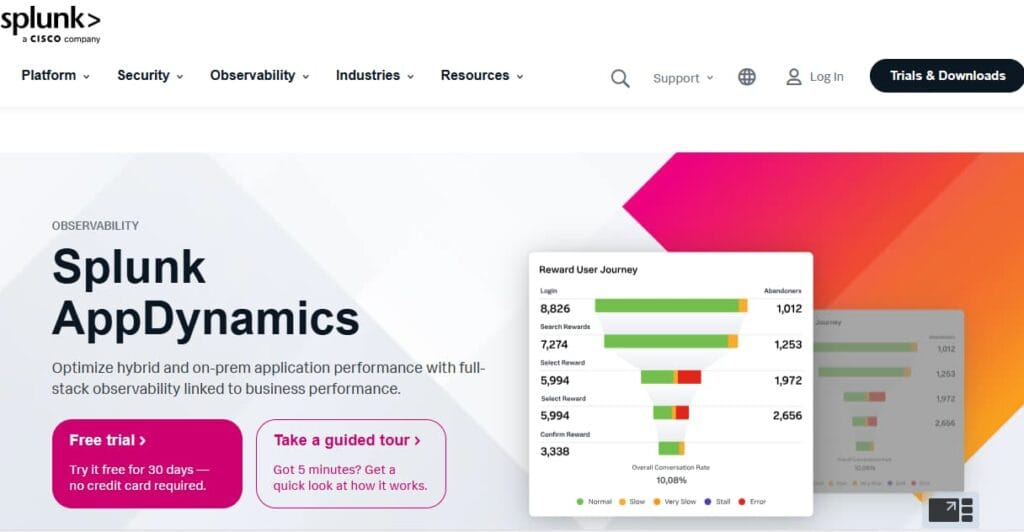
Splunk AppDynamics: Splunk AppDynamics is an enterprise-grade application performance monitoring solution focused on deep transaction visibility, automatic application discovery, and business context correlation across complex, hybrid application environments. It emphasizes tracing business transactions end-to-end to identify performance bottlenecks.
Multi-Agent Support
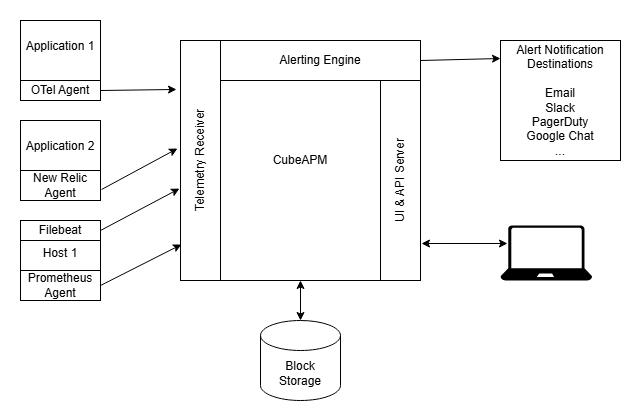
CubeAPM: Supports OpenTelemetry-native ingestion for metrics, logs, and traces, enabling compatibility with standard OTEL SDKs and collectors. CubeAPM documentation highlights support for Prometheus metrics and interoperability with common observability pipelines, allowing teams to instrument services without relying on proprietary agents.
Azure Monitor: Supports the Azure Monitor Agent (AMA) for infrastructure and VM telemetry and integrates with OpenTelemetry for application traces and metrics via exporters and collectors. Microsoft documentation emphasizes Azure-native agents with optional OTEL-based ingestion for broader application telemetry.
Splunk AppDynamics: Provides proprietary, language-specific agents for deep application instrumentation and also supports OpenTelemetry Collector pipelines for trace and metric ingestion. Official Splunk documentation highlights agent-based telemetry as the primary model, with OpenTelemetry support for standardized workflows.
MELT Support
CubeAPM: Provides unified coverage across Metrics, Events, Logs, and Traces (MELT) within a single platform. Official CubeAPM documentation highlights full-stack observability including RUM (Real User Monitoring) and synthetic checks, enabling teams to correlate signals without needing separate products.
Azure Monitor: Collects and analyzes metrics, logs, and distributed traces through core services such as Metrics, Log Analytics, and Application Insights. Microsoft positions Azure Monitor as a centralized data platform for telemetry that supports these key observability signals across Azure and hybrid environments.
Splunk AppDynamics: Delivers metrics and traces through its APM agents and integrates with the broader Splunk Observability suite (including logs and events) for full MELT signal coverage. Official Splunk AppDynamics resources emphasize transaction metrics and trace details with optional log correlation through the Splunk platform.
Deployment
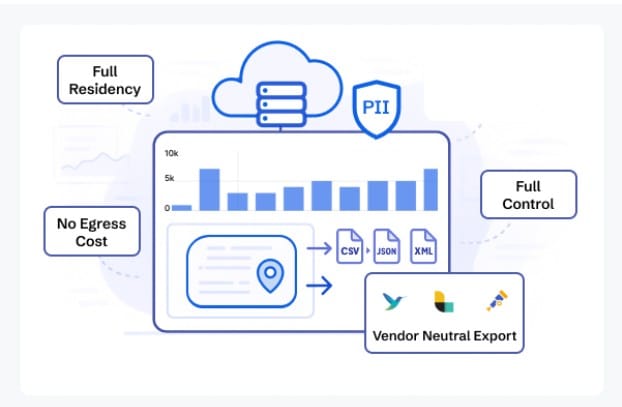
CubeAPM: Offers self-hosted deployment within the customer’s own cloud or infrastructure environment, with vendor-managed setup and support options. Official CubeAPM materials emphasize that telemetry data remains inside the customer’s cloud account, supporting data residency and compliance requirements.
Azure Monitor: Delivered as a fully managed SaaS service within Microsoft Azure. Telemetry is collected from Azure resources, hybrid systems, and on-premises environments, and stored within Azure-managed services such as Log Analytics workspaces and Application Insights.
Splunk AppDynamics: Available both as SaaS (AppDynamics Cloud/Splunk Observability Cloud) and as self-managed (on-premises) deployment. Official Splunk documentation confirms that customers can choose between cloud-hosted and self-hosted controller models depending on architectural and compliance requirements.
Pricing for Small, Mid, and Large Teams
*All pricing comparisons are calculated using standardized Small/Medium/Large team profiles defined in our internal benchmarking sheet, based on fixed log, metrics, trace, and retention assumptions. Actual pricing may vary by usage, region, and plan structure. Please confirm current pricing with each vendor.
| * Approx. cost for teams (size) | Small (~30) | Mid-Sized (~125) | Large (~250) |
| CubeAPM | $2,080 | $7,200 | $15,200 |
| Azure Monitor | $2,064 | $5,232 | $13,228 |
| Splunk AppDynamics | $2,290 | $8,625 | $17,750 |
CubeAPM Costs in Detail
CubeAPM: Uses ingestion-based pricing at $0.15 per GB of data ingested. There are no per-host or per-vCPU charges. Pricing scales linearly with telemetry volume rather than infrastructure footprint.
- Small teams (~ 30): $2,080
- Mid-sized teams (~ 125): $7,200
- Large teams (~250): $15,200
Azure Monitor Cost in Detail
Azure Monitor: Uses consumption-based pricing.
- Logs: $0.50 per GB (Basic Logs tier)
- Metrics: $0.16 per 10 million samples ingested
Retention beyond included windows incurs additional storage costs. Pricing varies by region and workspace configuration.
Pricing for different teams:
- Small teams: $2,064
- Mid-size teams: $5,232
- Large teams: $13,228
Splunk AppDynamics Cost in Detail
Splunk AppDynamics: Uses per-vCPU licensing for infrastructure and APM. Published tiers include:
- Infrastructure Monitoring: $6 per vCPU per month
- APM + Infrastructure: $33 per vCPU per month
- Enterprise tier: $50 per vCPU per month
Billed annually. Advanced features and add-ons may require enterprise agreements.
Pricing for different teams:
- Small teams: $2,290
- Mid-size teams: $8,625
- Large teams: $17,750
As telemetry grows with production traffic, distributed services, and higher log volumes, pricing differences between these models become more visible. What initially feels manageable during early deployment can evolve into a recurring operational expense that scales with infrastructure footprint or data volume. At that point, observability costs often move from a background tooling line item to something finance and engineering teams actively track and optimize.
Sampling Strategy
Sampling determines how much telemetry is retained for analysis, especially for distributed traces. As traffic grows, sampling policies directly influence both observability depth and cost behavior.

CubeAPM: Uses context-aware Smart Sampling that evaluates trace characteristics such as latency and errors before deciding what to retain. According to CubeAPM documentation, this approach prioritizes high-value traces instead of purely random sampling, helping teams preserve meaningful production signals while controlling ingestion volume.
Azure Monitor: Uses fixed-percentage and rate-limited sampling, particularly within Application Insights. Microsoft documentation describes percentage-based sampling configurations that limit the volume of telemetry sent to Azure Monitor, primarily to control ingestion and storage costs. Sampling must be configured explicitly in SDK or ingestion settings.
Splunk AppDynamics: Uses agent-based sampling with configurable policies. AppDynamics agents capture transactions based on defined rules, and when integrated with OpenTelemetry Collector, head-based and tail-based sampling can be configured. Official documentation describes policy-driven sampling controls rather than automated contextual prioritization.
Data Retention
Retention determines how long telemetry remains queryable and at what level of granularity. The limits below are taken directly from official vendor documentation.
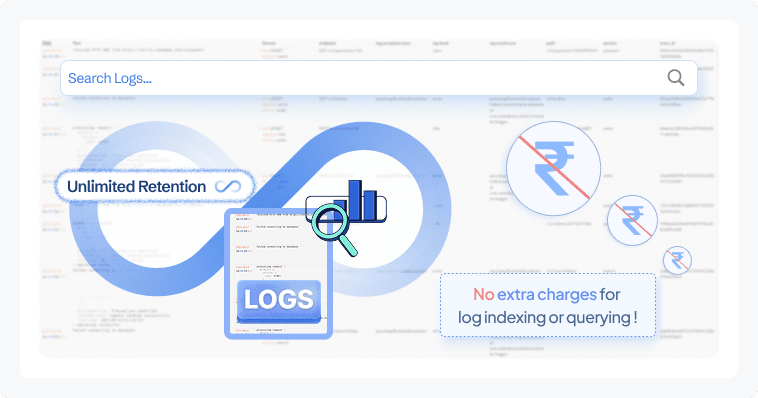
CubeAPM: CubeAPM offers unlimited retention. CubeAPM documentation states that data is stored inside the customer’s own cloud or infrastructure environment, and the platform does not impose time-based retention limits. Retention duration depends on the customer’s storage capacity rather than predefined product tiers.
Azure Monitor: Retention varies by data type and tier.
- Analytics Logs: Default retention is 30 days, configurable between 30 days and 730 days (2 years).
- Archive Logs: Can be retained for up to 12 years.
- Platform Metrics: Retained for 93 days.
Extended retention beyond included periods incurs additional storage charges.
Splunk AppDynamics: Retention depends on deployment type and data granularity.
SaaS deployment (official entitlement documentation v26.2.0):
- Metrics: 8 days at 1-minute resolution; retained up to 13 months at 1-hour resolution.
- Events: 8 days by default; extendable to 30 / 60 / 90 days with Enterprise add-ons.
On-Premises deployment:
- Metrics: 4 hours at 1-minute resolution; 48 hours at 10-minute resolution; up to 13 months at 1-hour resolution.
- Events: 8 days by default (configurable).
Support Channel & TAT
CubeAPM: Provides direct access to support via Slack and WhatsApp, including communication with core engineers. The platform emphasizes near real-time assistance rather than traditional tiered SLA queues.
Azure Monitor (Microsoft Support Plans): Azure defines response times by severity level and support plan. According to Microsoft’s official support page:
- Severity A (Critical): < 15 minutes (rapid response); < 1 hour (standard)
- Severity B (High): < 4 hours
- Severity C (Moderate): < 8 hours
Availability depends on the support plan (Professional Direct, Unified, etc.).
Splunk AppDynamics: Splunk defines support response times by priority level (P1–P4) and support program tier. According to Splunk’s official support program documentation:
- P1 (Critical): 2 hours to 30 minutes (Premium tier)
- P2 (High): 1 day to 1 hour (Premium tier; longer under Standard tier)
- P3 (Medium): 2 days to 4 hours
- P4 (Low): 2 business days to 1 business day
Response targets vary based on purchased support program.
How Teams Evaluate These Platforms at Scale
Choosing between Azure Monitor, Splunk AppDynamics, and a self-hosted model like CubeAPM rarely happens at the feature level alone. As telemetry volume grows and environments become more distributed, teams begin evaluating long-term architectural impact, cost behavior, and operational control.
Who Is Involved
Evaluation typically spans multiple stakeholders:
- Engineering teams assess instrumentation depth, distributed tracing visibility, sampling control, and integration with Kubernetes, microservices, and CI/CD pipelines.
- Finance teams evaluate how pricing scales — whether costs are tied to ingestion volume, vCPU counts, or retention duration.
- Security and compliance teams examine data residency, retention policies, and whether telemetry leaves controlled environments.
In larger organizations, platform engineering and SRE teams often lead technical validation while procurement and governance teams assess contract structure and SLA commitments.
What Questions Block Decisions
Several recurring questions tend to delay decisions:
- How does pricing behave once telemetry exceeds early-stage volumes?
- What happens during autoscaling spikes or traffic surges?
- Is sampling configurable enough to preserve critical traces without inflating cost?
- Where is data stored, and does it meet regulatory requirements?
- Can the platform support both current workloads and future architecture changes?
These questions move the discussion from “feature comparison” to operational risk management.
Why Comparisons Alone Aren’t Enough
Side-by-side tables provide clarity on features, pricing models, and retention limits — but they don’t always reflect real-world production behavior. At scale, observability tools must be tested under sustained load, high-cardinality logs, and distributed trace bursts.
Teams often run proof-of-concept deployments to validate:
- Query performance under high ingestion volume
- Trace completeness under configured sampling
- Retention flexibility and storage growth
- True monthly cost after accounting for infrastructure and support tiers
At scale, the evaluation becomes less about tool capability and more about architectural alignment, cost predictability, and operational resilience.
Splunk AppDynamics vs Azure Monitor vs CubeAPM: Use Cases
Different teams prioritize different outcomes — cost predictability, ecosystem alignment, compliance, or deep application diagnostics. Below are practical scenarios where each platform typically fits best based on official capabilities, published pricing models, and observed production usage patterns.
Choose CubeAPM if:
CubeAPM is best suited for teams that prioritize OpenTelemetry-native architecture, predictable ingestion-based pricing, and full control over data residency.
- You want a self-hosted, OpenTelemetry-based alternative where telemetry stays inside your own cloud or infrastructure (based on CubeAPM documentation).
- You need predictable pricing tied to ingestion volume rather than vCPU or host count. Based on published pricing ($0.15/GB), cost scales linearly with telemetry, not infrastructure footprint.
- You operate in regulated industries requiring strict data residency and compliance control.
- You are a startup or scale-up looking for lightweight, easy-to-deploy full-stack observability without enterprise licensing negotiations.
- You want unified MELT coverage (metrics, logs, events, traces, RUM, synthetic, error tracking) in one platform.
- You need end-to-end tracing across microservices to reduce mean time to resolution (MTTR) in distributed systems.
- You run high-traffic Kubernetes or containerized workloads where host-based licensing can become unpredictable.
- You want unlimited data retention without tiered time limits (based on CubeAPM documentation).
- You run Java-heavy services (Spring Boot, JVM microservices) and need distributed tracing, JVM metrics, and transaction-level visibility without proprietary agents, leveraging OpenTelemetry instrumentation.
Choose Splunk AppDynamics if:
Splunk AppDynamics is designed for enterprises that require deep business transaction monitoring and established APM workflows.
- You need automatic discovery and mapping of complex application tiers and business transactions (based on Splunk AppDynamics product documentation).
- You operate large Java or .NET monoliths where deep agent-based instrumentation is required.
- You prefer per-vCPU licensing aligned with infrastructure capacity (based on published Splunk pricing tiers).
- You require enterprise-grade SLA support structures with defined P1–P4 response commitments.
- You need granular control over sampling policies via agent configuration.
- You already operate within an environment standardized on Splunk products and want tight integration with existing monitoring investments.
- You want resolution-based metric retention (8 days at 1-minute resolution, up to 13 months at 1-hour resolution for SaaS).
Choose Azure Monitor if:
Azure Monitor is most effective for teams standardized on Microsoft Azure infrastructure and services.
- You run primarily on Azure VMs, Azure Kubernetes Service (AKS), Azure SQL, and other Microsoft-native services.
- You want seamless integration with Log Analytics, Application Insights, and Azure Resource Manager.
- You prefer a fully managed SaaS model within the Azure ecosystem.
- You need platform-level metrics retained for 93 days and configurable log retention up to 730 days (based on Microsoft documentation).
- You want consumption-based pricing aligned with Azure billing and cost management tools.
- You require enterprise support through Microsoft’s severity-based SLA model, including Rapid Response (<15 minutes for critical issues).
- You are building cloud-native applications tightly coupled to Azure services and want unified monitoring across those services without deploying third-party infrastructure.
Conclusion
Splunk AppDynamics, Azure Monitor, and CubeAPM reflect three distinct observability approaches. AppDynamics focuses on enterprise-grade, agent-based APM with deep business transaction monitoring. Azure Monitor delivers tight integration within the Microsoft ecosystem with consumption-based pricing and native cloud diagnostics.
CubeAPM offers OpenTelemetry-native, self-hosted observability with predictable ingestion-based pricing and unified MELT coverage. For teams prioritizing data control, cost predictability, and end-to-end tracing across microservices, CubeAPM provides a strong architectural balance.
Evaluate your workload, scale profile, and compliance needs, then choose the platform that aligns with your long-term observability strategy.
Disclaimer: The information in this article reflects the latest details available at the time of publication and may change as technologies and products evolve.
FAQ
1. Which platform is better for Kubernetes and containerized workloads?
Azure Monitor integrates natively with Azure Kubernetes Service (AKS). Splunk AppDynamics supports Kubernetes through its agents and cluster monitoring capabilities. CubeAPM, being OpenTelemetry-native, allows Kubernetes workloads to send metrics, logs, and traces using standard OTEL collectors, which can simplify instrumentation in cloud-native environments.
2. How do these platforms handle multi-cloud environments?
Azure Monitor works best inside the Azure ecosystem but supports hybrid and multi-cloud ingestion. Splunk AppDynamics supports hybrid environments with both SaaS and on-prem deployment options. CubeAPM, through OpenTelemetry-based ingestion and self-hosted deployment, can be deployed across AWS, Azure, GCP, or private clouds without being tied to a single cloud provider.
3. Which tool offers more flexibility in deployment models?
Splunk AppDynamics offers both SaaS and on-prem deployments. Azure Monitor is a fully managed SaaS service within Microsoft Azure. CubeAPM is self-hosted with vendor-managed support options, giving teams full control over where telemetry is stored and processed.
4. How do these platforms differ in cost behavior at scale?
Azure Monitor pricing scales with ingestion and retention. Splunk AppDynamics pricing scales with vCPU licensing tiers. CubeAPM pricing scales with ingestion volume, which can make cost forecasting more straightforward in high-autoscaling environments based on published per-GB pricing.
5. Which platform is better for Java-based applications?
Splunk AppDynamics provides deep Java agent instrumentation for JVM applications and business transaction tracing. Azure Monitor supports Java monitoring through Application Insights and OpenTelemetry. CubeAPM supports Java instrumentation via OpenTelemetry SDKs, enabling distributed tracing and JVM metrics without proprietary agents, making it suitable for modern microservices built on Spring Boot and other Java frameworks.