






The main difference between Amazon CloudWatch, New Relic, and CubeAPM lies in how each platform delivers observability and cost at scale. CloudWatch is a native AWS monitoring service focused on metrics, logs, and events within the AWS ecosystem. New Relic is a fully managed SaaS observability platform that provides deep application performance monitoring. CubeAPM is a unified observability platform designed to run inside the customer’s own environment and built around OpenTelemetry.
Amazon CloudWatch is best suited for teams operating primarily on AWS that want infrastructure and service-level visibility. New Relic is designed for organizations that need broad, application-centric observability, delivered as a managed SaaS platform. CubeAPM fits teams that want self-hosted full-stack observability while retaining control over data location, retention, and cost behavior as telemetry volume grows.
This article compares Amazon CloudWatch vs New Relic vs CubeAPM across observability capabilities, deployment models, and pricing behavior at scale, helping teams understand where each platform fits and how the trade-offs differ in real-world production environments.
Amazon CloudWatch vs New Relic vs CubeAPM: Feature Comparison
The comparison that follows draws on vendor documentation, commonly used production setups, and typical observability workloads seen in real environments. Pricing behavior, retention limits, sampling controls, and feature availability can change based on scale, region, telemetry volume, and configuration decisions. The goal of this table is to surface practical and architectural differences between the platforms, not to rank or endorse a specific solution.
| Features | CubeAPM | Amazon CloudWatch | New Relic |
| Known for | OpenTelemetry-native observability with predictable costs | Native AWS telemetry for infrastructure, services, and applications | Enterprise APM and observability with strong application-centric workflows |
| Multi-Agent Support | Yes (OTel, New Relic, Datadog, Elastic) | Limited (CloudWatch Agent, AWS SDKs, OpenTelemetry, AWS X-Ray) | Limited (OTel, Prometheus) |
| MELT Support | Full MELT | Full MELT | Full MELT |
| Setup | Self-hosted but vendor-managed | SaaS (Fully managed Azure service) | SaaS only |
| Pricing | Ingestion-based pricing of $0.15/GB | Logs: $0.50 per GB Traces(Over 30TB): $0.15/GB | Free: 100GB/month Paid: $0.40/GB Full Platform User: $349/user |
| Sampling Strategy | Smart sampling (95% compression) | Tail-based + Adaptive sampling | Head + Tail-based |
| Log Retention | Unlimited Retention | Logs: Indefinite | Logs: 30 days Metrics: 90 days |
| Support TAT | < 10 minutes | 15 minutes to <24hrs | 1hr to 2days |
Amazon CloudWatch vs New Relic vs CubeAPM: Feature-by-feature breakdown
Known For
CubeAPM: Known for providing an OpenTelemetry-native observability layer that runs inside the customer’s own cloud. It is used to collect and analyze traces, metrics, logs, and events through standardized OpenTelemetry pipelines, without tying telemetry storage or processing to a vendor-controlled SaaS backend. CubeAPM is commonly adopted by teams that want cloud-agnostic observability, predictable cost behavior, and tighter control over telemetry data as systems scale.
Amazon CloudWatch: Known as the native monitoring service for AWS workloads and managed services. It collects metrics, logs, and events emitted directly by AWS infrastructure and services, with configuration and visualization tightly integrated into the AWS console. CloudWatch is typically used to monitor infrastructure health, service behavior, and operational signals within AWS environments, rather than as a standalone, application-centric observability platform.
New Relic: Known for delivering application-focused observability through a fully managed SaaS platform. It is widely used to monitor application performance, request flows, and service dependencies using agent-based instrumentation and distributed tracing. New Relic is commonly adopted in environments where teams want centralized visibility across applications and infrastructure without managing the observability backend themselves.
Multi-agent Support
CubeAPM: Supports telemetry ingestion from multiple agents and data pipelines through native integration with OpenTelemetry collectors. In addition to OpenTelemetry SDKs, it can receive metrics from Prometheus and ingest telemetry emitted by commonly used vendor agents, including Datadog, New Relic, and Elastic. This allows teams to consolidate observability data without forcing a full re-instrumentation or immediate migration to a single agent.
Amazon CloudWatch: Supports telemetry collection through AWS-native agents as well as OpenTelemetry via the AWS Distro for OpenTelemetry. Teams can instrument applications using OpenTelemetry SDKs and export data into AWS services such as CloudWatch and X-Ray. Configuration, access control, and investigation workflows are primarily handled through AWS services and the AWS console, meaning observability remains tightly integrated with the broader AWS platform.
New Relic: Primarily built around its own language and infrastructure agents. At the same time, it supports ingesting telemetry from OpenTelemetry and Prometheus, allowing teams to adopt standardized instrumentation and migrate existing services without re-instrumenting code. This makes New Relic viable in environments transitioning to OpenTelemetry.
MELT Support
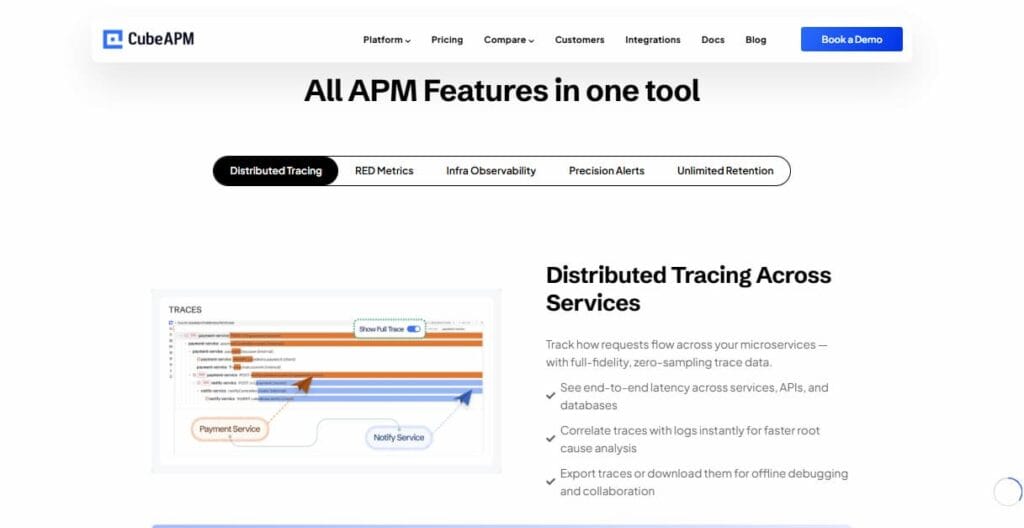
CubeAPM: Treats metrics, events, logs, and traces as first-class signals within a single observability model. All signals are ingested through OpenTelemetry-compatible pipelines and are designed to be correlated during investigation, allowing teams to move between traces, logs, and metrics without switching tools or contexts. This unified approach is intended to support end-to-end analysis of distributed systems rather than isolated signal monitoring.
Amazon CloudWatch: Supports metrics, logs, and events natively, with distributed tracing provided through AWS X-Ray. While these signals integrate at the AWS platform level, they are configured and explored across separate services, meaning cross-signal correlation typically requires additional setup and familiarity with multiple AWS monitoring components.
New Relic: Provides full support for metrics, events, logs, and traces through its SaaS platform. These signals are collected via agents and integrations and are designed to be correlated within New Relic’s interface during troubleshooting. MELT support in New Relic is application-centric, with workflows optimized around service performance and request behavior.
Deployment model

CubeAPM: It is self-hosted but vendor-managed. Deployed inside the customer’s own environment while being operationally managed by the vendor. This means the observability data plane runs in the customer’s cloud or infrastructure, giving teams control over data location, retention, and network boundaries, without taking on the full operational burden of running the platform themselves. This model is commonly used in environments with compliance, data residency, or architectural constraints that rule out fully external SaaS.
Amazon CloudWatch: Available only as a fully managed SaaS service operated by AWS. All telemetry is processed and stored within AWS-managed infrastructure, and there is no option to run CloudWatch components in a customer-controlled environment. Deployment is tightly coupled to AWS accounts and regions, which simplifies setup for AWS-native workloads.
New Relic: Provided exclusively as a SaaS platform. Telemetry data is sent to New Relic–managed infrastructure, and customers do not control where the observability backend runs. This model reduces operational overhead and accelerates onboarding, but it means deployment location, data plane control, and retention behavior are governed by the service rather than by customer infrastructure choices.
Pricing: Approximate Cost for Small, Mid-Sized & Large Teams
*All pricing comparisons are calculated using standardised small/medium/large team profiles defined in our internal benchmarking sheet, based on fixed log, metrics, trace, and retention assumptions. Actual pricing may vary by usage, region, and plan structure. Please confirm current pricing with each vendor.
*An APM host is a host that is actively generating trace data, and an Infra host is any physical or virtual OS instance that you monitor with any observability tool.
Below is a cost comparison for small, mid-sized, and large teams.
| Approx. Cost for Teams | Small (~30 APM Hosts) | Mid-sized (~125 APM Hosts) | Large (~250 APM Hosts) |
| CubeAPM | $2,080 | $7,200 | $15,200 |
| Amazon CloudWatch | $5,343.50 | $15,637 | $30,018 |
| New Relic | $7,896 | $25,990 | $57,970 |
What This Comparison Means at Scale
At small team sizes, observability costs remain relatively close across platforms. Spend is usually manageable, and tool choice is often influenced by ecosystem fit, familiarity, or setup speed rather than long-term cost behavior. At this stage, pricing differences exist, but they rarely drive urgent decisions.
As teams grow into mid-sized environments, cost behavior begins to separate more clearly. Telemetry volume increases, services multiply, and observability shifts from ad-hoc usage to continuous monitoring. Pricing models tied to hosts, features, or multiple billing dimensions start to compound, making costs harder to forecast as usage grows.
At larger scales, these differences become structural. Observability spend increasingly reflects how a platform prices data rather than how much operational value teams receive from it. Models that scale on multiple usage factors tend to grow non-linearly, while ingestion-based approaches remain more predictable as traffic, services, and data retention expand.
CubeAPM: Cost for Small, Medium, and Large Teams
CubeAPM uses an ingestion-based pricing model where observability scales with the volume of telemetry processed. Costs are tied directly to data ingested rather than host count, enabled features, or user seats, which makes spend easier to reason about as environments grow.
Pricing overview:
- $0.15 per GB ingested
Using consistent workload assumptions across environments, estimated monthly costs typically fall into the following ranges:
- Small teams (~30 APM hosts): $2,080
- Mid-sized teams (~125 APM hosts): $7,200
- Large teams (~250 APM hosts): $15,200
This model means cost growth is driven primarily by telemetry volume rather than infrastructure expansion alone, which helps keep observability spend predictable as services, traffic, and retention requirements increase.
Amazon CloudWatch: Cost for Small, Medium, and Large Teams
Amazon CloudWatch uses an ingestion-based pricing model where costs accumulate across multiple telemetry dimensions. Spend is driven by metrics ingestion, log ingestion and storage, alarms, API requests, and additional features such as custom metrics and enhanced monitoring.
Pricing overview:
- Logs: $0.50 per GB
- Traces(Over 30TB): $0.15/GB
Using consistent workload assumptions across environments, estimated monthly costs typically fall into the following ranges:
- Small teams (~30 APM hosts): $5,343.50
- Mid-sized teams (~125 APM hosts): $15,637
- Large teams (~250 APM hosts): $30,018
In practice, Amazon CloudWatch costs tend to grow as more AWS services emit metrics and logs by default. While this model works well for infrastructure monitoring inside AWS, forecasting spend becomes more complex at scale as telemetry sources and retention requirements increase.
New Relic: Cost for Small, Medium, and Large Teams
New Relic uses an ingestion and usage-based pricing model where costs are driven primarily by host count, enabled products, and telemetry usage.
Pricing overview:
- Free tier: 100 GB per month of data ingest
- Paid usage: $0.40 per GB ingested (beyond the free tier)
- Full Platform User: $349 per user per month
Using consistent workload assumptions across environments, estimated monthly costs typically fall into the following ranges:
- Small teams (~30 APM hosts): $7,896
- Mid-sized teams (~125 APM hosts): $25,990
- Large teams (~250 APM hosts): $57,970
At scale, New Relic costs tend to increase with telemetry volume and number of users. This model works well for teams that value a fully managed SaaS experience, but it can lead to steeper cost curves as environments expand and more services are brought under monitoring.
Want to understand how New Relic pricing works in detail, including ingest tiers, user licensing, and how costs scale as telemetry grows? Read our full breakdown here.
Sampling strategy
CubeAPM: Uses smart sampling to reduce telemetry volume while preserving investigative value. Sampling decisions are applied centrally, with awareness of request behavior and system conditions, rather than as a fixed percentage at the edge. This allows CubeAPM to significantly compress telemetry volume while retaining high-signal traces, especially during bursts, incidents, or high-traffic periods.
Amazon CloudWatch: Supports tail-based and adaptive sampling through AWS X-Ray and the AWS Distro for OpenTelemetry. Sampling rates adjust dynamically based on request patterns and service behavior, allowing higher-value traces to be retained while reducing noise during normal operation. This approach is designed to limit overhead in high-throughput AWS environments, but sampling behavior is closely tied to AWS-managed tracing workflows.
New Relic: Supports both head-based and tail-based sampling, with configuration available at the agent and pipeline level. Head-based sampling is commonly used to limit data volume at ingestion, while tail-based sampling enables teams to retain traces based on latency, errors, or other conditions after execution. This provides flexibility but requires careful configuration to balance cost, coverage, and trace completeness at scale.
Data retention
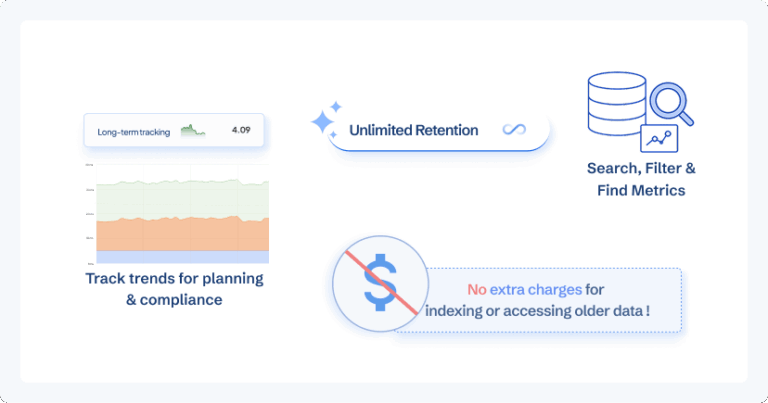
CubeAPM: Offers unlimited data retention, with retention length fully controlled by the customer. Metrics, logs, and traces can be retained for months or years depending on storage policy and compliance needs, since there are no product-imposed retention limits. Retention duration is determined by customer configuration rather than plan tiers or signal type.
Amazon CloudWatch: Retains log data indefinitely by default. Teams can configure a retention policy for each log group, either keeping logs with no expiration or setting a fixed retention period ranging from 1 day up to 10 years. This makes retention highly configurable at the log-group level, with data lifecycle behavior determined by explicit customer settings rather than automatic expiration.
New Relic: Applies retention limits based on the selected pricing model and subscription tier. Log data can be retained for up to 30 days, with shorter options such as 8 or 15 days available depending on configuration. Retention for APM telemetry depends on plan, with Essentials plan offering retention limits of 3 days for key metris while Pro plan is 90 days.
Support channels and response time (TAT)
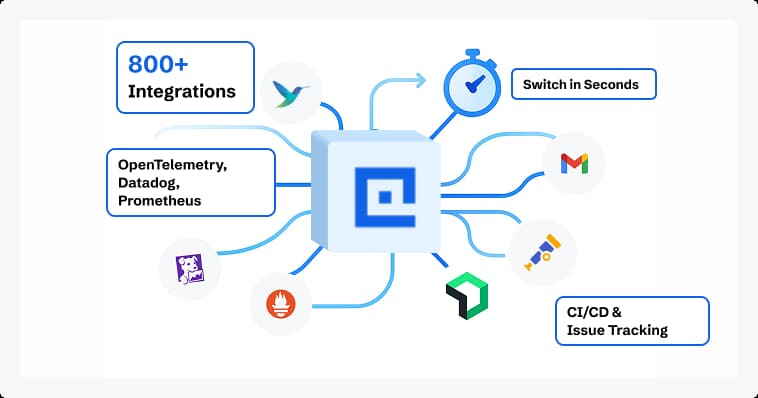
CubeAPM: Provides direct support through email and Slack, with response times typically within 10 minutes for active issues. Support is designed to be conversational and engineering-led, allowing teams to engage quickly during incidents without navigating plan-based escalation paths. This model is commonly used by teams that want fast, real-time interaction when observability issues impact production.
Amazon CloudWatch: Does not offer standalone support and instead relies on AWS Support plans. Support is accessed through AWS support cases, chat, or phone depending on the selected plan. Response times vary by severity and subscription level, with Enterprise Support offering responses for critical production issues in as little as 15 minutes, while Business Support generally targets around 1 hour. Lower-severity issues follow longer response timelines, making support experience closely tied to the broader AWS support tier rather than CloudWatch itself.
New Relic: Uses a tiered support model where response times depend on subscription level and issue priority. Higher-tier plans offer faster initial responses, often around 1 hour for high-severity incidents, while standard plans may see response times extend to one or two business days for lower-priority issues. Support is typically delivered through ticket-based systems, with escalation paths and response targets defined by the selected plan.
How teams evaluate these platforms at scale
As systems grow, teams stop evaluating observability tools based on feature availability and start evaluating them based on operational behavior. At scale, the questions are less about whether a platform supports metrics, logs, or traces, and more about how reliably those signals remain usable as traffic increases, architectures fragment, and incidents become harder to isolate.
One of the first factors teams examine is cost behavior under growth. This includes how pricing responds to higher telemetry volume, burst traffic during incidents, and longer retention requirements. Platforms that introduce multiple billing dimensions or tie cost to hosts and features can become difficult to forecast, while simpler ingestion-based models tend to be easier to reason about as environments expand.
Teams also look closely at control and flexibility. This includes where data is stored, how long it can be retained, how sampling decisions are applied, and how easily telemetry pipelines can be adjusted without re-instrumenting services. At scale, observability is no longer just a tooling choice. It becomes part of the system architecture, and platforms are evaluated based on how well they align with long-term reliability, cost predictability, and operational ownership.
Amazon CloudWatch vs New Relic vs CubeAPM: Use Cases
Choose CubeAPM if:
- You are standardizing on OpenTelemetry and want a vendor-neutral observability pipeline
- You need predictable, ingestion-based costs that are easier to forecast at scale
- Data residency, long-term retention, or compliance requires running observability in your own environment
- You want to consolidate telemetry from multiple agents and vendors without re-instrumenting services
Choose Amazon CloudWatch if:
- Your workloads run primarily on AWS and you want native visibility with minimal setup
- Infrastructure and managed service monitoring is the primary requirement
- You prefer AWS-integrated metrics, logs, alarms, and IAM-based access control
- Observability workflows are tightly coupled to AWS operations and tooling
Choose New Relic if:
- You want deep application performance monitoring without managing observability infrastructure
- Developer workflows depend on transaction tracing, service maps, and code-level insights
- A fully managed SaaS model is preferred over self-hosted deployment
- Centralized visibility across applications and infrastructure matters more than data-plane control
Conclusion
Amazon CloudWatch, New Relic, and CubeAPM each approach observability from a different architectural starting point. CloudWatch emphasizes native visibility for AWS services, New Relic focuses on application-centric observability delivered as SaaS, and CubeAPM centers on OpenTelemetry-first observability with customer-controlled deployment and cost behavior.
At small scale, these platforms can appear functionally similar. As environments grow, differences in pricing models, data retention, sampling strategies, and operational control become more pronounced. Choosing the right platform depends less on feature availability and more on how observability fits into long-term system architecture, cost predictability, and ownership requirements.
For teams evaluating observability as core infrastructure rather than an add-on tool, understanding these trade-offs early helps avoid friction as systems, traffic, and telemetry volume scale.
Disclaimer: The information in this article reflects the latest details available at the time of publication and may change as technologies and products evolve.
FAQs
1. Is Amazon CloudWatch enough for full observability on its own?
Amazon CloudWatch is sufficient for infrastructure and AWS service monitoring, especially in AWS-only environments. For deeper application-level insight, distributed tracing across services, or long-term analysis, teams often supplement it with additional observability tooling or services.
2. How does OpenTelemetry adoption affect tool choice?
Teams standardizing on OpenTelemetry often prioritize platforms that treat OpenTelemetry as a first-class data source rather than an integration. This affects how easily telemetry pipelines can be reused, how sampling is applied, and whether teams can switch tools later without re-instrumenting services.
3. Why do observability costs behave differently at scale across platforms?
Cost differences usually come from pricing mechanics rather than raw usage. Platforms that bill across multiple dimensions like hosts, features, retention tiers, and data types tend to scale non-linearly. Simpler ingestion-based models are often easier to forecast as telemetry volume and service count grow.
4. Can these platforms be used together?
Yes. Some teams use Amazon CloudWatch for AWS infrastructure visibility, CubeAPM or New Relic for application performance monitoring, and route OpenTelemetry data to another platform for long-term analysis or cost control. This is more common in transitional or hybrid setups.
5. What matters more than features when choosing an observability platform?
At scale, teams tend to prioritize cost predictability, data retention flexibility, sampling behavior during incidents, and operational ownership. Feature parity across observability tools is high, but differences in how those features behave under load often drive long-term satisfaction or friction.