










Better Stack is a popular monitoring platform known for uptime monitoring, incident alerting, status pages, log management, and a clean, developer-friendly experience. It is often a strong fit for teams that want fast setup and a single platform for availability monitoring and operational alerts.
Even so, many teams start evaluating alternatives as costs become harder to predict at scale, observability needs grow beyond uptime and logs, or data compliance requirements demand a self-hosted deployment. Better Stack claims to be 30x cheaper than Datadog, a claim worth examining carefully before it shapes a buying decision. This guide compares the top alternatives.
Top 7 Better Stack alternatives
- CubeAPM
- Datadog
- Dynatrace
- Coralogix
- SigNoz
- New Relic
- Sumo Logic
Quick comparison table: Best Better Stack alternatives at a glance
*The information in this table is based on publicly available vendor documentation at the time of writing. Feature availability, pricing models, and retention policies may vary by deployment configuration, subscription tier, or enterprise agreement. Consult official documentation before making platform decisions.
*All pricing comparisons are calculated using standardized small/medium/large team profiles defined in our internal benchmarking sheet, based on fixed log, metrics, trace, and retention assumptions. Actual pricing may vary by usage, region, and plan structure. Please confirm current pricing with each vendor.
| Tool | Pricing (Small / Mid / Large) | OTEL Native | Self-hosted? | Full APM / tracing? | Pricing model |
| CubeAPM | $2,080 / $7,200 / $15,200 | Yes | Yes (vendor-managed) | Yes, full APM | Flat $0.15/GB — single dimension |
| Better Stack | $5,723 / $20,550 / $43,350 | Yes | No | Tracing via OTel + eBPF | Per-responder + bundles + retention GB |
| Coralogix | $4,090 / $13,200 / $29,000 | Yes | No | Yes | Per-GB by signal type |
| SigNoz | $4,600 / $16,000 / $34,000 | Yes | Yes (self-managed) | Yes, OTel-native | Base plan + usage-based billing |
| Sumo Logic | $4,641 / $16,065 / $33,915 | Yes | No | Yes | Per-GB scanned |
| Dynatrace | $7,740 / $21,850 / $46,000 | Yes | Limited | Yes, enterprise depth | Multi-dimensional: host, memory, platform/add-ons |
| New Relic | $7,896 / $25,990 / $57,970 | Yes | No | Yes | Data ingest + user or compute tiers |
| Datadog | $8,185 / $27,475 / $59,050 | Yes | No | Yes, APM + profiling | Per-host + per-span + per-GB |
Unpacking Better Stack’s “30x cheaper than Datadog” claim
Better Stack does prominently advertise “30x cheaper than Datadog” on its homepage. That claim is tied to a specific modeled pricing example, and Better Stack explains the assumptions in an estimate note directly below the comparison.
Disclaimer: This comparison is based on publicly available data, including vendor documentation and community resources. Interpretations may vary depending on use case and configuration. This content is intended for informational purposes only and does not aim to misrepresent or criticize Better Stack.
What the 30x claim actually assumes
Reading Better Stack’s homepage footnote directly, the 30x comparison is built on these assumptions:
- Annual billing
- European data location
- 1 responder with a Tera bundle
- Average event size of 1 kB
- Datadog custom metrics priced at $5 per 100
- A modeling assumption that 1,000 Datadog custom metrics are equivalent to 1 GB of metrics
- Datadog logs and spans priced at $0.10 per ingested GB
- Datadog indexed spans and logs priced at $2.50 per million for 30-day retention
In plain terms, the comparison uses a low-cost Better Stack setup with 1 responder on an annual Tera bundle against a high-cost Datadog configuration that includes custom metrics and 30-day indexed spans and logs. What the headline does not show is that Better Stack’s costs rise as responder count and add-ons increase, which can narrow the gap for larger teams.
Better Stack’s own community article comparing itself with Datadog is candid about this: it positions the comparison at ‘95% less than Datadog for equivalent coverage’ in one phrasing and ’30x’ in another, the difference reflecting which Datadog configuration is used as the baseline.
Where the “30x” gap closes fast
Disclaimer: The details in the table are based on public pricing pages, documentation, and vendor-stated assumptions as of early 2026. Actual costs may vary depending on usage, retention, team size, region, and contract terms.
Here is what happens to Better Stack’s bill as a real team scales, based on Better Stack’s published pricing page:
| Team condition | Better Stack extra cost | Real-world note |
| 5 on-call responders (typical small team) | +$145/month ($29 x 5) | A per-responder charge does not exist in Datadog pricing |
| 10 on-call responders (mid-market) | +$290/month ($29 x 10) | Every additional on-call responder increases platform cost |
| Extra monitors beyond base plan | Add-on bundles required | Datadog has no per-monitor charge for infra hosts |
| 2 additional status pages | +$24/month ($12 x 2 annually) | Extra public status pages are billed separately |
| Log and trace retention beyond included | +$0.05/GB/month (annual tier) | Longer retention raises cost beyond the base bundle |
| Metrics retention beyond included | +$0.50/GB/month (annual tier) | Metrics retention billed separately from log retention |
| Full APM / distributed tracing | Available, but lighter than enterprise APM suites | Better Stack includes native tracing with OpenTelemetry and eBPF, but it is lighter than deeper enterprise APM platforms. |
At 10 responders and 2 extra status pages, Better Stack’s incident management cost is about $314/month on annual billing before telemetry. For a team ingesting 6 TB of logs and keeping them longer than the included 30 days, the total platform cost would be driven mainly by per-GB ingestion and retention charges, not just the base bundle. In that kind of setup, the savings gap versus Datadog can narrow far below the headline 30x claim.
Better Stack’s real limitations
Better Stack has genuine strengths: fast setup, clean UX, solid uptime monitoring, and good incident alerting. The limitations below are sourced from independent user reviews and third-party analysis, not vendor comparisons.
Better Stack is easy to approach at small scale, but pricing becomes more layered as teams grow. Responder licenses ($29/license/month annually), extra status pages ($12/page/month annually), telemetry bundles from Nano ($25/month annually) up to Tera ($420/month annually), and separate retention charges for logs, traces, and metrics mean the final bill does not rise on one simple metric. That structure is transparent on the pricing page, but it can make long-term cost planning harder for teams with growing telemetry volume and broader on-call coverage.
Independent analysis from Hyperping, based on 42 alternatives and 100+ G2 reviews, points to pricing that jumps sharply from free to paid as one of the main reasons teams look beyond Better Stack. The shift begins with the first paid responder license and can widen as more responders, monitors, and retention costs are added.
Better Stack is SaaS-only. Its public product and pricing pages do not offer a standard self-hosted, on-prem, or bring-your-own-cloud deployment model. That can be a real limitation for teams that need tighter control over where observability data is stored and processed, especially in internal-only, regulated, or data-sensitive environments.
Better Stack supports distributed tracing through OpenTelemetry and eBPF-based instrumentation. Its own comparison with Datadog describes the product as using eBPF-based, OpenTelemetry-native tracing, while also acknowledging that Datadog has an advantage in areas like code-level CPU profiling via Continuous Profiler. That makes the limitation more nuanced than “no APM.” Better Stack does include tracing, but teams that need deeper profiling, richer performance analysis, or more advanced enterprise APM workflows may still find it lighter than platforms built around full-stack observability depth.
Better Stack does not provide a unified dashboard showing the current status of monitors across all teams. Teams managing multiple groups must manually switch between team views to get a broader picture of system status. For organizations with more complex structures, that can create added friction during incident response and day-to-day monitoring. Hyperping’s independent analysis highlights this as one of the reasons some teams evaluate alternatives.
Hyperping’s independent analysis of G2 reviews identifies this as one of the three main reasons teams evaluate alternatives: ‘no unified dashboard across teams. ‘ It is a structural constraint of Better Stack’s team-scoped architecture, not a missing feature on a roadmap.
G2 reviewers frequently mention ‘missing features,’ ‘limited configuration options,’ and a desire for ‘more advanced integrations or customization’ as systems grow more complex. G2’s own review summary tags show 22 reviews tagged ‘Missing Features’ and 13 tagged ‘Pricing Issues.’ Specific complaints include limited status page customization on lower-tier plans and constraints on alert logic complexity.
Better Stack is intentionally designed for simplicity, which is a genuine strength for small teams and a genuine constraint for teams whose monitoring requirements become more sophisticated.
Better Stack’s mobile app supports incident alerts, on-call visibility, acknowledgements, and some on-call actions, so it is more than a simple notification relay. But the mobile experience is still centered on incident response rather than full platform administration, which can be limiting for engineers who need deeper investigation workflows away from a desktop.
How we evaluated Better Stack alternatives
We assessed each platform against nine criteria using publicly available pricing as of early 2026, independent user review analysis, and standardized cost scenarios across growing and mid-market team profiles.
- Uptime monitoring and synthetic depth: Availability checks, alerting coverage, and external monitoring.
- Incident management and on-call: Alert routing, escalation, and incident response coordination.
- Log management and query experience: Log search, investigation workflows, and high-volume query performance.
- Distributed tracing and APM: Whether the platform provides first-class trace support, service maps, and infrastructure correlation, not just basic eBPF collection.
- Pricing model and predictability: Whether costs stay forecastable as team size, monitor count, and data volume grow and, specifically, whether per-responder or per-monitor dimensions apply.
- Retention and data governance: Default and maximum retention windows, extension costs, compliance fit.
- Self-hosted vs. SaaS: Whether teams can run the platform inside their cloud is a hard gap in Better Stack’s current offering.
- Integrations and ecosystem depth: Connectivity with the broader engineering and incident response stack.
- Fit by team stage: Whether the platform remains practical operationally and financially as complexity grows.
Real-world scenarios: Which Better Stack alternative fits best?
How to find your scenario
| Primary reason for evaluating alternatives | Deployment preference | Likely best fit |
| Pricing stacks unpredictably as team grows | Any | CubeAPM, Coralogix, or SigNoz single-dimension GB pricing |
| Need self-hosting, BYOC, or strict data residency | Self-hosted | CubeAPM (vendor-managed) or SigNoz (self-managed open source) |
| Need full APM and distributed tracing, not just logs | Any | CubeAPM, Datadog, or New Relic |
| Data residency / self-hosted required | Self-hosted | CubeAPM (vendor-managed) or SigNoz (open-source) |
| Need security analytics alongside observability | Managed SaaS | Sumo Logic or Coralogix |
| Need enterprise automation + AI root cause | Managed SaaS | Dynatrace or Datadog |
| Want full MELT at better cost than Better Stack | Any | CubeAPM: the most cost-effective all-in option |
Scenario 1: Growing team where Better Stack costs are becoming unpredictable
The situation: You started on Better Stack for uptime monitoring and incident alerting. Now you have 4 on-call engineers, 120 monitors, 2 status pages, and a compliance team asking for 60-day log retention. The bill is noticeably higher than the bundle price suggested, and it climbs every time you add a service or an engineer goes on-call.
Reference profile
- Data ingested: ~13 TB/month (6 TB logs, 4 TB traces, 3 TB metrics)
- Infrastructure: 60 hosts
- Users: 4 (20% engineers)
- Retention: 30 days
- Scope: Core observability no security or synthetics
Approximate monthly costs for a growing team
*Directional estimates based on public pricing and documentation as of early 2026. Actual costs may vary by usage, retention, discounts, and contract terms.
| Tool | Est. monthly cost | vs Better Stack ($5,723) | Pricing model | Per-responder? |
| CubeAPM | $2,080 | -64% | $0.15/GB | No |
| Coralogix | $4,090 | -29% | Per-GB by signal type | No |
| SigNoz | $4,600 | -20% | Base fee + usage-based pricing by signal | No |
| Sumo Logic | $4,641 | -19% | Per-GB scanned | No |
| Better Stack | $5,723 | — | Per-responder + bundles | Yes, $29/respondent/month |
| Dynatrace | $7,740 | +35% | Host + memory/hour + add-ons | No |
| New Relic | $7,896 | +38% | Per-GB + user tiers | No |
| Datadog | $8,185 | +43% | Per-host + ingest + indexed spans/logs | No |
- CubeAPM: Eliminates all per-responder and per-monitor dimensions. Predictable pricing of $0.15/GB regardless of team size, monitor count, or retention plus full distributed tracing included, which Better Stack cannot provide natively. 64% less at this profile.
- Coralogix: Good cost step-down with strong log analytics. No per-responder charges. Best if log investigation depth is the primary requirement.
- SigNoz: Strong for teams that want open-source control alongside lower GB pricing. The self-hosted option carries ClickHouse management overhead; factor that into the total cost.
Scenario 2: Mid-market team that needs more than logs and uptime
The situation: You run 200 hosts and ingest ~45 TB/month. Better Stack handles uptime alerts and log management well.
Reference profile
- Data ingested: ~45 TB/month (20 TB logs, 15 TB traces, 10 TB metrics)
- Infrastructure: 200 hosts
- Users: 10 platform users
- Retention: 30 days
- Scope: Core observability only
Approximate monthly costs for mid-market team
*Directional estimates based on public pricing and documentation as of early 2026. Actual costs may vary by usage, retention, discounts, and contract terms.
| Tool | Est. monthly cost | vs Better Stack ($20,550) | Full APM + tracing? | Self-hosted? |
| CubeAPM | $7,200 | -65% | Yes, full-stack APM | Yes (vendor-managed) |
| Coralogix | $13,200 | -36% | Yes, with traces | No |
| SigNoz | $16,000 | -22% | Yes, OTel-native APM | Yes (self-managed) |
| Sumo Logic | $16,065 | -22% | Yes + security analytics | No |
| Better Stack | $20,550 | — | Yes, distributed tracing available, but it’s lighter than deeper enterprise APM suites | No |
| Dynatrace | $21,850 | +6% | Yes, enterprise depth | Limited |
| New Relic | $25,990 | +26% | Yes, full platform | No |
| Datadog | $27,475 | +34% | Yes, broadest coverage | No |
- CubeAPM: Strongest consolidation path. Replaces Better Stack at 65% less than Better Stack alone. Delhivery documented 75% savings after replacing three separate monitoring tools. Mamaearth documented nearly 70% savings with migration in under an hour and zero downtime. redBus reported 4x faster dashboards and 50% faster MTTR.
- Coralogix: Strong for teams where log analytics and investigation depth drive the evaluation. Streama in-stream processing reduces indexing overhead at scale.
- New Relic: Broad platform with 100 GB free ingest per month and no host-based charges, good for large engineering organizations wanting wide platform access.
- Dynatrace: Worth the premium for teams that need AI-assisted root cause analysis across large distributed systems.
Scenario 3: Kubernetes-heavy team needing fast incident diagnosis
The situation: You run 3 Kubernetes clusters, 120 nodes, and ~900 pods. Better Stack fires an alert and something is down. If you’re only using its uptime monitoring layer, that alert tells you an endpoint isn’t responding, but not which pod, node, deployment, or upstream dependency is the cause. And even with its full stack deployed, including eBPF, log ingestion, tracing, and service map, root-cause surfacing at this fleet size likely still needs a dedicated Kubernetes troubleshooting layer alongside it.
- CubeAPM: Kubernetes monitoring built around correlated infrastructure metrics, events, logs, and traces via OpenTelemetry. Drill down from node or pod conditions into Kubelet logs and related trace slowdowns in one workflow; no context switch is required.
- Dynatrace: Davis AI and Smartscape handle noise reduction in Kubernetes incidents; thousands of simultaneous events are correlated automatically, and the probable root cause surfaces.
- Datadog: Kubernetes Explorer correlates node activity with logs; Service Map and log trace correlation let teams pivot from a degraded service to supporting infrastructure without rebuilding context manually.
Scenario takeaway
Growing teams leave Better Stack because pricing stacks across responders, monitors, and retention faster than the bundle headline suggests. Mid-market teams leave because uptime monitoring and logs are not enough to diagnose distributed system failures, and running a second APM tool eliminates most of the cost advantage. The clearest alternatives in both cases are platforms with single-dimension pricing and full APM included.
- Growing team: CubeAPM, Coralogix, SigNoz
- Mid-market / full observability: CubeAPM, Coralogix, New Relic
- Kubernetes incidents: CubeAPM, Dynatrace, Datadog
7 best BetterStack alternatives
1. CubeAPM
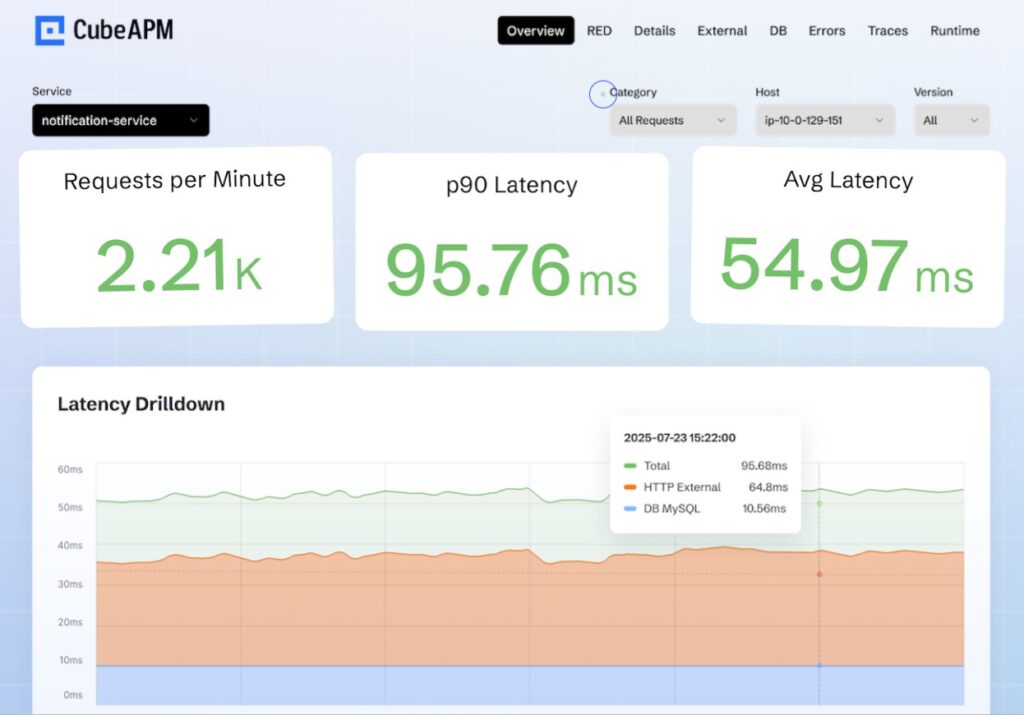
Best for: Teams that want full MELT observability with vendor-managed self-hosted deployment, predictable single-dimension pricing, and no per-responder or per-monitor charges.
Known for
CubeAPM is known for full-stack observability with a strong focus on pricing predictability and deployment control. It brings logs, metrics, traces, infrastructure monitoring, Kubernetes visibility, synthetic monitoring, RUM, and error tracking into one platform, replacing both Better Stack and a separate APM tool in a single deployment.
Recognized as a High Performer in G2’s Spring 2026 APM Grid Report and ranked #4 among the easiest-to-use APM tools on G2. Trusted by redBus (part of NASDAQ-listed MakeMyTrip, 8+ countries), Delhivery ($3.5B valuation), Mamaearth ($1.2B valuation), Policybazaar, Practo, and others.
Key features
- Full-stack unified monitoring: APM, logs, infrastructure, Kubernetes, Kafka, RUM, synthetic monitoring, error tracking
- OpenTelemetry-native, no proprietary agents; compatible with Prometheus, Datadog, and New Relic agents for incremental migration
- Self-hosted and BYOC deployment data sovereignty by design
- Data compliance: SOC 2 and ISO 27001 certified
- Unlimited data retention, no egress surprises, no extension costs
- AI-based trace sampling retains traces that matter while reducing storage overhead
- Direct engineering support via shared channel, not a ticket queue
Pros
- Simplest pricing model: $0.15/GB with no per-responder, per-monitor, or per-user dimensions
- Full MELT coverage replaces Better Stack plus a separate APM tool in one platform
- Consistently 70–75% lower cost than enterprise APM at scale
- Complete data ownership: no telemetry leaves your infrastructure
- Unlimited retention, predictable pricing, no egress charges
Cons
- Not suited for teams requiring off-premises SaaS
- Strictly an observability platform, no cloud security management
Pricing
- $0.15/GB ingested. No host charges. No user charges. No per-monitor charges. No per-responder charges. Unlimited retention.
CubeAPM vs Better Stack
Choose CubeAPM over Better Stack if you want full distributed tracing and APM alongside logs and uptime in one platform with pricing that does not compound across responders, monitors, status pages, and retention dimensions. Better Stack’s clean interface and fast incident alerting are genuine strengths for uptime-first teams, but it has no self-hosted deployment option, and its eBPF traces do not replace a full APM workflow. CubeAPM covers both in one vendor-managed, self-hosted platform at $0.15/GB flat.
2. Coralogix
Best for: Teams that want unified observability with strong log analytics, real-time investigation workflows, and predictable per-GB pricing without per-responder charges.
Known for
Coralogix is known for unified observability with strong analytics for modern cloud environments. Its Streama architecture processes telemetry in-stream rather than relying on traditional indexing, enabling faster analysis and more cost-efficient data management at scale.
Key features
- Unified logs, metrics, and traces
- Streama in-stream processing architecture
- Real-time analytics and investigation workflows
- Security observability and SIEM capabilities
- Cost optimisation controls
Pros
- Strong analytics depth, especially for log-heavy environments
- Streama reduces indexing overhead lowers cost at high log volumes
- No per-responder or per-monitor charges
- Unified coverage across logs, metrics, and traces
Cons
- Steep learning curve
- Initial setup can feel complex
- SaaS-only, no self-hosted deployment
Pricing
- Logs: from $0.42/GB
- Traces: $0.16/GB
- Metrics: $0.05/GB
Coralogix vs Better Stack
Choose Coralogix over Better Stack if your team needs deeper log analytics and faster investigation workflows at scale. Better Stack handles log management and uptime alerting, but Coralogix’s Streama architecture and richer query capabilities make it a stronger fit when logs are the primary investigation surface. Coralogix also includes distributed traces and metrics that without per-responder charges that stack as the team grows.
3. Datadog
Best for: Teams that need the broadest managed observability with deep Kubernetes monitoring, 900+ integrations, and one platform across infrastructure, APM, logs, and user experience.
Known for
Datadog is known for broad, cloud-native observability, combining infrastructure monitoring, APM, logs, RUM, security, and incident tooling. Datadog retains clear advantages in integration breadth, code-level profiling, HIPAA/FedRAMP compliance, and enterprise SIEM, as even Better Stack’s own comparison acknowledges.
Key features
- Unified infrastructure and application monitoring
- Distributed tracing and APM with code-level CPU profiling
- Log management with rehydration and archiving
- Synthetic monitoring
- 900+ integrations
Pros
- Broadest platform coverage: APM, logs, RUM, security, synthetics
- Strong Kubernetes and cloud monitoring
- Mature integrations, 900+
- HIPAA and FedRAMP compliance (Better Stack does not offer this)
Cons
- Costs rise quickly at scale across multiple products
- Multi-axis pricing is complex to forecast
- No self-hosted option
Pricing
- Infrastructure Pro: $15/host/month billed annually
- APM Pro: $35/APM host/month
- Log Management: from $0.10/GB ingested
Use the CubeAPM Datadog Pricing Calculator to enter your exact team size, host count, and telemetry volume and estimate what Datadog could cost in your environment.
Datadog vs Better Stack
Choose Datadog over Better Stack if your team needs HIPAA or FedRAMP compliance, code-level CPU profiling, or a mature Cloud SIEM, three areas Better Stack’s own comparison article explicitly concedes to Datadog. Better Stack is cheaper at minimum configuration; Datadog is the stronger fit when the full enterprise compliance and integration surface is required, or when teams need APM depth that Better Stack’s eBPF traces do not provide.
4. SigNoz
Best for: Teams that want OpenTelemetry-first observability with self-hosted deployment and full MELT visibility and have DevOps capacity to manage the ClickHouse backend.
Known for
SigNoz is an OpenTelemetry-native observability platform with flexible deployment and strong open-source presence. Often evaluated by teams that want unified logs, metrics, and traces without host-based or user-based pricing.
Key features
- Unified logs, metrics, and traces
- OpenTelemetry-native architecture
- Self-hosted and cloud deployment
- ClickHouse-based storage
- Correlated signals for debugging
Pros
- OpenTelemetry-native
- Flexible self-hosted deployment, true data residency
- No per-responder or per-user charges
- Strong open-source community
Cons
- Self-hosting requires managing ClickHouse backend: significant DevOps overhead
- Short default retention: 15 days for logs/traces extending costs more
- Steep learning curve
Pricing
- Community Edition: free to self-host
- Teams Cloud: from $49/month
- Traces: $0.30/GB
- Logs: $0.30/GB
- Metrics: $0.10/million samples
SigNoz vs Better Stack
Choose SigNoz over Better Stack if you want full OpenTelemetry-native observability logs, metrics, traces, and errors in one system with self-hosted deployment for data residency. Better Stack covers uptime and log management well but has no self-hosted option. SigNoz provides both, though teams should factor in the ClickHouse backend management overhead that comes with self-hosted deployment.
5. New Relic
Best for: Teams that want broad full-stack observability with APM, no host-based charges, and a managed platform supporting engineering and operations use cases at scale.
Known for
New Relic is known for full-stack observability, combining APM, infrastructure monitoring, logs, distributed tracing, browser monitoring, and incident workflows in one platform.
Key features
- Unified logs, metrics, and traces
- APM and infrastructure monitoring
- Browser and mobile monitoring
- Synthetic monitoring
- AI-assisted observability features
Pros
- Broad observability coverage
- Mature enterprise platform
- 100 GB free ingest per month
- No host-based charges
Cons
- User-based pricing adds cost as team grows
- Costs rise beyond free tier with telemetry volume
- Learning curve for new users
Pricing
- Free: 100 GB/month ingest
- Standard ingest: $0.40/GB
- Core users: $49/user/month
- Pro full platform: $349/user/year
Use the CubeAPM New Relic Pricing Calculator to enter your team size, data volume, and add-ons and estimate what New Relic could cost in your environment.
New Relic vs Better Stack
Choose New Relic over Better Stack if you want broader full-stack observability, APM, infrastructure metrics, and distributed tracing in a managed platform with 100 GB free ingest. Better Stack handles logs and alerting well, but New Relic includes distributed tracing, APM, and infrastructure monitoring as first-class capabilities rather than requiring a separate tool. Note that Better Stack does not carry per-user charges for unlimited team members, while New Relic’s user-based tiers add cost as the organization grows.
6. Dynatrace
Best for: Enterprise teams that want AI-assisted root cause analysis, topology-aware Kubernetes monitoring, and deep full-stack observability across complex distributed environments.
Known for
Dynatrace is known for enterprise-grade observability with Davis AI for automated root cause analysis and Smartscape for topology mapping. Often evaluated by organizations that want deep automation and broad platform coverage at scale.
Key features
- Full-stack application and infrastructure observability
- Davis AI for automated root cause analysis
- Kubernetes platform monitoring with Smartscape topology mapping
- Distributed tracing and log analytics
- Digital experience and security add-ons
Pros
- Best-in-class Kubernetes topology mapping
- Automated root cause analysis reduces MTTR in complex incidents
- Broad platform coverage
- Mature enterprise platform
Cons
- Expensive for smaller teams
- Complex configuration
- Steep learning curve
- Limited self-hosted option
Pricing
- Infrastructure Monitoring: $29/month per host
- Full-Stack Monitoring: $58/month per 8 GiB host
- Logs ingest and process: $0.20/GiB
Dynatrace vs Better Stack
Choose Dynatrace over Better Stack if you want deeper enterprise observability with AI-assisted root cause analysis built into the platform. Better Stack handles uptime monitoring and log alerts well, but Dynatrace is built around full-stack observability with automated dependency mapping that goes significantly further, making it the stronger fit when automated incident diagnosis across complex environments is the priority.
7. Sumo Logic
Best for: Teams that want observability and Cloud SIEM security analytics in one platform across cloud-native and multi-cloud environments.
Known for
Sumo Logic is known for unified observability and security analytics on a logs-first foundation. Often evaluated by teams that want one platform for monitoring, troubleshooting, log analytics, Cloud SIEM, and multi-cloud visibility.
Key features
- Unified logs, metrics, traces, and events
- Native OpenTelemetry onboarding
- APM and distributed tracing
- Kubernetes and multi-cloud observability
- Cloud SIEM and security analytics
- AI-driven alerting and automation
Pros
- Observability and security analytics in one platform
- Strong log analytics
- Native OpenTelemetry support
- Good fit for multi-cloud environments
- Unlimited users on paid plans
Cons
- Steep learning curve
- Costs can be high at scale
- SaaS-only
Pricing
- Estimated pricing: $3.14/TB scanned
Sumo Logic vs Better Stack
Choose Sumo Logic over Better Stack if your team needs Cloud SIEM and security event correlation alongside operational observability. Better Stack covers logs and uptime monitoring, but Sumo Logic adds security analytics and deeper log investigation workflows that Better Stack does not offer, making it a stronger fit for compliance-oriented environments where security data and monitoring need to live in the same platform.
Which Better Stack alternative is best for your use case?
- CubeAPM: A predictable price of $0.15/GB, with no per-responder, per-monitor, status-page, or retention stacking.
- Coralogix: Per GB per signal type, not per-user or per-responder charges.
- SigNoz: Per-GB ingestion, no host-based or user-based dimensions.
- CubeAPM: Vendor-managed in your cloud data residency, zero backend ops, SOC 2, and ISO 27001.
- SigNoz: Open-source, self-hosted, and the most flexible for teams with full DevOps capacity.
- CubeAPM: APM, distributed traces, infrastructure metrics, Kubernetes, RUM, synthetics, logs, and error tracking in one platform.
- Datadog: Broadest managed coverage infrastructure, APM, logs, RUM, and HIPAA compliance.
- Dynatrace: Full-stack with AI-assisted root cause analysis for enterprise environments.
- CubeAPM: Correlated pod/node/service metrics and logs via OpenTelemetry, one workflow during incidents.
- Dynatrace: Topology-aware Kubernetes monitoring with Davis AI for noise reduction.
- Datadog: Kubernetes Explorer and Service Map for mature managed coverage.
- Sumo Logic: Cloud SIEM and security event correlation alongside full observability.
- Coralogix: Security observability within a unified log analytics platform.
- Datadog: Deepest integration ecosystem (900+), HIPAA/FedRAMP, broadest cloud monitoring.
- New Relic: Mature full-stack observability with 100 GB free ingest and no host-based charges.
- Dynatrace: Enterprise automation, topology mapping, and AI root cause analysis.
Conclusion
Better Stack is a strong platform for teams whose primary need is clean uptime monitoring, incident alerting, and log management with fast setup. The ’30x cheaper than Datadog’ claim is accurate under minimum-configuration conditions, one responder, annual billing, European location, and a maximum-cost Datadog setup. For teams with multiple on-call engineers, extended retention requirements, and a need for distributed tracing, the effective cost advantage is materially smaller, and the lack of a self-hosted option remains a hard blocker for teams that want to take control over their own data and infra.
For teams evaluating alternatives because of pricing predictability, CubeAPM, Coralogix, and SigNoz are the strongest options; all use GB-based pricing without per-responder dimensions. For teams that need to consolidate from Better Stack plus a separate APM tool, CubeAPM and Datadog are the clearest paths. For teams in regulated industries, CubeAPM’s vendor-managed self-hosted model is the only option in this comparison that offers data residency without backend operations overhead.
Disclaimer: The information in this article reflects details available at the time of publication. Source links are provided throughout for all drawback claims.
FAQs
1. Why do teams look for Better Stack alternatives?
Two documented reasons: (1) Pricing stacks across per-responder, per-monitor, per-status-page, and retention dimensions, making costs hard to forecast as teams grow (G2: 22 ‘Missing Features’ tags, 13 ‘Pricing Issues’ tags). (2) SaaS-only deployment no self-hosted option for teams with data residency requirements.
2. Is Better Stack actually 30x cheaper than Datadog?
Under specific conditions, yes. Better Stack’s own pricing page footnote discloses the assumptions: 1 responder on the annual Tera bundle, European data location, and a Datadog configuration with high custom metrics and full span indexing. That is the minimum Better Stack configuration against a near-maximum Datadog configuration. Teams with multiple on-call engineers, extended log retention, or APM requirements will find the real cost difference significantly smaller, and some will find alternatives like CubeAPM cheaper than Better Stack itself.
3. What are the biggest documented limitations of Better Stack?
Sourced from independent reviews: (1) Per-responder pricing at $29/month each stacks as the team grows. Hyperping analysis identifies this as the primary reason teams leave. (2) No self-hosted Option: Capterra reviewers cite this explicitly as the reason they looked elsewhere. (3) No unified cross-team dashboard; teams must switch context manually during incidents.
4. Which Better Stack alternative is best for predictable pricing?
CubeAPM is the strongest option with a predictable pricing of $0.15/GB with no per-responder, per-monitor, or stacking-retention charges. Coralogix and SigNoz also use GB-based pricing without per-responder dimensions. Adding engineers to on-call rotations or scaling monitor counts does not directly increase their bill.
5. Is there a self-hosted Better Stack alternative?
Yes. CubeAPM runs inside your own AWS, GCP, or Azure environment and is fully managed by the CubeAPM team, guaranteeing data residency without backend operations overhead. SigNoz is the best fully open-source, self-managed option for teams with dedicated DevOps capacity. Datadog, New Relic, Sumo Logic, and Coralogix do not offer self-hosted deployment.
6. How does Better Stack pricing compare to CubeAPM at real team scale?
At a growing-team profile (~13 TB/month, 60 hosts): CubeAPM ~$2,080/month vs Better Stack ~$5,723, 64% less. At mid-market profile (~45 TB/month, 200 hosts): CubeAPM ~$7,200 vs Better Stack ~$20,550, 65% less. Better Stack’s per-responder and per-monitor dimensions stack on top of data costs, while CubeAPM uses a single GB rate regardless of team size or monitor count and includes full distributed tracing, which Better Stack cannot provide natively at any price tier.