










Honeycomb built its reputation on high-cardinality, event-based observability. It is still a strong choice for teams that want deep trace analysis and fast investigation of structured telemetry.
The observability market is growing fast. The observability tools and platforms market was estimated at $2.71 billion in 2023 and is projected to reach $5.40 billion by 2030, growing at a 10.7% CAGR from 2024 to 2030. That growth has given teams more alternatives with broader platform coverage and different pricing models.
That matters because teams evaluating Honeycomb today are comparing more than tracing depth. They are also looking at pricing predictability, logs, metrics, deployment flexibility, and long-term portability. Honeycomb still uses event-volume pricing, with Pro starting at $130 per month for 100 million events, while many alternatives now compete on GB-based pricing, full-stack coverage, or self-hosted deployment models.
Top 8 Honeycomb alternatives
- CubeAPM
- Datadog
- Grafana Cloud
- New Relic
- Dynatrace
- SigNoz
- Elastic Observability
- Coralogix
Quick comparison table: Best Honeycomb alternatives at a glance
Disclaimer: The estimated monthly costs in this table are directional figures based on our internal pricing sheet and scenario assumptions. Actual costs will vary by usage, retention, deployment, contract terms, and add-ons. Pricing predictability ratings are editorial assessments of each vendor’s pricing structure and should be treated as comparative guidance, not fixed benchmarks.
| Tool | Pricing (Small/Mid/Large) | OTelNative | Self-Hosting | Pricing Predictability | Pricing Model |
|---|---|---|---|---|---|
| CubeAPM | $2,080 / $7,200 / $15,200 | Yes | Yes (vendor-managed) | High | Flat $0.15/GB |
| Honeycomb | $3,900 / $11,600 / $24,200 | Yes | Yes | Moderate | Per ingested event |
| Datadog | $8,185 / $27,475 / $59,050 | Partial | No | Low | Per host + per span + per GB |
| Grafana Cloud | $0 (OSS) / $1,800+ Cloud | Yes | Yes | Moderate | Free OSS/Cloud usage |
| New Relic | $7,896 / $25,990 / $57,970 | Partial | No | Moderate | Data ingest + user tiers |
| Dynatrace | $7,740 / $21,850 / $46,000 | Partial | Limited | Low | Per host, multi-dimensional |
| SigNoz | $4,600 / $16,000 / $34,000 | Yes | Yes | Moderate | Ingestion-based + usage-based |
| Elastic APM | $4,550 / $17,435 / $35,370 | Partial | Yes | Moderate | OSS free / Cloud per GB |
| Coralogix | $4,090 / $13,200 / $29,000 | Yes | No | Moderate | Per-GB by signal type |
The Event-Pricing Problem: Why Honeycomb Gets Expensive During Incidents
Honeycomb charges per ingested event. That pricing model has a structural problem that most teams discover too late: your observability costs are highest when you can least afford distractions.
During a production incident, event volume spikes because traffic is anomalous, errors are multiplying, and you’re adding more instrumentation to understand what’s happening. With event-based pricing, this is precisely when your Honeycomb bill accelerates. You are financially penalized for doing more observability exactly when observability matters most.
The standard advice is to implement sampling, specifically Honeycomb’s Refinery tail-based sampler. But this introduces its own problems:
- Aggressive sampling means you miss rare events; the slowest 0.1% of requests may not be sampled.
- Refinery is a separate component requiring deployment, sizing, and ongoing maintenance.
- Sampling rules that looked correct last quarter may be wrong as traffic patterns change.
Retention across Honeycomb alternatives: What stays accessible, and for how long
Retention can change the real cost of an observability platform more than most buyers expect. Two tools may look similar in pricing at first, but the picture shifts once you factor in how long logs, traces, and metrics remain available by default; how far retention can be extended; and whether longer history brings extra cost.
This creates a practical limitation for:
- Teams with seasonal traffic patterns
- Businesses that do quarterly release reviews
- Regulated environments that need longer operational history
- Engineering orgs investigating problems that build slowly over months
Assumption for illustration: telemetry kept beyond the default window adds about $20–$35 per TB-month in storage and retrieval costs, excluding engineering time. This is a directional model for the article, not a Honeycomb-published rate. Honeycomb documents the 60-day default window, but not a simple public per-TB price for extended retention.
| Team Profile | Monthly | Retention target | Data kept beyond default window | Modeled added monthly cost | Modeled added annual cost |
| Small team | 3 TB | 90 days | 3 TB extra | $60–$105 | $720–$1,260 |
| Growing team | 10 TB | 180 days | 40 TB extra | $800–$1,400 | $9,600–$16,800 |
| Mid-market team | 25 TB | 240 days | 150 TB extra | $3,000–$5,250 | $36,000–$63,000 |
| Enterprise team | 50 TB | 365 days | 500 TB extra | $10,000–$17,500 | $120,000–$210,000 |
The hidden cost of self-managed operational overhead
Honeycomb’s self-managed Private Cloud option gives teams full infrastructure control, but it also shifts most operational responsibility to the customer. Honeycomb’s deployment docs say the customer owns provisioning, installation, upgrades, monitoring, scaling, backup and disaster recovery, security management, and integrations. Honeycomb also labels the operational overhead for this model as medium to high.
Assumption for illustration: the table below uses a blended engineering cost of $80–$120 per hour to show the operational impact of running a self-managed observability backend. These are directional scenario estimates for the article, not Honeycomb-published costs. Actual overhead depends on team maturity, infrastructure complexity, deployment size, and compliance requirements.
| Operational area | What the team owns in a self-managed model | Estimated hours/month | Modeled monthly cost |
| Infrastructure provisioning | Set up and size the cloud resources needed to run Honeycomb components | 2-4 hrs | $160–$480 |
| Installation and configuration | Deploy the platform, configure components, and validate the setup. | 2-3 hrs | $160–$360 |
| Upgrades and updates | Apply release packages, test changes, and manage rollout timing | 3-5 hrs | $240–$600 |
| Monitoring and incident response | Watch platform health and respond when the observability backend has issues | 4-6 hrs | $320–$720 |
| Scaling and capacity planning | Adjust resources as telemetry volume grows or traffic patterns shift | 2-4 hrs | $160–$480 |
| Security and compliance management | Patch systems, maintain controls, and support internal compliance needs | 2–4 hrs | $160–$480 |
How We Evaluated Honeycomb Alternatives
This section describes the methodology used to evaluate and compare the 11 alternatives in this guide. We applied a consistent framework across all tools so that comparisons are apples-to-apples.
Evaluation Criteria
We assessed how each platform bills per host, per GB, per event, or per data point and examined how costs behave under variable load conditions (specifically, do costs spike during incidents?). We sourced pricing from official vendor pricing pages and verified against third-party analyses where available.
We assessed whether each platform natively covers all four observability pillars: Metrics, Events, Logs, and Traces (MELT), or requires external tooling to fill gaps. A tool rated ‘full MELT’ means it ingests and queries all four signal types within a single platform without requiring a sidecar tool or secondary billing account.
We evaluated whether each platform supports self-hosting or Bring-Your-Own-Cloud (BYOC) or is SaaS only. This is a hard requirement for regulated industries (fintech, healthcare, and government) under frameworks such as HIPAA, GDPR, and PCI DSS.
We assessed each tool’s OTel-nativeness: Does it accept OTLP natively, support OTel Collector pipelines, and avoid requiring proprietary agents or SDKs? Full OTel-nativeness reduces instrumentation lock-in and enables migration with minimal re-instrumentation.
For high-volume environments, we assessed whether tail-based sampling is built-in or requires a separate component. Honeycomb’s Refinery, for example, is a separate proxy requiring its own cluster deployment and tuning, a real operational cost.
We assessed the quality of built-in alerting (threshold triggers, anomaly detection, SLO-based alerts) and dashboard capability. This was assessed using G2 and Gartner Peer Insights reviews, vendor documentation, and direct feature comparisons.
Real-world scenarios: Which Honeycomb alternative fits best?
How to find your scenario
| Primary reason for evaluating alternatives | Key requirement | Likely best fit | Why |
|---|---|---|---|
| Honeycomb bill is unpredictable at event scale | Cost control, no per-event billing | CubeAPM or SigNoz | Flat GB pricing; no event-count spikes during incidents |
| Need longer retention and better historical access | Longer default retention or easier long-term history | CubeAPM, Coralogix, or Dynatrace | CubeAPM, Coralogix, or Dynatrace | Longer retention options than Honeycomb |
| Data sovereignty / self-hosted requirement | Data stays in your cloud | CubeAPM (vendor-managed) or SigNoz | Offer stronger self-hosted, BYOC, or customer-controlled deployment models |
| Need a broader observability platform around traces | Logs, metrics, traces, and wider platform coverage | CubeAPM, Datadog, or New Relic | All three are positioned as broader, full-platform observability suites |
| Need better alerting and dashboards | Production-grade alerting & UX | CubeAPM, Datadog, or Grafana | These tools are widely adopted for broader operational monitoring workflows |
Scenario 1: Growing team where Honeycomb event costs are accelerating
The situation: You are a cloud-native team with 60 services instrumented for distributed tracing. Honeycomb was the right choice at early scale, but event volumes have grown faster than budgets. Your last two incidents produced unexpected Honeycomb bills. You have also started running Prometheus for infrastructure metrics and are manually correlating those dashboards with Honeycomb traces during incidents.
Reference profile
- Data ingested: ~13 TB/month (6 TB traces-equivalent, 4 TB logs, 3 TB metrics)
- Infrastructure: 60 hosts
- Users: 4 engineers (active platform users)
- Retention: 30 days
- Scope: Core observability: APM + logs + metrics + distributed tracing
Approximate monthly costs for a growing team
Disclaimer: Estimated costs come from our internal pricing sheet. Ops-overhead ratings are simplified comparison summaries based on public vendor documentation and deployment models, so they should be treated as directional, not absolute benchmarks.
| Tool | Est. Monthly Cost | vs Honeycomb ($3,900) | Self-hosted | Ops Overhead |
|---|---|---|---|---|
| CubeAPM | $2,080 | -47% | Yes (vendor-managed) | Low |
| Honeycomb Pro | $3,900 | — | Yes, but requires managing infra provisioning | High |
| SigNoz | $4,600 | +18% | Yes, but requires managing ClickHouse | High |
| Coralogix | $4,090 | +5% | No | Low |
| Dynatrace | $7,740 | +98% | Partial | Low-moderate |
| New Relic | $7,896 | +102% | No | Low |
| Datadog | $8,185 | +110% | No | Low |
| Elastic Observability | $4,550 | +17% | Yes | Moderate |
| Grafana | $3,870 | -1% | Yes | High |
- CubeAPM: Flat $0.15/GB eliminates the event-based billing spike problem entirely. Full-stack unified monitoring, APM, logs, infrastructure, and Kubernetes in one platform. Single billing dimension, no cost surprises during incidents. Documented customer outcomes after migrating to CubeAPM: Delhivery achieved 75% cost savings replacing three monitoring tools; redBus reported 50% faster MTTR.
- SigNoz: Best fit when the team wants to cut observability software spend as much as possible while keeping an OpenTelemetry-native setup. It can reduce the pricing pressure created by Honeycomb’s event model.
- Coralogix: Best fit when rising telemetry volume is making storage and processing efficiency a bigger cost issue. In this scenario, its Streama architecture is relevant because the team is not only looking for observability features but also better cost control as data volume grows.
Scenario 2: Mid-market team needing full observability, and long-term retention
The situation: Your organization runs around 200 services. Honeycomb still offers a strong, unified observability experience, but at mid-market scale, the evaluation shifts from feature coverage to economics and operating models. The key questions become how predictable pricing stays as event volume grows, how retention affects long-range investigations, and whether the deployment model fits your team’s compliance and operational needs.
Reference profile
- Data ingested: ~45 TB/month (20 TB logs, 15 TB traces-equivalent, 10 TB metrics)
- Infrastructure: 200 hosts
- Users: 10 platform users
- Retention: 30 days
- Scope: Core observability logs + metrics + traces + alerting
Approximate monthly costs for a mid-market team
Disclaimer: Estimated costs come from our internal pricing sheet. Ops-overhead ratings are simplified comparison summaries based on public vendor documentation and deployment models, so they should be treated as directional, not absolute benchmarks.
| Tool | Est. Monthly Cost | vs Honeycomb ($11,600) | Self-hosted | Ops Overhead |
|---|---|---|---|---|
| CubeAPM | $7,200 | -38% | Yes (vendor-managed) | Low |
| Honeycomb | $11,600 | — | No | High |
| SigNoz | $16,000 | +38% | Yes, but requires managing infra provisioning | High |
| Coralogix | $13,200 | +14% | Yes, but requires managing ClickHouse | High |
| Dynatrace | $21,850 | +88% | Partial | Low-moderate |
| New Relic | $25,990 | +124% | No | Low |
| Datadog | $27,475 | +137% | No | Low |
| Elastic Observability | $17,435 | +50% | Yes | Moderate |
| Grafana | $11,875 | +2% | Yes | High |
- CubeAPM: Best fit when the team wants a more predictable cost model, longer retention, and lower operational overhead without giving up unified observability. In this scenario, it is a strong option because the evaluation has moved beyond tracing alone.
- Elastic Observability: In this scenario, Elastic is relevant because retention is policy-driven rather than fixed to one short default window, and teams can choose self-managed, hosted, or serverless models depending on compliance and operating needs. Elastic’s pricing also separates ingest and retention, which is useful for teams that want to reason about long-term storage costs more explicitly.
- New Relic: Strong fit when the team wants a managed platform with more retention flexibility than a fixed short default window. It works better in this scenario when the organization is comfortable staying fully managed but wants more options for longer-term data access.
Scenario 3: Enterprise team with data sovereignty requirements
The situation: Your organization operates in a regulated industry, such as fintech, healthcare, or government. You evaluated Honeycomb and were impressed by the trace exploration capability. Trace data includes request parameters, user session identifiers, and system internals. Sending that data to a third-party SaaS platform is either prohibited or requires a compliance review cycle that will last 18 months.
Reference profile
- Deployment requirement: Data must remain in own cloud infrastructure (BYOC or self-hosted)
- Compliance: HIPAA / GDPR / SOC 2 / internal data residency policy
- Infrastructure: 150+ hosts across AWS/GCP
- Key requirement: Full distributed tracing + logs + infrastructure metrics, all on-prem or BYOC
- CubeAPM: Vendor-managed BYOC deployment full observability stack runs inside your own cloud VPC. No data egress, no third-party data access. SOC 2 and ISO 27001 certified. It is also vendor-managed, so the operations such as scaling and tuning is managed by the CubeAPM team.
- SigNoz: Open-source self-hosted. Complete data control. Requires ClickHouse infrastructure management but zero licensing cost and no third-party data dependency.
- Elastic APM (self-hosted): For teams already on the ELK stack, adding APM traces keeps everything in-house. Well-established self-hosted deployment model.
Scenario takeaway
Growing teams may start comparing Honeycomb more closely when event-based pricing becomes harder to forecast as telemetry volume rises. Mid-market teams often evaluate alternatives when retention limits, pricing structure, and deployment model start to matter as much as product capability. Regulated or security-conscious teams may also prefer platforms that let them keep observability data inside their own environment.
The 8 best Honeycomb alternatives in 2026
1. CubeAPM
Best for: Teams that want full-stack observability with vendor-managed self-hosting, flat pricing that doesn’t spike during incidents, and OpenTelemetry-native coverage across APM, logs, metrics, and Kubernetes all as a direct replacement for the Honeycomb + Prometheus + log tool combination.
Known for
CubeAPM is a self-hosted, vendor-managed, OpenTelemetry-native observability platform covering APM, distributed tracing, logs, infrastructure monitoring, Kubernetes, RUM, synthetic monitoring, Kafka monitoring, and error tracking. It runs inside your cloud: no data egress, no vendor lock-in, and no event-count billing surprises.
Recognized as a High Performer in G2’s Spring 2026 APM Grid Report and ranked #4 among the easiest-to-use APM tools on G2. Trusted by redBus (part of NASDAQ-listed MakeMyTrip, 8+ countries), Delhivery ($3.5B valuation), Mamaearth ($1.2B valuation), Policybazaar, Practo, and others.
Key features
- Full-stack unified monitoring: APM, logs, infrastructure, Kubernetes, Kafka, RUM, synthetic monitoring, error tracking
- OpenTelemetry-native, no proprietary agents; compatible with existing Prometheus, Datadog, and New Relic agents for incremental migration
- Vendor-managed BYOC deployment data sovereignty by design, no SaaS egress
- SOC 2 and ISO 27001 certified
- Unlimited data retention with no event-count accumulation
- AI-based trace sampling that retains traces that matter
- Direct engineering support via shared channel, not a ticket queue
Pros
- 70–75% lower cost than enterprise APM at scale, single billing dimension
- Replaces the Honeycomb + Prometheus + log tool combination with one platform
- Complete data ownership: no telemetry leaves your infrastructure
- Multi-agent compatible works alongside Datadog, New Relic, and Prometheus agents during migration
Cons
- Not suited for teams requiring fully off-premises third-party SaaS
- Strictly an observability platform no cloud security management or SIEM
Pricing
$0.15/GB ingested. No host charges. No user charges. No per-event charges. No per-node charges. Unlimited retention.
CubeAPM vs Honeycomb
CubeAPM is a stronger Honeycomb alternative for teams that want more predictable pricing and more control over deployment. Honeycomb is a capable unified observability platform, but its event-based pricing and fixed 60-day default retention can become harder to manage as telemetry volume grows. CubeAPM uses flat $0.15/GB pricing, includes unlimited retention on Enterprise, and supports vendor-managed BYOC deployment, which makes it a better fit for teams that care about cost stability, longer history, and keeping data inside their own environment.
2. Datadog
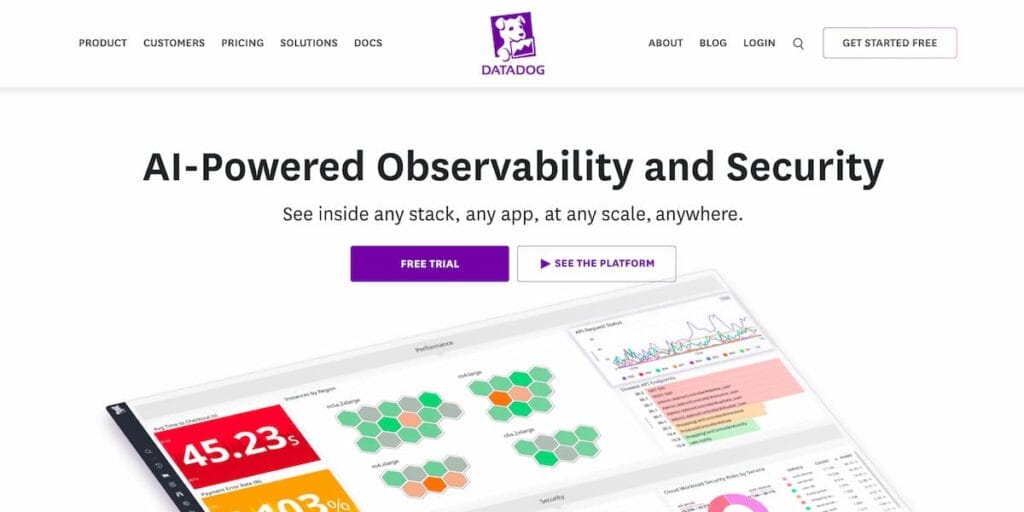
Best for: Mid-to-large engineering organizations that need one platform for metrics, logs, traces, security, and RUM and are willing to pay a premium for the broadest managed coverage available.
Known for
Datadog is the dominant full-stack observability platform. Where Honeycomb excels at trace exploration, Datadog excels at everything being connected: APM, infrastructure monitoring, log management, synthetic monitoring, SLO tracking, cloud security, RUM, and 1000+ integrations all in one cohesive product.
Key features
- 1000+ integrations including deep AWS, GCP, and Azure connectors
- Infrastructure monitoring, full APM, log analytics
- Distributed tracing with flame graphs, service maps, and anomaly detection
- AI-driven anomaly detection (Watchdog)
- Security monitoring and compliance tooling
Pros
- Most feature-complete managed observability platform available
- Best-in-class dashboarding, UX, and collaboration features
- Strongest AWS, Kubernetes, and cloud-native integration depth
Cons
- Complex multi-dimensional pricing per host, per custom metric, per indexed log
- Steep learning curve
- Expensive at scale
Pricing
- APM Pro: $31/host/month
- Infrastructure: $15/host/month
- Logs: $0.10/GB ingested + indexing charges
Datadog vs Honeycomb
Choose Datadog over Honeycomb when you need unified logs, metrics, traces, and security in one managed platform and are comfortable with the higher cost. Datadog does offer high-cardinality trace analysis, though its approach differs from Honeycomb’s columnar event model. For most teams, the broader coverage is worth the tradeoff.
3. Grafana Stack (LGTM)
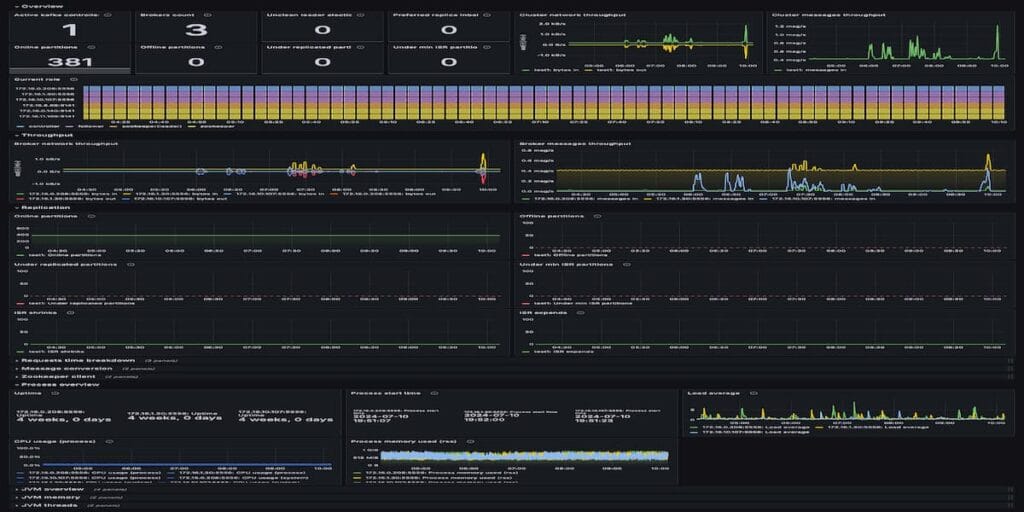
Best for: Teams with DevOps maturity who want maximum control, open-source freedom, and zero vendor lock-in at near-zero licensing cost.
Known for
Grafana, Loki (logs), Grafana (visualization), Tempo (traces), and Mimir (metrics) are the most powerful open-source observability stacks available. It covers all three observability pillars natively and is fully OpenTelemetry-compatible. Grafana Cloud offers a managed version with a generous free tier.
Key features
- Loki for cost-effective, label-based indexing of logs
- Tempo for distributed traces integrates directly with Grafana panels
- Mimir for scalable Prometheus-compatible metrics
- Grafana dashboards: the legendary industry standard for visualization
Pros
- Fully open-source, zero licensing cost when self-hosted
- Native OpenTelemetry support across Tempo and Loki
- Grafana Cloud’s free tier is genuinely generous for small teams
Cons
- Setup complexity: coordinating four separate components requires operational maturity
- Steep learning curve
- Grafana Cloud gets expensive at scale
Pricing
- Free: $0, with 14 days of retention.
- Pro: from $19/month + usage.
- Metrics: $6.50 per 1,000 series on Pro.
- Logs: $0.05/GB process, $0.40/GB write, and $0.10/GB retain on Pro.
- Traces: $0.05/GB process, $0.40/GB write, and $0.10/GB retain on Pro.
Grafana Stack vs Honeycomb
Choose Grafana Cloud over Honeycomb when you want a managed observability platform built around the Grafana ecosystem, with strong dashboarding, flexible signal correlation, and a pricing model based on telemetry usage rather than event counts. Honeycomb is still a strong unified observability platform, but its pricing is tied to event volume, with Pro starting at $130 per month for 100 million events. Grafana Cloud may be more attractive for teams already invested in Grafana workflows or those that want 13-month metrics retention and 30-day logs and traces on paid plans.
4. New Relic
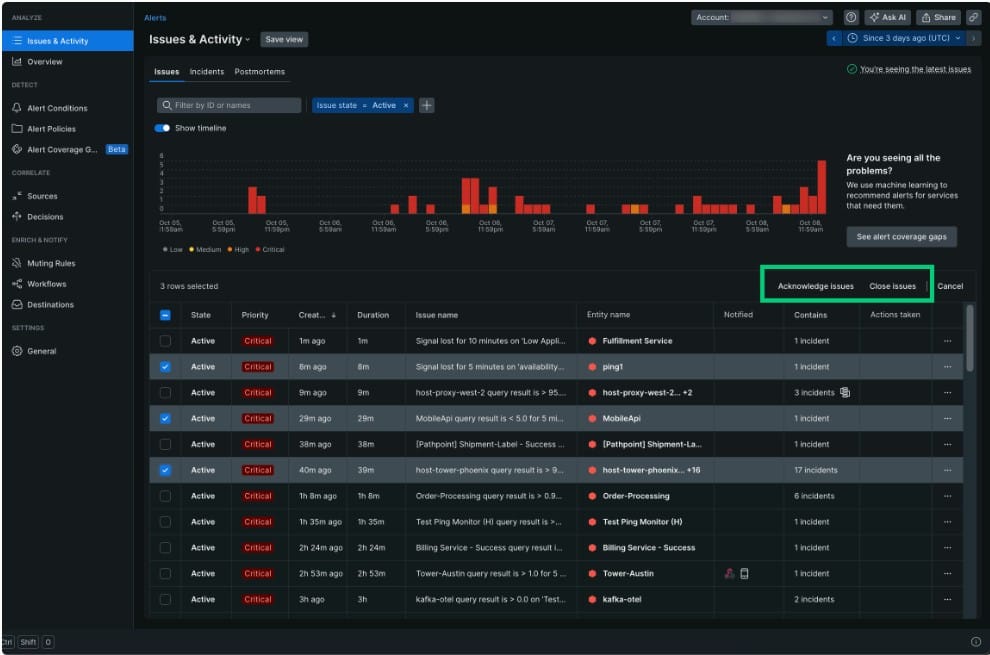
Best for: Small to mid-sized teams wanting comprehensive full-stack APM with a generous free tier and unlimited users on paid plans.
Known for
New Relic underwent a significant business model shift, moving to consumption-based pricing with unlimited users, which substantially improved its value proposition. The platform covers APM, infrastructure, browser monitoring, synthetic testing, distributed tracing, and log management all in one unified telemetry data platform.
Key features
- Full-stack monitoring: APM, infrastructure, RUM, synthetics, mobile
- 100 GB free ingest per month
- Unlimited users on all plans (only data ingest is billed)
- NRQL for powerful cross-signal querying and dashboarding
- Strong distributed tracing with flamegraph visualization
Pros
- Unlimited users prevents the per-seat bloat common in enterprise observability
- 100 GB free ingest is substantially more generous than Honeycomb’s free tier
- Strong APM and end-user experience monitoring alongside traces
Cons
- High-volume ingest can become expensive at scale
- Users often struggle with the complexity of setup and navigation
- Steep learning curve
Pricing
- Free: 100 GB/month
- Pro: $0.40/GB beyond 100 GB
- Full Platform user: $349/user (annual)
New Relic vs. Honeycomb
New Relic is a stronger Honeycomb alternative for teams that want broader retention options and a more conventional full-stack platform around logs, metrics, traces, and user-facing monitoring. Honeycomb is still strong for event-based investigation, but its pricing is tied to event volume and its standard dataset retention is 60 days for most customers. New Relic gives teams more flexibility around data retention, including Data Plus and Live Archives, but its own pricing can also become expensive as ingest grows.
5. Dynatrace
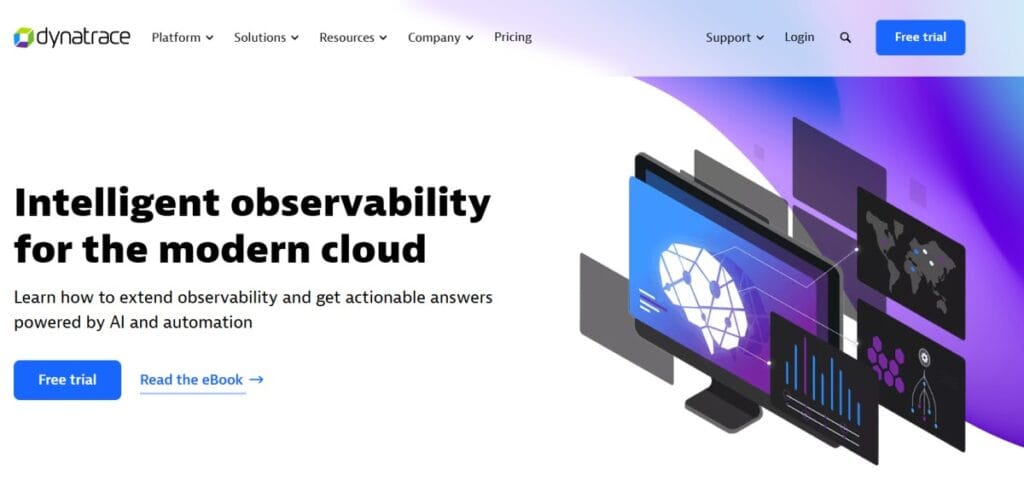
Best for: Large enterprises running complex hybrid and multi-cloud environments where automated root cause analysis and AI-driven noise reduction are worth the premium.
Known for
Dynatrace differentiates itself through Davis AI, its causal AI engine, which automatically detects anomalies, correlates problems across the full stack, and surfaces probable root causes. For teams frustrated by Honeycomb’s manual BubbleUp workflow, Davis AI provides a comparable capability but fully automated and covering infrastructure, logs, and traces simultaneously.
Key features
- Davis AI for automated root cause analysis, the closest enterprise equivalent to Honeycomb’s BubbleUp
- OneAgent auto-instrumentation eliminates manual SDK configuration
- Full-stack visibility: APM, infrastructure, logs, RUM, synthetics
- Automatic dependency mapping (Smartscape)
- Strong Kubernetes and cloud-native support
Pros
- Davis AI reduces MTTD without requiring engineers to know what to look for.
- OneAgent reduces instrumentation overhead significantly at enterprise scale
- Deep hybrid cloud visibility across on-prem and multi-cloud
Cons
- Premium pricing among the most expensive in the category
- Users find the UI to be cluttered and overwhelming
- Complexity of instrumentation with legacy technologies and the UI is challenging
Pricing
- Infrastructure Monitoring: $29/month per host
- Full-Stack Monitoring: $58/month per 8 GiB host
Dynatrace vs Honeycomb
Dynatrace is a stronger Honeycomb alternative for large teams that want broader enterprise observability, longer built-in retention options, and more automated root-cause analysis. Honeycomb remains strong for event-based investigation and high-cardinality observability, but Dynatrace is better suited to organizations that want deeper infrastructure coverage, AI-assisted troubleshooting through Davis, and a platform designed for large hybrid and multi-cloud environments.
6. SigNoz
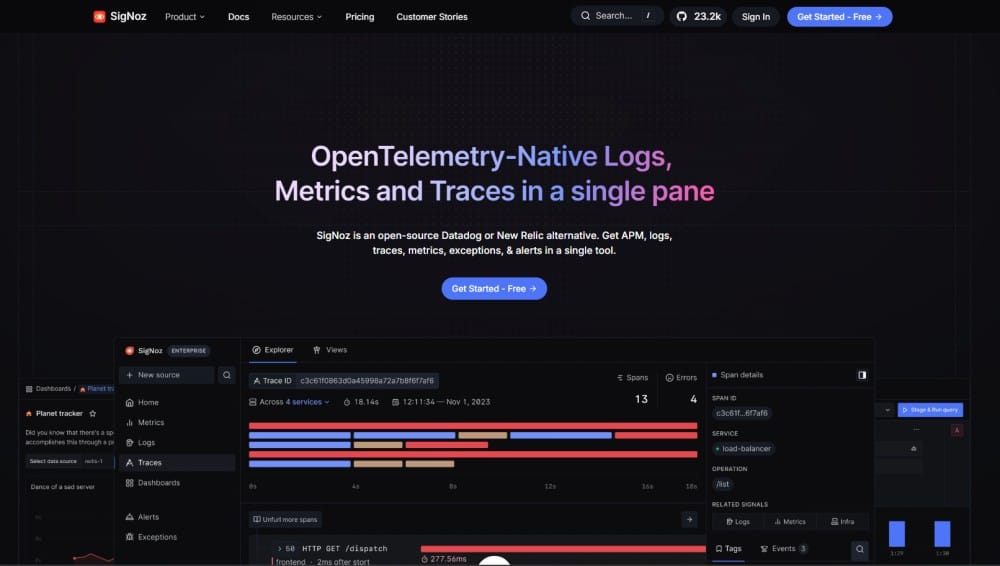
Best for: Startups and mid-sized teams wanting a self-hosted, OpenTelemetry-native alternative to Honeycomb with no licensing cost and full data control.
Known for
SigNoz is an open-source observability platform built around OpenTelemetry and ClickHouse. It is one of the closest structural alternatives to Honeycomb for teams that want an OpenTelemetry-native product with unified logs, metrics, and traces but with an open-source deployment model and less workflow lock-in.
Key features
- Fully open-source (MIT licensed) self-host at zero licensing cost
- OpenTelemetry-native: same data model, no proprietary adapters
- ClickHouse backend delivers fast high-cardinality queries comparable to Honeycomb
- Logs, metrics, and traces in one platform
- Clean, modern UI with correlated signal navigation
Pros
- OpenTelemetry-native, with strong standards-based portability.
- Open-source and self-hostable, with full data control.
- Unified observability across logs, metrics, and traces.
Cons
- Self-hosting requires ClickHouse operational expertise
- SigNoz Cloud adds cost for teams that prefer managed hosting
- SigNoz Cloud gets expensive as data volumes grow
Pricing
- Self-hosted: free (open-source)
- Logs: $0.30/GB ingested beyond included usage.
- Traces: $0.30/GB ingested beyond included usage.
- Metrics: $0.10 per million samples beyond included usage.
SigNoz vs Honeycomb
SigNoz is a stronger Honeycomb alternative for teams that want more deployment flexibility, whether that means self-hosting or using SigNoz Cloud. It is built around OpenTelemetry and gives teams a more open deployment model than Honeycomb, while still covering logs, metrics, and traces in one platform. Honeycomb remains strong for unified observability and event-based investigation, but SigNoz can be more attractive for teams that want to avoid event-based pricing or keep the option to self-host later.
7. Elastic Observability (ELK Stack)
Best for: Teams already invested in Elasticsearch who want to add APM traces to an existing log-centric observability stack.
Known for
The Elastic Observability suite extends the ELK Stack with APM, uptime monitoring, and distributed tracing. For teams whose primary observability need is log analysis, Elastic is among the most capable platforms available, with full-text search capabilities unmatched in the category.
Key features
- Best-in-class full-text log search and analytics
- Mature APM with distributed tracing and service maps
- Machine learning anomaly detection for logs and metrics
- Self-hosted (free) or managed via Elastic Cloud
Pros
- Log management depth that directly addresses one of Honeycomb’s hardest gaps
- Free and open-source when self-hosted
- Strong compliance and audit logging capabilities
Cons
- Users find the lack of proper filtering and log integration challenging
- Users find the learning curve steep
Pricing
Self-hosted (open-source): free. Elastic Cloud: from $95/month for Standard.
Elastic Observability vs Honeycomb
Elastic Observability is a stronger Honeycomb alternative for teams that want more control over retention and deployment, especially if they already use Elasticsearch or need flexible self-managed and cloud-hosted options. Honeycomb remains a strong unified observability platform, but Elastic is easier to position for log-heavy environments and for teams that want policy-based retention instead of Honeycomb’s standard 60-day dataset window for most customers.
8. Coralogix
Best for: Teams with high log volumes needing intelligent cost management and ML-powered log analytics.
Known for
Coralogix stands out for its Streama architecture, which processes telemetry in-stream before storage and indexing decisions are made. Coralogix says this reduces indexing delays, speeds up alerting, and helps lower observability costs by routing and analyzing data while it is still in motion. That makes it especially relevant for teams that care about log-heavy observability economics and want more control over how data is processed, stored, and queried.
Key features
- Streama in-stream processing route and filter logs before indexing
- ML-powered log clustering and anomaly detection
- Full APM and distributed tracing on top of log analytics
- Dynamic data routing with customer-cloud archival to your own S3
Pros
- Smart log routing tiers reduce storage costs by up to 70%
- ML clustering surfaces log patterns automatically
- SOC 2 Type II and HIPAA compliant
Cons
- Not suited for teams looking for self-hosted options
- UI can feel overwhelming for those new to observability
- Steeper learning curve for teams new to the Streama model
Pricing
- Logs: $0.42/GB
- Traces: $0.16/GB
- Metrics: $0.05/GB
Coralogix vs Honeycomb
Coralogix is a stronger Honeycomb alternative for teams that care a lot about log-heavy observability economics and real-time data processing. Coralogix’s Streama architecture analyzes logs, metrics, traces, and security events in-stream as data arrives, which Coralogix says helps reduce indexing delays, speed up alerting, and lower storage overhead. Honeycomb is still strong for unified observability and event-based investigation, but Coralogix can be more attractive for teams that want more control over how telemetry is routed, stored, and queried at scale.
Which Honeycomb alternative is best for your use case?
- CubeAPM: OpenTelemetry-native with lower operational overhead through vendor-managed BYOC.
- SigNoz: Strong fit for teams that want OpenTelemetry-first observability with self-hosting or SigNoz Cloud.
- New Relic: A broad managed platform with solid OpenTelemetry support and more retention flexibility.
- CubeAPM: Flat $0.15/GB pricing makes costs easier to forecast as telemetry grows.
- Grafana Cloud: Can be competitive for smaller teams, especially if usage stays controlled.
- SigNoz: A free self-hosted option and a paid cloud path make it attractive for teams watching spend closely.
- CubeAPM: Strong fit for teams that want vendor-managed BYOC and tighter data control.
- SigNoz: Good option for teams that want full self-hosting and full ownership of their environment.
- Elastic Observability: Strong choice for teams that need self-managed deployment and policy-based retention control.
- CubeAPM: Unlimited retention on Enterprise makes it strong for long-range historical visibility.
- Coralogix: Markets infinite retention, which is attractive for teams that want long-lived telemetry access.
- Dynatrace: Offers much longer retention options than many tools, including extended windows for logs and traces.
- CubeAPM: Best fit when teams want customer-controlled deployment without taking on full self-managed platform work.
- Grafana Cloud: Managed option for teams that want to avoid running the stack themselves.
- New Relic: Managed platform that keeps most backend operations off the customer team.
- Coralogix: Strong fit for teams focused on log economics and in-stream data processing through Streama.
- Elastic Observability: Better suited to search-heavy and log-centric workflows.
- Datadog: Strong managed option for teams that want logs tightly tied to a broader observability platform.
Migrating from Honeycomb: What to expect
Migration is usually easier when your telemetry is already based on OpenTelemetry. In that case, much of the hard work, especially instrumentation, is already in place, and the move is often more about updating exporters, endpoints, and pipeline configuration than rewriting application code.
If your services are already instrumented with OpenTelemetry, moving from Honeycomb to another OTLP-compatible platform like CubeAPM is often mostly a configuration change. In many cases, teams can keep the instrumentation code and update where telemetry is sent instead.
Honeycomb’s Beelines are legacy SDKs that reached end of life on August 12, 2025, and Honeycomb recommends migrating from Beelines to OpenTelemetry. Teams still using those SDKs will usually need to replace them with OpenTelemetry instrumentation before moving to a more vendor-neutral setup.
Honeycomb-specific queries, derived columns, dashboards, and sampling workflows generally do not move over one-to-one. Teams should expect to rebuild at least part of the investigation workflow in the target platform, even when the underlying telemetry remains portable through OpenTelemetry. This is an inference based on Honeycomb’s product model and migration guidance.
For Kubernetes environments, the OpenTelemetry Collector is a common migration path. Honeycomb’s Kubernetes guides show how to build Collector pipelines and route OpenTelemetry-instrumented applications through Collectors running in the cluster, which makes it easier to change destinations without reworking application code each time.
Conclusion: Choosing the right Honeycomb alternative
Honeycomb is still a strong unified observability platform, especially for teams that value high-cardinality analysis and its investigation workflow. But some teams still compare alternatives because of pricing predictability, retention limits, deployment model, and operational fit.
The right alternative depends on what matters most:
- Cost predictability: CubeAPM or SigNoz
- Broad managed platform: Datadog or New Relic
- More automated root-cause support: Dynatrace
- Stronger data control: CubeAPM, SigNoz, Elastic, or Grafana-based deployments
- Open-source flexibility: SigNoz or Grafana Stack
In many cases, teams can also migrate gradually instead of replacing Honeycomb all at once.
Disclaimer: The information in this article reflects publicly available details at the time of publication. All pricing figures should be verified with each vendor before making platform decisions. Source links are provided throughout for all claims about competitor weaknesses.
FAQs
1. Why do teams look for Honeycomb alternatives?
The main reasons are usually pricing predictability, retention limits, deployment preferences, and operational fit. Honeycomb’s Pro plan starts at $130 per 100 million events, and its standard dataset retention is 60 days for most customers, so some buyers compare it with tools that offer flatter pricing or longer default retention.
2. Why is Honeycomb pricing unpredictable?
Honeycomb charges per ingested event. Event volume correlates directly with system load and anomalous behavior. During incidents, event volume and therefore cost spikes. Unlike host-based or GB-based pricing that scales predictably with infrastructure size, event-based pricing scales with system behavior, which is inherently harder to forecast.
3. Does Honeycomb support logs and infrastructure metrics?
As of November 2025, yes with caveats. Honeycomb’s wide-event model accepts structured log data, and Honeycomb Metrics GA (November 2025) adds native time-series storage for infrastructure metrics. Prior to this, infrastructure metrics required external tools (Prometheus, CloudWatch). Free-text log search and analytics, as most teams define ‘logs,’ remains not Honeycomb’s primary design.
4. Which Honeycomb alternative is best for data compliance and self-hosting?
CubeAPM is strongest for vendor-managed BYOC deployment (SOC 2, ISO 27001 certified, data stays in your cloud VPC). SigNoz is strongest for teams wanting zero licensing cost and complete data control. Honeycomb Private Cloud (Nov 2025) adds AWS-based BYOC options with GDPR, HIPAA, PCI DSS, and SOC 2 support currently AWS-only.
5. Which Honeycomb alternative is best for self-hosting?
CubeAPM is strong for teams that want customer-controlled deployment without taking on full self-managed overhead, because it supports vendor-managed BYOC. Elastic and Grafana-based deployments are also relevant for teams that want more control over where data lives.
6. Which Honeycomb alternative is best for longer retention?
CubeAPM, Coralogix, and Dynatrace are strong choices for teams that care about longer history. CubeAPM offers unlimited retention on Enterprise, Coralogix markets infinite retention, and Dynatrace offers much longer retention options than many observability tools. Honeycomb’s standard dataset retention is 60 days for most customers.