










Grafana is the default visualization layer for most Kubernetes observability stacks. Paired with Prometheus, kube-state-metrics, node-exporter, and Alertmanager, it provides a capable metrics dashboard for cluster, node, and pod health. But it has specific friction points in Kubernetes environments that grow more visible at scale.
Grafana is a visualization layer only. It does not collect or store data. In a Kubernetes environment, this means deploying and maintaining Prometheus for metrics, Loki for logs, Tempo for traces, and the exporters and scrape configurations that connect them. Each component is independently scaled, upgraded, and configured. On Grafana Cloud, Kubernetes workloads introduce a separate cost problem. Active series pricing at $6.50 per 1,000 series on Pro means that a cluster generating high-cardinality pod-level metrics can produce cost surprises within the first billing cycle.
The Grafana alternatives in this guide are evaluated specifically on Kubernetes dashboard quality, how much they collect automatically, how many separate components they require, and pricing behavior as clusters scale.
Key Takeaways
- Grafana requires separate deployments of Prometheus, Loki, Tempo, and their exporters to deliver full Kubernetes observability. Grafana, Loki, Tempo, and Mimir are all licensed under AGPLv3 (source: grafana.com/licensing; github.com/grafana/mimir).
- Grafana Cloud free tier includes 10k active metric series and 14-day retention for metrics, logs, traces, and profiles. Pro is $19/month base with $6.50/1k active series, 13-month metric retention, and 30-day log/trace retention.
- CubeAPM covers all Kubernetes signals (node, pod, container, namespace, workload metrics, logs, traces) in a single self-hosted deployment at $0.15/GB with no active series pricing.
- SigNoz provides Kubernetes monitoring via OTel Collector kubeletstats and kubernetes_cluster receivers, with all signals in one ClickHouse-backed deployment. Community code is MIT Expat.
- Datadog provides the most automated Kubernetes discovery and out-of-the-box dashboards, but bills per Kubernetes node at $15/node/month (infra) and $31/node/month (APM) on annual plans, with container overages beyond 5 per host on the Pro plan.
- Dynatrace OneAgent auto-instruments Kubernetes workloads with zero manual configuration and provides AI-driven root-cause analysis across the cluster topology.
- Perses is a lightweight Apache 2.0 dashboard tool with Kubernetes CRD support for dashboard-as-code, suitable as a visualization layer over Prometheus or VictoriaMetrics.
Why Grafana Has Specific Friction in Kubernetes Environments
Multi-component stack creates high operational overhead: A production Kubernetes observability stack with Grafana requires kube-prometheus-stack (Prometheus, kube-state-metrics, node-exporter, Alertmanager), Loki with a DaemonSet agent for log collection, Tempo for traces, and Grafana itself. Each component needs separate resource allocation, persistent storage, and upgrade management inside the cluster. Keeping these components at compatible versions and managing their storage backends is itself a platform engineering workload.
Active series pricing compounds with Kubernetes label cardinality on Grafana Cloud: Kubernetes naturally generates high-cardinality metrics. Labels like pod, container, namespace, node, and deployment multiplied across a cluster of 50 nodes running 20 pods each can produce 50,000 to 200,000 active series. On Grafana Cloud Pro at $6.50 per 1,000 series, 100,000 active series costs $650/month in metrics charges alone, on top of the $19/month base fee, log ingestion, and trace ingestion costs. All figures from grafana.com/pricing.
Dashboard setup requires manual effort: Grafana does not ship with working Kubernetes dashboards out of the box. The kube-prometheus-stack Helm chart installs pre-built dashboards, but configuring them, adjusting variable queries to match your cluster’s label structure, and keeping them updated as Grafana versions change requires ongoing effort. Most Kubernetes-specific Grafana dashboards are community-maintained and can break across Grafana version upgrades.
Best Grafana Alternatives for Kubernetes Dashboards
1. CubeAPM
CubeAPM is a self-hosted full-stack observability platform with dedicated Kubernetes monitoring covering node, pod, container, namespace, and workload-level metrics, correlated with logs and distributed traces in a single deployment. There is no separate Prometheus, Loki, or Tempo to manage inside the cluster.
Key features
- Dedicated Kubernetes monitoring: node health, pod status, container resource usage, namespace-level aggregation, workload (Deployment, DaemonSet, StatefulSet) health
- Collects metrics via the OTel Collector kubernetes_cluster and kubeletstats receivers; no proprietary agents
- Kubernetes logs collected via the OTel filelog receiver or log forwarding from existing agents
- Distributed traces correlated with infrastructure metrics and logs in the same interface
- Flat $0.15/GB pricing: no active series model, no per-node fees, no per-pod charges
- Full signals in one deployment: APM, traces, logs, infrastructure monitoring, Kubernetes monitoring, RUM, synthetics, error tracking
- No annual commitment required; vendor-managed operations
Why it fits Kubernetes teams: CubeAPM eliminates both the multi-component operational overhead and the active series pricing problem simultaneously. A 100-node cluster generating 150,000 active metric series on Grafana Cloud Pro pays $975/month in metrics charges alone. On CubeAPM, the same cluster is billed on ingested bytes at $0.15/GB with no cardinality dimension at all.
Best for: Teams that want all Kubernetes observability signals in one self-hosted platform with predictable GB-based pricing, no active series billing, and no separate exporters or storage backends to maintain.
Limitations: Self-hosted deployment required. Grafana’s large community dashboard template ecosystem for Kubernetes does not carry over to CubeAPM.
2. SigNoz
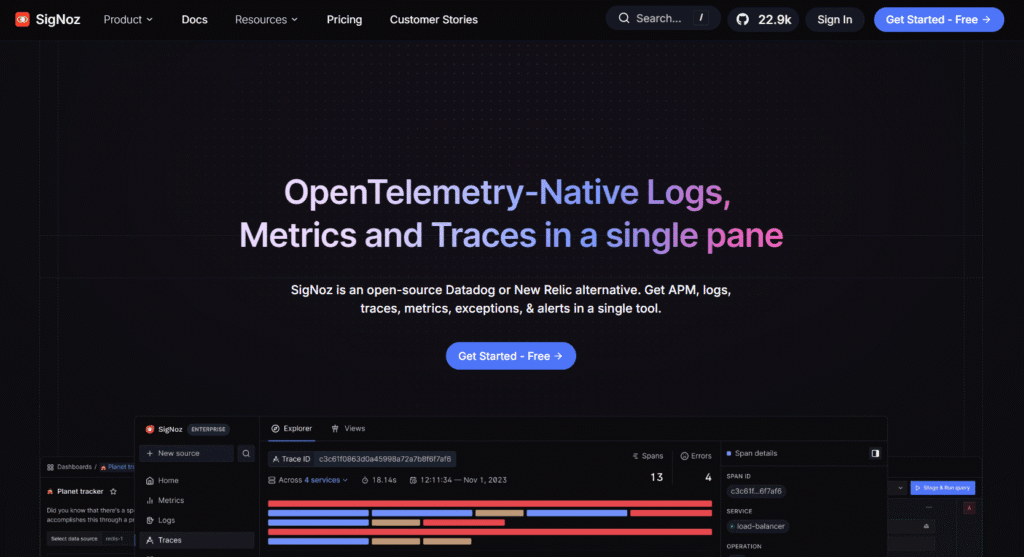
SigNoz is an open-source, OTel-native observability platform that covers Kubernetes monitoring alongside APM, distributed tracing, logs, and exception tracking in a single ClickHouse-backed deployment. Kubernetes metrics are collected via the OTel Collector’s kubeletstats and kubernetes_cluster receivers, with rich metadata enrichment via the k8sattributes processor. Community code is MIT Expat licensed.
Key features
- Kubernetes monitoring via OTel Collector kubeletstats receiver (pod CPU, memory, network) and kubernetes_cluster receiver (deployment status, pod phase, node conditions)
- k8sattributes processor enriches all telemetry (metrics, traces, logs) with Kubernetes metadata: namespace, pod name, deployment, node, cluster
- k8s-infra Helm chart provides a quick-start deployment for Kubernetes metric collection
- All signals (traces, metrics, logs, exceptions) in one ClickHouse-backed interface
- Fully OTel-native: no proprietary agents; all standard OTel Collector receivers work with SigNoz
- Community code MIT Expat; Cloud Teams plan from $49/month, $0.30/GB logs and traces, $0.10/million metric samples
- No per-node, per-pod, or per-user fees
Why it fits Kubernetes teams: SigNoz’s single ClickHouse deployment is significantly simpler to operate inside Kubernetes than the full kube-prometheus-stack plus Loki plus Tempo stack. Teams that already instrument their applications with OTel SDKs get Kubernetes infrastructure metrics and application traces correlated in the same interface without additional configuration.
Best for: Teams that want an open-source, OTel-native Kubernetes observability platform with a simpler operational model than the full LGTM stack, and no active series pricing.
Limitations: Kubernetes dashboard templates are less mature than the Grafana/kube-prometheus-stack ecosystem. ClickHouse requires meaningful memory allocation at high ingest rates. Community code is MIT Expat, not Apache 2.0.
3. Datadog
Datadog provides the most automated and polished out-of-the-box Kubernetes monitoring experience of any commercial platform. A single Datadog Agent DaemonSet deployed via Helm automatically discovers all pods, containers, nodes, namespaces, and workloads and begins populating pre-built dashboards without manual configuration.
Key features
- Auto-discovery: Datadog Agent DaemonSet automatically discovers and instruments Kubernetes workloads, services, and pods from annotations
- Pre-built Kubernetes dashboards covering node health, pod status, container resource usage, namespace-level aggregation, and cluster-wide overview
- Live Containers view: real-time process-level visibility inside every running container
- Kubernetes Events correlation: links metric anomalies to Kubernetes Events (pod restarts, OOMKills, scheduling failures)
- Distributed tracing correlated with Kubernetes labels and infrastructure metrics in a single view
- Full signals: APM, distributed tracing, logs, infrastructure, RUM, synthetics, security monitoring
Pricing (verified from datadoghq.com/pricing as of June 2026): Infrastructure Pro at $15/host/month (annual); a Kubernetes node counts as one host. APM at $31/host/month (annual). Pro plan includes 5 containers free per host; additional containers cost $0.002/container/hour or $1/container/month prepaid. A 50-node cluster with APM enabled pays a minimum of ($15 + $31) x 50 = $2,300/month before log volume, container overages, and custom metrics.
Best for: Enterprise teams that need the deepest out-of-the-box Kubernetes observability with minimal manual configuration and have the budget to justify per-node pricing.
Limitations: Per-node pricing stacks with per-module pricing. Container overages beyond 5 per host on Pro compound significantly in dense Kubernetes environments. High-cardinality Kubernetes labels generate custom metric overages. Per-node billing creates incentives to run fewer, larger nodes rather than the right-sized architecture.
4. Dynatrace
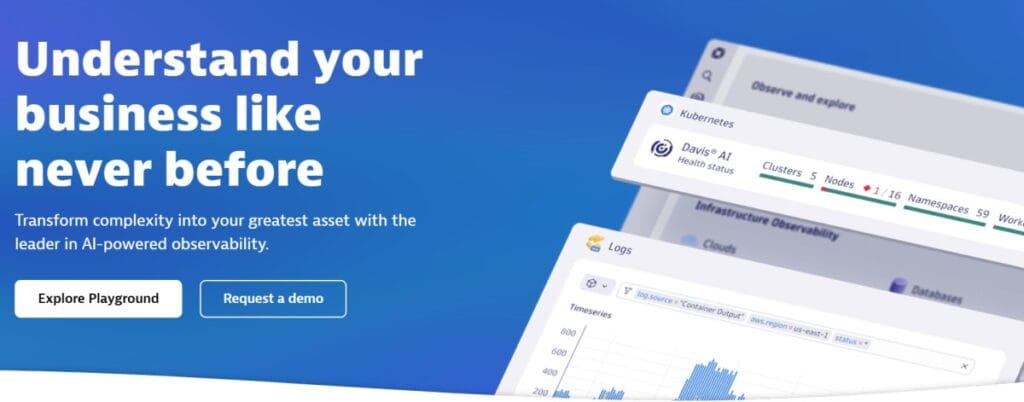
Dynatrace provides automatic Kubernetes observability through its OneAgent, deployed as a DaemonSet, which instruments all workloads without manual configuration. The Davis AI engine automatically maps Kubernetes service dependencies, correlates anomalies across the cluster topology, and surfaces root-cause analysis during incidents.
Key features
- OneAgent DaemonSet automatically discovers all Kubernetes nodes, pods, namespaces, deployments, and services without manual annotation
- Full-stack topology map: visualizes the dependency graph from user requests through Kubernetes services to infrastructure in real time
- Kubernetes Events integration: correlates Davis AI problem notifications with pod restarts, OOMKills, and rescheduling events
- Davis AI: automatically identifies root cause across the Kubernetes call chain, distinguishing between application-level and infrastructure-level issues
- Kubernetes-native RBAC and namespace isolation support for multi-tenant cluster monitoring
- Full signals: APM, distributed tracing, logs, infrastructure, RUM, security
Pricing: Usage-based, starting at approximately $0.08/host-hour for Full-Stack Monitoring. Annual commitment required for standard pricing.
Best for: Enterprise teams running complex Kubernetes environments who want zero-touch observability with AI-driven root-cause analysis, and whose priority is reducing mean time to diagnose rather than minimizing tooling cost.
Limitations: One of the more expensive options in this comparison. Annual commitment required. Teams that prefer managing their own OTel-based instrumentation get a more limited experience than with OneAgent.
5. Perses
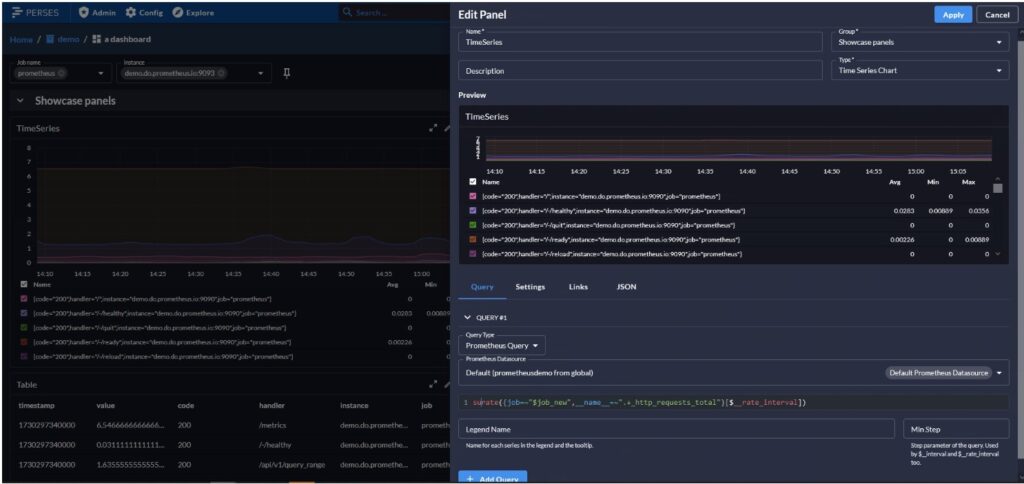
Perses is a lightweight, Apache 2.0 licensed open-source dashboard tool specifically designed for observability use cases, and a CNCF Sandbox project. It is Kubernetes-native: dashboards are deployed and managed via Kubernetes CRDs, enabling GitOps-based dashboard lifecycle management. It supports Prometheus and VictoriaMetrics as metrics backends, Tempo for traces, Loki for logs, and Pyroscope for profiling.
Key features
- Apache 2.0 licensed, CNCF Sandbox project (accepted August 2024)
- Kubernetes-native: dashboards deployed and managed as Kubernetes CRDs via the Perses Operator, enabling GitOps workflows
- Dashboard-as-code: define dashboards in Go or CUE with compile-time validation, version control, and CI/CD integration
- Supports Prometheus, VictoriaMetrics, Tempo, Loki, and Pyroscope as data sources
- Grafana dashboard migration tool imports existing Grafana JSON dashboards to Perses format on a best-effort basis
- Red Hat ships a downstream build in the OpenShift Cluster Observability Operator (technology preview, April 2026)
- OIDC/OAuth and Kubernetes-inspired RBAC for multi-team cluster dashboard management
Why it fits Kubernetes teams: Perses is purpose-built for GitOps-native Kubernetes environments. Storing dashboard definitions as CRDs in a Git repository, validating them in CI, and deploying them as part of cluster configuration is not possible with Grafana’s JSON blob workflow. It is Apache 2.0 rather than AGPLv3, removing the licensing concerns that apply to the entire Grafana stack.
Best for: Platform engineering teams managing Kubernetes cluster dashboards at scale via GitOps. Teams that need Apache 2.0 licensed dashboarding and already have Prometheus or VictoriaMetrics as their metrics backend.
Limitations: CNCF Sandbox maturity: project is still evolving with fewer community panel types than Grafana. Does not include data storage, alerting, log collection, or tracing. Requires existing Prometheus/VictoriaMetrics and Loki/Tempo backends.
Comparison at a Glance
| Tool | K8s Auto-Discovery | All Signals Included | Self-hosted | License | Starting Cost |
| CubeAPM | Yes (OTel receivers) | Yes | Yes (required) | Proprietary (self-hosted) | $0.15/GB |
| SigNoz | Yes (OTel receivers) | Yes | Yes | MIT Expat (community) | Free / $49/mo Cloud |
| Datadog | Yes (Agent DaemonSet) | Yes | No | Commercial SaaS | $15/node/mo (infra) |
| Dynatrace | Yes (OneAgent DaemonSet) | Yes | No | Commercial SaaS | ~$0.08/host-hr |
| Perses | Via Prometheus backend | No (visualization only) | Yes | Apache 2.0 | Free |
Monitor Your Kubernetes Cluster with CubeAPM
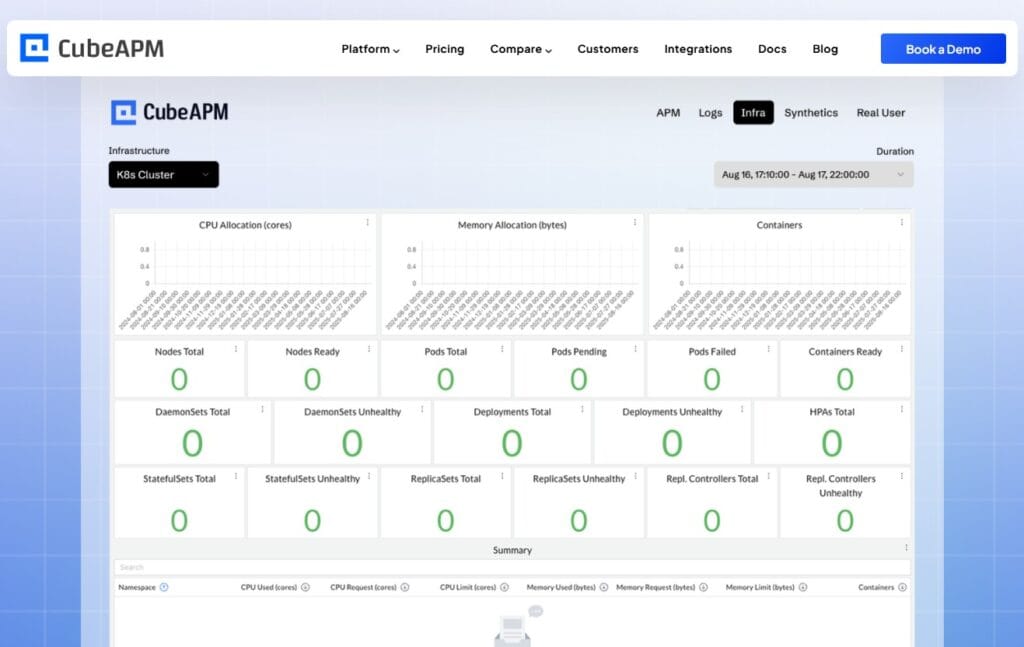
CubeAPM gives Kubernetes teams complete cluster observability without managing four separate LGTM components inside the cluster, without active series pricing surprises as pod-level label cardinality grows, and without per-node fees that compound as clusters scale.
A single CubeAPM deployment covers node health, pod status, container resource usage, namespace-level aggregation, workload health, application distributed traces, logs, and infrastructure metrics in one interface. The OTel Collector’s Kubernetes receivers handle metric collection with no proprietary DaemonSet agents required. At $0.15/GB with no per-node, per-pod, or per-series pricing, a 100-node cluster generating dense telemetry pays based only on the volume it actually ingests.
Summary
Grafana’s multi-component operational overhead and active series pricing behavior on Grafana Cloud are the two primary friction points for Kubernetes teams. The five alternatives in this guide each address them differently.
| Tool | Best For | Key Kubernetes Advantage |
| CubeAPM | Full-stack K8s observability, no active series pricing | Single deployment, all signals, $0.15/GB flat pricing |
| SigNoz | OTel-native K8s observability, MIT Expat open source | Single ClickHouse deployment, OTel Collector native K8s receivers |
| Datadog | Enterprise K8s teams, zero-config dashboards | Richest auto-discovery and pre-built K8s dashboards |
| Dynatrace | Enterprise K8s teams, AI root-cause analysis | Zero-touch topology mapping and Davis AI across K8s call chains |
| Perses | GitOps-native dashboard management, Apache 2.0 | CRD-based dashboard deployment, compile-time validation |
Disclaimer: All Grafana pricing and licensing sourced directly from grafana.com/pricing and grafana.com/licensing as of June 2026. Grafana Cloud free tier: 10k active metric series, 50 GB logs/month, 14-day retention for metrics, logs, traces, and profiles. Grafana Cloud Pro: $19/month base, $6.50 per 1,000 active metric series, 13-month metric retention, 30-day log/trace/profile retention. Enterprise: from $25,000/year. Grafana, Loki, Tempo: AGPLv3 since April 2021 (grafana.com/licensing). Mimir: AGPLv3 (github.com/grafana/mimir). Plugins, agents, and certain libraries remain Apache-licensed. Datadog pricing from datadoghq.com/pricing: Infrastructure Pro $15/host/month annual, APM $31/host/month annual, 5 containers free per host on Pro, additional containers $0.002/container/hour or $1/container/month prepaid. Dynatrace: Full-Stack ~$0.08/host-hour, annual commitment required. SigNoz: community code MIT Expat, Cloud Teams from $49/month. Perses: Apache 2.0, CNCF Sandbox accepted August 2024. CubeAPM: $0.15/GB, no per-node or per-series fees. All pricing subject to change; verify at official vendor pages before purchasing.
Also read:
What Are the Best Open Source Grafana Alternatives?