




The synthetic monitoring tool market in 2026 divides into three tiers: full-stack observability platforms with synthetics built in (CubeAPM, Datadog, New Relic, Grafana Cloud), developer-first platforms built around code-native scripting (Checkly), and lightweight tools for teams that need availability checks without full observability complexity (UptimeRobot, Better Stack).
The right synthetic monitoring tool depends on whether you need multi-step browser transaction testing, API check chaining, CI/CD integration, or simple uptime monitoring, and whether synthetics is a standalone need or part of a broader observability stack.
Key Takeaways
- CubeAPM provides HTTP uptime monitors, multi-step API flows, and real browser headless tests, connected to distributed traces, infrastructure metrics, and logs in a self-hosted environment at $0.15/GB ingestion with no per-user fees
- Checkly is the developer-first choice for Playwright-based browser checks and API monitoring managed as code, running 32.5 million checks daily across 22 global locations. Hobby tier is genuinely free with 1,000 browser checks and 10,000 API checks per month
- Datadog Synthetics is the strongest choice for teams already on Datadog who need synthetics tightly correlated with APM, logs, and RUM. Pricing is consumption-based and scales quickly with check frequency and location count
- Grafana Cloud Synthetic Monitoring uses k6 scripts natively, making it the natural fit for teams already using Grafana and k6. The same script runs in CI, load testing, and synthetic monitoring without duplication
- UptimeRobot remains the fastest way to start basic uptime monitoring. Its free tier is now limited to personal non-commercial use following a 2025 Terms of Service change. Pro plans start at $7/month
- New Relic’s free tier includes 100GB/month data ingest, 1 full platform user, and 500 synthetic monitoring checks per month. Full platform users start at $10/user beyond the free allocation
- Better Stack combines uptime checks, Playwright-based browser tests, incident management, and status pages starting at $29/month
Tools at a Glance
| Tool | Best for | Browser checks | API checks | CI/CD integration | Self-hosted |
| CubeAPM | Full APM plus synthetics, self-hosted | Yes (headless) | Yes (multi-step) | Yes | Yes |
| Checkly | Developer teams, monitoring as code | Yes (Playwright) | Yes (multi-step) | Yes (native CLI + Terraform) | No |
| Datadog Synthetics | Teams in Datadog ecosystem | Yes (Chromium) | Yes (multi-step, gRPC) | Yes | No |
| Grafana Cloud | Teams using Grafana and k6 | Yes (k6 scripts) | Yes (k6) | Yes | Partial (open source) |
| UptimeRobot | Simple uptime monitoring | No | No | No | No |
| Better Stack | Uptime plus incident management | Yes (Playwright) | Yes | Yes | No |
| New Relic | Teams on New Relic platform | Yes (scripted) | Yes | Yes | No |
CubeAPM
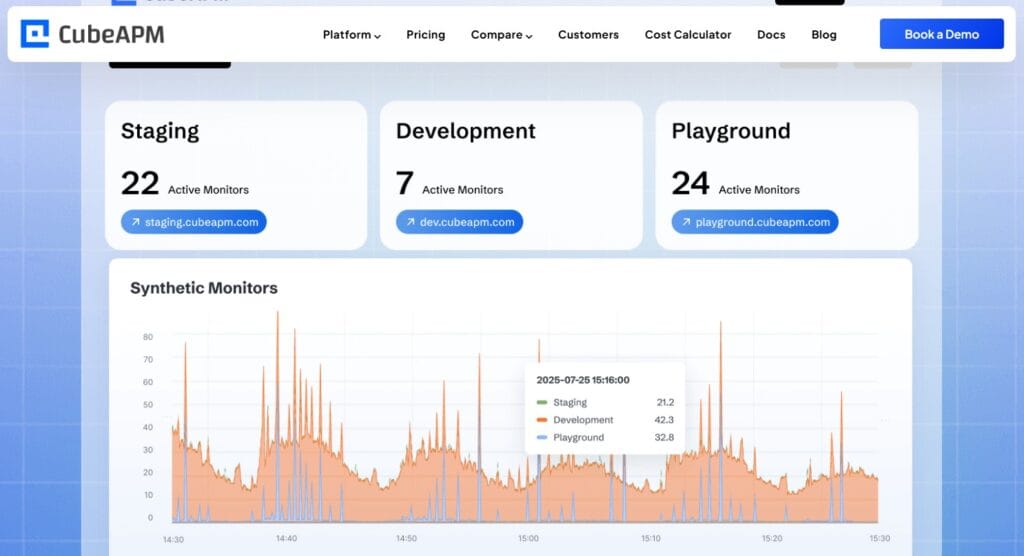
CubeAPM is an OpenTelemetry-native observability platform that includes synthetic monitoring as part of a unified stack covering distributed traces, infrastructure metrics, and logs. Unlike standalone synthetic tools, a failing check in CubeAPM links directly to the distributed trace for that request, the infrastructure metrics at that moment, and the logs from the affected service, all within a single platform.
What it does: CubeAPM runs HTTP uptime monitors, multi-step API flows with assertions, and real browser headless tests from multiple regions. Checks can be integrated into CI/CD pipelines to gate deployments. All check results are correlated with application telemetry via the shared OpenTelemetry context, so the path from “checkout is slow” to “this database query is responsible” requires no tool switching.
Best for: Engineering teams that want synthetics, APM, distributed tracing, and infrastructure monitoring in one self-hosted platform with predictable, usage-based pricing and no per-user fees.
Pricing: $0.15/GB ingestion, self-hosted. No per-user fees.
Checkly
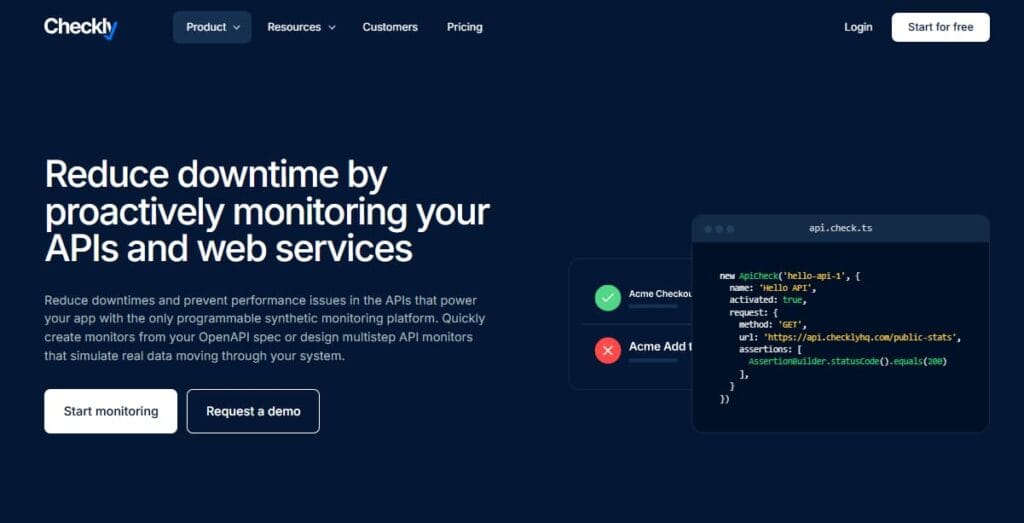
Checkly is the category-defining platform for developer-first synthetic monitoring. Founded in Berlin in 2018 and backed by Balderton Capital ($20M Series B, 2024), it pioneered “Monitoring as Code”, monitoring checks written in TypeScript and JavaScript, stored in Git, deployed via CI/CD pipelines using a native CLI, and managed through Terraform or Pulumi.
Browser checks run on real Playwright scripts, the same framework most engineering teams use for end-to-end testing. API checks support multi-step chaining, assertions on response body and headers, and authentication flow testing. Both run from 22 global locations. Checkly also provides AI-powered root cause analysis (Rocky AI) and OpenTelemetry tracing for individual check runs.
Pricing
| Plan | Price | Uptime monitors | Browser runs/month | API runs/month | Locations |
| Hobby | Free | 10 | 1,000 | 10,000 | 6 |
| Starter | $24/month (annual) | 50 | 3,000 | 25,000 | 6 |
| Team | $64/month (annual) | 75 | 12,000 | 100,000 | 22 |
| Enterprise | Custom | Custom | Custom | Custom | 22 + private |
Best for: Engineering and SRE teams that want monitoring configuration in version control. Teams already using Playwright for testing. Organizations that need CI/CD gating on synthetic checks before deployment.
Limitations: No built-in APM or infrastructure metrics. When a synthetic check fires, root cause investigation requires a separate observability tool.
Datadog Synthetics
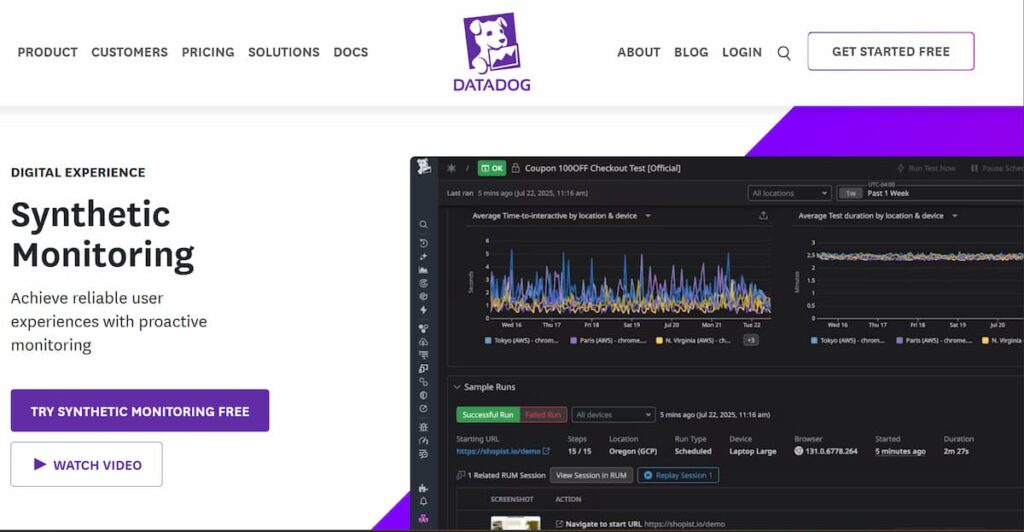
Datadog Synthetics is the synthetic monitoring module within Datadog’s broader observability platform. It supports HTTP API tests, multi-step API tests with chained requests and assertions, browser tests using real Chromium rendering, gRPC checks, and mobile app testing. Tests run from over 70 managed global locations.
The primary strength is integration depth. A failing synthetic check links directly to APM traces, infrastructure metrics, logs, and RUM data from the same time window, all within the Datadog platform.
Pricing: Datadog publishes consumption-based pricing for synthetic monitoring on its pricing page. Charges are per test run, with each location counting as a separate run. Browser tests are priced separately from API tests. Teams running checks at high frequency across multiple locations should model costs carefully before committing, as per-run billing can scale quickly. Contact Datadog or consult their current pricing page for exact figures.
Best for: Teams already invested in the Datadog ecosystem who need synthetics tightly correlated with their existing observability data.
Limitations: Consumption-based pricing multiplies with check frequency and location count. Each additional monitoring location multiplies total run volume. No flat-rate option for predictable budgeting.
Grafana Cloud Synthetic Monitoring
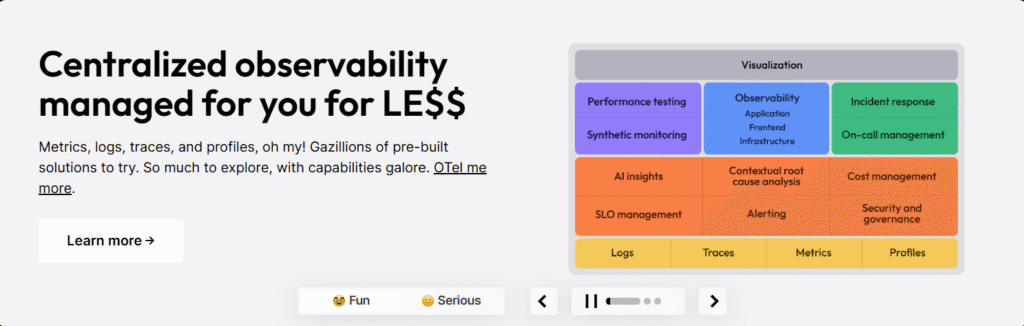
Grafana Cloud Synthetic Monitoring uses k6 scripts natively for scripted check types. The same k6 script used for load testing in CI can be deployed as a synthetic monitoring check running on a schedule in production, with no script duplication across environments. Grafana Labs was named a Leader and Outperformer in the 2025 GigaOm Radar Report for Cloud Performance Testing for this cross-functional approach.
The tool supports HTTP uptime checks, multi-step k6 scripted checks, DNS checks, TCP checks, ping checks, and Traceroute. When a check fires, it integrates with the rest of the Grafana observability stack: Prometheus metrics in Mimir, logs in Loki, traces in Tempo, and dashboards in Grafana.
Pricing: Synthetic monitoring is included in Grafana Cloud’s free tier. Paid Grafana Cloud plans start at $19/month overall. k6 cloud test execution is billed separately in virtual user hours, with 500 VUh included in the free tier. Consult grafana.com/pricing for current figures.
Best for: Teams already using Grafana Cloud and k6 who want to reuse performance test scripts as production synthetic monitors.
Limitations: Learning curve for teams unfamiliar with k6 scripting. Synthetic monitoring is one part of a broader platform purchase rather than a focused tool.
UptimeRobot
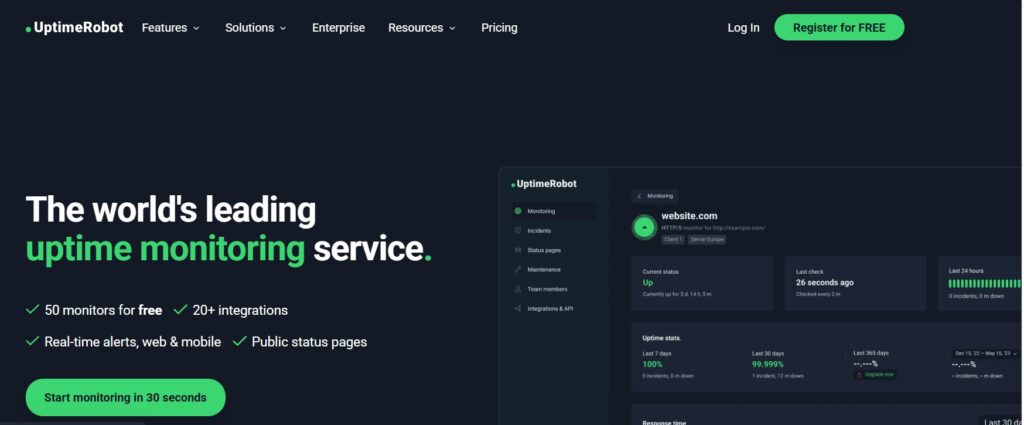
UptimeRobot is the most widely deployed uptime monitoring service with over 3.2 million users. It checks HTTP/HTTPS endpoints, TCP ports, DNS records, ping, and keywords on a configurable interval. Setup time from sign-up to first alert is under 5 minutes.
Important change since 2025: UptimeRobot updated its Terms of Service. The free tier is now limited to personal, non-commercial use. Commercial projects require a paid plan.
Pricing
| Plan | Price | Monitors | Check interval |
| Free | $0 | 50 | 5 minutes (personal use only) |
| Pro | From $7/month | Scales with plan | 30 seconds or 1 minute |
Best for: Personal projects and small teams that need basic availability monitoring on a minimal budget and do not require multi-step transaction testing or browser checks.
Limitations: No browser execution or JavaScript rendering. No multi-step transaction testing. The free tier is no longer suitable for commercial use. Single-location checks on most plans.
Better Stack
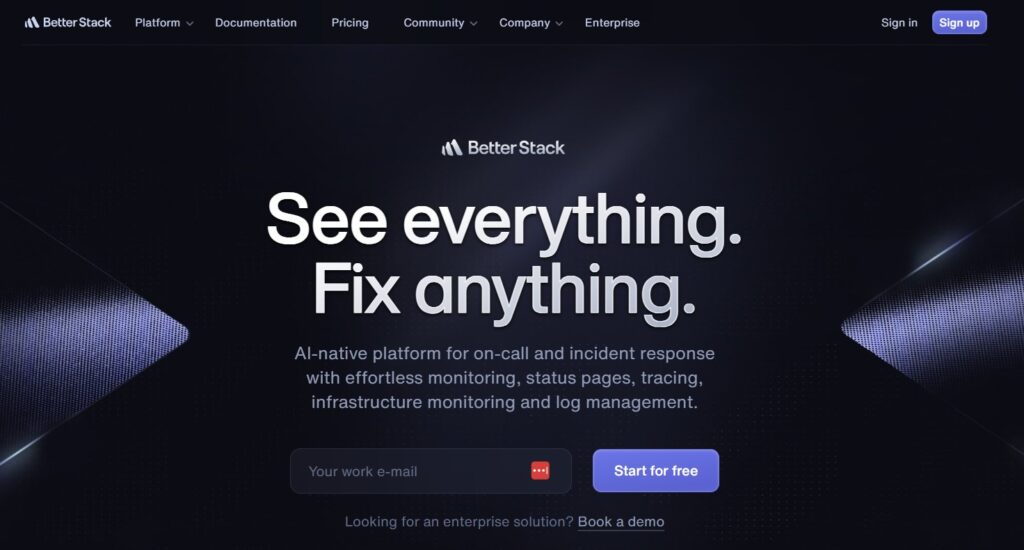
Better Stack combines uptime monitoring, Playwright-based browser transaction checks, log management, and incident management workflows in one platform. The official pricing page (betterstack.com/pricing) confirms plans start at $29/month.
Browser transaction checks run Playwright scripts in real browser instances. The platform includes heartbeat monitoring for scheduled jobs and cron tasks, hosted status pages, and incident response workflows with on-call scheduling.
Best for: Teams that want uptime monitoring, Playwright-based browser checks, incident management, and status pages without a full enterprise observability platform.
Pricing: Starts at $29/month (verified from betterstack.com/pricing). Usage-based elements for log ingestion and metrics are billed separately at $0.50/GB/month (annual) for accounts created in 2026.
Limitations: Not a replacement for full APM or distributed tracing. Less focused than Checkly for pure code-native synthetic workflows.
New Relic
New Relic‘s platform includes synthetic monitoring as part of its full observability suite. It supports ping monitors (free on all tiers), simple browser monitors, scripted browser checks, and API tests. The free tier includes 500 synthetic monitoring checks per month in addition to 100GB data ingest and one full platform user.
Pricing
| Component | Free tier | Paid |
| Data ingest | 100GB/month | $0.40/GB (standard) or $0.60/GB (Data Plus) |
| Full platform users | 1 user | From $10/user/month to $349/user/month |
| Synthetic checks | 500/month included | Add-on pricing applies beyond included checks |
| Ping monitors | Unlimited | Unlimited (not counted toward check limits) |
Note: Synthetic monitor checks do not count toward the GB data ingest allowance. New Relic also offers a compute-based pricing model (New Relic Compute) as an alternative to the user-based model for teams with specific usage patterns.
Best for: Teams already on New Relic who want synthetics integrated with their existing APM and infrastructure data. Solo developers and small teams who can stay within the free tier.
Limitations: New Relic’s scripting API for browser checks is proprietary and not portable to other platforms. Per-user pricing becomes a significant cost factor for teams beyond single-digit headcount.
How to Choose
| If you need… | Use this |
| Synthetics plus APM, traces, and logs self-hosted with predictable pricing | CubeAPM |
| Monitoring as code with Playwright and CI/CD integration | Checkly |
| Synthetics tightly integrated with APM and logs in Datadog | Datadog Synthetics |
| Synthetics using existing k6 scripts in a Grafana environment | Grafana Cloud Synthetic Monitoring |
| Fast, simple uptime checks on a minimal budget (personal project) | UptimeRobot free tier |
| Uptime monitoring with incident management and status pages | Better Stack |
| Synthetics included in a free-tier all-in-one platform | New Relic free tier (small teams) |
Summary
The right synthetic monitoring tool in 2026 depends on one question: do you need synthetics as a focused standalone tool, or as part of a broader observability stack? For full-stack correlation of synthetic alerts with application traces and infrastructure metrics in a self-hosted environment, CubeAPM is the choice. For focused synthetic monitoring with code-native Playwright workflows, Checkly is the category leader. For teams already in Datadog or Grafana Cloud, those platforms are the natural fit. For lightweight uptime-only monitoring, UptimeRobot and Better Stack cover the basics.
| Tool | Playwright browser checks | API multi-step | CI/CD native | Self-hosted | Starting price |
| CubeAPM | Yes (headless) | Yes | Yes | Yes | $0.15/GB ingestion |
| Checkly | Yes | Yes | Yes | No | Free (Hobby) |
| Datadog Synthetics | Yes (Chromium) | Yes | Yes | No | Consumption-based (see datadoghq.com/pricing) |
| Grafana Cloud | Yes (k6) | Yes | Yes | Partial | Free tier available |
| UptimeRobot | No | No | No | No | Free (personal only) |
| Better Stack | Yes (Playwright) | Yes | Yes | No | $29/month |
| New Relic | Yes (scripted) | Yes | Yes | No | Free (1 user, 100GB, 500 checks) |
Disclaimer: The information in this article reflects the latest details available at the time of publication and may change as technologies and products evolve. All pricing verified directly from official product pages: checklyhq.com/pricing, newrelic.com/pricing, betterstack.com/pricing, uptimerobot.com, grafana.com/pricing, and cubeapm.com as of May 2026. Datadog Synthetics pricing is consumption-based; consult datadoghq.com/pricing for current figures. All pricing subject to change.
Also read:
What Is Synthetic Monitoring and How Does It Differ From Uptime Monitoring?