









Uptime monitoring and synthetic monitoring are frequently treated as the same thing. They are not. Uptime monitoring answers one question: is this endpoint reachable and returning a response? Synthetic monitoring answers a harder question: does the actual user journey work, and how fast is it?
A service can pass every uptime check while a login flow is broken, a checkout step is slow, or a third-party script is failing in one region. Synthetic monitoring is what catches those failures before users do.
Key Takeaways
- Uptime monitoring is a subset of synthetic monitoring, not a synonym. All uptime checks are synthetic, but most synthetic monitoring goes far beyond uptime checks
- Uptime monitoring operates at the network and HTTP layer: it confirms an endpoint is reachable, returns the expected status code, and has a valid SSL certificate
- Synthetic monitoring simulates real user behavior: multi-step transaction flows, JavaScript rendering, form submissions, login sequences, and API call chains, tested on a schedule from multiple global locations
- A passing uptime check does not mean your application is working. A checkout flow can be broken, a login can return a 200 with an error message, or an API can respond slowly enough to violate your SLA while uptime stays green
- The three monitoring approaches that teams need are uptime checks (availability), synthetic transaction monitoring (user journey correctness), and Real User Monitoring or RUM (actual user experience). They are complementary, not competing
- Synthetic checks are the only monitoring signal that gives you consistent, reproducible baseline measurements during low-traffic periods, including 3am, weekends, and periods between deployments
What Uptime Monitoring Does
Uptime monitoring sends periodic probes to a target and checks whether a valid response comes back. It operates at three network layers, each validating something different.
| Check type | Protocol | What it confirms | What it misses |
| Ping / ICMP | ICMP | Host is on the network | Application health. Many firewalls block ICMP entirely |
| Port check | TCP | Port is open and accepting connections | Whether the service behind the port is functioning |
| HTTP/HTTPS check | HTTP | Endpoint returns a status code, optionally matching expected content | Whether the full page or transaction actually works |
| SSL certificate check | HTTPS | Certificate is valid and not expiring | Application logic and user-facing functionality |
| DNS check | DNS | Domain resolves to the correct IP | Application behavior behind the DNS record |
For application monitoring, HTTP checks with content assertions are the most meaningful uptime signal. Confirming a /health endpoint returns 200 is useful. It is not the same as confirming the checkout flow completes successfully.
What uptime monitoring cannot catch:
A checkout flow that silently returns HTTP 200 with an error message inside the body. A login page that loads but fails to authenticate users after a session token change. A page that renders correctly in the server response but breaks when JavaScript executes. A third-party payment script that fails to load in specific regions. An API that responds within the timeout but returns malformed data. All of these pass a standard uptime check.
What Synthetic Monitoring Does
Synthetic monitoring executes scripted simulations of user behavior from external locations on a schedule. Rather than asking “does this endpoint respond?” it asks “does this flow work the way a real user would experience it?”
The four types of synthetic checks:
- API monitoring sends programmatic requests to API endpoints, validates status codes, response schema, authentication flows, and response time. Supports REST, GraphQL, and gRPC. Can chain multiple API calls to test multi-step flows like token refresh followed by an authenticated request.
- Browser transaction monitoring runs a headless browser (Chromium) that loads a page, executes JavaScript, fills in forms, clicks buttons, and validates the result. This is the check type that catches JavaScript errors, broken frontend flows, and third-party script failures that HTTP checks cannot see.
- Multi-step transaction monitoring scripts a complete user journey through multiple pages: landing page, login, search, add to cart, checkout, confirmation. Each step is validated individually. If any step fails or takes longer than the defined threshold, an alert fires.
- Uptime checks are the simplest synthetic check type: a single HTTP request to a single endpoint with a status code and optional content assertion. This is the overlap between uptime monitoring and synthetic monitoring.
Uptime Monitoring vs Synthetic Monitoring: The Core Difference
| Uptime monitoring | Synthetic monitoring | |
| What it simulates | A single network probe | Real user behavior across one or more steps |
| Execution engine | Simple HTTP client or TCP socket | Headless browser or scripted API client |
| What it validates | Reachability and status code | Functionality, correctness, and performance |
| JavaScript execution | No | Yes (browser checks) |
| Multi-step flows | No | Yes |
| Performance measurement | Response time only | Full page load breakdown, Core Web Vitals, API timing per step |
| Catches broken login | No (returns 200 even if login fails) | Yes (validates the post-login state) |
| Catches broken checkout | No | Yes (validates each step through confirmation) |
| Catches third-party script failure | No | Yes (browser checks see the full page render) |
| Typical check interval | 1 to 5 minutes | 1 minute to 1 hour depending on check complexity |
| Global locations | Yes | Yes |
Where Uptime Monitoring Still Belongs
Uptime monitoring is not obsolete. It is fast, lightweight, and inexpensive to run at high frequency from many locations. It is the right tool for:
- High-frequency availability checks on API endpoints and infrastructure health URLs
- SSL certificate expiration monitoring
- DNS resolution validation
- Port-level availability on non-HTTP services
- Simple latency trending on individual endpoints
The practical approach is to run uptime checks at 30-second to 1-minute intervals for critical endpoints alongside synthetic transaction checks at 5 to 15-minute intervals for key user journeys. The uptime checks give you fast detection on simple failures. The synthetic checks give you deep validation on complex flows.
Synthetic Monitoring and RUM: The Third Layer
Synthetic monitoring and Real User Monitoring (RUM) are frequently confused or treated as alternatives. They solve different problems and both are needed for complete visibility.
| Synthetic monitoring | Real User Monitoring (RUM) | |
| Who runs the checks | Automated bots from fixed locations | Real users on real devices and networks |
| When data is collected | On a schedule, including low-traffic periods | Only when users are actually on your site |
| Consistency | Identical conditions every run | Variable: different devices, browsers, networks |
| Proactive detection | Yes. Fires before users are affected | No. Requires actual user traffic to detect issues |
| Real-world variability | No. One browser type, one network | Yes. Reflects actual user device and connection distribution |
| Core Web Vitals data | Lab measurements (approximations) | Field measurements (actual user experience) |
| Coverage at 3am | Full | None if no users are present |
The right mental model: synthetic monitoring gives you consistent, controlled, proactive baseline measurements. RUM gives you what is actually happening for real users across every device, browser, and network condition. Using both together gives the most complete picture of the application experience.
Synthetic Monitoring in CI/CD Pipelines
A significant shift in how teams use synthetic monitoring in 2025 and 2026 is running synthetic checks as part of CI/CD pipelines, not just in production. Before a deployment is promoted to production, automated synthetic checks run against the staging environment to validate that critical user flows still pass. If a checkout flow breaks in staging, the deployment is blocked before it reaches users.
This use case requires synthetic checks to be scriptable, versioned alongside application code, and callable from pipeline tools. The check that runs post-deployment in production and the check that gates promotion in staging should be the same script.
Common Setup Problems
| Problem | Likely cause | Fix |
| Uptime check passes but users report login failures | HTTP check is not validating the post-login response, only the status code | Add a content assertion that validates a token or element present only on successful login |
| Synthetic check passes from one location but fails from another | CDN misconfiguration, regional routing issue, or a third-party service with regional availability differences | Run checks from at least three geographically distributed locations and alert when any single location fails consistently |
| False positive alerts during deployments | Deployment temporarily makes the endpoint unavailable while the check fires | Set a minimum consecutive failure count (2 to 3 failures) before alerting, or pause checks during deployment windows |
| Synthetic check passes but Core Web Vitals are poor in RUM | Lab conditions in synthetic checks do not reflect real device and network variability | Use RUM alongside synthetics. Synthetic passes mean the flow works. RUM data reflects actual user experience |
| SSL certificate alert fires too late | Warning threshold too close to expiry | Monitor SSL expiry with a 30-day warning threshold and a 7-day critical threshold. As of March 15, 2026, the CA/Browser Forum maximum TLS certificate validity is 200 days (reducing to 100 days in March 2027 and 47 days by March 2029). Automation is increasingly essential at these renewal frequencies |
From Synthetic Alerts to Root Cause: Where CubeAPM Fits
A synthetic check tells you a user journey is failing or slow. A checkout flow that used to complete in 800ms is now taking 3 seconds. The synthetic alert fires. The next question is always: why?
The answer is rarely visible from the synthetic check itself. The slowdown might be in a database query the checkout service makes, a downstream payment API that has slowed down, or a memory pressure event on the server handling checkout requests. Finding the cause requires jumping from the synthetic alert into application traces, infrastructure metrics, and logs.
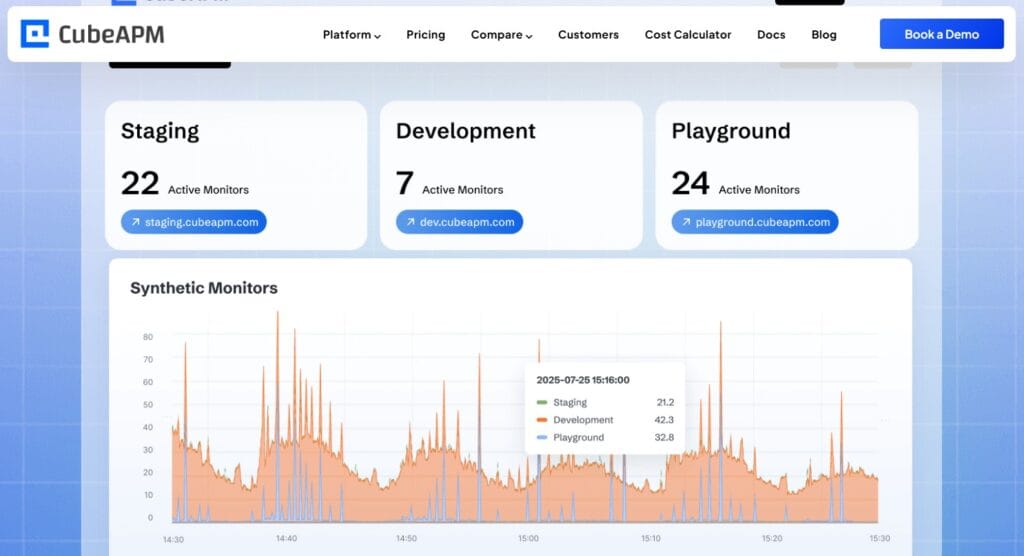
CubeAPM runs synthetic checks, including HTTP uptime monitors, multi-step API flows, and real browser headless tests from multiple regions, and connects them directly to the full observability stack. When a synthetic check fires, you move from the alert into the distributed trace for that request, see the breakdown of where time was spent, correlate with infrastructure metrics at that moment, and jump to the logs from the affected service. Everything is in one place using the shared context that OpenTelemetry provides. CubeAPM runs self-hosted inside your own infrastructure at $0.15/GB ingestion pricing, so no data leaves your environment.
Summary
Uptime monitoring confirms an endpoint is reachable. Synthetic monitoring confirms that the user journey actually works. They operate at different layers, catch different failure modes, and are not interchangeable. A complete monitoring strategy uses uptime checks for fast, high-frequency availability detection, synthetic transaction monitoring for user journey correctness, and RUM for real-world user experience data. Synthetic checks also belong in CI/CD pipelines to catch regressions before they reach production.
| Uptime monitoring | Synthetic monitoring | RUM | |
| Primary question | Is it up? | Does the flow work? | What are real users experiencing? |
| Execution | Single HTTP probe | Scripted multi-step flow | JavaScript agent in real browsers |
| Proactive | Yes | Yes | No (requires real traffic) |
| Catches broken login | No | Yes | Only after users encounter it |
| Core Web Vitals | No | Lab approximation | Field measurements |
| Low-traffic coverage | Yes | Yes | No |
| CI/CD integration | Rarely | Yes | No |
| Best check interval | 30 seconds to 1 minute | 5 to 15 minutes | Continuous |
Disclaimer: Feature descriptions, monitoring type definitions, SSL certificate validity limits (CA/Browser Forum Ballot SC-081v3: 200-day maximum from March 15, 2026, 100-day from March 2027, 47-day by March 2029), and tool capabilities are verified against CA/Browser Forum documentation (cabforum.org), DigiCert certificate validity announcements (February 2026), and CubeAPM documentation (cubeapm.com/blog/what-is-synthetic-monitoring, cubeapm.com/blog/top-uptime-monitoring-tools) as of May 2026.
Also read:
What Is Java Application Performance Monitoring (APM)?
How to Instrument a FastAPI App with OpenTelemetry
What is the Difference Between OpenTelemetry and Prometheus?