







Zipkin is a free, open-source distributed tracing system built to help engineering teams collect and analyze timing data across distributed services. It helps teams troubleshoot latency problems by showing how requests move through service architectures, where time is spent, and where failures occur.
Zipkin pricing is simple on the surface because the software itself costs $0. It is licensed under Apache 2.0, has no paid edition, and does not charge per host, user, span, or GB. The real cost comes from the infrastructure and engineering work required to run it in production.
In this guide, we explore Zipkin pricing and review, supported features, storage options, real self-hosted cost drivers, user-review themes, and how Zipkin compares with Jaeger, Grafana Tempo, CubeAPM, Datadog, and New Relic.
What Is Zipkin?
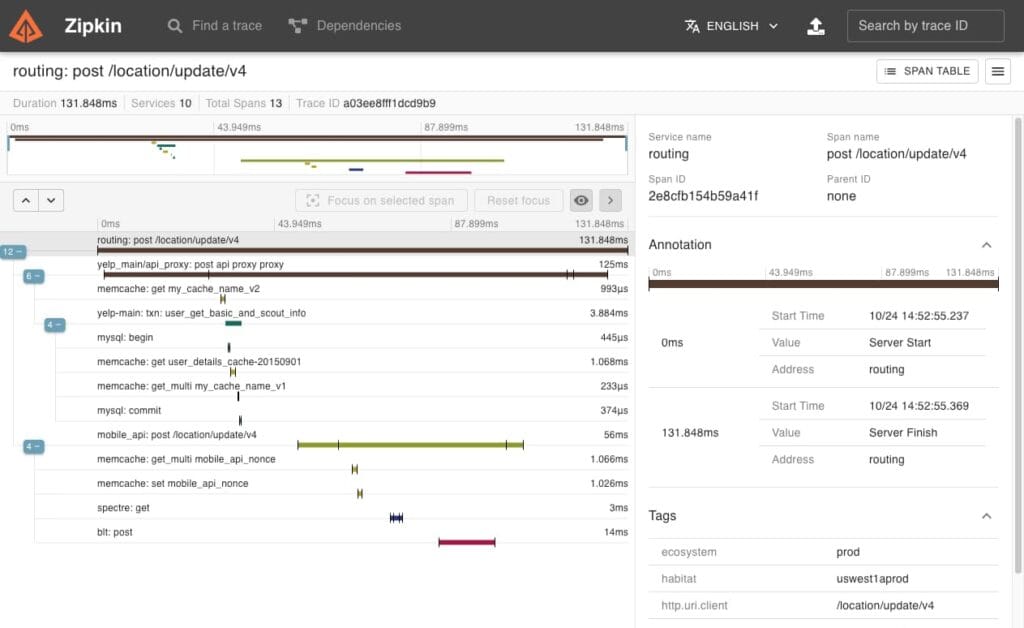
Zipkin is a distributed tracing system used by DevOps, SRE, platform, and backend engineering teams to understand request flows across microservices. It collects trace data from instrumented applications, stores it, and makes it searchable through a web UI and API.
The project was originally created to solve latency debugging in service-oriented architectures. Zipkin follows the distributed tracing model popularized by Google’s Dapper paper and focuses on collecting and looking up trace data, not on full-stack observability.
That focus matters for pricing. Zipkin does not include native logs, infrastructure metrics, RUM, synthetics, session replay, or commercial support. It is best understood as a self-hosted tracing backend, not a full observability platform.
Supported Languages, Integrations, and Data Sources
Zipkin works with instrumented applications that send trace data to the Zipkin backend. The OpenZipkin ecosystem includes official and community libraries, and Zipkin can also receive traces from OpenTelemetry-compatible instrumentation through Zipkin-compatible exporters.
| Area | Zipkin support |
| Main use case | Distributed tracing |
| Data collected | Spans and trace timing data |
| Common transports | HTTP, Kafka, RabbitMQ, ActiveMQ, gRPC, Apache Pulsar |
| Storage backends | In-memory, Cassandra, Elasticsearch, OpenSearch 2.x, MySQL legacy |
| Deployment | Self-hosted JAR, Docker image, Helm chart |
| Server requirement | Zipkin server requires JRE 17+ |
Zipkin’s default server can collect spans over HTTP, Kafka, or RabbitMQ and store them in-memory, MySQL, Cassandra, or Elasticsearch. The GitHub README also confirms support for ActiveMQ, gRPC, RabbitMQ, Apache Pulsar, Cassandra, Elasticsearch, and OpenSearch 2.x.
How Zipkin Works
Zipkin has four practical parts: instrumentation, collection, storage, and query/UI. Applications are instrumented to send spans. Zipkin receives those spans, stores them in a backend, and lets users search or inspect traces through the UI.
If you already have a trace ID from a log file, Zipkin can jump directly to that trace. Otherwise, users can search by service, operation name, tags, and duration. Zipkin also summarizes useful trace details such as service time percentage and failed operations.
Zipkin can run as a single server, which makes it simpler to deploy than more modular tracing systems. The server is available as a runnable JAR, Docker image, and Helm chart. The Zipkin server itself is a Java 17+ service.
Key Features of Zipkin
Zipkin’s core feature is distributed tracing. Teams can search traces by service, operation name, tags, duration, or trace ID. This helps developers identify slow calls, failed operations, and cross-service request paths.
Zipkin’s UI includes a dependency diagram that shows how traced requests move between applications. This helps teams understand service relationships, error paths, and deprecated service calls.
For persistent storage backends, dependency links require a separate Zipkin Dependencies job. That job is implemented as an Apache Spark job and analyzes stored spans for later display in the UI.
Zipkin supports in-memory storage for testing and persistent storage through Cassandra, Elasticsearch, OpenSearch 2.x, and legacy MySQL. In-memory storage is not suitable for realistic production workloads because it is volatile and limited by memory.
Zipkin commonly receives trace data over HTTP and Kafka, but it also supports transports such as RabbitMQ, ActiveMQ, gRPC, and Apache Pulsar. Apache Pulsar support was added in a Zipkin 3.5.0 release.
Zipkin can be started quickly with a JAR or Docker image. The GitHub README shows a one-command Docker startup using openzipkin/zipkin, and released images are published to Docker Hub and GitHub Container Registry.
Zipkin search is enabled by default, but it can be disabled. The project notes that disabling search can reduce storage costs or increase write throughput, although traces then need to be retrieved by ID.
Zipkin Pricing in 2026
Zipkin’s software price is $0.
Zipkin is open source under the Apache 2.0 license. There are no license fees, no paid plans, no per-seat charges, no per-host charges, and no per-GB ingestion fees charged by the Zipkin project.
| Cost item | What you pay |
| Zipkin software license | $0 |
| Per-user fees | $0 |
| Per-host fees | $0 |
| Per-GB ingestion fees | $0 |
| Compute | Your cloud or on-prem cost |
| Storage backend | Your Cassandra, Elasticsearch, or OpenSearch cost |
| Maintenance | Your engineering time |
| Official commercial SLA | Not provided by the OpenZipkin project |
The important pricing point is that free software is not the same as free operations. Zipkin shifts cost from a vendor bill to your own infrastructure and engineering budget.
Where Zipkin Costs Actually Come From
Zipkin’s real cost comes from running and maintaining the tracing stack yourself.
| Cost area | Why it matters |
| Compute | Zipkin servers need VMs, containers, or Kubernetes resources |
| Storage | Cassandra, Elasticsearch, or OpenSearch usually becomes the largest cost |
| Retention | Longer trace retention increases storage size |
| Dependency jobs | Dependency graphs require a separate Spark aggregation job |
| Engineering time | Your team owns deployment, upgrades, tuning, and incidents |
The storage backend is usually the biggest cost driver. Zipkin’s own docs describe in-memory storage as useful for testing, not realistic high-volume production workloads, which means production teams normally need Cassandra, Elasticsearch, or OpenSearch.
Is There a Free Tier in Zipkin?
Zipkin does not have a traditional free tier because the entire product is free. There is no paid edition, no enterprise tier from the OpenZipkin project, and no feature gate between free and paid plans.
That makes Zipkin attractive for testing, small production environments, learning, and teams that want tracing data to stay in their own infrastructure. The trade-off is that you do not get official vendor support, managed hosting, or an SLA from the project.
What Does Zipkin Really Cost to Run?
Zipkin is free software, but production tracing still has operational cost. You do not pay Zipkin license fees, per-user fees, per-host fees, or per-GB ingest fees. Instead, you pay for the infrastructure and engineering work required to run it yourself.
The main cost is usually the storage backend. Zipkin can use in-memory storage for testing, but production teams normally use Cassandra, Elasticsearch, or OpenSearch. As trace volume and retention increase, that backend becomes the biggest cost driver.
A better way to think about Zipkin pricing is this: Zipkin has no vendor bill, but it still has a total cost of ownership.
| Cost area | Why it matters |
| Compute | Zipkin servers need VM, container, or Kubernetes resources |
| Storage | Cassandra, Elasticsearch, or OpenSearch stores trace data |
| Retention | Longer trace history increases storage requirements |
| Dependency jobs | Dependency graphs require a separate Spark job |
| Engineering time | Your team owns upgrades, tuning, security, and incidents |
For small teams, Zipkin can be very inexpensive because the software is free and a basic deployment does not require much infrastructure. For larger teams, cost rises through trace volume, storage replication, query performance, retention, and the staff time needed to keep the tracing stack reliable.
So the honest pricing takeaway is simple: Zipkin is free to use, but not free to operate. It is usually a strong low-cost option when you only need distributed tracing and have the team to manage it. If you need logs, metrics, alerting, RUM, synthetics, or vendor support, those will come from separate tools outside Zipkin.
What Drives Zipkin Costs?
The more spans you store, the more storage and query capacity you need. Sampling is the main cost-control lever because it reduces the number of traces stored.
In-memory storage is useful for testing but not realistic production workloads. Cassandra, Elasticsearch, and OpenSearch are stronger production choices, but they introduce storage, replication, maintenance, and tuning costs.
Longer retention means more stored trace data. Teams that need weeks of trace history will pay more than teams that keep only a short incident-debugging window.
The Zipkin dependency view needs a separate Spark job that reads spans from storage, analyzes service links, and stores dependency data for the UI.
Zipkin is self-hosted. Your team owns deployment, upgrades, storage tuning, security, backups, monitoring, and incident response for the tracing system itself.
Zipkin covers distributed tracing only. If you need logs, infrastructure metrics, alerting, RUM, synthetics, or session replay, those costs sit outside Zipkin.
Zipkin User Reviews
Zipkin has a small but positive review footprint on G2. It does not appear to have strong public review coverage on Gartner Peer Insights, PeerSpot, or AWS Marketplace, which is common for open-source infrastructure projects.
| Review source | Rating shown publicly | Review count |
| G2 | 4.8/5 | 2 reviews |
| Gartner Peer Insights | No verified public Zipkin review profile found | Not listed |
| PeerSpot | No verified public Zipkin review profile found | Not listed |
| GitHub | Not a review rating | ~17k+ stars |
What Users Like
A G2 reviewer praised Zipkin for tracing and graph representation, especially for showing how long a server or database took to respond to a query.
Zipkin’s single-server design, quick-start JAR, Docker image, and default in-memory setup make it easy to test quickly before connecting persistent storage.
Teams can choose in-memory storage for testing or Cassandra, Elasticsearch, and OpenSearch for more durable production setups.
Zipkin has visible community adoption, with GitHub showing about 17.4k stars and the project continuing to publish releases.
What Users Criticize
⚠️ Disclaimer
These points reflect public user-review themes and technical limitations. They should be treated as feedback, not universal limitations.
A G2 reviewer said Zipkin is easy to use but that the UI could still improve. This matches the broader perception that Zipkin’s UI is functional but not as polished as modern commercial observability platforms.
Zipkin does not provide full-stack observability. Product Owl’s analysis also classifies Zipkin as open-source and free, while its capability scoring reflects that the product is narrower than broader APM platforms.
The OpenZipkin project is community-driven. Teams that need vendor-backed SLAs, onboarding, or production support may need a commercial observability platform or a managed service.
Zipkin is easy to start, but production setups require persistent storage, retention decisions, dependency jobs, and operational ownership.
Zipkin Alternatives: How it Compares to Competitors
Zipkin vs CubeAPM
Zipkin is a tracing-only system. CubeAPM is a self-hosted, vendor-managed observability platform that covers APM, distributed tracing, logs, infrastructure monitoring, RUM, synthetics, error tracking, SLOs, dashboards, RBAC, SSO, MFA, and audit logs under a $0.15/GB Pro pricing model.
| Category | Zipkin | CubeAPM |
| Scope | Tracing only | Full-stack observability |
| Pricing | Free software, infra cost | $0.15/GB |
| Deployment | Self-hosted | Self-hosted, vendor-managed |
| Support | Community | Vendor support |
| Best for | Lightweight tracing | Teams wanting broader coverage |
CubeAPM is a stronger fit when teams want data control and predictable pricing but do not want to stitch together separate tools for traces, logs, metrics, RUM, and synthetics.
Zipkin vs Jaeger
Jaeger is another popular open-source distributed tracing system. Both tools are free and self-hosted, but Zipkin is simpler to start, while Jaeger is generally associated with larger cloud-native deployments and a more modular architecture.
| Category | Zipkin | Jaeger |
| Software cost | $0 | $0 |
| License | Apache 2.0 | Apache 2.0 |
| Core use case | Distributed tracing | Distributed tracing |
| Architecture | Simple single-server option | More modular |
| Best for | Lightweight tracing | Larger tracing environments |
Zipkin is a good fit when simplicity and quick setup matter. Jaeger is often considered when teams want a more cloud-native tracing architecture.
Zipkin vs Grafana Tempo
Grafana Tempo is Grafana’s distributed tracing backend. It is available as open-source software and as Grafana Cloud Traces. Grafana Cloud’s public pricing page lists a free traces tier limited to 50 GB/month with 14-day retention, and Pro on-demand traces pricing at $0.05/GB process, $0.40/GB write, and $0.10/GB retain.
| Category | Zipkin | Grafana Tempo |
| Software cost | $0 self-hosted | $0 self-hosted |
| Managed option | No official Zipkin SaaS | Grafana Cloud Traces |
| Free cloud tier | Not applicable | 50 GB/month traces |
| Pricing model | Your infra cost | Cloud traces usage pricing |
| Best for | Simple self-hosted tracing | Grafana/LGTM teams |
Tempo is stronger if your team already uses Grafana, Loki, and Prometheus/Mimir. Zipkin is simpler if you only want a standalone tracing backend.
Zipkin vs Datadog
Datadog is a commercial SaaS observability platform with modular pricing. Datadog’s public pricing list shows Infrastructure Pro at $15 per host/month on annual billing, while Datadog’s APM billing docs show APM Host at $31 per underlying APM host/month, with additional indexed span and ingested span billing above included allowances.
| Category | Zipkin | Datadog |
| Deployment | Self-hosted | SaaS |
| Software cost | $0 | Paid |
| Scope | Tracing only | Broad observability |
| Pricing model | Infrastructure-driven | Modular SaaS meters |
| Best for | Data-control teams | SaaS-first teams wanting breadth |
Datadog is much broader than Zipkin, but its pricing is also more complex. Zipkin avoids vendor meters but requires your team to operate the stack.
Zipkin vs New Relic
New Relic is a commercial SaaS observability platform. Its official pricing page confirms a perpetual free tier with 100 GB/month of data ingest, unlimited basic users, one free full platform user, and access to 50+ capabilities.
| Category | Zipkin | New Relic |
| Deployment | Self-hosted | SaaS |
| Free option | Full software is free | 100 GB/month ingest free |
| Scope | Tracing only | Full-stack observability |
| Pricing model | Your infra cost | SaaS usage and plan pricing |
| Best for | Self-hosted tracing | Teams wanting managed observability |
New Relic is easier to adopt as a managed platform, while Zipkin gives more infrastructure control at the cost of operational ownership.
Is Zipkin the Right Choice?
Zipkin Works Best For
Zipkin is a strong fit for teams that need backend distributed tracing without buying a full observability suite.
Because Zipkin is self-hosted, trace data stays in your own infrastructure.
Zipkin works well when you have engineers who can manage storage, retention, upgrades, and reliability.
The $0 software cost, quick-start JAR, and Docker deployment make Zipkin useful for demos, proofs of concept, and tracing education.
Zipkin is a good fit for teams that prefer open-source infrastructure and are comfortable owning operations.
Zipkin May Not Be the Right Fit For
Zipkin can start with in-memory storage, but production setups normally need Cassandra, Elasticsearch, or OpenSearch. That means teams must plan storage, retention, scaling, and backup strategy.
Zipkin can show service dependencies, but dependency links require the separate Zipkin Dependencies process. This adds another job to schedule, monitor, and maintain.
Zipkin is free software, but your team still owns deployment, upgrades, storage tuning, monitoring, and troubleshooting.
Zipkin is an open-source community project, not a commercial SaaS product. Teams that need vendor-backed onboarding, support, or contractual SLAs may need a managed or commercial observability platform.
Conclusion
Zipkin remains a practical, reliable, and free distributed tracing system in 2026. It helps teams collect and search trace data, inspect request paths, and troubleshoot latency across service-based architectures. The Apache 2.0 license, quick deployment model, and active open-source footprint make it especially attractive for teams that want self-hosted tracing without license fees.
The pricing story is simple but easy to misunderstand. Zipkin costs $0 as software, but production use still requires compute, storage, retention management, dependency jobs, and engineering time. At small scale, that can be very cheap. At larger scale, storage and operations can become a meaningful part of the observability budget.
The main trade-off is scope. Zipkin is excellent for tracing, but it is not a full observability platform. If your team only needs self-hosted distributed tracing, Zipkin is a strong option. If you need logs, metrics, RUM, synthetics, dashboards, alerting, access control, and vendor-backed support in one place, compare it carefully with broader platforms such as CubeAPM, Grafana Cloud, Datadog, and New Relic.
Disclaimer: Pricing, packaging, support terms, product limits, and cloud infrastructure costs can change. Zipkin itself has no list price because it is open-source software. The cost examples in this article are directional editorial estimates based on common self-hosting patterns, not official quotes. Always validate your own infrastructure costs with your cloud provider and confirm commercial vendor pricing directly before purchase.
FAQs
1. How much does Zipkin cost?
Zipkin costs $0 as software. It is open source under the Apache 2.0 license and does not charge per user, host, span, or GB. You pay for the infrastructure and engineering time required to run it.
2. Does Zipkin have a paid or enterprise edition?
No. The OpenZipkin project does not sell a paid or enterprise edition. Product Owl also classifies Zipkin as open-source with no paid-only access, no freemium split, and no contact-sales pricing model.
3. What drives Zipkin cost?
The biggest cost drivers are trace volume, retention, storage backend, dependency-job processing, and engineering time. Production deployments usually require Cassandra, Elasticsearch, or OpenSearch rather than in-memory storage.
4. Does Zipkin support OpenSearch?
Yes. The Zipkin GitHub README says the Elasticsearch storage component is tested against Elasticsearch 7–8.x and OpenSearch 2.x.
5. Does Zipkin support Apache Pulsar?
Yes. Zipkin’s release notes show Apache Pulsar support added as a span transport in Zipkin 3.5.0.
6. Does Zipkin include logs and metrics?
No. Zipkin focuses on distributed tracing. Logs, infrastructure metrics, RUM, synthetics, and session replay require other tools.
7. Is Zipkin good for production?
Yes, Zipkin can be used in production, but production use requires persistent storage, retention planning, sampling, monitoring, and operational ownership. In-memory storage is not viable for realistic high-workload production use.
8. What are the best Zipkin alternatives?
Common alternatives include Jaeger, Grafana Tempo, CubeAPM, Datadog, and New Relic. The right choice depends on whether you need only tracing or a broader observability platform.