

If you’re evaluating SigNoz alternatives, whether because ClickHouse management has become a second job, SaaS costs are climbing faster than your telemetry budget, or you need a self-hosted observability platform without the backend overhead, this guide is for you. We compare 7 platforms against SigNoz across pricing, operational burden, OpenTelemetry support, self-hosted deployment options, and Kubernetes visibility so you can make a confident decision.
SigNoz is a well-regarded OpenTelemetry-native platform that brings logs, metrics, and traces together in one place. Engineering-led teams often gravitate toward it for the deployment control it offers. But as environments scale, two pressure points emerge consistently: the SaaS tier becomes expensive as telemetry volume grows, and self-hosted deployments require operating the ClickHouse backend, adding real maintenance overhead for teams without dedicated DevOps resources.
Top 7 SigNoz alternatives
- CubeAPM
- Datadog
- Dynatrace
- Elastic Observability
- Grafana Cloud
- New Relic
- Better Stack
Quick comparison table: Best SigNoz alternatives at a glance
The information in this table is based on publicly available vendor documentation at the time of writing. Feature availability, pricing models, and retention policies may vary by deployment configuration, subscription tier, or enterprise agreement. Consult official documentation before making platform decisions.
| Tool | Pricing (Small / Mid / Large) | Native OTEL | Self-hosted? | Backend managed by | Support TAT |
| CubeAPM | $2,080 $7,200 $15,200 | Yes | Yes | Vendor (CubeAPM) | Minutes |
| SigNoz | $4,600 $16,000 $34,000 | Yes | Yes | Self-hosted: YouSaaS: SigNoz | Not available |
| Grafana Cloud | $3,870 $11,875 $26,750 | Yes | Yes | Self-hosted: You SaaS: Grafana | 2–6 hrs |
| Elastic Observability | $4,550 $17,435 $35,370 | Yes | Yes | You or Elastic | 30 min–3 days |
| Dynatrace | $7,740 $21,850 $46,000 | *No | Limited | Dynatrace | 4 hrs–days |
| Better Stack | $5,723 $20,550 $43,350 | *No | No | Better Stack | Within hours |
| New Relic | $7,896 $25,990 $57,970 | *No | No | New Relic | 2 hrs–days |
| Datadog | $8,185 $27,475 $59,050 | *No | No | Datadog | <2 hrs–48 hrs |
Why teams look for SigNoz alternatives
- OpenTelemetry-native observability: SigNoz appeals to teams that want observability built around open standards instead of proprietary instrumentation
- Logs, metrics, and traces in one platform: Core telemetry signals in one place makes troubleshooting easier and reduces tool sprawl
- Open-source and self-hosted appeal: Engineering teams that want more deployment control and data residency flexibility are often drawn to SigNoz
- Good fit for engineering-led teams: Developer and platform teams that prefer hands-on control over their observability stack tend to gravitate toward it
Increasing operational complexity: The combined SigNoz + ClickHouse stack introduces real maintenance overhead. Scaling nodes, handling upgrades, managing storage, and ensuring query performance can feel like a second job for teams without dedicated DevOps resources.
UI feels functional but unrefined: While the interface works, it can feel rigid or clunky during daily use. Navigating dashboards, searching logs, or drilling into traces often requires extra steps, slowing routine troubleshooting.
Steep learning curve: Extracting full value requires understanding ClickHouse tuning, OTEL enrichment pipelines, and YAML-based configurations. Teams without dedicated observability engineers may struggle to optimize retention, performance, and alerting.
Managing ClickHouse adds operational overhead: ClickHouse needs constant attention as the amount of data grows. This includes tuning memory usage, changing retention rules, and fixing performance problems, all of which take time away from debugging real applications.
How we evaluated these SigNoz alternatives
We assessed each platform against seven criteria and modeled costs across three standardized usage scenarios: growing team, mid-market, and Kubernetes-heavy, using publicly available pricing as of early 2026.
- Telemetry coverage: Full MELT observability (metrics, events, logs, traces) in one unified workflow.
- OpenTelemetry support: Native or strong OTel support to reduce migration friction and preserve instrumentation.
- Deployment flexibility: SaaS, self-hosted, hybrid, and controlled deployment options for varying security and compliance needs.
- Pricing model: How costs scale across ingest volume, hosts, retention, and add-on usage, not just entry-level pricing.
- Kubernetes and cloud-native support: Weight is given to tools that perform well in containerized and microservices-heavy environments.
- Alerting and usability: Ease of use during routine monitoring and active incidents.
- Self-hosted operational overhead: How much backend work does your team absorb when deploying self-hosted? Particularly relevant for teams evaluating SigNoz’s ClickHouse-managed model against alternatives.
Cost methodology
We used standardized usage assumptions and applied each vendor’s publicly available pricing as of early 2026. The goal was not to produce exact quotes but to estimate how each pricing model behaves under the same observability workload.
What we included:
- Data ingestion across logs, metrics, and traces
- Host-based pricing for infrastructure and APM, where applicable
- User-based pricing, where applicable
- Log indexing assumptions: 30% indexed, 70% archived
We focused only on core observability (logs, metrics, traces, alerting, Kubernetes monitoring) and excluded add-ons like security, synthetics, and RUM. Actual costs may vary based on usage, discounts, and deployment choices.
*An APM host is a host actively generating trace data. An infra host is any physical or virtual OS instance monitored with any observability tool.
Retention comparison: Default vs. Maximum across all tools
Retention is one of the most misunderstood cost drivers in observability. A tool that looks cheaper at first can become significantly more expensive when you factor in what you’re paying for longer log or trace retention. This table compares default retention windows and what it costs to extend them, a detail that rarely appears in vendor comparison pages.
| Tool | Logs default | Logs max | Traces default | Traces max | Metrics default | Metrics max | Extended retention cost |
| CubeAPM | Unlimited | Unlimited | Unlimited | Unlimited | Unlimited | Unlimited | Included in $0.15/GB |
| SigNoz | 15 days | Custom | 15 days | Custom | 1 month | Custom | Increases with storage |
| Datadog | Pricing tiers include 3, 7, 15, 30 days | 30 days for indexed logs | 15 days | 30 days | 15 months | 15 months | Higher indexed-retention tiers for logs and spans |
| New Relic | 30 days | 7 years | 8 days | 365 days | 8 days | 395 days | Live Archives add-on |
| Grafana Cloud | 30 days | Custom | 30 days | Custom | 13 months | Custom | Charged on retained volume |
| Elastic Observability | Managed via Streams, data streams, and ILM | Custom | Governed by ILM/default policies | Custom | No public default | Custom | Charged as retained storage |
| Dynatrace | 35 days | 10 years | 10 days | 10 years | 15 months | 10 years | Grail DPS add-on |
| Better Stack | 3 days | Custom | 3 days | Custom | 13 months | Custom | $0.05/GB/month retain |
Disclaimer: Retention policies are based on publicly available documentation as of early 2026 and may vary by plan, configuration, or region. Verify with each vendor before making decisions.
The key insight from this table: CubeAPM’s unlimited retention model is the most cost-predictable at scale. SigNoz’s default windows are the shortest across all three signal types, which means teams that need 30+ day log or trace retention pay more from the start. Dynatrace and New Relic offer the longest maximum retention windows, valuable for compliance-heavy environments, but at additional cost through add-on modules.
Per-signal pricing breakdown: What you pay for logs, traces, and metrics
Most vendor pricing pages show a single blended rate. In practice, logs, traces, and metrics are often priced very differently, and which signal type dominates your workload directly determines your actual bill. This breakdown makes cross-vendor pricing easier to compare at signal level.
| Tool | Log ingest (per GB) | Trace ingest (per GB) | Metrics (per series/month) | User seats | Host charges |
| CubeAPM | $0.15 | $0.15 | Included | Free | None |
| SigNoz (SaaS) | $0.30 | $0.30 | $0.10/mil samples | Free | None |
| Grafana Cloud | $0.50 all-in | $0.50 all-in | 6.50 per 1k series | Free | None |
| Elastic Observability | No separate per-signal | No separate per-signal | Included | Varies | None |
| Datadog | $0.10 | APM is host-based | $1/100 custom metrics/month | None | $15–$31/host |
| New Relic | $0.40–$0.60 | $0.40–$0.60 | Included in ingest | $49–$418 | None |
| Dynatrace | $0.20/GiB | $0.20/GiB | $0.15/100k datapoints | Included | $29–$58/host |
| Better Stack | $0.15/GB | $0.15/GB | $0.50/GB/month | Included | None |
Disclaimer: Per-signal rates are directional estimates derived from publicly available pricing pages as of early 2026. Actual rates depend on volume, tier, region, and negotiated contracts. Verify all figures with each vendor.
The standout pattern: Datadog’s trace pricing is particularly high at scale because it prices by span volume rather than GB, which can surprise teams running distributed systems with high trace cardinality. CubeAPM and SigNoz both use a flat ingestion rate regardless of signal type, which makes cost modeling simpler. Grafana Cloud’s all-in write cost looks higher per GB but includes processing and retention in one number.
The hidden cost: Engineering time on ClickHouse management
For teams running SigNoz self-hosted, the real cost is not just infrastructure; it is the engineering time absorbed by ClickHouse operations. This is rarely quantified in comparison articles, so we have modelled it here based on common team profiles.
Assumptions: $80/hour blended engineering rate (mid-level SRE/DevOps). Hours estimated from community reports and SigNoz operational documentation.
| Task | Hours/month (small team) | Hours/month (mid-market) | Annual cost (small) | Annual cost (mid-market) |
| ClickHouse scaling & node management | 4–6 hrs | 8–12 hrs | $3,840–$5,760 | $7,680–$11,520 |
| Upgrades & version compatibility | 2–3 hrs | 3–5 hrs | $1,920–$2,880 | $2,880–$4,800 |
| Retention & indexing tuning | 2–4 hrs | 4–6 hrs | $1,920–$3,840 | $3,840–$5,760 |
| Ingestion pipeline debugging | 1–2 hrs | 2–4 hrs | $960–$1,920 | $1,920–$3,840 |
| Query performance optimisation | 2–3 hrs | 4–8 hrs | $1,920–$2,880 | $3,840–$7,680 |
| Total estimated | 11–18 hrs | 21–35 hrs | $10,560–$17,280 | $20,160–$33,600 |
At the mid-market level, a team running SigNoz self-hosted can spend $20,000–$34,000 per year in engineering time on ClickHouse management alone before counting infrastructure costs. For teams that are cost-comparing SigNoz against CubeAPM’s vendor-managed self-hosted model, adding this engineering overhead to SigNoz’s licensing cost often reverses the apparent cost advantage.
These estimates are directional and will vary significantly based on team experience, cluster size, and workload. They are intended to make the operational tradeoff visible, not to serve as precise forecasts.
Real-world scenarios: Which SigNoz alternative fits best?
Instead of listing features in the abstract, we modelled three scenarios that reflect common situations where teams outgrow SigNoz or start looking for alternatives. Each scenario defines the team profile, the key decision drivers, and which platforms tend to perform best with pricing to support it.
How to find your scenario
| Question | Your answer | Likely best fit |
| What is your primary reason for evaluating alternatives? | ClickHouse ops overhead | CubeAPM (Scenario 1) |
| SaaS cost at scale | CubeAPM or Grafana Cloud (Scenario 1 or 2) | |
| Need more enterprise features | Dynatrace or Datadog (Scenario 2 or 3) | |
| What is your deployment requirement? | Must stay self-hosted / in my cloud | CubeAPM, Grafana OSS, Elastic |
| Prefer managed SaaS | New Relic, Datadog, Better Stack | |
| What is your primary signal type? | Log-heavy | Elastic Observability or Datadog |
| Trace-heavy (distributed systems) | Dynatrace, CubeAPM, or Datadog | |
| Balanced MELT workload | CubeAPM or Grafana Cloud |
Scenario 1: Growing team hitting SigNoz operational limits
The situation: Your team is 4 engineers, running 60 hosts, and ingesting about 13 TB/month. You started on SigNoz self-hosted because it was free and OpenTelemetry native. Now ClickHouse management is absorbing 10–15 hours of engineering time per month, and you want to stop being a database administrator and start being an SRE.
Reference profile
- Data ingested: ~13 TB/month (6 TB logs, 4 TB traces, 3 TB metrics)
- Infrastructure: 60 hosts
- Users: 4 (20% engineers)
- Retention: 30 days across all signal types
- Scope: Core observability only no security, profiling, or synthetics
Approximate monthly costs for a growing team
*Directional estimates based on public rate cards, early 2026. Vendor discounts may reduce SaaS costs significantly.
| Tool | Est. monthly cost | vs SigNoz ($4,600) | Self-hosted? | Ops overhead |
| CubeAPM | $2,080 | -55% | Yes (vendor-managed) | Very low |
| Grafana Cloud | $3,870 | -16% | Yes (optional) | Moderate |
| Elastic Observability | $4,550 | -1% | Yes (optional) | Moderate–high |
| SigNoz | $4,600 | — | Yes (self-managed) | High |
| Better Stack | $5,723 | +24% | No | Low |
| Dynatrace | $7,740 | +68% | Limited | Low–moderate |
| New Relic | $7,896 | +72% | No | Low |
| Datadog | $8,185 | +78% | No | Low |
- CubeAPM: Most cost-effective and removes ClickHouse management entirely. Vendor-managed self-hosted means you keep data inside your cloud without backend ops. Best overall fit for teams in this situation.
- Grafana Cloud: Reasonable cost, familiar tooling if you’re already using Prometheus/Grafana. More moving parts than CubeAPM but a natural evolution from a Grafana-based stack.
- Better Stack: Good if you also want built-in incident management and simpler onboarding. Costs more but removes all backend work.
Scenario 2: Mid-market team scaling observability
The situation: Your organization is running 200 hosts, ingesting 45 TB/month, and has 10 platform users who need observability access. SigNoz’s SaaS bill is growing faster than your budget, and you want either a more cost-effective managed option or a self-hosted platform that doesn’t require a full-time ClickHouse engineer.
Reference profile
- Data ingested: ~45 TB/month (20 TB logs, 15 TB traces, 10 TB metrics)
- Infrastructure: 200 hosts
- Users: 10 full-platform users
- Retention: 30 days across all signal types
- Scope: Core observability only, no security, profiling, or synthetics
Approximate monthly costs for a mid-market team
*Directional estimates based on public rate cards, early 2026.
| Tool | Est. monthly cost | vs SigNoz ($16,000) | Self-hosted? | Ops overhead |
| CubeAPM | $7,200 | -55% | Yes (vendor-managed) | Very low |
| Grafana Cloud | $11,875 | -26% | Yes (optional) | Moderate |
| SigNoz | $16,000 | — | Yes (self-managed) | High |
| Elastic Observability | $17,435 | +9% | Yes (optional) | Moderate–high |
| Better Stack | $20,550 | +28% | No | Low |
| Dynatrace | $21,850 | +37% | Limited | Low–moderate |
| New Relic | $25,990 | +62% | No | Low |
| Datadog | $27,475 | +72% | No | Low |
- CubeAPM: Pricing stays centered on ingestion at $0.15/GB with free user licenses. Delhivery documented 75% savings after replacing three separate monitoring tools. Mamaearth documented nearly 70% savings and completed migration in under an hour with zero downtime. redBus reported 4x faster dashboards and 50% faster MTTR.
- Grafana Cloud: Strong for teams already standardized on Grafana/Prometheus tooling. More cost-effective than SigNoz SaaS at this scale.
- Elastic Observability: Worth considering if log analytics and deep search workflows are central to your team. The cost is similar to SigNoz at this scale but with stronger log querying capabilities.
- New Relic: Makes sense for mid-market teams that want broad platform access across large engineering organizations. The free user ingestion model removes per-seat pressure.
- Dynatrace: Fits mid-market teams willing to pay more for deeper operational automation. Bundles full-stack monitoring, Kubernetes monitoring, and log ingestion into a single platform with AI-assisted root cause analysis.
Scenario 3: Kubernetes-heavy team during live incidents
The situation: You are running 3 clusters, 120 nodes, and roughly 900 pods across customer-facing services, background workers, and shared platform components. During a live incident, pods restart, replicas reschedule, and one slowdown ripples across services, queues, and databases. The question is not whether your observability platform collects telemetry; it is whether it helps engineers isolate the failing pod, service, or node fast enough to reduce MTTR.
- CubeAPM: Kubernetes monitoring is built around correlated infrastructure metrics, Kubernetes events, logs, and traces collected through OpenTelemetry, enabling drill-down from node or pod conditions into kubelet logs, events, and related trace slowdowns.
- Dynatrace: Kubernetes incidents generate thousands of simultaneous events across hosts, containers, services, and dependencies. Davis AI, Smartscape topology mapping, and Grail-backed context reduce noise and isolate the failing layer faster than manual correlation.
- Datadog: Kubernetes Explorer correlates node activity with logs, while Service Map and log-trace correlation help teams pivot from a degraded service to the supporting infrastructure without rebuilding context manually.
- Grafana Cloud: Fits teams already standardized on Grafana, Prometheus, Loki, and Tempo. Supports contextual root-cause analysis and direct correlation across logs, traces, and metrics in workflows teams already know.
Scenario takeaway
Growing teams optimize for cost and operational simplicity. Mid-market teams care more about governance, retention, and platform breadth. Kubernetes-heavy teams prioritize speed of diagnosis. Across all three scenarios, CubeAPM and Grafana Cloud appear as the most cost-effective options with self-hosting available, while Dynatrace and Datadog lead on automation and managed depth at higher price points.
- Growing team: CubeAPM, Grafana Cloud, Better Stack
- Mid-market: CubeAPM, Grafana Cloud, New Relic, Elastic Observability
- Kubernetes incidents: CubeAPM, Dynatrace, Datadog, Grafana Cloud
Hidden costs of using SigNoz at scale
While SigNoz is often attractive due to its open-source foundation and OpenTelemetry-native design, many teams underestimate the true cost of operating it at scale. The engineering time table above captures the ClickHouse overhead. Below are the additional hidden cost vectors.
SigNoz relies on ClickHouse for storing and querying telemetry data. As ingestion grows, teams need to provision and scale ClickHouse clusters, manage storage, and optimize disk, memory, and compute. This drives higher cloud infrastructure bills, overprovisioning, and backup costs.
As telemetry volume increases, query performance degrades without proper tuning , requiring index optimization, query tuning, schema adjustments, and latency monitoring. These tasks require specialized ClickHouse knowledge that most application teams don’t have in-house.
Scaling SigNoz introduces architectural decisions: when to shard or replicate ClickHouse, how to balance ingestion vs. query workloads, and how to manage high-cardinality metrics. Poor decisions lead to slower dashboards, delayed incident response, and spiraling infrastructure costs.
Operational complexity directly impacts MTTR. Slower dashboards, longer queries, and harder log-metric-trace correlations all increase time-to-resolution, often the most expensive hidden cost, even though it never appears in a pricing comparison.
Takeaway
For many teams, the decision is not about feature parity — it is about whether they want to operate an observability platform or simply use one. The total cost of SigNoz self-hosted includes licensing, infrastructure, and a significant amount of engineering time that does not show up on any vendor pricing page.
7 best SigNoz alternatives
1. CubeAPM
Best for: growing teams, mid-market environments, and Kubernetes-heavy organizations that want unified observability with strong cost control, data residency, and no backend management overhead.
Known for
CubeAPM is known for unified observability across logs, metrics, traces, infrastructure, and application performance monitoring. It is self-hosted and vendor-managed; your data stays inside your cloud, but CubeAPM’s team manages the platform. This solution removes the ClickHouse management burden that comes with SigNoz self-hosted while preserving data sovereignty.
Recognized as a High Performer in G2’s Spring 2026 APM Grid Report and ranked #4 among the easiest-to-use APM tools on G2. Trusted by redBus (part of NASDAQ-listed MakeMyTrip, 8+ countries), Delhivery ($3.5B valuation), Mamaearth ($1.2B valuation), Policybazaar, Practo, and others.
Key features
- Full-stack observability with OpenTelemetry-native support
- Kubernetes monitoring
- Log management
- Synthetic monitoring
- Error tracking
Standout features
- Smart sampling
- Predictable ingestion-based pricing ($0.15/GB) — all signal types, no host or user charges
- Unlimited retention included
- Self-hosted, vendor-managed deployment
- Data compliance: SOC 2 and ISO 27001 certified
Pros
- Full MELT observability in one platform
- Keeps telemetry data inside the customer’s cloud, ideal for compliance-driven teams
- Lower operational overhead than any self-managed stack
- Strong Kubernetes and microservices visibility
Cons
- Not suited for teams requiring fully off-premises SaaS
- Strictly an observability platform no cloud security management
Pricing
- $0.15/GB ingested. No host charges. No user charges. Unlimited retention.
CubeAPM vs SigNoz
CubeAPM is the strongest self-hosted alternative to SigNoz for teams that want data residency without ClickHouse management. SigNoz’s self-hosted model puts full backend ownership on your team, including ClickHouse scaling, upgrades, storage, and query optimization. CubeAPM’s vendor-managed model removes all of that while keeping your data in your own cloud. CubeAPM also offers unlimited retention at $0.15/GB, while SigNoz’s default retention windows are among the shortest in this comparison, and extending them increases cost.
2. Dynatrace
Best for: mid-market and enterprise teams that need advanced automation, topology-aware root cause analysis, and enterprise-scale Kubernetes observability.
Known for
Dynatrace is known for enterprise-grade observability, AI-assisted root cause analysis, and strong support for large, complex environments. Popular with organizations that want deep automation, topology mapping, and a managed platform experience at scale.
Key features
- Full-stack monitoring
- Infrastructure monitoring
- Kubernetes platform monitoring
- Log analytics
- AI-assisted root cause analysis
Standout features
- Davis AI for automated root cause analysis
- Smartscape topology mapping
- Grail data lakehouse
- Hourly usage-based pricing
Pros
- Strong automation for dependency mapping and root cause analysis
- Broad platform coverage across applications, infrastructure, Kubernetes, and logs
- Best-in-class for large distributed system incident triage
Cons
- Expensive for smaller teams
- Complex pricing across multiple modules
- Steep learning curve
Pricing
- Full-Stack Monitoring: $58/month per 8 GiB host
- Infrastructure Monitoring: $29/month per host
Dynatrace vs SigNoz
Choose Dynatrace over SigNoz if your team wants stronger built-in automation for incident investigation in large distributed systems. SigNoz has anomaly-based alerts and AI assistant integrations, but Dynatrace goes further with Davis AI, Smartscape, and Grail-backed context for topology-aware troubleshooting, significantly more powerful for complex enterprise incidents.
3. Elastic Observability
Best for: teams with log-heavy environments and mature platform teams that want deeper search and analytics with flexible deployment options.
Known for
Elastic Observability is known for log analytics, search-driven troubleshooting, and full-stack observability built on the Elastic platform. Especially strong when logs are central to investigation and root-cause analysis.
Key features
- Log analytics
- Application performance monitoring
- Infrastructure and Kubernetes monitoring
- OpenTelemetry support
Standout features
- ES|QL for powerful log querying
- Elastic AI Assistant
- Machine learning and AIOps
- Search AI Lake
Pros
- Strong log search and analytics
- Broad observability coverage
- Flexible deployment: serverless, hosted, and self-managed
- Deep query and exploration workflows
Cons
- More complex to operate than simpler platforms
- Pricing depends on ingest, retention, and egress needs; close tracking at scale
- Steep learning curve
Pricing
- Standard: $99/month
- Gold: $114/month
- Platinum: $131/month
- Enterprise: $184/month
Elastic Observability vs SigNoz
Choose Elastic Observability over SigNoz if your team depends on deeper log search and more flexible data exploration. SigNoz is simpler and more OpenTelemetry-first, but its default retention is shorter and its self-hosted deployment requires ClickHouse management. Elastic gives more search power and deployment flexibility in exchange for a steeper operational learning curve.
4. Datadog
Best for: teams that want a managed observability platform with broad coverage, fast onboarding, and strong ecosystem depth.
Known for
Datadog is known for managed full-stack observability, broad integrations, and fast time to value across infrastructure, applications, logs, and cloud services.
Key features
- Infrastructure monitoring
- Application performance monitoring
- Log management
- Kubernetes monitoring
- Cloud integrations
Standout features
- Watchdog AI for anomaly detection
- 900+ integrations
- Unified dashboards
- Managed SaaS experience
Pros
- Easy to set up and instrument
- Strong dashboards and visualisations
- Good correlation across logs, metrics, and traces
- Broad feature coverage
Cons
- Can get expensive at scale
- Costs are hard to predict at high cardinality
- Feature breadth can feel overwhelming
Pricing
- Infrastructure Monitoring Pro: from $15/host/month
- Application Performance Monitoring: from $31/host/month
- Log Management: from $0.10/GB ingested
Datadog vs SigNoz
Choose Datadog over SigNoz if your team needs mature long-term log workflows with flexible archiving, rehydration, and retention controls. Datadog is also a stronger fit for teams that do not want to manage the storage layer behind a self-hosted stack. SigNoz’s self-hosted architecture puts ClickHouse ownership squarely on the team, while Datadog handles all backend operations as a fully managed SaaS.
5. New Relic
Best for: teams that want broad observability coverage with strong real-time visibility and a usage-based model that scales without host-based charges.
Known for
New Relic is known for full-stack observability, real-time monitoring, and a broad platform that brings application performance, infrastructure, logs, and user experience data into one place.
Key features
- Application Performance Monitoring
- Infrastructure monitoring
- Log management
- Distributed tracing
- OpenTelemetry support
Standout features
- New Relic AI
- NRQL for flexible querying
- Live Archives (log retention up to 7 years)
Pros
- Strong real-time monitoring
- Unified visibility across all signal types
- Clean dashboards
- Broad integrations
Cons
- Pricing can become expensive at scale
- Cost model is hard to predict at high user counts
- UI can feel complex in larger environments
Pricing
- Data ingest: 100 GB free/month
- Original data ingest: $0.40/GB
- Data Plus data ingest: $0.60/GB
- Core users: $49/user
- Full Platform users, Pro: $349/user (annual) or $418.80/user (monthly)
Explore New Relic pricing in detail using the New Relic pricing calculator here.
New Relic vs SigNoz
Choose New Relic over SigNoz if your team needs longer log retention without staying inside short default windows. New Relic keeps logs for 30 days by default and offers Live Archives up to seven years, while SigNoz starts with 15 days for logs and traces and 1 month for metrics. New Relic is also stronger for large engineering organizations that want broad access without host-based charges; its pricing includes 100 GB free ingest monthly, unlimited hosts, and tiered user models.
6. Grafana Cloud
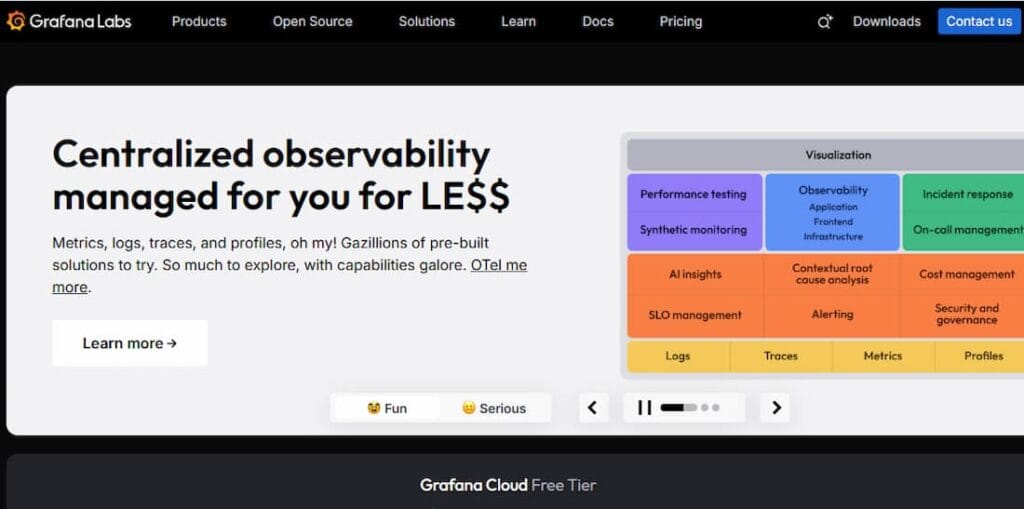
Best for: cloud-native teams already using Grafana-style workflows that want a flexible platform for metrics, logs, traces, and Kubernetes monitoring.
Known for
Grafana Cloud is known for cloud-native observability, dashboarding, and a composable monitoring stack built around Grafana, Loki, Tempo, and Prometheus-style workflows.
Key features
- Application observability
- Infrastructure monitoring
- Log management (Loki)
- Kubernetes monitoring
- Metrics and traces (Prometheus + Tempo)
Standout features
- Grafana dashboards
- Loki for logs
- Tempo for traces
- Prometheus-compatible metrics
- OpenTelemetry support
Pros
- Strong dashboards and visualisations
- Good flexibility for cloud-native monitoring
- Broad metrics, logs, and traces support
- Familiar to Grafana users
Cons
- More setup and architectural decisions required
- Pricing across multiple dimensions is harder to track
- UI can be overwhelming in large environments
Pricing
- Pro platform fee: from $19/month
- Logs: $0.05 process + $0.40 write + $0.10 retain per GB
- Traces: $0.05 process + $0.40 write + $0.10 retain per GB
Grafana Cloud vs SigNoz
Choose Grafana Cloud over SigNoz if your team wants longer built-in retention on the managed plan (30 days for logs and traces, 13 months for metrics vs. SigNoz’s 15 days/1 month defaults) or is already standardised on Grafana, Prometheus, Loki, and Tempo tooling. Grafana Cloud is also a strong self-hosted alternative to SigNoz for teams that want to run the full open-source stack without being locked into ClickHouse as the backend.
7. Better Stack
Best for: small and growing teams that want a managed observability platform with simpler setup and integrated incident response workflows.
Known for
Better Stack is known for combining observability, incident management, uptime monitoring, and log management in a simpler managed platform. Often associated with fast setup and cleaner workflows for teams that want modern monitoring without enterprise stack complexity.
Key features
- Log management
- Distributed tracing
- Infrastructure monitoring
- Uptime monitoring
- Incident management
Standout features
- eBPF-based collection
- Integrated on-call scheduling
- VRL transformations, SQL, and PromQL querying
Pros
- Easy to set up
- Clean, simple workflows
- Good mix of monitoring and incident response in one product
- Strong value for smaller teams
Cons
- Can get expensive once free-tier limits are exceeded
- Some users have noted difficulties configuring status pages during setup
Pricing
- Free plan: $0/month (3 GB logs/3 days, 30 GB metrics, 10 monitors, 1 status page)
- Logs & Traces: $0.10/GB ingested
- Logs & Traces retention: $0.05/GB/month
- Metrics retention: $0.50/GB/month
- Telemetry bundles (US, billed yearly): Nano $38/mo, Micro $150/mo, Mega $315/mo, Tera $630/mo
Better Stack vs SigNoz
Choose Better Stack over SigNoz if your team wants simpler managed observability with built-in uptime monitoring, on-call scheduling, and incident workflows in the same product. That is a natural fit for teams that want monitoring and response in one place instead of building around an engineering-led observability stack. Better Stack also offers easier pricing entry points, free plans, and prepaid bundles that compare favorably to SigNoz’s short default retention windows and increasing costs for longer retention.
Which SigNoz alternative is best for your use case?
One of the most common reasons teams look beyond SigNoz is to find a self-hosted observability platform that doesn’t require them to operate a ClickHouse cluster. The distinction matters because ‘self-hosted’ means different things depending on the tool: with SigNoz, you own both the application layer and the ClickHouse storage backend. With CubeAPM, the platform runs inside your own cloud environment, but the vendor manages the backend, giving you data residency without the operational burden.
This section focuses specifically on teams searching for a self-hosted SigNoz alternative — whether for data compliance, cost control, or security reasons — and compares the realistic operational differences between each option.
Self-hosted options compared
| Tool | Deployment model | Who manages the backend? | Data stays in your cloud? | Ops effort (1–5) | Best for |
| CubeAPM | Self-hosted, vendor-managed | CubeAPM team | Yes | 1 — very low | Teams wanting data residency with zero backend ops |
| SigNoz | Self-hosted, self-managed | Self-hosted: You SigNoz for cloud | Yes for self-hosted | 4—high for self-hosted | Engineering-led teams with DevOps capacity |
| Grafana Cloud | Self-hosted or SaaS | Self-hosted: YouSaaS: Grafana Cloud | Yes (OSS) | 3 — moderate for self-hosted | Teams already on Grafana/Prometheus stack |
| Elastic Observability | Self-managed, hosted & serverless | You or Elastic | Yes (OSS) | 3–4 — moderate for self-hosted | Log-heavy teams needing deep search |
| Dynatrace | SaaS and Self-hosted | Dynatrace | Partial | 2 — low-moderate | Enterprise teams, limited true self-hosting |
Ops effort scale: 1 = almost no backend work required by your team; 5 = significant ongoing engineering investment.
What “self-hosted” actually means for each tool
Runs entirely inside your own AWS, GCP, or Azure environment. You keep data sovereignty and meet compliance requirements without running or scaling any database backend yourself. CubeAPM’s team manages the platform. This is the closest thing to ‘self-hosted without the ops tax’ available today.
True self-hosted open-source platform. Your team owns everything: the application layer, the ClickHouse cluster, storage scaling, upgrade management, and query optimization. Best for teams with the DevOps capacity to maintain it; the tradeoff for full control is a real operational investment.
A fully open-source, self-hostable observability stack with a large community. The operational burden depends on how you deploy it. Self-managed requires configuring and scaling each component separately, while Grafana Cloud provides a managed version. A good fit for teams already invested in the Prometheus ecosystem.
Available in self-managed (Elasticsearch cluster) and Elastic Cloud serverless forms. The self-managed option requires operating the Elasticsearch/OpenSearch backend, which has its own scaling and tuning demands. Better suited to teams with existing Elastic expertise.
When to choose a self-hosted SigNoz alternative
- Your data cannot leave your cloud environment due to compliance requirements (HIPAA, SOC 2, GDPR, or internal data governance)
- You’re frustrated with ClickHouse management overhead in SigNoz’s self-hosted model and want the data residency without the backend work
- You want predictable infrastructure costs without SaaS egress or per-seat charges • You’re migrating off a SaaS tool and want to bring observability in-house without rebuilding from scratch
CubeAPM is the strongest match for teams that check the first or second box above. Grafana’s self-hosted stack is the most flexible for teams that want fully open-source and have the engineering capacity to run it.
Which SigNoz alternative is best for your use case?
- CubeAPM: OpenTelemetry-native with lower operational overhead.
- Grafana Cloud: A strong fit for Grafana, Loki, Tempo, and Prometheus-style workflows.
- New Relic: A broad managed platform with strong OpenTelemetry support.
- CubeAPM: Predictable $0.15/GB ingestion, unlimited retention, and no host or user charges.
- Grafana Cloud: More control over how observability spend scales.
- Better Stack: Free tier and simple bundles for very small teams.
- Dynatrace: AI-assisted root cause analysis and topology-aware enterprise workflows.
- Datadog: Broad managed coverage across apps, infrastructure, and cloud services.
- CubeAPM: Unified observability with Kubernetes visibility and deployment control.
- Elastic Observability: Strong for search, log analytics, and deep querying.
- Better Stack: Simpler log workflows with integrated incident tooling.
- Datadog: Good for teams that want logs inside a broader managed platform.
- CubeAPM: Correlated Kubernetes metrics, events, logs, and traces via OpenTelemetry.
- Dynatrace: Topology-aware Kubernetes monitoring with Davis AI for noise reduction.
- Grafana Cloud: A good fit for teams standardized on Prometheus-style Kubernetes monitoring.
Migrating from SigNoz
If you are using OpenTelemetry-based instrumentation, migrating to most platforms in this guide is more straightforward than it might seem. OpenTelemetry’s vendor-neutral SDKs mean your existing instrumentation can point to a new backend with minimal changes typically just updating your OTEL exporter endpoint and credentials.
The main migration effort typically falls into three areas:
- Reconfiguring OTEL collector pipelines to export to the new destination endpoint
- Validating that dashboards and alert rules translate correctly to the new platform
- Managing the retention transition historical data in SigNoz/ClickHouse will not automatically transfer
Platforms like CubeAPM are designed to accept OpenTelemetry data directly, making the instrumentation side of the migration the simplest part. The bigger effort is usually recreating dashboards and alerting rules, which both CubeAPM and Grafana Cloud provide guided migration support for.
Conclusion
SigNoz remains a strong observability platform for teams that want OpenTelemetry-native monitoring and unified MELT visibility. But as environments scale, the hidden costs of ClickHouse management, short default retention windows, and growing SaaS pricing lead many teams to evaluate alternatives.
For teams looking for the best self-hosted SigNoz alternative, CubeAPM offers the most direct upgrade path data stays in your cloud, you stop managing ClickHouse, and pricing becomes more predictable at scale. For teams that want fully open-source and self-managed, Grafana’s OSS stack is the most widely adopted option. For teams that want a fully managed SaaS with strong automation, Dynatrace and Datadog lead. For teams prioritising log analytics, Elastic Observability stands out.
For teams evaluating the best observability platform in 2026, the right choice depends less on feature count and more on three questions: where does your data need to live, how much operational overhead can your team absorb, and which pricing model stays predictable as your telemetry volume grows?
Disclaimer: The information in this article reflects the latest details available at the time of publication and may change as technologies and products evolve.
FAQs
The best SigNoz alternative depends on what your team needs most. CubeAPM is the strongest option for cost control and self-hosted deployment without ClickHouse management. Dynatrace is better for enterprise-scale automation. Datadog leads for managed full-stack breadth.
CubeAPM is the best self-hosted alternative to SigNoz for most teams. It runs inside your own cloud environment and is fully managed by the CubeAPM team so you get data residency without operating a ClickHouse cluster. For teams that want fully self-managed open-source, the Grafana stack (Grafana, Loki, Tempo, Mimir) is the most widely adopted option.
CubeAPM, Grafana Cloud, and Dynatrace are strong options for Kubernetes-heavy environments. CubeAPM fits cost-conscious teams that want correlated pod/node/log visibility via OpenTelemetry. Dynatrace is stronger for enterprise environments that need AI-assisted noise reduction and topology awareness.
CubeAPM, Grafana Cloud, and Better Stack are typically the strongest options. CubeAPM’s $0.15/GB flat rate with unlimited retention is the most predictable pricing model at scale, particularly compared to SigNoz’s short default retention windows that increase cost as volumes grow.
Yes. In the growing-team scenario (~13 TB/month, 60 hosts), CubeAPM costs approximately $2,080/month versus SigNoz’s $4,600, a 55% reduction. Grafana Cloud ($3,870) is the next most cost-effective option. Pricing model matters as much as entry costs. Tools that appear cheaper at a small scale can become more expensive as log volume and trace cardinality increase.
In most cases, yes. Teams using OpenTelemetry-based instrumentation can migrate by updating the OTEL exporter endpoint without touching application-level instrumentation code. The main migration work is reconfiguring collector pipelines, recreating dashboards, and re-establishing alert rules in the new platform.
At the growing-team profile (~13 TB/month, 60 hosts, 4 users), CubeAPM is cheapest at ~$2,080/month. Grafana Cloud ($3,870) and Elastic Observability ($4,550) are the next most cost-effective. Better Stack ($5,723) is higher but includes uptime monitoring and incident management.
Yes, SigNoz offers a SaaS option alongside its self-hosted open-source version. However, the SaaS tier becomes significantly more expensive at scale compared to alternatives like CubeAPM and Grafana Cloud, based on the cost scenarios modelled in this guide.
SigNoz self-hosted is the open-source deployment model where your team operates the full stack, including the ClickHouse database backend, inside your own infrastructure. SigNoz SaaS is the managed cloud offering where SigNoz operates the platform. Self-hosted gives you more data control but requires significant ongoing engineering investment. SaaS reduces that burden but at a higher cost at scale and with no public SLA for support response times.