









Rollbar is a popular error monitoring platform used for real-time detection and triage of application errors across web, backend, and mobile environments. However, as usage grows, teams may face inconsistent error grouping in complex systems and higher costs driven by increasing error volumes.
CubeAPM is the best Rollbar alternative, offering full-stack observability with native $0.15/GB flat-rate ingestion, smart sampling that cuts storage costs, and full MELT coverage.
In this article, we’ll explore why teams are moving away from Rollbar, the criteria to evaluate better alternatives, and a detailed breakdown of the top Rollbar alternatives in 2025, including CubeAPM, Datadog, New Relic, Coralogix, Sentry, and others.
Top 7 Rollbar Alternatives
- CubeAPM
- Datadog
- New Relic
- Coralogix
- Sentry
- Splunk AppDynamics
- Dynatrace
Why Look for Rollbar Alternatives?
Criteria for Suggesting Rollbar Alternatives
1. Full-Stack Coverage (MELT)
We prioritized tools that go beyond error tracking. Look for platforms that unify Metrics, Events, Logs, and Traces (MELT) along with RUM and synthetic monitoring. This gives end-to-end visibility—from frontend performance to backend services and infrastructure health.
2. OpenTelemetry support
We prioritized tools that support OpenTelemetry because it provides a vendor-neutral standard for collecting and exporting telemetry data. This allows teams to standardize observability across services, avoid lock-in, and retain flexibility as their monitoring needs evolve.
3. Support & Time-to-Resolution
Evaluate not just the availability of support tiers but the actual turnaround time (TAT). CubeAPM provides real-time access to core developers, whereas Rollbar and other incumbents often take days.
4. Root Cause Analysis & Performance Optimization
W prioritised APM platforms that correlate errors with distributed traces, infrastructure metrics, and logs to identify where bottlenecks originate. This accelerates root cause analysis and provides actionable insights for performance optimization, helping teams improve uptime, protect SLAs, and enhance user experience.
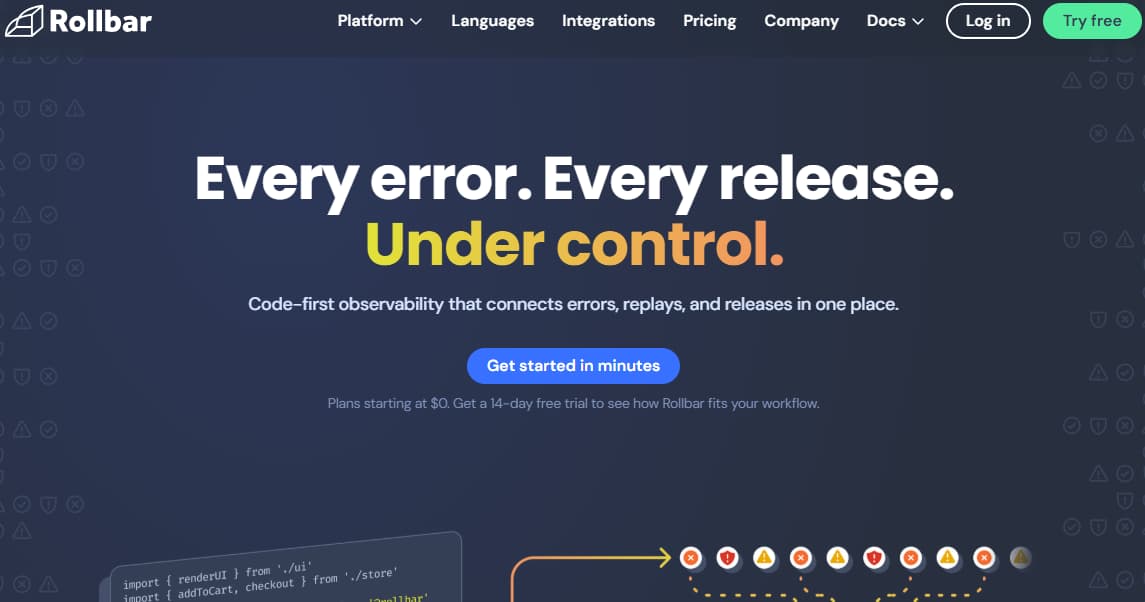
Rollbar Overview
Known For
A dependable error monitoring and crash reporting solution—quick to set up, offering real-time tracking, contextual diagnostics, and automation workflows.
Standout Features
- Seamless integration with popular languages (Ruby, JavaScript, Python, etc.)
- AI-powered error grouping and customizable workflows
- Easy Slack/Jira integration and real-time alerts
Key Features
- Real‑time error and crash tracking
- Rich telemetry context (stack traces, user impact, metadata)
- Automation-driven assignments and deployment tracking
- Integration-friendly platform (Slack, Jira, etc.)
Pros
- Easy setup and intuitive UI
- Reliable error grouping and centralized dashboard are praised for improving developer productivity
- Strong integration ecosystem and responsive support
Cons
- High costs as usage grows
- Some users report error-handling inconsistencies
Best For
Teams needing a lightweight, easy-to-deploy error monitoring system rather than full-stack observability.
Pricing & Customer Reviews
- Free – $0/month, 5,000 error events monthly, basic error discovery
- Essentials – $15.83/month for 25K events, production error tracking
- Advanced – $32.15/month for 25K events, advanced error trackingEnterprise – Starts at $25K/year, 80M+ events, tailored features, enterprise-grade support.
- Rating: 4.5/7(G2)
Top 7 Rollbar Alternatives
1. CubeAPM

Known For
CubeAPM is known for being an OpenTelemetry-native, full-stack observability platform purpose-built for modern engineering teams. It delivers complete MELT coverage—metrics, events, logs, and traces—along with RUM, synthetic monitoring, and error tracking in a single, unified solution.
Key Features
- Distributed Tracing & APM
- Metrics & Infrastructure Monitoring
- Logs & Error Tracking
- RUM & Synthetic Monitoring
- Smart Sampling
Standout Features
- Slack/WhatsApp direct access to core developers (minutes-level TAT).
- Flat-rate $0.15/GB ingestion with no hidden add-ons.
- Self-hosting and compliance-ready deployment (HIPAA, GDPR, SOC2).
Pros
- Predictable pricing model that scales linearly with data volume, not hosts.
- Full MELT (Metrics, Events, Logs, Traces) observability in one platform.
- Deployment flexibility (cloud and on-prem).
- Extremely responsive support—real engineers instead of ticket queues.
Cons
- Not suited for teams looking for off-prem solutions
- Strictly an observability platform and does not support cloud security management
Best For
Engineering and SRE teams that need end-to-end observability with strict cost control and compliance flexibility.
Pricing & Customer Reviews
- Pricing: $0.15/GB all-inclusive (APM, infra, logs, RUM, synthetics).
- G2 Rating: 5/5
CubeAPM vs Rollbar
Rollbar is well-suited for teams focused primarily on real-time error tracking and fast issue triage, while CubeAPM provides a broader, OpenTelemetry-aligned observability approach that brings metrics, logs, and traces together in one platform. For teams looking to scale observability beyond error monitoring with predictable costs and long-term flexibility, CubeAPM is ideal.
2. Datadog
Known For
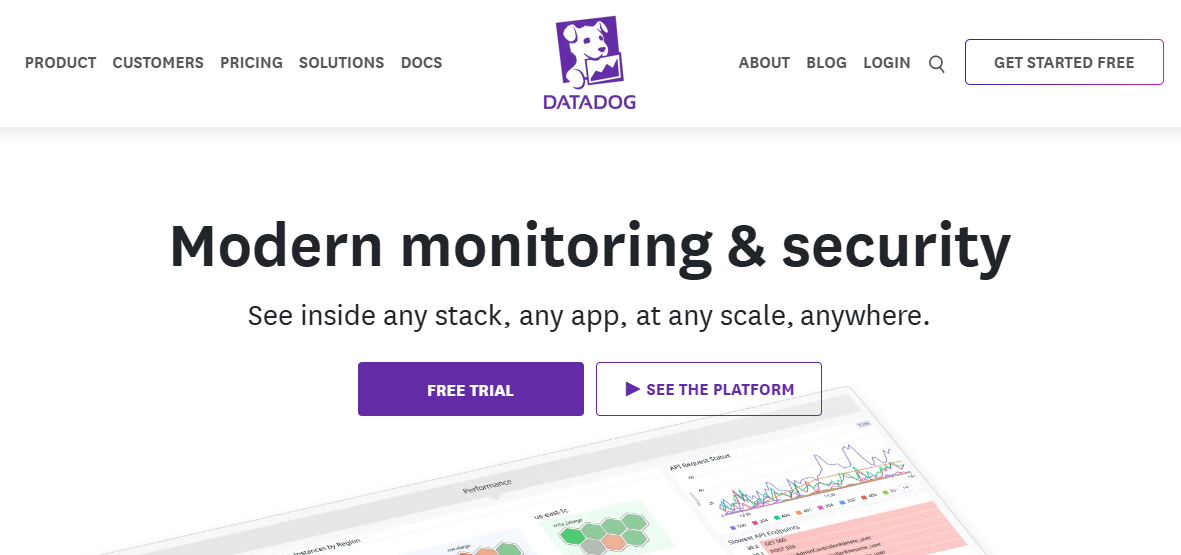
Datadog is known as a comprehensive observability and security platform that covers nearly every corner of modern infrastructure. It brings together APM, infrastructure monitoring, logs, RUM, synthetics, and cloud security features under one umbrella.
Key Features
- APM & Infrastructure Monitoring
- Logs Management
- RUM & Synthetics
- Security & AI
Standout Features
- 900+ integrations across cloud, infra, and SaaS tools.
- Granular dashboards with ML-driven insights.
- Strong adoption in Fortune 500 and regulated industries.
Pros
- Full-spectrum observability in a single platform.
- Mature integrations ecosystem spanning cloud, SaaS, and DevOps stacks.
- Enterprise-ready with compliance, RBAC, and audit features.
- Highly flexible dashboards and alerting mechanisms.
Cons
- Costs rise quickly as systems scale
- Hard to learn and time-consuming to configure
- The interface can feel overwhelming
Best For
Large enterprises that need a broad feature set and advanced analytics, and are willing to manage complex cost structures.
Pricing & Customer Reviews
- Infrastructure Monitoring (Pro Plan): $15/host/month
- APM (Pro Plan): $35/host/month
- Logs: $0.10/per ingested GB/month
- G2 Rating: 4.4/5 — praised for its breadth, but widely criticized for billing complexity.
Datadog vs Rollbar
Datadog provides full-stack observability across metrics, logs, traces, and applications, while Rollbar is designed to help teams monitor and manage application errors in production. For teams that need end-to-end visibility across their entire stack, Datadog is best suited.
3. New Relic
Known For
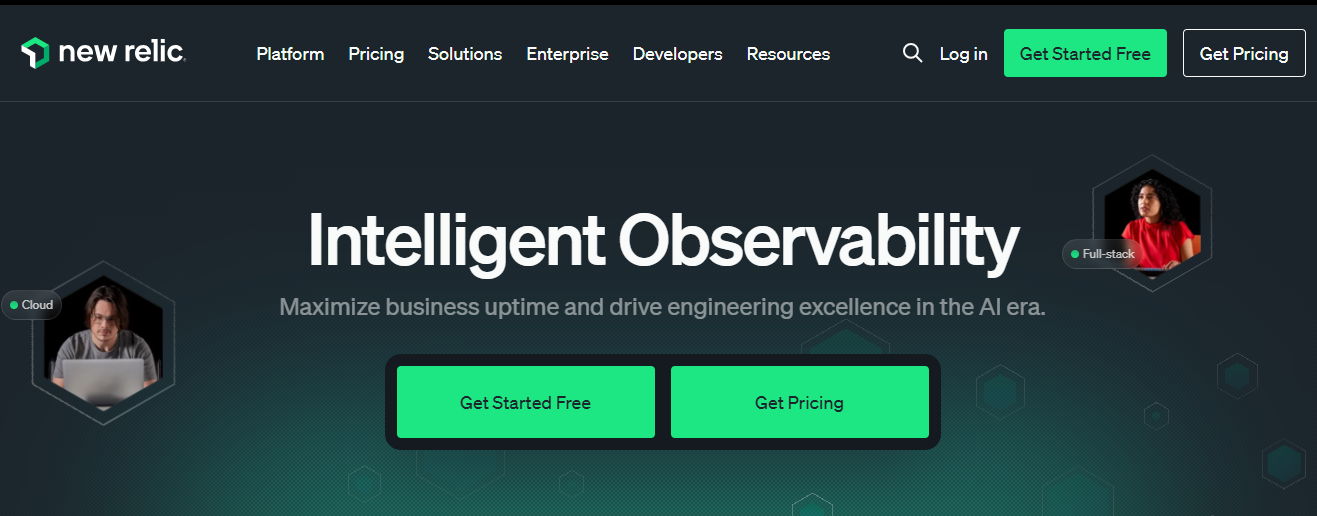
New Relic is one of the oldest and most established observability platforms, trusted by Fortune 500 enterprises for its APM and performance analytics. It provides visibility across applications, infrastructure, logs, synthetics, and end-user experience, with a strong focus on detailed dashboards and business intelligence.
Key Features
- APM & Infrastructure Monitoring – Deep performance visibility for applications and hosts.
- Logs, RUM, Synthetics – Unified monitoring across MELT.
- Analytics & Dashboards – Advanced visualization and AI-based anomaly detection.
Standout Features
- Long history and maturity in enterprise APM.
- Global enterprise adoption with compliance certifications.
- Advanced anomaly detection with AI/ML insights.
Pros
- Mature, battle-tested platform trusted by enterprises.
- Broad feature set covering the full observability stack.
- Rich dashboards and analytics for custom reporting.
- Extensive integrations with cloud and SaaS platforms.
Cons
- High costs at scale due to ingestion + user licenses.
- Steeper learning curve compared to newer OTEL-native tools.
Best For
Large organizations are already embedded in New Relic’s ecosystem or need enterprise-grade compliance and long-term stability.
Pricing & Customer Reviews
- Free: 100GB/month ingested
- Data ingested: $0.40/GB beyond the free 100 GB
- Full Platform User: $418.80/user(for monthly pay as you go)
- G2 Rating: 4.4/5 — praised for APM depth but criticized for cost and licensing complexity.
New Relic vs Rollbar
New Relic provides full-stack application performance monitoring with deep insights into metrics, traces, infrastructure, and user experience, while Rollbar focuses on capturing and reporting application errors in real time. For teams that need broad observability across performance, infrastructure, and errors in a single platform, New Relic is best suited.
4. Coralogix
Known For
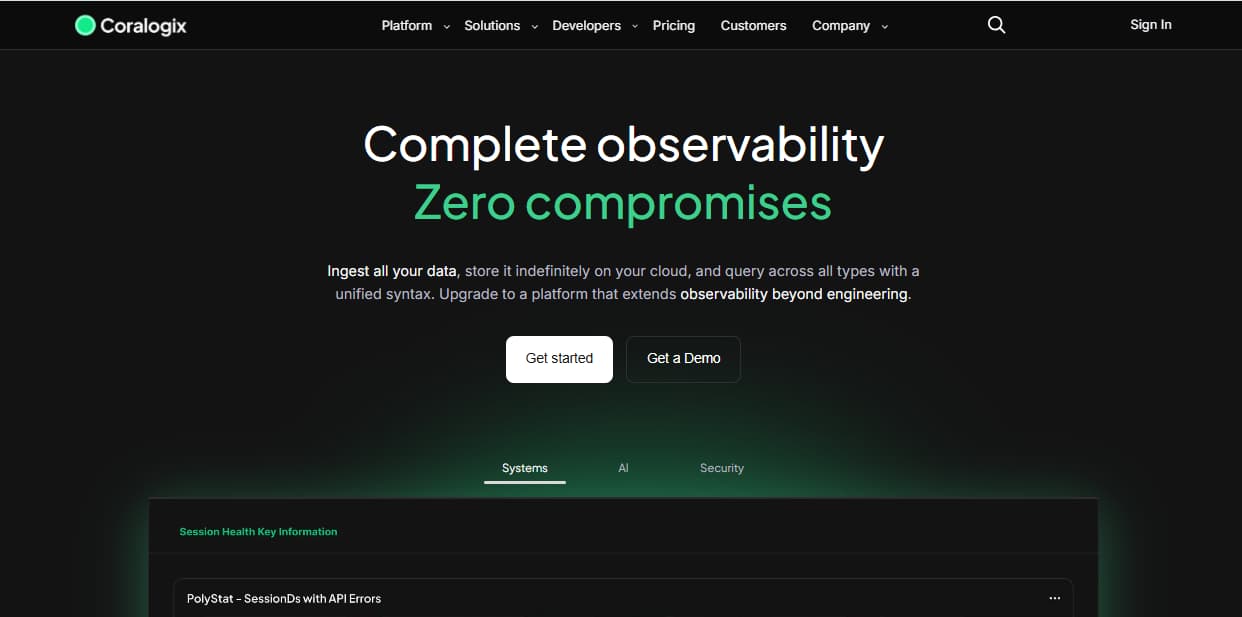
Coralogix is recognized as sull-stack observability solution designed to optimize storage and indexing costs. Its Streama™ technology routes logs into hot, warm, or archive tiers, while archived telemetry can be stored in the customer’s own cloud account for reduced costs.
Key Features
- Streama™ Log Routing – Classify logs into hot, warm, or archival tiers.
- Customer-Owned Archival – Archived telemetry stored in customer’s own cloud account.
- Metrics & Traces – Full OTEL ingestion support.
- Compliance – SOC2, HIPAA, and GDPR certifications.
- Dashboards – Visualization for infra, app, and business KPIs.
Standout Features
- Flexible log pipeline optimization reduces costs.
- Compliance support for regulated industries.
- Strong focus on log lifecycle management.
Pros
- Significant cost savings for high log volumes.
- Customer-owned archival reduces storage expenses long-term.
- Strong OTEL compatibility ensures vendor-neutral instrumentation.
Cons
- Steep learning curve for advanced features
- Costs can spike as data volume grows
- Interface can feel unintuitive at times
Best For
Enterprises with heavy log volumes and compliance requirements, seeking to optimize costs without giving up observability.
Pricing & Customer Reviews
- Logs: $0.42/GB
- Traces: $0.16/GB
- Metrics: $0.05/GB
- AI: $1.5/1M tokens
- G2 Rating: 4.6/5 — praised for cost efficiency, but some note setup complexity and gaps in full-stack features.
Coralogix vs Rollbar
Coralogix provides unified observability across logs, metrics, traces, and errors, giving teams broader context when diagnosing issues, while Rollbar focuses on monitoring and managing application errors. Coralogix is best suited for teams that want centralized visibility across all telemetry data alongside error insights.
5. Sentry
Known For
Sentry is best known as a developer-friendly error and performance monitoring tool. It integrates directly with developer workflows via GitHub, Jira, and Slack, making it especially popular with front-end, mobile, and product teams. With open-source origins, Sentry is easy to adopt and provides lightweight APM and release tracking alongside error monitoring.
Key Features
- Error Monitoring – Real-time detection and alerting for application errors.
- Performance Monitoring – Tracing for transactions and bottlenecks.
- Release Tracking – Links errors to commits and code releases.
- Integrations – Seamless with GitHub, Jira, Slack, and other dev tools.
Standout Features
- Strong open-source roots and community adoption.
- Developer-friendly interface tailored for modern workflows.
- Lightweight APM, in addition to error tracking.
Pros
- Easy to implement with SDKs for multiple languages and frameworks.
- Affordable starter plans make it attractive to small teams.
- Great GitHub/Jira integration for developer productivity.
- Popular among open-source projects and startups.
Cons
- No native support for infrastructure metrics, logs
- Complex configuration setup
- Expensive at scale
- Delays in error reporting, alerts, and display
Best for
Front-end and product teams seeking simple error + performance tracking integrated into their dev workflow.
Pricing & Customer Reviews
- Developer – Free: 1 user, Error monitoring and tracing, Alerts/notifications via email
- Team – $26/month: Everything in Developer + Unlimited users, Third-party integrations
- Business – $80/month: Everything in Team + Insights (90-day lookback), Unlimited custom dashboards
- Enterprise – Custom Pricing Everything in Business + Technical account manager
- G2 Rating: 4.4/5 — praised for ease of use, but limited in scope.
Sentry vs Rollbar
Sentry offers error monitoring with additional performance insights, distributed tracing, and broader language support, while Rollbar focuses on capturing and triaging application errors with rich context. For teams that want both error tracking and performance observability in one platform, Sentry is a strong choice.
6. Splunk AppDynamics
Known For
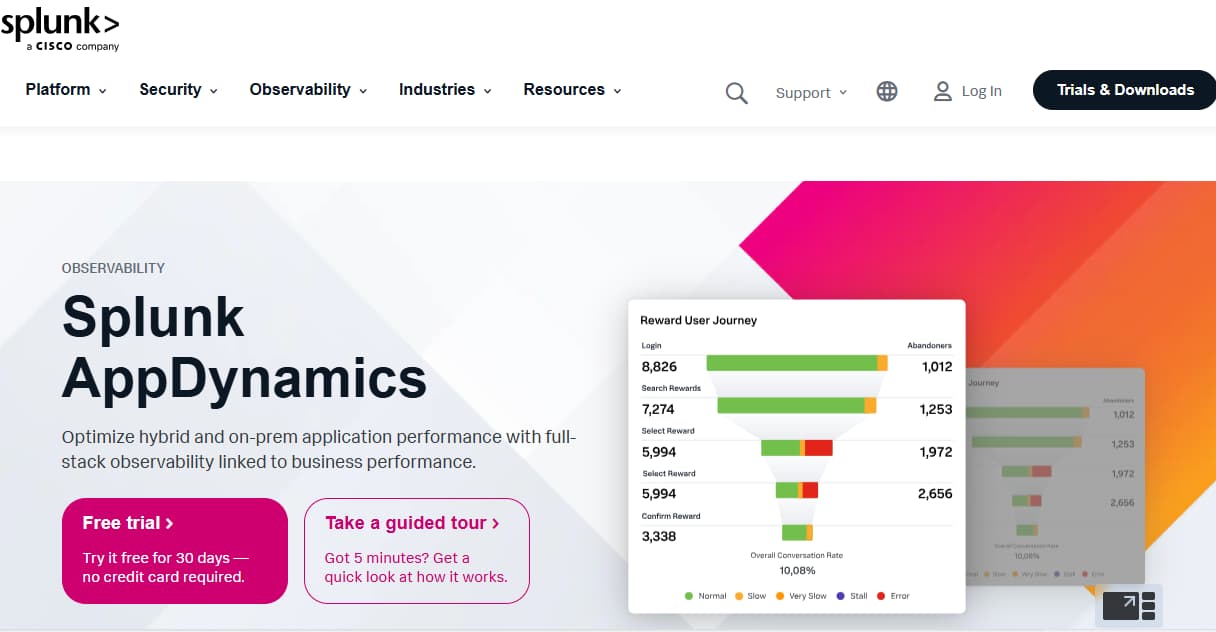
Splunk AppDynamics, part of Splunk’s observability cloud, is known for enterprise-scale observability combined with market-leading log analytics. It is especially favored by highly regulated industries that require compliance, security, and operational resilience. With strong AI-driven anomaly detection and extensive analytics, Splunk is a heavyweight designed for large-scale, mission-critical environments.s.
Key Features
- APM & Tracing – Deep service-level monitoring for distributed systems.
- Logs & Metrics – Advanced indexing and high-volume log search.
- AI & Security – Predictive anomaly detection with strong security overlap.
- Compliance – SOC2, HIPAA certifications for enterprise users.
Standout Features
- Market leader in log analytics, extended into observability.
- Combines security and observability into one stack.
- Predictive AI capabilities for anomaly detection.
Pros
- Powerful enterprise-class analytics for logs and APM.
- Unified observability + security, rare in the market.
- Trusted by regulated industries for compliance.
- Flexible integration with legacy and hybrid environments.
Cons
- High cost, often prohibitive for smaller teams.
- Steep learning curve with complex dashboards.
Best For
Large enterprises with strict compliance requirements and high observability budgets.
Pricing & Customer Reviews
- APM: $33/month/CPU core
- Infrastructure Monitoring: starts at $6/month.CPU core
- RUM: $0.06/month/1000 tokens
- G2 Rating: 4.3/5 — praised for depth, but heavily criticized for cost.
Splunk APM vs Rollbar
Splunk delivers broad observability, log analytics, and security analytics across infrastructure and applications, while Rollbar focuses on application error monitoring and triage. For teams that need comprehensive data analysis and visibility across logs, metrics, traces, and security telemetry, Splunk is a strong fit.
7. Dynatrace
Known For
Dynatrace is recognized for its AI-driven full-stack observability, powered by the Davis AI engine for automated root cause analysis. It covers applications, infrastructure, logs, RUM, and synthetics, with strong support for Kubernetes and hybrid cloud deployments. Its automation-first approach makes it appealing to enterprises managing extremely complex environments.
Key Features
- APM & Infrastructure – Deep agent-based monitoring.
- Logs & Security – Built-in log analysis and vulnerability scanning.
- RUM & Synthetics – User experience monitoring included.
- Davis AI Engine – Automated root cause analysis powered by AI.
Standout Features
- Advanced AI automation for monitoring at scale.
- Comprehensive hybrid-cloud and Kubernetes monitoring.
- Strong enterprise adoption in complex environments.
Pros
- AI-driven automation reduces manual troubleshooting.
- Deep hybrid and multi-cloud observability coverage.
- Strong support for Kubernetes and microservices.
- Enterprise-grade compliance and governance.
Cons
- Expensive licensing; costs grow steeply with scale.
- Complexity makes it less suited for smaller teams.
- Learning curve due to heavy feature set.
Best For
Large enterprises with complex hybrid environments requiring automation and AI-driven insights.
Pricing & Customer Reviews
- Full-Stack Monitoring: $58 /month/8 GiB host
- Infra Monitoring: $29/month/8 GiB host
- G2 Rating: 4.4/5 — praised for automation, but expensive at scale.
Dynatrace vs Rollbar
Dynatrace offers AI-powered full-stack observability, automated dependency mapping, and performance insights across infrastructure, applications, and user experience, while Rollbar focuses on capturing and managing application errors. For teams seeking deep, automated visibility and analytics across their entire environment, Dynatrace is an excellent choice.
Conclusion
Rollbar remains a reliable tool for error monitoring and crash reporting, but today’s engineering teams demand much more than error tracking. Modern observability requires full MELT coverage—metrics, events, logs, and traces—alongside RUM, infrastructure, and synthetics. That’s where Rollbar falls short, driving organizations to explore alternatives.
Among the options, tools like Datadog, New Relic, Splunk APM, and Dynatrace deliver enterprise-grade observability but often at steep, unpredictable costs. Sentry extends error monitoring with lightweight performance tracking, while Coralogix offers log-first cost optimization with compliance controls. Each serves a niche, but none combine transparency, flexibility, and affordability the way CubeAPM does.
With flat $0.15/GB pricing, OpenTelemetry-native pipelines, and real-time support, CubeAPM offers 60–70% cost savings compared to legacy vendors while delivering true end-to-end observability. For teams that want to move beyond Rollbar’s limitations without sacrificing cost efficiency or compliance, CubeAPM is the clear best alternative.
Disclaimer: The information in this article reflects the latest details available at the time of publication and may change as technologies and products evolve.