








The main difference between SigNoz, New Relic, and CubeAPM is how they balance observability depth, cost predictability, and operational control.
SigNoz and New Relic both offer capable observability platforms. At scale, New Relic’s usage-based pricing becomes expensive, while SigNoz’s self-hosted option requires managing ClickHouse, adding operational overhead. CubeAPM addresses these challenges with full MELT observability, predictable pricing that delivers over +60% cost savings compared to New Relic.
In this guide, we compare SigNoz vs New Relic vs CubeAPM across pricing, deployment, and observability capabilities.
SigNoz vs New Relic vs CubeAPM: Comparison
| Features | CubeAPM | SigNoz | New Relic |
| Known for | Unified OpenTelemetry-native with predictable pricing | OpenTelemetry-native observability with SaaS and self-hosted options | Enterprise SaaS observability platform |
| Multi-Agent Support | Yes (OTel, New Relic, Datadog, Elastic) | Partial (OTel) | Partial (OTel) |
| MELT Support | Full MELT | Full MELT | Full MELT |
| Setup | Self-hosted but vendor-managed | SaaS & Self-hosted | SaaS-only |
| Pricing | Ingestion-based pricing of $0.15/GB | Logs: $0.3/GB Traces: $0.3/GB Metrics: $0.1/mil samples | Free: 100GB/month Paid: $0.40/GB Full Platform User: $349/user |
| Sampling Strategy | Smart sampling | Head + Tail-based | Head + Tail-based |
| Log Retention | Infinite Retention | 15 days | 30 days |
| Support TAT | < 10 minutes | No details | 1hr to 2days |
SigNoz vs New Relic vs CubeAPM: Feature-by-Feature Breakdown
Known For
CubeAPM: Known for its OpenTelemetry-native design with self-hosted and BYOC deployment, predictable ingestion-based pricing, unlimited retention, and real-time engineer support. It is designed for teams that need full-stack MELT observability and minimal operational overhead.
SigNoz: Known for its OpenTelemetry-first architecture built on ClickHouse, with both SaaS and self-hosted options. It is commonly used by developer-led teams that want transparency and flexibility within the OpenTelemetry ecosystem.
New Relic: Known for its mature, enterprise-grade SaaS observability platform with broad coverage across applications, infrastructure, logs, and user monitoring. It is widely adopted by teams that prefer a fully managed observability experience.
Multi-Agent Support
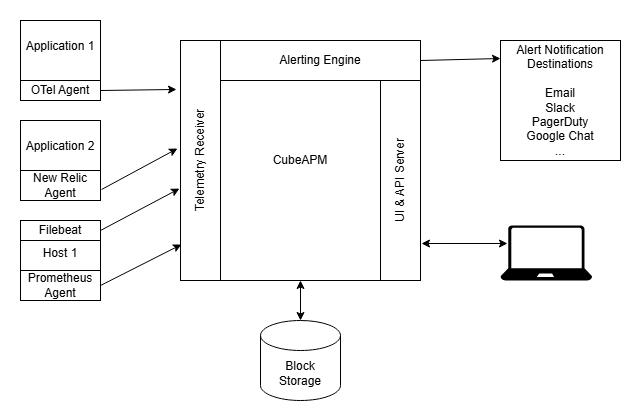
CubeAPM: Supports true multi-agent ingestion, including OpenTelemetry, Prometheus, Datadog, New Relic, and Elastic agents. This allows teams to migrate without rewriting instrumentation or replacing existing collectors, making it suitable for hybrid environments running mixed agent types.
SigNoz: OpenTelemetry-native and supports ingestion through OpenTelemetry SDKs and Collectors, along with widely used formats such as Jaeger, Zipkin, and Prometheus. This makes it flexible within OpenTelemetry-based observability pipelines.
New Relic: Supports OpenTelemetry alongside its own agents, allowing teams to ingest telemetry using both standard OpenTelemetry instrumentation and New Relic-specific integrations.
MELT Support
CubeAPM: Provides full MELT observability in a single platform, covering metrics, events, logs, traces, RUM, synthetics, and errors. All signals are correlated natively on OpenTelemetry without stitching multiple tools together.
SigNoz: Supports full MELT observability using an OpenTelemetry-first architecture. Metrics, logs, traces, and events can be collected and analyzed together, enabling end-to-end visibility across distributed systems when configured through standard OpenTelemetry pipelines.
New Relic: Supports full MELT observability as part of its SaaS platform, bringing together metrics, events, logs, and traces in a single interface. This enables teams to monitor application performance, infrastructure health, and system behavior across their environments.
Deployment (Self-host, Setup)
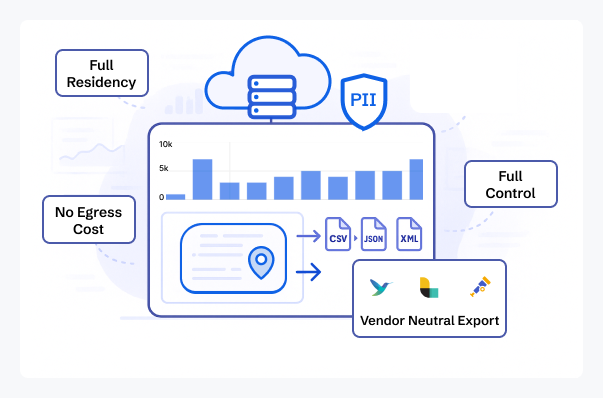
CubeAPM: Supports self-hosted and BYOC deployments while remaining vendor-managed. This lets teams keep all telemetry inside their own cloud or on-prem environment without handling upgrades, scaling, or day-to-day operations.
SIgNoz: Supports both SaaS and Self-hosted options. The self-hosted option gives teams full control over infrastructure, but setup and scaling depend on configuring and operating the ClickHouse backend, including storage, replicas, and cluster topology.
New Relic: New Relic is offered as a SaaS-only platform. All telemetry is processed and stored in New Relic’s cloud. However, teams still incur data-out (egress) costs charged by their cloud provider, because telemetry data is first sent from the customer’s cloud into New Relic’s SaaS platform.
Pricing: Approximate Cost for Small, Mid-Sized & Large Teams
*All pricing comparisons are calculated using standardized Small/Medium/Large team profiles defined in our internal benchmarking sheet, based on fixed log, metrics, trace, and retention assumptions. Actual pricing may vary by usage, region, and plan structure. Please confirm current pricing with each vendor.
*An APM host is a host that is actively generating trace data, and an Infra host is any physical or virtual OS instance that you monitor with any observability tool.
Below is a cost comparison for small, mid-sized, and large teams.
| Approx. Cost for Teams | Small (~30 APM Hosts) | Mid-sized (~125 APM Hosts) | Large (~250 APM Hosts) |
| CubeAPM | $2,080 | $7,200 | $15,200 |
| SigNoz | $4,600 | $16,000 | $34,000 |
| New Relic | $7,896 | $25,990 | $57,970 |
Teams switching to CubeAPM save roughly 55% compared to SigNoz and around 72% compared to New Relic for mid-sized environments.
CubeAPM: Cost for Small, Medium, and Large Teams
CubeAPM uses simple, predictable ingestion-based pricing with no user-based or feature-based charges.
Pricing details:
- Ingestion pricing: $0.15 per GB
Based on comparable production workloads, the approximate monthly costs are:
- Small teams (~30 APM hosts): $2,080
- Mid-sized teams (~125 APM hosts): $7,200
- Large teams (~250 APM hosts): $15,200
Because CubeAPM supports self-hosted and BYOC deployment, all telemetry remains inside the customer’s cloud, avoiding SaaS data egress and enabling predictable cost scaling.
SigNoz: Cost for Small, Medium, and Large Teams
SigNoz uses usage-based pricing, with separate charges for logs, traces, and metrics, each with default retention limits.
Pricing by telemetry type:
- Logs: $0.30 per GB ingested, 15 days retention
- Traces: $0.30 per GB ingested, 15 days retention
- Metrics: $0.10 per million samples, 1 month retention
- Platform fee starts at $49 per month
Based on comparable production workloads and team sizes, the approximate monthly costs are:
- Small teams (~30 APM hosts): $4,600
- Mid-sized teams (~125 APM hosts): $16,000
- Large teams (~250 APM hosts): $34,000
New Relic: Cost for Small, Medium, and Large Teams
New Relic follows a usage-based pricing model that combines telemetry ingestion with user-based access.
Pricing details:
- Free tier: 100 GB per month of data ingest
- Paid usage: $0.40 per GB ingested (beyond the free tier)
- Full Platform User: $349 per user per month
Based on comparable production workloads, the approximate monthly costs are:
- Small teams (~30 APM hosts): $7,896
- Mid-sized teams (~125 APM hosts): $25,990
- Large teams (~250 APM hosts): $57,970
Sampling Strategy
CubeAPM: Uses smart sampling, a real-time, signal-driven sampling approach that prioritizes high-value telemetry instead of collecting everything. It automatically retains traces tied to latency spikes, rising error rates, and anomalies, while reducing noise from low-value data. This allows teams to control observability costs without losing critical visibility during incidents.
SigNoz: Supports both head-based and tail-based sampling through OpenTelemetry SDKs and collectors. Teams can configure sampling rules at the application or collector level, including dropping spans, filtering attributes, or retaining complete traces based on defined conditions. This allows flexible control over trace volume while maintaining OpenTelemetry-native workflows.
New Relic: Supports head-based sampling for standard distributed tracing, and tail-based sampling through Infinite Tracing. It also notes that sampling can be applied before data reaches New Relic when using third-party telemetry services such as OpenTelemetry.
Data Retention

CubeAPM: Offers unlimited data retention as part of its pricing. Logs are stored within the customer’s own cloud or VPC, which helps teams meet long-term audit, compliance, and historical analysis needs
SigNoz: Retention is limited by default, with logs stored for about 15 days, traces retained for up to 30 days, and metrics kept for roughly one month. Increasing these retention periods, such as extending logs to 30 days, leads to higher per-GB ingestion pricing, with log costs increasing from around $0.3/GB to $0.4/GB, which can substantially raise costs as data volume scales.
New Relic: New Relic applies retention limits based on the pricing model and subscription level. Log data can be retained for up to 30 days, with shorter options such as 8 or 15 days also available. Retention for logs in context and other telemetry types is tied to the selected plan, meaning longer retention typically requires higher spend, which can increase costs as data volume and usage grow.
Support Channels & TAT
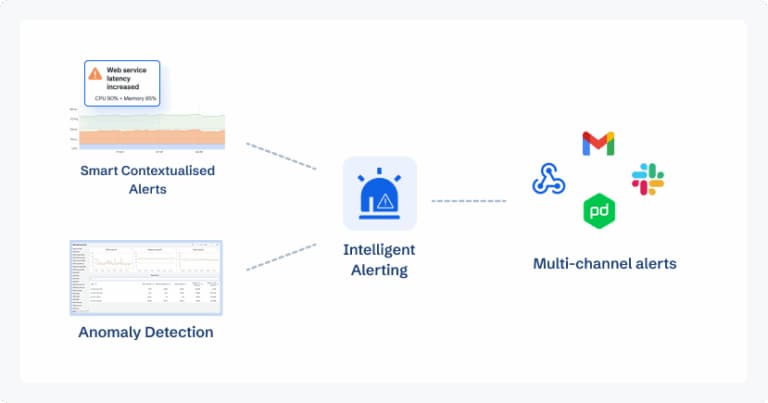
CubeAPM: Provides direct access to engineers via real-time support channels, with response times under 10 minutes. This level of support is built into the platform and is well-suited for teams operating production-critical systems.
SigNoz: Provides support through channels such as Slack, GitHub, and email. While paid support options are available, there are no publicly documented SLAs or guaranteed response times.
New Relic: New Relic follows a tiered support model with defined response targets based on plan and issue severity. According to New Relic’s published support offerings, first response times range from about 1 hour on higher tiers to up to 2 business days on standard plans, depending on priority level.
Which Tool Is Best for You? Why Brands Choose CubeAPM
Why teams choose CubeAPM
- Predictable pricing: CubeAPM uses a straightforward ingestion-based pricing model at $0.15 per GB. There are no separate charges for users, hosts, or feature tiers, making costs easier to forecast as telemetry volume grows.
- Smart sampling: CubeAPM applies intelligent, real-time sampling that focuses on meaningful signals such as errors, latency spikes, and anomalies. This reduces low-value data noise significantly while preserving critical visibility during incidents.
- Unified MELT observability: Metrics, events, logs, and traces are available in a single, correlated view. This helps teams troubleshoot faster and identify root causes without switching between tools.
- Self-hosted with vendor management: CubeAPM runs inside your own cloud or on-prem environment while being managed by the vendor. Teams retain full control over telemetry data while avoiding the operational burden of maintaining the observability backend.
- Long-term data retention: Teams can retain observability data for as long as required using their own storage. This supports audits, compliance needs, SLA validation, and long-term performance analysis without added retention fees.
- Broad agent compatibility: CubeAPM works with OpenTelemetry, Prometheus, Datadog, New Relic, and Elastic agents. This simplifies migrations and reduces the need for re-instrumentation.
- Open, API-first access: All telemetry data remains accessible through open APIs. Teams can query, export, automate workflows, and integrate with external systems without feature gating or locked tiers.
SigNoz vs New Relic vs CubeAPM: Use Cases
Choose CubeAPM if
- You want predictable observability costs with a simple ingestion-based pricing model and no charges for users, hosts, or feature tiers.
- You need smart sampling that automatically prioritizes errors, latency spikes, and anomalies while reducing low-value data.
- You want unified MELT observability where metrics, events, logs, and traces are correlated in a single view.
- You require self-hosted or BYOC deployment while avoiding the operational burden of managing the observability backend.
- You need long-term or unlimited data retention to support audits, compliance, and historical analysis.
- You expect fast, engineer-led support with response times measured in minutes.
Choose SigNoz if
- You want an OpenTelemetry-native observability platform.
- You prefer the flexibility of SaaS or self-hosted deployment options.
- You are building modern, distributed systems and want native support for traces, logs, and metrics.
- You value transparency and control within an OpenTelemetry-based observability ecosystem.
Choose New Relic if
- You want a mature, fully managed SaaS observability platform.
- You need broad coverage across applications, infrastructure, logs, and user monitoring.
- You prefer a platform with an extensive ecosystem of integrations and dashboards.
- You want to get started quickly with minimal setup and operational effort.
Conclusion
SigNoz and New Relic are well-established observability platforms, each suited to different needs. CubeAPM stands out by combining full MELT observability, predictable pricing, and flexible self-hosted or BYOC deployment, making it a strong option for teams that want visibility, cost control, and data ownership as they scale.
Disclaimer: The information in this article reflects the latest details available at the time of publication and may change as technologies and products evolve.
FAQs
1. Which tool is best for OpenTelemetry-native observability?
SigNoz and CubeAPM are OpenTelemetry-native by design, meaning they rely on standard OpenTelemetry pipelines for ingesting metrics, logs, and traces. New Relic supports OpenTelemetry, but also uses its own agents and platform-specific features alongside it.
2. How do SigNoz, New Relic, and CubeAPM differ in cost predictability?
CubeAPM offers predictable ingestion-based pricing that scales linearly with data volume. SigNoz pricing varies by telemetry type and retention, and costs increase when retention is extended. New Relic uses usage-based pricing combined with per-user licensing, which can make forecasting harder as usage grows.
3. Can these tools be deployed in a self-hosted or BYOC setup?
CubeAPM supports self-hosted and BYOC deployments while remaining vendor-managed. SigNoz supports both SaaS and self-hosted deployments. New Relic is a SaaS-only platform and does not offer self-hosted or BYOC deployment options.
4. Which platform is better for long-term or compliance-driven data retention?
CubeAPM is better suited for long-term or unlimited retention because data is stored within the customer’s own cloud environment. SigNoz and New Relic include limited default retention, and extending retention typically increases costs.
5. How do support response times compare across these tools?
CubeAPM provides engineer-led support with response times under 10 minutes. New Relic offers tiered support with response times ranging from about one hour to up to two business days, depending on plan and severity. SigNoz does not publicly publish guaranteed response-time SLAs.