










OpenObserve and SigNoz both promise cost-effective, self-hosted observability for teams leaving enterprise SaaS platforms. Both are built for OpenTelemetry, run on your infrastructure, and eliminate per-host or per-seat pricing. But their architectures diverge sharply: SigNoz runs as a multi-container Docker Compose stack with ClickHouse as its storage backend, while OpenObserve ships as a single Rust binary with its own storage engine built on Apache Parquet.
This creates measurable differences in resource consumption. On an 8 GB VPS running both tools, SigNoz leaves around 6 GB for your applications at idle. OpenObserve leaves over 7.5 GB. Under load, the gap widens. Reddit users evaluating both have reported similar findings: “Qryn + SigNoz performing well and nearly the same, because both are based on ClickHouse. The smallest footprint in memory and disk had VictoriaLogs.”
This guide compares OpenObserve and SigNoz on pricing, resource consumption, deployment complexity, signal depth, and migration effort. We include CubeAPM as a third option for teams that want self-hosted observability with managed Day 2 operations. Pricing figures are sourced from each vendor’s public documentation as of early 2026.
Quick Comparison: OpenObserve vs SigNoz vs CubeAPM
| OpenObserve | SigNoz | CubeAPM | |
|---|---|---|---|
| Pricing | Free OSS, Cloud starts ~$50/mo | Free OSS, Cloud $0.30/GB | $0.20/GB, no seat fees |
| Deployment | Single container | Multi-container stack | Self-hosted, vendor-managed |
| Storage backend | Parquet + S3 | ClickHouse | Optimized columnar |
| Memory at idle | ~512 MB | 1.5–2 GB | ~800 MB |
| OTel native | Yes | Yes | Yes |
| Logs-first | Yes | No | No |
| Full MELT | Logs, metrics, traces | Logs, metrics, traces | Logs, metrics, traces, RUM, synthetics |
| Best for | Solo devs, log-heavy | Teams needing APM + traces | Teams wanting managed self-hosted |
OpenObserve Overview
OpenObserve is an open-source, Rust-based observability platform designed for logs first, with metrics and traces support added over time. It runs as a single binary and can operate on as little as 512 MB RAM. The default storage uses the local filesystem, with optional S3-compatible backends for scalability. OpenObserve targets solo developers and small teams who need log aggregation at scale without the operational overhead of multi-service stacks.
Pricing: Free for self-hosted. Cloud pricing starts around $50/month for small workloads, scaling based on ingestion volume.
Deployment: Single Docker container or binary. No ZooKeeper, no ClickHouse, no distributed state management required.
Data format: Stores logs, metrics, and traces in Apache Parquet format. This allows data to be queried by external tools outside of OpenObserve if needed.
Architecture: Stateless nodes. You can scale horizontally by adding more OpenObserve instances behind a load balancer. Object storage handles persistence.
Signal support: Originally built for logs. Metrics and traces support was added later and is less mature than SigNoz’s APM capabilities.
Resource consumption: Users have reported running OpenObserve on Raspberry Pi and ingesting terabytes of data on a single node. Memory footprint at idle is around 512 MB.
OpenObserve is best for teams that need a lightweight log aggregation layer and want to avoid the complexity of managing ClickHouse or Elasticsearch. It trades some APM depth for operational simplicity.
SigNoz Overview
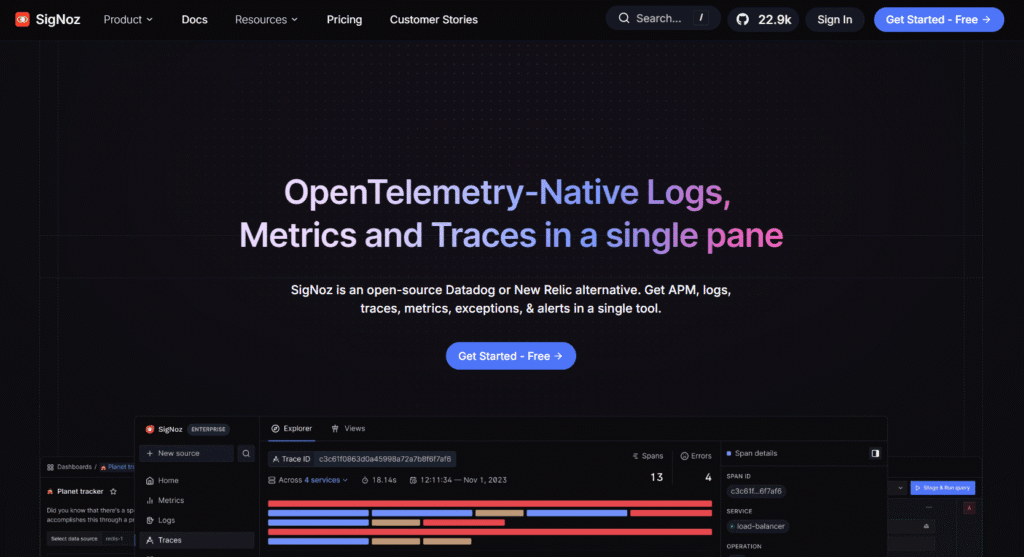
SigNoz is an open-source, OpenTelemetry-native observability platform that combines logs, metrics, and traces in a single UI. It uses ClickHouse as its storage backend and runs as a multi-container Docker Compose stack. SigNoz targets teams that need distributed tracing and APM without per-host SaaS pricing.
Pricing: Free for self-hosted. Cloud pricing is $0.30/GB for ingestion, with a $49/month minimum.
Deployment: Multi-container stack deployed via Docker Compose. Includes ClickHouse, ZooKeeper, the SigNoz frontend/backend, and an OpenTelemetry Collector. First startup takes 2–5 minutes depending on connection speed.
Storage backend: ClickHouse. This gives SigNoz fast query performance on high-cardinality trace data but requires managing ClickHouse, ZooKeeper, and the OTel Collector as separate containers.
Architecture: Designed around distributed tracing. SigNoz was built APM-first, with logs and metrics support added to complete the observability stack.
Resource consumption: Baseline RAM usage at idle is 1.5-2 GB. Under load, this increases based on ingestion volume and query frequency.
Signal support: Strong APM and tracing capabilities. Logs and metrics are available but not as feature-rich as dedicated log platforms like OpenObserve.
SigNoz is best for teams that need distributed tracing and are comfortable managing a multi-service stack. It requires more infrastructure than OpenObserve but delivers deeper APM insights.
Pricing Comparison: OpenObserve vs SigNoz
Both platforms offer free self-hosted options. The cost difference appears when you compare cloud-hosted versions or factor in infrastructure overhead.
Self-Hosted: Infrastructure Cost
OpenObserve: Runs on minimal resources. A 4 vCPU, 8 GB RAM VPS can handle OpenObserve alongside your applications. Estimated infrastructure cost: $40–$80/month depending on cloud provider.
SigNoz: Requires more resources due to ClickHouse and ZooKeeper. A dedicated 8 vCPU, 16 GB RAM instance is recommended for production. Estimated infrastructure cost: $120-$200/month.
CubeAPM: Self-hosted but managed by CubeAPM. Pricing is $0.20/GB ingested. For 10 TB/month, total cost is $2,000/month including infrastructure, support, and managed upgrades. No per-seat fees.
Cloud-Hosted Pricing
OpenObserve Cloud: Starts around $50/month for small workloads. Pricing scales based on ingestion volume, but exact tier breakdowns are not publicly detailed.
SigNoz Cloud: $0.30/GB ingested, $49/month minimum. For 10 TB/month, cost is approximately $3,000/month.
CubeAPM: $0.20/GB ingested. For 10 TB/month, cost is $1,500/month. No minimum spend, no per-seat fees.
Cost Scenario: 10 TB/Month Ingestion
| OpenObserve (self-hosted) | SigNoz (self-hosted) | SigNoz Cloud | CubeAPM | |
|---|---|---|---|---|
| Ingestion | Free | Free | $3,000 | $2,000 |
| Infrastructure | ~$60/month | ~$150/month | Included | Included |
| Support | Community | Community | Included | Included |
| Total | ~$60/month | ~$150/month | $3,000/month | $2,000/month |
This estimate models production-ready self-hosted or cloud-hosted deployments. Smaller or simpler setups may cost less.
Resource Consumption: OpenObserve vs SigNoz
Resource usage matters when you are running observability tools on the same infrastructure as your applications.
OpenObserve at idle: ~512 MB RAM, minimal CPU usage. One container, no external dependencies beyond optional S3 storage.
SigNoz at idle: 1.5-2 GB RAM. Includes ClickHouse, ZooKeeper, SigNoz frontend/backend, and OTel Collector. All must run simultaneously.
Under load: OpenObserve scales horizontally by adding stateless instances. SigNoz scales by increasing ClickHouse resources, which can require significant memory and disk I/O capacity.
A VPS benchmark published by Virtua Cloud found that on an 8 GB VPS, SigNoz leaves around 6 GB for applications at idle, while OpenObserve leaves over 7.5 GB. Under sustained ingestion load, the gap widens further.
CubeAPM: Runs self-hosted but is managed by CubeAPM’s team. Resource consumption is optimized through AI-based smart sampling, reducing storage overhead by up to 95% compared to full-fidelity storage. Estimated resource usage for 10 TB/month ingestion: 8 vCPU, 16 GB RAM.
Deployment Complexity: Single Container vs Multi-Service Stack
OpenObserve: Single binary or single Docker container. Start it, point your logs/metrics/traces at it, done. No external database to manage. Optional S3 backend for persistence.
SigNoz: Multi-container stack. Requires managing ClickHouse, ZooKeeper, SigNoz backend, frontend, and OTel Collector. Each component needs monitoring, backup, and upgrade coordination. Initial setup takes 2-5 minutes. Day 2 operations are significantly heavier.
CubeAPM: Self-hosted but fully managed by CubeAPM. Deployment, upgrades, patches, and scaling are handled by CubeAPM’s engineering team. You control data residency and infrastructure access, but you do not manage the observability stack itself.
Signal Depth: Logs vs APM vs Full Stack
OpenObserve: Built for logs. Metrics and traces were added later. Log search is fast, full-text indexing is automatic, and retention is unlimited. Trace correlation with logs works but is not as deep as SigNoz’s APM-first design.
SigNoz: Built for APM and distributed tracing. Strong support for trace-to-log correlation, service maps, and RED metrics (rate, errors, duration). Logs are available but not as feature-rich as OpenObserve.
CubeAPM: Full-stack observability built natively on OpenTelemetry. Covers APM, logs, infrastructure, Kubernetes, RUM, synthetic monitoring, and error tracking in a unified platform. Trace-to-log correlation is first-class, and all signals share the same data model.
OpenTelemetry Support: Both Are Native
Both OpenObserve and SigNoz are built natively on OpenTelemetry. This means you can send OTLP data (traces, metrics, logs) directly to either platform without vendor-specific agents.
OpenObserve: Accepts OTLP over HTTP on port 5080 and OTLP over gRPC on port 5081. No additional collector required unless you need protocol translation.
SigNoz: Bundles its own OpenTelemetry Collector. Applications send telemetry to SigNoz’s collector on ports 4317 (gRPC) or 4318 (HTTP). The collector forwards data to ClickHouse.
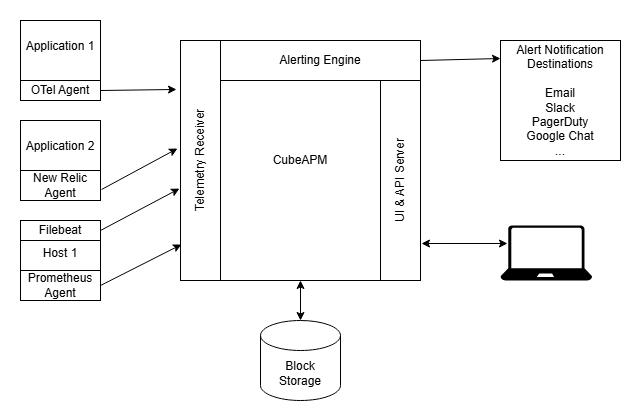
CubeAPM: Fully OpenTelemetry-native. Also compatible with Datadog, New Relic, Prometheus, and Elastic agents for incremental migration. No vendor lock-in.
Migration Effort: Switching from New Relic or Datadog
Both platforms are designed to make migration from SaaS APM tools easier by supporting OpenTelemetry.
From New Relic to OpenObserve: If your applications are already instrumented with OpenTelemetry, change the OTLP endpoint from New Relic to OpenObserve. If you are using New Relic agents, you will need to re-instrument with OTel SDKs.
From New Relic to SigNoz: Same process. Applications instrumented with OTel can switch endpoints. New Relic-specific agents require re-instrumentation.
From Datadog to OpenObserve or SigNoz: If using Datadog agents, you will need to migrate to OpenTelemetry instrumentation. Both platforms support OTLP, so the migration path is the same.
From New Relic or Datadog to CubeAPM: CubeAPM supports OpenTelemetry, Datadog, New Relic, Prometheus, and Elastic agents. You can run agents in parallel during migration, gradually shifting traffic. Zero-downtime migration is documented by multiple customers, including Mamaearth, which completed migration in under an hour.
Retention and Storage: Unlimited vs Disk Capacity
OpenObserve: Unlimited retention by default. Data is stored in Parquet format on local disk or S3. No additional cost for retention. Storage cost is whatever your S3 provider charges.
SigNoz: Retention is limited by ClickHouse disk capacity. You can configure retention policies to drop old data automatically. For long-term retention, you will need to scale ClickHouse storage, which increases infrastructure cost.
CubeAPM: Unlimited retention at no extra cost. All ingested data is searchable indefinitely. Pricing is $0.15/GB ingested, regardless of how long you keep it.
Query Performance: Parquet vs ClickHouse
OpenObserve: Uses Apache Parquet as its storage format. Parquet is columnar and optimized for analytical queries. Query speed is fast for most log queries but may be slower than ClickHouse on very high-cardinality trace queries.
SigNoz: Uses ClickHouse, a columnar database designed for real-time analytics on massive datasets. ClickHouse excels at high-cardinality queries, making it ideal for distributed tracing where you need to filter by pod, endpoint, user ID, or trace ID.
CubeAPM: Uses an optimized columnar storage engine with AI-based indexing. Query performance is consistently fast across logs, traces, and metrics, even at high cardinality.
Who Should Choose OpenObserve
Choose OpenObserve if you:
- Need a lightweight log aggregation platform with minimal resource overhead
- Want to run observability on the same VPS as your applications
- Prefer a single binary or container over managing a multi-service stack
- Are comfortable with logs-first architecture and do not need deep APM features
- Want unlimited retention with S3 storage backend
OpenObserve is best for solo developers, small teams, and log-heavy workloads where simplicity and resource efficiency matter more than APM depth.
Who Should Choose SigNoz
Choose SigNoz if you:
- Need distributed tracing and APM as your primary observability signal
- Are comfortable managing ClickHouse, ZooKeeper, and a multi-container stack
- Want OpenTelemetry-native observability without SaaS pricing
- Have the infrastructure budget to run SigNoz on dedicated VMs (8 vCPU, 16 GB RAM minimum)
- Need high-cardinality trace queries and strong service map visualizations
SigNoz is best for teams that prioritize APM and distributed tracing over logs and are willing to manage a heavier infrastructure stack.
Who Should Choose CubeAPM
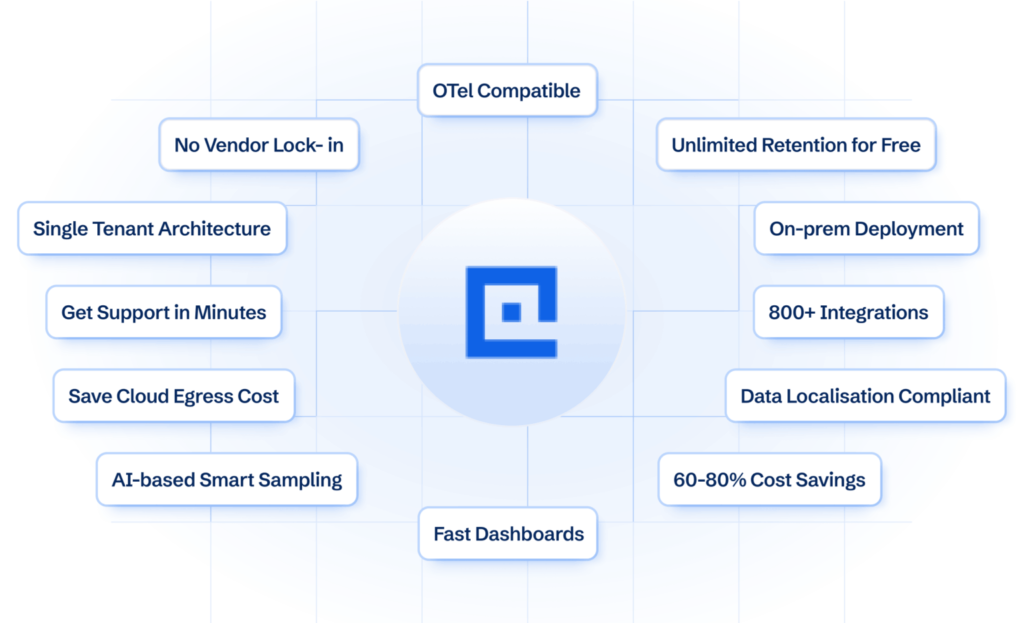
Choose CubeAPM if you:
- Want self-hosted observability but do not want to manage the Day 2 operational burden
- Need full-stack observability (APM, logs, infra, RUM, synthetics) in one platform
- Require data residency, compliance, or zero egress cost
- Want predictable pricing with no per-seat fees or per-host charges
- Need engineering-level support that responds in minutes, not days
CubeAPM is best for DevOps and platform teams that want SaaS-like convenience with self-hosted data control.
Verdict: OpenObserve vs SigNoz
Start with OpenObserve if:
- You need a lightweight log aggregation layer with minimal overhead
- You are a solo developer or small team running on constrained infrastructure
- Logs are your primary signal, and traces are secondary
Start with SigNoz if:
- You need distributed tracing and APM as your core observability signal
- You are comfortable managing ClickHouse and a multi-service stack
- You have dedicated infrastructure for observability (8 GB+ RAM)
Start with CubeAPM if:
- You want self-hosted observability without the Day 2 operational burden
- You need full-stack visibility across logs, traces, metrics, RUM, and synthetics
- You want predictable pricing and engineering-level support
Both OpenObserve and SigNoz are strong open-source alternatives to enterprise SaaS platforms. The right choice depends on whether you prioritize logs or APM, and whether you want to manage infrastructure yourself or delegate that to a vendor.
Disclaimer: The information in this article reflects the latest details available at the time of publication and may change as technologies and products evolve. Features, pricing, and plan limits can change over time. Always verify the latest information directly with the vendor before making purchasing or deployment decisions.
Frequently Asked Questions
Can I run both OpenObserve and SigNoz on the same VPS?
Yes, but it is not recommended. SigNoz requires 1.5-2 GB RAM at idle, and OpenObserve requires at least 512 MB. On an 8 GB VPS, running both leaves minimal resources for your applications. Choose one based on whether you need logs-first (OpenObserve) or APM-first (SigNoz).
Which tool has better OpenTelemetry support?
Both are OpenTelemetry native. SigNoz bundles its own OTel Collector, while OpenObserve accepts OTLP directly. The integration experience is similar for both.
Can I migrate from SigNoz to OpenObserve or vice versa?
Yes. Both platforms store data in open formats (ClickHouse for SigNoz, Parquet for OpenObserve). You can export historical data and re-ingest it, though this requires manual effort. Switching live ingestion is as simple as changing the OTLP endpoint in your applications.
Does CubeAPM support migration from OpenObserve or SigNoz?
Yes. CubeAPM supports OpenTelemetry, so applications already instrumented with OTel can switch endpoints. CubeAPM also supports running multiple agents in parallel, allowing gradual migration with zero downtime.
Which tool is cheaper at scale?
For self-hosted deployments, OpenObserve has the lowest infrastructure cost due to its single-container architecture. SigNoz costs more because of ClickHouse and ZooKeeper overhead. For cloud-hosted, CubeAPM is cheaper than SigNoz Cloud ($0.20/GB vs $0.30/GB). OpenObserve Cloud pricing is not publicly detailed for high-volume scenarios.
Can I use OpenObserve or SigNoz for Kubernetes monitoring?
Yes. Both accept Kubernetes metrics and logs via OpenTelemetry. SigNoz has stronger APM features for distributed tracing across Kubernetes pods. OpenObserve is better for log aggregation from Kubernetes clusters. CubeAPM offers full Kubernetes monitoring with pod-level traces, logs, and infrastructure metrics in a unified platform.
Which tool has better retention options?
OpenObserve offers unlimited retention by default using S3 storage. SigNoz retention is limited by ClickHouse disk capacity. CubeAPM offers unlimited retention at no extra cost, with all data searchable indefinitely.