










OpenObserve and Grafana serve different roles in the observability stack. Grafana is a visualization layer that connects to data sources like Prometheus, Loki, and Tempo. OpenObserve is a unified observability platform that ingests, stores, and queries logs, metrics, and traces in a single binary.
According to the CNCF Annual Survey 2024, 78% of organizations use Prometheus and Grafana together, making Grafana the most deployed visualization tool in cloud native environments. But Grafana itself does not store telemetry data, and teams often spend weeks configuring backends before they can visualize anything.
This guide compares OpenObserve and Grafana across architecture, pricing, deployment complexity, and signal depth. It covers what each tool does well, where they differ, and which fits your stack based on team size, infrastructure, and budget.
Quick Comparison: OpenObserve vs Grafana
| OpenObserve | Grafana | |
|---|---|---|
| Primary role | Unified observability platform (ingest, store, query, visualize) | Visualization layer (requires external data sources) |
| Deployment | Single binary or Kubernetes cluster | Single binary or cloud service (requires backend storage) |
| Pricing | Free OSS; Cloud starts at $0.50/GB | Free OSS; Grafana Cloud starts at $0 (free tier), paid plans usage-based |
| Native OTel support | Yes | Strong (via Tempo and Loki) |
| Built-in storage | Yes (ClickHouse-based) | No (requires Prometheus, Loki, Tempo, etc.) |
| Best for | Teams wanting a single platform for logs, metrics, traces | Teams with existing Prometheus/Loki/Tempo stacks needing visualization |
OpenObserve Overview
OpenObserve is an open source observability platform built in Rust that handles logs, metrics, traces, and analytics in a single binary. It stores data in ClickHouse or S3-compatible object storage, indexes everything by default, and provides a UI for dashboarding, alerting, and search.
Architecture: OpenObserve runs as a single binary for small deployments or scales to a distributed cluster on Kubernetes. Telemetry data is ingested via OpenTelemetry, Prometheus remote write, or syslog protocols. Data is stored in ClickHouse for high-performance queries or in object storage (S3, MinIO, GCS) for cost-efficient retention.
Key features:
- Native OpenTelemetry ingestion (logs, metrics, traces)
- Full-text search with auto-indexing
- VRL (Vector Remap Language) for parsing, enrichment, and redaction
- Drag and drop dashboarding with 18 chart types
- Alerts via Slack, PagerDuty, email, webhooks
- On-prem or cloud deployment
Pricing: OpenObserve is open source under AGPL. The hosted cloud service charges $0.50/GB ingested with no separate indexing or retention fees. Enterprise support and managed on-prem deployments are available via custom contracts.
Pros:
- Unified platform reduces operational complexity (no need to manage Prometheus + Loki + Tempo separately)
- Fast setup (single binary gets you from zero to ingesting data in under 10 minutes)
- Low storage costs (uses object storage or ClickHouse instead of expensive SSD-backed Elasticsearch-style indices)
- Built-in query editor supports SQL and PromQL
Cons:
- Smaller plugin ecosystem compared to Grafana (fewer pre-built integrations)
- Newer project (started 2022) means less community content and fewer third-party dashboards
- Limited support for Graphite and other legacy time-series formats
- Self-hosted ClickHouse deployments require some database tuning for production scale
Grafana Overview
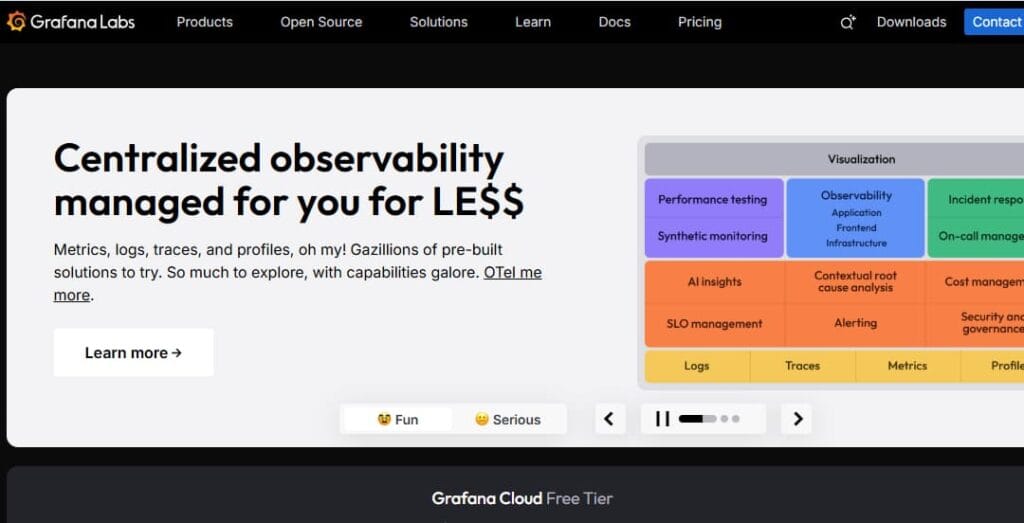
Grafana is an open source visualization and dashboarding platform that connects to data sources. It does not store telemetry data itself. Instead, it queries backends like Prometheus (for metrics), Loki (for logs), Tempo (for traces), Elasticsearch, InfluxDB, and over 100 other data sources.
Architecture: Grafana is a stateless web application. You deploy it as a single binary, Docker container, or managed service (Grafana Cloud). Users configure data source connections, build dashboards using a visual editor or JSON, and create alerts based on query results. All telemetry data lives in external systems.
Key features:
- Connects to 100+ data sources (Prometheus, Loki, Tempo, Elasticsearch, InfluxDB, MySQL, BigQuery, and more)
- Rich plugin ecosystem (thousands of community-built panels, data sources, and integrations)
- Alerting with support for multiple notification channels
- Dashboard sharing and templating
- Grafana Cloud includes hosted Prometheus, Loki, and Tempo (paid tiers)
Pricing: Grafana OSS is free. Grafana Cloud offers a free tier (10,000 series metrics, 50 GB logs, 50 GB traces per month). Paid plans are usage-based and scale with metrics, logs, and traces ingested. Enterprise plans add SSO, SLA support, and dedicated account management.
Pros:
- Extremely flexible (works with almost any data source)
- Massive plugin ecosystem (pre-built dashboards for Kubernetes, AWS, databases, and more)
- Single pane of glass for multiple backends (visualize Prometheus + Elasticsearch + custom SQL in one dashboard)
- Strong community support and documentation
Cons:
- Requires managing separate backends (setting up Prometheus, Loki, Tempo, or other storage systems adds operational overhead)
- Configuration sprawl (each data source, dashboard, and alert rule is managed separately)
- Performance depends entirely on backend systems (slow Prometheus queries mean slow Grafana dashboards)
- Grafana Cloud pricing can scale unpredictably with cardinality and retention
Feature-by-Feature Comparison
Data Ingestion and Storage
OpenObserve: Ingests logs, metrics, and traces natively via OpenTelemetry, Prometheus remote write, syslog, and Fluentd. Data is stored in ClickHouse or object storage (S3, MinIO, GCS). OpenObserve handles indexing, compression, and retention policies automatically.
Grafana: Does not ingest or store data. You configure external data sources (Prometheus for metrics, Loki for logs, Tempo for traces). Grafana queries these sources on demand. Data retention and indexing are handled by the backend systems, not Grafana.
Winner: OpenObserve for teams that want a single system for ingestion, storage, and query. Grafana for teams that already have Prometheus/Loki/Tempo and just need visualization.
Query and Search
OpenObserve: Provides a built-in query editor supporting SQL and PromQL. Full-text search is indexed by default across all fields in logs. Queries run directly against ClickHouse or object storage, with response times under 1 second for most searches on terabyte-scale datasets.
Grafana: Queries are written in the language of the connected data source (PromQL for Prometheus, LogQL for Loki, SQL for MySQL, etc.). Query performance depends entirely on the backend. Grafana itself adds minimal overhead, but a slow Prometheus instance will produce slow dashboards.
Winner: OpenObserve for unified query language and built-in indexing. Grafana for flexibility across multiple data sources.
Dashboards and Visualization
OpenObserve: Includes 18 chart types (line, bar, area, pie, heatmap, table, and more). Dashboards are built via drag-and-drop UI. Templates and variables are supported. Dashboard export and import use JSON format.
Grafana: Over 50 visualization types including graphs, gauges, heatmaps, geo maps, and custom plugins. Dashboards are highly customizable with variables, annotations, and templating. Thousands of pre-built dashboards are available from the Grafana community.
Winner: Grafana for breadth of visualization options and community dashboards. OpenObserve for faster setup and simplicity.
Alerting
OpenObserve: Alerts are configured via UI or API. Supports threshold-based, anomaly-based, and query-based alerts. Notifications via Slack, PagerDuty, email, webhooks. Alert rules are stored alongside data in the same database.
Grafana: Alerting supports multi-dimensional rules, query-based conditions, and notification channels including Slack, PagerDuty, email, OpsGenie, and more. Alerts can query any connected data source. Grafana Cloud includes a hosted alerting manager.
Winner: Tie. Both support robust alerting. Grafana has broader notification integrations. OpenObserve has tighter integration with stored data.
Deployment and Operations
OpenObserve: Single binary deployment or Kubernetes Helm chart. Scaling horizontally requires adding nodes to the cluster. Data is stored in ClickHouse or S3-compatible storage, which scales independently. No separate backend services to manage.
Grafana: Single binary deployment or managed Grafana Cloud. Grafana itself is stateless and scales easily. But you still need to deploy, configure, and scale Prometheus, Loki, and Tempo separately. For production LGTM stacks (Loki, Grafana, Tempo, Mimir), expect to manage 4 to 6 separate services.
Winner: OpenObserve for operational simplicity. Grafana for flexibility if you already manage the LGTM stack.
Ecosystem and Integrations
OpenObserve: Supports OpenTelemetry, Prometheus, Fluentd, and syslog ingestion. Has a Grafana plugin for teams that want to visualize OpenObserve data in Grafana dashboards. Growing ecosystem but far smaller than Grafana’s.
Grafana: Connects to over 100 data sources. Thousands of community plugins for panels, data sources, and apps. Pre-built dashboards for almost every common service (Kubernetes, AWS, MySQL, Redis, and more).
Winner: Grafana by a wide margin.
Pricing Comparison
Pricing varies significantly based on deployment model, data volume, and retention requirements. Below is a cost estimate for a mid-sized team ingesting 10 TB per month with 30-day retention.
| Cost component | OpenObserve (Cloud) | Grafana Cloud |
|---|---|---|
| Data ingestion (10 TB) | $5,000 (at $0.50/GB) | $0 (free tier covers first 50 GB logs + 10K metrics; paid tiers usage-based) |
| Metrics storage (500K series) | Included | ~$290/mo (estimate based on Grafana Cloud pricing for active series) |
| Logs storage (10 TB) | Included | ~$4,000/mo (estimate at $0.40/GB for logs ingestion on paid tier) |
| Traces storage (2 TB) | Included | ~$800/mo (estimate at $0.40/GB for traces on paid tier) |
| Total monthly cost | $5,000 | ~$5,090 |
Pricing based on publicly available information as of June 2026. Enterprise discounts, custom contracts, and negotiated rates are not reflected here.
OpenObserve self-hosted: Running OpenObserve on your own infrastructure costs only the compute and storage resources. A typical setup on AWS (3 m7g.xlarge instances + 20 TB S3 storage) costs approximately $800 per month. Self-hosted Grafana is free, but you still need to deploy and run Prometheus, Loki, and Tempo backends, which add infrastructure costs and operational overhead.
Who Should Choose OpenObserve
Choose OpenObserve if:
- You want a single platform for logs, metrics, and traces without managing separate backends
- You need fast full-text search without complex Loki query syntax
- You prefer self-hosted deployment with low infrastructure overhead
- You want predictable pricing based on ingestion volume
- You are building a new observability stack from scratch
Real-world use case: A fintech startup ingesting 5 TB of logs per month replaced their Grafana + Loki + Prometheus stack with OpenObserve. They reduced operational overhead (from managing 4 services to 1) and cut infrastructure costs by 60% by moving log storage from Elasticsearch to S3-backed OpenObserve.
Who Should Choose Grafana
Choose Grafana if:
- You already have Prometheus, Loki, Tempo, or other backends deployed
- You need to visualize data from multiple disparate sources in a single dashboard (e.g., Prometheus + MySQL + custom APIs)
- You rely on community-built dashboards and plugins
- You want maximum flexibility in choosing and swapping data sources
- You need a visualization layer only, not a storage platform
Real-world use case: A SaaS company with 200 microservices uses Grafana to visualize data from Prometheus (metrics), Loki (logs), Tempo (traces), and PostgreSQL (business metrics). They built custom dashboards that correlate application performance with database query latency and business KPIs, all in one view.
CubeAPM: A Third Option for Unified Observability
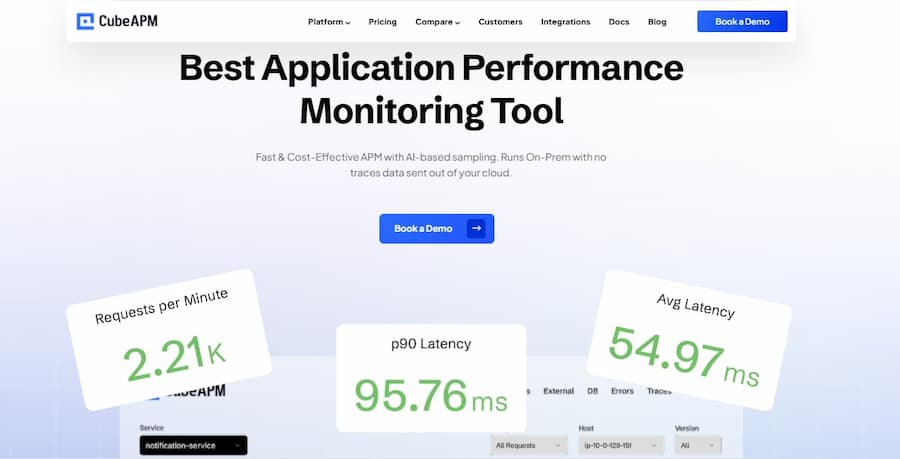
CubeAPM is another unified observability platform that competes with both OpenObserve and the Grafana LGTM stack. It runs on-prem or in your VPC, handles logs, metrics, traces, RUM, and synthetics in a single platform, and charges $0.20/GB with no per-seat fees.
| CubeAPM | OpenObserve | Grafana LGTM | |
|---|---|---|---|
| Deployment | Self-hosted (vendor-managed) | Self-hosted or cloud | Self-hosted or Grafana Cloud |
| Pricing | $0.20/GB all-in | $0.50/GB cloud; free self-hosted | Free OSS; Cloud usage-based |
| Built-in storage | Yes | Yes | Requires Mimir, Loki, Tempo |
| OTel-native | Yes | Yes | Strong (via Tempo, Loki) |
| Full MELT | Yes | Yes | Yes (if you deploy all LGTM components) |
CubeAPM fits if: You want unified observability like OpenObserve but need vendor-managed self-hosted deployment, faster dashboards (4x faster than New Relic in documented benchmarks), and lower pricing at scale. Teams moving from Datadog or New Relic to reduce costs while keeping full-stack visibility choose CubeAPM.
Verdict
OpenObserve is best for teams that want a single platform for logs, metrics, and traces without managing separate backends. It simplifies operations, reduces infrastructure costs, and provides fast search out of the box. Choose OpenObserve if you are building a new observability stack or replacing a complex multi-tool setup.
Grafana is best for teams that already run Prometheus, Loki, Tempo, or other data sources and need a powerful visualization layer. Its plugin ecosystem, flexibility, and community support make it the default choice for teams that want full control over their backend storage and visualization.
CubeAPM is best for teams that need unified observability with on-prem deployment, vendor-managed infrastructure, and predictable pricing. It competes directly with both OpenObserve and Grafana Cloud for teams moving away from expensive SaaS APM tools.
Disclaimer: The information in this article reflects the latest details available at the time of publication and may change as technologies and products evolve. Features, pricing, and plan limits can change over time. Always verify the latest information directly with the vendor before making purchasing or deployment decisions.
Frequently Asked Questions
Can I use Grafana to visualize data from OpenObserve?
Yes, OpenObserve provides a Grafana plugin that allows you to add OpenObserve as a data source in Grafana. You can query logs, metrics, and traces stored in OpenObserve and build Grafana dashboards using that data.
Does OpenObserve replace Prometheus and Loki entirely?
Yes, OpenObserve can ingest metrics via Prometheus remote write and logs via syslog or Fluentd, eliminating the need to run separate Prometheus and Loki instances. It stores and indexes both signal types in the same backend.
Is Grafana free for commercial use?
Yes, Grafana OSS is licensed under AGPL and is free to use in commercial environments. Grafana Cloud has a free tier and paid plans. Grafana Enterprise requires a commercial license.
How does OpenObserve pricing work for self-hosted deployments?
OpenObserve OSS is free to self-host under AGPL. You pay only for infrastructure costs (compute and storage). The hosted cloud service charges $0.50/GB ingested with no separate indexing or retention fees.
Can I run Grafana without Prometheus or Loki?
Yes, Grafana can connect to any supported data source including MySQL, PostgreSQL, Elasticsearch, InfluxDB, and more. Prometheus and Loki are popular choices but not required.
Which tool has better alerting, OpenObserve or Grafana?
Both support robust alerting. Grafana has broader notification integrations and works with any connected data source. OpenObserve has tighter integration with its built-in storage, making it easier to correlate alerts with specific log or trace data.
What is the LGTM stack and how does it relate to Grafana?
LGTM stands for Loki (logs), Grafana (visualization), Tempo (traces), and Mimir (metrics). It is a full observability stack built and maintained by Grafana Labs. Grafana is the visualization layer; the other three components handle data ingestion, storage, and querying.