










Dynatrace’s AI-powered automation is technically impressive, but its pricing model creates a specific problem for Kubernetes environments: you pay per GiB-hour for infrastructure monitoring, then separately for full-stack monitoring, then again for log ingestion. A 50-node Kubernetes cluster running mixed workloads can reach $3,000 or more per month before adding application tracing, log analytics, or synthetic monitoring.
Approximately 93% of organizations are now using, piloting, or evaluating Kubernetes, which means these costs compound as adoption grows. Beyond cost, two other factors drive teams to evaluate alternatives: Dynatrace’s cloud-first primary offering limits data residency options, and its proprietary agents create lock-in that complicates migration.
This guide compares top Dynatrace alternatives across open-source tools, SaaS platforms, and self-hosted solutions, evaluated specifically for Kubernetes monitoring depth. This comparison includes CubeAPM, which is the platform behind this blog. All tools are evaluated on the same criteria.
Quick Comparison: 10 Dynatrace Alternatives for Kubernetes
| Tool | Best For | Pricing Model | K8s Native | On-Prem |
| CubeAPM | Self-hosted K8s monitoring with unified observability | $0.15/GB, unlimited retention | Yes | Yes |
| Prometheus + Grafana | Open-source metrics and visualization | Free (self-hosted) | Yes | Yes |
| Datadog | Managed multi-cloud with broad integration ecosystem | $15/host/month (Pro) + add-ons | Strong | No |
| SigNoz | OpenTelemetry-native APM and metrics | Free self-hosted / $49/month cloud | Native | Yes |
| New Relic + Pixie | Auto-instrumentation with eBPF | $0.40/GB after 100GB free | Native | No |
| Sysdig | Container security + Kubernetes monitoring | Custom pricing | Native | Hybrid |
| Elastic Observability | ELK stack with K8s integration | Free OSS / ~$0.105/GB serverless | Partial | Yes |
| Splunk Observability | Enterprise APM with infrastructure correlation | $15/host/month infra, $60/host/month infra + APM | Strong | Hybrid |
| Sematext | Cost-effective infra and log monitoring | From $2.80/host/month | Auto-discovery | No |
| Dash0 | Developer-first OpenTelemetry platform | Consumption-based per million data points | Native | No |
Table data based on publicly available information as of June 2026.
1. CubeAPM
CubeAPM is a self-hosted, OpenTelemetry-native observability platform built specifically for teams running Kubernetes workloads who need full data control and predictable costs. It deploys inside your Kubernetes cluster or VPC, giving you unified APM, log management, infrastructure monitoring, and Kubernetes-specific metrics without routing telemetry outside your environment.
Unlike Dynatrace, which requires a proprietary OneAgent and prices by host memory, CubeAPM ingests data from existing OpenTelemetry collectors and prices per GB regardless of cluster size or node count, making costs predictable as clusters scale.
Key Features
- Pod, node, and cluster-level Kubernetes metrics with high-cardinality search
- Automatic correlation of traces, logs, and K8s events for root cause analysis
- Native support for HPA scaling events, OOMKill reasons, and pod eviction causes
- Unlimited data retention at predictable $0.15/GB pricing
- Compatible with OpenTelemetry, Prometheus, Datadog, and New Relic agents
Pricing
$0.15/GB for all ingested data (metrics, traces, logs), unlimited users, unlimited retention.
Pros
- 60-75% lower cost than enterprise SaaS at equivalent scale
- Full data sovereignty; telemetry never leaves your infrastructure
- Direct engineering support via Slack and WhatsApp with sub-hour response times
- Compatible with existing OpenTelemetry instrumentation; no re-instrumentation needed
Cons
- Requires your team to provision and manage the underlying infrastructure
- Newer product with less brand recognition than Dynatrace or Datadog
- SSO and RBAC features less mature than enterprise incumbents
Best for: Teams that need Kubernetes monitoring with full data control, predictable pricing, and willingness to self-host in exchange for significant cost savings.
2. Prometheus + Grafana
Prometheus and Grafana are the de facto open-source monitoring stack for cloud-native environments, underpinning the Kubernetes monitoring strategy of thousands of organizations from individual startups to hyperscalers. Prometheus handles metric collection via a pull-based scraping model with native Kubernetes service discovery, while Grafana provides dashboards, alerting, and visualization on top.
The kube-prometheus-stack Helm chart bundles both tools with pre-built Kubernetes dashboards, making initial deployment relatively straightforward for teams with Kubernetes experience. The tradeoff is that everything beyond basic metrics, including tracing, log aggregation, and long-term storage, requires additional components and dedicated operational effort.
Key Features
- Native Kubernetes service discovery automatically detects pods, nodes, and services
- PromQL enables powerful queries for pod-level metrics and custom SLO tracking
- Pre-built Grafana dashboards for Kubernetes via kube-prometheus-stack Helm chart
- Alertmanager handles alert routing with deduplication and grouping
- Massive ecosystem of exporters for application, infrastructure, and service metrics
Pricing
Free and open-source. Infrastructure hosting costs typically $200–$500/month for a mid-size cluster.
Pros
- Zero licensing costs
- Production-proven with CNCF backing and a massive community
- Complete control over data and deployment
- Highly customizable with flexible PromQL query language
Cons
- No native distributed tracing; requires separate tools like Jaeger or Tempo
- Long-term storage scaling requires additional components like Thanos or Cortex
- Operational burden for setup, maintenance, and upgrades falls entirely on your team
Best for: Teams with strong DevOps capability that want mature, metrics-focused monitoring with complete control and no vendor lock-in.
3. Datadog
Datadog is one of the most widely deployed commercial observability platforms, with deep Kubernetes support built through years of production usage across large engineering organizations. Its Kubernetes-native agent provides auto-discovery across namespaces, services, and pods, collecting metrics, logs, traces, and events under a single UI with 700+ integrations.
The platform is fully managed and deploys via a Helm chart in under 30 minutes, making it the fastest path to comprehensive Kubernetes visibility. The tradeoff is a multi-dimensional pricing model where infrastructure hosts, APM hosts, log volume, and custom metrics each bill independently, making cost forecasting difficult as clusters scale with auto-scaling.
Key Features
- Auto-discovers Kubernetes resources with unified metrics, logs, and events
- Out-of-the-box dashboards for cluster health, pod performance, and resource saturation
- APM with distributed tracing correlated to Kubernetes metadata
- 700+ integrations covering cloud providers, databases, and application frameworks
- Real-time anomaly detection and forecasting powered by machine learning
Pricing
Infrastructure Monitoring starts at $15/host/month (Pro plan, billed annually). APM, when purchased alongside infrastructure, is $31/host/month (billed annually). Logs are $0.10/GB ingested plus indexing and retention fees. Custom metrics cost $0.05 per 100 custom metrics.
Pros
- Fully managed with no infrastructure overhead
- Excellent documentation and extensive integration library
- Strong real-time analytics and correlation across telemetry types
- Fast deployment with minimal configuration required
Cons
- Cost scales unpredictably with multi-dimensional pricing across hosts, data, and features
- Per-host pricing punishes Kubernetes auto-scaling workloads
- SaaS-only deployment rules out teams with data residency requirements
- Vendor lock-in through proprietary agents and DQL query language
Best for: Large enterprises prioritizing managed service breadth over cost control, willing to accept SaaS deployment.
4. SigNoz
SigNoz is an open-source observability platform built natively on OpenTelemetry, designed as a self-hostable alternative to Datadog and New Relic for Kubernetes environments. It provides unified metrics, traces, and logs in a single UI backed by ClickHouse, which handles high-cardinality Kubernetes metrics at scale.
Because SigNoz is OTel-native from the ground up, teams avoid re-instrumentation when adopting or migrating to it, and there is no proprietary agent dependency. The self-hosted version covers most production use cases, while the managed cloud offering removes ClickHouse operational overhead for teams that prefer SaaS convenience.
Key Features
- OpenTelemetry-native support for Kubernetes instrumentation across all languages
- Out-of-the-box dashboards for CPU/memory per node, pod restarts, and resource saturation
- ClickHouse backend enables high-cardinality Kubernetes metrics with fast queries
- Unified correlation of logs, metrics, and traces for multi-pod troubleshooting
- Flamegraphs and Gantt charts for deep performance analysis
Pricing
Self-hosted is free and open-source. Managed cloud starts at $49/month (Teams plan), with logs and traces billed at $0.30/GB beyond the included usage.
Pros
- True OpenTelemetry-native design ensures future-proof, vendor-neutral observability
- Self-hosted option eliminates data egress costs entirely
- Active open-source community with frequent updates
- Unified interface avoids tool sprawl
Cons
- Self-hosted deployment requires managing ClickHouse, which has operational overhead
- Smaller ecosystem of pre-built integrations compared to commercial platforms
- Limited enterprise features (SSO, advanced RBAC) in the open-source version
Best for: Teams prioritizing OpenTelemetry compatibility and willing to self-host for cost savings and data control.
5. New Relic + Pixie
New Relic with Pixie integration provides Kubernetes observability through eBPF-based auto-instrumentation that captures pod-level metrics, traces, and network data without code changes or application restarts. Pixie runs entirely within your Kubernetes cluster, sending only summary telemetry to New Relic’s platform, which is useful for teams that want instant visibility without modifying application code.
The combination covers the full observability stack from infrastructure through APM in a single platform with unified querying via NRQL. The primary cost driver is data ingest volume, which scales quickly for high-traffic Kubernetes clusters generating large telemetry volumes.
Key Features
- Pixie captures pod-level metrics, traces, and network data automatically via eBPF
- Live debugging with real-time telemetry at the pod and service level
- AI-driven insights surface anomalies and suggest root causes
- Unified platform covering application, infrastructure, and Kubernetes monitoring
- Automatic instrumentation across Go, Java, Node.js, Python, and more
Pricing
100 GB data ingest free per month, then $0.40/GB for additional data. Full platform users are billed separately depending on edition (Standard: $99/user/month; Pro and Enterprise pricing requires contacting sales).
Pros
- Zero-code instrumentation dramatically reduces setup time
- Pixie provides instant visibility without application restarts
- Strong AI/ML-powered anomaly detection and incident correlation
- Unified platform eliminates need for separate tools
Cons
- Per-user pricing becomes expensive as engineering teams grow
- SaaS-only deployment limits data residency options
- eBPF instrumentation can miss custom application metrics
- Data ingest costs scale steeply for high-volume Kubernetes clusters
Best for: Teams wanting instant Kubernetes observability with minimal setup effort, willing to accept SaaS deployment and user-based pricing.
6. Sysdig
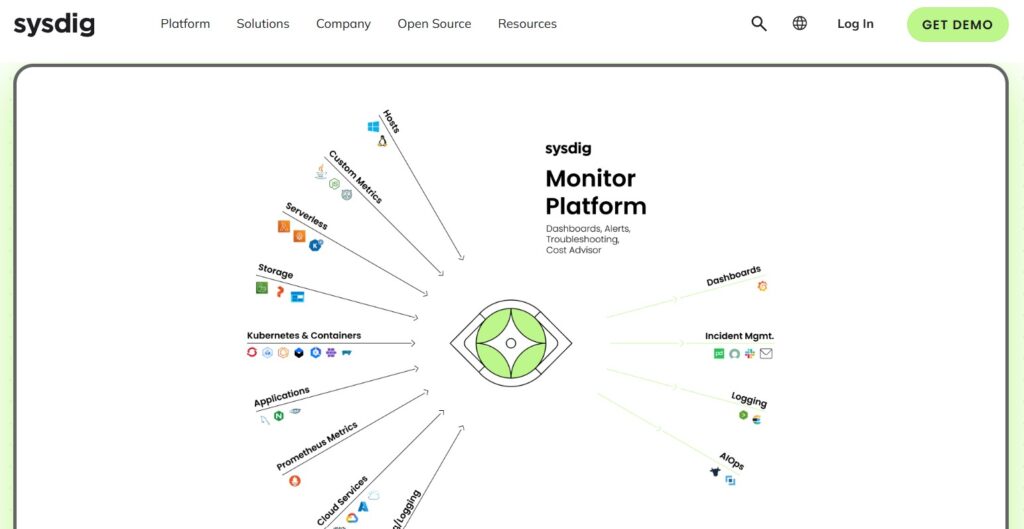
Sysdig differentiates itself by combining Kubernetes security and performance monitoring in a single platform, built on eBPF technology for deep container runtime visibility. Where most observability tools focus exclusively on performance signals, Sysdig adds vulnerability scanning, Falco-based threat detection, CIS Kubernetes benchmark compliance, and runtime security alongside the standard metrics and traces layer.
This makes it particularly relevant for regulated industries or platform teams that cannot afford to separate security and monitoring into different tools. Its eBPF agent captures system calls at the kernel level, providing a depth of visibility that metrics-only collectors cannot match.
Key Features
- eBPF-based agent captures system calls for security and performance monitoring
- Kubernetes-native dashboards for cluster health, workload performance, and resource usage
- Container security scanning, runtime threat detection, and compliance monitoring
- Service mesh visibility for Istio and Linkerd
- Cloud infrastructure monitoring across AWS, Azure, and GCP
Pricing
Custom pricing based on host count and feature selection. Sysdig Monitor uses host-based and time-series-based licensing; contact Sysdig directly for a quote.
Pros
- Unified security and monitoring eliminates tool sprawl
- Deep container runtime visibility with system call tracing
- Strong compliance capabilities (PCI-DSS, SOC 2, HIPAA)
- Hybrid deployment options (SaaS or self-hosted)
Cons
- No publicly listed pricing; requires sales engagement
- eBPF agent can have higher resource overhead than metrics-only collectors
- Steeper learning curve due to security-focused feature set
Best for: Platform teams that need integrated Kubernetes security and observability, particularly in regulated industries requiring compliance capabilities.
7. Elastic Observability
Elastic Observability extends the ELK stack with APM, infrastructure monitoring, and Kubernetes integration, making it a natural choice for teams already using Elasticsearch for log management who want to avoid introducing a separate observability platform. The unified search across logs, metrics, and traces stored in Elasticsearch is genuinely powerful, particularly for teams that need to correlate structured log data with application traces at high volume.
Elastic has moved to Elastic Cloud Serverless, which uses consumption-based pricing and removes cluster management overhead, making the hosted option more accessible than the older provisioned-capacity model.
Key Features
- Unified search across logs, metrics, and traces stored in Elasticsearch
- Kubernetes integration via Metricbeat and Filebeat for metrics and log collection
- APM with distributed tracing for microservices running in Kubernetes
- Machine learning-powered anomaly detection on time-series data
- Fleet management for deploying agents across large Kubernetes clusters
Pricing
Self-hosted Elastic Stack is free (OSS). Elastic Cloud Serverless Observability is consumption-based: ingestion starts at approximately $0.105/GB for the Logs Essentials tier and $0.150/GB for the Complete tier, plus separate retention and egress fees. (Pricing effective November 2025.)
Pros
- Powerful search capabilities across all telemetry types
- Self-hosted option provides full data control
- Strong log analytics foundation extends naturally to metrics and traces
- Mature product with extensive documentation
Cons
- Self-hosted Elasticsearch clusters are resource-intensive and require significant memory
- Multiple components to manage (Elasticsearch, Kibana, APM server, Beats)
- OpenTelemetry support is not as mature as OTel-native platforms
Best for: Teams already invested in the ELK stack for log management wanting to extend to full observability without adding new platforms.
8. Splunk Observability Cloud
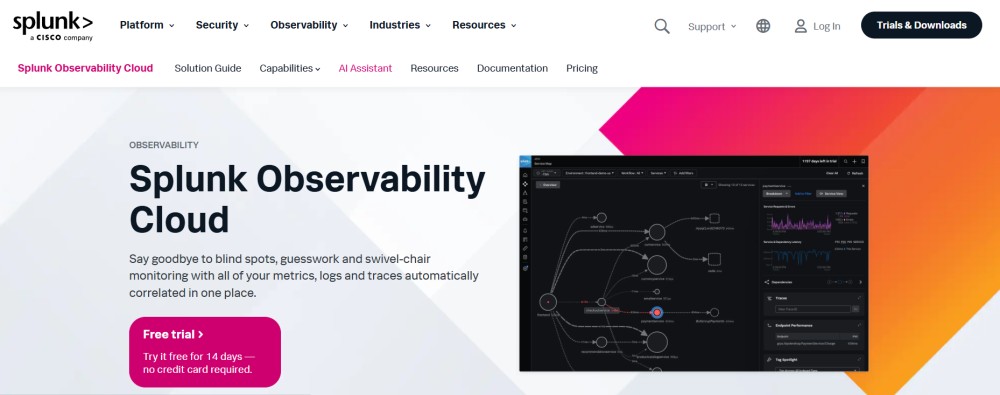
Splunk Observability Cloud (formerly SignalFx) provides enterprise-grade APM, infrastructure monitoring, and real-user monitoring with Kubernetes-native capabilities built on a real-time streaming architecture. Its Kubernetes Navigator surfaces topology views of clusters, nodes, and pods with sub-second metric resolution, making it effective for diagnosing Kubernetes scheduling and resource saturation issues in real time.
Splunk’s NoSample tracing captures 100% of request paths without sampling gaps, which is valuable for organizations that cannot afford to miss low-frequency but high-impact errors. The primary constraint is pricing: the full-stack plan is among the most expensive in this comparison.
Key Features
- Real-time streaming architecture with sub-second metric resolution
- Kubernetes Navigator provides topology views of clusters, nodes, and pods
- Infrastructure monitoring with auto-discovery across cloud providers
- APM with NoSample distributed tracing capturing 100% of traces
- AI-driven alerting reduces noise with intelligent grouping and correlation
Pricing
Infrastructure Monitoring starts at $15/host/month (billed annually). Infrastructure with APM starts at $60/host/month. End-to-end observability (infra + APM + RUM) starts at $75/host/month. All pricing sourced from splunk.com/en_us/products/pricing/observability.html.
Pros
- Real-time analytics with streaming architecture, not batch processing
- NoSample tracing captures complete request paths without sampling gaps
- Strong visualization with topology maps and dependency graphs
- Hybrid deployment options (SaaS or on-premises)
Cons
- Enterprise pricing puts it out of reach for smaller teams
- Complex pricing tiers make cost forecasting difficult
- Steeper learning curve than newer observability platforms
Best for: Large enterprises with existing Splunk investments needing enterprise-scale Kubernetes observability with real-time analytics.
9. Sematext
Sematext is a cost-focused SaaS monitoring platform that offers automatic Kubernetes resource discovery, infrastructure monitoring, log management, and experience monitoring in a single tool. Its per-host pricing is among the lowest of any commercial observability platform, making it a practical choice for smaller teams or cost-sensitive organizations that find Datadog, Dynatrace, or Splunk prohibitively expensive.
The single-agent deployment auto-discovers Kubernetes pods, services, and nodes without manual configuration, and correlated log and metrics dashboards are available out of the box. Sematext prices each product independently, so you pay only for the components you need.
Key Features
- Single-agent deployment auto-discovers Kubernetes resources automatically
- Out-of-the-box dashboards for cluster, node, and pod monitoring
- Integrated log management correlates logs with metrics and events
- Anomaly detection with configurable thresholds and alerts
- Distributed tracing with service maps via OpenTelemetry
Pricing
Infrastructure Monitoring Basic starts at $2.80/host/month; Standard at $3.60/host/month. Log management starts at $5/month. Products are priced independently. All pricing sourced from sematext.com/pricing.
Pros
- Significantly lower cost than Datadog, New Relic, or Dynatrace
- Transparent per-component pricing with no annual commitment required
- Fast deployment with automatic Kubernetes resource discovery
- No contracts required; pay as you go
Cons
- UI less flexible than Grafana for custom visualization
- Smaller integration ecosystem than enterprise platforms
- SaaS-only deployment limits data residency options
- Limited advanced AI-driven analytics compared to enterprise tools
Best for: Small to mid-size teams needing cost-effective Kubernetes monitoring with straightforward pricing and minimal operational overhead.
10. Dash0
Dash0 is an OpenTelemetry-native observability platform built specifically for cloud-native teams running Kubernetes and microservices. It provides unified metrics, traces, and logs with Kubernetes-specific views for pod health, resource usage, and deployment tracking, alongside a developer-focused UX built around PromQL for querying across all signal types. Dash0 has no proprietary agents; all instrumentation is standard OpenTelemetry, which means all observability artifacts (dashboards, alerts, pipeline rules) are fully portable.
Pricing is consumption-based with no base fee, no per-seat charges, and no per-GB model: you pay a flat rate per million data points (metrics, spans, log records, web events) with 13-month retention for metrics and 30-day retention for logs and spans. All features are included in a single plan. A 14-day unlimited free trial requires no credit card.
Key Features
- OpenTelemetry-native with zero proprietary agents or vendor lock-in
- Kubernetes-specific views for pod health, resource usage, and deployment tracking
- Unified metrics, traces, and logs queryable with a single PromQL-based language
- Developer-focused UX with built-in spam filters and cost forecasting
- Agent0 AI SRE agent for autonomous root cause analysis and alert generation
Pricing
Consumption-based, billed per million data points (metrics, spans, log records, web events). No base fee, no per-seat fees. All features included. Sourced from dash0.com/pricing.
Pros
- Fully public, transparent pricing with no custom quotes required
- True OpenTelemetry-native architecture ensures portability
- All features included in one plan with no upsells
- Built-in cost controls (budget limits, spam filters, cost forecast)
Cons
- Newer product with a shorter track record than established vendors
- SaaS-only deployment; no self-hosting option
- Smaller integration ecosystem compared to Datadog or Splunk
Best for: Developer teams prioritizing OpenTelemetry compatibility and transparent pricing, comfortable with a SaaS platform built by observability engineers.
How to Choose the Right Dynatrace Alternative for Kubernetes
Data sovereignty and deployment model come first
If data residency, HIPAA compliance, or GDPR requirements mandate that telemetry cannot leave your infrastructure, SaaS platforms are immediately ruled out. Datadog, New Relic, Sematext, and Dash0 are SaaS-only.
CubeAPM, Prometheus + Grafana, SigNoz, and Elastic Observability all support on-premises or private cloud deployment. CubeAPM provides the closest to a managed self-hosted experience: you own the infrastructure, and the platform handles upgrades and operations. Prometheus + Grafana is fully DIY, offering maximum control but requiring dedicated platform engineering capacity.
Cost model matters more than list price for Kubernetes
Per-host pricing creates a structural problem for Kubernetes: auto-scaling that doubles your node count doubles your monitoring bill. Datadog ($15/host/month), Splunk ($15/host/month infra, $60 with APM), and Dynatrace ($58/month per 8 GiB host) all follow this pattern.
Ingestion-based pricing (CubeAPM at $0.15/GB, New Relic at $0.40/GB after free tier) and per-component pricing (Sematext from $2.80/host/month) are more predictable for dynamic workloads. For a 50-node cluster generating 10 TB/month of telemetry, CubeAPM costs $1,500/month versus Datadog at roughly $4,500/month (infrastructure + APM + logs, before custom metrics). For a full comparison methodology, see the CubeAPM guide to top Kubernetes monitoring tools.
OpenTelemetry compatibility determines your migration freedom
Proprietary agents create lock-in that makes switching platforms expensive. SigNoz, CubeAPM, and Dash0 are built natively on OpenTelemetry from day one. Prometheus integrates well via the OpenTelemetry Collector.
Datadog, New Relic, Elastic, and Splunk support OpenTelemetry ingestion but continue to prioritize their proprietary agents as the primary integration path. If avoiding vendor lock-in is a requirement, start with OTel-native platforms. If you are already OTel-instrumented, any of these platforms can ingest your existing telemetry without changes.
Kubernetes-specific signal depth varies significantly
Not all monitoring tools understand Kubernetes orchestration natively. Look for platforms that surface HPA scaling decisions, pod eviction reasons, OOMKill analysis, and control plane health (API server latency, etcd performance), not just CPU and memory charts.
CubeAPM, Sysdig, and New Relic + Pixie provide the deepest Kubernetes-native insights. Generic APM tools retrofitted with Kubernetes support often miss container orchestration signals that are critical for diagnosing scheduling failures and resource saturation.
Unified Kubernetes Observability Without the Cost Ceiling: CubeAPM
The structural challenge with Dynatrace and most enterprise alternatives is that Kubernetes clusters are designed to scale dynamically, but per-host monitoring pricing punishes that elasticity. Every auto-scaling event increases your monitoring bill proportionally.
CubeAPM solves this with ingestion-based pricing at $0.15/GB, running inside your own infrastructure. As your cluster scales, telemetry volume grows, but the per-GB rate stays flat. There are no per-host fees, no per-user seats, and no egress charges.
At 10 TB/month across a 50-node cluster:
- CubeAPM: $1,500/month (plus self-hosted infrastructure costs)
- Datadog: ~$4,500/month (infrastructure + APM + logs, before custom metrics)
- Splunk Observability Cloud infra + APM: ~$3,000/month
- New Relic: ~$4,000/month in data ingest alone
CubeAPM ingests data from your existing OpenTelemetry collectors, Prometheus exporters, and Datadog or New Relic agents, so existing instrumentation is preserved during migration. Smart Sampling retains high-value traces (latency spikes, errors, OOMKill events) and drops low-signal data, reducing storage overhead without losing diagnostic coverage.
Conclusion
The right Dynatrace alternative depends on whether your primary constraint is cost predictability, data residency, OpenTelemetry compatibility, or time-to-value. Prometheus + Grafana is the lowest-cost option if you have DevOps capacity to operate it. SaaS platforms like Datadog and New Relic deploy fastest but cost the most at scale. CubeAPM and SigNoz offer the best combination of data control, OTel compatibility, and predictable pricing for teams willing to self-host.
Before committing, model your actual costs using the current node count and projected telemetry volume. A tool that looks affordable at 20 nodes becomes your largest infrastructure cost at 200 nodes. Evaluate CubeAPM for your Kubernetes environment?
Disclaimer: Pricing data was sourced from official vendor websites and documentation as of June 2026. Vendor pricing changes frequently; verify all figures directly with each vendor before making purchasing decisions. CubeAPM is the platform behind this blog.
FAQs
What is the cheapest Dynatrace alternative for Kubernetes monitoring?
Prometheus + Grafana has zero licensing cost (only infrastructure overhead, roughly $200–$500/month for a mid-size cluster) if you have the DevOps capacity to operate it. Among commercial options, Sematext starts at $2.80/host/month and CubeAPM at $0.15/GB are the most predictable. Avoid per-host pricing platforms when running Kubernetes auto-scaling workloads.
Which Dynatrace alternatives work with OpenTelemetry?
SigNoz, CubeAPM, and Dash0 are built natively on OpenTelemetry. Prometheus integrates well via the OpenTelemetry Collector. Datadog, New Relic, Elastic, and Splunk support OTel ingestion but continue to prioritize their proprietary agents, creating potential lock-in.
Can I self-host a Dynatrace alternative in my own Kubernetes cluster?
Yes. CubeAPM, Prometheus + Grafana, SigNoz, and Elastic Observability all support self-hosted deployment. CubeAPM offers managed self-hosted (you provide infrastructure, the platform handles operations). Prometheus and SigNoz are fully DIY. Sysdig and Splunk offer hybrid options.
What Kubernetes-specific metrics should a monitoring tool provide?
Pod CPU/memory usage and limits, container restart counts and reasons, node resource saturation, HPA scaling events, pod eviction causes, OOMKill analysis, control plane health (API server, etcd, scheduler), persistent volume status, and network policy enforcement. Verify these signals are surfaced before committing to a platform.
How do I migrate from Dynatrace to another Kubernetes monitoring tool?
Run both platforms in parallel for two to four weeks by deploying the new agent alongside Dynatrace OneAgent. Compare data accuracy during normal and incident conditions, then migrate alerting rules incrementally by service or team. OpenTelemetry-compatible platforms simplify this by letting you route telemetry to multiple backends during the transition period.
Does replacing Dynatrace with an open-source tool increase operational burden?
It depends on the tool. Prometheus + Grafana requires managing storage, scaling, upgrades, and alert routing. SigNoz reduces this but still requires ClickHouse management. CubeAPM’s managed self-hosted model handles platform operations while keeping data in your infrastructure. Fully managed SaaS options have zero operational burden but sacrifice data control.
Which Dynatrace alternative provides the best AI-powered insights for Kubernetes?
No. Alternative fully matches Dynatrace Davis AI for automated root cause analysis. New Relic and Datadog both offer machine learning-powered anomaly detection and incident correlation that come closest. Dash0’s Agent0 provides AI-driven triage and root cause analysis with agentic workflows. Open-source tools require custom alerting logic for AI-driven capabilities.