








The main difference between Datadog, Splunk AppDynamics, and CubeAPM is how they approach observability at scale.
Datadog is a SaaS-first platform with broad coverage, but with rising costs as data and usage grow. Splunk AppDynamics focuses on deep enterprise APM and business transaction visibility, often with complex licensing and a learning curve. CubeAPM is a full-stack observability platform with predictable ingestion-based pricing and self-hosting for full data ownership.
This Datadog vs Splunk AppDynamics vs CubeAPM comparison is for startups, fast-growing SaaS teams, and enterprises who need full-stack observability, faster MTTR, and cost control.
Datadog vs Splunk AppDynamics vs CubeAPM Comparison
| Feature | CubeAPM | Datadog | Splunk AppDynamics |
| Known for | Unified MELT, self-hosting, OTel-native, cost predictability | Large enterprise SaaS ecosystem with 900+ integrations. | Enterprise APM with business transaction monitoring & dependency mapping |
| Multi-Agent Support | Yes (OTel, New Relic, Datadog, Elastic, etc.) | Yes (Datadog Agent, OTel, 3rd-party agents) | Yes (AppDynamics agents, OTel) |
| MELT Support (Metrics, Events, Logs, Traces) | Full MELT coverage | Full MELT coverage | Full MELT coverage |
| Deployment (Self-Host / Setup) | Self-hosted with vendor-managed | SaaS-only | SaaS & self-hosted |
| Pricing | Ingestion-based pricing of $0.15/GB | APM: $31/host/ month; Infra: $15 /host/month; Logs: $0.10/GB | Infra: $6/vCPU/month; APM+infra:$33/vCPU/month; Enterprise: $50/vCPU/month |
| Sampling Strategy | Smart sampling – fully automated, context-aware | Head-based, tail-based, and adaptive sampling | Agent-based with configurable rules; head- & tail-based via OTel Collector |
| Data Retention | Unlimited Retention (no extra cost) | 15-30 days based on plan | Logs: 8d (can extend to 30/60/90d); Metrics: 4h-1y; events: 14d; |
| Support Channel & TAT | Slack, WhatsApp; response in minutes | Community-based; email & chat (paid); TAT: <2-48 hrs; | Support portal (paid); TAT: 2d to 30 min tier-based (P1-P4) |
Datadog vs Splunk AppDynamics vs CubeAPM: Feature-by-Feature Breakdown
Known for
CubeAPM: CubeAPM is known for unified MELT observability built on an OpenTelemetry-native, self-hosted architecture with predictable ingestion-based pricing, full data ownership, and low operational overhead for cloud-native and Kubernetes environments.
Datadog: Datadog is known for its SaaS-first observability platform with a large enterprise ecosystem, offering infrastructure monitoring, APM, logs, security, and 900+ integrations through a single hosted solution.
Splunk AppDynamics: Splunk AppDynamics is known for enterprise APM focused on deep business transaction monitoring, dependency mapping, and root-cause analysis, particularly in large, complex, or legacy application environments.
Multi-Agent Support
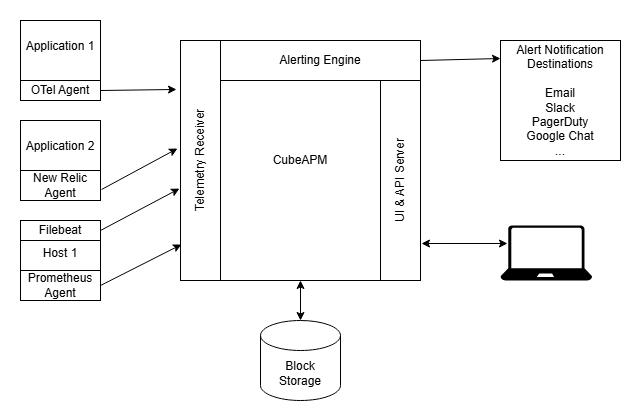
CubeAPM: CubeAPM supports OpenTelemetry SDKs and Collectors, Prometheus exporters, and telemetry from existing Datadog, New Relic, Elastic, and compatible agents. This enables teams to ingest data from multiple agent sources and standardize observability pipelines using OpenTelemetry.
Datadog: Datadog supports the Datadog Agent as well as OpenTelemetry through native OTel ingestion and the OpenTelemetry Collector. Datadog also integrates with a wide range of third-party tools and services for metrics, logs, and traces.
Splunk AppDynamics: Splunk AppDynamics supports proprietary AppDynamics agents (Java, .NET, Node.js, Python, PHP, Machine Agent, Database Agent) for application and infrastructure monitoring. It also supports OpenTelemetry ingestion via the OpenTelemetry Collector or dual-signal agents. This allows customers to collect telemetry using both AppDynamics and OpenTelemetry instrumentation.
MELT Support (Metrics, Events, Logs, Traces)
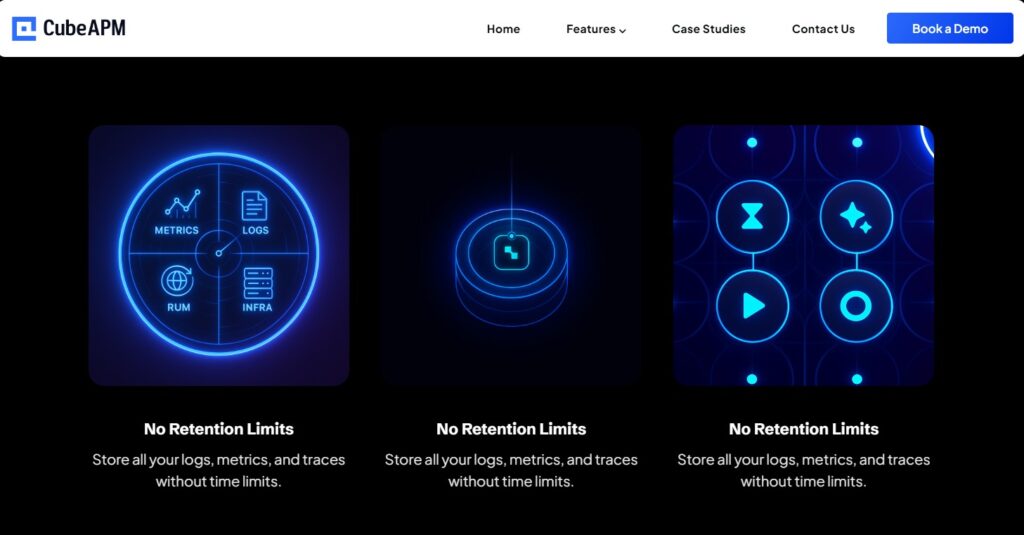
CubeAPM: CubeAPM provides full MELT support by ingesting metrics, events, logs, and traces through an OpenTelemetry-native pipeline. All four signals are designed to work together within a single platform, enabling end-to-end correlation across applications, infrastructure, and user experience.
Datadog: Datadog supports full MELT observability, including metrics, logs, traces, and events, delivered through integrated SaaS products such as Infrastructure Monitoring, APM, Log Management, and Events Explorer. These signals are correlated within the Datadog platform for unified analysis.
Splunk AppDynamics: Splunk AppDynamics supports metrics, events, logs, and traces across its observability offerings, including Application Performance Monitoring, Infrastructure Monitoring, and Log monitoring. MELT data is collected via AppDynamics agents and OpenTelemetry and analyzed across AppDynamics and the broader Splunk Observability portfolio.
Deployment (Self-Host/Setup)

CubeAPM: CubeAPM is designed for self-hosted deployment inside the customer’s own cloud or on-premises, with the platform operated and supported by the CubeAPM team. Telemetry is collected using OpenTelemetry and compatible agents, while data storage and processing remain within the customer’s infrastructure for control and compliance.
Datadog: Datadog is delivered as a fully managed SaaS platform. Customers deploy the Datadog Agent and integrations in their environments, while Datadog operates the backend, storage, upgrades, and scaling. Datadog does not offer a self-hosted deployment option.
Sources:
Splunk AppDynamics: Splunk AppDynamics supports both SaaS and self-hosted deployments. In the self-hosted model, AppDynamics is deployed as an on-premises virtual appliance where customers manage the Controller, storage, scaling, upgrades, and retention policies themselves. SaaS deployments are managed by Splunk, with agents installed in the customer environment.
Pricing for Small, Mid, and Large Teams
To summarize the pricing:
*All pricing comparisons are calculated using standardized Small/Medium/Large team profiles defined in our internal benchmarking sheet, based on fixed log, metrics, trace, and retention assumptions. Actual pricing may vary by usage, region, and plan structure. Please confirm current pricing with each vendor.
| Approx. cost for teams (size) | Small (~30) | Medium (~125) | Large (~250) |
| CubeAPM | $2,080 | $7,200 | $15,200 |
| Datadog | $8,185 | $27,475 | $59,050 |
| Splunk AppDynamics | $2,290 | $8,625 | $17,750 |
CubeAPM Costs in Detail
CubeAPM uses ingestion-based pricing, charging approximately $0.15 per GB of telemetry ingested, including logs, metrics, and traces, with no extra fees for retention or add-on modules. Here’s how it costs for different team sizes:
- Small teams (~ 30): $2,080
- Mid-sized teams (~ 125): $7,200
- Large teams (~250): $15,200
Datadog Cost in Detail
Datadog’s pricing is modular and product-based: infrastructure monitoring starts at $15 per host per month (billed annually), APM starts at $31 per host per month (billed annually), and log management is priced at $0.10 per GB ingested. Additional modules such as custom metrics, synthetics, and RUM may incur separate charges. The pricing for different teams:
- Small teams: $8,185
- Mid-size teams: $27,475
- Large teams: $59,050
Splunk AppDynamics Cost in Detail
Splunk AppDynamics pricing is based on CPU cores (vCPUs) with the following published starting rates (all billed annually):
- $6 per vCPU/month for the Infrastructure Monitoring edition
- $33 per vCPU/month for the Premium edition (Infrastructure + APM)
- $50 per vCPU/month for the Enterprise edition
Additional modules include RUM at $0.06 per 1,000 tokens/month, Secure Application at $13.75 per CPU core/month, and Browser Synthetics at $12 per test location/month. Here’s what the cost looks like for different teams:
- Small teams: $2,290
- Mid-size teams: $8,625
- Large teams: $17,750
Sampling Strategy
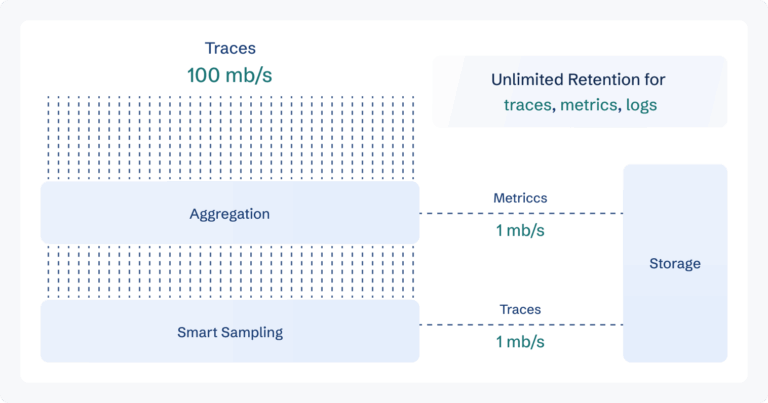
CubeAPM: CubeAPM uses smart, automated sampling that is designed to work with OpenTelemetry data. Sampling decisions are made using contextual signals such as latency, errors, and request characteristics, allowing higher-value traces to be retained while reducing overall ingestion volume. Sampling is handled transparently without requiring per-service manual rules.
Datadog: Datadog supports multiple sampling approaches, including head-based sampling (decisions made at trace start), tail-based sampling (decisions made after trace completion), and adaptive sampling. Datadog sampling can be configured via the Datadog Agent or OpenTelemetry Collector, allowing teams to balance cost and trace fidelity across services.
Splunk AppDynamics: Splunk AppDynamics applies sampling primarily at the agent level for application monitoring, where transaction snapshots and diagnostics are selectively captured. AppDynamics also supports OpenTelemetry-based sampling using the OpenTelemetry Collector, including head-based and tail-based sampling configurations, enabling standards-based trace ingestion alongside native agents.
Data Retention

CubeAPM: CubeAPM offers unlimited data retention at no extra cost under its standard pricing model. Metrics, logs, traces, and events can be stored and queried indefinitely without additional charges for longer retention windows, making long-term analysis and root-cause investigations more predictable.
Datadog: Datadog provides retention policies that vary by signal type and plan:
- Traces: Stored for 15 days by default and can be extended with higher-tier plans.
- APM logs: Retention depends on the Logs plan; for example, 30 days is common on mid-tier plans, with longer options available for higher tiers.
- Metrics: Typically retained at full resolution for 15 days and longer at aggregated resolution, depending on plan.
Splunk AppDynamics: Splunk AppDynamics data retention varies by data type, edition, and configuration:
- Metrics: Retention is configurable within the AppDynamics Controller; typical defaults include 1-minute resolution data for up to 4 hours, 10-minute resolution data for up to 48 hours, and 1-hour resolution data for up to ~365 days when rolled up for longer-term trending.
- Events and transaction snapshots: stored by default for approximately 14 days, depending on controller and license configuration.
- Logs and events: Default SaaS/on-prem retention around 8 days; can be extended to 30, 60, or 90 days with add-on packages or storage configurations.
Support Channels & TAT
CubeAPM: CubeAPM provides support primarily through direct messaging channels such as Slack or WhatsApp, with access to engineers and support staff. Response times are typically reported in minutes for critical issues, especially for customers on enterprise or premium support plans. Support documentation and customer guidance highlight direct communication channels designed for fast turnaround.
Datadog: Datadog offers support via the Datadog Support Portal, email, and chat, depending on the plan. Officially published support tiers and response targets are:
- Standard Support:
- P1 (Critical): < 2 hours response time
- P2 (High): < 4 hours
- P3 (Medium): < 1 business day
- P4 (Low): < 2 business days
- Premium Support:
- P1 (Critical): < 1 hour response time
- P2 (High): < 2 hours
- P3 & P4 improved over Standard but vary by customer contract.
These response targets are published in Datadog’s support documentation and vary slightly by region and contract level.
Splunk AppDynamics: Splunk AppDynamics support is provided through the Splunk Support Portal (ticketing) and phone escalation for Severity 1 cases based on the customer’s Support level. Officially published targets under the Splunk Support Programs are:
- Standard Support:
- P1: < 2 hours
- P2: < 1 business day
- P3: < 2 business days
- P4: < 2 business days
- Premium Support:
- P1: < 30 minutes
- P2: < 1 hour
- P3: < 4 hours
- P4: < 1 business day
These targets apply to AppDynamics customers covered under Splunk’s support programs.
Which tool is best for you? Why brands choose CubeAPM
Choosing the right observability platform depends on how well it scales with your architecture, data volume, and operational goals.
Datadog is best for teams that want a fully managed SaaS observability platform with a broad integration ecosystem and fast initial setup across cloud services. Splunk AppDynamics is best for large enterprises that require deep business transaction monitoring and dependency mapping, especially in complex or legacy application environments.
CubeAPM is best for modern engineering teams that want full-stack observability with OpenTelemetry, predictable pricing as data scales, self-hosted deployment for control and compliance, and faster mean time to resolution.
Key Benefits of CubeAPM
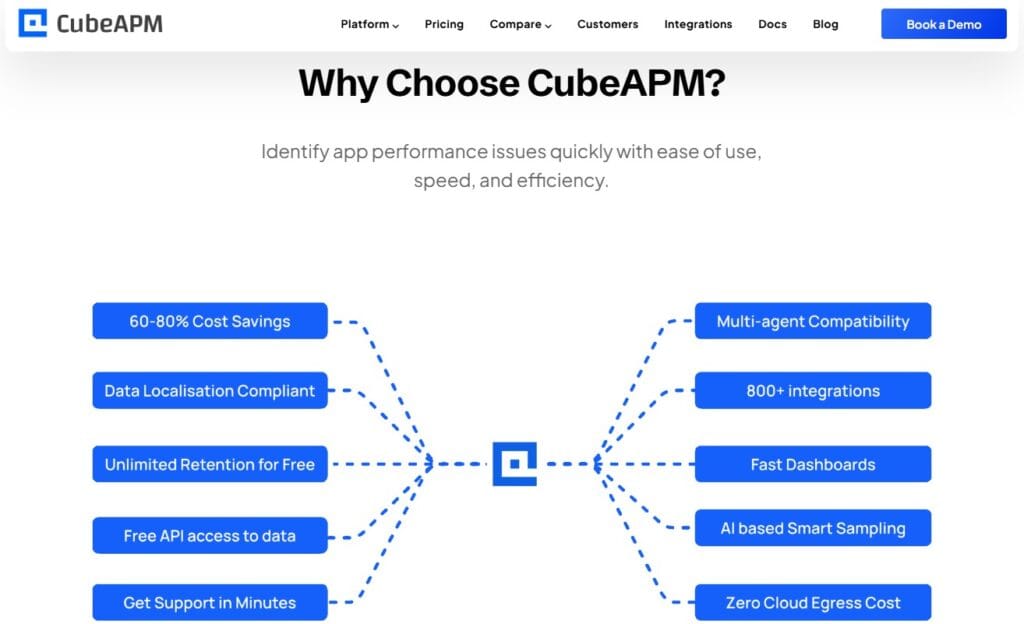
- Unified MELT observability: Metrics, events, logs, and traces are analyzed together in a single platform, enabling faster root-cause analysis across services and infrastructure.
- OpenTelemetry-native design: Built from the ground up for OpenTelemetry, allowing teams to standardize instrumentation and avoid vendor lock-in.
- Predictable, simple pricing: Ingestion-based pricing tied to data volume makes costs easier to forecast and manage as environments grow.
- Self-hosted with data ownership: Runs inside your cloud or on-prem, supporting strict data residency, security, and compliance requirements.
- Faster incident resolution: Smart, context-aware insights help engineering teams detect issues early and reduce MTTR in distributed systems.
Datadog vs Splunk AppDynamics vs CubeAPM: Use Cases
Each platform serves a distinct type of team and operating model. Below are practical, real-world use cases based on product capabilities, official documentation, and our research across demos and sales conversations.
Choose CubeAPM if:
CubeAPM fits teams that want modern, scalable observability without cost surprises or loss of data control.
- You are a startup or fast-growing SaaS company that needs full-stack observability (metrics, logs, traces, events) with a lightweight, easy-to-deploy setup and minimal operational overhead, based on CubeAPM demos and onboarding flows.
- You run microservices or Kubernetes and need end-to-end distributed tracing across services to quickly identify latency, errors, and bottlenecks.
- You require strict data residency, security, or compliance, and prefer a self-hosted observability platform that runs inside your own cloud or on-prem.
- You want predictable, simple pricing tied to data volume instead of host counts or feature add-ons, based on our sales data and customer cost comparisons.
- You need unlimited data retention for long-term debugging, trend analysis, or audits without paying extra for extended retention.
- You want to reduce mean time to resolution (MTTR) using unified telemetry and OpenTelemetry-native instrumentation across your stack.
Choose Datadog if:
Datadog is well-suited for teams that value a managed SaaS experience and a broad ecosystem.
- You want a fully managed, cloud-hosted observability platform with fast onboarding and minimal infrastructure management.
- You benefit from a large marketplace of integrations across cloud providers, managed services, and third-party tools, as described in Datadog’s official documentation.
- You prefer an all-in-one SaaS approach for monitoring infrastructure, applications, logs, and user experience.
Choose Splunk AppDynamics if:
Splunk AppDynamics is commonly used in large enterprise environments with complex application landscapes.
- You operate large-scale or legacy applications and need deep application performance monitoring with detailed business transaction visibility.
- You want strong dependency mapping and root-cause analysis focused on application behavior and business impact, based on AppDynamics product documentation.
- You require flexibility to deploy observability as SaaS or as a self-hosted solution to align with enterprise infrastructure or compliance requirements.
Conclusion
This Datadog vs Splunk AppDynamics vs CubeAPM comparison explored differences between the three tools across observability depth, deployment models, pricing approaches, and operational fit for modern teams.
While Datadog and Splunk AppDynamics are established platforms, teams often encounter challenges as scale increases, such as navigating complex pricing structures, managing retention limits, or aligning deployment models with compliance needs. CubeAPM addresses these gaps with OpenTelemetry-native full-stack observability, self-hosted deployment for data ownership, predictable pricing, unlimited retention, and smart sampling that helps reduce MTTR.
If you’re evaluating a modern observability platform built to scale without surprises, CubeAPM is a strong choice. Book a free demo to get started.
Disclaimer: The information in this article reflects the latest details available at the time of publication and may change as technologies and products evolve.
FAQs
1. What is the main difference between Datadog, Splunk AppDynamics, and CubeAPM?
The main difference lies in the deployment model and pricing approach. Datadog is a SaaS-only observability platform with modular pricing. Splunk AppDynamics focuses on enterprise APM with business transaction visibility, while CubeAPM offers OpenTelemetry-native, self-hosted observability with predictable, ingestion-based pricing.
2. Which tool is better for Kubernetes and microservices monitoring?
All three support Kubernetes and microservices, but CubeAPM is designed specifically around OpenTelemetry and distributed tracing, making it well-suited for end-to-end visibility across modern microservices architectures.
3. How do Datadog, Splunk AppDynamics, and CubeAPM differ in pricing?
Datadog uses host- and feature-based pricing, Splunk AppDynamics uses vCPU-based pricing with different editions, and CubeAPM uses simple, predictable pricing based on data ingestion volume, based on official pricing documentation and product pages.
4. Can CubeAPM replace Datadog or Splunk AppDynamics?
Yes, for many teams. CubeAPM provides full MELT observability, OpenTelemetry-native ingestion, self-hosted deployment, and unlimited retention, covering the core observability use cases teams typically rely on Datadog or AppDynamics for.
5. Which observability tool is best for data residency and compliance requirements?
CubeAPM is often preferred for strict data residency or compliance needs because it runs inside the customer’s own cloud or VPC, while Datadog is SaaS-only, and AppDynamics offers both SaaS and self-hosted options.