









The main difference between Datadog, New Relic, and CubeAPM lies in their pricing models, deployment flexibility, and OpenTelemetry-native architecture.
Datadog and New Relic are leading SaaS-based platforms, but can be costly for smaller teams with a host- or user-based pricing. CubeAPM, on the other hand, offers predictable ingestion-based pricing, self-hosting options, and smart sampling that help teams reduce observability costs by up to 50% while maintaining full data ownership.
In this guide, let’s explore Datadog vs New Relic vs CubeAPM comparison across pricing, deployment, sampling, log retention, support, and more.
Datadog vs New Relic vs CubeAPM Comparison
| Feature | CubeAPM | Datadog | New Relic |
| Known for | Unified MELT, self-hosting, OpenTelemetry-native, cost predictability | Large enterprise SaaS ecosystem with 900+ integrations. | Full-stack APM with advanced analytics, strong OTel support, and detailed service maps |
| Multi-Agent Support | Yes (OTel, New Relic, Datadog, Elastic, etc.) | Yes (proprietary Datadog Agent, third-party agents) | Yes (proprietary New Relic Agent, OTel, Prometheus) |
| MELT Support (Metrics, Events, Logs, Traces) | Full MELT coverage | Full MELT coverage | Full MELT coverage |
| Deployment (Self-Host / Setup) | Self-hosted with vendor-managed | SaaS-only | SaaS-only |
| Pricing | Ingestion-based pricing of $0.15/GB | APM: $31/host/ month; Infra: $15 /host/month; Logs: $0.10/GB | Free 100 GB/month; beyond that $0.40/GB. User-based licensing: $49-$349/user/month |
| Sampling Strategy | Smart sampling – fully automated, context-aware | Head-based, tail-based, and adaptive sampling | Adaptive head-based (via APM agents) and tail-based (via Infinite Tracing or OTel Collector) |
| Log Retention | Unlimited Retention (no extra cost) | 15-30 days based on plan | 30 days for logs/events (120 days in Data Plus); longer retention requires add-ons/live archive |
| Support Channel & TAT & Pricing | Slack, WhatsApp; response in minutes | Community-based; email & chat (paid plan) with TAT: <2 hrs. to 48 hrs; premium support costs extra | Community, docs, ticket-based; TAT: 2 days to 2 hrs. or 1 hr (priority support) based on the tier |
Datadog vs New Relic vs CubeAPM: Feature-by-Feature Breakdown
Known For
CubeAPM: Recognized for its predictable pricing model, OpenTelemetry-native design, and unlimited retention, CubeAPM combines full MELT observability with cost transparency and flexibility. Its self-hosting and BYOC options appeal to organizations with data localization or compliance needs, while direct Slack/WhatsApp developer support ensures faster issue resolution. It’s often chosen by teams migrating from legacy APM tools seeking control, simplicity, and lower costs.
Datadog: Known for its extensive integration ecosystem, with over 900 supported services and frameworks, Datadog remains a leader in enterprise observability. It delivers powerful dashboards, correlated traces, and infrastructure metrics under a unified SaaS platform.
New Relic: Best known for deep analytics, service maps, and comprehensive APM visualization. It offers robust OpenTelemetry support, advanced error analytics, and a rich user experience for debugging distributed systems. Its hybrid adaptive and tail-based sampling ensures balanced trace coverage.
Multi-Agent Support
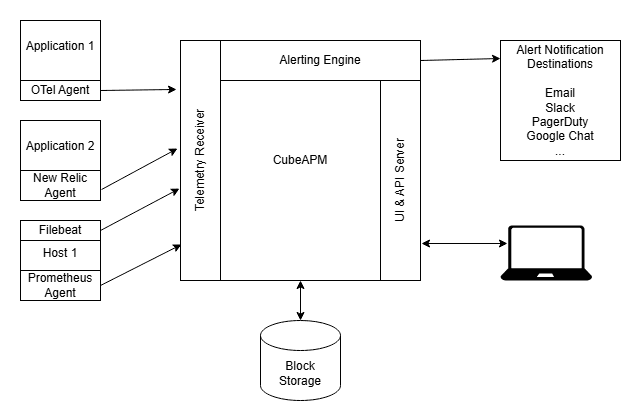
CubeAPM: CubeAPM provides complete multi-agent interoperability, supporting OpenTelemetry, Prometheus, Datadog, New Relic, and Elastic agents natively. This allows teams to collect and correlate telemetry from mixed environments without vendor dependency. It’s designed for flexibility across hybrid and cloud-native systems, making migration or co-existence with existing setups seamless.
Datadog: Datadog primarily depends on its proprietary Datadog Agent, although it supports OpenTelemetry Collector and limited Prometheus remote-write integration.
New Relic: New Relic provides language-specific APM agents for Java, .NET, Node.js, Python, PHP, Ruby, and Go, each designed to instrument application code and send telemetry to the New Relic platform. The Java agent supports JVM-based languages, while the .NET agent works with both .NET Framework and .NET Core runtimes. New Relic also offers dedicated agents for infrastructure, browser, mobile, and synthetic monitoring, extending observability beyond APM.
MELT Support
CubeAPM: Offers complete MELT coverage across Application, Infrastructure, Log, Synthetic, Real User, and Database Monitoring. All signals (metrics, events, logs, and traces) are unified under one ingestion model, enabling contextual correlation across distributed systems. Teams gain full visibility and troubleshooting depth without managing separate modules or pricing tiers.
Datadog: Provides comprehensive MELT functionality, but distributed across separate capabilities (APM, Infrastructure, Logs, Synthetics, and RUM). While integration between these modules is seamless, there are independent billing and retention policies
New Relic: Delivers full-stack MELT observability through the New Relic One platform, integrating APM, Infrastructure, Browser (RUM), Logs, and Errors Inbox. It supports OpenTelemetry ingestion for all signal types.
Pricing for Small, Mid, and Large Teams
To summarize the pricing*:
*All pricing comparisons are calculated using standardized Small/Medium/Large team profiles defined in our internal benchmarking sheet, based on fixed log, metrics, trace, and retention assumptions. Actual pricing may vary by usage, region, and plan structure. Please confirm current pricing with each vendor.
| Approx. Cost for Teams | Small (~30) | Mid-Sized (~125) | Large (~250) |
| CubeAPM | $2,080 | $7,200 | $15,200 |
| Datadog | $8,185 | $27,475 | $59,050 |
| New Relic | $7,896 | $25,990 | $57,970 |
CubeAPM Costs in Detail
CubeAPM: Offers a straightforward, ingestion-based pricing model at approximately $0.15 per GB of telemetry data. This includes metrics, logs, traces, and events in a consolidated billing scheme with no additional host, user, or feature-fee layers. Designed for predictability, especially for teams migrating from legacy or host-based pricing structures.
- Small teams (~ 30): $2,080
- Mid-sized teams (~ 125): $7,200
- Large teams (~250): $15,200
Datadog Cost in Detail
Datadog: Uses a tiered pricing model based on modules and host counts. For example, APM might cost around $31 per host/month, infrastructure monitoring around $15 per host/month, and log ingestion at about $0.10 per GB, according to recent data. Cost for teams:
- Small teams: $8,185
- Mid-size teams: $27,475
- Large teams: $59,050
New Relic Cost in Detail
New Relic: New Relic follows a usage-based pricing model that combines data ingestion and user-based licensing. Teams get 100 GB/month free; beyond that, standard data rates are around $0.40 per GB, or $0.60 per GB for the Data Plus tier (with extended retention and reliability). User pricing is tiered: Core users are billed at $49/user/month, and Full Platform users at $99/user/month (annually) or $340/user/month on a pay-as-you-go plan. The pricing for different teams:
- Small teams: $7,896
- Mid-size teams: $25,990
- Large teams: $57,970
Sampling Strategy

CubeAPM: Implements Smart adaptive sampling, a context-aware approach that dynamically prioritizes spans based on latency, error rate, and transaction criticality. This ensures high-value traces are retained while minimizing ingestion costs. The algorithm continuously adjusts sampling frequency in real time, maintaining observability depth without overwhelming storage or budgets. It’s optimized for OpenTelemetry pipelines, making CubeAPM highly efficient for large-scale distributed environments.
Datadog: Uses primarily head-based sampling, where traces are sampled at the start of a request before completion data is available. While simple to implement, this can omit important slow or error traces under high throughput. It also offers adaptive and probabilistic sampling for Real User Monitoring (RUM), error tracking, and rare traces, helping retain valuable sessions and exceptions more intelligently.
New Relic: Its APM agents use standard head-based sampling, deciding which spans to collect early in the trace to control volume and ensure representative data. For most users, this head-based sampling is enabled by default and captures a subset of traces (e.g., up to 10 per minute) unless Infinite Tracing is configured. With Infinite Tracing, New Relic supports tail-based sampling where all traces are accepted and then filtered after complete arrival to retain the most important ones. Agents may also sample when disconnected from New Relic to limit payload size, with sampling increasing the longer the disconnect lasts.
Data Retention

CubeAPM: Provides unlimited log retention at no extra cost, regardless of data volume or storage duration. This ensures teams retain full historical visibility without additional tiered pricing or deletion policies. Ideal for organizations prioritizing long-term analytics, compliance, and RCA without cost escalation.
Datadog: Metrics are stored for 15 months, while indexed APM traces are typically retained for about 15 days (up to ~30 days depending on plan and filters). Logs retention is configurable per log index and depends on the customer’s plan and settings. RUM data is kept for 30 days for sessions and 15 days for resource and long-task events, as documented in Datadog’s official docs.
New Relic: New Relic’s default telemetry data retention varies by data type and plan, with standard retention starting at about8 days for core data under default settings. Logs in the Original Data option are typically retained for around 30 days, while with Live Archives or extended retention you can store logs much longer (up to years with the archive feature). Metrics raw data is retained for about 30 days, with longer aggregated storage beyond that period. With the Data Plus option, default retention for many data types (including logs and traces) can be extended significantly, commonly up to ~98–120 days.
Support Channel, TAT & Pricing
CubeAPM: Provides direct Slack and WhatsApp support with its core engineering team, ensuring response times within minutes. Customers get immediate access to product experts for debugging and configuration assistance. There are no additional support charges, and enterprise users automatically receive priority handling, making it one of the fastest and most accessible support models in the APM space.
Datadog: Relies on email and ticket-based support, supplemented by extensive documentation and community forums. Standard plans generally experience response times ranging from 1 business day to 2 hours, while premium support packages, offered at an additional cost, include faster SLAs and dedicated assistance. Support quality scales with the plan, which can make rapid resolution costly for smaller teams.
New Relic: Support is delivered via ticketing and email channels, with community and documentation resources available to all users. The Standard Edition provides ticket-based support with a 2-day response SLA, while the Pro Edition improves this to a 2-hour SLA for critical incidents. The Enterprise Edition offers 1-hour critical incident SLAs, priority case routing, and access to dedicated account and customer success managers. Advanced SLAs and priority access are included only in paid Pro and Enterprise support tiers.
Which tool is best for you? Why brands choose CubeAPM
If you’re evaluating observability platforms, the right choice depends on your priorities: cost predictability, deployment flexibility, and data ownership.
Datadog is best suited for large enterprises already deeply invested in the Datadog ecosystem, New Relic is Ideal for organizations that value in-depth analytics and full-stack visualization and are comfortable with tiered pricing and retention add-ons.
CubeAPM is excellent for teams that want predictable pricing, OpenTelemetry-native observability, and complete control over their data. It’s particularly well-suited for SaaS companies, fintechs, and enterprises that prioritize compliance, self-hosting, and long-term visibility without unpredictable billing.
Key benefits of CubeAPM
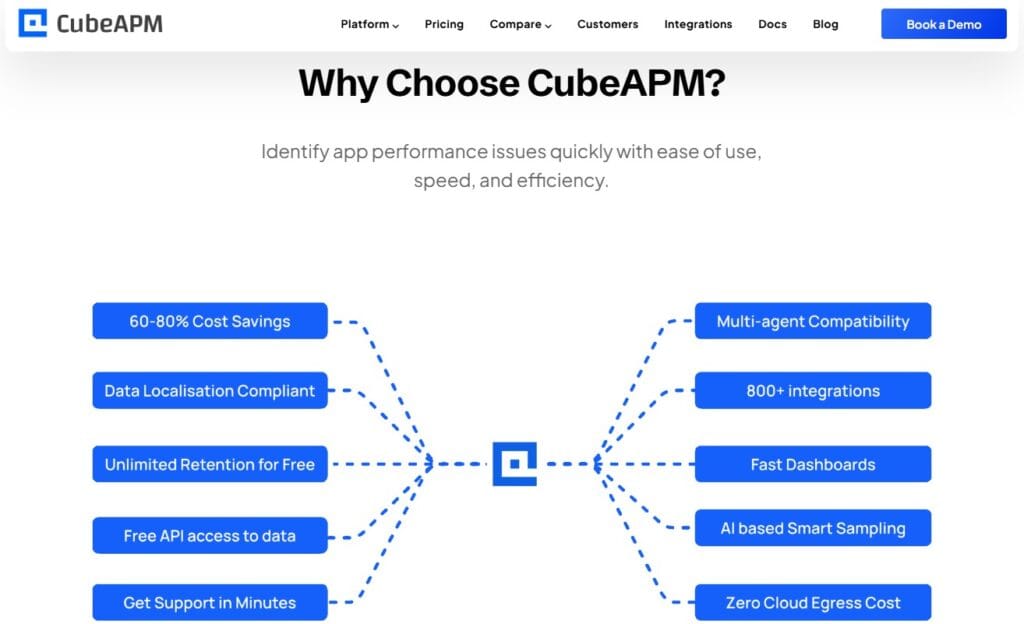
- Predictable pricing: Simple ingestion-based model that scales with your data usage, not hosts or user seats.
- Self-hosting: Deploy in your own cloud or on-premises for full data localization and compliance.
- Unlimited retention: Retain logs, traces, and metrics indefinitely without extra charges.
- OpenTelemetry-native: Seamlessly integrates with OTel, Prometheus, Datadog, and New Relic agents.
- Fast, developer-first support: Access expert assistance directly via Slack or WhatsApp, minimizing MTTR.
Datadog vs New Relic vs CubeAPM: Use Cases
Each tool serves distinct needs depending on your organization’s priorities: cost, data control, scale, and visibility. Here’s when each solution fits best based on our research, demo insights, and vendor documentation.
Choose CubeAPM if:
You want predictable, OpenTelemetry-native observability with complete control over deployment and data retention.
- For startups and scale-ups: Ideal for growing teams that need full-stack observability without worrying about escalating costs. CubeAPM’s ingestion-based pricing ( $0.15/GB) provides transparency and predictable budgeting.
- For compliance-driven enterprises: Perfect for industries like fintech, healthcare, or government, where data localization is critical. CubeAPM supports self-hosting BYOC (Bring Your Own Cloud) or on-prem, ensuring full data sovereignty.
- For OpenTelemetry adopters: Built around OTel and Prometheus, CubeAPM simplifies migration from legacy APMs without requiring agent lock-in.
- For microservices and distributed systems: Delivers complete MELT visibility with smart adaptive sampling to reduce noise and cost while maintaining trace fidelity.
- For teams focused on MTTR reduction: Slack- and WhatsApp-based developer support ensures fast resolution and real-time collaboration during incidents.
- For long-term data analysis: Unlimited log and trace retention at no additional cost allows deep trend analysis, RCA, and audit tracking.
Choose Datadog if:
You prioritize wide integrations and a mature SaaS ecosystem over cost predictability.
- For large, cloud-native enterprises: Best suited for multi-cloud and hybrid setups with extensive service coverage (900+ integrations).
- For teams focused on automation: Datadog’s AI-driven alerts, dashboards, and anomaly detection are strong for complex DevOps environments.
- For centralized SaaS observability: Ideal when ease of onboarding and out-of-the-box dashboards matter more than self-hosting flexibility.
- For digital experience monitoring: Datadog’s RUM, Synthetics, and error tracking modules offer unified front-end to back-end visibility.
Choose New Relic if:
You want deep analytics, adaptive sampling, and a unified SaaS APM platform with extensive visualization options.
- For enterprises prioritizing detailed analytics: New Relic One’s visualizations and service maps provide strong insights into performance dependencies.
- For OpenTelemetry or hybrid setups: Supports OTel ingestion alongside its native agents, offering flexibility for partial OTel migration.
- For teams needing adaptive sampling: Uses adaptive head-based and tail-based sampling (Infinite Tracing) to capture relevant traces efficiently.
- For data retention flexibility: Offers 30-day default retention (120 days with Data Plus) and up to 7 years via Live Archives ($0.05/GB-month for every 30-day extension).
- For organizations investing in analytics depth: Great for teams that prefer managed SaaS convenience with strong visualization and correlation tools despite tiered pricing.
Datadog vs New Relic vs CubeAPM: Conclusion
Both Datadog and New Relic offer powerful observability features, but their usage-based pricing and SaaS-only deployment can be limiting.
CubeAPM eliminates these pain points with predictable ingestion-based pricing and self-hosted deployment that gives you complete control over your data. Its unlimited retention, smart adaptive sampling, and instant developer support make it both efficient and reliable for modern engineering teams.
Take a free demo to explore CubeAPM today.
Disclaimer: The information in this article reflects the latest details available at the time of publication and may change as technologies and products evolve.
FAQs
1. Which tool offers the most predictable pricing model?
CubeAPM provides a simple ingestion-based pricing model (around $0.15/GB) with no host, user, or feature add-ons. Datadog and New Relic both follow usage- and seat-based pricing that can scale up as data volume and user count increase.
2. Can all three tools be self-hosted?
Only CubeAPM supports self-hosting via Bring Your Own Cloud (BYOC) or on-prem deployment, enabling full control over data storage and compliance. Datadog and New Relic are cloud-hosted SaaS platforms, meaning data is stored in vendor-managed regions.
3. Which platform is best for OpenTelemetry environments?
CubeAPM is OTel-native across metrics, logs, and traces, and is designed to run purely on OTel/Prometheus pipelines. New Relic and Datadog both supports OpenTelemetry as well.
4. What kind of support does each platform provide?
CubeAPM offers real-time Slack and WhatsApp access with response times in minutes. Datadog provides email and ticket-based support, with faster SLAs (2-48 hrs) in premium tiers. New Relic uses a tiered support model: 2 business days for Standard, 2 hours for Pro, and 1 hour for Enterprise plans.
5. Which is most suitable for compliance-heavy or data-residency use cases?
CubeAPM is ideal for industries like fintech, healthcare, and government that require strict data residency, self-hosting, and unlimited retention. Datadog and New Relic offer strong compliance frameworks but are SaaS-based platforms.