








The main difference between Datadog, Elastic Observability, and CubeAPM lies in pricing, deployment control, and features.
Datadog is a SaaS-first platform for teams that want a fully managed SaaS experience with broad cloud integrations and minimal setup, but can be costly for smaller teams as telemetry volume grows. Elastic Observability is built on the Elastic Stack and excels at log search and analytics, but typically requires significant operational effort to manage at scale.
CubeAPM takes a fundamentally different approach with an affordable ingestion-based pricing, self-hosted (via BYOC/on-prem), deployment, and ease of use, whether you are a small team or an enterprise.
In this guide, we compare Datadog vs Elastic Observability vs CubeAPM across pricing models, deployment options, sampling strategies, data retention, and more.
Datadog vs Elastic Observability vs CubeAPM Comparison
| Feature | CubeAPM | Datadog | Elastic Observability |
| Known for | Unified MELT, self-hosting, OTel-native, cost-efficient | Large enterprise SaaS ecosystem with 900+ integrations. | Search-driven observability built on the Elastic Stack |
| Multi-Agent Support | Yes (OTel, New Relic, Datadog, Elastic, etc.) | Yes ( Datadog Agent, OTEL, third-party agents) | Yes (Elastic Agent and Beats-based data collection) |
| MELT Support (Metrics, Events, Logs, Traces) | Full MELT coverage | Full MELT coverage | Full MELT coverage |
| Deployment (Self-Host / Setup) | Self-hosted with vendor-managed | SaaS-only | SaaS and self-managed |
| Pricing | Ingestion-based pricing of $0.15/GB | APM: $31/host/ month; Infra: $15 /host/month; Logs: $0.10/GB | Serverless: $0.09/GB;Elastic Cloud: $99/host/month; self-managed: Custom |
| Sampling Strategy | Smart sampling – fully automated, context-aware | Head-based, tail-based, and adaptive sampling | Head-based and tail-based |
| Data Retention | Unlimited Retention (no extra cost) | 15-30d based on plan | Traces & logs: 10d; metrics & RUM: 90 d; synthetics: 1 yr |
| Support Channel & TAT | Slack, WhatsApp; response in minutes | Community-based; email & chat (paid plan); TAT: <2-48 hrs | Standard: web-based; TAT: 3d; higher tiers paid, TAT: 2d to 30 min |
Datadog vs Elastic Observability vs CubeAPM: Feature Breakdown
Known for
CubeAPM: It is primarily known for delivering unified MELT observability in a self-hosted, OpenTelemetry-native architecture with predictable, ingestion-based pricing. The platform is designed to store all telemetry data within the customer’s own cloud or on-prem environment, while still providing vendor-managed operations. This appeals to teams prioritizing cost predictability, data residency, and full-stack visibility without per-host or per-feature pricing complexity.
Datadog: The platform is best known as a large enterprise SaaS observability platform with a broad ecosystem (900+) of cloud integrations and managed services. Its strength lies in fast onboarding, deep integrations across infrastructure, applications, logs, security, and user monitoring. This makes Datadog attractive for organizations that want minimal operational ownership, even though pricing and data storage are fully controlled by Datadog’s cloud backend.
Elastic Observability: It is known for search-driven observability built on the Elastic Stack, with Elasticsearch at its core. Elastic Observability’s documentation emphasizes powerful indexing, querying, and correlation across logs, metrics, and traces, especially for teams that already operate Elasticsearch clusters. It offers flexible retention and deep log analytics, but requires operational responsibility when self-managing clusters or tuning Elastic Cloud deployments.
Multi-Agent Support
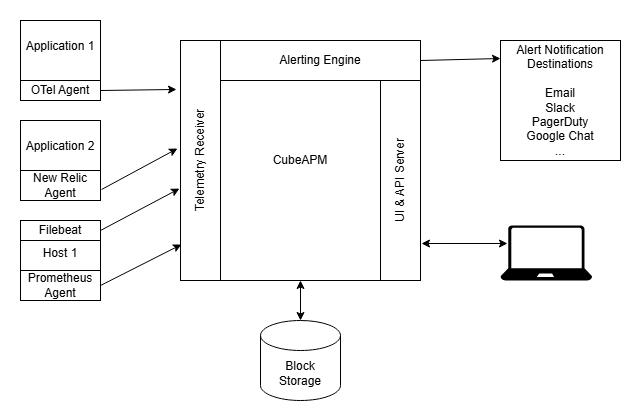
CubeAPM: It is designed to work with multiple telemetry agents and formats out of the box. Based on CubeAPM’s official documentation, it natively supports OpenTelemetry and is compatible with agents and exporters from Datadog, New Relic, Elastic, Prometheus, and other common ecosystems, allowing teams to migrate incrementally or operate heterogeneous environments without being locked into a single proprietary agent.
Datadog: It primarily relies on its proprietary Datadog Agent for collecting metrics, logs, and traces across infrastructure and applications. Datadog also supports ingesting telemetry from third-party agents, including the OpenTelemetry Collector via the Datadog exporter or OTLP ingestion, enabling customers to send metrics and traces from a vendor-neutral collector into Datadog.
Elastic Observability: It uses Elastic Agent as its primary data collection mechanism, managed centrally through Elastic Fleet. According to Elastic’s official documentation, Elastic Agent consolidates what were previously multiple Beats (such as Filebeat and Metricbeat) into a unified agent capable of collecting logs, metrics, traces, and uptime data.
MELT Support (Metrics, Events, Logs, Traces)
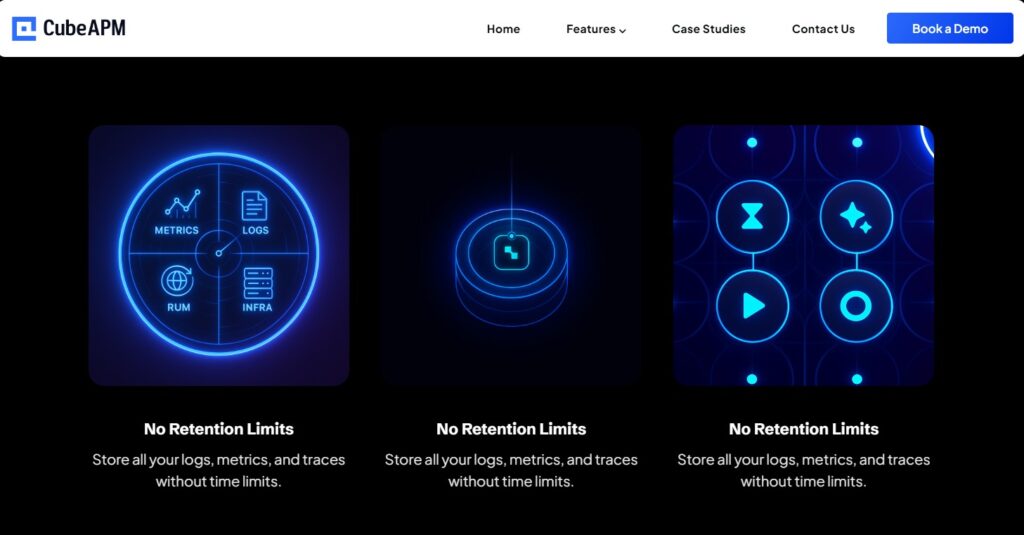
CubeAPM: It offers comprehensive observability across all four pillars of MELT, metrics, events, logs, and traces, through a unified ingestion and analysis platform. The platform is built on OpenTelemetry and provides full-stack telemetry coverage in a single interface, enabling teams to correlate signals without stitching together separate products or billing models.
Datadog: It supports full MELT coverage, enabling collection and correlation of metrics, events, logs, and traces across applications and infrastructure. Datadog ingests OpenTelemetry metrics, traces, and logs using both the Datadog Agent and OpenTelemetry Collector, and integrates all telemetry types into dashboards, monitors, and APM workflows for comprehensive observability.
Elastic Observability: It also supports full MELT coverage; unified observability across metrics, logs, traces, and user experience data via the Elastic Stack. According to Elastic’s official overview, it combines these telemetry types into a single analytics and visualization experience backed by Elasticsearch and Kibana, with native support for OpenTelemetry ingestion and cross-signal correlation.
Deployment (Self-Host/Setup)

CubeAPM: It is designed around a self-hosted, BYOC (Bring Your Own Cloud) or on-premise, deployment model with vendor-managed operations. The platform is deployed inside the customer’s own cloud or on-prem environment, ensuring that all telemetry data remains within the customer’s infrastructure. At the same time, CubeAPM manages upgrades, platform maintenance, and operational complexity remotely, allowing teams to retain data control without taking on full observability stack management. This deployment model is commonly chosen by teams with strict data residency, compliance, or cost-control requirements.
Datadog: It follows a SaaS-only deployment model. According to Datadog’s official documentation, telemetry is collected using the Datadog Agent or OpenTelemetry pipelines and sent to Datadog-managed cloud backends for storage and analysis. Datadog does not offer a self-hosted or on-prem deployment option for its observability backend, which simplifies setup and operations but requires all observability data to be processed and stored outside the customer’s infrastructure.
Elastic Observability: It supports both SaaS and self-managed deployment options. Elastic Observability can be consumed through Elastic Cloud, where Elastic manages the underlying infrastructure, or deployed as a self-managed Elastic Stack within the customer’s own environment. According to Elastic’s official documentation, self-managed deployments provide full control over data locality and configuration but require teams to handle cluster sizing, scaling, upgrades, and operational maintenance themselves.
Pricing for Small, Mid, and Large Teams
To summarize the pricing:
*All pricing comparisons are calculated using standardized Small/Medium/Large team profiles defined in our internal benchmarking sheet, based on fixed log, metrics, trace, and retention assumptions. Actual pricing may vary by usage, region, and plan structure. Please confirm current pricing with each vendor.
| Approx. cost for teams (size) | Small (~30) | Medium (~125) | Large (~250) |
| CubeAPM | $2,080 | $7,200 | $15,200 |
| Datadog | $8,185 | $27,475 | $59,050 |
| Elastic Observability | $4,550 | $17,435 | $35,370 |
CubeAPM Costs in Detail
CubeAPM follows a transparent, ingestion-based pricing model. CubeAPM’s pricing is set at $0.15 per GB of ingested telemetry data, with no per-host, per-user, or per-feature charges. This pricing applies uniformly across metrics, logs, traces, and other observability signals, and includes unlimited data retention at no additional cost.
- Small teams (~ 30): $2,080
- Mid-sized teams (~ 125): $7,200
- Large teams (~250): $15,200
Datadog Cost in Detail
Datadog’s pricing model is based on modules and host counts. For example, APM costs $31 per host/month, infrastructure monitoring costs $15 per host/month, and log ingestion costs $0.10 per GB. Cost for teams:
- Small teams: $8,185
- Mid-size teams: $27,475
- Large teams: $59,050
Elastic Observability Cost in Detail
The pricing depends on the chosen deployment model. Based on Elastic’s official website, Serverless Observability for full-stack costs $0.09/GB plus egress and retention cost extra. Elastic Cloud plans are priced per resource unit (memory, storage, and compute) with entry-level paid tiers starting at $99 per month, while higher tiers scale based on data volume and retention requirements. For self-managed Elastic Observability deployments, the pricing is custom under Elastic’s licensing terms.
- Small teams: $4,550
- Mid-size teams: $17, 435
- Large teams: $35,370
Sampling Strategy
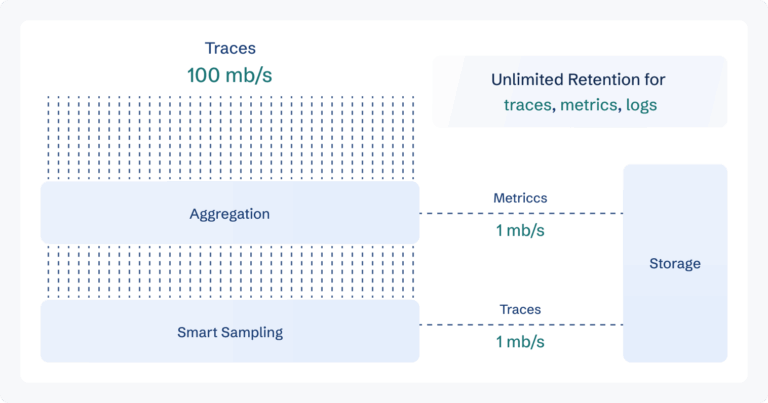
CubeAPM: It uses a context-aware “smart sampling” approach that goes beyond basic head-based or random sampling. Smart sampling dynamically identifies and retains high-value data (such as traces tied to latency spikes, errors, or anomalies) while filtering out redundant or low-value events to reduce ingestion volume without losing diagnostic fidelity. This helps teams maintain high signal quality and lower storage/processing costs as telemetry scales.
Datadog: It supportsmultiple sampling techniques within its APM pipeline to control trace ingestion volume. By default, Datadog uses head-based sampling where the decision to keep or drop a trace is made early in the request flow. Datadog also supports tail-based sampling through the OpenTelemetry Collector and adaptive sampling mechanisms that adjust sampling rates based on budget targets or service characteristics, helping balance data fidelity and cost.
Elastic Observability: It supports both head-based sampling and tail-based sampling as part of its Elastic APM capabilities. According to Elastic’s official documentation, head-based sampling allows agents to make early sampling decisions at transaction start, while tail-based sampling enables sampling decisions after full traces are collected, based on criteria such as latency or errors. These sampling behaviors are configured through Elastic APM Server and Fleet policies rather than applied automatically across the platform.
Data Retention

CubeAPM: It offers unlimited data retention with no additional charges. All observability data, metrics, logs, traces, and related telemetry, is retained without time-based limits, and data is stored entirely within the customer’s own cloud or on-prem environment. This model allows teams to perform long-term trend analysis, historical debugging, and audits without upgrading storage tiers or paying retention premiums.
Datadog: It applies retention limits that vary by data type and pricing plan. According to Datadog’s official documentation, infrastructure and APM metrics are typically retained for 15 months, while logs have shorter default retention periods (often 15 to 30 days) depending on the plan and configuration. Longer log retention requires additional paid options or higher-tier plans, making retention an explicit cost consideration as data volumes increase.
Elastic Observability: It uses Index Lifecycle Management (ILM) and data stream lifecycle policies to control retention, with default values applied per data stream unless customized. According to Elastic’s official documentation, Elastic APM retains raw traces and application/error logs for 10 days by default, APM metrics and RUM data for 90 days, and synthetics monitoring data for 1 year. Other logs and metrics do not have a single universal retention period and are retained based on the ILM policies configured by the user, meaning retention can range from days to indefinite storage depending on cluster setup.
Support channel, TAT & pricing
CubeAPM: It provides direct, real-time support channels as part of its standard offering. Based on CubeAPM’s official website and product material, customers receive support via Slack and WhatsApp with direct access to CubeAPM engineers. Response times are positioned in minutes, not hours, and this level of support is included by default, with no separate premium support pricing tier. This model is designed to support rapid incident resolution and reduce MTTR without requiring paid SLA upgrades.
Datadog: It offers tiered, ticket-based support that varies by subscription level. According to Datadog’s official support documentation, response times range from under 2 hours for critical issues on higher-tier plans to 24–48 hours on lower tiers. Support is primarily delivered via email and web-based tickets, with chat available on paid plans. Faster response times and enhanced support require higher subscription tiers or additional premium support costs.
Elastic Observability: Based on Elastic’s official support documentation, standard support offers web-based case submission with a response target of up to 3 business days. Higher tiers reduce response times to 2 days, several hours, or as low as 30 minutes for critical (P1) issues, depending on the plan. Elastic support pricing is calculated as approximately 5–15% of the customer’s total Elastic subscription spend, as defined in Elastic’s subscription model.
Which tool is best for you? Why brands choose CubeAPM
When choosing an observability platform, teams want clear answers: which tool will actually help them reduce costs, increase visibility, and scale with confidence.
Datadog is best for teams that want a fully managed SaaS observability platform with broad integrations and quick onboarding, but at a higher cost. Elastic Observability is best for teams already invested in the Elastic Stack that want deep, search-centric log analytics, flexible retention and indexing control, but at the cost of setup complexity, learning curve, and cost.
CubeAPM is best for engineering teams and organizations that need full-stack observability at scale with cost-effectiveness, self-hosting, and ease of use.
Benefits of CubeAPM
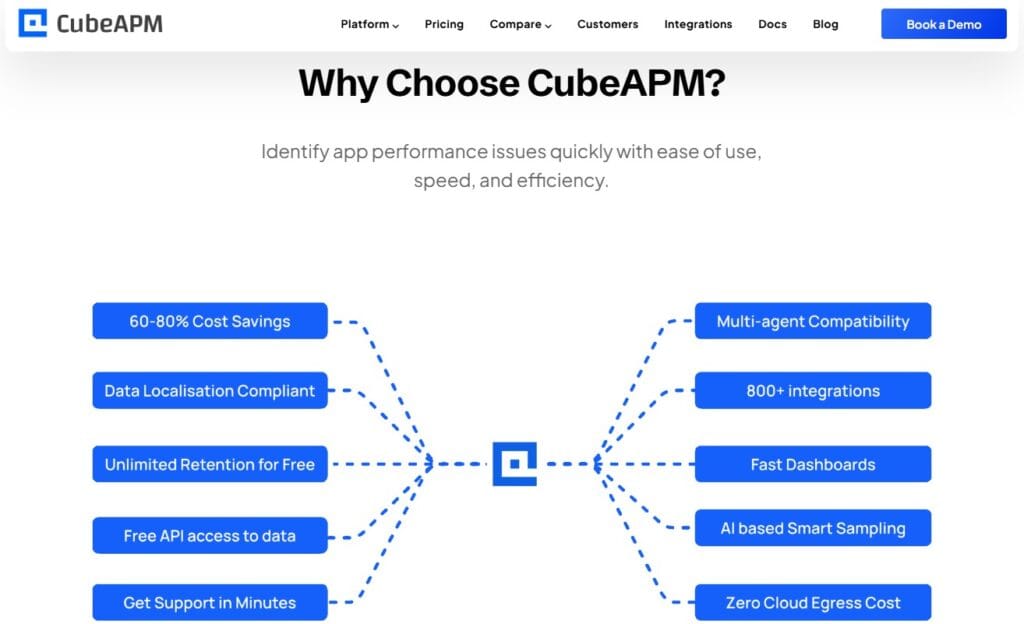
- Cost-efficient pricing: Ingestion-based pricing of $0.15/GB that scales with volume, not per host, feature, or signal type, making budgeting easier as telemetry grows.
- Full data control: Self-hosted deployment keeps observability data in your environment for compliance and residency requirements.
- OpenTelemetry-native: Built around OpenTelemetry standards, enabling flexible agent choices and simplifying instrumentation across microservices.
- Unlimited retention: All metrics, logs, traces, and events can be kept without extra retention charges, supporting long-term analysis and debugging.
- Smart sampling: Uses context-based sampling with 95% compression to filter noise and keep valuable data while optimizing cost.
Datadog vs Elastic Observability vs CubeAPM: Use cases
Each platform fits a different operational reality. Below are clear, use-case–driven choices to help teams decide quickly, based on architecture, scale, and cost behavior.
Choose CubeAPM if:
CubeAPM is built for teams that want full-stack observability with cost control, data ownership, and OpenTelemetry at the core.
- Predictable observability at scale: Teams choose CubeAPM when they want ingestion-based pricing that scales with data volume, not hosts or features, making spend easier to forecast as telemetry grows.
- Strict data residency and compliance: Ideal for organizations that must keep observability data inside their own cloud or on-prem environment for regulatory or security reasons.
- OpenTelemetry-first environments: Well suited for teams standardizing on OpenTelemetry across services and wanting to avoid proprietary agent lock-in.
- Kubernetes and microservices debugging: Designed for end-to-end tracing, logs, and metrics correlation across distributed systems to reduce mean time to resolution (MTTR).
- Long-term analysis and audits: Chosen by teams that need unlimited retention for historical debugging, trend analysis, or compliance reviews without paying extra for storage tiers.
- Startups to scaling SaaS teams: CubeAPM is often selected by teams that want a lightweight, easy-to-deploy APM that won’t penalize growth later.
Choose Datadog if:
Datadog is optimized for convenience and breadth in a fully managed SaaS model.
- Fast SaaS onboarding: Best for teams that want to get monitoring running quickly with minimal infrastructure management.
- Broad cloud integrations: Commonly chosen by organizations that rely heavily on managed cloud services and want deep, prebuilt integrations across infrastructure, APM, logs, RUM, and security.
- Centralized vendor management: Suitable for teams that prefer a single SaaS vendor handling storage, scaling, and operations, based on Datadog’s product model.
- Short- to mid-term observability needs: Works well when retention windows and per-feature pricing are acceptable trade-offs for managed convenience.
Choose Elastic Observability if:
Elastic Observability is a strong fit for search-centric and Elastic-native environments.
- Log-heavy, search-driven use cases: Ideal for teams that prioritize powerful log search, filtering, and correlation using Elasticsearch.
- Existing Elastic Stack investments: Commonly chosen by organizations already running Elasticsearch and Kibana who want to extend into APM and metrics.
- Custom retention and indexing control: Suitable for teams that want fine-grained control over data lifecycle policies, based on Elastic’s ILM model.
- In-house Elasticsearch expertise: Best for teams comfortable managing clusters themselves or optimizing Elastic Cloud deployments for performance and cost.
Conclusion
In this Datadog vs Elastic Observability vs CubeAPM comparison, we learnt that both Datadog and Elastic deliver strong observability capabilities, but can have complex pricing and operational overhead. These issues become more visible as telemetry volume, microservices, and compliance requirements grow.
CubeAPM addresses these gaps with a unified MELT platform that is OpenTelemetry-native, self-hosted or BYOC, and designed for predictable pricing, unlimited retention, and faster MTTR. By combining full-stack visibility with data ownership and simplicity, CubeAPM stands out as the most practical observability platform for modern teams.
If you’re rethinking observability in 2026, CubeAPM is built to scale with you. Book a free demo to see it in action.
Disclaimer: The information in this article reflects the latest details available at the time of publication and may change as technologies and products evolve.
FAQs
1. Is CubeAPM suitable for regulated industries like finance or healthcare?
Yes. CubeAPM is often evaluated by regulated organizations because it supports self-hosted (BYOC/on-prem) deployments, allowing all observability data to stay within the customer’s own cloud or on-prem environment. This helps meet data residency, compliance, and audit requirements that are harder to satisfy with SaaS-only platforms.
2. Can I migrate gradually from Datadog or Elastic Observability to CubeAPM?
Yes. Based on CubeAPM’s documentation and sales demos, teams can migrate incrementally using OpenTelemetry and existing agents. This allows parallel running, phased cutovers, and reduced risk compared to full rip-and-replace migrations.
3. How do these tools differ in handling high-cardinality telemetry?
Datadog and Elastic Observability can experience cost or performance pressure as cardinality increases, depending on configuration and pricing tiers. CubeAPM is designed to handle high-cardinality metrics and traces using smart sampling and ingestion-based pricing, making it easier to scale without aggressive data drops.
4. Does CubeAPM support end-to-end observability beyond APM?
Yes. CubeAPM provides full-stack observability across metrics, logs, events, traces, infrastructure monitoring, synthetic monitoring, real user monitoring, and error tracking in a single platform, reducing the need for multiple tools or add-ons.
5. Which platform is easiest to budget for over time?
Based on our research and pricing analysis, CubeAPM is generally easier to budget for because its pricing is tied to data ingestion rather than hosts, users, or individual features. Datadog and Elastic Observability pricing can become harder to forecast as usage, retention, and add-on features grow.