









The main difference between Datadog, Dynatrace, and CubeAPM is how each platform balances cost predictability, deployment control, and operational complexity at scale.
Datadog offers a broad SaaS observability platform, but it becomes expensive as telemetry volume grows. Dynatrace focuses on enterprise-grade automation and AI-driven insights with a heavier setup and licensing model.
CubeAPM is a cost-efficient, full-stack observability platform with self-hosting, advanced features, unlimited data retention, and more. Let’s compare Datadog vs Dynatrace vs CubeAPM based on features, pricing, deployment, and other aspects.
Datadog vs Dynatrace vs CubeAPM Comparison
| Feature | CubeAPM | Datadog | Dynatrace |
| Known for | Unified MELT, self-hosting, OTel-native, predictable cost | Large enterprise SaaS ecosystem with 900+ integrations. | Enterprise-grade observability, AI-driven automation |
| Multi-Agent Support | Yes (OTel, New Relic, Datadog, Elastic, etc.) | Yes (Datadog Agent, OTEL, 3rd-party agents) | Limited (OneAgent, OTel) |
| MELT Support | Full MELT coverage | Full MELT coverage | Full MELT coverage |
| Deployment (Self-Host / Setup) | Self-hosted with vendor-managed | SaaS-only | SaaS-based & self-managed |
| Pricing | Ingestion-based: $0.15/GB | APM: $31/host/ month; Infra: $15 /host/month; Logs: $0.10/GB | Full-stack:$0.01/GiB-hour;infra:$0.04/host-hour;Logs: $0.20/GiB; RUM: $0.00225/session; |
| Sampling Strategy | Smart sampling – fully automated, context-aware | Head-based, tail-based, and adaptive sampling | Adaptive and tail-based (via OTEL Collector) |
| Data Retention | Unlimited Retention (no extra cost) | 15-30d based on plan | Metrics: 15m-10 yrs; Traces: 10d; Logs: 35d; Audit logs: 30d |
| Support Channel & TAT | Slack, WhatsApp; response in minutes | Community-based; email & chat (paid); TAT: <2-48 hrs | Chat & web ticketing; Standard: 4d-4 hrs; Enterprise: 2d-30 min |
Datadog vs Dynatrace vs CubeAPM: Feature-by-Feature Breakdown
This section explains what each platform is fundamentally designed for and why teams typically choose it, before diving into bigger feature-level differences in this Datadog vs Dynatrace vs CubeAPM comparison.
Known for
CubeAPM: CubeAPM is known for unified MELT observability built natively on OpenTelemetry, combined with self-hosted or BYOC deployment and predictable, ingestion-based pricing. It is designed for teams that want full-stack visibility without SaaS lock-in, with a strong emphasis on cost control, unlimited data retention, and data residency while still keeping operational overhead low through vendor-managed setup.
Datadog: Datadog is known for its broad, SaaS-based observability ecosystem with hundreds of native integrations across infrastructure, applications, cloud services, security, and user experience. It is commonly adopted by teams that want fast onboarding, managed operations, and a single platform to monitor diverse cloud-native stacks, especially in AWS-heavy and microservices environments.
Dynatrace: Dynatrace is known for enterprise-grade observability with automated discovery, deep infrastructure visibility, and AI-driven analysis powered by Davis AI. Its OneAgent approach enables automatic instrumentation and topology mapping, making it popular with large enterprises that prioritize automation, root-cause analysis, and standardized observability across complex, hybrid environments.
Multi-Agent Support
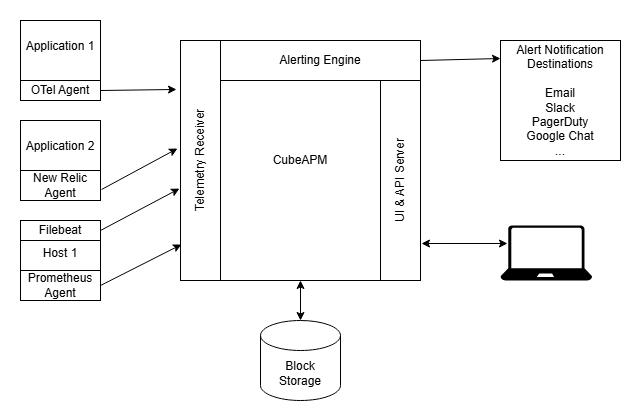
CubeAPM: CubeAPM is designed as an OpenTelemetry-native platform and supports multiple agent and ingestion paths, including OpenTelemetry SDKs and Collectors, Prometheus exporters, and existing Datadog, New Relic, Elastic, and other common agents, allowing teams to reuse current instrumentation, standardize on OTEL, or migrate gradually without changing application code or redeploying services.
Datadog: Datadog supports multiple telemetry collection methods through the Datadog Agent, OpenTelemetry SDKs and Collectors, and a large catalog of third-party integrations, enabling teams to collect metrics, logs, and traces from diverse environments while still centering advanced features around the Datadog Agent and Datadog-specific instrumentation.
Dynatrace: Dynatrace provides limited multi-agent support, with its proprietary OneAgent serving as the primary mechanism for automatic instrumentation, topology discovery, PurePath distributed tracing, and Davis AI analysis, while OpenTelemetry is supported mainly as an ingestion path for metrics, logs, and traces; full platform capabilities depend on OneAgent-collected data rather than interchangeable agents.
MELT Support (Metrics, Events, Logs, Traces)
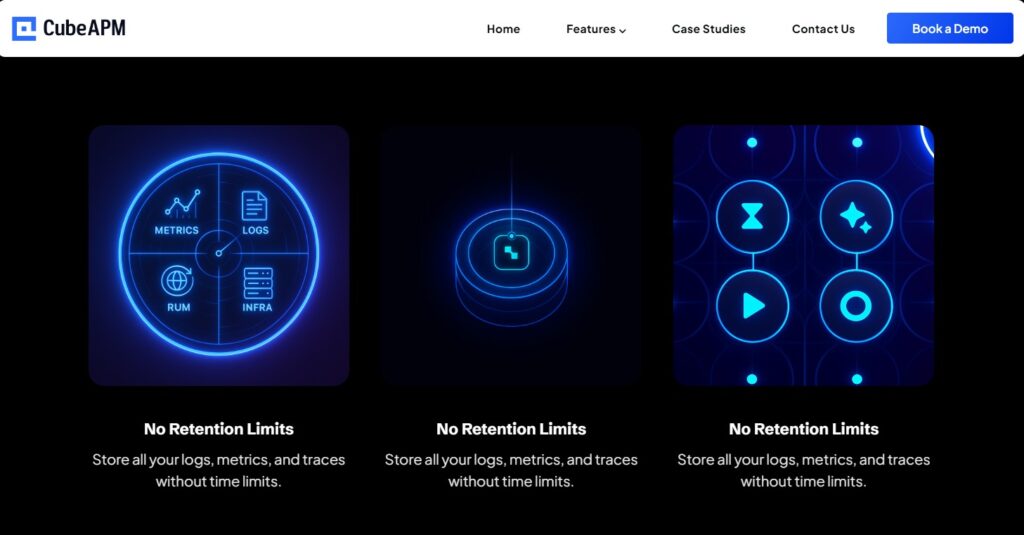
CubeAPM: CubeAPM provides full MELT coverage using OpenTelemetry as the foundation, ingesting metrics, logs, events, and traces into a unified backend where all signals are correlated natively, enabling end-to-end service visibility, trace-log correlation, and infrastructure context without separating pricing or storage by signal type.
Datadog: Datadog supports complete MELT observability by collecting metrics, events, logs, and traces across its platform, with tight correlation between signals through service maps and dashboards, although each signal type is metered, retained, and priced independently based on usage and plan tier.
Dynatrace: Dynatrace offers full MELT support through its Grail data lakehouse, unifying metrics, logs, events, and traces collected primarily via OneAgent and OpenTelemetry ingestion, with automatic correlation and AI-assisted analysis driven by Davis AI across application, infrastructure, and user experience data.
Deployment (Self-Host/Setup)

CubeAPM: CubeAPM supports self-hosted deployments where the observability backend runs inside the customer’s own cloud (BYOC) or on-prem environment. CubeAPM manages setup, upgrades, and scaling; this model is designed to meet strict data residency and compliance requirements without introducing the operational burden typically associated with self-managed observability platforms.
Datadog: Datadog is offered exclusively as a SaaS platform hosted and operated by Datadog, with customers deploying the Datadog Agent on their infrastructure to send telemetry to Datadog’s cloud; while this simplifies setup and maintenance, it does not support self-hosted or customer-managed backend deployments.
Dynatrace: Dynatrace supports both a SaaS deployment (Dynatrace Platform) and a self-managed option (Dynatrace Managed), where the Dynatrace platform runs in a customer-controlled environment, though both models rely on OneAgent installation across hosts, and the Managed option requires customers to operate and maintain Dynatrace cluster components.
Pricing for Small, Mid, and Large Teams
To summarize the pricing:
*All pricing comparisons are calculated using standardized Small/Medium/Large team profiles defined in our internal benchmarking sheet, based on fixed log, metrics, trace, and retention assumptions. Actual pricing may vary by usage, region, and plan structure. Please confirm current pricing with each vendor.
| Approx. cost for teams (size) | Small (~30) | Mid-Sized (~125) | Large (~250) |
| CubeAPM | $2,080 | $7,200 | $15,200 |
| Datadog | $8,185 | $27,475 | $59,050 |
| Dynatrace | $7,740 | $21,850 | $46,000 |
CubeAPM Costs in Detail
CubeAPM: CubeAPM uses predictable, ingestion-based pricing at $0.15 per GB of telemetry ingested, with no per-host or per-user fees and unlimited data retention included in the price.
- Small teams (~ 30): $2,080
- Mid-sized teams (~ 125): $7,200
- Large teams (~250): $15,200
Datadog Cost in Detail
Datadog: Datadog’s pricing consists of $31 per host per month for APM, $15 per host per month for infrastructure, and $0.10 per GB for log ingestion; additional telemetry tiers like RUM, synthetics, and advanced features may incur separate charges based on plan.
- Small teams: $8,185
- Mid-size teams: $27,475
- Large teams: $59,050
Dynatrace Cost in Detail
Dynatrace: Dynatrace uses consumption-based pricing with full-stack at $0.01 per memory-GiB-hour (e.g., ~$58.40/mo for an 8 GiB host), infrastructure at $0.04 per host-hour (~$28.80/mo), logs at $0.20 per GiB ingest + $0.0007 per GiB-day retention + $0.0035 per GiB queried, RUM at $0.00225 per session, and Kubernetes at $0.002 per pod-hour; synthetics are billed separately as an add-on.
- Small teams: $7,740
- Mid-size teams: $21,850
- Large teams: $46,000
Sampling Strategy
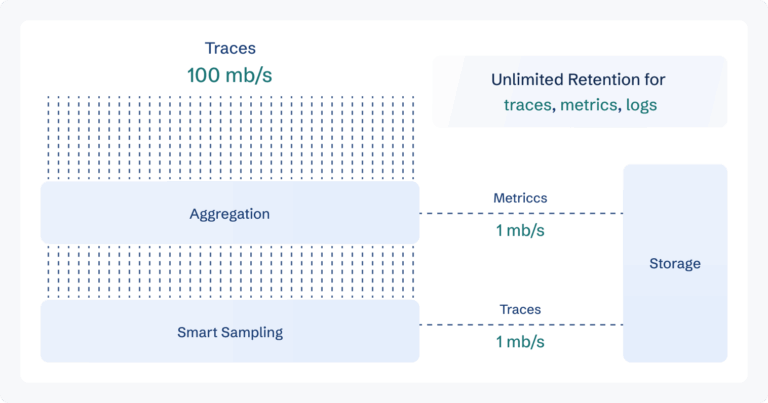
CubeAPM: CubeAPM uses smart, context-aware sampling that automatically prioritizes high-value telemetry such as errors, high-latency requests, and anomalous traces while aggressively down-sampling low-value noise; sampling decisions are applied across traces and logs to reduce ingestion cost without losing critical debugging context, and work natively with OpenTelemetry pipelines.
Datadog: Datadog supports multiple sampling approaches, including head-based sampling at the agent or SDK level, tail-based sampling for traces based on latency and error conditions, and adaptive sampling that dynamically adjusts trace volumes to stay within configured limits, with controls available through the UI and APIs.
Dynatrace: Dynatrace relies on Adaptive Traffic Management to automatically control distributed trace capture rates collected by OneAgent based on traffic volume and defined rules, allowing prioritization or exclusion of specific request patterns; additional sampling control is supported through OpenTelemetry Collector configurations for OTEL-ingested telemetry.
Data Retention

CubeAPM: CubeAPM provides unlimited retention for all telemetry types, metrics, logs, traces, and events, at no additional cost. This means teams can store full historical data for long-term analysis, compliance, and retrospective debugging without managing separate retention tiers or incurring extra fees. CubeAPM’s retention policy is designed to support deep forensic investigations, SLA reporting, and trend analysis without retention limits.
Datadog: Datadog’s telemetry retention varies by data type and plan.
- Metrics are retained for 15 months, allowing long-term trend analysis.
- Trace data is available live for about 15 minutes, and indexed spans and traces are retained for 15 days, with extended retention supported up to ~30 days depending on configured retention filters.
- Logs are typically retained for 15 days by default, with options to configure longer retention periods per log index.
- Real User Monitoring (RUM) sessions, views, and actions are retained for 30 days, while resource-level and other detailed RUM signals are retained for 15 days.
These retention windows reflect default settings and can vary by account configuration.
Dynatrace: Dynatrace uses its Grail data platform to manage telemetry retention with configurable buckets and policies. Officially,
- Metrics retention ranges from 15 months up to 10 years, depending on configuration and business needs.
- Distributed traces are stored for 10 days by default, but retention can be extended up to 10 years for longer historical analysis.
- Log data is retained for 35 days by default, and can also be extended up to 10 years through bucket configuration.
- Audit logs for configuration and user activity are retained for 30 days
These retention settings allow enterprises to balance operational needs with storage costs while supporting long-term compliance and analytics.
Support Channel & TAT
CubeAPM: CubeAPM provides direct human support through Slack and WhatsApp, with customers interacting directly with core engineers; based on CubeAPM’s official support model, response times are typically within minutes, prioritizing rapid troubleshooting, architectural guidance, and faster MTTR without paid support tiers.
Datadog: Datadog offers community support, email, and in-app chat depending on the plan, with response times defined by severity and support tier; according to Datadog’s official support policy, response times range from under 2 hours for critical issues on higher tiers to 24–48 hours for lower-severity issues, with faster SLAs requiring paid support plans.
Dynatrace: Dynatrace provides in-product chat and web-based ticketing, with clearly defined SLAs based on support tier; per Dynatrace’s official support policy, Standard Support response times range from 4 business days to 4 business hours, while Enterprise Success & Support offers response times from 2 business days down to 30 minutes for critical issues, including 24/7 coverage at higher tiers.
Which tool is best for you? Why brands choose CubeAPM
Choosing the right observability platform depends on your scaling needs, cost sensitivity, control requirements, and team expertise.
Datadog is best for teams that want a comprehensive, fully managed SaaS observability platform with hundreds of integrations and fast setup. Dynatrace is best for large enterprises that need deep automation, AI-driven insights (via Davis AI), and powerful infrastructure monitoring across hybrid environments.
CubeAPM is best for engineering teams, cloud-native startups, and compliance-driven organizations that want full-stack observability with predictable costs, deep OpenTelemetry support, and complete control over their telemetry data with self-hosted deployment.
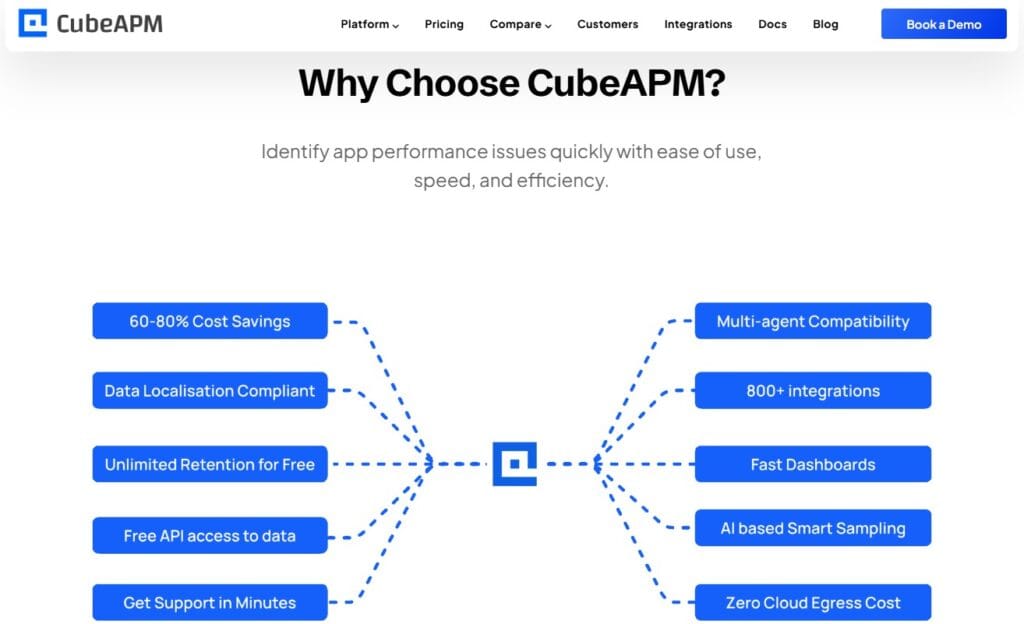
- Cost Predictability: Ingestion-based pricing with no per-host, per-user, or tiered retention fees makes forecasting observability spend simple.
- OpenTelemetry Native: Built from the ground up on OpenTelemetry standards, supporting existing OTEL SDKs/collectors and flexible agent adoption.
- Unlimited Retention: Keep logs, traces, and metrics as long as needed for compliance, security audits, and long-term trend analysis.
- Self-Hosted: Run entirely in your own cloud or on-premises; ideal for strict compliance and data sovereignty requirements.
Datadog vs Dynatrace vs CubeAPM: Use Cases
The right observability platform depends on how your team scales, where your data must live, and how predictable you want costs to be as telemetry volume grows.
Choose CubeAPM if:
CubeAPM is ideal for teams that want full-stack observability with predictable costs, OpenTelemetry-native instrumentation, and full control over their telemetry data as systems scale.
- You are a startup or growing SaaS team looking for a lightweight, easy-to-deploy APM that does not require managing multiple backends or complex pricing tiers.
- You need self-hosted or BYOC observability for strict data residency, security, or compliance requirements.
- You want predictable, ingestion-based pricing and unlimited data retention to avoid cost spikes as logs, traces, and metrics grow.
- You are standardizing on OpenTelemetry and want native support for OTEL SDKs, collectors, and existing agents without re-instrumenting applications.
- You want to reduce MTTR with unified MELT correlation and keep historical data available for long-term debugging, audits, and trend analysis.
Choose Datadog if:
Datadog works well for teams that prioritize a fully managed SaaS experience and broad ecosystem coverage over cost predictability at scale.
- You want fast onboarding with minimal setup and a cloud-hosted platform managed entirely by the vendor.
- You rely heavily on third-party integrations across cloud services, managed databases, and SaaS tools (based on Datadog’s integration catalog).
- You are comfortable with host-based and usage-based pricing models and shorter default retention windows as long as operational simplicity is maintained.
- You need a single SaaS platform to monitor infrastructure, applications, logs, and user experience without running any observability backend yourself.
Choose Dynatrace if:
Dynatrace is best suited for large enterprises with complex environments that benefit from automation and AI-assisted analysis.
- You operate large, hybrid, or legacy enterprise environments where automatic discovery and topology mapping are critical.
- You want AI-driven root cause analysis and anomaly detection powered by Davis AI to reduce manual troubleshooting.
- You are comfortable deploying and managing proprietary agents (OneAgent) across hosts and services for deep instrumentation.
- You can accommodate consumption-based pricing and configurable retention tied closely to data volume and platform usage (based on Dynatrace’s rate card and docs).
Conclusion
Datadog and Dynatrace are powerful platforms, but both introduce trade-offs as observability scales: Datadog with a SaaS-only model and rising costs for smaller teams, and Dynatrace with higher complexity and cost.
CubeAPM addresses these gaps with cost-efficient observability with ingestion-based pricing of just $0.15/GB, self-hosting support, and unlimited data retention. It unifies metrics, logs, events, and traces while reducing MTTR and operational overhead.
Book a FREE demo and see the difference firsthand.
Disclaimer: The information in this article reflects the latest details available at the time of publication and may change as technologies and products evolve.
FAQs
1. Can CubeAPM replace Datadog or Dynatrace completely for production workloads?
Yes. CubeAPM covers core observability needs, including APM, infrastructure monitoring, logs, distributed tracing, error tracking, synthetics, and RUM. Based on CubeAPM demos and customer deployments, many teams seek CubeAPM as a Datadog or Dynatrace alternative for affordability, unlimited retention, and self-hosting.
2. Which tool is better for OpenTelemetry-first architectures?
CubeAPM is the most OpenTelemetry-aligned option because it is built natively on OTEL and works directly with OTEL SDKs and collectors. Datadog and Dynatrace both support OpenTelemetry ingestion, but still rely heavily on proprietary agents.
3. How do these tools differ in handling data residency and compliance requirements?
CubeAPM is well-suited for strict data residency and compliance needs because it supports self-hosted and BYOC deployments where telemetry stays inside the customer’s cloud or on-prem environment. Datadog is SaaS-only, and while Dynatrace offers a self-managed option, it requires running and maintaining Dynatrace platform components.
4. Which platform is easier to operate with a small or mid-sized engineering team?
CubeAPM is typically easier for small and mid-sized teams because it avoids complex pricing tiers, proprietary agent lock-in, and multi-backend operations. Datadog simplifies setup through SaaS, but operational complexity can increase as usage grows. Dynatrace offers strong automation, but setup and management are better suited to larger, dedicated platform teams.
5. How do these tools compare for long-term debugging and historical analysis?
CubeAPM stands out for long-term debugging because it includes unlimited data retention without extra charges, making it easier to investigate past incidents and analyze trends over time. Datadog and Dynatrace both impose default retention limits and may require additional configuration or spending for extended historical access.