









Apache Cassandra is a distributed NoSQL database known for its scalability and always-on architecture. It powers real-time apps like Netflix and Uber, but monitoring it is challenging—tracking latency, compaction, and node health across clusters often requires multiple tools.
CubeAPM simplifies Cassandra observability with native OpenTelemetry support and pre-built Cassandra dashboards that visualize key JMX metrics, storage usage, and query latency in real time. With smart sampling and $0.15/GB ingestion pricing, it delivers deep Cassandra performance insights without hidden costs or user-based licensing.
In this guide, we’ll explore the best Cassandra monitoring tools, compare their pricing, and show which solutions deliver the most value at scale.
Best Cassandra Monitoring Tools
- CubeAPM
- Datadog
- New Relic
- Dynatrace
- Sematext
- Zabbix
- ManageEngine Applications Manager
- SolarWinds
What is Cassandra Monitoring?
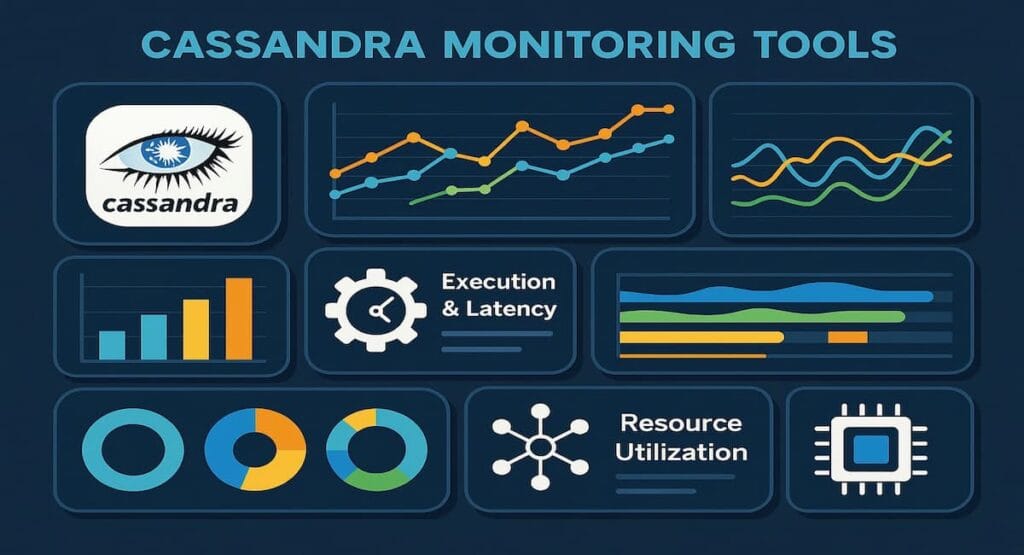
Cassandra monitoring involves tracking database performance, resource utilization, and cluster health to keep workloads stable and predictable. It helps teams identify slow queries, uneven node loads, or replication issues before they cause downtime.
Modern observability tools collect JMX metrics, logs, and traces to visualize read/write throughput, garbage collection, and storage trends in real time. Integrating these insights with infrastructure metrics allows engineers to correlate database behavior with application performance.
Key Cassandra metrics to monitor include:
- Read/Write Latency: Detects slow queries and overloaded nodes.
- Pending Compactions & Repairs: Indicates data backlog or imbalance.
- Tombstone Count: Reveals inefficient deletes affecting query speed.
- Disk & Memory Usage: Tracks capacity and garbage collection pressure.
- Coordinator Requests: Shows workload distribution across nodes.
- Dropped Mutations: Highlights replication or network instability.
Example: How CubeAPM Handles Cassandra Monitoring
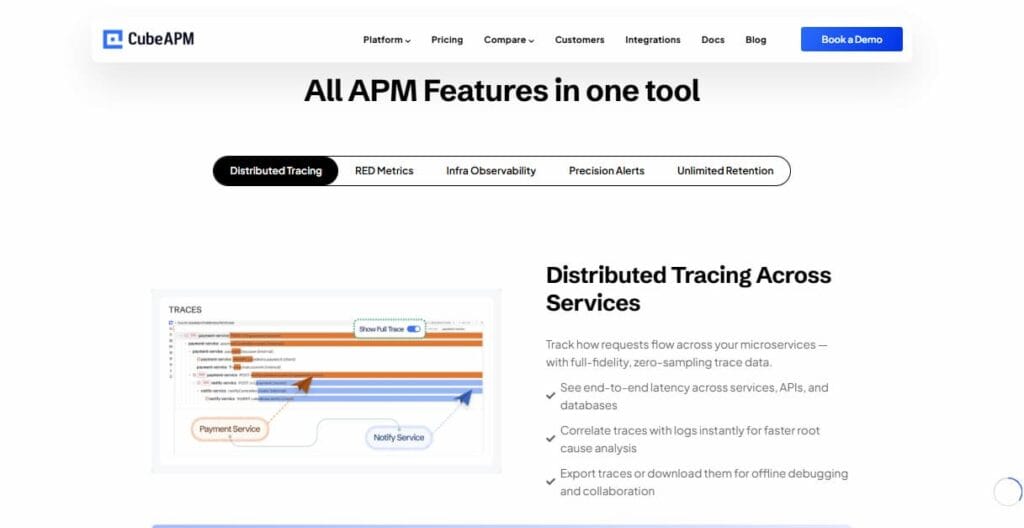
CubeAPM delivers complete observability for Cassandra by combining APM, logs, infrastructure, and tracing in one unified platform. Using OpenTelemetry collectors, it automatically captures JMX metrics such as compactions, SSTable counts, garbage collection pauses, and read/write latency — all correlated with application traces and logs for faster troubleshooting.
Its infrastructure view tracks Cassandra nodes, containerized services, and host resources in real time, helping teams detect disk saturation, CPU spikes, or network bottlenecks early. The log analytics module supports full-text search and trace-to-log correlation, making it easy to identify slow queries, failed repairs, or replication delays.
With Smart Sampling, CubeAPM retains high-value telemetry while cutting ingestion costs by up to 60%. At just $0.15/GB with no per-user or host fees, it offers predictable pricing for Cassandra clusters at scale while supporting both cloud and on-prem deployments.
Why Teams Choose Different Cassandra Monitoring Tools
1. Scalability and Metric Cardinality
Cassandra emits thousands of JMX metrics per node, and in large clusters this can quickly multiply into millions of time series. Monitoring tools vary in how efficiently they handle this scale and cardinality. Teams prefer platforms that can process compaction, repair, and SSTable metrics across hundreds of nodes without latency or data loss.
2. OpenTelemetry-Native Compatibility
OpenTelemetry has become the standard for collecting metrics, logs, and traces across distributed systems. Tools with native OTel support allow Cassandra teams to unify observability pipelines without proprietary agents, simplifying setup, reducing overhead, and ensuring future interoperability.
3. Predictable Cost at Scale
Cassandra generates heavy telemetry from logs, traces, and node-level metrics. Many vendors charge separately for each data type, causing unpredictable costs as ingestion grows. Teams choose tools that offer transparent pricing and intelligent sampling—helping them manage multi-terabyte telemetry budgets with financial control.
4. Self-Hosting and Data Residency
Enterprises in regulated sectors—like banking, government, or telecom—often need on-prem or Bring Your Own Cloud (BYOC) deployments to meet data sovereignty and compliance requirements. Tools that let organizations retain full control over where telemetry is stored are preferred over purely SaaS options.
5. Kubernetes and Cloud-Native Integration
Most modern Cassandra clusters run on Kubernetes. Observability platforms that automatically discover pods, services, and persistent volumes simplify troubleshooting. Native K8s integrations ensure Cassandra node metrics align with container states, reducing blind spots in cloud-native deployments.
6. Prebuilt Dashboards and Alerts
Out-of-the-box Cassandra dashboards and alert templates dramatically speed up setup. Teams value tools that already visualize latency, compactions, tombstones, dropped mutations, and coordinator load—providing quick insights without complex manual configurations.
7. Unified MELT Observability (Metrics, Events, Logs, Traces)
Cassandra failures often span multiple layers—from queries and JVM performance to disk I/O. Tools that unify metrics, logs, and traces into one workflow let SREs pinpoint issues faster and eliminate context switching between disjointed dashboards.
8. Automation and Noise Reduction
Cassandra’s workloads are bursty, with frequent compaction spikes and GC pauses. Tools using AI or anomaly detection can suppress repetitive alerts and highlight genuine anomalies. This automation helps teams cut alert fatigue and maintain consistent focus on critical signals.
Top 8 Cassandra Monitoring Tools
1. CubeAPM
Known For
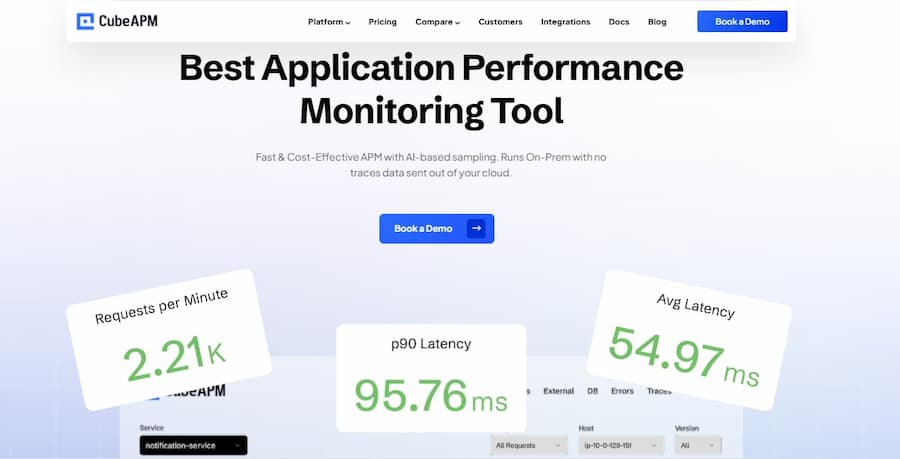
CubeAPM is known for its OpenTelemetry-native observability and full visibility into distributed systems like Cassandra. It unifies metrics, traces, and logs, helping teams quickly detect latency spikes, compaction backlogs, and node imbalance across clusters. Optimized for hybrid and Kubernetes environments, it ensures reliable performance tracking for high-throughput Cassandra workloads.
Cassandra Monitoring Features
- Tracks read/write latency, SSTable counts, and compactions via JMX and OpenTelemetry.
- Correlates traces and logs to find coordinator slowdowns and replica delays.
- Prebuilt Cassandra dashboards for node health, storage, and pending repairs.
- Real-time alerts for GC pauses, tombstones, and replication lag.
- Integrates seamlessly with alerting tools like Slack and PagerDuty.
Key Features
- Smart Sampling to retain high-value traces efficiently.
- Unified MELT observability across APM, logs, and infra.
- Supports BYOC and on-prem deployments.
- Prometheus and OpenTelemetry compatible.
Pros
- Comprehensive Cassandra visibility in a single view.
- Real-time correlation between metrics, logs, and traces.
- Easy setup through OpenTelemetry collectors.
- Responsive, developer-led support.
Cons
- Not suited for teams looking for off-prem solutions
- Strictly an observability platform and does not support cloud security management
Pricing
- Flat pricing of $0.15/GB ingestion-based model
CubeAPM Cassandra Monitoring Pricing at Scale
*All pricing comparisons are calculated using standardized Small/Medium/Large team profiles defined in our internal benchmarking sheet, based on fixed log, metrics, trace, and retention assumptions. Actual pricing may vary by usage, region, and plan structure. Please confirm current pricing with each vendor.
For a mid-sized SaaS company ingesting 45TB(~45,000) total monthly data ingestion and 45,000TB of observability data outcharged by the cloud provider, the total cost will be about ~$7200/month.
Tech Fit
CubeAPM is best suited for SRE and DevOps teams managing multi-node Cassandra clusters that require end-to-end observability and control. Its OpenTelemetry foundation, correlation-rich dashboards, and flexible deployment options make it ideal for hybrid, multi-cloud, or Kubernetes-based Cassandra environments where real-time insight and cost stability are critical.
2. Datadog
Known For
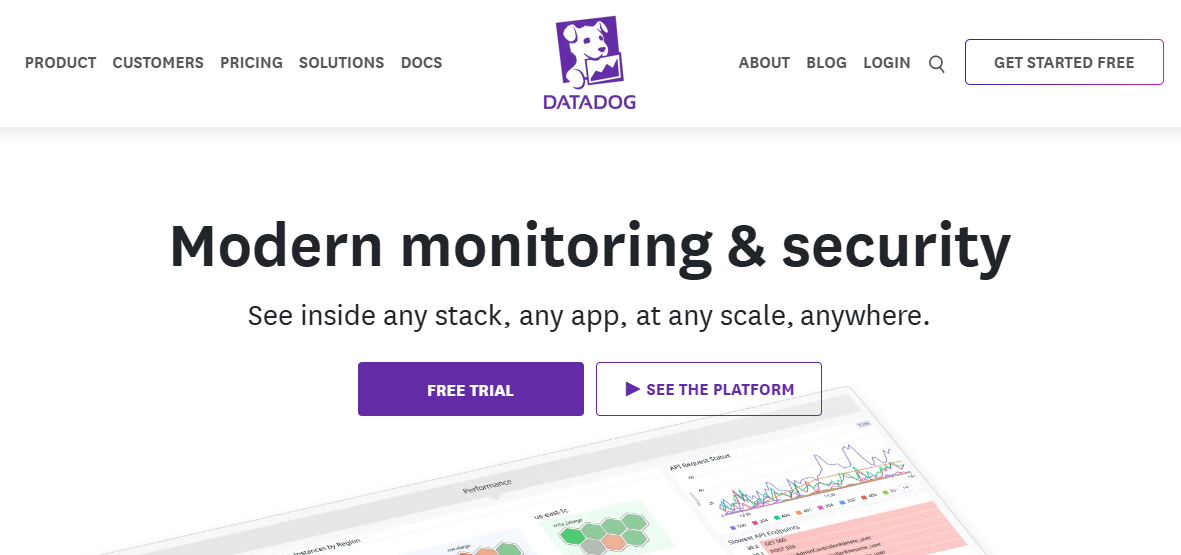
Datadog is known for its vast integration ecosystem and enterprise-grade observability suite spanning APM, infrastructure, logs, RUM, and synthetics. It offers deep insights into distributed systems like Cassandra, helping teams correlate query latency, storage metrics, and JVM behavior in a unified dashboard. Its AI-driven alerting and anomaly detection make it a top choice for large organizations running hybrid or multi-cloud Cassandra clusters.
Cassandra Monitoring Features
- Native Cassandra integration for collecting JMX metrics through the Datadog Agent.
- Monitors read/write latency, pending compactions, and dropped mutations.
- Prebuilt dashboards for node health, thread pool utilization, and cluster load.
- Detects slow queries and GC pauses via APM and JVM metrics correlation.
- Automated alerting and forecasting for node performance trends.
Key Features
- 900+ integrations with databases, messaging systems, and cloud services.
- Unified log, metric, and trace correlation in a single console.
- Advanced synthetic and RUM monitoring capabilities.
- AI-based anomaly detection and predictive alerts.
Pros
- Extensive plugin ecosystem and integration coverage.
- Mature UI with customizable dashboards and query builders.
- Strong documentation and enterprise-level support.
- Great for multi-environment visibility (Kubernetes, VMs, and bare metal).
Cons
- Expensive at scale.
- Steeper learning curve for new users
Pricing
- APM (Pro Plan): $35/host/month
- Infra (Pro Plan): $15/host/month
- Ingested Logs: $0.10 per ingested or scanned GB per month
Datadog Cassandra Monitoring Pricing at Scale
For a mid-sized SaaS company operating 125 APM hosts, 40 profiled hosts, 100 profiled container hosts, 500,000,000 indexed spans, 200 infra hosts, 1,500,000 container hours, 300,000 custom metrics, and ingesting around 10TB(~10,000 GB) of logs per month with 3500 indexed logs, the monthly cost would be around ~$27,475/month.
Tech Fit
Datadog suits large enterprises with complex, multi-cloud Cassandra deployments that demand AI-based alerting, historical trend analysis, and integration breadth. It’s ideal for teams already using Datadog for infrastructure or Kubernetes monitoring.
3. New Relic

Known For
New Relic is known for its all-in-one observability platform combining APM, infrastructure, browser, mobile, logs, and synthetics into a single interface. It delivers detailed performance insights across distributed applications and databases like Cassandra, helping teams visualize read/write latency, query throughput, and JVM metrics in real time. With its powerful NRQL query engine, New Relic enables deep custom analysis across Cassandra clusters.
Cassandra Monitoring Features
- Native Cassandra quickstart to monitor latency, pending tasks, and node uptime.
- Integration with JMX to collect key Cassandra metrics such as compactions, heap usage, and SSTable reads.
- Visual dashboards for replication health and client request performance.
- Query-level analysis through OpenTelemetry traces and distributed spans.
- Alerts on slow queries, dropped mutations, and replication failures.
Key Features
- Unified observability with NRQL-based analytics for metrics and events.
- Correlation of Cassandra performance data with APM and infra metrics.
- Browser, mobile, and synthetic monitoring for end-to-end visibility.
- AI-assisted incident correlation and anomaly detection.
Pros
- Rich visualization and querying via NRQL.
- Easy integration with OpenTelemetry and JMX exporters.
- Mature alerting and automation ecosystem.
- Strong user experience with guided setup for database monitoring.
Cons
- Expensive at scale due to ingestion and user-based pricing.
- Steep learning curve for new users.
- Requires deep expertise to execute advanced queries.
Pricing
- Free tier: 100GB/month of data ingested
- Data Ingest: $0.40 per GB ingested beyond the free 100GB
- Full Platform Users: $418.80 per user/month
New Relic Cassandra Monitoring Pricing at Scale
A mid-sized SaaS company ingesting 45TB (~45,000 GB) of telemetry data per month and with 10 full users, the cost would come around ~$25,990/month.
Tech Fit
New Relic fits organizations that prioritize deep analytics and visualization capabilities over pricing simplicity. It’s best suited for enterprises running Cassandra in production alongside multiple application stacks that need advanced correlation, custom queries, and full-stack insight from client to database.
4. Dynatrace

Known For
Dynatrace is known for its AI-powered observability platform that automatically discovers services, dependencies, and databases across large-scale environments. It uses its proprietary Davis AI engine to detect anomalies and predict performance issues before they impact production. For Cassandra, Dynatrace offers deep JMX-based monitoring and dependency mapping that helps teams understand how database performance affects applications and infrastructure.
Cassandra Monitoring Features
- Automatic discovery and instrumentation of Cassandra nodes via OneAgent.
- Monitors key JMX metrics like latency, compactions, thread pool usage, and heap memory.
- Visualizes data distribution and query load across clusters.
- Detects replication delays and garbage collection spikes in real time.
- Provides AI-based anomaly detection for cluster health and performance degradation.
Key Features
- Davis AI for automatic root-cause detection and impact analysis.
- Full-stack observability across apps, infra, and databases.
- Built-in log and trace correlation with topology visualization.
- Support for hybrid and Kubernetes-based Cassandra deployments.
Pros
- Powerful AI-driven analytics and proactive alerting.
- Automatic discovery and instrumentation with minimal setup.
- Excellent dependency visualization between Cassandra and connected services.
- Unified monitoring for application, database, and infrastructure layers.
Cons
- High pricing for continuous full-stack monitoring.
- Complex configuration for custom JMX metrics.
- Steeper learning curve for dashboard customization.
Pricing
- Infrastructure Monitoring: $29/mo/host
- Full-Stack Monitoring: $58/mo/8 GiB host
Dynatrace Cassandra Monitoring Pricing at Scale
A midsized SaaS company operating 125 APM hosts, 200 infra hosts, 10TB(~10,000 GB) of ingested logs, 300,000 custom metrics, 1,500,000 container hours, and 45,000GB of observability data out(charged by cloud provider), the cost would come around ~$21,850/month.
Tech Fit
Dynatrace is ideal for large enterprises operating mission-critical Cassandra clusters that require continuous performance optimization, AI-based anomaly detection, and automatic dependency mapping. It’s a strong choice for teams running Cassandra within complex microservice or Kubernetes ecosystems that demand automated insights.
5. Sematext
Known For
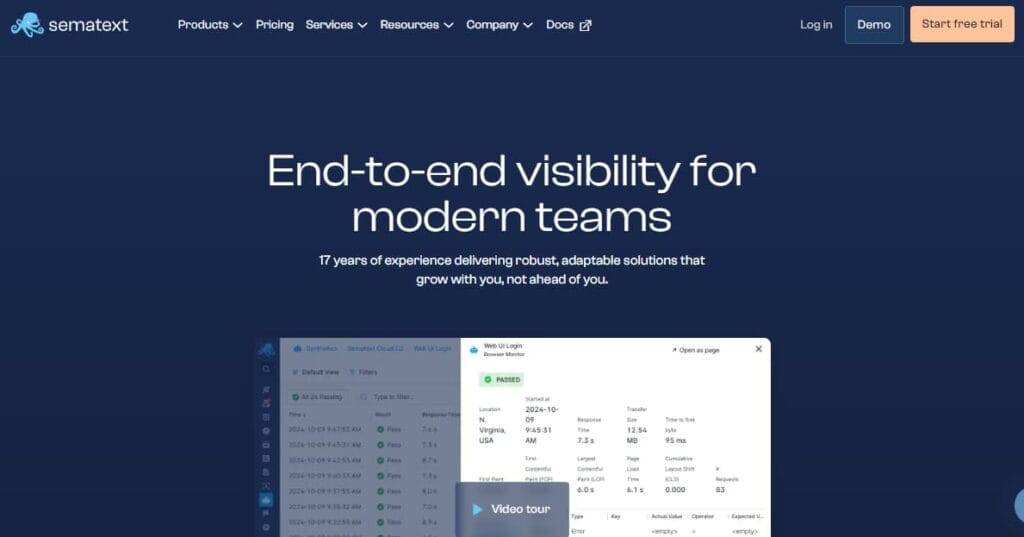
Sematext is known for its lightweight, scalable monitoring and log analytics platform built for modern distributed systems. It offers unified visibility across infrastructure, applications, and databases, including Apache Cassandra. Its agent-based monitoring automatically collects JMX metrics, system health data, and performance trends, making it a reliable alternative to heavier enterprise tools.
Cassandra Monitoring Features
- Native Cassandra integration through JMX and Sematext Agent.
- Tracks key metrics like read/write latency, compaction tasks, and dropped mutations.
- Prebuilt dashboards for node health, pending repairs, and GC activity.
- Real-time alerting for replication lag, failed repairs, and disk usage spikes.
- Correlates Cassandra performance metrics with system logs and traces.
Key Features
- Unified logs, metrics, and traces in a single UI.
- Automatic anomaly detection and alert tuning.
- Flexible data retention and alert policies.
- Seamless integration with OpenTelemetry and Prometheus exporters.
Pros
- Lightweight agent with fast setup and minimal overhead.
- Transparent, ingestion-based pricing.
- Rich visualization for JVM and cluster-level Cassandra metrics.
- Solid alerting system with integrations for Slack, PagerDuty, and Opsgenie.
Cons
- New users might find the UI overwhelming
- Complex initial setup and configuration
Pricing
- Data Received (Ingest): $0.10 per GB
- Data Stored: $1.90 per GB
- Retention: 7 days (configurable)
- Daily Volume: Up to 1 GB/day included, scalable as needed
Sematext Cassandra Monitoring Pricing at Scale
For a company ingesting 10 TB/month of Cassandra telemetry, log ingestion costs 10,240 GB × $0.10 = $1,024, and assuming data storage costs around $5,000/month for 7-day retention, the total monthly estimate comes to roughly $6,024. This makes Sematext’s Pro Plan a mid-range option — simpler and more transparent than many enterprise tools, but still relatively expensive for high-volume Cassandra clusters with heavy log retention.
Tech Fit
Sematext fits DevOps and SRE teams seeking a lightweight, scalable, and transparent monitoring platform for Cassandra. It’s particularly strong for organizations using hybrid or cloud-native deployments that need fast setup and OpenTelemetry compatibility without the overhead of complex enterprise agents. Its clean dashboards and JVM integration make it ideal for Cassandra clusters running on Kubernetes or managed cloud nodes.
6. Zabbix
Known For
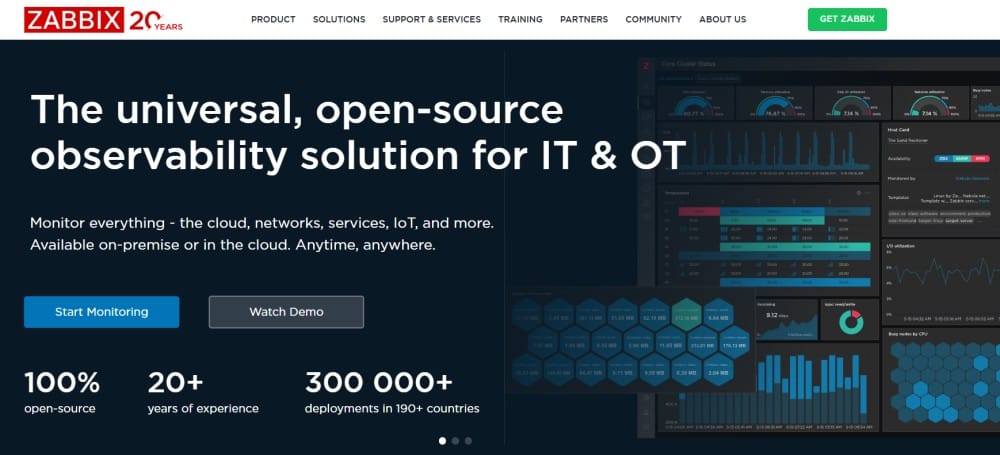
Zabbix is known for its self-hosted, enterprise-grade monitoring platform that provides complete visibility across infrastructure, networks, and databases. It’s widely used for mission-critical systems where security, control, and on-premise deployment are top priorities. With native templates and JMX integration, Zabbix delivers detailed Cassandra monitoring for large-scale clusters without relying on third-party services.
Cassandra Monitoring Features
- Built-in JMX monitoring for Cassandra nodes using Zabbix Java Gateway.
- Tracks essential metrics like read/write latency, heap memory, thread pools, and compactions.
- Custom templates for node availability, replication status, and pending repairs.
- Alerting on failed nodes, high disk usage, and cluster imbalance.
- Integration with Prometheus exporters for hybrid Cassandra setups.
Key Features
- Agentless and agent-based monitoring options.
- Auto-discovery of Cassandra hosts and dynamic item configuration.
- Advanced alerting with escalation rules and dependency mapping.
- Fully self-hosted, secure, and customizable dashboarding.
Pros
- 100% open-source with no data ingestion costs.
- Highly extensible through templates and community integrations.
- Strong security and control for on-prem Cassandra clusters.
- Efficient for long-term metric retention without added fees.
Cons
- Manual configuration required for custom JMX metrics.
- Overwhelming UI for new users
- Complex initial setup
Pricing
While Zabbix is free and open-source for on-prem deployments, Zabbix Cloud offers managed tiers:
- Nano: $50/month
- Micro: $100/month
- Small: $250/month
- Medium: $750/month
- Large: $1,875/month
- xLarge: $2,500/month
- 2xLarge: $5,000/month
Zabbix Cassandra Monitoring Pricing at Scale
For a company running large Cassandra clusters, the Zabbix Cloud 2xLarge plan ($5,000/month) supports up to 10,000 NVPS (New Values Per Second) — enough for monitoring hundreds of Cassandra nodes with frequent metric collection. This plan covers infrastructure, database metrics, and alerting, without additional ingestion or retention fees, making it a predictable choice for enterprise-scale Cassandra observability.
Tech Fit
Zabbix is best suited for enterprises that prioritize data sovereignty, on-prem security, and predictable ownership costs. It’s ideal for organizations running Cassandra in private data centers or hybrid environments where external data transfer isn’t allowed.
7. ManageEngine Applications Manager
Known For
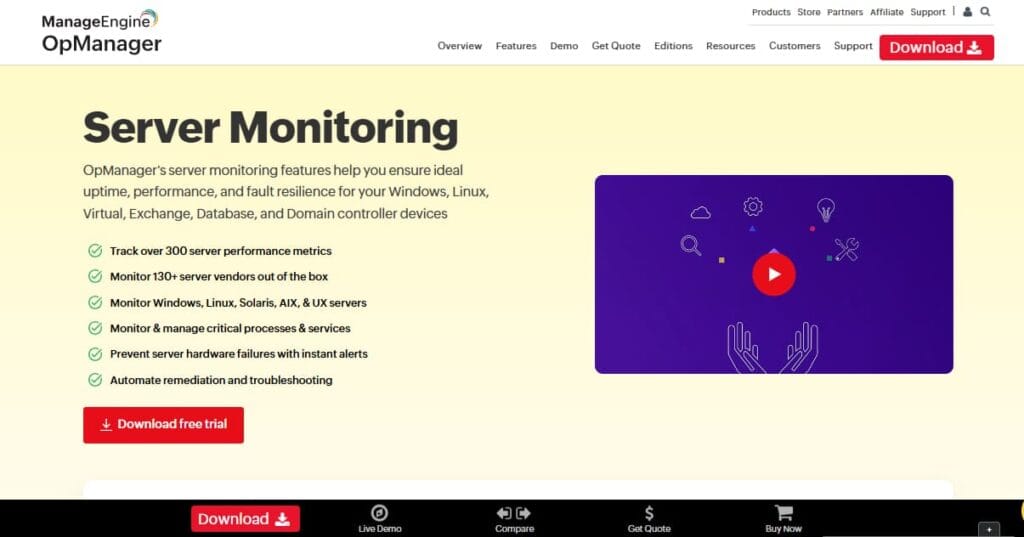
ManageEngine Applications Manager (AAM) is known for its comprehensive enterprise monitoring suite covering over 150 technologies, including databases, servers, and application frameworks. It provides detailed Cassandra performance visibility through JMX, giving enterprises deep insights into latency, node health, and resource utilization. Its blend of agent-based and agentless collection makes it flexible for both on-prem and cloud-based Cassandra clusters.
Cassandra Monitoring Features
- Monitors Cassandra cluster health, keyspaces, and node availability in real time.
- Tracks read/write latency, compaction throughput, and pending repair tasks via JMX.
- Visual dashboards for heap memory, thread pools, and active connections.
- Alerting for failed nodes, high CPU, and excessive garbage collection.
- Provides correlation between Cassandra performance and connected applications.
Key Features
- Unified visibility across databases, middleware, and applications.
- Automated anomaly detection with baseline learning.
- Role-based access and audit logging for secure enterprise use.
- Integration with ServiceNow, Slack, and Opsgenie for incident response.
Pros
- Easy setup with prebuilt Cassandra templates.
- Hybrid monitoring for on-prem, private, and public cloud.
- Strong root-cause analysis and dependency mapping.
- Affordable pricing with perpetual license options.
Cons
- Complex setup and configuration required for large Cassandra clusters.
- Overwhelming UI for new users
Pricing
- 100 monitors: $3,995 per year
- 250 monitors: $9,595 per year
- 1,000 monitors: $22,795 per year
Additional user licenses start at $98 per year, and optional APM add-ons (Java, .NET, Node.js, etc.) are available separately.
ManageEngine Cassandra Monitoring Pricing at Scale
For large-scale deployments monitoring up to 5,000 Cassandra and infrastructure monitors, the Enterprise Edition costs approximately $83,995 per year (~$7,000/month). This covers database performance, JVM health, and infrastructure metrics within a single license — with no data-ingestion charges. While predictable and transparent, the upfront enterprise pricing model may feel steep for smaller teams compared to usage-based SaaS tools.
Tech Fit
ManageEngine Applications Manager is best suited for enterprises and mid-sized organizations running Cassandra in hybrid or on-prem environments where predictability and compliance are critical. It’s ideal for IT teams that prefer perpetual licensing over consumption-based billing and need comprehensive visibility across databases, servers, and applications.
8. SolarWinds
Known For
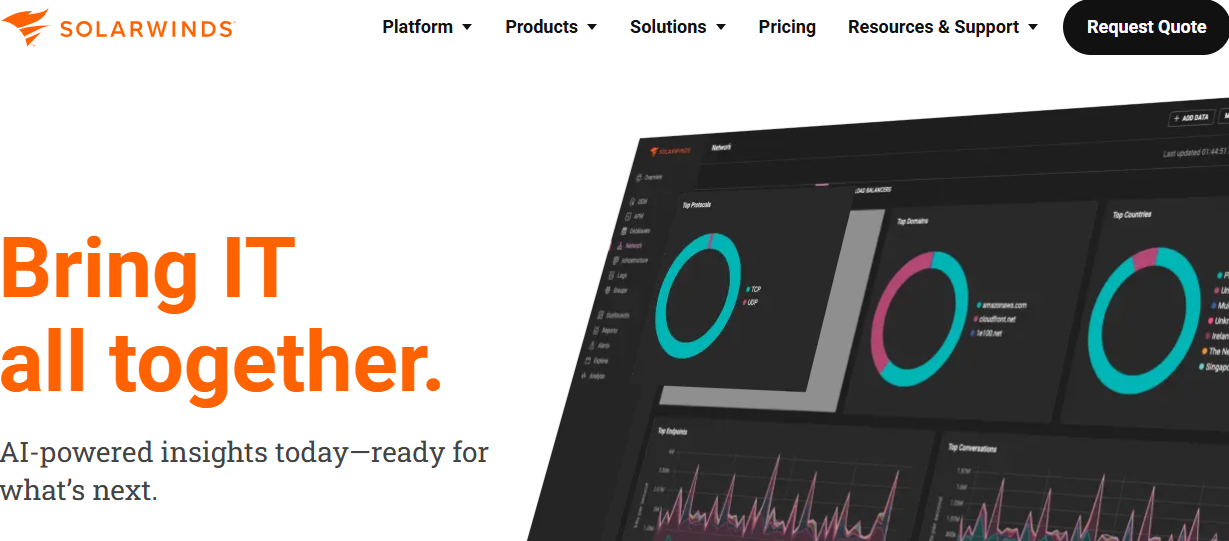
SolarWinds is known for its comprehensive infrastructure and application monitoring suite, widely adopted across enterprises and managed service providers. It offers deep observability for databases, networks, and servers through its Database Performance Analyzer (DPA) and Server & Application Monitor (SAM). For Cassandra, SolarWinds provides visibility into node performance, storage utilization, and query efficiency through native JMX integration and agentless data collection.
Cassandra Monitoring Features
- Monitors Cassandra nodes and clusters using JMX-based templates.
- Tracks key metrics like read/write latency, heap usage, GC time, and compaction backlog.
- Provides dashboards for node uptime, replication consistency, and active connections.
- Detects resource bottlenecks affecting query throughput or disk utilization.
- Integrates with SolarWinds Orion Platform for topology and dependency mapping.
Key Features
- Database Performance Analyzer (DPA) for detailed query and wait-time analysis.
- Unified view across databases, applications, and infrastructure.
- Custom thresholds, baselining, and anomaly alerts.
- Hybrid deployment support (on-prem and cloud).
Pros
- Strong visualization and correlation for database workloads.
- Centralized platform for both application and infra monitoring.
- Long-standing reliability with extensive support ecosystem.
- Customizable dashboards and alert logic.
Cons
- Resource-intensive in large-scale deployments.
- Steep learning curve for new users.
Pricing
- SolarWinds Observability (Self-Hosted): $7.42 per node/month
- Storage Resource Monitor (Self-Hosted): Starts at $2,970 (one-time license)
- Service Desk (SaaS): Starts at $39 per technician/month
SolarWinds Cassandra Monitoring Pricing at Scale
For a company monitoring 300 Cassandra nodes, the Observability license at $7.42 per node/month totals $2,226/month. Adding the Storage Resource Monitor ($2,970 license amortized over 12 months ≈ $248/month) and Service Desk for 10 technicians ($39 × 10 = $390/month) brings the estimated total to roughly $2,864/month. This setup provides full-stack Cassandra visibility with self-hosted control, predictable costs, and flexibility to expand across infrastructure, storage, and service operations.
Tech Fit
SolarWinds is best suited for large enterprises and IT operations teams managing hybrid Cassandra clusters with a focus on database health and infrastructure visibility. It’s ideal for organizations already using SolarWinds for server or network monitoring who want to extend coverage to Cassandra without adding another platform. Its stability, historical analytics, and comprehensive DB insights make it a strong fit for legacy-heavy environments.
Conclusion
Monitoring Apache Cassandra is essential for maintaining consistent performance, preventing node failures, and ensuring data reliability at scale. A robust monitoring solution helps teams visualize latency, compaction, and replication behavior before issues impact production.
CubeAPM simplifies this process with unified observability, real-time insights, and OpenTelemetry-native monitoring — empowering teams to manage Cassandra clusters efficiently while keeping costs predictable and operations stable.
Disclaimer: The information in this article reflects the latest details available at the time of publication and may change as technologies and products evolve.