










Apache Spark has become the backbone of modern data engineering—powering large-scale ETL, analytics, and machine-learning workloads. But as Kubernetes clusters grow and jobs scale, monitoring Apache Spark performance becomes challenging. Executors fail, stages slow down, and memory issues surface without clear visibility. That’s why teams rely on Apache Spark monitoring tools to track job latency, resource usage, and pipeline health in real time.
CubeAPM gives Apache Spark teams full visibility into every layer of execution. It automatically captures driver and executor metrics, shuffle I/O, stage durations, and task failures, all through native OpenTelemetry instrumentation. With smart sampling, it keeps the most critical traces—such as slow or failed jobs—while cutting noise and data bloat.
In this guide, we’ll break down what Apache Spark monitoring really means, why it matters, and how to choose a tool that balances deep visibility with predictable costs.
Best Apache Spark Monitoring Tools
- CubeAPM
- Datadog
- New Relic
- Dynatrace
- IBM Instana
- Grafana
- ManageEngine Applications Manager
- Sumo Logic
What is Apache Spark Monitoring

Apache Spark monitoring refers to the process of collecting, analyzing, and visualizing performance data from Apache Spark applications running across distributed clusters. It helps engineering and data teams track how efficiently their Apache Spark jobs execute—whether they’re processing streaming data, training models, or running large ETL pipelines.
At its core, Apache Spark monitoring focuses on key metrics such as job duration, stage latency, shuffle read/write throughput, executor memory usage, CPU utilization, garbage collection time, and failed tasks. These insights allow teams to identify performance bottlenecks, tune resource allocation, and prevent cascading job failures before they impact production workloads.
While Apache Spark includes a built-in web UI and history server, those tools are often limited to single-job visibility and lack long-term storage, centralized alerting, or correlation across systems. Modern observability platforms extend Apache Spark’s native metrics with distributed tracing, log correlation, and infrastructure monitoring, giving teams end-to-end visibility across both the Apache Spark cluster and the services it depends on—like Kafka, S3, or databases.
In short, effective Apache Spark monitoring isn’t just about tracking metrics—it’s about connecting the dots between jobs, infrastructure, and user impact, so teams can move from reactive troubleshooting to proactive optimization.
Example: How CubeAPM Handles Apache Spark Monitoring
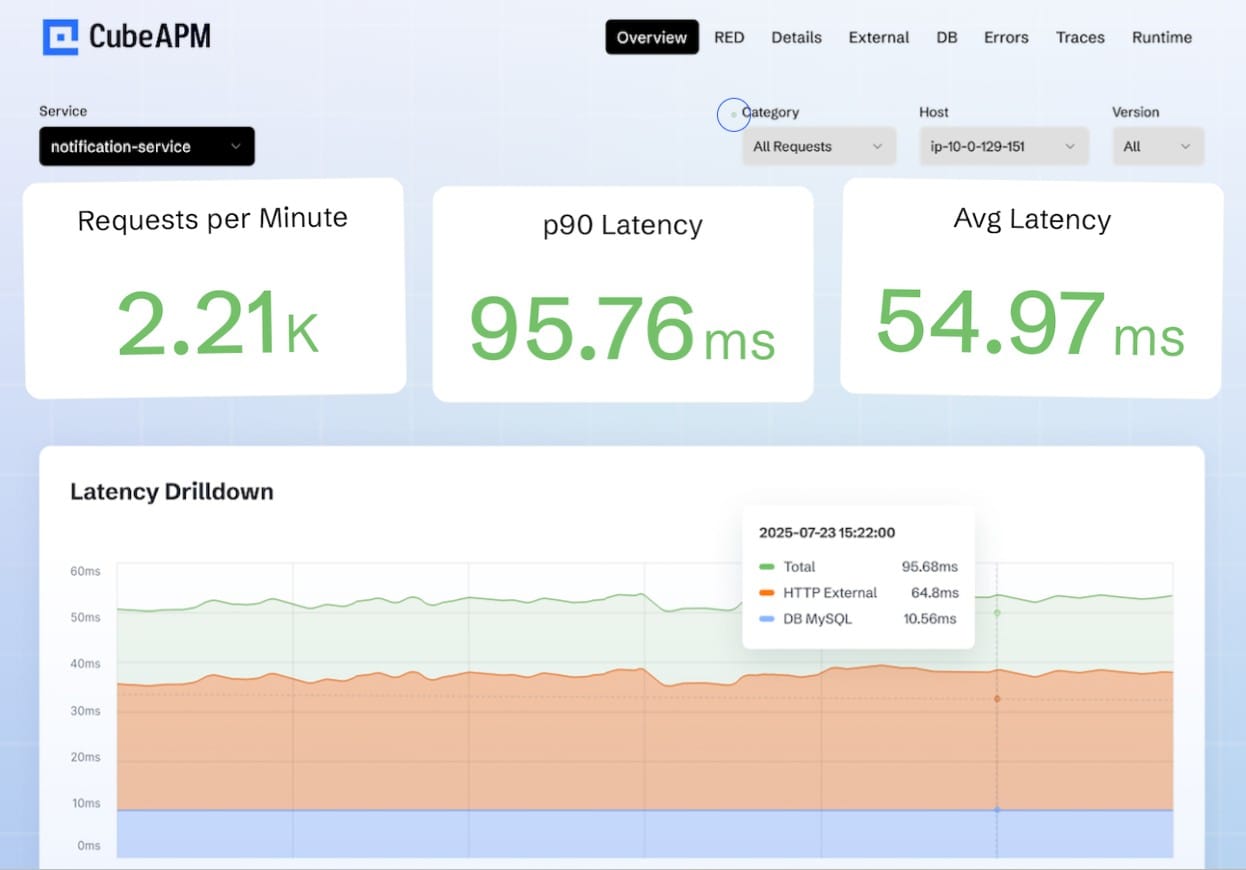
CubeAPM brings full-stack observability to Apache Spark without the overhead of complex setup or unpredictable pricing. It’s built on OpenTelemetry, so it automatically collects Apache Spark driver and executor metrics, logs, and traces—connecting job-level insights with the infrastructure they run on.
CubeAPM’s Apache Spark integration tracks job and stage performance in real time, surfacing issues like slow stages, data skew, and excessive shuffle I/O. Its distributed tracing capability links Apache Spark tasks to downstream systems such as Kafka, S3, or database writes—so teams can pinpoint the exact source of latency or failure across the data pipeline.
With smart sampling, CubeAPM focuses on retaining the traces that actually matter—like those involving high latency or errors—allowing teams to keep visibility deep while reducing data volume and cost. This results in up to 60–80% savings compared to traditional APM tools, with flat, transparent pricing at $0.15 per GB of data ingested.
Teams can also monitor Apache Spark clusters at the infrastructure level using CubeAPM’s Infra Monitoring module, view executor and driver logs through Log Monitoring, and analyze pipeline health trends over time—all from a single dashboard. Combined, this gives a clear, unified view of Apache Spark performance from code to cluster, without switching tools or dashboards.
Why Teams Choose Different Apache Spark Monitoring Tools
Every organization’s Apache Spark environment looks different—some run massive batch jobs on Kubernetes, others manage real-time data streams on EMR or Databricks. Because of this, teams prioritize different aspects of Apache Spark monitoring based on their architecture, compliance needs, and scaling goals.
1. Scalability and Integration
Teams operating large Apache Spark clusters require monitoring that scales horizontally and integrates natively with Kubernetes, YARN, and managed Apache Spark services. The ability to handle thousands of concurrent tasks while maintaining low-latency metric ingestion is non-negotiable for production-grade pipelines.
2. Pricing and Cost Predictability
With Apache Spark telemetry generating terabytes of logs and traces, cost control becomes critical. Tools that rely on host- or user-based pricing models can quickly spiral out of budget. Modern teams prefer transparent, ingestion-based pricing that scales linearly with data volume—so they can plan budgets without surprises.
3. Data Retention and Compliance
Enterprises operating under GDPR, HIPAA, or data localization laws need control over where telemetry lives. Platforms offering bring-your-own-cloud (BYOC) or on-premises hosting options give teams confidence in compliance while minimizing data transfer costs and latency.
4. Sampling and Performance Optimization
Efficient sampling determines the visibility-to-cost ratio. Traditional probabilistic sampling may drop key traces, while context-aware approaches—like CubeAPM’s smart sampling—prioritize events tied to high latency or errors. The result: deeper visibility with less data bloat.
5. Support and Total Cost of Ownership
Fast, expert-level support can dramatically reduce mean time to resolution (MTTR). Teams increasingly value vendors that provide direct engineer access and transparent troubleshooting, not just ticket queues and email delays.
6. Ecosystem Compatibility
The best Apache Spark monitoring tools integrate seamlessly with existing observability stacks Compatibility ensures teams can extend Apache Spark insights into their larger system monitoring strategy without rebuilding pipelines.
7. AI-Driven Insights and Automation
As Apache Spark jobs scale, manual root-cause analysis becomes unsustainable. Many modern platforms now leverage AI to detect anomalies, forecast resource needs, and automatically correlate Apache Spark job failures with underlying infrastructure issues. This transforms observability from reactive monitoring to proactive optimization.
8. Visualization and Collaboration
Data engineers and SREs need actionable dashboards, not raw metrics. Tools that offer rich visualization, contextual drill-downs, and collaborative dashboards enable teams to move faster—especially in hybrid environments where Apache Spark jobs impact multiple services.
Top 8 Apache Spark Monitoring Tools
1. CubeAPM
Known For
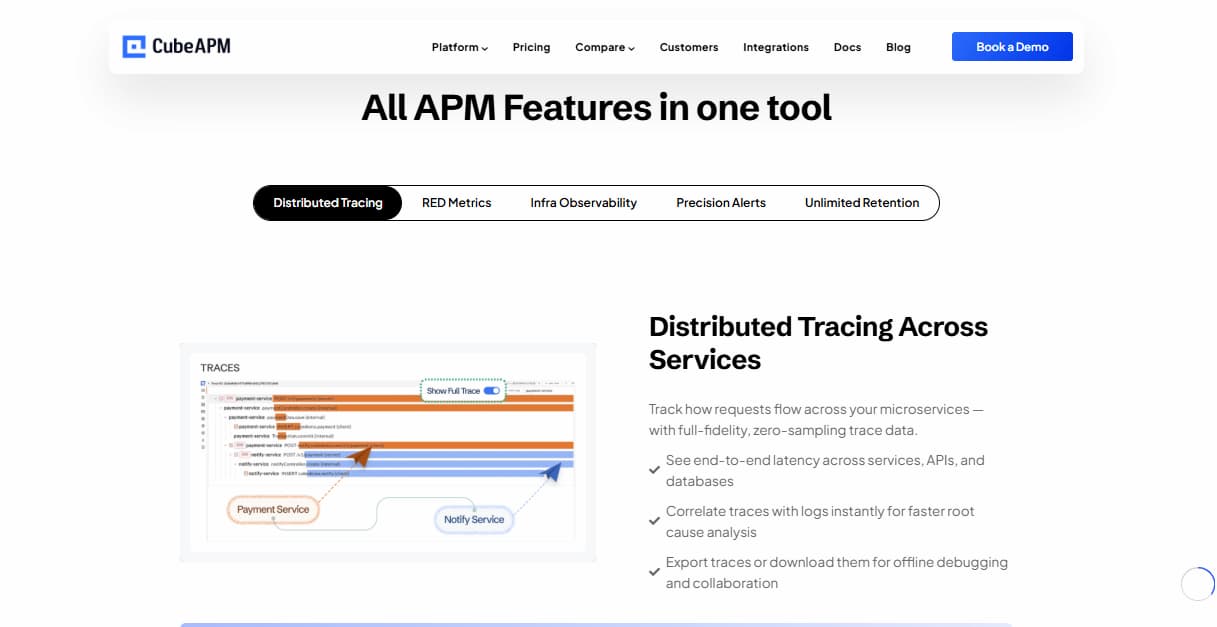
CubeAPM is an OpenTelemetry-native observability platform designed to simplify monitoring for data-intensive systems like Apache Spark. It provides unified visibility across application, infrastructure, and data layers—helping teams trace performance bottlenecks from Apache Spark executors to underlying infrastructure. With a focus on efficiency, simplicity, and cost predictability, CubeAPM enables organizations to achieve enterprise-grade observability without enterprise-level complexity or pricing.
Apache Spark Monitoring Features
- Automatically captures Apache Spark driver and executor metrics using OpenTelemetry collectors.
- Monitors job stages, task latencies, and shuffle I/O performance in real time.
- Detects data skew, memory bottlenecks, and failed stages across distributed workloads.
- Links Apache Spark telemetry with infrastructure and logs for end-to-end visibility.
Key Features
- Unified monitoring for APM, logs, traces, and infrastructure in a single platform.
- Smart sampling focuses on error or latency-heavy traces to reduce storage overhead.
- Bring-your-own-cloud (BYOC) and on-prem deployment options for full data control.
- Unlimited retention without extra charges.
- Seamless compatibility with Prometheus, OpenTelemetry, and legacy APM agents.
Pros
- Predictable and transparent pricing—no hosts, users, or retention add-ons.
- Up to 80% cheaper than traditional APM solutions at scale.
- Instant access to engineers for support via Slack or WhatsApp.
- Fully compliant with data localization and privacy regulations.
Cons
- Not suited for teams looking for off-prem solutions
- Strictly an observability platform and does not support cloud security management
Pricing
- Flat pricing $0.15 per GB of data ingestion.
CubeAPM Apache Spark Monitoring Pricing at Scale
For a Apache Spark workload producing 10 TB of telemetry per month, the cost is straightforward:
10,240 GB × $0.15 = $1,536 per month total. That’s all-inclusive—covering logs, metrics, and traces with unlimited retention and zero hidden costs. Competing platforms often charge 3–5× more for equivalent data volumes, making CubeAPM ideal for high-throughput Apache Spark environments where ingestion costs dominate.
Tech Fit
CubeAPM is best suited for data engineering and SRE teams managing Apache Spark pipelines across Kubernetes, EMR, or on-prem clusters. Its OpenTelemetry-native design ensures smooth integration with modern data stacks, while BYOC deployment appeals to organizations with strict compliance or localization requirements. For teams that value deep visibility, simple setup, and predictable spend, CubeAPM delivers full-stack Apache Spark observability that scales effortlessly from small jobs to multi-petabyte pipelines.
2. Datadog
Known For
Datadog is one of the most comprehensive cloud monitoring platforms, known for its deep integrations across cloud providers, containers, and microservices. It offers full-stack observability—covering APM, logs, infrastructure, network, RUM, and security—through an easy-to-use SaaS model. For organizations running Apache Spark alongside complex distributed systems, Datadog delivers powerful dashboards and alerting across multiple data sources.
Apache Spark Monitoring Features
- Integrates with Apache Apache Spark via JMX metrics to monitor driver and executor performance.
- Provides prebuilt dashboards for job duration, shuffle metrics, GC pauses, and task failures.
- Correlates Apache Spark metrics with logs and infrastructure data for faster troubleshooting.
- Supports alerting on failed jobs, executor memory spikes, and cluster saturation through Datadog’s advanced monitor system.
Key Features
- Unified observability for APM, logs, infrastructure, RUM, and synthetics.
- 900+ native integrations covering AWS, Kubernetes, Kafka, and Hadoop ecosystems.
- AI-powered anomaly detection and forecasting for Apache Spark performance trends.
- Advanced collaboration features—dashboards can be shared across engineering and ops teams.
Pros
- Robust integration ecosystem for hybrid and multi-cloud Apache Spark deployments.
- Real-time alerting and automated root-cause analysis with Datadog’s Watchdog AI.
- Enterprise-grade visualization and correlation capabilities.
Cons
- Expensive at scale, with separate pricing for APM, logs, and infrastructure.
- Sampling and retention controls limited on lower plans.
- Requires manual fine-tuning to reduce noisy data ingestion costs.
Pricing
- APM: $42 per host/month
- Infrastructure Monitoring: $23 per host/month
- Logs: $0.10 per GB ingested
Datadog Apache Spark Monitoring Pricing at Scale
For an Apache Spark deployment running 125 hosts continuously and ingesting about 10 TB (10,240 GB) of telemetry per month, Datadog’s costs can add up quickly. At $42 per host for APM and $23 per host for infrastructure monitoring, the host-based charges alone total roughly $8,125 per month. Adding log ingestion at $0.10 per GB contributes another $1,024, bringing the overall monthly cost for Apache Spark monitoring to around $9,100 before factoring in add-ons like synthetics, serverless tracing, or extended data retention. This per-host and per-GB model scales well for smaller clusters but becomes expensive as Apache Spark environments expand and telemetry volume grows.
Tech Fit
Datadog fits enterprises and DevOps teams that already operate within the Datadog ecosystem or need a single-pane-of-glass solution across cloud, infrastructure, and Apache Spark workloads. It’s especially strong for teams running Apache Spark on AWS EMR or Kubernetes, where integrations and alerting automation are critical. However, for high-ingestion Apache Spark pipelines or telemetry-heavy jobs, Datadog can become expensive without tight data sampling and retention policies.
3. New Relic
Known For
New Relic is a long-standing leader in application performance monitoring (APM), widely used for full-stack observability across infrastructure, applications, and end-user experiences. It combines APM, logs, traces, synthetics, and dashboards into a single cloud platform. For Apache Spark, New Relic helps teams monitor job performance, JVM health, and resource utilization—but its pricing and data storage approach often make it more suitable for enterprises with higher budgets and established observability practices.
Apache Spark Monitoring Features
- Collects Apache Spark driver and executor metrics through its Java agent and JMX integrations.
- Tracks job and stage execution times, garbage collection, and executor memory usage.
- Displays Apache Spark application data within custom New Relic dashboards for unified observability.
- Integrates with cloud services and data pipelines like Kafka, AWS, and Databricks for extended visibility.
Key Features
- End-to-end monitoring across APM, infrastructure, synthetics, and browser (RUM).
- Powerful NRQL query language for custom metrics and visualization.
- AI-assisted anomaly detection and automated alerting through New Relic Applied Intelligence (AI).
- Multi-tenant cloud platform with secure data storage and configurable retention policies.
Pros
- Mature ecosystem with robust features and integrations.
- Strong AI-based insights and proactive anomaly detection.
- Unified dashboards across multiple data sources.
Cons
- High pricing for ingestion and user licenses.
- Limited flexibility for self-hosted or data-localization requirements.
- Data stored outside customer environments—less ideal for compliance-driven teams.
Pricing
- Free tier: 100GB/month ingested
- Data Ingestion: $0.40 per GB
- Full-Access Users: $400 per user/month
New Relic Apache Spark Monitoring Pricing at Scale
For an Apache Spark environment ingesting 10 TB (10,240 GB) of telemetry data per month and used by 10 team members, New Relic’s costs start after the free 100 GB monthly allowance. That leaves 10,140 GB of billable data, priced at $0.40 per GB, for a total of $4,056 in data-ingestion charges. Adding 10 full-access users at $400 each contributes another $4,000, bringing the overall monthly Apache Spark-monitoring cost to roughly $8,056. This structure gives smaller teams a brief buffer for low-volume workloads, but at enterprise Apache Spark scales, the pricing still grows rapidly with both ingestion and user count.
Tech Fit
New Relic suits large enterprises and SaaS platforms that require deep APM visibility, cross-service correlation, and advanced anomaly detection. It’s ideal for teams that already rely on New Relic’s ecosystem for infrastructure or application monitoring and want to extend that visibility to Apache Spark. However, for cost-sensitive or compliance-heavy environments, the combination of higher ingestion fees and external data storage makes it less optimal than newer, ingestion-based observability platforms.
4. Dynatrace
Known For
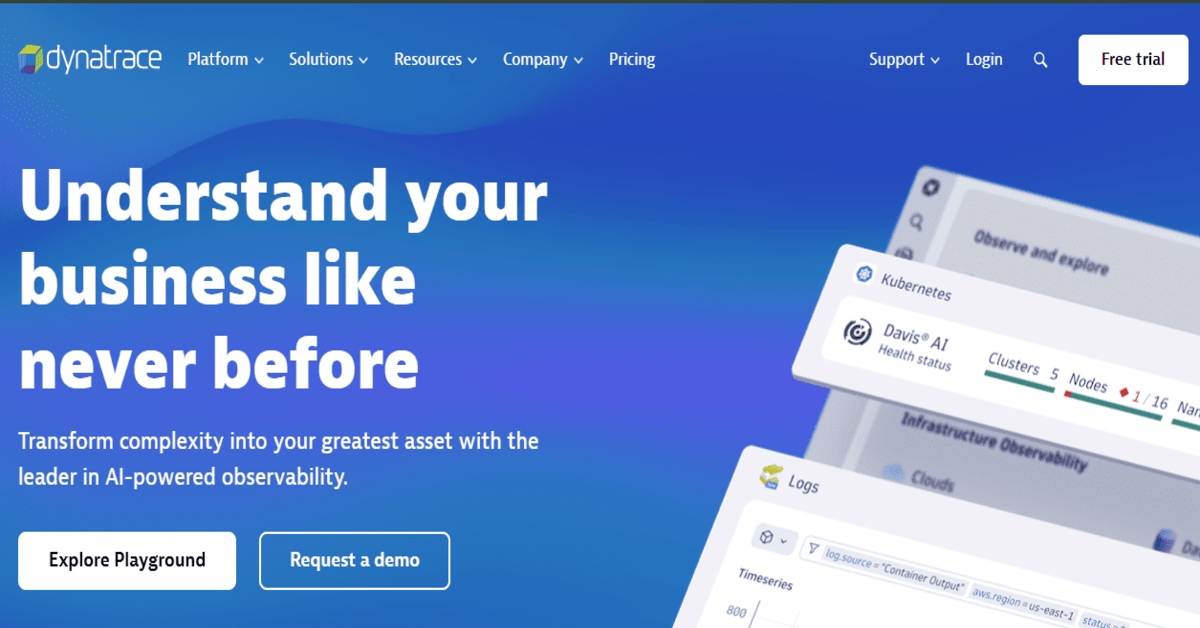
Dynatrace is an AI-powered observability and performance platform built for scale and automation. Its Davis AI engine continuously maps dependencies, detects anomalies, and pinpoints root causes across distributed systems. For Apache Spark , it provides intelligent, automated visibility into JVM health, cluster performance, and execution behavior—without requiring heavy manual setup.
Apache Spark Monitoring Features
- Auto-discovers Apache Spark applications, drivers, and executors.
- Monitors job duration, stage latency, and GC time in real time.
- Detects bottlenecks, failed tasks, and memory leaks automatically.
- Maps Apache Spark dependencies to downstream systems like Kafka, S3, or databases.
Key Features
- AI-driven root-cause detection powered by Davis AI.
- Unified platform for logs, metrics, traces, and security.
- OneAgent deployment with zero manual instrumentation.
- Long-term analytics with predictive baselines for Apache Spark workloads.
Pros
- Highly automated—minimal setup or tuning required.
- Excellent visualization and dependency mapping.
- Scales efficiently across large, hybrid Apache Spark clusters.
Cons
- Premium pricing, especially at large telemetry volumes.
- Proprietary setup limits integration flexibility.
- Retention and sampling less customizable than open platforms.
Pricing
- Full-Stack Monitoring: $0.08 per hour (8 GiB host)
- Infrastructure Monitoring: $0.04 per hour (8 GiB host)
- Logs: $0.20 per GB
Dynatrace Apache Spark Monitoring Pricing at Scale
For an Apache Spark deployment running 125 hosts continuously and ingesting about 10 TB (10,240 GB) of telemetry data per month, Dynatrace’s costs scale significantly. With Full-Stack Monitoring billed at $0.08 per hour for each 8 GiB host and Infrastructure Monitoring at $0.04 per hour, the combined host charges amount to roughly $10,800 per month (125 hosts × 24 hours × 30 days × $0.12). Adding log ingestion and analytics at $0.20 per GB contributes another $2,048, bringing total estimated monthly Apache Spark-monitoring costs to about $12,850. This model delivers deep AI-powered insights, but at large Apache Spark scales, hourly and per-GB pricing can quickly become one of the higher-cost observability options.
Tech Fit
Dynatrace is best for large enterprises and platform teams running Apache Spark on hybrid or multi-cloud infrastructure. It’s ideal for organizations that prioritize AI-driven insights, automated discovery, and zero-touch instrumentation. However, its closed ecosystem and usage-based pricing can limit flexibility for teams seeking full control or predictable monthly spend.
5. IBM Instana
Known For
IBM Instana is an enterprise-grade observability platform focused on automatic discovery, continuous instrumentation, and real-time application visibility. It delivers deep insights across microservices, containers, and data processing frameworks like Apache Spark. Instana is especially recognized for its agent-based automation and strong JVM monitoring, making it a solid fit for Apache Spark clusters running in dynamic or containerized environments.
Apache Spark Monitoring Features
- Auto-detects Apache Spark jobs, drivers, and executors without manual setup.
- Captures JVM metrics, job execution time, and resource utilization.
- Traces Apache Spark task performance from application to infrastructure layer.
- Provides real-time anomaly detection and impact visualization for Apache Spark stages.
Key Features
- Continuous discovery of services and dependencies.
- Built-in support for JVM, Kafka, Kubernetes, and cloud-native workloads.
- 1-second granularity metrics for near real-time Apache Spark visibility.
- AI-assisted alerting with automated root-cause correlation.
Pros
- Fully automated instrumentation—no configuration overhead.
- Fast metric refresh rate ideal for real-time Apache Spark pipelines.
- Excellent JVM and microservice-level insights.
Cons
- Limited data retention on lower tiers.
- Pricing scales quickly with ingestion and host count.
- Less flexible for on-prem or BYOC deployments.
Pricing
- Essentials Tier (SaaS): $20 per MVS/month (for infra monitoring)
- Standard Tier (SaaS): $75 per MVS/month (for full-stack observability: tracing, logs, infra)
Instana Apache Spark Monitoring Pricing at Scale
For an Apache Spark deployment with 125 monitored hosts, IBM Instana’s pricing varies by plan. Under the Standard Tier at $75 per MVS/month, full-stack observability—including infrastructure metrics, code-level tracing, and log analytics—totals roughly $9,375 per month (125 × $75). Teams opting for the Essentials Tier at $20 per MVS/month, focused primarily on infrastructure monitoring, would spend about $2,500 per month. While Instana’s pricing remains more predictable than hourly models, costs can rise as Apache Spark clusters scale, especially when full observability features like tracing and log correlation are enabled across hundreds of executors.
Tech Fit
IBM Instana fits enterprises and data engineering teams that want deep JVM-level visibility with minimal setup effort. It’s particularly useful for organizations running Apache Spark alongside Kubernetes, Kafka, and microservices, where automatic dependency discovery reduces operational complexity. However, for Apache Spark-heavy environments with large data ingestion volumes, Instana’s per-host pricing model can become restrictive compared to ingestion-based platforms like CubeAPM.
6. Grafana
Known For
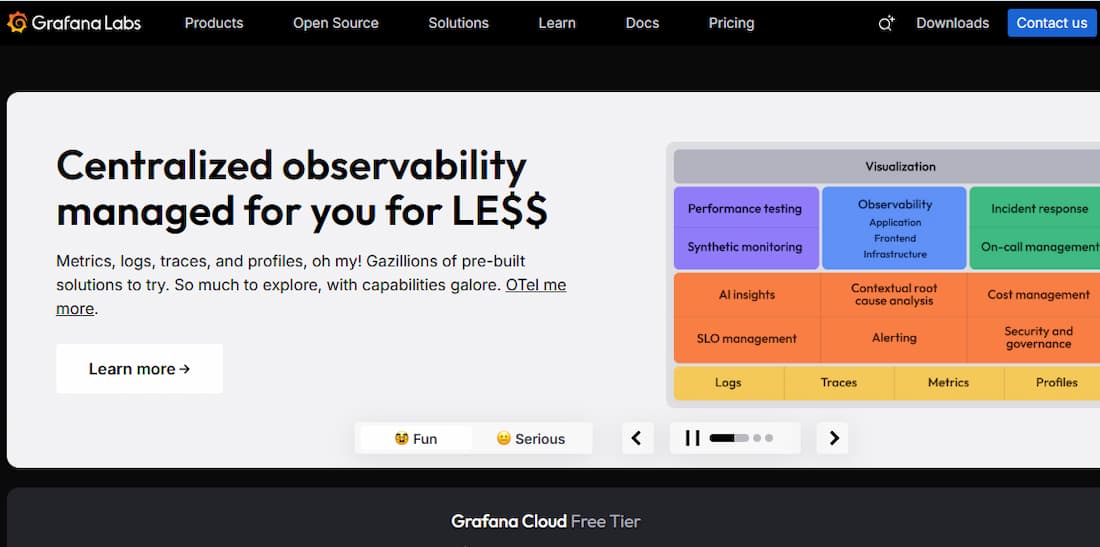
Grafana is an open-source analytics and visualization platform widely used for monitoring distributed systems. It’s best known for its flexibility, open integrations, and visual dashboards that let teams build real-time views across metrics, logs, and traces. For Apache Spark environments, Grafana is often used alongside Prometheus, Loki, or OpenTelemetry to monitor cluster health and job performance.
Apache Spark Monitoring Features
- Visualizes Apache Spark driver and executor metrics collected via Prometheus or JMX exporters.
- Tracks job latency, task execution, and memory usage across stages.
- Integrates Apache Spark telemetry with infrastructure and system dashboards.
- Customizable alerts for failed jobs, slow tasks, or high resource utilization.
Key Features
- Unified dashboards for metrics, logs, and traces.
- Works with Prometheus, Loki, and Tempo for open-source observability.
- Highly customizable visualizations and alerting pipelines.
- Compatible with cloud services and managed Apache Spark platforms.
Pros
- Open-source and highly extensible.
- Integrates easily with existing Apache Spark monitoring pipelines.
- No license costs; wide community support.
Cons
- Requires setup of collectors like Prometheus and Loki for full observability.
- Lacks built-in tracing and APM features compared to commercial tools.
- Operational overhead at large scale.
Pricing
- Grafana Cloud Free: Limited support, 14 day retention for logs
- Logs: 0.50/GB ingested
- Pro: $19/ month + usage
Grafana Apache Spark Monitoring Pricing at Scale
For an Apache Spark setup producing 10 TB (10,240 GB) of logs per month, Grafana Cloud’s costs can vary depending on usage and tier. Under the Pro plan at $19 per user per month plus usage-based billing, log ingestion at $0.50 per GB would total roughly $5,120 per month (10,240 × $0.50), with an additional base fee of $19 per user. For a small team of five users, the total monthly cost would be around $5,215. While Grafana Cloud offers powerful visualization and alerting for Apache Spark telemetry, its pay-per-ingestion model can become expensive at large data volumes.
Tech Fit
Grafana is ideal for engineering and DevOps teams who prefer open-source observability and want full control over their stack. It’s a great choice for organizations already using Prometheus or OpenTelemetry exporters for Apache Spark, enabling end-to-end visibility without vendor lock-in.
7. ManageEngine Applications Manager
Known For
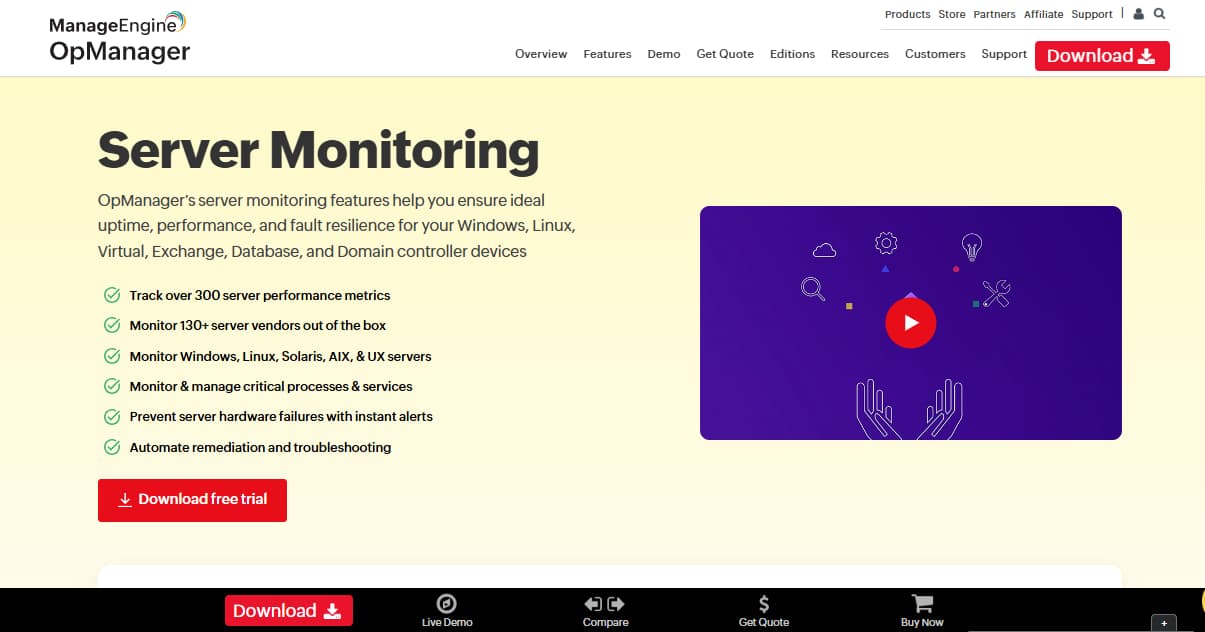
ManageEngine Applications Manager is a long-standing enterprise monitoring solution known for its broad IT observability, deep JVM insights, and strong support for traditional and hybrid infrastructures. It provides end-to-end visibility across applications, servers, and middleware components, including Apache Apache Spark. Its on-premises deployment model makes it a reliable choice for organizations prioritizing security and internal data control.
Apache Spark Monitoring Features
- Monitors Apache Spark job execution times, stages, and task latency.
- Tracks driver and executor memory, GC time, and thread health.
- Provides alerts for failed jobs, slow stages, and resource bottlenecks.
- Offers JMX-based integration for Apache Spark, Hadoop, and related systems.
Key Features
- Unified APM for applications, databases, servers, and containers.
- Custom dashboards for Apache Spark cluster and node performance.
- Supports hybrid environments and on-prem deployment.
- Anomaly detection and SLA tracking for Apache Spark workloads.
Pros
- Strong JVM and infrastructure-level observability.
- Ideal for on-prem Apache Spark clusters or private data centers.
- Flexible licensing and role-based access control.
Cons
- User interface less modern compared to cloud-native tools.
- Limited support for advanced trace correlation.
- Cloud integrations require extra configuration.
Pricing
- 100 monitors: $3,995 per year
- 250 monitors: $9,595 per year
- 1,000 monitors: $22,795 per year
ManageEngine Apache Spark Monitoring Pricing at Scale
For a Apache Spark environment with around 250 active monitors—covering job execution, executor health, and cluster-level metrics—ManageEngine’s Professional Edition would cost approximately $9,595 per year, which comes to about $800 per month. Smaller setups with 100 monitors are priced at $3,995 annually, while larger enterprise-scale environments with 1,000 monitors reach about $22,795 per year. This pricing model is predictable and well-suited for on-prem Apache Spark deployments, but as the number of monitored jobs and executors grows, costs increase proportionally with the size of the cluster.
Tech Fit
ManageEngine suits enterprises running Apache Spark on-prem or in secure private clouds that need full control over data and compliance. It’s particularly strong for teams managing mixed workloads—Apache Spark, Hadoop, databases, and web applications—under one interface.
8. Sumo Logic

Known For
Sumo Logic is a cloud-native observability and security analytics platform known for its scalable log management, real-time analytics, and machine learning–driven anomaly detection. It provides a unified view of logs, metrics, and traces across distributed systems, making it a versatile option for organizations running large-scale Apache Spark clusters on AWS, GCP, or Kubernetes.
Apache Spark Monitoring Features
- Collects and correlates Apache Spark driver and executor logs through lightweight agents.
- Monitors job duration, shuffle read/write performance, and task latency.
- Tracks cluster CPU, memory, and network metrics for Apache Spark-on-Kubernetes or YARN.
- Uses ML-based analytics to detect abnormal job execution patterns.
Key Features
- Unified log, metric, and trace ingestion pipeline.
- Built-in search and correlation engine for fast query execution.
- Anomaly detection and predictive analytics for Apache Spark performance.
- Cloud-native architecture with elastic scalability and managed storage.
Pros
- Excellent for large log volumes and streaming data.
- Simple cloud setup with no infrastructure overhead.
- ML insights for trend prediction and root-cause detection.
Cons
- High storage and query costs at scale.
- Retention limits on lower tiers.
- Fewer built-in Apache Spark dashboards—requires setup or custom queries.
Pricing
- Price per TB scanned $ 3.14
Sumo Logic Apache Spark Monitoring Pricing at Scale
For a Apache Spark environment generating around 10 TB (10,240 GB) of telemetry data per month, Sumo Logic’s Cloud Flex pricing uses a credit-based billing model, where customers pay per TB scanned and per analytic query executed. While the base rate starts at roughly $3.14 per TB scanned, actual billing depends on credit consumption—with log ingestion, frequent queries, and data retention each consuming additional credits. In active Apache Spark monitoring environments, where data is queried and reprocessed continuously, effective credit usage can push total costs to around $4,500 – $5,500 per month.
Tech Fit
Sumo Logic is best for cloud-native organizations managing Apache Spark jobs alongside other analytics or security workloads. It fits teams that need log-heavy observability, fast search performance, and built-in ML insights without maintaining on-prem infrastructure.
Conclusion
Effective Apache Spark monitoring keeps data pipelines fast, reliable, and cost-efficient. As workloads scale, visibility across jobs, executors, and infrastructure becomes essential.
CubeAPM simplifies Apache Spark observability with native OpenTelemetry integration, smart sampling, and flat $0.15/GB pricing—delivering deep insights without complexity or cost surprises. It’s built for teams that want clear visibility, full control, and performance that scales as their Apache Spark clusters grow.
Disclaimer: The information in this article reflects the latest details available at the time of publication and may change as technologies and products evolve.