







Dynatrace is an enterprise observability platform for application performance monitoring, infrastructure monitoring, logs, traces, digital experience monitoring, automation, and application security. It is known for OneAgent, Smartscape topology mapping, Grail, and Davis AI, which Dynatrace now positions under its broader Dynatrace Intelligence layer.
Understanding Dynatrace pricing and review matters because the platform does not use one simple pricing meter. Dynatrace prices different capabilities separately, including Full-Stack Monitoring, Infrastructure Monitoring, logs, traces, RUM, synthetics, security, automation, and support. That makes the platform powerful, but it also means buyers need to model usage carefully.
In this guide, we break down Dynatrace pricing, explain how the billing model works, show real cost scenarios, summarize user-review themes, and compare Dynatrace with alternatives such as Datadog, New Relic, and CubeAPM.
🔑 Key Takeaways
- Dynatrace shows simple monthly examples on its pricing page: Foundation & Discovery from $7/month per host, Infrastructure Monitoring from $29/month per host, and Full-Stack Monitoring from $58/month per 8 GiB host. These are rounded examples based on the underlying hourly rate card.
- The underlying rate card lists Foundation & Discovery at $0.01 per host-hour, Infrastructure Monitoring at $0.04 per host-hour, and Full-Stack Monitoring at $0.01 per memory-GiB-hour.
- Dynatrace bills usage in 15-minute intervals. For Full-Stack Monitoring, Dynatrace calculates GiB-hours based on monitored host memory, also in 15-minute intervals.
- Log ingest is listed at $0.20 per GiB, traces ingest at $0.20 per GiB, RUM at $0.00225 per session, browser synthetics at $0.0045 per synthetic action, and HTTP monitors at $0.001 per synthetic request.
- Dynatrace offers a public Playground and a trial, but it does not position itself around a permanent free tier like some lower-cost tools.
- Enterprise Success & Support can be a major cost item. Dynatrace’s pricing FAQ and support materials state that Enterprise Success & Support is priced as a percentage of annualized product fees, with a $25,000 minimum.
What Is Dynatrace?
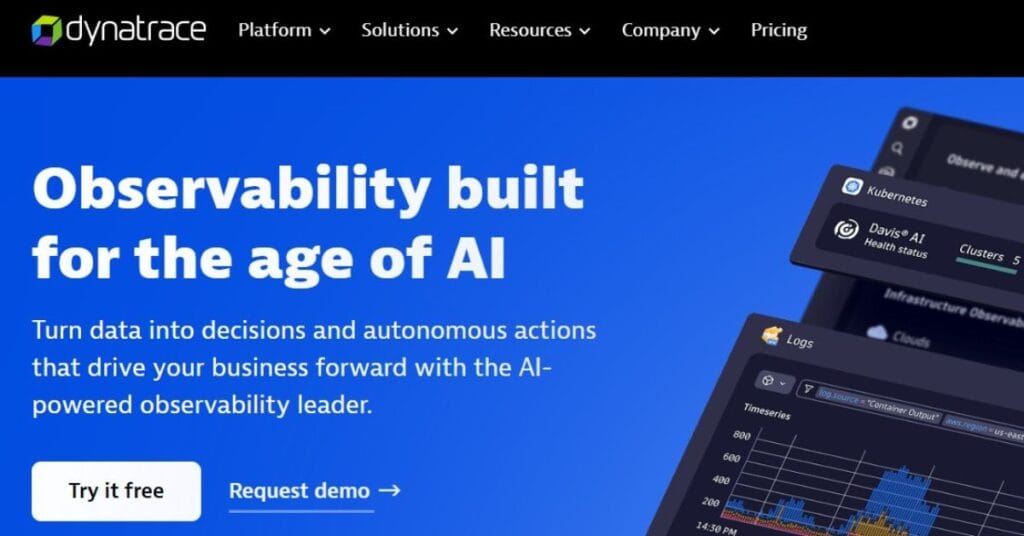
Dynatrace is an observability and security platform used to monitor applications, infrastructure, logs, metrics, traces, user experience, synthetic tests, Kubernetes, and cloud-native environments. Its core strength is automated discovery and correlation across complex systems.
Dynatrace Full-Stack Monitoring includes application performance monitoring, distributed tracing, code-level visibility, profiling, infrastructure monitoring, and Kubernetes monitoring when used in supported host-based configurations.
The platform also supports OpenTelemetry ingestion. This helps teams send OpenTelemetry telemetry into Dynatrace while still using Dynatrace for analysis, topology, alerting, and platform workflows.
How Dynatrace Works: Architecture and Deployment
Dynatrace mainly collects data through OneAgent. OneAgent is installed on monitored hosts and automatically discovers applications, processes, services, dependencies, infrastructure, and performance data. This reduces manual setup because teams do not need to configure every runtime or service one by one.
For Kubernetes, Dynatrace uses Kubernetes deployment models that support application observability and platform monitoring. Under DPS, Full-Stack Monitoring consumption is still tied to monitored memory in GiB-hours, so teams should model node memory, cluster size, and workload scale carefully.
Dynatrace supports OpenTelemetry ingestion for teams that already use vendor-neutral instrumentation. This is useful for OpenTelemetry-first teams, but trace volume should still be reviewed because extra trace ingest can create additional cost.
Dynatrace ActiveGate helps route traffic between OneAgents and Dynatrace. It is useful for enterprises with private networks, hybrid cloud, restricted outbound access, or sealed environments where direct agent-to-SaaS communication is not ideal.
Dynatrace is commonly used as a SaaS platform, and Dynatrace also documents managed deployment options for organizations with specific enterprise requirements. Buyers should confirm the deployment model in their agreement because it affects networking, data routing, procurement, and support.
Dynatrace Features
Dynatrace is known for AI-driven detection, correlation, and root-cause analysis. Its public site positions Dynatrace Intelligence as part of its broader platform for observability, AI, automation, and application security.
OneAgent is Dynatrace’s automatic instrumentation agent. It helps teams discover and monitor hosts, services, processes, and dependencies without manually configuring each component.
Smartscape is Dynatrace’s topology mapping capability. It helps teams understand relationships between applications, services, infrastructure, and dependencies during investigation.
Grail is Dynatrace’s data lakehouse layer for observability and security data. It helps unify logs, metrics, traces, events, and context for analysis across the platform.
Dynatrace supports OpenTelemetry ingestion, which helps teams keep instrumentation more vendor-neutral while still using Dynatrace for observability workflows.
Dynatrace prices Runtime Vulnerability Analytics and Runtime Application Protection at $0.00225 per memory-GiB-hour each. Security Posture Management is listed at $0.007 per host-hour.
Dynatrace Pricing 2026
Dynatrace shows simplified monthly starting prices on its main pricing page, while the rate card explains the underlying billing units. Both are official and both are useful. The monthly examples are easier for buyers to understand, while the rate-card units are better for cost modeling.
| Dynatrace capability | Pricing page example | Underlying billing unit |
| Foundation & Discovery | $7/month per host | $0.01/hour/host |
| Infrastructure Monitoring | $29/month per host | $0.04/hour/host |
| Full-Stack Monitoring | $58/month per 8 GiB host | $0.01 per memory-GiB-hour |
The monthly prices are rounded examples based on continuous usage. Foundation & Discovery works out to about $7.30/month per host using $0.01 × 730 hours. Infrastructure Monitoring works out to about $29.20/month per host using $0.04 × 730 hours. Full-Stack Monitoring works out to about $58.40/month for an 8 GiB host using 8 GiB × 730 hours × $0.01.
What Is the Billing Unit?
Dynatrace uses different billing units for different capabilities. Full-Stack Monitoring is billed per memory-GiB-hour, Infrastructure Monitoring and Foundation & Discovery are billed per host-hour, Kubernetes Platform Monitoring is billed per pod-hour, logs and traces are billed by GiB, RUM is billed per session, browser synthetics are billed per synthetic action, and HTTP monitors are billed per synthetic request.
Dynatrace also bills usage in 15-minute intervals. This matters for short-lived workloads because a host, pod, container, or monitored capability that appears briefly can still create billable usage for the 15-minute billing interval.
Dynatrace Pricing Rate Card: Key Cost Drivers
Dynatrace publishes a detailed rate card, but most teams do not need every line item to understand the likely bill. The most important cost drivers are application monitoring, infrastructure monitoring, logs, traces, RUM, synthetics, and support.
| Cost driver | Billing unit | Public price |
| Full-Stack Monitoring | Per memory-GiB-hour | $0.01 |
| Infrastructure Monitoring | Per host-hour | $0.04 |
| Log ingest | Per GiB | $0.20 |
| Trace ingest | Per GiB | $0.20 |
| RUM | Per session | $0.00225 |
| Browser synthetics | Per synthetic action | $0.0045 |
| HTTP synthetics | Per request | $0.001 |
These are the main numbers buyers should model first. Other Dynatrace capabilities, such as metrics ingest, retention, log queries, security features, automation, and data egress, can add cost depending on how the platform is configured.
How Dynatrace Pricing Works in 2026
Dynatrace pricing is usage-based. Instead of paying only for seats or a single plan, customers pay based on which capabilities they use and how much of each capability they consume. The main cost drivers are infrastructure footprint, memory size, telemetry volume, RUM traffic, synthetic test frequency, retention, queries, security features, automation, and support tier.
Dynatrace’s public pricing does not list a standard per-user fee. This can help large engineering organizations where many teams need access, but it does not make the platform automatically cheap. The bill moves with monitored infrastructure and telemetry usage.
Billing Granularity
Dynatrace calculates usage in 15-minute intervals. For Full-Stack Monitoring, each OneAgent-monitored host consumes GiB-hours based on physical or virtual RAM, calculated in 15-minute intervals.
This is more flexible than monthly high-watermark billing, but short-lived workloads still need attention. Ephemeral infrastructure can create cost if it appears often enough across the billing period.
Memory Rounding
For Full-Stack Monitoring, Dynatrace calculates consumption based on monitored host memory. Its documentation explains that physical and virtual RAM is used to calculate GiB-hour consumption.
This is why teams should not estimate Full-Stack Monitoring only by host count. A 16 GiB host costs twice as much as an 8 GiB host if both run continuously.
Free Trial and Playground
Dynatrace provides a public Playground for exploring the platform with sample data. It also offers trial access, but it does not market a permanent free tier as the main entry point.
What Does Dynatrace Really Cost?
⚠️ Disclaimer
The scenarios below are directional editorial estimates, not official Dynatrace quotes. Dynatrace publishes public pricing, but final cost can change based on monitored memory, host count, telemetry volume, RUM sessions, synthetic monitoring usage, retained data, support level, contract terms, and negotiated discounts.
Dynatrace pricing is mainly usage-based. For application and infrastructure observability, the main pricing anchor is Full-Stack Monitoring, shown on Dynatrace’s pricing page at $58/month per 8 GiB host. The underlying rate-card unit is $0.01 per memory-GiB-hour, so larger-memory hosts cost more than the $58/month example.
Dynatrace is not priced like a pure ingest-based observability tool. A team producing 5 TB/month of telemetry does not automatically pay only for 5 TB of data. The main bill can come from monitored memory, with added costs for logs, traces, RUM, synthetics, retention, queries, security, and support.
Pricing Assumptions Used in These Scenarios
These scenarios use the workload profiles from the CubeAPM calculator, but map the Dynatrace estimate to Dynatrace’s public pricing model.
| Scenario | Dynatrace pricing anchor | Dynatrace estimate | CubeAPM estimate |
| Small team | 10 hosts, Full-Stack Monitoring | ~$885/month | ~$522/month |
| Growing team | 50 hosts, Full-Stack Monitoring + RUM + synthetics | ~$7,698/month | ~$919/month |
| Mid-market team | 250 hosts, Full-Stack Monitoring + high telemetry usage | ~$37,788/month | ~$4,594/month |
These estimates do not include Enterprise Success & Support, professional services, custom retention, log query overages, security add-ons, contract discounts, or negotiated commitments.
Workload Assumptions Used for Dynatrace Estimates
| Team size | Infrastructure context | Telemetry context | Dynatrace usage assumption | Estimated Dynatrace cost |
| Small team | 10 hosts | ~1.1 TB/month | Full-Stack Monitoring, logs, traces, light RUM, light synthetics | ~$885/month |
| Growing team | 50 hosts | ~5.4 TB/month | Full-Stack Monitoring, logs, traces, RUM, API and browser synthetics | ~$7,698/month |
| Mid-market team | 250 hosts | ~27 TB/month | Full-Stack Monitoring, logs, traces, RUM, API and browser synthetics | ~$37,788/month |
The telemetry volume is included for comparison with ingest-based tools like CubeAPM. For Dynatrace, the main public price calculation still depends heavily on monitored memory under Full-Stack Monitoring.
Scenario 1: Small Team, ~10 Hosts
Situation
A small production team runs around 10 hosts and produces roughly 1.1 TB of monthly telemetry across logs, traces, and metrics. The team needs infrastructure monitoring, APM, basic frontend visibility, and lightweight synthetic monitoring.
For Dynatrace, the 1.1 TB/month telemetry estimate does not fully define the bill. The stronger pricing factor is the 10 monitored hosts and the memory assigned to those hosts.
Why teams at this stage consider Dynatrace
Teams at this stage may consider Dynatrace because they want automatic discovery, APM, infrastructure monitoring, distributed tracing, Kubernetes visibility, RUM, and synthetic checks in one enterprise platform.
Estimated profile
| Configuration | Detail |
| Infrastructure context | 10 hosts |
| Assumed memory | 8 GiB per host |
| Telemetry context | ~1.1 TB/month |
| Base Dynatrace capability | Full-Stack Monitoring |
| RUM sessions | 5,000/month |
| Synthetic activity | 50,000 API runs + 2,000 browser runs/month |
| Pricing basis | Memory-GiB-hours + telemetry add-ons |
Estimated monthly cost
Disclaimer: This estimate uses Dynatrace’s public pricing as a planning anchor. Full-Stack Monitoring is calculated at $0.01 per memory-GiB-hour. Logs, traces, RUM, and synthetics are modeled separately using public rate-card prices.
| Component | Assumption | Monthly cost |
| Full-Stack Monitoring | 10 hosts × 8 GiB × 730 hours × $0.01 | $584 |
| Logs | 720 GB ingest + 30-day standard retain | ~$159 |
| Extra traces | 360 GB × $0.20 | $72 |
| RUM | 5,000 sessions × $0.00225 | ~$11 |
| Synthetics | 50,000 HTTP requests + 2,000 browser actions | ~$59 |
| Estimated total | Production app + infra setup | ~$885/month |
CubeAPM cost comparison
| Platform | Pricing basis | Estimated monthly cost |
| Dynatrace | Full-Stack Monitoring + logs, traces, RUM, synthetics | ~$885/month |
| CubeAPM | ~1.1 TB/month ingestion estimate | ~$522/month |
| Estimated savings with CubeAPM | Difference vs Dynatrace | ~$363/month |
| Percentage savings | $363 ÷ $885 | ~41% lower |
What this scenario shows
For a small team, Dynatrace cost is mostly driven by Full-Stack Monitoring. The $58/month per 8 GiB host example is useful, but the real estimate rises when logs, traces, RUM, and synthetics are included.
CubeAPM is lower in this scenario because it does not charge separately per host, per user, or per observability module. Its estimate follows telemetry ingestion volume.
Scenario 2: Growing Team, ~50 Hosts
Situation
A growing SaaS team runs around 50 hosts and produces roughly 5.4 TB of monthly telemetry. The team has more services, more customer traffic, and more production workflows. It needs infrastructure monitoring, APM, RUM, API checks, and browser synthetic coverage.
For Dynatrace, the 5.4 TB/month figure is useful for comparison, but monitored memory is still the main Full-Stack Monitoring cost driver.
Why teams at this stage consider Dynatrace
At this stage, teams usually need stronger production visibility, frontend-to-backend correlation, better alerting, and faster troubleshooting. Dynatrace becomes attractive because it combines OneAgent-based discovery, APM, infrastructure monitoring, RUM, synthetics, and AI-assisted root-cause analysis.
Estimated profile
| Configuration | Detail |
| Infrastructure context | 50 hosts |
| Assumed memory | 16 GiB per host |
| Telemetry context | ~5.4 TB/month |
| Base Dynatrace capability | Full-Stack Monitoring |
| RUM sessions | 50,000/month |
| Synthetic activity | 500,000 API runs + 20,000 browser runs/month |
| Pricing basis | Memory-GiB-hours + telemetry add-ons |
Estimated monthly cost
Disclaimer: This estimate uses Dynatrace public list pricing as a planning model. Buyers should confirm included trace volume, retention, support terms, and negotiated discounts directly with Dynatrace.
| Component | Assumption | Monthly cost |
| Full-Stack Monitoring | 50 hosts × 16 GiB × 730 hours × $0.01 | $5,840 |
| Logs | 3,600 GB ingest + 30-day standard retain | ~$796 |
| Extra traces | 1,800 GB × $0.20 | $360 |
| RUM | 50,000 sessions × $0.00225 | ~$112 |
| Synthetics | 500,000 HTTP requests + 20,000 browser actions | ~$590 |
| Estimated total | Growing app + infra setup | ~$7,698/month |
CubeAPM cost comparison
| Platform | Pricing basis | Estimated monthly cost |
| Dynatrace | Full-Stack Monitoring + logs, traces, RUM, synthetics | ~$7,698/month |
| CubeAPM | ~5.4 TB/month ingestion estimate | ~$919/month |
| Estimated savings with CubeAPM | Difference vs Dynatrace | ~$6,779/month |
| Percentage savings | $6,779 ÷ $7,698 | ~88% lower |
What this scenario shows
This is where the cost gap becomes much clearer. Dynatrace rises quickly because Full-Stack Monitoring scales with monitored memory, not only telemetry volume.
CubeAPM stays lower because its pricing follows ingested telemetry volume instead of charging separately for host memory, RUM, synthetics, logs, traces, and other modules.
Scenario 3: Mid-Market Team, ~250 Hosts
Situation
A mid-market team runs around 250 hosts and produces roughly 27 TB of monthly telemetry across logs, traces, and metrics. The environment may include Kubernetes clusters, customer-facing applications, backend services, APIs, queues, databases, and frontend user journeys.
At this stage, the team is usually buying Dynatrace for full-stack observability, not basic infrastructure monitoring only. It likely needs APM, infrastructure monitoring, logs, traces, RUM, synthetics, dashboards, alerting, and incident investigation workflows.
Why teams at this stage consider Dynatrace
At mid-market scale, Dynatrace is attractive because it brings automatic discovery, topology mapping, APM, Kubernetes visibility, RUM, synthetics, and AI-assisted root-cause analysis into one enterprise platform.
Estimated profile
| Configuration | Detail |
| Infrastructure context | 250 hosts |
| Assumed memory | 8 GiB per host |
| Telemetry context | ~27 TB/month |
| Base Dynatrace capability | Full-Stack Monitoring |
| RUM sessions | 200,000/month |
| Synthetic activity | 1,000,000 API runs + 40,000 browser runs/month |
| Pricing basis | Memory-GiB-hours + logs, RUM, and synthetics |
Estimated monthly cost
Disclaimer: This estimate uses Dynatrace public list pricing as a planning model. It does not include Enterprise Success & Support, security add-ons, custom retention, professional services, or negotiated discounts. Trace overages are not separately added here because included trace volume and overage treatment can depend on deployment source, configuration, and contract terms.
| Component | Assumption | Monthly cost |
| Full-Stack Monitoring | 250 hosts × 8 GiB × 730 hours × $0.01 | $14,600 |
| Logs | 18,000 GB ingest + 30-day standard retain | ~$3,978 |
| RUM | 200,000 sessions × $0.00225 | $450 |
| Synthetics | 1,000,000 HTTP requests + 40,000 browser actions | $1,180 |
| Estimated total | Mid-market full-stack setup | ~$20,208/month |
CubeAPM cost comparison
| Platform | Pricing basis | Estimated monthly cost |
| Dynatrace | Full-Stack Monitoring + logs, RUM, synthetics | ~$20,208/month |
| CubeAPM | ~27 TB/month ingestion estimate | ~$4,594/month |
| Estimated savings with CubeAPM | Difference vs Dynatrace | ~$15,614/month |
| Percentage savings | $15,614 ÷ $20,208 | ~77% lower |
What this scenario shows
At mid-market scale, Dynatrace cost is still driven mainly by monitored memory. Even with a more conservative 8 GiB average host assumption, Full-Stack Monitoring becomes the largest line item.
This estimate is more reasonable than assuming every host has 16 GiB of memory and every trace byte is separately billed. It still shows the main pricing pattern clearly: Dynatrace scales with monitored memory and add-on usage, while CubeAPM scales mainly with ingested telemetry volume.
Updated Summary: Dynatrace vs CubeAPM Estimated Monthly Cost
| Team profile | Dynatrace estimate | CubeAPM estimate | Monthly savings with CubeAPM | Percentage savings |
| Small team | ~$885/month | ~$522/month | ~$363/month | ~41% |
| Growing team | ~$7,698/month | ~$919/month | ~$6,779/month | ~88% |
| Mid-market team | ~$20,208/month | ~$4,594/month | ~$15,614/month | ~77% |
What Drives Dynatrace Cost Up?
Full-Stack Monitoring is billed by memory-GiB-hour, not simply by host count. A 16 GiB host costs twice as much as an 8 GiB host when both run for the same amount of time.
Dynatrace log ingest is listed at $0.20 per GiB. Retention and query costs are separate under the pay-per-query model, while “Retain with Included Queries” is listed at $0.02 per GiB-day.
That means log-heavy environments should model log cost separately. A team ingesting 3 TB of logs per month would pay about $600/month for ingest alone before retention and query costs.
Dynatrace traces ingest and process is listed at $0.20 per GiB. Teams using OpenTelemetry should confirm included trace volume, sampling rules, and any extra trace ingest before rollout.
RUM is billed per session, session replay per capture, browser monitoring per synthetic action, and HTTP monitoring per synthetic request. These costs can grow for high-traffic apps and frequent global checks.
Enterprise Success & Support can become a major procurement line item because of its minimum cost. Buyers should include it when comparing Dynatrace against other observability platforms.
Dynatrace User Reviews
Dynatrace has strong review visibility across major review platforms. Gartner Peer Insights lists Dynatrace at 4.6/5 stars in the Observability Platforms market, while G2 lists Dynatrace at 4.5/5 based on over 1000 reviews. Reviews commonly highlight deep monitoring, AI-driven observability, topology mapping, and single-agent deployment. TrsutRadius lists Dynatrace at 8.4/10 based on 624 reviews.
| Review source | Public rating shown | Review count shown |
| G2 | 4.5/5 | Review count varies by page and category |
| Gartner Peer Insights | 4.6/5 | 1,785 reviews shown in comparison view |
| TrustRadius | 8.4/10 | Review count varies by page and category |
What Users Like
Users often praise Dynatrace for reducing manual setup through automatic discovery and single-agent deployment. This matches Dynatrace’s OneAgent-led architecture and enterprise positioning.
Review summaries frequently highlight Dynatrace’s ability to detect anomalies, reduce noise, and surface root-cause insights. This is one of the main reasons Dynatrace is often selected for complex production environments.
Gartner reviews describe Dynatrace as strong for full-stack observability across infrastructure and application layers. This aligns with its positioning for hybrid, cloud-native, and enterprise systems.
What Users Criticize
⚠️ Disclaimer
These themes reflect public user-review patterns and should be treated as user feedback, not universal platform limitations.
Pricing complexity is a common concern because buyers need to model memory, hosts, logs, traces, RUM, synthetics, retention, queries, security, automation, and support separately.
Dynatrace is powerful, but it is deep. New users may need time to understand the platform, especially if they are moving from simpler monitoring tools.
Enterprise Success & Support can improve coverage, but the $25,000 minimum makes it an important cost item for buyers that need enterprise-grade support.
Dynatrace vs Alternatives: How it Compares to Competitors
Dynatrace vs CubeAPM
CubeAPM is a self-hosted, OpenTelemetry-native observability platform with flat ingestion-based pricing at $0.15/GB. Dynatrace uses multiple usage meters across application observability, infrastructure, logs, traces, RUM, synthetics, security, and automation.
| Category | Dynatrace | CubeAPM |
| Pricing model | Multiple usage meters | Flat $0.15/GB ingestion |
| Deployment | SaaS and enterprise deployment options | Self-hosted, vendor-managed |
| User pricing | No public per-seat charge in rate card | No per-user fee |
| Cost predictability | Requires detailed usage modeling | Easier to estimate from ingest volume |
| Best fit | Large enterprises needing automated AI-driven observability | Teams wanting OpenTelemetry-native observability with predictable costs |
Dynatrace vs Datadog
Datadog and Dynatrace both serve enterprise observability buyers, but they price differently. Dynatrace uses capability-specific usage meters such as memory-GiB-hours and host-hours. Datadog is more modular, with separate products for infrastructure, APM, logs, RUM, synthetics, security, and other features.
| Category | Dynatrace | Datadog |
| Pricing model | Usage-based by capability | Modular per product |
| Infrastructure pricing | $0.04 per host-hour | Public pricing varies by product and billing term |
| APM pricing | Full-Stack Monitoring at $0.01/memory-GiB-hour | APM billed separately |
| Strength | Automated topology and root-cause analysis | Broad product ecosystem |
| Best fit | Large teams wanting automated full-stack correlation | Teams wanting modular observability across many product lines |
Dynatrace vs New Relic
New Relic uses a data-ingest and user-based pricing model, while Dynatrace uses multiple capability-specific meters. Dynatrace may fit teams that want automated full-stack correlation, while New Relic may be easier to estimate for teams that prefer data-ingest pricing.
| Category | Dynatrace | New Relic |
| Pricing model | Usage-based by capability | Data ingest plus users |
| Free tier | Trial and Playground | Permanent free tier available |
| User pricing | No public per-seat charge in rate card | User pricing is part of the model |
| Strength | Automated enterprise-scale observability | Simpler entry point for many teams |
| Best fit | Complex enterprise environments | Teams that want easier entry and usage-based data pricing |
Dynatrace vs Coralogix
Coralogix is a stronger fit for teams that want usage-based observability pricing tied more directly to telemetry volume. Its public pricing lists logs at $0.42/GB, traces at $0.16/GB, and metrics at $0.05/GB, with no per-host or per-user fees shown on the pricing page. Dynatrace is stronger for automated enterprise discovery, topology mapping, and AI-assisted root-cause analysis, but its pricing model has more moving parts across memory-GiB-hours, host-hours, logs, traces, RUM, synthetics, security, and support.
| Category | Dynatrace | Coralogix |
| Pricing model | Multi-meter usage pricing | Telemetry-volume pricing |
| Logs | $0.20/GB ingest | $0.42/GB |
| Traces | $0.20/GB ingest | $0.16/GB |
| User fees | No public per-seat fee | No per-user fee shown |
| Best fit | Enterprise automation and topology | Teams wanting volume-based observability |
Dynatrace vs Grafana Cloud
Grafana Cloud is a better fit for teams already using Prometheus, Grafana dashboards, Loki, Tempo, or Mimir. Its pricing includes a free tier, Pro usage-based pricing, and Advanced plans with a $25,000/year minimum commit. Dynatrace is more opinionated and automated, while Grafana Cloud is more open-source-native and flexible for teams that want Grafana’s ecosystem.
| Category | Dynatrace | Grafana Cloud |
| Pricing model | Multi-meter usage pricing | Free, Pro, Advanced |
| Entry point | Trial and Playground | Always-free tier |
| App observability | Memory-GiB-hour model | Host-hour + telemetry usage |
| Strength | Automated root-cause analysis | Open-source observability ecosystem |
| Best fit | Enterprise full-stack automation | Prometheus/Grafana-native teams |
Dynatrace vs SigNoz
SigNoz is an OpenTelemetry-native alternative for teams that want cloud or self-hosted observability with simpler pricing. SigNoz Cloud Teams starts at $49/month, with usage-based charges for logs, traces, and metrics after the base credit. Dynatrace is broader and more automated for large enterprise environments, but SigNoz may be easier to adopt for teams that want OpenTelemetry-first instrumentation and lower entry cost.
| Category | Dynatrace | SigNoz |
| Pricing model | Multi-meter usage pricing | Base fee + usage |
| Starting price | Trial/usage-based | Teams from $49/month |
| Deployment | SaaS/enterprise options | Cloud and self-hosted |
| Strength | AI-assisted enterprise observability | OpenTelemetry-native APM |
| Best fit | Large complex environments | OTel-first teams wanting simpler pricing |
Is Dynatrace Right for Your Team?
Dynatrace is a strong fit for large enterprises with complex distributed systems, hybrid infrastructure, Kubernetes, microservices, and mission-critical applications. It is especially relevant when automated discovery, topology mapping, root-cause analysis, and enterprise-grade support are worth the premium.
Dynatrace is also a good fit for teams that want observability and application security in one platform. Its rate card includes observability, logs, traces, RUM, synthetics, runtime vulnerability analytics, runtime application protection, security posture management, automation, and data egress.
Dynatrace may be a poor fit for smaller teams that need simple pricing, a permanent free tier, or a lightweight monitoring setup. The public unit prices are transparent, but the final cost depends on many moving parts.
Conclusion
Dynatrace is one of the strongest enterprise observability platforms available in 2026. Its strengths are automatic instrumentation, topology-aware correlation, AI-assisted root-cause analysis, broad monitoring coverage, and enterprise support options.
The main challenge is cost predictability. Dynatrace publishes detailed list prices, but buyers still need to model many separate meters: memory-GiB-hours, host-hours, logs, traces, metrics, RUM sessions, synthetic actions, synthetic requests, security features, retention, queries, automation, support, and possible contract discounts.
For large enterprises, Dynatrace can justify its cost when faster incident resolution and operational consolidation matter more than the monitoring bill. For smaller or mid-market teams, it is worth comparing Dynatrace with simpler OpenTelemetry-native options such as CubeAPM, especially when predictable ingestion-based pricing and self-hosted data control are priorities.
FAQs
1. How much does Dynatrace cost?
Dynatrace shows Foundation & Discovery from $7/month per host, Infrastructure Monitoring from $29/month per host, and Full-Stack Monitoring from $58/month per 8 GiB host. The rate card lists the underlying units as $0.01 per host-hour, $0.04 per host-hour, and $0.01 per memory-GiB-hour respectively.
2. Does Dynatrace have a free tier?
Dynatrace offers trial access and a public Playground, but it does not advertise a permanent free tier as its main pricing entry point.
3. What is a memory-GiB-hour?
A memory-GiB-hour means monitoring one GiB of host memory for one hour. For example, an 8 GiB host running for 730 hours at $0.01 per memory-GiB-hour costs about $58.40/month.
4. Does Dynatrace charge per user?
Dynatrace’s public rate card does not list a per-user charge. Cost is mainly driven by monitored infrastructure, memory size, telemetry volume, digital experience usage, synthetic monitoring, security capabilities, automation, retention, queries, and support.
5. What are the biggest Dynatrace hidden cost drivers?
The biggest cost drivers are Full-Stack Monitoring memory size, log ingest, trace ingest, RUM sessions, synthetic tests, retention, queries, automation, security features, and Enterprise Success & Support.
6. How does Dynatrace compare with CubeAPM on pricing?
Dynatrace uses multiple usage meters across its platform. CubeAPM uses flat ingestion-based pricing at $0.15/GB, which is easier to estimate for teams that already know their telemetry volume.