










Datadog leads the observability market with 1,000+ integrations and a full-stack platform that covers APM, logs, infrastructure, RUM, synthetics, and security monitoring. Chronosphere challenges that model with a focused alternative built around two problems: unpredictable costs at scale and telemetry noise in cloud native environments. The biggest difference between these platforms lies in cost philosophy. Datadog bills for ingested data across multiple SKUs per host, per GB, per custom metric, per user and costs compound as infrastructure scales. Chronosphere bills primarily for retained data after filtering, letting teams ingest everything but pay only for what they store.
This guide compares both platforms across pricing transparency, data control, OpenTelemetry compatibility, and production readiness to help you decide which fits your team.
| Chronosphere | Datadog | |
|---|---|---|
| Primary Focus | Cost control and reliability for cloud native scale | All-in-one observability for broad use cases |
| Cost Model | Predictable, based on retained data after filtering | Consumption-based across many SKUs, can be complex |
| Data Control | Granular control plane to filter and aggregate at ingest | Robust controls like Metrics without Limits, but shaping happens before or at indexing |
| Open Standards | Native Prometheus and OpenTelemetry support | Supports OTel, but ecosystem favors proprietary agents |
| Platform Breadth | Focused on metrics, logs, traces | Extensive: MELT, RUM, synthetics, security, and 1,000+ integrations |
| Alerting | SLO-driven to reduce noise | Flexible, but can easily lead to alert fatigue if unmanaged |
| Deployment | SaaS only | SaaS only |
| High Cardinality | Architected for high-cardinality data | Can become very expensive at high cardinality |
| Best For | Cloud native teams managing telemetry scale and cost | Enterprises needing broad platform coverage and fast onboarding |
Chronosphere Overview
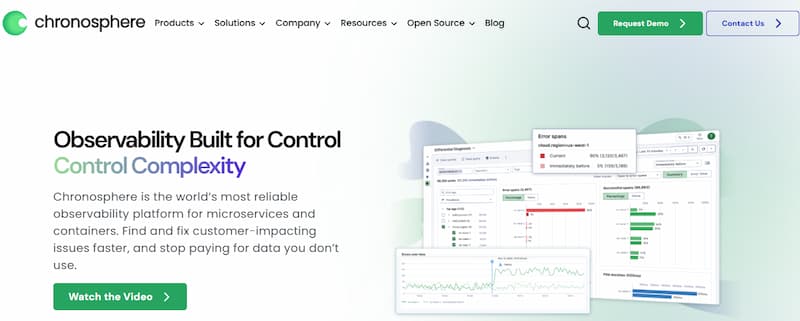
Chronosphere was founded by the creators of M3, the open source metrics engine built at Uber to handle billions of time series. The platform is designed specifically for cloud native environments where Kubernetes pods, ephemeral containers, and microservices generate high-cardinality data at scale.
The core value proposition is telemetry control. Chronosphere lets teams send all raw telemetry to the platform, then applies filtering, aggregation, and retention rules at the point of ingestion. This means you can collect everything, analyze what matters, and pay only for what you store. The control plane shows which data is actually used in dashboards and alerts, helping teams make informed decisions about what to retain.
Chronosphere is fully compatible with Prometheus remote write and OpenTelemetry, so instrumentation is portable. The query language is PromQL, and the platform stores metrics in M3DB, a time series database designed for high throughput and high cardinality workloads.
Pricing: Chronosphere uses a retention-based model. Teams pay a small ingest fee, then primarily for retained data after filtering. Exact pricing is custom and not publicly listed, but documented migrations show 30–50% cost savings compared to per-host models at scale.
Pros:
- Control plane provides real-time visibility into which telemetry is actually used
- Native Prometheus and OpenTelemetry compatibility
- Architected for high cardinality data without cost explosion
- Predictable costs that scale with value, not infrastructure size
- Hands-on customer success team helps with migration and optimization
Cons:
- Requires upfront configuration to define what data is valuable
- Platform breadth narrower than Datadog (no RUM, synthetics, or security monitoring)
- Custom pricing means no public rate card for budget modeling
- Smaller integration ecosystem compared to Datadog
Datadog Overview
Datadog is the market leader in full-stack observability, serving thousands of customers with a platform that covers infrastructure monitoring, APM, log management, RUM, synthetics, security monitoring, and CI/CD visibility. The platform is known for fast onboarding, an agent that auto-discovers services, and pre-built dashboards for hundreds of integrations.
Datadog’s strength is breadth. You can monitor AWS EC2 instances, Kubernetes clusters, databases, frontend user sessions, API synthetics, and security vulnerabilities from a single UI. The ecosystem includes over 1,000+ integrations, making it easy to connect almost any tool in your stack.
The platform supports OpenTelemetry ingestion, but the agent-based architecture and proprietary data format create vendor lock-in. Dashboards, queries, and alerts are built in Datadog’s own query language, not PortableQL or LogQL.
Pricing: Datadog uses consumption-based pricing across multiple SKUs. Infrastructure monitoring starts at $15/host/month for standard plans, APM at $31/host/month, logs at $0.10/GB ingested plus $1.70/million events indexed, and custom metrics at $0.05 per 100 custom metrics. Bills can jump unexpectedly when infrastructure auto-scales or metric cardinality increases.
Pros:
- Broadest platform coverage in the market, covering MELT + security + CI/CD
- Fast time to value with agent-based auto-discovery
- 1,000+ integrations cover almost every tool and cloud service
- Strong anomaly detection and ML-based alerting
- Enterprise-grade support and documentation
Cons:
- Cost complexity across multiple billing dimensions makes forecasting hard
- High cardinality metrics can become very expensive
- Proprietary query language and data format create lock-in
- Public cloud egress fees add $0.10/GB when sending telemetry to Datadog SaaS
- Retention limits require additional spend for long-term storage
Chronosphere vs Datadog: Feature-by-Feature Comparison
Cost Model and Predictability
Chronosphere charges a small ingest fee, then bills primarily for retained data after filtering. This separates data collection from storage cost. The control plane shows which metrics, logs, and traces are actively used in dashboards and alerts, helping teams drop low-value telemetry before it hits long-term storage. Documented case studies show 30–50% savings compared to per-host models at the same scale. Pricing is custom, so no public rate card exists for modeling.
Datadog bills across multiple dimensions: hosts, custom metrics, log ingestion, indexed logs, APM traces, and product-specific fees for RUM, synthetics, and security monitoring. A 50-node Kubernetes cluster costs $1,550/month for APM alone before adding logs or custom metrics. High cardinality metrics like Kubernetes pod labels can drive custom metric counts into the hundreds of thousands, adding thousands in monthly costs. Reddit threads document bills jumping from $900 to $8,000 in a single month after a traffic spike.
Pricing based on publicly available information as of June 2026. Enterprise discounts, custom contracts, and negotiated rates are not reflected here.
Verdict: Chronosphere offers better cost predictability for cloud native workloads with high cardinality. Datadog’s cost model is easier to understand initially but harder to forecast as infrastructure scales.
Data Control and Telemetry Management
Chronosphere is built around at-ingest control. The control plane analyzes all incoming data in real time, letting you filter, aggregate, or drop low-value telemetry before storage. For example, you can retain a metric at 10-second resolution for alerting but store it at 1-minute resolution for long-term trending. The platform provides analytics showing which data is used in dashboards and alerts, helping teams identify noise. This approach works well for teams drowning in telemetry from Kubernetes auto-scaling and ephemeral containers.
Datadog relies primarily on pre-ingest control. Cost management requires filtering data before it reaches Datadog using agent-side configuration, Observability Pipelines, or custom OpenTelemetry collectors. In-platform controls like Metrics without Limits and Logging without Limits help after ingestion, but the fundamental strategy for cost-conscious users is shaping data before it enters Datadog. This places more burden on engineering teams to predict what data will be valuable before collecting it.
Verdict: Chronosphere gives better post-collection control, letting teams send everything and decide value later. Datadog requires more upfront filtering, which can lead to blind spots if you filter too aggressively.
OpenTelemetry and Open Standards Support
Chronosphere is fully compatible with Prometheus remote write and OpenTelemetry. The query language is PromQL, and the platform stores metrics in M3DB, an open source time series database. Instrumentation is portable. If you switch platforms, your Prometheus exporters and OTel agents work with any OpenTelemetry-compatible backend. This avoids vendor lock-in at the instrumentation layer.
Datadog supports OpenTelemetry ingestion, but the ecosystem is built around the proprietary Datadog Agent. Dashboards use Datadog’s query language, not PromQL or LogQL. Alerts and SLOs are configured in Datadog-specific formats. Migrating away from Datadog requires rewriting dashboards, queries, and alert definitions, not just changing an endpoint. This creates significant switching cost for teams deeply integrated with the platform.
Verdict: Chronosphere provides better open standards alignment and instrumentation portability. Datadog’s proprietary ecosystem creates lock-in.
Platform Breadth and Observability Coverage
Chronosphere focuses on metrics, logs, and traces. The platform does not include RUM, synthetics, security monitoring, or CI/CD visibility. For teams that need only core MELT signals, this is fine. For teams that want one platform covering everything, Chronosphere requires additional tools.
Datadog offers the broadest coverage in the observability market. Beyond MELT, it includes Real User Monitoring for frontend performance, Synthetic Monitoring for proactive endpoint checks, Application Security Management for runtime threat detection, and CI/CD visibility for pipeline performance. The platform integrates with over 1,000+ services, from AWS and GCP to niche databases and SaaS tools. This breadth reduces tool sprawl and provides a single pane of glass for all observability needs.
Verdict: Datadog wins on breadth. Chronosphere is narrower but deeper for cloud native metrics and cost control.
Alerting and Noise Reduction
Chronosphere takes an opinionated, SLO-driven approach to alerting. The platform encourages teams to define service level objectives first, then alert on meaningful deviations. The control plane helps reduce noise by filtering out low-value signals before they trigger alerts. This works well for teams struggling with alert fatigue from Kubernetes pod restarts and ephemeral container churn.
Datadog offers highly flexible alerting across all signal types. You can alert on metrics, logs, traces, events, and composite conditions using anomaly detection, forecasting, and outlier analysis. The flexibility is powerful but can lead to alert fatigue if not carefully managed. Community discussions highlight alert noise as a common challenge, requiring teams to tune thresholds and anomaly models continuously.
Verdict: Chronosphere reduces alert noise through opinionated SLO-driven workflows. Datadog provides more flexibility but requires active tuning to avoid fatigue.
Ease of Onboarding and Migration
Chronosphere requires more upfront configuration. Teams must define which telemetry is valuable, set retention policies, and configure aggregation rules. The customer success team provides hands-on migration support, but the process takes longer than Datadog. Documented migrations show 4-6 weeks for full cutover, including dashboard and alert migration.
Datadog is known for fast onboarding. Install the agent, point it at your infrastructure, and pre-built dashboards appear immediately. The agent auto-discovers services, containers, and cloud resources without manual configuration. This makes Datadog the fastest path to initial visibility, especially for teams new to observability.
Verdict: Datadog wins on speed to initial value. Chronosphere requires more setup but delivers better long-term cost and control.
Pricing Comparison: Real Cost Scenarios
The table below models total monthly cost for a mid-sized engineering team running a cloud native stack. The scenario assumes 30TB monthly ingestion (20TB logs, 7TB traces, 3TB metrics), 100 hosts, 30-day retention, and 500,000 active metric series.
| Cost Component | Chronosphere | Datadog |
|---|---|---|
| Infrastructure monitoring | Included in data retention fee | $1,500 (100 hosts × $15/host) |
| APM traces | Included in data retention fee | $3,100 (100 hosts × $31/host) |
| Log ingestion | Small ingest fee + retained data | $2,000 (20TB × $0.10/GB ingest) |
| Log indexing | Included | $5,100 (3B events × $1.70/M indexed) |
| Custom metrics | Included in data retention fee | $2,500 (500K series × $0.05/100) |
| Data egress | $0 (SaaS hosted) | $3,000 (30TB × $0.10/GB AWS egress) |
| Estimated monthly total | $8,000–$12,000 (custom pricing, retained data model) | $17,200 (before RUM, synthetics, security) |
This estimate models a production-ready setup with high availability. A smaller or simpler deployment may cost significantly less.
Chronosphere’s cost depends on how much data you retain after filtering. The control plane typically helps teams reduce retained data by 40-60%, bringing the effective cost well below headline ingestion rates. Datadog’s cost is more predictable for small deployments but compounds as infrastructure, cardinality, and product usage scale.
Who Should Choose Chronosphere
Best for:
- Cloud native teams managing Kubernetes clusters with high pod churn
- Engineering organizations drowning in telemetry noise and high cardinality metrics
- Teams that want OpenTelemetry and Prometheus compatibility without vendor lock-in
- Companies with unpredictable Datadog bills looking for cost control
Not ideal for:
- Teams needing RUM, synthetics, or security monitoring in one platform
- Organizations that want fast onboarding with minimal upfront configuration
- Small teams without dedicated platform engineering resources
- Companies requiring public pricing transparency for budget approval
Who Should Choose Datadog
Best for:
- Enterprises needing broad platform coverage across MELT, RUM, synthetics, security, and CI/CD
- Teams that value fast time to value with agent-based auto-discovery
- Organizations with complex multi-cloud environments requiring 700+ integrations
- Companies willing to pay premium pricing for enterprise-grade support
Not ideal for:
- Cost-sensitive teams managing high cardinality Kubernetes workloads
- Organizations with data residency or compliance requirements that block SaaS
- Teams prioritizing open standards and avoiding vendor lock-in
- Small to mid-sized engineering teams with tight observability budgets
CubeAPM: A Third Option for Teams Evaluating Both
CubeAPM is a self-hosted observability platform that runs inside your cloud or data center, combining the full-stack coverage of Datadog with the cost control and data sovereignty of self-hosted solutions. It covers APM, logs, infrastructure, Kubernetes, RUM, synthetics, and error tracking with OpenTelemetry-native instrumentation and predictable $0.20/GB pricing.
Unlike SaaS platforms, CubeAPM keeps telemetry data inside your infrastructure, eliminating public cloud egress fees and meeting data residency requirements by default. Unlike DIY self-hosted stacks, CubeAPM is vendor-managed so upgrades, patches, and backend maintenance are handled by the CubeAPM team, not your engineers.
| Feature | Chronosphere | Datadog | CubeAPM |
|---|---|---|---|
| Cost model | Retained data after filtering | Consumption-based across many SKUs | $0.20/GB ingested, unlimited users |
| Deployment | SaaS only | SaaS only | Self-hosted, vendor-managed |
| Data egress fees | Included | $0.10/GB to SaaS | $0 (data stays in your VPC) |
| OpenTelemetry | Native | Supported, but ecosystem favors Datadog Agent | Native |
| Platform breadth | Metrics, logs, traces | MELT + RUM + synthetics + security | MELT + RUM + synthetics + Kubernetes |
| Retention | Configurable | 15 months standard, pay more for longer | Unlimited at no extra cost |
| Best for | Cloud native cost control | Broad enterprise observability | Cost-sensitive teams needing data control |
CubeAPM fits teams that want Datadog-level coverage without SaaS pricing or data export, and Chronosphere-level cost control without giving up RUM and synthetics. Documented migrations show 70-75% savings compared to Datadog at the same scale.
Verdict: Chronosphere vs Datadog in 2026
Choose Chronosphere if: You run cloud native infrastructure at scale, need better cost control than Datadog provides, want OpenTelemetry and Prometheus compatibility, and are willing to invest upfront in telemetry filtering and retention strategy. Chronosphere is the better choice for teams drowning in high-cardinality Kubernetes metrics and unpredictable SaaS bills.
Choose Datadog if: You need the broadest observability platform coverage, want fast onboarding with minimal configuration, require 700+ integrations across your stack, and have budget for premium pricing. Datadog is the better choice for enterprises that prioritize feature breadth and are willing to manage cost complexity.
Choose CubeAPM if: You need full-stack observability like Datadog but want to keep telemetry data inside your infrastructure, avoid unpredictable SaaS pricing, and meet data residency or compliance requirements. CubeAPM is the better choice for cost-sensitive teams that want control without DIY backend complexity.
Disclaimer: The information in this article reflects the latest details available at the time of publication and may change as technologies and products evolve. Features, pricing, and plan limits can change over time. Always verify the latest information directly with the vendor before making purchasing or deployment decisions.
Frequently Asked Questions
How much does Chronosphere cost compared to Datadog?
Chronosphere uses a retention-based model where you pay primarily for stored data after filtering, while Datadog bills across multiple SKUs for hosts, logs, metrics, and products. Documented migrations show Chronosphere delivering 30 to 50 percent cost savings at scale for cloud native workloads, but exact pricing requires a custom quote.
Does Chronosphere support OpenTelemetry?
Yes, Chronosphere is fully compatible with OpenTelemetry and Prometheus remote write. The query language is PromQL and instrumentation is portable, avoiding vendor lock-in at the agent layer.
Can Datadog handle high cardinality metrics?
Datadog can ingest high cardinality metrics but costs scale quickly. Custom metrics are billed at $0.05 per 100 metrics, and Kubernetes environments with pod labels can generate hundreds of thousands of unique series, adding thousands in monthly costs.
Does Chronosphere include RUM and synthetics?
No, Chronosphere focuses on metrics, logs, and traces. Teams needing RUM or synthetics must use additional tools alongside Chronosphere.
Does Netflix use Datadog?
Netflix uses a mix of observability tools including internal platforms and open source solutions. While Datadog is widely adopted across the industry, Netflix primarily relies on custom-built observability infrastructure tailored to its scale.
Which platform is better for Kubernetes monitoring?
Chronosphere is architected specifically for cloud native environments with high pod churn and ephemeral containers. Its control plane helps filter Kubernetes noise and reduce cardinality. Datadog offers broader Kubernetes coverage including security and cost monitoring, but high cardinality can drive up costs quickly.
Can I migrate from Datadog to Chronosphere?
Yes, but dashboards and alerts must be rebuilt because Datadog uses proprietary query syntax. Chronosphere provides migration tooling and customer success support, with documented migrations taking four to six weeks for full cutover including alert and dashboard migration.