










Stackify Retrace is an application performance monitoring and troubleshooting platform for developers and DevOps teams. It combines APM, code-level tracing, centralized logging, error tracking, server and application monitoring, RUM, deployment tracking, dashboards, and alerts. Stackify’s current Retrace page describes it as a full-lifecycle APM and observability product built for code-level tracing and production troubleshooting.
Stackify Retrace pricing and review in 2026 needs extra care because the product has an announced End of Life date. BMC’s official EOL notice says Stackify Retrace will continue to receive support through March 31, 2027, but it is functionally stabilized and will not receive further enhancements during that period.
In this guide, we verify Retrace pricing signals, plan limits, cost drivers, user reviews, EOL risk, and alternatives such as CubeAPM, Datadog, New Relic, Dynatrace, Splunk AppDynamics, Site24x7, ManageEngine Applications Manager, and Grafana Cloud.
What Is Stackify Retrace?
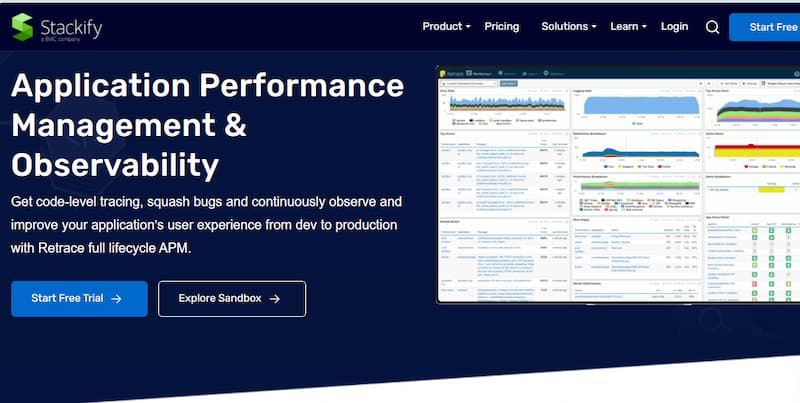
Stackify Retrace is a SaaS APM and observability platform used by engineering teams to troubleshoot application performance issues. It helps teams connect slow requests, exceptions, logs, SQL queries, external calls, deployments, server metrics, and application behavior in one workflow. Stackify’s Retrace page lists centralized logging, full transaction tracing, error tracking, application and server monitoring, real user monitoring, and deployment tracking as product areas.
Retrace has historically been especially relevant for .NET and Java teams, but Stackify’s current page also lists .NET Core, PHP, Node.js, Ruby, Python, and Java support, along with common databases and infrastructure such as SQL Server, Oracle, PostgreSQL, MySQL, MongoDB, Elasticsearch, Redis, AWS, and Azure.
The key point for buyers is that Retrace is now a lifecycle-risk product. BMC says Stackify is SaaS-only and will no longer be available or accessible after March 31, 2027. Customers will not be able to log in, ingest data, or access stored information after that date.
Important 2026 Status Note: Stackify Retrace End of Life
Stackify Retrace will reach End of Life on March 31, 2027. Stackify’s own Retrace page displays this EOL notice at the top of the product page.
BMC’s official EOL letter says support continues through March 31, 2027, but the product is functionally stabilized and will not receive further enhancements. It also recommends customers consider transitioning to BMC Helix AIOps with OpenTelemetry as part of their future roadmap.
This changes the buying decision. The question is not only “How much does Retrace cost?” The bigger question is whether a team should buy, renew, or migrate away from a SaaS product that becomes inaccessible after March 31, 2027.
Who Uses Stackify Retrace?
Stackify Retrace is mainly used by developers, DevOps teams, application support teams, backend engineering teams, and SRE teams that need code-level troubleshooting.
Common users include:
- .NET developers
- Java developers
- Backend engineering teams
- DevOps and application support teams
- SaaS teams running production web applications
Retrace is strongest when the team wants to connect application performance problems with code, logs, exceptions, SQL queries, dependencies, deployments, and server metrics.
Supported Platforms, Integrations, and Data Sources
| Area | Verified Stackify Retrace support |
| Core use case | APM, logs, traces, errors, app/server monitoring |
| Languages listed by Stackify | .NET, .NET Core, PHP, Node.js, Ruby, Python, Java |
| Databases and dependencies | SQL Server, Oracle, PostgreSQL, MySQL, MongoDB, Elasticsearch, Redis |
| Cloud support | AWS and Azure |
| Developer workflows | Code profiling, deployment tracking, custom dashboards, alerts |
Stackify’s live Retrace page also lists CI/CD and workflow integrations such as TeamCity, Jenkins, Octopus, Jira, VS Online/TFS, Axosoft, Slack, email, and SMS.
Key Features of Stackify Retrace
Retrace provides application performance visibility across requests, dependencies, application metrics, slow transactions, errors, and alerts. Stackify describes Retrace as full-lifecycle APM that helps teams continuously improve application performance from development to production.
Retrace supports full transaction tracing. Developers can move from a log statement to a transaction trace, inspect SQL queries and HTTP calls, and troubleshoot slow dependencies.
Retrace includes lightweight code-level profiling. This is one of its strongest developer-focused features because it helps teams identify slow code paths and runtime bottlenecks without relying only on infrastructure metrics.
Retrace combines error tracking with logs and APM. Stackify says users can view logs and exceptions side by side, identify exceptions, monitor exception rates, and proactively detect application bugs.
Retrace includes centralized logging for application and server logs. Stackify says teams can search and drill into logs, use structured logging, monitor custom log queries, and connect logs with transaction traces.
The original draft needed a correction here. Retrace should not be described as having no RUM. Stackify’s live product page lists Real User Monitoring and says Retrace RUM combines front-end and back-end monitoring to connect user experience with application performance.
Retrace includes deployment tracking. Stackify says teams can see when and where deployments happen, click deployment markers for context, automate deployment tracking through CI/CD tools, and attribute performance changes to releases.
Stackify Retrace Pricing in 2026
Stackify Retrace does not currently publish a clear, current 2026 pricing table on its live product page. The live Retrace page describes the product, features, and trial path, but it does not show a visible self-serve rate card with current plan prices, included traces, included logs, server limits, retention limits, or Enterprise pricing.
That means the safest verified statement is: Stackify Retrace pricing is not publicly listed in a current vendor rate card. Buyers should contact Stackify or BMC directly for current pricing, renewal terms, support terms, and migration guidance.
This is especially important because Stackify Retrace has an announced End of Life date. BMC’s official notice says Stackify customers will continue to have access to support through March 31, 2027. After that date, buyers should not assume normal long-term product availability or roadmap support.
| Pricing question | Verified answer |
| Does Stackify publish current 2026 Retrace pricing? | No clear current public pricing table is visible |
| Are current plan prices listed? | Not publicly listed on the live Retrace page |
| Are included logs and traces listed? | Not clearly listed in a current public rate card |
| Is Enterprise pricing listed? | Not publicly listed |
| What should buyers do? | Contact Stackify/BMC directly |
Historical Stackify Retrace Pricing Context
Stackify has older vendor-owned pricing content that can be used only as historical context, not as current 2026 pricing.
A Stackify pricing article from September 2020 said Retrace pricing started at $99/month, or $79/month with annual billing. The same article said additional traces cost $1.50 per 10,000 traces and additional logs cost $0.025 per 10,000 logs. However, because this is older vendor content and not shown as a current 2026 rate card, it should not be presented as current pricing.
Stackify also published a 2022 announcement saying Netreo introduced consumption-based Retrace pricing starting at $9.99/month. This should also be treated as historical vendor-published pricing, not current confirmed 2026 pricing, unless Stackify/BMC confirms it during procurement.
| Historical vendor source | Published pricing signal | How to use it |
| Stackify 2020 pricing article | Starts at $99/month, or $79/month annually | Historical context only |
| Stackify 2020 pricing article | $1.50 per 10,000 extra traces | Historical context only |
| Stackify 2020 pricing article | $0.025 per 10,000 extra logs | Historical context only |
| Stackify/Netreo 2022 announcement | Starts at $9.99/month | Historical context only |
| Current live Retrace page | No visible current rate card | Use “contact vendor” wording |
How Stackify Retrace Pricing Works
Based on vendor-owned historical pricing content, Retrace has used a mix of base plan pricing, trace volume, and log volume. Older Stackify pricing content specifically mentioned extra charges for additional traces and additional logs, which suggests that high-volume environments could pay more than the base plan price.
However, the current live product page does not expose a complete 2026 pricing table. So buyers should not assume that old plan names, old starting prices, old overage rates, or old usage limits still apply.
The correct 2026 wording is:
Stackify Retrace does not currently publish transparent public pricing. Buyers must contact Stackify or BMC for current pricing, renewal terms, usage limits, and migration guidance.
What Does Stackify Retrace Really Cost?
⚠️ Disclaimer
The scenarios below are directional editorial estimates, not official Stackify, Netreo, or BMC quotes. Stackify does not publish a clear current 2026 Retrace pricing table on its live product page. Historical vendor pricing exists, but it should not be treated as current pricing. Buyers should confirm final pricing directly before purchase or renewal.
Retrace is difficult to estimate in 2026 because current vendor-published pricing is limited. Stackify’s older pricing content suggests that logs and traces have historically affected cost, but current plan limits, included usage, overage terms, renewal pricing, and Enterprise pricing are not publicly visible in a current vendor rate card.
The product lifecycle also affects the real cost. Since Retrace has an announced EOL timeline, teams should consider not only subscription pricing, but also migration planning, data export, dashboard rebuilding, alert migration, agent removal, and team retraining. BMC confirms continued customer support through March 31, 2027.
Pricing Assumptions Used in These Scenarios
Because current Stackify Retrace pricing is not publicly listed, the cost scenarios below should be framed as planning ranges, not verified plan calculations.
| Scenario | Pricing basis | Editorial Retrace estimate | CubeAPM estimate |
| Small team | Vendor quote or renewal discussion required | Quote-based | ~$522/month |
| Growing team | Vendor quote or renewal discussion required | Quote-based | ~$919/month |
| Mid-market team | Enterprise quote and migration planning required | Quote-based | ~$4,594/month |
The important change here is that we should not invent a Retrace monthly cost range if Stackify/BMC does not publish current pricing. We can still compare pricing transparency, but not exact Retrace cost.
Workload Assumptions Used for Evaluation
| Team size | Infra context | Logs | Traces/APM | Metrics | Total telemetry |
| Small team | 10 hosts | 720 GB/mo | 360 GB/mo | 1 GB/mo | 1.1 TB/mo |
| Growing team | 50 hosts | 3,600 GB/mo | 1,800 GB/mo | 5 GB/mo | 5.4 TB/mo |
| Mid-market team | 250 hosts | 18,000 GB/mo | 9,000 GB/mo | 25 GB/mo | 27 TB/mo |
For Retrace, these workload assumptions are useful for procurement discussions, but they cannot be converted into an accurate public monthly price because Stackify does not publish a current 2026 rate card.
Scenario 1: Small Team, About 10 Hosts
Situation
A small production team runs about 10 hosts and produces about 1.1 TB/month of total telemetry. This includes logs, traces/APM data, and metrics.
Retrace may still be useful for a small team that wants APM, transaction traces, error tracking, centralized logs, application metrics, server monitoring, and deployment tracking. Stackify’s live page still describes these as Retrace capabilities.
Estimated Monthly Cost
| Component | Status |
| Current Retrace plan price | Not publicly listed |
| Included logs/traces | Not publicly listed in a current vendor rate card |
| Enterprise or renewal terms | Contact Stackify/BMC |
| Estimated Retrace total | Quote-based |
| CubeAPM estimate | ~$522/month |
What This Scenario Shows
For a small team, Retrace cannot be accurately priced from public 2026 vendor information. The team should contact Stackify/BMC and ask for current pricing, included usage, retention, support terms, and EOL transition options.
CubeAPM is easier to estimate because the workload maps directly to ingestion-based pricing.
Scenario 2: Growing Team, About 50 Hosts
Situation
A growing team runs about 50 hosts and produces about 5.4 TB/month of total telemetry. At this scale, pricing clarity becomes more important because logs, traces, retention, and support needs can materially affect the final cost.
Estimated Monthly Cost
| Component | Status |
| Current Retrace plan price | Not publicly listed |
| Included logs/traces | Not publicly listed in a current vendor rate card |
| Renewal or Enterprise package | Contact Stackify/BMC |
| Migration planning | Should be included because of EOL |
| Estimated Retrace total | Quote-based |
| CubeAPM estimate | ~$919/month |
What This Scenario Shows
For a growing team, Retrace should be evaluated carefully as a lifecycle and migration decision, not only a pricing decision. The lack of a current public pricing table makes budgeting harder, and the EOL timeline means teams should ask about migration paths before renewing.
Scenario 3: Mid-Market Team, About 250 Hosts
Situation
A mid-market team runs about 250 hosts and produces about 27 TB/month of total telemetry. This type of environment likely needs Enterprise-level support, retention planning, multiple teams, alert migration, dashboard migration, and long-term vendor confidence.
Estimated Monthly Cost
| Component | Status |
| Current Retrace Enterprise pricing | Not publicly listed |
| Current usage limits | Not publicly listed |
| Current retention terms | Not publicly listed |
| EOL migration planning | Required before March 31, 2027 |
| Estimated Retrace total | Quote-based |
| CubeAPM estimate | ~$4,594/month |
What This Scenario Shows
At mid-market scale, Retrace should mainly be treated as an existing-customer renewal or migration-planning question. Since public pricing is not available and EOL is confirmed, teams should ask Stackify/BMC for pricing, support terms, export options, and migration guidance before committing.
Summary: Stackify Retrace vs CubeAPM Pricing Visibility
| Team profile | Stackify Retrace estimate | CubeAPM estimate | Pricing clarity |
| Small team | Quote-based | ~$522/month | CubeAPM easier to estimate |
| Growing team | Quote-based | ~$919/month | CubeAPM easier to estimate |
| Mid-market team | Quote-based | ~$4,594/month | CubeAPM easier to estimate |
What This Cost Comparison Shows
Stackify Retrace is hard to model from public pricing information because Stackify does not publish a current 2026 rate card on the live product page. Historical vendor pricing exists, but it should not be used as current pricing unless Stackify/BMC confirms it.
The biggest issue is not just pricing. It is product lifecycle. BMC’s EOL notice confirms continued support through March 31, 2027, so teams should include migration planning in the real cost of staying on Retrace.
CubeAPM is easier to estimate in these scenarios because the provided workload assumptions map to a per-GB pricing model. Retrace may still make sense for existing customers that need short-term continuity, but new buyers should compare current alternatives before adopting it.
What Drives Stackify Retrace Costs?
Public listings show plan ranges such as 1–2 servers and 3–5 servers. Larger environments likely need custom or Enterprise pricing.
Retrace plans include log-count limits, such as 2M logs on Logs & Errors and Essentials, and 10M logs on Standard.
APM traces are a key pricing factor. GetApp lists 500K traces on Essentials and 2M traces on Standard. G2 also says Stackify pricing is based on trace and log usage.
Public listings show 7-day log and trace retention on Essentials, 15-day log retention on Standard, and 7-day trace retention on Standard.
The biggest real cost driver is migration. Because Stackify Retrace becomes inaccessible after March 31, 2027, teams need to plan data export, agent removal, dashboard migration, alert migration, runbook updates, and team retraining.
Stackify Retrace User Reviews
Stackify Retrace has a moderate public review footprint.
| Review source | Public rating | Review count |
| G2 | 4.2/5 | 56 reviews |
| GetApp | 4.3/5 | 76 reviews |
| Capterra/GetApp network | 4.3/5 | 76 reviews |
G2 lists Stackify APM at 4.2/5 from 56 reviews. GetApp lists Retrace by Netreo at 4.3/5 from 76 reviews, with ratings of 4.2 for ease of use, 4.2 for features, 4.3 for value for money, and 4.2 for customer support.
What Users Like
GetApp’s review summary says users report strong tools for identifying and resolving bugs, with error tracking, root cause analysis, and real-time monitoring helping teams reduce troubleshooting time.
Users value Retrace’s ability to keep application and server logs searchable and connected to debugging workflows. Stackify’s product page supports this positioning by describing centralized logging with log search, drill-down, structured logging, and links from logs to traces.
Retrace’s error tracking is a recurring strength. Stackify says teams can view logs and exceptions side by side, monitor exception rates, and identify application bugs.
Retrace helps teams inspect slow dependencies, traces, SQL queries, and runtime performance. This is especially useful for teams that need application-level debugging rather than only infrastructure monitoring.
G2 lists unlimited users as part of the Standard pricing signal. This can be attractive for teams that want developers, QA, support, and operations teams to collaborate without per-seat billing.
What Users Criticize
⚠️ Disclaimer
These points reflect public user-review themes and buyer concerns. They should not be treated as universal platform limitations.
GetApp’s review summary mentions occasional configuration challenges. This is common with APM tools because agents, logs, traces, dashboards, and alerts must be configured correctly.
GetApp’s review summary also mentions rare stability problems. Buyers should test agent reliability, trace collection, log ingestion, and alert behavior during a trial or renewal review.
Retrace pricing is harder to estimate from GB-based telemetry workloads because public plans use servers, logs, traces, and retention rather than a simple per-GB model.
Stackify Retrace Alternatives: How it Compares to Competitors
Stackify Retrace vs CubeAPM
Stackify Retrace is a developer-focused APM, logging, tracing, and error tracking tool with an announced EOL date. CubeAPM is a full-stack observability platform with predictable per-GB pricing, self-hosted vendor-managed deployment, and data that stays inside the customer environment. CubeAPM publishes pricing starting at $0.15/GB of data ingestion.
| Category | Stackify Retrace | CubeAPM |
| Best for | Existing Retrace users, developer APM | Full-stack observability |
| Pricing model | Servers, logs, traces, retention, custom terms | Per-GB ingestion |
| Deployment | SaaS-only | Self-hosted, vendor-managed |
| EOL status | EOL on March 31, 2027 | Not affected by Retrace EOL |
| Best buyer | Teams needing short-term continuity | Teams wanting predictable long-term observability |
Choose Retrace if you already use it and need continuity during the support window. Choose CubeAPM if you want predictable full-stack observability without the Retrace EOL risk.
Stackify Retrace vs Datadog
Datadog is a broad SaaS observability and security platform. Its official pricing page covers infrastructure monitoring, APM, logs, synthetics, RUM, network monitoring, security, and many other modules. Datadog pricing is modular, so teams need to model each product separately.
| Category | Stackify Retrace | Datadog |
| Best for | Developer APM and logs | Broad SaaS observability |
| Pricing model | Server/log/trace limits | Modular by product |
| Logs | Included by plan limits | Separate log pricing |
| RUM/synthetics | RUM listed; synthetics not a core Retrace pricing unit | Strong dedicated products |
| Best buyer | Existing Retrace teams | Teams wanting a large SaaS platform |
Datadog is stronger for teams that want a modern, broad observability suite. Retrace is more relevant for existing customers that need continuity before EOL.
Stackify Retrace vs New Relic
New Relic is a SaaS observability platform with data-ingest and user-based pricing. New Relic’s pricing page says the free tier includes 100 GB/month of data ingest, and New Relic’s billing documentation says it bills by GB ingested regardless of data type.
| Category | Stackify Retrace | New Relic |
| Best for | Developer-focused APM | Broad SaaS observability |
| Pricing model | Servers, logs, traces, retention | Data ingest plus users |
| Free tier | Trial signals | 100 GB/month free ingest |
| Long-term roadmap | EOL risk | Active platform |
| Best buyer | Existing Retrace users | Teams wanting modern SaaS observability |
New Relic is better for teams that want a current full-stack SaaS observability platform. Retrace is better treated as a short-term continuity option for existing users.
Stackify Retrace vs Dynatrace
Dynatrace is an enterprise observability platform with application, infrastructure, log, digital experience, and security monitoring. Dynatrace publishes a rate card with hourly pricing, including Full-Stack Monitoring at $0.01 per memory-GiB-hour and Infrastructure Monitoring at $0.04 per hour for any size host.
| Category | Stackify Retrace | Dynatrace |
| Best for | Developer troubleshooting | Enterprise observability |
| Pricing model | Plan limits and custom pricing | Usage-based rate card |
| Automation | More limited | Strong enterprise automation |
| EOL risk | Yes | No Retrace-specific EOL risk |
| Best buyer | Existing Retrace customers | Enterprises needing deep automation |
Dynatrace is stronger for large enterprises that need automation and broad monitoring. Retrace is lighter and developer-focused, but the EOL risk weakens its long-term case.
Stackify Retrace vs Splunk AppDynamics
Splunk AppDynamics is an enterprise APM platform for application performance and business transaction monitoring. Splunk’s official observability pricing page lists AppDynamics APM starting at $33 per month per CPU core, billed annually.
| Category | Stackify Retrace | Splunk AppDynamics |
| Best for | Developer APM and logs | Enterprise APM |
| Pricing model | Server/log/trace limits | Per CPU core |
| Enterprise depth | Moderate | Stronger |
| EOL risk | Yes | No Retrace-specific EOL risk |
| Best buyer | Existing Retrace users | Large enterprises with complex apps |
AppDynamics is a stronger long-term enterprise APM option. Retrace may still be useful for developer teams already using it, but it is not a clean long-term choice for new buyers.
Stackify Retrace vs Site24x7
Site24x7 is an all-in-one monitoring platform for websites, servers, applications, logs, cloud services, networks, and user experience. Site24x7’s pricing page shows All-in-One Monitoring Lite starting at $10/month, or $9/month when paid annually, with higher tiers and add-ons available.
| Category | Stackify Retrace | Site24x7 |
| Best for | Developer APM and debugging | Affordable all-in-one monitoring |
| Pricing model | Plan limits and custom terms | Public tiered pricing |
| Website monitoring | Not primary focus | Stronger |
| APM | Developer-focused | Included in broader monitoring |
| Best buyer | Existing Retrace users | Cost-conscious teams |
Site24x7 may be better for teams that want broad monitoring at a lower entry price. Retrace may be better for developer-centric code tracing during the remaining support window.
Stackify Retrace vs ManageEngine Applications Manager
ManageEngine Applications Manager is an application and infrastructure monitoring tool for servers, apps, databases, cloud workloads, and enterprise IT environments. ManageEngine’s official pricing page says add-ons are priced as flat fees and gives SAP Add-on pricing as an example, while public directory listings show Professional and Enterprise annual pricing signals.
| Category | Stackify Retrace | ManageEngine Applications Manager |
| Best for | Developer APM and logs | IT ops and app monitoring |
| Pricing model | Plan limits and custom terms | Annual monitor-based pricing |
| Deployment | SaaS-only | Often self-hosted/enterprise-managed |
| Code-level focus | Stronger for developer tracing | Broader IT monitoring |
| Best buyer | Developer teams | IT operations teams |
ManageEngine is better for IT operations teams that want broader application and infrastructure monitoring. Retrace is more developer-focused, but its EOL status limits the long-term buying case.
Stackify Retrace vs Grafana Cloud
Grafana Cloud is a managed observability platform for metrics, logs, traces, profiles, dashboards, and k6 performance testing. Grafana’s pricing page lists a free tier and Pro plan starting from $19/month plus usage, while Grafana Cloud documentation lists logs, traces, and profiles usage charges such as $0.40/GB written after the free allotment.
| Category | Stackify Retrace | Grafana Cloud |
| Best for | Developer APM and logs | Metrics, logs, traces, dashboards |
| Pricing model | Servers, logs, traces, retention | Platform fee plus usage |
| Dashboards | Built-in Retrace dashboards | Grafana-native dashboards |
| EOL risk | Yes | No Retrace-specific EOL risk |
| Best buyer | Existing Retrace users | Teams standardizing on Grafana |
Grafana Cloud is a better fit for teams that already use Grafana or want a composable observability stack. Retrace is more focused on developer APM but has a limited runway.
Is Stackify Retrace the Right Choice?
Stackify Retrace Works Best For
- Existing Retrace customers that need continuity before EOL
- .NET and Java teams that rely on Retrace workflows
- Developer-focused teams that need code-level tracing and logs
- Teams that use Retrace for errors, logs, and deployment context
- Organizations planning a short-term renewal while preparing migration
Stackify Retrace May Not Be the Right Fit For
- New long-term buyers
- Teams that need roadmap confidence beyond March 31, 2027
- Teams that want simple GB-based pricing
- Teams that need a broad modern observability suite
- Teams that cannot risk losing SaaS access after the EOL date
Buyer Checklist: Questions to Ask Before Buying or Renewing Retrace
Before buying or renewing Stackify Retrace, ask:
- Can new customers still buy Retrace?
- What happens after March 31, 2027?
- What support is included before EOL?
- Is there a migration path to BMC Helix AIOps?
- Can we export all required data before EOL?
- Which plan applies to our server count?
- How many logs and traces are included?
- What happens if we exceed log or trace limits?
- How long are logs and traces retained?
- Are there short-term renewal or migration incentives?
Conclusion
Stackify Retrace pricing and review in 2026 should be understood through two lenses: cost and lifecycle risk.
Public pricing signals show Logs & Errors around $35/month, Essentials around $99/month, Standard around $249/month, and Enterprise without public pricing. However, these are mostly directory-based pricing signals, not a clean official 2026 self-serve rate card. Pricing also does not map neatly to GB-based telemetry because public plan limits focus on servers, logs, traces, and retention.
The bigger issue is EOL. BMC says Stackify Retrace will be supported through March 31, 2027, but it is functionally stabilized, will not receive further enhancements, and will no longer be accessible after that date.
For existing customers, Retrace may still make sense as a short-term continuity tool while migration is planned. For new buyers, the safer move is to compare modern alternatives such as CubeAPM, Datadog, New Relic, Dynatrace, Splunk AppDynamics, Site24x7, ManageEngine Applications Manager, or Grafana Cloud before committing.
Disclaimer: Pricing, packaging, plan limits, support terms, renewal options, migration incentives, product availability, and EOL timelines can change. The cost examples in this article are editorial estimates based on publicly available information as of June 2026. Always confirm final pricing, support, limits, data export options, and migration terms directly with Stackify, BMC Helix, or the relevant vendor before purchase or renewal.
FAQs
1. How much does Stackify Retrace cost?
Public directory pricing signals show Logs & Errors at $35/month, Retrace Essentials at $99/month, and Retrace Standard at $249/month. G2 also lists a Tier 1 Annual Plan at $80/month. Enterprise pricing is not publicly listed.
2. Is Stackify Retrace still available in 2026?
Retrace appears accessible during its support period, but it has an announced End of Life date of March 31, 2027. Buyers should confirm new-purchase availability directly before starting a trial or procurement process.
3. When is Stackify Retrace End of Life?
Stackify Retrace reaches End of Life on March 31, 2027. BMC says the SaaS service will no longer be available or accessible after that date.
4. Does Stackify Retrace have a free trial?
Stackify’s live Retrace page still shows a “Start Free Trial” option, and GetApp also lists free trial availability. Buyers should confirm whether trials are still available for new customers in 2026.
5. What is included in Logs & Errors?
GetApp lists Logs & Errors at $35/month with 1–2 servers, 2M logs, 7-day log retention, no APM, and no traces.
6. What is included in Retrace Essentials?
GetApp lists Retrace Essentials at $99/month with 1–2 servers, 2M logs, 500K traces, 7-day log retention, 7-day summary data retention, and 7-day trace retention.
7. What is included in Retrace Standard?
GetApp lists Retrace Standard at $249/month with 3–5 servers, 10M logs, 2M traces, 15-day log retention, 7-day trace retention, and 12-month summary data retention.
8. Does Retrace charge per user?
G2 lists unlimited users for the Standard pricing signal. Buyers should confirm current user limits directly because public pricing information is not presented as a clean official 2026 rate card.