








AI models fail differently than traditional software. A slow database query shows up in latency percentiles. A memory leak triggers an alert when heap usage crosses a threshold. But when a large language model starts hallucinating, returning biased outputs, or silently degrading in accuracy, traditional observability tools miss it entirely. According to the CNCF AI Working Group’s Cloud Native Artificial Intelligence white paper, “Observability is vital to detect model drift, usage load, and more” as AI workloads move from experimentation to production.
This guide covers the AI specific metrics teams must track across every layer of the AI stack: from prompt level token consumption and latency to model drift detection, cost attribution, and AI safety signals that traditional APM was never designed to surface.
What Is AI Model Observability?
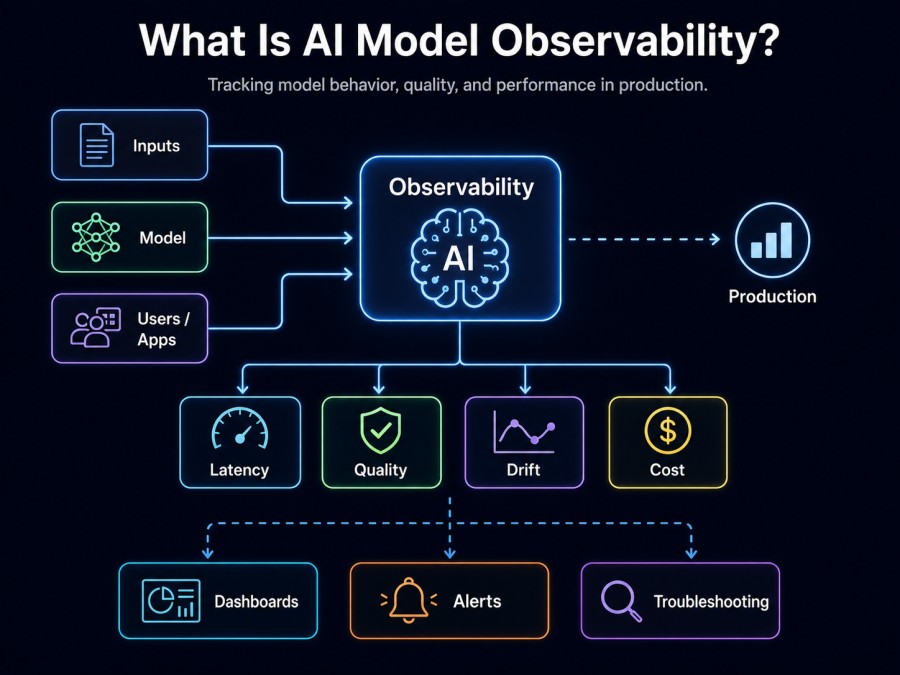
AI model observability is the practice of measuring and understanding the behavior of AI systems in production by tracking metrics that matter specifically for probabilistic, non deterministic workloads. Unlike traditional observability which focuses on uptime, latency, and error rates, AI observability adds entirely new dimensions: response quality, token economics, model drift, bias detection, and safety compliance.
Traditional software is deterministic. Run the same code with the same input and you get the same output every time. AI models break this assumption. The same prompt sent to an LLM twice can return different responses. A user complaint that “the chatbot gave a weird answer” cannot be debugged by replaying the request because the model might respond differently the second time.
AI observability solves this by capturing the full context of every inference: the exact prompt template used, all model parameters like temperature and top_p, the specific model version, intermediate chain of thought steps if applicable, and the final output. Without this level of instrumentation, reproducing issues becomes impossible and debugging becomes guesswork.
The metrics AI observability tracks fall into categories that do not exist in traditional monitoring. Token usage determines your largest infrastructure cost. Model drift detection tells you when real world data has shifted away from training baselines. Response quality metrics like hallucination rate and relevance scoring measure whether the model is actually working well, not just whether it returned a 200 status code. AI safety signals flag toxic outputs, bias patterns, and privacy leaks before they reach users.
Why AI Workloads Need Different Observability Metrics
AI workloads flip the performance characteristics that shaped traditional observability tooling. Classic microservices handle millions of requests per second with millisecond latencies and kilobyte payloads. AI inference handles hundreds to thousands of requests per minute with multi second latencies and payloads that routinely reach tens of kilobytes for text or megabytes for multimodal inputs.
This inverted scale changes what matters. In traditional APM, every millisecond of instrumentation overhead is optimized away because requests complete in under 50ms. In AI observability, an LLM call that takes 8 seconds to generate a response can afford 200ms of tracing overhead without anyone noticing. The engineering tradeoffs are fundamentally different.
Response latency tolerance is measured in seconds, not milliseconds. Users expect LLM responses to stream over 5 to 15 seconds. A 200ms delay that would break a payment API is invisible noise in an AI chat interface. This makes comprehensive instrumentation practical in ways it never was for high frequency APIs.
Payload sizes are larger by orders of magnitude. A typical REST API request is 2KB. A multimodal prompt with an image and context history can be 5MB. Logging full request and response bodies which is considered wasteful in traditional systems becomes necessary in AI observability because you cannot debug hallucinations or bias without seeing exactly what the model received and returned.
The cost structure is inverted. In traditional infrastructure, compute and memory are your biggest cost drivers. In AI systems, token processing is the dominant cost. A single LLM inference can cost more than running a container for an hour. This makes token level cost attribution non negotiable, not a nice to have feature.
Core AI Model Observability Metrics by Layer
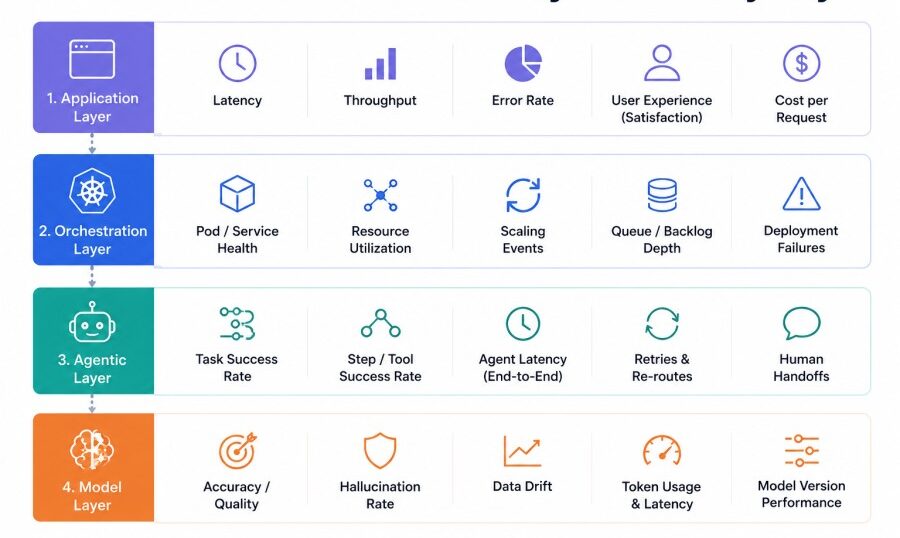
AI observability spans multiple layers of the stack and each layer produces metrics that do not exist in the layers above or below it. Understanding what to measure at each layer is the difference between knowing your system is slow and knowing exactly why.
Application Layer Metrics
The application layer is where users interact with your AI system. Metrics here measure human experience, not just technical performance. Traditional APM stops at HTTP status codes and response times. AI observability at this layer must capture user intent, satisfaction signals, and session level behavior.
Track session level analytics that show how users move through multi turn conversations. A chatbot that answers the first question perfectly but loses context by turn three has a session continuity problem that single request metrics will never surface. Monitor conversation abandonment rates: what percentage of users stop mid conversation without completing their goal. High abandonment at specific turn counts or question types reveals where your AI is failing to understand or assist.
Capture end user feedback collection in structured form. Thumbs up and thumbs down ratings, correction submissions, and explicit “this answer was helpful” signals provide ground truth that no technical metric can replace. When users consistently rate responses about a specific topic negatively, that is a signal your model needs retraining or your retrieval augmented generation system is surfacing the wrong context.
User intent classification helps you understand what people are actually trying to accomplish. Are they asking factual questions, requesting creative content, troubleshooting problems, or attempting tasks your system was not designed for? Mismatched intent is a leading cause of poor AI experiences and it is invisible without application layer instrumentation.
Feature usage tracking shows which AI capabilities users actually rely on versus which ones are ignored. If 80% of usage goes to one feature and the rest sit unused, that tells you where to focus optimization effort and where you might be over investing in capabilities nobody wants.
Orchestration Layer Metrics
The orchestration layer sits between the user facing application and the underlying models. This is where tools like LangChain, LlamaIndex, and custom agent frameworks live. Metrics here reveal how well your AI system is coordinating multiple components to fulfill requests.
Monitor guardrail effectiveness to ensure safety and policy checks are working. If you have a filter that should block toxic prompts but 15% of flagged content still reaches the model, your guardrail has a gap. Track both the number of requests blocked and the false positive rate where legitimate requests get incorrectly filtered.
Chain performance matters in multi step AI workflows. A retrieval augmented generation system might: retrieve documents, rerank them, generate a prompt, call the LLM, and post process the output. If the total latency is 12 seconds but the LLM call only took 3 seconds, the bottleneck is in orchestration, not inference. Track the duration of each step in the chain separately to identify where optimization effort should go.
Prompt caching hit rates directly impact cost and latency. Many orchestration frameworks cache frequently used prompt prefixes or system messages to avoid reprocessing them on every request. A 60% cache hit rate means 60% of your prompts are reusing cached context, which can cut token costs significantly. A sudden drop in cache hit rate often indicates a change in user behavior or a prompt template modification that broke caching logic.
Routing decisions between models need visibility. Systems that route simple questions to small fast models and complex questions to large capable models must track routing accuracy. If 40% of requests routed to the small model fail and require fallback to the large model, your routing logic needs refinement. Track fallback rates and the accuracy of routing predictions.
Agentic Layer Metrics
AI agents operate autonomously across your infrastructure, making decisions, invoking tools, and executing workflows without human intervention in the loop. This autonomy makes observability critical because agents can cause cascading failures that are difficult to trace after the fact.
Agent to agent communication patterns reveal how autonomous systems coordinate. In a multi agent setup where one agent handles user queries, another retrieves data, and a third formats responses, track the message flow between them. High retry rates or timeouts in agent communication indicate coordination problems. Long message chains where agents repeatedly ask each other for clarification suggest poorly defined interfaces or ambiguous task delegation.
Command execution monitoring tracks what agents actually do in the real world. When an agent is authorized to restart services, modify configurations, or trigger deployments, log every action with full context: which agent made the decision, what data informed it, and what the outcome was. This is not optional. Without execution logs, debugging an agent caused outage is nearly impossible.
Tool usage and external API invocations show how agents interact with external systems. Track API call success rates, latency distributions, and error types for every tool an agent uses. If an agent is failing 30% of the time because a third party API is rate limiting it, you need to see that explicitly, not infer it from vague “agent task failed” errors.
Protocol compliance ensures agents follow expected interaction patterns. If your agent framework defines specific message formats or state transitions, monitor adherence. Protocol violations where an agent sends malformed requests or skips required steps often indicate bugs in agent logic or unexpected edge cases the agent was not trained to handle.
Decision tree analysis helps you understand agent reasoning paths. For agents that make multi step decisions, log the decision tree: what options were considered, what criteria were evaluated, and why the chosen path was selected over alternatives. This is especially important in high stakes domains where you need to explain why an agent took a specific action.
Model Layer Metrics
The model layer is where inference happens. This is the LLM API call, the embedding generation, or the classification prediction. Metrics here measure the raw performance and behavior of the AI model itself, independent of orchestration or application logic.
Token usage is the single most important cost metric in AI systems. Track tokens consumed per request, broken down by prompt tokens and completion tokens. Prompt tokens are input, completion tokens are output. A request that uses 500 prompt tokens and generates 2000 completion tokens costs 4x more than one with 500 prompt and 500 completion because generation is typically more expensive than processing input.
Monitor average tokens per request over time. A sudden spike often indicates prompt templates got longer, users started asking more complex questions, or context windows expanded without anyone noticing. Track token usage per user or per feature to identify which parts of your application are the biggest cost drivers. If one feature accounts for 60% of token consumption but only 10% of user activity, that feature is a cost optimization target.
Model stability across versions prevents regressions during upgrades. When you switch from GPT 4 to GPT 4 Turbo or deploy a new fine tuned model, track output quality metrics for both versions in parallel before fully cutting over. Compare hallucination rates, relevance scores, and task completion success between versions. A model upgrade that improves speed but degrades accuracy is not always a win.
Inference latency has two critical components: time to first token and total generation time. Time to first token measures how long before the model starts responding. This matters for streaming interfaces where users see output as it generates. A 3 second time to first token feels slow even if total generation finishes in 5 seconds because users wait in silence for 3 seconds. Total generation time measures end to end how long the model took to complete the response.
Track both metrics separately. A model with fast time to first token but slow total generation might be fine for chat interfaces where users see progress. A model with slow time to first token is poor for any interactive use case, even if total time is reasonable.
Invocation errors and rate limiting need granular tracking. Distinguish between client side errors like malformed requests, server side errors from the model provider, and rate limit errors where you hit quota. Each error type requires a different fix. High client side errors indicate bugs in your prompting logic. High server side errors suggest model provider instability. High rate limit errors mean you need to request higher quotas or implement request throttling.
Resource utilization for self hosted models includes GPU memory usage, GPU utilization percentage, CPU usage for pre and post processing, and inference batch size. Track these per model and per request type. A model that uses 80% of GPU memory leaves little headroom for traffic spikes. A batch size of 1 means you are not taking advantage of batching optimizations that could improve throughput.
Token Economics: The Metrics That Control AI Costs
- Token consumption is the dominant cost driver in AI systems. While traditional infrastructure costs like compute, memory, and bandwidth matter, token costs often exceed all of them combined at scale. A single GPT 4 API call processing a 10,000 token prompt and generating a 2,000 token response costs roughly $0.36. That same request handled by a self hosted 7B parameter model might cost $0.0001 in GPU time. The model selection decision is a cost decision first and a capability decision second.
- Track cost per request as a primary metric. Break it down by prompt tokens and completion tokens separately because pricing differs. Most LLM APIs charge less per token for input than output. A request with 1,000 prompt tokens and 100 completion tokens costs far less than one with 100 prompt tokens and 1,000 completion tokens even though both total 1,100 tokens.
- Monitor cost per user and cost per feature to identify where spend concentrates. In most AI applications, a small percentage of users or features account for the majority of costs. If 5% of users generate 60% of token usage because they ask complex multi turn questions, that user segment is your cost optimization priority. You might implement token budgets per user, suggest shorter questions, or route their requests to cheaper models.
- API call optimization requires visibility into caching opportunities and batching potential. Prompt caching where repeated prompt prefixes are cached to avoid reprocessing can cut costs by 50% or more for applications with stable system prompts. Track cache hit rates and identify prompts that are almost identical but differ by small variations that break caching. Fixing prompt inconsistencies to improve cache hit rates is one of the highest ROI optimizations in AI cost management.
- Batching requests together when possible reduces per request overhead. If you process 100 requests sequentially, you pay full inference cost 100 times. If you batch them into groups of 10, you pay inference cost 10 times with higher throughput per call. Track average batch size and identify opportunities to increase it without impacting latency requirements.
- Model selection economics need empirical measurement, not assumptions. Do not assume GPT 4 is always better or that a self-hosted model is always cheaper. Measure accuracy, latency, and cost for your specific use case across multiple models. A question answering system might find that GPT 3.5 Turbo achieves 92% accuracy at $0.002 per request while GPT 4 achieves 96% accuracy at $0.02 per request. Whether the 4% accuracy gain justifies 10x cost depends on your business context, but you need the data to make that decision.
- For self-hosted models, track GPU utilization and inference cost per request to calculate true total cost of ownership. A model that uses $10,000 per month in GPU time but handles 1 million requests has a $0.01 cost per request. The same model on more expensive GPUs might cost $30,000 per month but handle 5 million requests, bringing cost per request down to $0.006. Raw infrastructure cost is not the metric that matters, cost per request is.
Model Drift Detection: Measuring Degradation Over Time
AI models degrade in ways traditional software does not. Your application code does not spontaneously start behaving differently unless you deploy a change. AI models can drift silently as the real world data they encounter shifts away from their training distribution. A model trained on 2023 data might perform poorly on 2026 questions because language, topics, and user expectations have changed.
Prediction accuracy over time is the primary drift signal. Track the percentage of model outputs that meet your quality bar week over week. If accuracy was 94% in January and is now 88% in March, your model is drifting. The challenge is defining accuracy for generative AI. For classification tasks, accuracy is straightforward: did the model predict the correct class? For open ended generation, accuracy requires evaluation frameworks that score outputs on relevance, factual correctness, and coherence.
Data distribution shifts measure how much incoming production data differs from training data. Track feature distributions for key inputs. If your model was trained on customer support questions where 60% were about billing and 40% were about technical issues, but production traffic is now 80% technical and 20% billing, the input distribution has shifted. The model might still perform well, or it might struggle because it is seeing more technical questions than it was optimized for.
Output diversity changes over time can indicate model degradation. A healthy generative model produces varied, contextually appropriate responses. A model that starts returning repetitive, generic, or templated outputs is showing signs of failure. Track response uniqueness by measuring how often the model generates identical or near identical outputs for different inputs. A sudden drop in output diversity often precedes more obvious quality degradation.
Feature importance drift reveals when the signals your model relies on have changed in importance. If a model used pricing as the most important feature for predicting customer churn but recent data shows product quality is now more predictive, the model is using outdated feature weights. Track feature importance over time using SHAP values or similar explainability methods to detect when the model’s internal decision logic no longer matches reality.
Establish drift detection thresholds that trigger alerts before quality degrades visibly to users. If accuracy drops by 2%, investigate. If it drops by 5%, prepare to retrain or roll back to a previous model version. Do not wait for user complaints to discover drift. By the time users notice quality problems, the model has likely been degrading for weeks.
Response Quality Metrics: Beyond Status Codes
HTTP status codes tell you whether a request succeeded. They do not tell you whether the response was good. An LLM can return a 200 status code with a completely hallucinated answer. Traditional monitoring is blind to this failure mode.
Hallucination rate measures how often the model generates factually incorrect or fabricated information. This is especially critical for retrieval augmented generation systems where the model should only answer based on retrieved documents. Track the percentage of responses that cite facts not present in the source material. Automated evaluation using a secondary LLM to check output against source documents can provide continuous hallucination monitoring without manual review of every response.
Relevance scoring evaluates whether the response actually addresses the user’s question. A response can be factually accurate but completely irrelevant. If a user asks “What is your return policy” and the model responds with a detailed explanation of shipping times, the answer is accurate but irrelevant. Use semantic similarity between the question and answer or fine tuned relevance classifiers to score how well responses match user intent.
Coherence and readability ensure outputs are understandable. Track metrics like reading grade level, sentence structure complexity, and logical flow. A model that generates technically accurate but incomprehensible text has a quality problem. Monitor for incomplete sentences, contradictory statements within the same response, and abrupt topic shifts that indicate the model lost coherence mid generation.
User feedback signals provide the highest fidelity quality data. Track explicit feedback like thumbs up and thumbs down ratings, but also implicit signals like immediate follow up questions, corrections, or conversation abandonment. If 40% of users ask a clarifying question immediately after receiving an answer, that answer was probably unclear or incomplete.
Task completion rate for goal oriented interactions measures how often the AI successfully helps users achieve their objective. For a customer support chatbot, did the user’s issue get resolved? For a code assistant, did the generated code run without errors? For a search system, did the user click on a result and stay engaged? Task completion is the ultimate quality metric because it measures real value, not proxy signals.
Compare quality metrics across model versions, prompt templates, and retrieval strategies in production using A/B testing. Run 10% of traffic on a new prompt template and compare relevance scores, hallucination rates, and user feedback against the baseline. Data driven prompt engineering based on production quality metrics is far more effective than intuition based iteration.
AI Safety Metrics: Ethical and Compliance Monitoring
AI safety is not optional. Models can generate biased, toxic, harmful, or privacy violating outputs. Monitoring for these failure modes is as critical as monitoring uptime.
- Bias detection requires instrumentation to identify when model outputs treat different demographic groups unfairly. Track output sentiment, tone, and content by inferred user demographics when possible and legally permissible. If your model generates professional, respectful responses to questions from one group but dismissive or stereotypical responses to another, that is a bias signal requiring immediate investigation.
- Content safety monitoring flags toxic, harmful, or inappropriate outputs before they reach users. Run all generated text through content filters that check for profanity, hate speech, sexual content, violence, and self harm. Track the percentage of outputs flagged and the severity distribution. A sudden spike in flagged content often indicates a prompt injection attack or model drift toward unsafe outputs.
- Privacy compliance monitoring ensures no personally identifiable information leaks into prompts or responses. Track whether user inputs contain PII like email addresses, phone numbers, or social security numbers. Monitor whether model outputs accidentally reveal PII from training data or retrieved documents. Implement redaction filters that strip PII before logging requests for debugging while preserving enough context to investigate issues.
- Data handling audits answer critical compliance questions: where does user data go, how long is it retained, who has access, and is it ever sent to third party APIs? For models hosted by external providers like OpenAI, monitor whether prompts containing sensitive data are being sent externally. Log every external API call with metadata about what data was included.
- Regulatory compliance tracking becomes essential as AI regulations emerge globally. The EU AI Act, various US state laws, and industry specific regulations impose requirements on AI system transparency, explainability, and auditability. Track metrics that demonstrate compliance: how often was human oversight involved in high stakes decisions, what percentage of model outputs were reviewed, how quickly were problematic outputs detected and remediated.
- Implement automated safety checks in production rather than relying on manual review. A secondary LLM can evaluate every output for bias, toxicity, and policy violations in real time, flagging issues for human review. This scales far better than sampling a small percentage of outputs and hoping to catch problems.
Debugging AI Systems: The Non Deterministic Problem
Traditional debugging assumes determinism. You reproduce a bug by running the same code with the same input and seeing the same failure. AI systems break this assumption. An LLM can generate a problematic response once and never repeat it, even with an identical prompt.
Structured logging for LLM requests must capture the full context to enable reproduction even when outputs vary. Log the exact prompt template used, all variable substitutions, every model parameter like temperature, top_p, max_tokens, presence_penalty, and frequency_penalty, the specific model version including any fine tuning identifiers, the random seed if one was set, and the complete generated output.
Without this level of detail, debugging is impossible. A user reports “the chatbot said something weird” but you have no record of what prompt generated the response, what model version was active, or what parameters were set. Replaying the conversation from logs becomes guesswork.
Capture intermediate steps in multi stage AI workflows. For retrieval augmented generation, log: the original user question, the query used for retrieval, the retrieved documents and their relevance scores, the constructed prompt combining question and context, the model’s raw output, and any post processing applied. When the final response is wrong, you need to see where in the pipeline the failure occurred. Was retrieval surfacing the wrong documents? Was the prompt template poorly structured? Did the model ignore the context?
Error categorization for non deterministic outputs requires rethinking what an error is. A hallucination is not a 500 error, it is a semantic failure. Create error categories specific to AI failures: hallucination, irrelevant response, incomplete answer, biased output, unsafe content, context misunderstanding. Track the frequency of each error type over time to identify patterns.
Implement trace IDs that connect every component involved in fulfilling an AI request. A single user question might trigger: an embedding model to vectorize the query, a vector database retrieval, a reranking model, an LLM inference, and a post processing function. If any step fails or underperforms, the trace ID lets you reconstruct the full request path across all systems.
Preserve prompt and response pairs in long term storage separate from metrics aggregation. Metrics tell you that hallucination rate increased by 3% this week. Detailed logs tell you what the hallucinations were, what prompts triggered them, and whether they share patterns. Store these logs with appropriate retention policies, access controls, and PII redaction to balance debuggability with privacy compliance.
Tools and Implementation
Implementing AI observability requires tools that understand AI-specific metrics, not just generic telemetry collection. OpenTelemetry provides standardization for trace and metric collection but needs AI-specific semantic conventions to be useful for model monitoring.
OpenTelemetry for GenAI includes conventions for tracking LLM requests as spans with attributes like model name, prompt tokens, completion tokens, and response time. These conventions are evolving through projects like OpenLLMetry, which extends OpenTelemetry to capture AI-specific context automatically. Using OTel-compatible instrumentation future-proofs your observability stack because you can change backends without rewriting instrumentation.
CubeAPM provides full-stack observability that extends beyond traditional APM to include infrastructure, logs, traces, and metrics in one platform. For teams running AI workloads, CubeAPM tracks API latency, request throughput, error rates, and resource utilization with support for OpenTelemetry-compatible agents. While it does not currently provide AI-specific semantic analysis like hallucination detection, its unified approach to telemetry collection and unlimited retention at $0.15/GB makes it cost-effective for teams that need to store high volumes of AI request logs for compliance or debugging. CubeAPM runs on premises or inside your VPC, which is critical for teams with data residency requirements or privacy constraints that prevent sending AI telemetry to external SaaS platforms.
LangSmith specializes in LLM application observability with native support for tracing LangChain workflows, prompt versioning, and LLM call debugging. It captures full prompt and response pairs, tracks token usage, and provides evaluation frameworks for measuring response quality. Best suited for teams building on LangChain or LangGraph who need deep visibility into multi step agent workflows.
Arize focuses on model performance monitoring and drift detection with support for both traditional ML and LLMs. It tracks prediction accuracy, data distribution shifts, and feature importance changes over time. Arize is strong for teams running fine tuned models in production who need to detect when models degrade and require retraining.
Weights and Biases offers experiment tracking, model evaluation, and production monitoring in one platform. For AI observability, it provides prompt evaluation tools, LLM comparison frameworks, and integration with Weave for tracing LLM calls. Best for teams that want to unify experimentation and production monitoring in a single tool.
Datadog APM includes LLM observability features that track token usage, model latency, and error rates for OpenAI, Anthropic, and other LLM providers. It integrates with Datadog’s broader observability platform, making it a good choice for teams already using Datadog who want to add AI monitoring without adopting a separate tool. Pricing follows Datadog’s per host and per GB model which can become expensive at scale.
Implement monitoring incrementally. Start with basic token usage and latency tracking to control costs and meet SLAs. Add response quality metrics like relevance scoring once you have baseline cost and performance visibility. Layer on safety monitoring for bias and toxicity detection as your AI system matures and handles more critical use cases.
Best Practices for AI Model Observability
- Define quality metrics before deploying models to production. You cannot improve what you do not measure, and post launch scrambling to define success metrics leads to poor decisions. Establish baseline accuracy, relevance, and safety thresholds during development and track them continuously in production.
- Instrument every layer of the AI stack independently. Application layer metrics, orchestration layer metrics, and model layer metrics all matter but they measure different things. A slow response might be caused by retrieval taking too long, orchestration adding latency, or model inference being slow. Without instrumentation at each layer, you cannot isolate the root cause.
- Correlate AI metrics with traditional observability metrics like MELT. A sudden increase in LLM errors might correlate with an infrastructure issue like high CPU usage or network latency. Unified observability across AI and infrastructure telemetry lets you see these relationships instead of investigating in silos.
- Track costs as a first class metric equal to performance. In AI systems, an unoptimized prompt template or model selection can double your monthly bill without anyone noticing until the invoice arrives. Real time cost dashboards showing spend per feature, per user, and per model prevent budget surprises.
- Implement automated quality checks in production. Use evaluation models to score outputs for hallucination, relevance, and safety on every request. Flag low scoring outputs for human review rather than hoping manual sampling will catch issues. Automated evaluation scales in ways manual review never will.
- Build alerting around semantic failures, not just infrastructure failures. Alert when hallucination rate exceeds 5%, when average relevance score drops below 0.7, or when unsafe content detection rate spikes. These semantic alerts detect AI specific problems that uptime monitoring misses.
- Retain full request and response logs for high value or high risk interactions. If your AI system handles medical advice, financial decisions, or legal guidance, store complete audit trails showing exactly what the model was asked and what it returned. This is non negotiable for compliance and liability protection.
- Use A/B testing and gradual rollouts for model changes. Do not switch from GPT 3.5 to GPT 4 for 100% of traffic at once. Roll it out to 5%, compare quality metrics and costs against the baseline, and expand gradually. This limits blast radius if the new model underperforms.
- Monitor user behavior as the ultimate quality signal. Click through rates, conversation abandonment, follow up questions, and explicit feedback tell you whether users find the AI useful. Technical metrics like latency and token usage matter, but user satisfaction is the goal.
- Adopt ingestion based pricing models for observability tools when handling AI workloads. AI telemetry volumes are high because you need full request and response logging. Per host or per seat pricing becomes prohibitively expensive. Ingestion based pricing at predictable rates like $0.15/GB gives cost certainty as your AI workloads scale.
Conclusion
AI model observability requires rethinking metrics, instrumentation, and tooling from first principles. The deterministic assumptions baked into traditional APM do not hold. Response quality, token economics, model drift, and safety monitoring become primary concerns rather than afterthoughts.
Start by instrumenting the model layer to track token usage, latency, and error rates. These metrics control costs and availability, the most immediate production concerns. Expand to orchestration and application layers to understand how well your AI system coordinates multi step workflows and delivers value to users. Layer on quality and safety metrics to detect semantic failures that infrastructure monitoring cannot see.
Use OpenTelemetry compatible instrumentation to future proof your stack, retain full request and response logs for debugging and compliance, and monitor costs as rigorously as you monitor latency. AI systems fail differently than traditional software, and observability must adapt to catch those failures before users do.
Disclaimer: The information in this article reflects the latest details available at the time of publication and may change as technologies and products evolve. Features, pricing, and plan limits can change over time. Always verify the latest information directly with the vendor before making purchasing or deployment decisions.
Frequently Asked Questions
What is the difference between AI observability and traditional APM?
Traditional APM tracks uptime, latency, and errors assuming deterministic behavior. AI observability adds response quality, token costs, model drift, and safety metrics because AI systems are probabilistic and can fail semantically without infrastructure errors.
What are the most important metrics to track for LLM applications?
Token usage per request, time to first token, total generation latency, hallucination rate, relevance scoring, and cost per request. These cover cost control, performance, and quality which are the three pillars of production LLM reliability.
How do you detect model drift in production?
Track prediction accuracy over time, compare input data distributions to training data, monitor output diversity changes, and use feature importance tracking to detect when the model’s decision logic no longer matches current data patterns.
Why is token usage more important than infrastructure cost for AI observability?
Token processing costs often exceed compute, memory, and bandwidth combined in LLM applications. A single API call can cost more than running a container for an hour, making token level cost attribution the primary cost control lever.
What tools support AI specific observability metrics?
OpenTelemetry with GenAI semantic conventions provides standardized instrumentation. LangSmith specializes in LLM workflow tracing. Arize focuses on model drift detection. Datadog APM includes LLM observability features. CubeAPM offers unified telemetry collection with on premises deployment for teams with data residency requirements.
How do you debug non deterministic AI failures?
Log the full context of every request including prompt template, model parameters, model version, intermediate steps, and complete output. Use trace IDs to connect multi stage workflows. Categorize semantic errors like hallucination separately from infrastructure errors to identify patterns over time.
What safety metrics should AI systems monitor in production?
Bias detection across demographic groups, content toxicity scoring, PII leak monitoring, data handling audit trails, and regulatory compliance tracking. Automated evaluation models can score every output for safety violations in real time at scale.