




Kubernetes security monitoring is no longer optional. Clusters change constantly, containers restart, workloads move between nodes, permissions drift, and exposed services can appear before security teams notice.
The bigger challenge is that Kubernetes security is not one problem. Teams need visibility into workloads, logs, metrics, traces, runtime behavior, misconfigurations, vulnerabilities, and cluster posture. A single scanner is rarely enough.
This guide compares the best Kubernetes security monitoring tools in 2026, including CubeAPM, Falco, Kubescape, New Relic, Dynatrace, and Datadog. It covers what each tool does, where it fits, pricing, Kubernetes security monitoring features, and verified user-review pros and cons.
🔑 Key Takeaways
- Kubernetes security monitoring works best as a layered stack, not as a single tool.
- CubeAPM is useful as the first observability layer because it gives teams logs, metrics, traces, dashboards, and application context for Kubernetes investigations.
- Falco is best for open-source runtime threat detection, especially when teams need to detect suspicious container behavior in live clusters.
- Kubescape is best for Kubernetes posture management, misconfiguration scanning, compliance checks, and workload risk visibility.
- Datadog, New Relic, and Dynatrace combine Kubernetes monitoring with broader observability and security features, but pricing can increase as hosts, users, modules, or data volume grow.
- No tool in this list replaces every other tool. Most production teams combine observability, posture scanning, runtime detection, vulnerability context, and alerting.
What Is Kubernetes Security Monitoring?
Kubernetes security monitoring is the process of continuously watching Kubernetes clusters, workloads, nodes, containers, policies, and runtime behavior for security risk.
It usually covers several layers.
- Pre-deployment and posture scanning checks Kubernetes manifests, Helm charts, container images, cluster settings, and policies before or after deployment.
- Runtime threat detection watches running containers and workloads for suspicious behavior such as shell execution, privilege escalation, sensitive file access, container escape attempts, or unusual network activity.
- Vulnerability and exposure monitoring helps teams identify risky container images, vulnerable packages, exposed services, and workload-level security gaps.
- Observability connects security findings with logs, metrics, traces, services, namespaces, deployments, and user-facing impact.
The best Kubernetes security monitoring setup usually combines these layers instead of depending on one tool.
Kubernetes Security Monitoring Tools at a Glance
| Tool | Category | Best for | Pricing model |
| CubeAPM | Observability / APM | Self-hosted Kubernetes telemetry and investigation context | $0.15/GB |
| Falco | Runtime threat detection | Real-time syscall and Kubernetes threat detection | Open source |
| Kubescape | Kubernetes posture management | Misconfiguration, compliance, and risk scanning | Open source |
| New Relic | Full-stack observability | Kubernetes monitoring with eBPF, APM, logs, and vulnerability context | Usage-based |
| Dynatrace | AI-powered observability | Enterprise Kubernetes monitoring and application security context | Usage-based |
| Datadog | Cloud security and observability | Kubernetes monitoring, cloud security, workload protection, logs, and APM | Modular usage-based |
Best Kubernetes Security Monitoring Tools
1. CubeAPM

Best for: DevOps, SRE, and engineering teams that need self-hosted Kubernetes observability with logs, metrics, traces, dashboards, and application context.
CubeAPM is a self-hosted, OpenTelemetry-native observability and APM platform. It is not a dedicated Kubernetes runtime security engine like Falco, and it is not a posture scanner like Kubescape.
Its value is in the investigation layer. When a Kubernetes security tool raises an alert, teams still need to know which service was involved, which request triggered the behavior, which deployment changed recently, and whether users were affected. CubeAPM helps answer those questions by correlating logs, metrics, traces, and infrastructure signals in one place.
This makes CubeAPM a strong first tool for teams that want Kubernetes visibility before adding specialized security layers.
Kubernetes security monitoring features
| Feature | What it covers |
| Log monitoring | Centralized Kubernetes, application, and infrastructure logs |
| Distributed tracing | Service-level request paths across Kubernetes workloads |
| Infrastructure monitoring | Node, pod, container, and service health context |
| Alerting and dashboards | Operational signals for incident investigation |
Pricing
CubeAPM pricing starts at $0.15/GB of ingested telemetry. It does not charge per host, per user, or per series.
Pros and cons
| Pros | Cons |
| Predictable ingestion pricing | Not a runtime security engine |
| Self-hosted data control | No Kubernetes posture scanning |
| Strong OTEL-native visibility | Needs security tools alongside it |
2. Falco
Best for: Teams that need open-source runtime threat detection for live Kubernetes clusters.
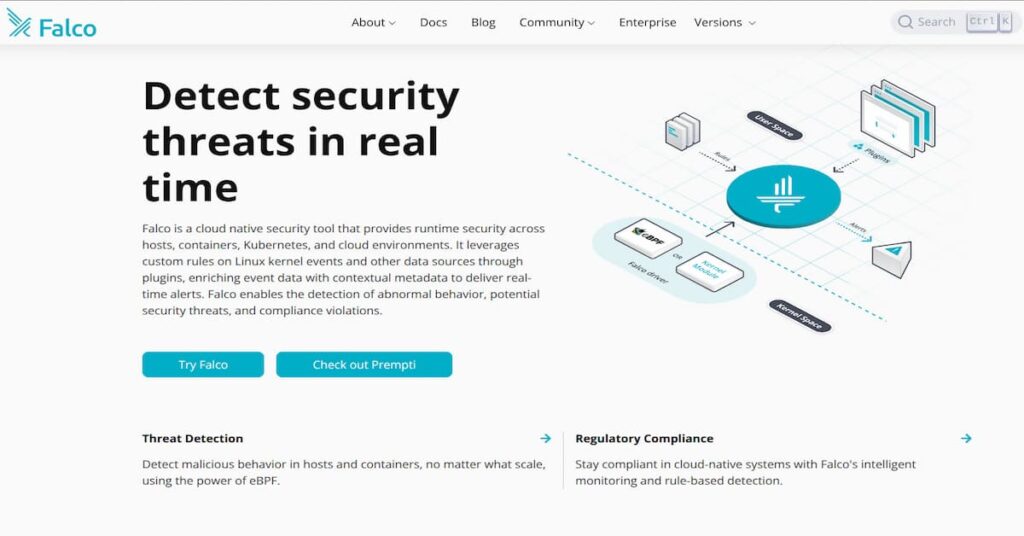
Falco is one of the most important open-source Kubernetes runtime security tools. It detects suspicious behavior by monitoring system calls, Kubernetes metadata, and other event sources.
Falco is useful when teams need to know what containers are doing after they are already running. It can detect events such as shell execution inside a container, access to sensitive files, privilege escalation behavior, or unexpected outbound network activity.
Falco is especially useful when paired with an observability layer such as CubeAPM. Falco can tell you that suspicious behavior happened; CubeAPM can help show which service, trace, request, or deployment was involved.
Kubernetes security monitoring features
| Feature | What it covers |
| Runtime threat detection | Suspicious behavior in live containers and hosts |
| Syscall monitoring | Kernel-level activity through drivers or eBPF |
| Kubernetes context | Pod, namespace, container, and service account metadata |
| Alert routing | Integrations through Falcosidekick and external systems |
Pricing
Falco is open source and free to use. Operational cost comes from deployment, rule tuning, alert routing, storage, upgrades, and team maintenance.
Pros and cons
| Pros | Cons |
| Strong runtime detection | Requires rule tuning |
| Open-source and widely adopted | Alert noise possible |
| Good Kubernetes context | Needs separate dashboards |
3. Kubescape
Best for: Teams that need Kubernetes posture management, compliance scanning, and misconfiguration detection.
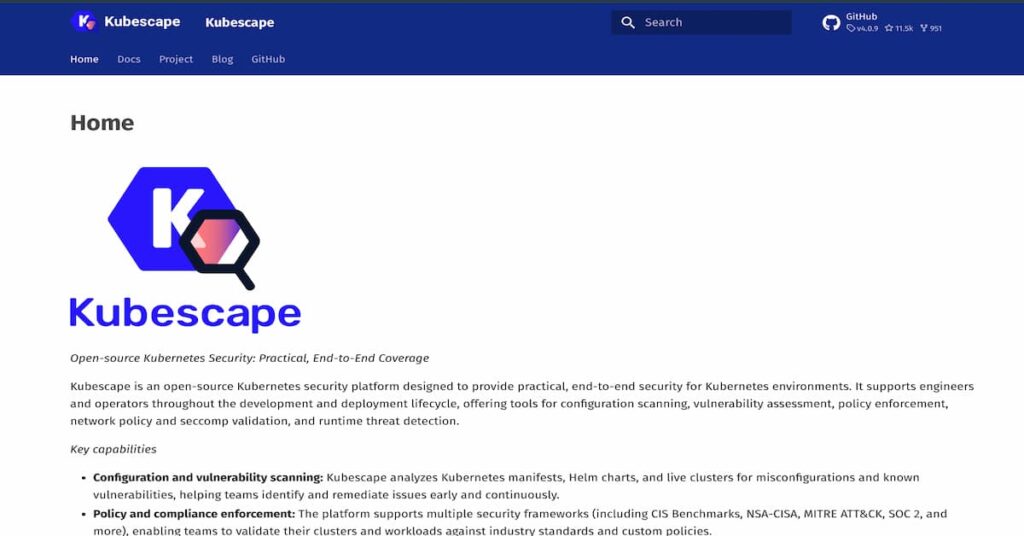
Kubescape helps teams scan Kubernetes clusters, manifests, repositories, and images for security posture issues. It can check against security frameworks and detect risky configurations before they become production problems.
Kubescape is useful in CI/CD pipelines and running clusters. It helps catch risky workloads before deployment and detect posture drift after deployment.
Kubescape is different from Falco. Falco focuses on runtime behavior. Kubescape focuses more on posture, misconfigurations, policies, and compliance risk.
Kubernetes security monitoring features
| Feature | What it covers |
| Cluster scanning | Running Kubernetes cluster posture and risk |
| Manifest scanning | YAML, Helm, and workload configuration issues |
| Compliance checks | Security frameworks and Kubernetes hardening guidance |
| Risk prioritization | Misconfigurations, RBAC issues, and workload exposure |
Pricing
Kubescape is open source and free to use. Commercial support or managed offerings may be available through ecosystem vendors, but the core project is open source.
Pros and cons
| Pros | Cons |
| Broad posture scanning | Not a full SIEM |
| Works before deployment | Runtime depth is limited |
| Strong compliance coverage | Needs policy tuning |
4. New Relic
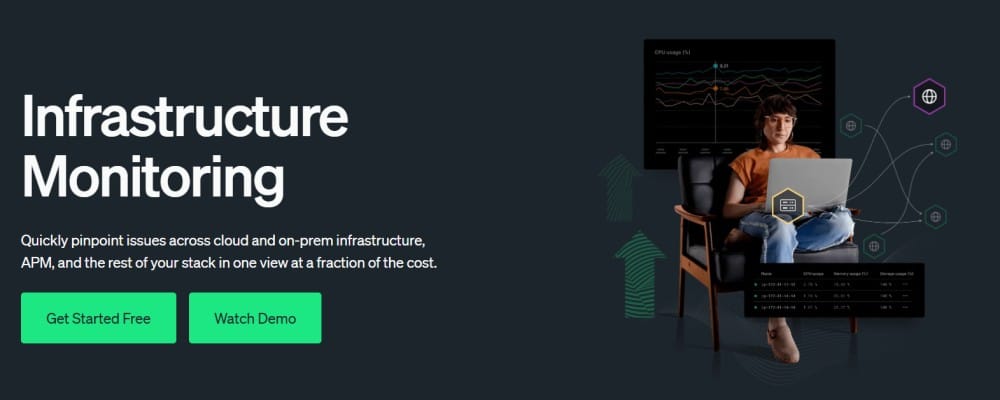
Best for: Engineering teams that want Kubernetes observability, APM, logs, eBPF telemetry, vulnerability context, and alerting in one SaaS platform.
New Relic provides Kubernetes monitoring through its Kubernetes integration and Pixie. Pixie uses eBPF to collect Kubernetes telemetry without requiring code-level instrumentation for every workload.
New Relic is strongest when teams want Kubernetes security context inside a broader observability workflow. It is useful for connecting cluster behavior to application performance, service health, logs, alerts, and vulnerability data.
It is not a direct replacement for Falco or Kubescape. It is better understood as an observability-led Kubernetes monitoring platform with security-adjacent visibility.
Kubernetes security monitoring features
| Feature | What it covers |
| Kubernetes monitoring | Cluster, node, pod, workload, and namespace visibility |
| Pixie eBPF telemetry | Workload and network visibility without code changes |
| Vulnerability management | Software and dependency risk context |
| Alerting | Anomaly and threshold-based incident detection |
Pricing
New Relic includes 100 GB/month of free data ingest. Standard and Pro list $0.40/GB beyond the free 100 GB limit. Data Plus is listed at $0.60/GB beyond the free limit.
Pros and cons
| Pros | Cons |
| Strong real-time visibility | Pricing can grow with data |
| Good Kubernetes dashboards | UI can feel busy |
| Broad observability stack | Not a dedicated runtime tool |
5. Dynatrace
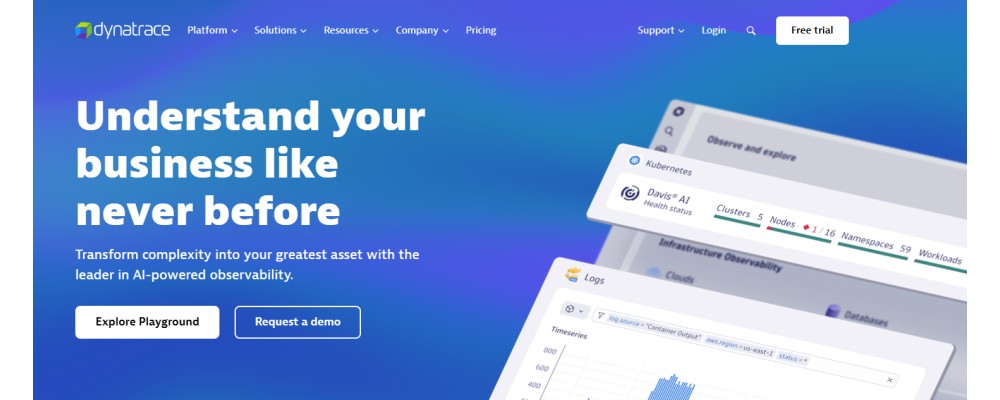
Best for: Enterprises that need AI-assisted Kubernetes observability, full-stack monitoring, runtime application security context, and automated root-cause analysis.
Dynatrace monitors Kubernetes through OneAgent and Kubernetes integrations. It automatically discovers workloads, services, dependencies, and infrastructure relationships.
Its strength is correlation. Dynatrace can connect Kubernetes signals with application performance, service dependencies, logs, traces, and application security findings. This makes it useful for large Kubernetes environments where alert noise and root-cause analysis are major problems.
Dynatrace fits best in enterprise environments that want managed, AI-assisted observability and application security context rather than a lightweight open-source stack.
Kubernetes security monitoring features
| Feature | What it covers |
| Kubernetes monitoring | Clusters, workloads, pods, services, and dependencies |
| Application Security | Runtime vulnerability and exploitability context |
| Davis AI | Root-cause analysis and anomaly correlation |
| Full-stack visibility | Apps, infrastructure, logs, traces, and services |
Pricing
Dynatrace publishes usage-based pricing. Its rate card lists Full-Stack Monitoring at $0.01 per memory-GiB-hour and Infrastructure Monitoring at $0.04 per hour for any size host. Dynatrace’s public pricing page also presents Full-Stack Monitoring around $58/month per 8 GiB host.
Pros and cons
| Pros | Cons |
| Strong root-cause analysis | Expensive for small teams |
| Good Kubernetes automation | Learning curve reported |
| Full-stack visibility | Pricing needs planning |
6. Datadog
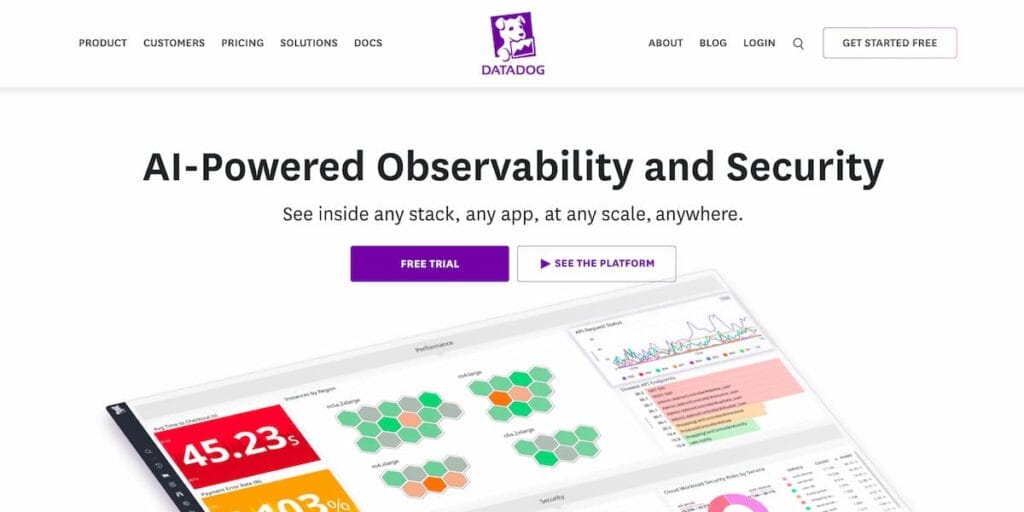
Best for: Teams that want Kubernetes monitoring, cloud security, workload protection, logs, metrics, traces, and APM in one managed platform.
Datadog is widely used for Kubernetes monitoring because it combines infrastructure metrics, logs, traces, container visibility, service maps, and cloud security features in one platform.
Datadog Cloud Security and Workload Protection add security context. Teams can monitor misconfigurations, vulnerabilities, containers, hosts, suspicious process execution, and workload behavior from the same interface used for observability.
Datadog is a strong fit for teams that want a managed commercial platform and are already using Datadog for infrastructure, logs, APM, or cloud monitoring.
Kubernetes security monitoring features
| Feature | What it covers |
| Kubernetes monitoring | Nodes, pods, containers, deployments, and services |
| Cloud Security | Misconfigurations, vulnerabilities, identity risk, and compliance |
| Workload Protection | Runtime threat detection for hosts and containers |
| Logs, metrics, traces | Unified telemetry for investigations |
Pricing
Datadog pricing is modular. Infrastructure Pro is listed at $15/host/month on annual billing. APM is listed at $31/host/month on annual billing. Log ingestion is listed separately, and final cost depends on the products, hosts, logs, containers, and security features enabled.
Pros and cons
| Pros | Cons |
| Strong unified monitoring | Costs can scale fast |
| Good dashboards and alerts | Pricing is modular |
| Broad integrations | Setup can feel complex |
Open Source vs Commercial Kubernetes Security Monitoring Tools
Open-source tools are usually stronger for teams that want control and lower licensing cost. Falco and Kubescape can cover runtime detection, posture scanning, compliance checks, and Kubernetes risk visibility without commercial licensing fees.
The tradeoff is operational effort. Teams must deploy, configure, tune, upgrade, integrate, and maintain the stack themselves.
Commercial tools such as Datadog, New Relic, and Dynatrace reduce operational burden by combining Kubernetes monitoring, application telemetry, logs, traces, dashboards, alerting, vulnerability context, and security signals in one managed platform.
The tradeoff is cost. Pricing can grow as clusters, hosts, data volume, users, and modules increase.
CubeAPM sits between these approaches. It gives teams self-hosted observability with predictable ingestion pricing while still allowing them to pair with open-source runtime and posture tools.
How to Build a Layered Kubernetes Security Monitoring Stack
Layer 1: Observability and investigation context
Start with logs, metrics, traces, dashboards, and alerting. CubeAPM fits here because it gives teams the telemetry needed to investigate incidents and understand application impact.
Layer 2: Pre-deployment and posture scanning
Use Kubescape to scan manifests, repositories, images, and running clusters for posture risk, missing controls, RBAC problems, exposed workloads, and compliance drift.
Layer 3: Runtime detection
Use Falco to detect suspicious runtime behavior such as shell execution, sensitive file access, unexpected network activity, privilege escalation, or container escape indicators.
Layer 4: Managed Kubernetes security and observability
Teams that prefer a managed SaaS approach can use Datadog, New Relic, or Dynatrace to combine Kubernetes telemetry, alerting, vulnerability context, infrastructure monitoring, and security signals in one platform.
Common Kubernetes Security Threats These Tools Address
Overly broad roles and service accounts can let workloads read secrets, escalate privileges, or access resources across namespaces. Kubescape helps detect many of these posture and policy risks.
Privileged pods, hostPath mounts, and host namespace access can increase container escape risk. Kubescape can catch many of these issues before deployment, while Falco can help detect suspicious runtime behavior.
Unexpected shells, package managers, crypto miners, or admin tools inside containers may indicate compromise. Falco and Datadog Workload Protection are useful here.
Publicly exposed services, weak API server settings, and poor authentication controls can create major attack paths. Kubescape and managed security platforms can help surface these risks.
Container images and dependencies may include known vulnerabilities. Datadog, New Relic, Dynatrace, and Kubescape can help teams surface and prioritize vulnerability context.
Security alerts are less useful when teams cannot connect them to the affected service, deployment, request, trace, or namespace. CubeAPM helps close that gap by correlating Kubernetes telemetry with application-level behavior.
📌 Monitor Your Kubernetes Cluster with CubeAPM
CubeAPM gives Kubernetes teams self-hosted, OpenTelemetry-native observability without per-host or per-user pricing.
At $0.15/GB, CubeAPM helps teams monitor logs, metrics, traces, services, workloads, and infrastructure while keeping telemetry data inside their own environment.
For Kubernetes security monitoring, CubeAPM is most useful as the investigation layer. When Falco, Kubescape, Datadog, New Relic, or Dynatrace surfaces a problem, CubeAPM helps teams understand which service, request, namespace, deployment, and trace were involved.
Conclusion
Kubernetes security monitoring requires layered tooling. No single tool covers every security problem across cluster posture, runtime detection, observability, vulnerability context, and investigation.
CubeAPM should be first in this list because it gives teams the observability foundation needed to investigate Kubernetes incidents. It does not replace Falco or Kubescape, but it makes their alerts easier to understand and act on.
For runtime detection, Falco is the open-source standard. For posture management, Kubescape is a strong choice. For managed observability and security workflows, Datadog, New Relic, and Dynatrace are strong but can become expensive as usage grows.
The best setup is usually a combination: CubeAPM for observability, Kubescape for posture, Falco for runtime detection, and Datadog, New Relic, or Dynatrace when teams want a managed commercial platform.
Disclaimer
Pricing, licensing, and product capabilities change over time. Verify current pricing and licensing directly with each vendor before making a purchasing or deployment decision. Open-source tools may be free to license but still require operational work to deploy, tune, upgrade, and maintain.
FAQs
1. What is Kubernetes security monitoring?
Kubernetes security monitoring is the process of continuously checking clusters, workloads, policies, nodes, containers, and runtime behavior for security risks. It includes posture scanning, runtime detection, logging, metrics, traces, vulnerability context, and alerting.
2. What is the best Kubernetes security monitoring tool?
There is no single best tool for every team. CubeAPM is strong for observability and investigation context. Falco is strong for runtime detection. Kubescape is strong for posture management. Datadog, New Relic, and Dynatrace are stronger for managed observability and security workflows.
3. Is CubeAPM a Kubernetes security tool?
CubeAPM is not a dedicated Kubernetes security scanner or runtime enforcement tool. It is an observability platform that supports Kubernetes security investigations by correlating logs, metrics, traces, dashboards, and infrastructure signals.
4. Is Falco enough for Kubernetes security monitoring?
Falco is strong for runtime detection, but it is not enough by itself. It does not replace posture scanning, vulnerability management, or application observability. Most teams pair Falco with Kubescape, CubeAPM, or a managed platform.
5. Is Kubescape enough for Kubernetes security monitoring?
Kubescape is strong for posture management and misconfiguration scanning, but it does not replace runtime threat detection or observability. It works best alongside Falco and CubeAPM.
6. What is the difference between Datadog, New Relic, and Dynatrace for Kubernetes security?
Datadog is strong for Kubernetes observability, cloud security, workload protection, and unified telemetry. New Relic is strong for Kubernetes monitoring, eBPF telemetry through Pixie, vulnerability context, and APM workflows. Dynatrace is strong for automated discovery, AI-assisted root-cause analysis, full-stack monitoring, and application security context.
7. How does CubeAPM reduce Kubernetes monitoring cost?
CubeAPM uses flat ingestion-based pricing at $0.15/GB with no per-host, per-user, or per-series fees. This can make Kubernetes observability more predictable for teams with many nodes, containers, engineers, or telemetry sources.