









Grafana is the most widely deployed open-source observability visualization platform, but teams increasingly run into two friction points that push them toward alternatives.
The AGPLv3 license creates compliance concerns for some organizations. Grafana OSS moved from Apache 2.0 to AGPLv3 in April 2021. This applies not just to Grafana itself but to all three core Grafana Labs projects: Grafana, Loki, and Tempo are all AGPLv3. Mimir is also AGPLv3. Only Grafana plugins, agents, and certain libraries remain Apache-licensed. For organizations that embed or distribute software, or that run a modified version as a network-accessible service, AGPLv3 imposes source-sharing obligations that legal teams often flag.
The four-component LGTM stack is operationally heavy. Grafana is a visualization layer. It does not store data. Running it meaningfully for observability means also running Loki for logs, Tempo for traces, and Mimir or Prometheus for metrics, each independently deployed, scaled, and maintained. Teams that started with Grafana for dashboards and then tried to use it as a full observability platform often find themselves managing four separate systems with four separate query dialects (PromQL, LogQL, TraceQL, MetricsQL).
The Grafana alternatives in this guide are evaluated on open-source licensing, the signals they cover without additional components, operational simplicity, and relevance to observability use cases.
Key Takeaways
- Grafana, Loki, Tempo, and Mimir are all licensed under AGPLv3 (since April 2021). Only Grafana plugins, agents, and certain libraries remain Apache-licensed. Source: grafana.com/licensing.
- CubeAPM is a self-hosted full-stack observability platform covering all signals in one deployment, with no separate components required.
- SigNoz community code is licensed under MIT Expat; the ee/ directory (enterprise features) is under the SigNoz Enterprise license. It is OTel-native, covering APM, traces, logs, and metrics in one ClickHouse-backed deployment.
- Perses is a CNCF Sandbox dashboard tool licensed under Apache 2.0, purpose-built for dashboard-as-code with Grafana dashboard import support. It does not include data storage.
- VictoriaMetrics is a drop-in Prometheus replacement licensed under Apache 2.0 with significantly better compression and lower resource usage. VictoriaLogs reached GA in Q1 2026.
- Kibana uses the Elastic License 2.0 (not OSI-approved open source since 2021). OpenSearch Dashboards is the Apache 2.0 licensed alternative for log-heavy workloads.
Why Teams Look for Open Source Grafana Alternatives
AGPLv3 licensing extends across the entire LGTM stack: Grafana Labs confirmed in its official licensing page that Grafana, Grafana Loki, and Grafana Tempo all moved to AGPLv3 in April 2021. Mimir, launched in 2022, is also AGPLv3. Only plugins, agents, and certain libraries remain Apache-licensed. This means the entire self-hosted LGTM stack is AGPLv3, not just Grafana itself. Organizations building products on any of these components, or running modified versions as a network service, should verify their compliance obligations with legal counsel.
Grafana is a visualization layer, not a full observability platform: Grafana does not store any data on its own. Every meaningful observability use case requires pairing it with a backend: Prometheus or Mimir for metrics, Loki for logs, Tempo for traces. That means at least three to four components to deploy, operate, and upgrade independently. Each has its own scaling characteristics, storage requirements, and query language. Teams that want a single open-source system covering all signals look elsewhere.
Dashboard-as-code workflows are poorly supported in Grafana: Grafana dashboards are defined as JSON blobs. Version-controlling them, validating them in CI, and programmatically generating them at scale is possible but requires workarounds. Perses is built around dashboard-as-code as a first-class workflow from day one, with compile-time validation and native Kubernetes CRD support.
Best Open Source Grafana Alternatives
1. CubeAPM
CubeAPM is a self-hosted full-stack observability platform covering all the signals Grafana needs separate backends for, in a single deployment. Where Grafana requires Loki for logs, Tempo for traces, and Mimir for metrics alongside the Grafana UI, CubeAPM covers all of these in one place. It is OpenTelemetry-native with no proprietary agents.
Key features
- Single platform covering APM, distributed tracing, logs, infrastructure monitoring, Kubernetes monitoring, RUM, synthetic monitoring, and error tracking
- OpenTelemetry-native: OTLP is the only ingestion path, no proprietary agents
- Also accepts data from existing Prometheus, Datadog, and New Relic agents for incremental migration
- $0.15/GB pricing with no active series pricing, no per-host or per-user fees
- No annual commitment required
- Vendor-managed operations: CubeAPM handles upgrades and operational support
- Self-hosted inside your own infrastructure; telemetry data never leaves your cloud
Why it fits teams leaving Grafana: CubeAPM removes the multi-component operational burden entirely. There is no separate Loki, Tempo, or Mimir to manage. One deployment covers all signals. Teams migrating from a self-hosted LGTM stack can point existing OTel Collectors and Prometheus agents at CubeAPM without re-instrumenting services.
Best for: Teams that want a complete Grafana replacement covering all observability signals in one self-hosted platform, with predictable GB-based pricing and no active series billing.
Limitations: Self-hosted deployment required. Grafana’s visualization ecosystem (hundreds of community dashboard templates and panel plugins) does not carry over to CubeAPM.
2. SigNoz
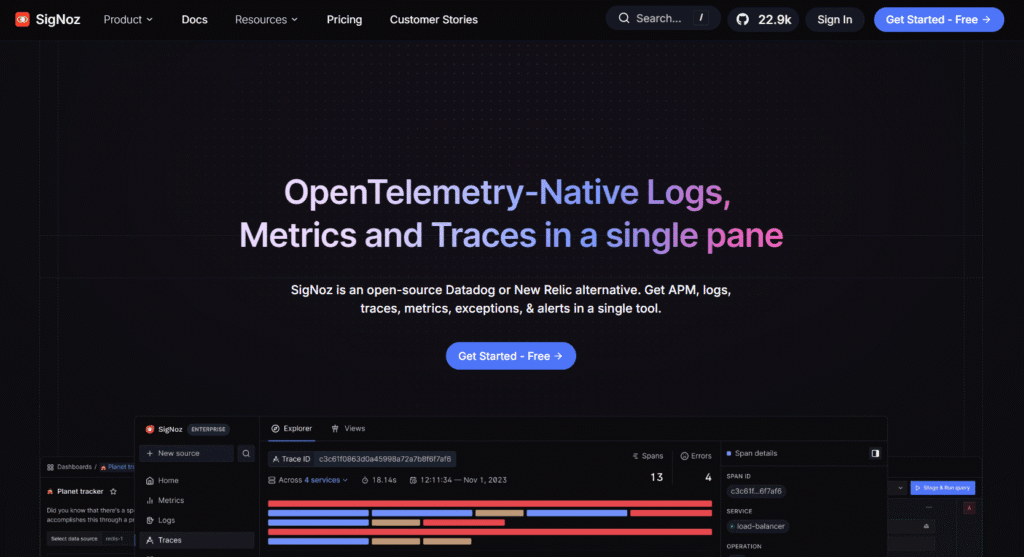
SigNoz is an open-source, OpenTelemetry-native observability platform built on ClickHouse. It replaces the full LGTM stack with a single deployment covering APM, distributed tracing, logs, infrastructure metrics, and exception tracking. The community code is licensed under MIT Expat; enterprise features in the ee/ directory are under the SigNoz Enterprise license. SigNoz Cloud starts at $49/month.
Key features
- Single platform replacing the full LGTM stack: APM, traces, metrics, logs, and exceptions in one interface
- Fully OTel-native: all instrumentation via standard OTel SDKs, no proprietary agents
- Built on ClickHouse: high-compression columnar storage, typically 5x to 10x more compact than Loki or Tempo for the same data
- Exception tracking linked directly to the triggering trace
- Community code licensed under MIT Expat; enterprise features under SigNoz Enterprise license
- Cloud Teams plan from $49/month; $0.30/GB logs and traces, $0.10/million metric samples; no per-host or per-user fees
- SOC2 Type II and HIPAA compliant on Cloud; data centers in US, EU, and India
Why it fits teams leaving Grafana: SigNoz’s single ClickHouse-backed architecture is significantly simpler to operate than the four-component LGTM stack. Teams with existing Grafana OTel instrumentation can migrate by updating the OTLP exporter endpoint alone, with no re-instrumentation required.
Best for: Teams that want an open-source LGTM stack replacement with a simpler operational model, OTel-native instrumentation, and a self-hosted path at zero licensing cost for the community edition.
Limitations: Community code is MIT Expat, not Apache 2.0. Enterprise features require the SigNoz Enterprise license. Fewer pre-built integration dashboards than Grafana. ClickHouse requires meaningful memory allocation at high ingest rates.
3. Perses
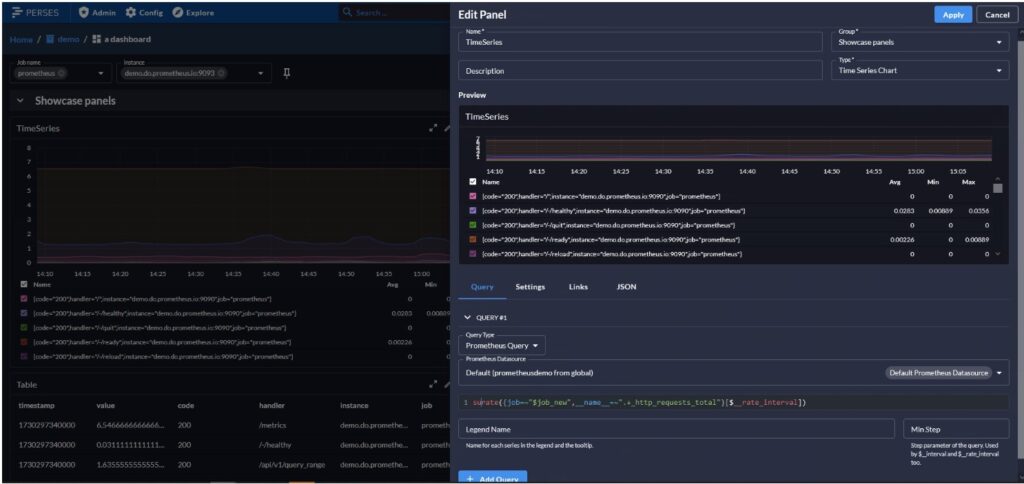
Perses is an open-source dashboard and visualization platform built specifically for observability, licensed under Apache 2.0. It is a CNCF Sandbox project (accepted August 2024) and is purpose-built for dashboard-as-code workflows, with native Kubernetes CRD support and a Grafana dashboard migration tool. It does not store data and requires a metrics, logs, or traces backend.
Key features
- Apache 2.0 licensed, CNCF Sandbox project; 100% open-source and community-driven
- Dashboard-as-code using Go or CUE with compile-time validation and GitOps-friendly workflows
- Kubernetes-native: deploy and manage dashboards via CRDs, enabling GitOps-based dashboard lifecycle management
- Supports Prometheus metrics, Tempo traces, Loki logs, and Pyroscope profiling
- Grafana dashboard import tool: migrates existing Grafana JSON dashboard definitions to Perses format on a best-effort basis
- Hierarchical resource scoping: global, project, and dashboard-level datasource and variable management
- Authentication via native user management or OIDC/OAuth; RBAC with Kubernetes-inspired roles and role bindings
- Red Hat ships an official downstream build in the OpenShift Cluster Observability Operator (technology preview, April 2026)
Why it fits teams leaving Grafana: Perses is Apache 2.0, which removes the AGPLv3 compliance concerns that Grafana, Loki, Tempo, and Mimir all carry. For teams managing dashboards at scale, the dashboard-as-code approach with compile-time validation and CRD-based deployment is significantly more maintainable than Grafana’s JSON blob workflow. The Grafana migration tool lowers the cost of switching for teams with existing Grafana dashboards.
Best for: Teams that need a Grafana-like visualization layer with Apache 2.0 licensing and dashboard-as-code workflows. Platform engineering teams managing dashboards at scale via GitOps.
Limitations: CNCF Sandbox maturity level means the project is still evolving. Fewer panel types and community dashboard templates than Grafana’s mature ecosystem. Does not include data storage, alerting, or data collection; requires existing Prometheus, Loki, Tempo, or Pyroscope backends.
4. VictoriaMetrics
VictoriaMetrics is a high-performance, open-source time-series database licensed under Apache 2.0. It is designed as a drop-in replacement for Prometheus with significantly better compression, higher ingestion rates, and lower resource usage. As of Q1 2026, VictoriaLogs reached GA and VictoriaTraces is available alongside VictoriaMetrics Stack, giving teams a metrics-plus-logs-plus-traces observability stack on Apache 2.0.
Key features
- Apache 2.0 licensed, entirely open-source (OSS edition)
- Drop-in Prometheus replacement: accepts Prometheus remote_write, PromQL-compatible MetricsQL query API, and existing alert rules without changes
- Typically 5x to 10x better data compression than Prometheus TSDB, with lower CPU and memory at equivalent ingest rates
- VictoriaLogs: GA as of Q1 2026, high-volume log ingestion with LogsQL querying
- VictoriaTraces: distributed tracing support available as part of VictoriaMetrics Stack
- Native Prometheus histogram ingestion added in v1.143.0 (May 2026)
- Usually paired with Perses (Apache 2.0) for visualization to build a fully Apache 2.0 stack, or with Grafana (AGPLv3) for a richer dashboard experience
- VictoriaMetrics Enterprise adds multi-tenancy, downsampling, and anomaly detection under a commercial license
Why it fits teams leaving Grafana: Teams running Prometheus who want better long-term storage economics without migrating query language or alert rules can adopt VictoriaMetrics as a drop-in backend. Paired with Perses as the visualization layer, teams can build a fully Apache 2.0 observability stack without any AGPLv3 components.
Best for: Teams with heavy Prometheus investment who want a drop-in long-term storage upgrade. Teams building an Apache 2.0 stack by pairing VictoriaMetrics with Perses.
Limitations: Not a full-stack observability platform on its own for most teams. VictoriaLogs and VictoriaTraces are newer and less mature than Loki and Tempo. Enterprise features require a commercial license.
5. Kibana and OpenSearch Dashboards
Kibana is the visualization layer of the Elastic Stack. OpenSearch Dashboards is the Apache 2.0 licensed fork maintained by the OpenSearch Software Foundation (a Linux Foundation project), released alongside OpenSearch 3.6.0 (April 8, 2026). Both are strong alternatives specifically for log-heavy observability workloads.
Key features (OpenSearch Dashboards)
- Apache 2.0 licensed; maintained by the OpenSearch Software Foundation (Linux Foundation project)
- Latest stable release: OpenSearch Dashboards 3.6.0 (April 4, 2026)
- Full-text log search and analysis via OpenSearch (Elasticsearch-compatible API)
- Observability dashboards for logs, traces, and metrics in one interface
- OpenTelemetry ingestion supported via the OpenSearch Data Prepper pipeline
- Alerting, anomaly detection, and security analytics built in
- Large exporter and integration ecosystem inherited from the Elasticsearch project
Kibana licensing note: Kibana is licensed under the Elastic License 2.0, which is not OSI-approved open source. Teams that require a truly open-source license should use OpenSearch Dashboards instead.
Why it fits teams leaving Grafana: For teams with high log volumes, OpenSearch’s full-text search and aggregation capabilities are significantly more powerful than Loki’s LogQL for log investigation. OpenSearch Dashboards covers logs, traces, metrics, and alerting in one interface without requiring separate Tempo or Mimir deployments.
Best for: Teams with high log volumes who need powerful full-text search alongside observability dashboards. Teams already running OpenSearch for log aggregation.
Limitations: Primarily log and search-oriented. Metric visualization is less rich than Grafana for time-series use cases. Managing OpenSearch at scale requires meaningful infrastructure expertise.
Comparison at a Glance
| Tool | License | Signals Covered | Data Storage Included | OTel Native | Best For |
| CubeAPM | Proprietary (self-hosted) | Metrics, traces, logs, infra, Kubernetes, RUM | Yes | Yes | Full-stack replacement, single deployment |
| SigNoz | MIT Expat (community) | Metrics, traces, logs, exceptions | Yes (ClickHouse) | Yes | LGTM replacement, OTel-native |
| Perses | Apache 2.0 | Visualization only | No (needs backend) | Partial | Dashboard-as-code, Apache 2.0 compliance |
| VictoriaMetrics | Apache 2.0 | Metrics, logs (GA), traces | Yes | Partial | Prometheus replacement, Apache 2.0 stack |
| OpenSearch Dashboards | Apache 2.0 | Logs, traces, metrics | Yes (OpenSearch) | Yes (via Data Prepper) | Log-heavy workloads, full-text search |
Monitor Your Infrastructure with CubeAPM
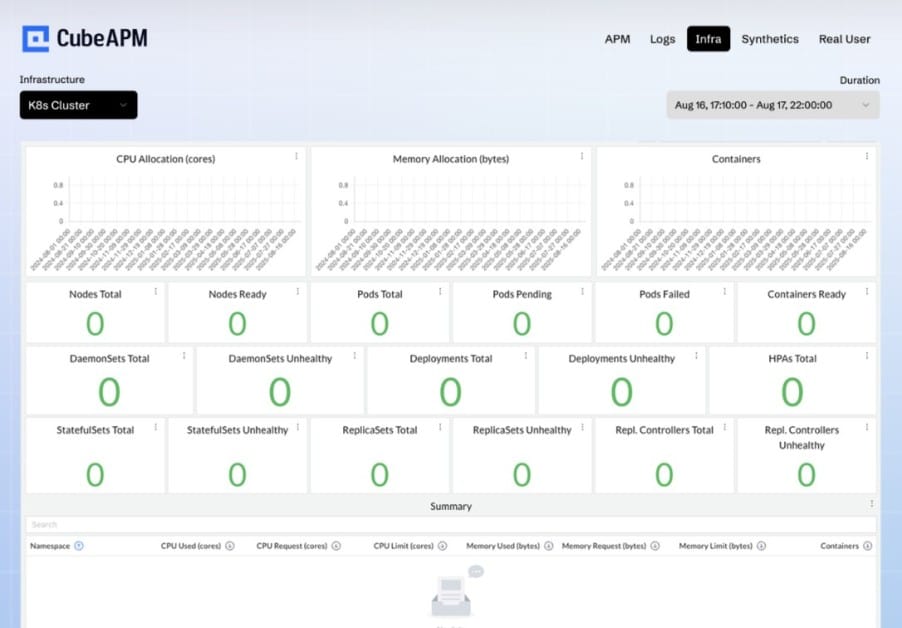
CubeAPM gives teams a complete open-standards, self-hosted observability platform without the AGPLv3 licensing concerns of the Grafana stack, without the four-component operational overhead of LGTM, and without active series pricing.
A single CubeAPM deployment covers metrics, distributed tracing, logs, infrastructure monitoring, and Kubernetes monitoring in one interface. OTLP is the only ingestion path, so there are no proprietary agents to install or maintain. Teams migrating from Grafana can point existing Prometheus agents and OTel Collectors at CubeAPM without changing their instrumentation. At $0.15/GB with no per-series, per-host, or per-user fees, costs scale only with actual telemetry volume.
Summary
Grafana’s AGPLv3 licensing across its entire core stack (Grafana, Loki, Tempo, and Mimir) and its dependence on separate backends for each signal type are the two primary reasons teams explore open-source alternatives. The five options in this guide cover the full range of replacement strategies.
| Tool | Best For | Key Difference from Grafana |
| CubeAPM | Full-stack replacement, all signals in one deployment | No LGTM stack required; flat GB pricing |
| SigNoz | OTel-native LGTM replacement, MIT Expat community license | Single ClickHouse deployment replaces four AGPLv3 LGTM components |
| Perses | Dashboard-as-code, Apache 2.0 compliance | Apache 2.0 vs. Grafana’s AGPLv3; GitOps-native dashboard lifecycle |
| VictoriaMetrics | Prometheus teams, Apache 2.0 metrics + logs stack | Drop-in PromQL compatibility, 5-10x better compression |
| OpenSearch Dashboards | Log-heavy teams, full-text search observability | Full-text search + observability in one Apache 2.0 platform |
Disclaimer: All licensing verified from official sources as of June 2026. Grafana, Loki, Tempo, and Mimir: all AGPLv3 since April 2021; plugins, agents, and certain libraries remain Apache-licensed (source: grafana.com/licensing). SigNoz community code: MIT Expat; enterprise features under SigNoz Enterprise license (source: github.com/SigNoz/signoz/blob/main/LICENSE). Perses: Apache 2.0; CNCF Sandbox project accepted August 2024 (source: perses.dev, cncf.io). VictoriaMetrics OSS: Apache 2.0; Enterprise under commercial license. OpenSearch Dashboards: Apache 2.0; latest stable release 3.6.0 (April 4, 2026). Kibana: Elastic License 2.0, not OSI-approved open source since 2021. Grafana Cloud pricing sourced from grafana.com/pricing: Free tier 10k active series and 50 GB logs/month with 14-day retention; Pro $19/month base, $6.50 per 1,000 active series, logs at $0.40/GB write + $0.05/GB process + $0.10/GB/month retain; Enterprise from $25,000/year. CubeAPM: $0.15/GB, no per-series or per-host fees. All pricing and licensing subject to change; verify at official vendor pages.
Also read:
What Are the Best Self-Hosted Grafana Cloud Alternatives?