









Sentry is one of the most widely used error monitoring platforms for developers. It has broad SDK coverage, strong issue grouping, release tracking, and a clean workflow for debugging application errors. Its pricing page lists a free Developer plan, paid Team and Business plans, and event-based pricing across errors, traces, replays, logs, and related telemetry.
But backend teams often need more than grouped exceptions. A stack trace can tell you where an error surfaced, but it may not explain whether the real cause was a slow SQL query, a failing downstream service, a Kubernetes resource issue, or a deployment-related latency spike. For distributed backend systems, error tracking works best when it is connected to traces, logs, metrics, and service dependencies.
This guide compares seven verified Sentry alternatives for backend error tracking: CubeAPM, GlitchTip, SigNoz, Rollbar, Bugsnag, Honeybadger, and Datadog Error Tracking. The focus is practical: pricing model, self-hosting, OpenTelemetry support, backend context, and where each tool is stronger or weaker than Sentry.
🔑 Key Takeaways
- Sentry is the mature default for error monitoring with strong SDKs, issue grouping, and developer-friendly workflows.
- Self-hosted Sentry is resource-heavy, requiring at least 4 CPU cores, 16 GB RAM, and 20 GB disk space.
- GlitchTip is the closest lightweight Sentry alternative, open source and compatible with Sentry SDKs for easy migration.
- SigNoz and CubeAPM are better when backend errors need to be investigated alongside traces, logs, metrics, and service dependencies.
- CubeAPM is the best fit for full OpenTelemetry-based observability with self-hosting or managed deployment and usage-based pricing at $0.15/GB.
- Datadog Error Tracking is strongest for teams already using Datadog APM, logs, RUM, or infrastructure monitoring.
| Tool | Best For | Pricing | Self-Host | OTel Native |
| CubeAPM | Full-stack backend observability with error context | $0.15/GB ingested | Yes | Yes |
| GlitchTip | Lightweight Sentry-style replacement | Free self-hosted / hosted plans available | Yes | No |
| SigNoz | OTel-native traces, logs, metrics, and exceptions | Free self-hosted / Cloud from $49/mo | Yes | Yes |
| Rollbar | Error triage with deploy correlation | Free tier with 5K occurrences/month | No | No |
| Datadog Error Tracking | Existing Datadog users | APM from $31/host/mo; standalone backend error tracking available | No | Supports OTel ingestion |
| New Relic | Full-stack observability with Errors Inbox | 100 GB free, then $0.40/GB Standard ingest | No | Supports OTel ingestion |
| Dynatrace | Enterprise APM, traces, and automated root cause analysis | Full-Stack Monitoring from $0.01 per memory-GiB-hour | No | Supports OTel ingestion |
Why Backend Teams Look for a Sentry Alternative
Sentry is good at error monitoring, but backend teams usually need to answer a deeper question: why did this service fail?
In a simple application, a stack trace and request context may be enough. In a distributed backend system, the cause may sit outside the code path where the exception appeared. A payment service may throw a timeout because a downstream API slowed down. A checkout service may fail because a database query crossed a latency threshold. A queue worker may throw repeated errors because CPU throttling started inside Kubernetes.
That is where standalone error tracking starts to feel limited. Backend teams often want error tracking connected to:
- Distributed traces
- Logs around the failing request
- Database query timing
- Infrastructure metrics
- Kubernetes pod/container health
- Deployment markers
- Service dependency maps
- Alerting and SLOs
Sentry can support broader application monitoring workflows, but teams that want backend error tracking as part of a full observability platform often compare it with tools like CubeAPM, SigNoz, and Datadog.
Self-hosting is another reason teams look elsewhere. Sentry’s official self-hosted docs list a minimum of 4 CPU cores, 16 GB RAM plus 16 GB swap, and 20 GB free disk space. The docs also recommend 32 GB RAM. That makes self-hosted Sentry a serious operational system, not a small sidecar-style deployment.
Top 7 Sentry Alternatives for Backend Error Tracking
1. CubeAPM
Best for: Backend, DevOps, and platform teams that need error tracking connected with traces, logs, infrastructure metrics, and service dependency context.
CubeAPM is an OpenTelemetry-based full-stack observability platform for APM, distributed tracing, log management, infrastructure monitoring, RUM, synthetics, and error tracking. Its public pricing page lists $0.15/GB ingestion and includes error tracking, exception stack traces, service graphs, alerting, dashboards, SLOs, runtime metrics, RBAC, SSO, MFA, and audit logs.
For backend teams, the main advantage is context. Instead of treating an exception as an isolated issue, CubeAPM lets teams investigate errors alongside the related trace, logs, service graph, and infrastructure signals. That matters when the root cause is not just a line of code, but a slow database query, bad downstream dependency, or resource pressure inside the runtime environment.
What CubeAPM Covers for Backend Error Tracking
- Exception stack traces
- Error tracking
- Distributed tracing
- Log management
- Infrastructure monitoring
- Runtime metrics
- Custom dashboards
- OpenTelemetry-based instrumentation
- Self-hosted or customer-cloud deployment
Pricing
CubeAPM pricing starts at $0.15/GB ingested, billed quarterly. Its pricing page includes APM, distributed tracing, log management, infrastructure monitoring, RUM, synthetics, error tracking, exception stack traces, service graphs, SLOs, dashboards, and security controls under that usage-based model.
Self-Hosting
Yes. CubeAPM is designed for self-hosted and customer-cloud deployments.
Where CubeAPM Is Stronger for Backend Teams
CubeAPM is stronger when backend errors need to be investigated with full observability context. Sentry is strong for application error monitoring and developer workflows, but CubeAPM is better suited when the team wants errors, traces, logs, metrics, and infrastructure signals in one OpenTelemetry-based platform.
2. GlitchTip

Best for: Teams that want a lightweight, open-source, Sentry-compatible error tracking tool.
GlitchTip is an open-source error tracking platform that is compatible with Sentry client SDKs. Its site states that teams can track errors, monitor performance, and check uptime, while using Sentry client SDK compatibility. That makes it one of the easiest migration paths for teams that already use Sentry SDKs and want to point events to another backend.
The biggest appeal is simplicity. GlitchTip is not trying to be a full observability suite. It focuses on error tracking, performance monitoring, and uptime monitoring. For teams that mainly want a Sentry-style open-source alternative without running Sentry’s heavier self-hosted stack, GlitchTip is one of the most practical choices.
What GlitchTip Covers for Backend Error Tracking
- Sentry SDK compatibility
- Error tracking
- Issue grouping
- Basic performance monitoring
- Uptime monitoring
- Open-source deployment
- Hosted option
Pricing
GlitchTip is free to self-host. Hosted plans are available, and older official GlitchTip material states that paid hosted plans start at $15/month. Teams should verify current hosted pricing directly before purchase.
Self-Hosting
Yes. GlitchTip is open source and can be self-hosted.
Where GlitchTip Is Stronger for Backend Teams
GlitchTip is stronger when the priority is a lighter, open-source, Sentry-compatible error tracking setup. It is especially useful when teams want to keep Sentry SDKs and avoid the operational weight of self-hosted Sentry.
3. SigNoz
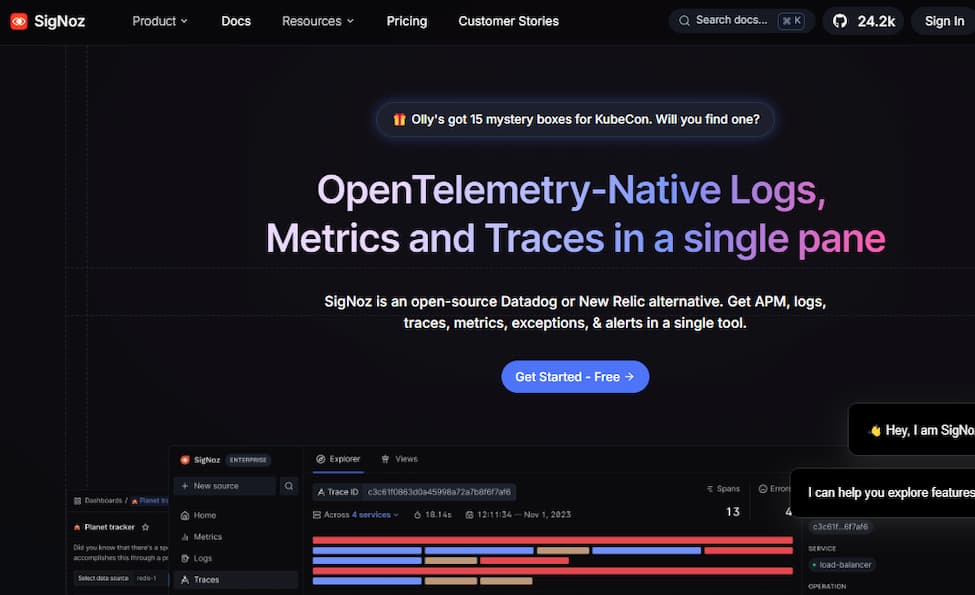
Best for: Teams that want OpenTelemetry-native observability with traces, logs, metrics, and exception tracking in one platform.
SigNoz is an open-source observability platform built around OpenTelemetry. It supports traces, metrics, logs, dashboards, alerts, and exceptions. For backend teams, SigNoz is a stronger Sentry alternative when errors need to be debugged inside a distributed tracing workflow rather than treated only as grouped exception events.
What SigNoz Covers for Backend Error Tracking
- Exception tracking
- Distributed traces
- Logs
- Metrics
- Dashboards
- Alerts
- OpenTelemetry instrumentation
- Self-hosted deployment
- Cloud deployment
Pricing
SigNoz is free to self-host. SigNoz Cloud starts at $49/month, with included usage credit and pay-as-you-go billing beyond that amount.
Self-Hosting
Yes. SigNoz can be self-hosted.
Where SigNoz Is Stronger for Backend Teams
SigNoz is stronger when backend errors need to be connected with traces, logs, and metrics through OpenTelemetry. It is a better fit for teams that want vendor-neutral instrumentation and full observability context.
4. Rollbar
Best for: Development teams that want focused error monitoring with deploy correlation and issue triage.
Rollbar is a dedicated error monitoring platform. Its pricing page lists a free plan with 5,000 occurrences and 1,000 replays per month. It focuses on discovering, grouping, assigning, and resolving errors quickly.
For backend teams, Rollbar works well when the problem is not lack of infrastructure visibility, but alert noise and issue ownership. It helps group similar errors, notify the right people, and show which deployments introduced new failures.
What Rollbar Covers for Backend Error Tracking
- Error monitoring
- Issue grouping
- Stack traces
- Telemetry context
- Alerting
- Deploy tracking
- Workflow integrations
- Session replay on supported plans
Pricing
Rollbar has a free tier with 5,000 occurrences and 1,000 replays per month. Paid plans vary by usage and plan selection, so teams should verify current plan details directly on Rollbar’s pricing page.
Self-Hosting
No. Rollbar is a SaaS product.
Where Rollbar Is Stronger for Backend Teams
Rollbar is strongest when teams want focused error triage and deployment correlation without adopting a broad observability platform. It can be a good fit for teams that want something simpler and lightweight.
5. Datadog Error Tracking
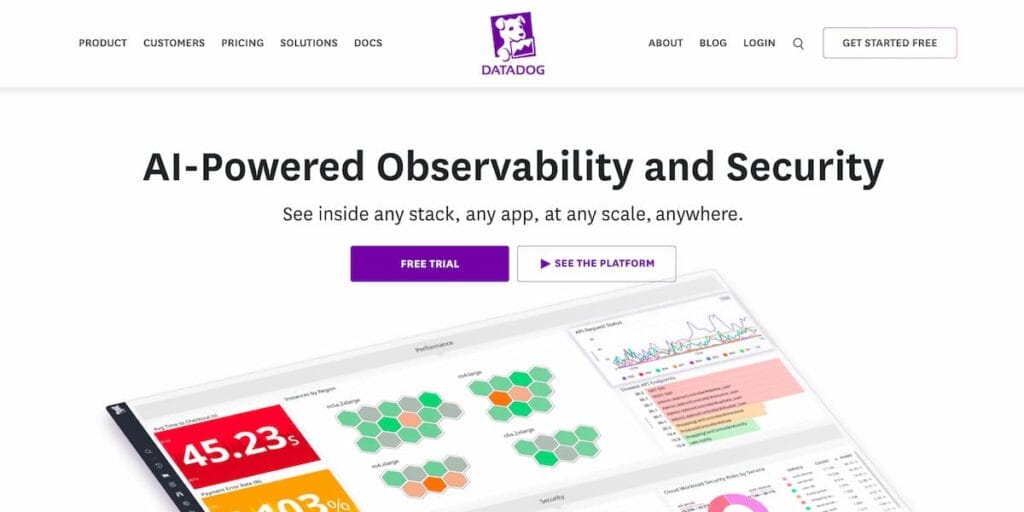
Best for: Teams already using Datadog APM, logs, infrastructure monitoring, RUM, or service maps.
Datadog Error Tracking captures and processes errors across web, mobile, and backend applications. Datadog’s docs state that errors can be ingested from logs, traces, RUM events, and SDK instrumentation. For backend services, Datadog Error Tracking automatically categorizes errors into issues and includes impacted spans, stack traces, span attributes, host tags, container tags, and metrics for APM-collected issues.
What Datadog Covers for Backend Error Tracking
- Backend error tracking
- Error grouping
- APM trace correlation
- Stack traces
- Span attributes
- Host and container tags
- Logs-based error tracking
- RUM and mobile error tracking
- Dashboards and alerts
Pricing
Datadog’s public pricing list shows APM at $31 per underlying APM host/month when billed annually. Datadog Infrastructure Monitoring starts at $15 per infra host/month, but that should not be used as the main pricing reference for backend error tracking through APM.
Self-Hosting
No. Datadog is SaaS.
Where Datadog Is Stronger for Backend Teams
Datadog is stronger when backend errors need to be connected with infrastructure metrics, container tags, host tags, traces, logs, and dashboards inside an existing Datadog environment.
6. New Relic
Best for: Teams that want error tracking as part of a broad SaaS observability platform with APM, logs, infrastructure, browser, mobile, serverless, and OpenTelemetry data in one interface.
New Relic’s Errors Inbox is an error tracking workflow designed to help teams detect, triage, and resolve errors across their stack. New Relic docs state that Errors Inbox can include APM, browser, mobile, workloads, serverless AWS Lambda data, and OpenTelemetry entities in one screen.
For backend teams, New Relic is stronger than a standalone error tracker when errors need to be connected with application performance, logs, distributed traces, workloads, and service-level views. Errors Inbox is also embedded in the APM UI, and New Relic supports grouping, expected errors, ignored errors, notifications, and version-based workflows.
What New Relic Covers for Backend Error Tracking
- Errors Inbox
- APM error reporting
- Error grouping
- Expected and ignored errors
- Version tracking
- Slack and workflow integrations
- Logs in context
- OpenTelemetry entity support
- Serverless error visibility
- Browser and mobile error views
Pricing
New Relic pricing includes 100 GB of free monthly data ingest. Standard ingest is listed at $0.40/GB beyond the free 100 GB, while Data Plus ingest is listed at $0.60/GB beyond the free allowance. New Relic docs also state that billing is based on GB ingested, regardless of telemetry type.
Self-Hosting
No. New Relic is SaaS.
Where New Relic Is Stronger for Backend Teams
New Relic is stronger when backend errors need to be analyzed alongside APM, logs, distributed traces, workloads, serverless data, and OpenTelemetry entities. It is especially useful when the engineering team already uses New Relic as its main observability workspace.
7. Dynatrace
Best for: Enterprise teams that want backend error analysis inside an automated, full-stack APM and observability platform.
Dynatrace is a full-stack observability platform known for automatic instrumentation, topology mapping, distributed tracing, and AI-assisted root cause analysis. For backend errors, Dynatrace captures errors and exceptions as attributes on spans inside distributed traces, including error type, message, stack traces, timestamp, and span context.
What Dynatrace Covers for Backend Error Tracking
- Exception analysis
- Failure analysis
- Distributed tracing
- Stack traces
- Span-level error context
- OneAgent automatic instrumentation
- OpenTelemetry trace ingestion
- Service topology
- Infrastructure monitoring
- Automated root cause analysis
- Logs in context
Pricing
Dynatrace Full-Stack Monitoring is listed at $0.01 per memory-GiB-hour, which Dynatrace also presents as roughly $58/month per 8 GiB host. Infrastructure Monitoring is listed at $0.04 per hour for any-size host, while Foundation & Discovery starts at $0.01 per hour per host.
Self-Hosting
Dynatrace is primarily a commercial observability platform. Teams should verify deployment and hosting options directly with Dynatrace because packaging can vary by customer environment and contract.
Where Dynatrace Is Stronger for Backend Teams
Dynatrace is stronger when backend errors need to be analyzed with distributed traces, service topology, infrastructure context, and automated root cause analysis. It is built for complex enterprise environments where error tracking is one part of a much larger observability workflow.
How to Choose the Right Sentry Alternative for Backend Error Tracking
CubeAPM is the strongest fit when errors need to be investigated with traces, logs, infrastructure metrics, service graphs, and OpenTelemetry-based instrumentation in one place. It also fits teams that want self-hosting or customer-cloud deployment with predictable ingestion-based pricing.
GlitchTip is the lowest-friction option if you already use Sentry SDKs and mainly want an open-source, Sentry-compatible backend for error tracking.
SigNoz is a strong choice for teams that want traces, logs, metrics, dashboards, alerts, and exceptions in an open-source OpenTelemetry-native platform.
Rollbar is good for teams that deploy frequently and want focused error grouping, triage, and release/deploy correlation.
Bugsnag is best for mobile-first teams or teams that care heavily about crash reporting, stability scores, and release health.
Honeybadger is a clean fit for smaller teams that need errors, uptime checks, and cron/check-in monitoring without adopting a large observability suite.
Datadog Error Tracking makes the most sense when your team already uses Datadog APM, logs, infrastructure monitoring, or RUM.
📌 Monitor Backend Errors with CubeAPM
Sentry is strong at tracking application errors, but backend teams often need the full path behind the failure. CubeAPM brings error tracking, distributed tracing, logs, infrastructure metrics, service graphs, dashboards, and alerts into one OpenTelemetry-based observability platform.
Instead of stopping at the stack trace, CubeAPM helps teams investigate the failing span, related logs, service dependency, runtime signal, and infrastructure context in the same workflow.
→ Explore CubeAPM Error Tracking
Conclusion
Sentry is still a strong error monitoring platform and remains a good default for many engineering teams. It has mature SDKs, good issue grouping, and a polished developer workflow. But backend teams often need more than grouped exceptions.
If you want a lightweight Sentry-style replacement, GlitchTip is the easiest fit. If you want OpenTelemetry-native observability, SigNoz is a strong open-source option. If you want focused error triage, Rollbar and Honeybadger keep the workflow simple. If mobile release stability is central, Bugsnag is worth considering. If your organization already runs Datadog, Datadog Error Tracking fits naturally into that environment.
For backend teams that want error tracking connected with traces, logs, infrastructure metrics, service graphs, and OpenTelemetry instrumentation, CubeAPM is the strongest overall Sentry alternative in this list.
Disclaimer: Pricing, packaging, and product capabilities change frequently. The pricing and feature details in this article are based on publicly available vendor pages and documentation reviewed in June 2026. Always verify current pricing and plan limits directly with each vendor before making a purchase decision.
FAQs
1. What is the best Sentry alternative for backend error tracking?
CubeAPM is the best fit for backend teams that need error tracking connected with traces, logs, infrastructure metrics, and service graphs. GlitchTip is better if you only want a lightweight Sentry-style replacement, while SigNoz is strong for teams that want open-source OpenTelemetry-native observability.
2. What is the most lightweight self-hosted Sentry alternative?
GlitchTip is one of the most lightweight Sentry-style alternatives because it is open source and compatible with Sentry client SDKs. It is narrower than Sentry, but easier to evaluate for teams that mainly need error tracking and basic monitoring.
3. Which Sentry alternatives support OpenTelemetry?
CubeAPM and SigNoz are the strongest OpenTelemetry-based options in this list. Datadog can ingest OpenTelemetry data, but it is not usually described as OpenTelemetry-native in the same way as SigNoz or CubeAPM.
4. How does CubeAPM pricing compare with Sentry pricing?
CubeAPM uses ingestion-based pricing at $0.15/GB. Sentry pricing is plan-based and event-based across categories such as errors, traces, replays, and logs. The cheaper option depends on your actual telemetry profile, including error volume, trace volume, log volume, retention, and team workflow.
5. Can I use Sentry and another backend observability tool together?
Yes. Many teams use Sentry for frontend or mobile error monitoring while using CubeAPM, SigNoz, or Datadog for backend observability. This can work well when frontend debugging and backend root cause analysis need different workflows.