









A data pipeline that silently corrupts customer revenue data for three hours on a Monday morning can cost far more than the engineering time to debug it. According to the CNCF Annual Survey 2024, 68% of organizations cite data quality and observability gaps as the top blocker to scaling analytics and ML workloads in production. Without observability, data teams discover pipeline failures only after dashboards break, ML models degrade, or compliance audits flag missing records.
Observability for data pipelines means continuously monitoring the health, quality, and flow of data as it moves through ingestion, transformation, and delivery stages. This guide covers what data pipeline observability is, how it works, what metrics and signals matter, and how to implement it without adding operational overhead or unpredictable vendor costs.
What Is Observability for Data Pipelines?
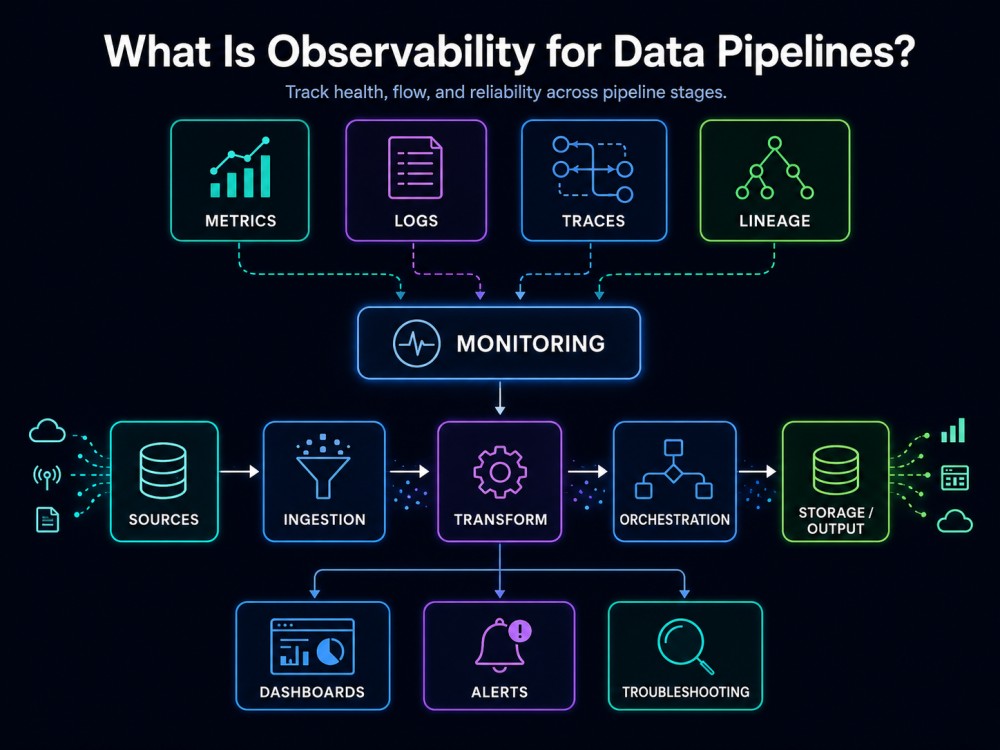
Observability for data pipelines is the practice of continuously tracking the state, behavior, and quality of data systems in production by collecting and correlating telemetry across ingestion, transformation, storage, and delivery layers.
Traditional monitoring answers whether a pipeline job succeeded or failed. Observability goes deeper: it tells you why a job succeeded but produced incomplete data, why query latency spiked during a batch window, or which upstream schema change broke downstream transformations three hops later.
Data pipeline observability combines three types of signals:
System health metrics: job success rates, execution duration, resource consumption, queue depth, and scheduler lag. These track whether pipelines are running.
Data quality signals: row counts, schema drift, null rates, duplicate keys, value distributions, and freshness. These track whether the data produced is correct and usable.
Context and lineage: column level lineage showing how data flows from source to dashboard, dependency graphs revealing which downstream jobs depend on each upstream stage, and change tracking linking data anomalies to code deployments or config changes.
The gap between system success and data correctness is where most issues hide. A Fivetran sync can complete successfully while missing 40% of expected rows due to an API rate limit that went undetected. A dbt transformation can run without errors while producing duplicate records because a JOIN condition silently changed behavior after a schema migration. Observability surfaces these problems before they cascade.
Why Data Pipeline Observability Matters in 2026
Data pipelines have gone from supporting occasional reports to powering real time dashboards, fraud detection models, dynamic pricing engines, and compliance audit trails. The cost of failure has increased accordingly.
Three structural changes make observability non negotiable for modern data teams:
Pipeline complexity scales faster than headcount: the median data team manages 50+ source connectors, 200+ transformation jobs, and 15+ consumer applications according to dbt Labs’ 2024 State of Analytics Engineering survey. Manual monitoring does not scale at this ratio.
Downstream consumers expect SLAs: business stakeholders, ML engineers, and customer facing apps now treat data pipelines like production APIs. A late dashboard refresh or stale feature store breaks trust and blocks decisions.
Data quality issues are expensive to fix retroactively: cleaning up three months of corrupted revenue data after a silent schema drift is far more expensive than catching the drift at ingestion. Observability shifts detection left to where fixes are cheapest.
Beyond avoiding failures, observability enables proactive optimization. Teams can identify which transformations consume disproportionate compute, which connectors are bottlenecks, and which datasets are never queried but still cost storage and processing overhead.
How Observability for Data Pipelines Works
Data pipeline observability works by instrumenting each stage of the pipeline to emit telemetry, collecting that telemetry into a unified system, and applying automated checks and anomaly detection to surface issues before they reach downstream consumers.
The pipeline stages that need instrumentation:
Ingestion and transport layer: CDC streams, API connectors like Fivetran or Airbyte, event buses like Kafka, file drops to S3 or blob storage, and scheduled batch imports. Key signals: sync success rate, row throughput, schema changes detected, connector lag, API rate limit hits.
Transformation layer: dbt models, Spark jobs, Airflow DAGs, stored procedures, and feature engineering pipelines. Key signals: job duration, rows read vs. rows written, data quality test failures, query performance, and upstream dependency freshness.
Storage and query layer: data warehouses like Snowflake or BigQuery, data lakes, feature stores, and OLAP databases. Key signals: query latency, storage growth rate, table freshness, partition skew, and concurrent query load.
Delivery and consumption layer: BI dashboards, ML model serving, reverse ETL syncs to CRMs, and API endpoints serving computed data. Key signals: dashboard load time, model inference latency, stale data warnings, and failed reverse syncs.
Observability platforms correlate signals across these layers using lineage graphs. When a BI dashboard shows stale data, lineage traces back through the transformation layer to find which upstream ingestion job missed its SLA, then links that job to the specific API connector experiencing rate limiting.
Key Metrics and Signals for Data Pipeline Observability
Effective observability requires tracking metrics at three levels: system health, data quality, and business impact.
System health metrics
These track whether pipeline infrastructure is functioning:
Job success rate: percentage of scheduled jobs that complete without throwing errors. A job can succeed technically but produce bad data, which is why this metric alone is insufficient.
Execution duration and SLA adherence: how long each job takes vs. its expected runtime. A job that suddenly takes 3x longer than usual often signals data volume spikes, query regression, or resource contention.
Resource utilization: CPU, memory, and network usage during pipeline execution. Unusually high resource consumption can indicate inefficient transformations or data skew.
Queue depth and backlog: for event driven pipelines, how many messages are waiting to be processed. Growing queues indicate throughput bottlenecks.
Dependency freshness: whether upstream data is available before downstream jobs run. A common failure mode is scheduling a dbt transformation before its source table refresh completes.
Data quality metrics
These track whether the data produced is correct:
Row count anomalies: sudden drops or spikes in record count vs. historical baselines. A Fivetran connector that ingests 10,000 rows daily for six months then drops to 2,000 rows signals a problem even if the sync technically succeeds.
Schema drift: unexpected column additions, type changes, or column removals. An upstream API adding a new required field without warning can break downstream transformations that expect fixed schemas.
Null rate and completeness: percentage of required fields that contain null values. A user ID column that historically has 0.1% nulls but suddenly jumps to 15% nulls indicates data corruption or source system issues.
Uniqueness violations: duplicate primary keys or business keys where uniqueness is expected. Duplicate customer IDs in a fact table break aggregations and reporting.
Value distribution shifts: mean, median, and percentile values for numeric columns. A revenue column that historically averages $150 per transaction but drops to $15 suggests a unit conversion bug or data mapping error.
Cross table consistency: referential integrity checks ensuring foreign keys match across tables. Orders referencing non existent customer IDs indicate join failures or incomplete data propagation.
Business impact signals
These connect technical metrics to business outcomes:
Dashboard and report freshness: how stale the data is in downstream BI tools. Business users care about this more than job success rates.
Model performance degradation: for ML pipelines, tracking when feature distributions drift or model accuracy drops below thresholds.
Compliance audit readiness: ensuring all required data is retained, all deletions are logged, and all transformations are traceable for regulatory audits.
Cost per pipeline stage: tracking compute and storage costs per transformation job to identify optimization opportunities.
The most effective observability setups combine automated anomaly detection on these metrics with manual business logic tests. Anomaly detection catches unknown unknowns like an unexpected traffic spike causing a 10x row count increase. Business logic tests catch known failure modes like revenue totals not matching expected monthly benchmarks.
Best Practices for Implementing Data Pipeline Observability
Implementing observability without adding overwhelming operational burden requires focusing on high value signals first and building incrementally.
Start with automated freshness and volume checks
Before writing complex data quality tests, deploy automated checks on row count and table freshness across all critical tables. These catch 60% of common pipeline failures with minimal configuration. Most orchestration tools and data warehouses support these natively.
Instrument at ingestion, not just transformation
The most expensive data quality bugs originate at ingestion when incorrect or incomplete data enters the warehouse. Placing checks here catches issues before they propagate through dozens of downstream transformations. A missing API field detected at ingestion saves hours of debugging vs. discovering it in a broken dashboard.
Use column level lineage to trace impact
When a data quality issue is detected, column level lineage shows exactly which downstream dashboards, models, or reports are affected. This prevents wasting engineering time investigating tables and pipelines that are not in the critical path.
Set alert thresholds based on business impact, not technical perfection
Alerting on every anomaly creates noise. Prioritize alerts for pipelines feeding customer facing dashboards, revenue reporting, fraud detection, or compliance systems. Internal analytics tables used occasionally can tolerate more relaxed SLAs.
Separate automated anomaly detection from known business rules
Anomaly detection is excellent for catching unexpected volume shifts or schema drift. Business rule validation for example, ensuring daily revenue totals fall within expected ranges catches domain specific issues that statistical anomaly detection misses. Use both.
Centralize observability data with APM and infrastructure metrics
Data Privacy and On-Prem Security in Modern Observability Architectures explores how unified observability platforms reduce context switching by correlating data pipeline health with application traces, infrastructure metrics, and logs in one interface.
Deploy incremental rollouts, not big bang migrations
Start by instrumenting the 10 most critical pipelines first. Prove value before expanding. Trying to observe every pipeline and table at once creates configuration debt and alert fatigue before delivering measurable benefit.
Tools and Implementation: Building Observable Data Pipelines
Implementing observability for data pipelines requires choosing between building on open standards vs. using vendor platforms, and deciding whether to separate data observability from infrastructure and application monitoring or unify them.
Native data platform observability features
Modern data platforms include built in observability capabilities:
dbt: includes data quality tests run during transformation, metadata on test pass rates, and integration with dbt Cloud for test results visualization. Limited to transformation layer only.
Airflow: provides DAG run history, task duration metrics, and failure logs. Does not track data quality or schema drift, only job execution status.
Fivetran: monitors connector sync success, row throughput, and schema change detection. Useful for ingestion observability but does not extend to downstream transformation or consumption.
Snowflake and BigQuery: expose query performance metrics, storage costs, and table access logs. Helpful for understanding warehouse utilization but lack end to end pipeline lineage.
These native features work well for small teams or single stage observability but require stitching together multiple tools as pipelines grow.
Specialized data observability platforms
Tools purpose built for data pipeline observability include:
Monte Carlo: focuses on automated anomaly detection, schema drift tracking, and column level lineage. SaaS only, pricing starts around $50,000 annually for mid market teams.
Great Expectations: open source Python library for defining data quality tests as code. Strong community, no built in alerting or lineage visualization. Requires integration with orchestration tools for production deployment.
Datafold: provides column level diff testing before and after transformations, useful for validating dbt model changes. Limited runtime monitoring.
Elementary: open source dbt native data observability. Tests run inside dbt, results stored in the warehouse, integrates with Slack for alerting. Best for teams already standardized on dbt.
These tools excel at data quality testing and schema tracking but often require separate infrastructure monitoring and APM for full stack visibility.
Full stack observability platforms
For teams running data pipelines alongside microservices and cloud infrastructure, unified observability platforms correlate pipeline health with application traces, logs, and infrastructure metrics in one interface.
CubeAPM: self hosted observability platform covering APM, logs, infrastructure, and data pipeline monitoring. Runs inside your VPC, so no telemetry leaves your environment. Predictable $0.15/GB ingestion pricing with unlimited retention. Native OpenTelemetry support allows ingesting data pipeline metrics alongside application traces. Best for teams with data residency requirements or unpredictable SaaS observability costs. Deployment typically completes in under an hour with vendor managed backend operations.
Datadog: SaaS observability platform with data pipeline monitoring through integrations with Airflow, dbt, Fivetran, and Kafka. Strong ecosystem but pricing compounds quickly as pipeline scale increases. Infrastructure monitoring starts at $18/host/month, APM at $42/host/month, and logs at $0.10/GB ingest plus $1.70/million events indexed. For a team running 50 Airflow workers processing 10TB monthly, estimated cost reaches $8,000 to $12,000/month before custom metrics or RUM.
Grafana: open source dashboards with Loki for logs, Tempo for traces, and Prometheus for metrics. Self hosted option gives full control but requires dedicated DevOps resources. Grafana Cloud offers managed hosting starting at $50/month for small workloads but costs scale with ingestion volume and retention.
Splunk: enterprise platform with strong log aggregation and SIEM capabilities. Handles high volume pipeline logs but expensive at scale. Pricing starts at $150/GB for ingest and indexing in Splunk Cloud.
Choosing between specialized data observability tools and full stack platforms depends on whether you want one unified interface for all telemetry or prefer best of breed tools stitched together via APIs.
Building vs. buying: when to instrument pipelines yourself
Some teams build custom observability by instrumenting pipelines to emit metrics to Prometheus, writing dbt tests for data quality, and creating Grafana dashboards for visualization. This works well for teams with strong data platform engineering resources and specific needs not met by vendors.
- Build if: your team has dedicated platform engineers, you need deep customization, you already standardized on open source tools like dbt and Airflow, and vendor costs exceed the fully loaded cost of maintaining internal tooling.
- Buy if: your data team is focused on delivering analytics and ML products rather than building infrastructure, you need to scale observability quickly across many pipelines, or you lack the engineering capacity to maintain custom solutions long term.
Most teams start with native features and open source tools, then adopt vendor platforms as pipeline complexity outpaces internal tooling capacity.
Observability for Data Pipelines vs. Traditional Monitoring
Traditional data pipeline monitoring answers whether jobs succeeded. Observability answers whether the data produced is correct and usable.
Monitoring tracks job execution status, logs errors, and alerts when pipelines fail. It operates at the infrastructure and orchestration layer: Did the Airflow DAG complete? Did Fivetran sync finish? Are there error messages in logs?
Observability tracks data correctness, freshness, and downstream impact. It operates at the data layer: Did the sync pull all expected rows? Did the transformation produce the right aggregates? Is the data fresh enough for downstream consumers?
A common failure mode illustrates the gap: a Fivetran connector completes successfully, logs show no errors, but only 40% of expected rows were synced because an upstream API rate limit silently dropped records. Traditional monitoring shows green. Observability shows red because row count fell below threshold.
Another example: a dbt transformation runs without errors but produces duplicate customer IDs due to a faulty JOIN after a schema migration. The job succeeds, monitoring shows no failure, but the data is unusable. Observability detects the uniqueness violation and alerts before downstream reports break.
The distinction matters because SLAs for data pipelines increasingly focus on data quality, not just job completion. A pipeline that succeeds but produces incorrect data violates user trust more than a pipeline that fails visibly and triggers immediate remediation.
Migrating to Observable Data Pipelines: A Practical Roadmap
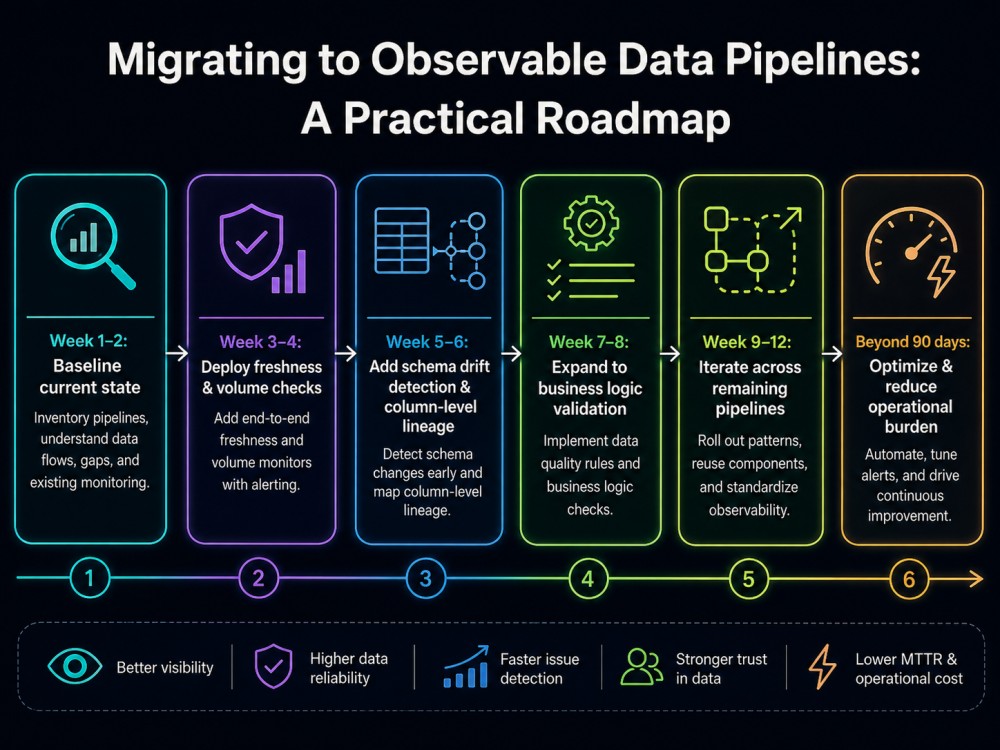
Implementing observability across an existing data stack without disrupting production pipelines requires a staged rollout.
Week 1-2: Baseline current state
Audit your pipeline inventory. Document all ingestion connectors, transformation jobs, and downstream consumers. Identify the 10 most critical pipelines those feeding customer facing dashboards, revenue reporting, compliance audits, or ML models. These become your observability pilot.
Map current failure detection methods. How do you learn about pipeline issues today? User reports? Manual dashboard checks? Ad hoc Slack alerts? Document mean time to detection (MTTD) and mean time to resolution (MTTR) for recent incidents to establish baseline metrics.
Week 3-4: Deploy automated freshness and volume checks
Implement row count and table freshness monitors on your 10 critical pipelines. Most data warehouses and orchestration tools support these natively with minimal configuration. Set alert thresholds based on historical baselines, not arbitrary values.
Route alerts to a dedicated Slack channel or PagerDuty service. Avoid sending every alert to a shared engineering channel where they get lost in noise.
Week 5-6: Add schema drift detection and column level lineage
Deploy schema change tracking on ingestion tables. Alert when columns are added, removed, or change types. This catches breaking changes before they cascade downstream.
Implement column level lineage if your tooling supports it. When a data quality issue is detected, lineage shows which downstream dashboards and models are affected without manual investigation.
Week 7-8: Expand to business logic validation
Add domain specific data quality tests for your pilot pipelines. Examples: revenue totals within expected range, customer ID uniqueness, required fields non null, foreign key referential integrity.
Write these tests close to where data enters the warehouse, not just at the final transformation layer. Catching bad data at ingestion prevents it from polluting dozens of downstream tables.
Week 9-12: Iterate and expand to remaining pipelines
Review alert effectiveness after two months. Are alerts actionable? Are they caught before users report issues? Adjust thresholds and add new checks based on incidents.
Gradually roll out observability to remaining pipelines in priority order. High value pipelines first, low priority internal analytics tables last.
Beyond 90 days: Optimize and reduce operational burden
After three months, analyze which checks provide the most value and which create alert fatigue. Consolidate overlapping checks, increase thresholds for low priority pipelines, and automate remediation for known failure modes where possible.
Track MTTD and MTTR improvements vs. baseline. Observability should cut detection time from hours or days to minutes, and reduce resolution time by surfacing root causes faster.
Disclaimer: This estimate models a phased rollout over 90 days. Actual timelines vary based on pipeline complexity, team size, and existing tooling maturity. Verify implementation scope and resource requirements with your platform team before committing to a timeline.
Frequently Asked Questions
What is the difference between data observability and data monitoring?
Data monitoring tracks whether pipeline jobs succeed or fail. Data observability tracks whether the data produced is correct, complete, and fresh enough for downstream use. Monitoring answers “did it run” while observability answers “is the data good.”
What are the most common data pipeline observability issues teams face?
Row count drops due to upstream API changes, schema drift breaking downstream transformations, stale data violating SLAs, duplicate records from faulty JOINs, and null rate spikes in required fields. Most issues originate at ingestion or early transformation stages.
How does observability help with data quality?
Observability detects data quality issues in real time by tracking row counts, schema drift, null rates, uniqueness violations, and value distributions. Automated checks surface problems before downstream dashboards or ML models consume bad data.
What metrics should I track for data pipeline observability?
Track job success rate, execution duration, row count anomalies, schema changes, null rates, uniqueness violations, table freshness, and query performance. Correlate these with business impact metrics like dashboard staleness and model accuracy.
Can I implement observability without a dedicated tool?
Yes, many teams start by writing dbt tests, instrumenting Airflow DAGs to emit metrics to Prometheus, and building Grafana dashboards. This works well for small pipelines but becomes operationally heavy as scale increases.
How does data pipeline observability integrate with APM and infrastructure monitoring?
Unified observability platforms correlate pipeline health with application traces, logs, and infrastructure metrics. When a dashboard is slow, you can trace back through API latency, database query performance, and pipeline freshness in one interface rather than switching between tools.
What is column level lineage and why does it matter?
Column level lineage shows how individual data fields flow from source systems through transformations to final dashboards or models. When a data issue is detected, lineage instantly reveals which downstream assets are affected without manual tracing.