










Datadog is built for enterprise observability budgets. Its pricing model assumes teams with many hosts, dedicated procurement, and the scale to negotiate multi-year contracts at 15 to 40% below list price. For a small team of three to ten engineers monitoring five to twenty hosts, Datadog’s modular per-host, per-product structure creates a bill that is disproportionate to the infrastructure it monitors and difficult to predict month to month.
At five hosts on the Pro plan with APM enabled, the minimum annual commitment is ($15 + $31) × 5 = $230/month before logs, containers, or custom metrics. That is before a single byte of log data is ingested. At twenty hosts with APM and moderate log volume, the bill regularly reaches $2,000 to $3,000/month. For an early-stage team where observability is a cost center rather than a revenue driver, that is a significant allocation.
The Datadog alternatives in this guide are chosen specifically for their fit with small teams: low or zero entry cost, no annual commitment required to get started, simple setup that does not require a dedicated platform engineer, and pricing that scales proportionally with actual usage rather than host count.
Key Takeaways
- Datadog’s free tier covers only 5 hosts with 1-day metric retention and no APM, logs, RUM, or synthetics. Most small teams outgrow it immediately and face the full Pro pricing on their next host
- Annual commitment is required for Datadog’s best per-unit pricing. Month-to-month billing is approximately 20% higher per unit. Small teams that cannot forecast infrastructure 12 months ahead pay the higher on-demand rate
- CubeAPM covers APM, logs, infrastructure monitoring, RUM, synthetic monitoring, and Kubernetes monitoring at $0.15/GB with no per-host fees, no per-user fees, and no annual commitment requirement
- New Relic’s free tier includes 100GB/month, one standard user with full access to all 50+ capabilities, unlimited basic users, and 500 synthetic checks. It does not expire. A small team can run production APM, infrastructure monitoring, logs, and distributed tracing at zero cost indefinitely
- Grafana Cloud’s free tier includes 14-day retention and covers the core monitoring needs of a small team. The paid tier is usage-based with no per-host licensing fees
- SigNoz Cloud starts at $49/month (currently reduced from $199/month) with no per-host fees. The community edition is free to self-host
- Sentry covers error tracking, performance monitoring, and session replay from $26/month for unlimited users. It does not replace infrastructure monitoring, but is the best-priced tool for error-first observability
Why Datadog Is Specifically Difficult for Small Teams
The challenges Datadog creates are not uniform across team sizes. They compound differently for small teams.
- The free tier is genuinely insufficient for production: Datadog’s free plan covers 5 hosts with 1-day metric retention. A small team running a production application needs at minimum 7-day retention for incident investigation. The moment you go to 6 hosts or need APM, you are on the Pro plan with an annual commitment.
- Annual commitments require forecasting you cannot do: The Pro plan at $15/host/month and APM at $31/host/month are annual commitment rates. Month-to-month billing is approximately $18/host for infrastructure and $36/host for APM. A small team that is growing, pivoting, or uncertain about infrastructure requirements in 12 months is penalized for choosing the flexibility of month-to-month billing.
- The median Datadog customer pays $152,340 per year: This figure is from Vendr’s analysis of 1,023 verified Datadog purchases (April 2026) and reflects the reality that Datadog’s platform is priced for enterprise volume. Small teams that have not reached the scale to negotiate meaningful discounts pay closer to list price for a platform designed for much larger deployments.
- Most small teams need 3 to 4 Datadog modules: You almost never just use infrastructure monitoring. You need APM to trace requests, logs to debug issues, and likely synthetics or RUM to catch frontend problems. Each module stacks independently. A small team enabling infrastructure, APM, and logs on 10 hosts spends ($15 + $31) × 10 plus log volume costs, over $460/month at minimum before overages.
- There is no self-service downgrade path: Removing services or downgrading your Datadog contract requires contacting account management. Small teams that added a product during an evaluation and want to remove it do not have a self-service option.
Top Datadog Alternatives
1. CubeAPM
CubeAPM is a full-stack observability platform that runs inside your own infrastructure. For a small team, it removes three Datadog pain points simultaneously: per-host billing, module-based pricing, and data leaving your infrastructure. One deployment, one pricing dimension, all signals.
Why it fits small teams specifically: A small team monitoring 10 hosts with APM enabled pays the same per-GB rate as a team monitoring 100 hosts. Growth does not trigger a pricing step change. Adding a new service or a new engineer costs nothing at the platform level. There is no account manager to call if you want to change your configuration.
Pricing: $0.15/GB ingestion. No per-host fees. No per-user fees. No per-module charges. No annual commitment required.
A small team generating 10GB/day across all signals (traces, metrics, logs) pays $45/month regardless of host count, user count, or which features they use.
Signals covered: APM, distributed tracing, log management, infrastructure monitoring, Real User Monitoring, synthetic monitoring, error tracking, and Kubernetes monitoring.
Setup for a small team: Deploy via Helm into your cluster or Docker Compose on a single VM. Point OTEL_EXPORTER_OTLP_ENDPOINT at your CubeAPM instance. No per-service configuration. All OTel-instrumented services send data automatically.
Best for: Small teams that want a complete Datadog replacement without per-host billing surprises as they scale. Teams handling sensitive data who cannot send telemetry to a third-party SaaS. Teams that want all signals in one place without paying per module.
Limitations: Self-hosted deployment required. Not a fit for teams with zero infrastructure management capacity.
2. New Relic
New Relic is the closest functional equivalent to Datadog at a small-team price point. The free tier is the most operationally useful free monitoring tier in the market. It does not expire.
New Relic currently offers two pricing models: the standard Data + User model (what most teams use, described below), and a newer Core Compute model currently in Preview that unlocks full platform access for all users based on consumption rather than per-user licensing. The Core Compute model requires contacting a New Relic account executive and is not self-service as of May 2026.
Pricing:
| Tier | Data | Users | Cost |
| Free (perpetual) | 100GB/month from any source | 1 standard user (full access to all 50+ capabilities), unlimited basic users | $0 |
| Standard | 100GB/month free, then $0.40/GB | Up to 5 standard users | Contact for pricing |
| Pro | 100GB/month free, then $0.40/GB | Unlimited standard users | Contact for pricing |
The free tier’s one standard user gets complete access to every New Relic capability including APM with distributed tracing, infrastructure monitoring, log management, synthetic monitoring (500 checks included), browser monitoring, error tracking, and dashboards. Basic users (unlimited, free on all tiers) can run queries and build and view dashboards. Additional standard users start at $49/month on Core tier plans.
What 100GB/month covers for a small team: A typical small production deployment with 5 to 10 services generating traces, metrics, and logs at moderate volume comfortably fits within 100GB/month. One engineer with full troubleshooting access and as many dashboard-viewing team members as needed, all for free.
Best for: Small teams that want a full-stack SaaS observability platform at zero cost. Teams that cannot afford to deploy and maintain self-hosted infrastructure. The most complete free tier to try before evaluating paid alternatives.
Limitations: Free tier has 8-day data retention. Additional standard users cost from $49/month. Data leaves your infrastructure.
3. Grafana Cloud
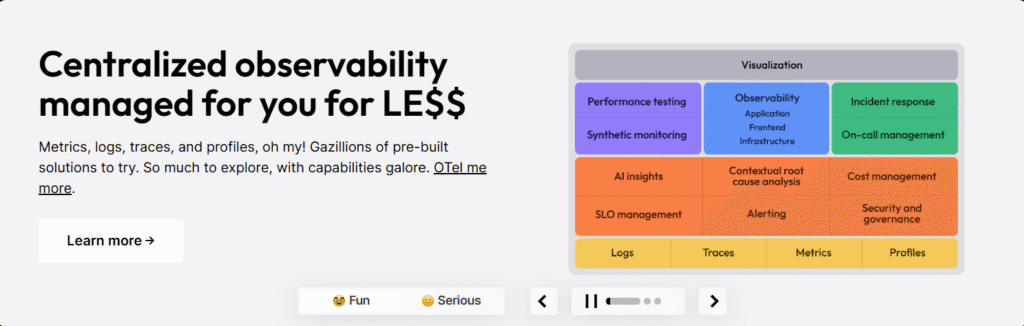
Grafana Cloud is the managed LGTM stack. The free tier is appropriate for small teams doing basic monitoring. The paid tier adds no per-host license fees and scales on usage dimensions that small teams can control directly.
Pricing:
| Tier | What is included | Cost |
| Free | 2,232 host hours/month, 14-day retention, full platform access, Grafana Assistant AI | $0 |
| Pro | 13-month metric retention, 30-day log/trace retention, usage-based billing | Per active series, per GB, per host hour |
The free tier’s 2,232 host hours per month is approximately 3 hosts monitored continuously for the full month. For a small team running 3 to 5 services, the free tier covers a meaningful production environment.
Why it fits small teams: Teams already familiar with Prometheus and Grafana from open-source deployments can move their dashboards and alert rules to Grafana Cloud with no changes. There is no new query language to learn and no new visualization tool to adopt.
Best for: Small teams already using Prometheus and Grafana locally who want a managed backend. Teams that want PromQL-based alerting and dashboards without running the storage backend themselves.
Limitations: Free tier 14-day retention is not enough for trend analysis beyond two weeks. Active series billing can grow unexpectedly with high-cardinality instrumentation.
4. SigNoz
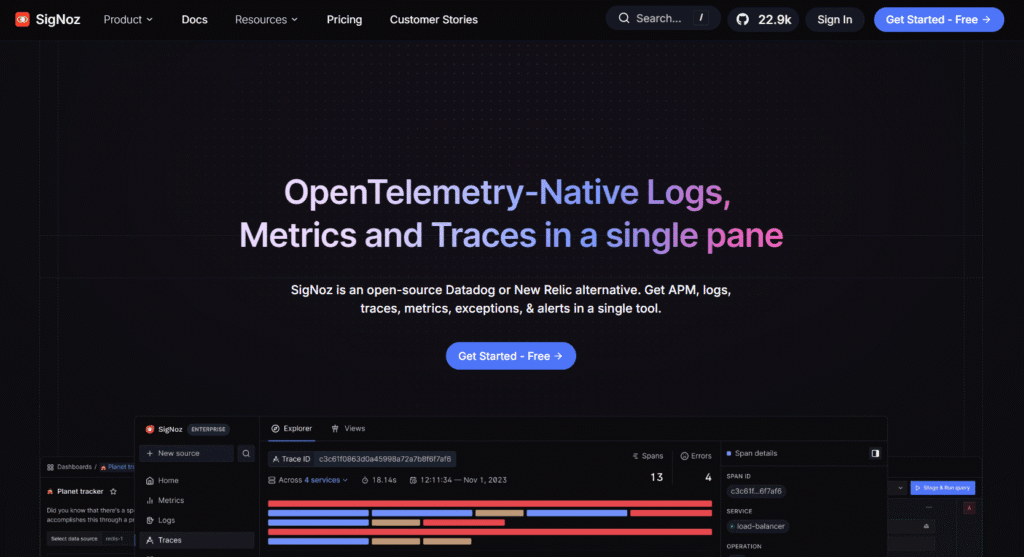
SigNoz is an OTel-native, open-source observability platform covering APM, distributed tracing, logs, infrastructure metrics, and exceptions in a single interface. The community edition is free to self-host. The Teams Cloud offering starts at $49/month.
Pricing:
| Tier | Cost | What is included |
| Community (self-hosted) | Free (infrastructure cost only) | All signals, unlimited hosts, capped dashboard panels |
| Teams Cloud | $49/month (currently reduced from $199/month) | $49 worth of usage (163GB logs/traces or 490M metric samples), then $0.30/GB logs/traces, $0.10/M metric samples |
| Enterprise | From $4,000/month | Dedicated environment, BYOC, SLAs |
No per-host fees on any tier. Unlimited teammates on Teams Cloud. SOC2 Type II and HIPAA compliant on Teams Cloud with data centers in the US, EU, and India.
Why it fits small teams: The community edition gives a small team with one platform-capable engineer a production-grade observability stack at zero licensing cost. Teams that do not want to manage infrastructure can use Teams Cloud at $49/month. As team size grows, the bill grows only with data volume, not with headcount or host count.
Best for: Small teams comfortable with OTel-native tooling. Teams that want open-source roots and a self-hosted path at zero licensing cost. Teams scaling fast who want data volume-based pricing.
Limitations: Community edition has capped dashboard panel counts for traces and logs. UI is less polished than Datadog or New Relic for teams new to observability tooling.
5. Better Stack
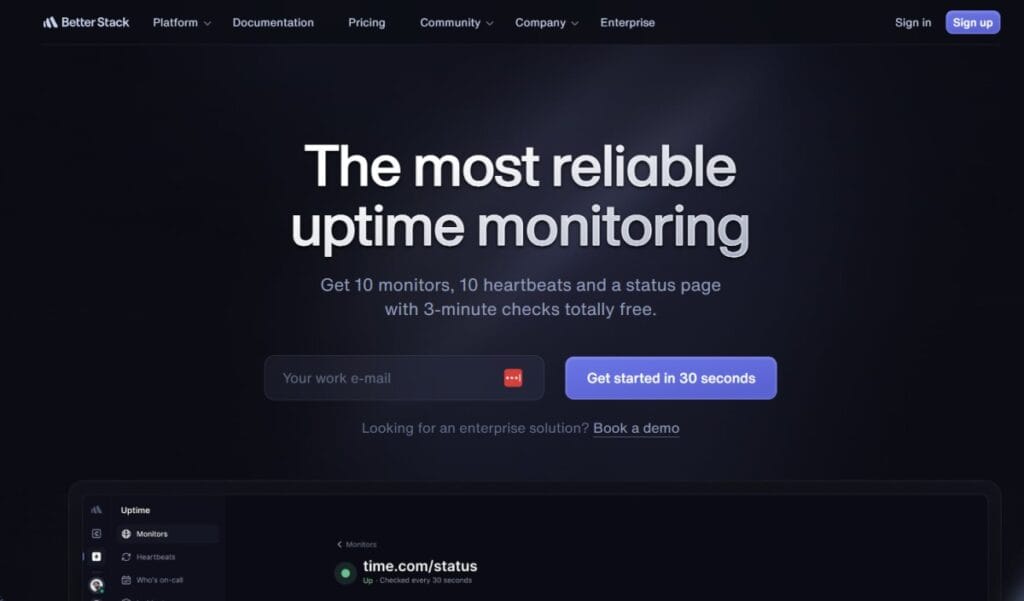
Better Stack combines uptime monitoring, log management, incident management, and on-call scheduling in one platform. For a small team currently paying separately for Datadog, PagerDuty, and StatusPage, Better Stack can replace all three at a lower combined cost.
Pricing: Free tier: 10 uptime monitors, 10 heartbeats, 1 status page. Paid (Responder license): $29/month per responder (annual) or $34/month (monthly) for full incident management, including on-call scheduling and unlimited phone and SMS alerts.
Why it fits small teams: Small teams are often paying for several separate tools. Better Stack consolidates monitoring, incident management, and status pages. The Playwright-based browser transaction checks replace basic synthetic monitoring. Log management handles application logs without a separate log aggregation platform.
Best for: Small teams that currently pay for separate monitoring, alerting, and status page tools and want to consolidate. Teams where uptime monitoring and incident response are the primary observability needs.
Limitations: Better Stack is not a full APM platform. It does not provide distributed tracing or deep infrastructure metrics dashboards. Most teams use it alongside a separate metrics or APM tool.
6. Sentry
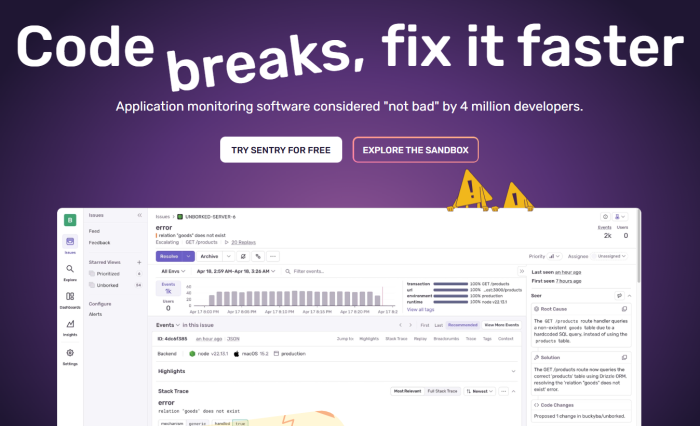
Sentry focuses on error tracking, performance monitoring, session replay, and release health. It does not monitor infrastructure. For small teams where the primary observability need is catching and fixing application errors quickly, Sentry is the most cost-effective specialized tool.
Pricing:
| Plan | Errors/month | Users | Logs included | Cost |
| Developer | 5,000 | 1 | 5GB | Free forever |
| Team | 50,000 | Unlimited | 5GB | $26/month |
| Business | 100,000 | Unlimited | 5GB | $80/month |
Why it fits small teams: $26/month for unlimited users and 50,000 errors/month covers the error tracking needs of most small production applications. Sentry’s AI-assisted root cause analysis (Seer) groups similar errors automatically and suggests fixes. Session replay shows exactly what a user experienced before an error occurred.
Best for: Small teams where error tracking is the primary observability need. Frontend and full-stack JavaScript teams. Teams that want AI-assisted error triage at a predictable monthly cost.
Limitations: Sentry does not monitor infrastructure. Most small production teams pair Sentry with a separate metrics tool.
Decision Framework for Small Teams
| Your situation | Best choice |
| Want all signals in one self-hosted platform, no per-host billing as you scale | CubeAPM |
| Want zero-cost full-stack SaaS observability, can stay within 100GB/month | New Relic free tier |
| Already using Prometheus/Grafana locally, want a managed backend | Grafana Cloud free tier |
| Want OTel-native observability, open-source community edition or $49/month managed | SigNoz |
| Need to consolidate monitoring, incident management, and status page in one tool | Better Stack |
| Primary need is error tracking and session replay, not infrastructure metrics | Sentry Team ($26/month) |
| Team has one platform engineer and wants zero licensing cost for the full stack | SigNoz community edition or Prometheus with Grafana |
Comparison at a Glance
| Tool | Starting cost | Per-host fee | Annual commitment required | All signals | Self-hosted option |
| CubeAPM | $0.15/GB | No | No | Yes | Yes (required) |
| New Relic | Free (100GB/month, 1 standard user) | No | No | Yes | No |
| Grafana Cloud | Free (14-day retention) | No | No | Yes | Partial |
| SigNoz | Free (community) or $49/month (Cloud) | No | No | Yes (APM, logs, traces, metrics) | Yes |
| Better Stack | Free (10 monitors) or $29/month | No | No (annual optional) | Uptime, logs, incidents | No |
| Sentry | Free or $26/month (Team) | No | No | Errors, performance, session replay | Yes (open source) |
| Datadog | $15/host/month (Pro annual) | Yes | Yes (for best pricing) | Yes (separate module billing) | No |
Summary
Datadog’s pricing model is specifically misaligned with small team needs: per-host billing that requires 12-month forecasting, module stacking that makes basic observability (infrastructure plus APM plus logs) expensive, and a free tier that covers only 5 hosts with 1-day retention. The alternatives above solve these problems in different ways.
CubeAPM eliminates per-host fees entirely at $0.15/GB self-hosted. New Relic gives the most complete free SaaS tier at 100GB/month with one standard user and full platform access. Grafana Cloud extends an existing Prometheus investment into a managed backend. SigNoz provides OTel-native observability free or at $49/month. Better Stack consolidates monitoring and incident management. Sentry handles error tracking from $26/month for unlimited users.
Disclaimer: All pricing verified directly from official product pages: datadoghq.com/pricing (Infrastructure Pro $15/host/month annual, APM $31/host/month annual, free tier 5 hosts 1-day retention, month-to-month approximately 20% higher, verified May 2026), newrelic.com/pricing and newrelic.com/pricing/free-tier (100GB/month free perpetual, one standard user with full access to all 50+ capabilities, unlimited basic users, 500 synthetic checks included, 8-day retention, $0.40/GB beyond free, core users from $49/month, verified May 2026), grafana.com/pricing (free tier 2,232 host hours/month, 14-day retention, verified May 2026), signoz.io/pricing (Teams Cloud $49/month currently reduced from $199/month, community edition free, Enterprise from $4,000/month, verified May 2026), betterstack.com/pricing (free tier 10 monitors, Responder $29/month annual, verified May 2026), sentry.io/pricing (Developer free, Team $26/month/50K errors/unlimited users, 5GB logs free all plans, verified May 2026), cubeapm.com/pricing ($0.15/GB, verified May 2026). Datadog median customer spend ($152,340/year based on 1,023 verified purchases) sourced from Vendr platform data (April 2026). Pricing is subject to change; verify current rates before purchasing.
Also read:
What Are the Best Datadog Alternatives for Python Applications?
What Are the Best Datadog Alternatives With No Per-Host Pricing?
What Is the Best Datadog Alternatives for Kubernetes Monitoring?