







The main difference between Amazon CloudWatch, Splunk Observability Cloud, and CubeAPM is how each platform handles telemetry at scale. CloudWatch is AWS-native and works best for teams already running most workloads inside AWS. Splunk Observability Cloud is a SaaS observability platform for infrastructure monitoring, APM, RUM, synthetics, and incident troubleshooting.
CloudWatch gives AWS teams fast access to logs, metrics, alarms, and service-level visibility with minimal setup. Splunk Observability Cloud gives broader visibility across cloud-native environments using OpenTelemetry collectors, Splunk APM, Infrastructure Monitoring, RUM, and Synthetic Monitoring.
CubeAPM is built for teams that want OpenTelemetry-native observability, full MELT support, self-hosted or BYOC deployment, and predictable ingestion-based pricing. In this article, we compare CloudWatch vs Splunk Observability Cloud vs CubeAPM across architecture, telemetry pipelines, sampling, retention, pricing behavior, and scaling trade-offs.
Amazon CloudWatch vs Splunk Observability Cloud vs CubeAPM: Comparison Table
Disclaimer The comparison below is based on publicly available documentation and typical production usage patterns. Actual pricing, sampling, and retention behavior may vary depending on workload characteristics and system configuration.
| Features | CubeAPM | AWS CloudWatch | Splunk Observability Cloud |
| Known for | OpenTelemetry-native full-stack observability with unified telemetry | Native AWS monitoring for metrics, logs, alarms, and events | SaaS observability across infrastructure, APM, RUM, synthetics, and incident troubleshooting |
| Multi-Agent Support | Yes (OTel, New Relic, Datadog, Elastic) | Limited (CloudWatch Agent, AWS SDKs, OpenTelemetry, AWS X-Ray) | Broad (OpenTelemetry, Splunk Forwarder, custom agents, third-party integrations) |
| MELT Support | Full MELT | Full MELT | Full MELT |
| Setup | Self-hosted but vendor-managed | SaaS (Fully managed AWS service) | SaaS only |
| Pricing | Ingestion-based pricing of $0.15/GB | Logs: $0.50 per GBApplication Observability: $0.15/GB | Infra: $15 per host/month App & Infra: $60 per host/month End-to-End: $75 per host/month |
| Sampling Strategy | Smart sampling | Tail-based + Adaptive | Head + Tail-based + Probabilistic sampling |
| Log Retention | Unlimited retention | Logs: Indefinite retention | Usage Data: 13 months Traces: 8 days |
| Support TAT | < 10 minutes | Business Plan: 15 minutes | P1: 30 minutes P4: 1 business day |
Amazon CloudWatch vs Splunk vs CubeAPM: Feature-by-Feature Breakdown
Known for
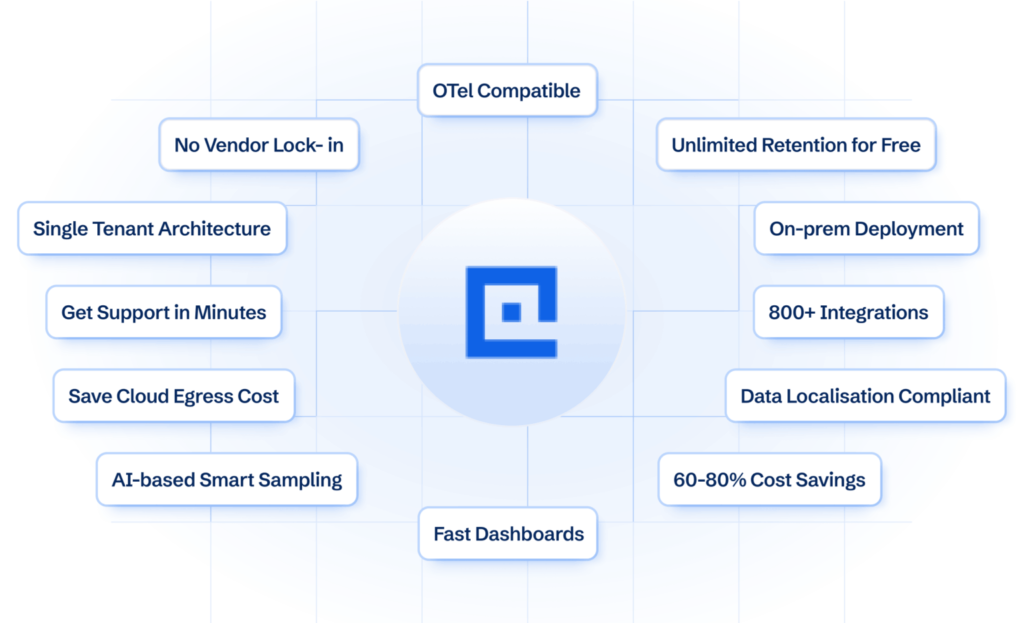
CubeAPM: Known for OpenTelemetry-native, full-stack observability across metrics, logs, and traces in a single backend. It is designed to ingest telemetry directly from OpenTelemetry collectors and existing agents, allowing teams to standardize observability pipelines without re-instrumenting services. CubeAPM runs inside the customer’s cloud or VPC while being vendor-managed, giving teams control over data residency and infrastructure without taking on operational overhead.
Amazon CloudWatch: Known for being the native monitoring and observability service within the Amazon Web Services ecosystem. It is designed primarily for tracking infrastructure-level metrics, logs, alarms, and events generated by AWS services such as EC2, RDS, Lambda, ECS, and EKS. Because it is deeply integrated into AWS, CloudWatch works out of the box with minimal configuration and is often the default choice for teams already running entirely on AWS.
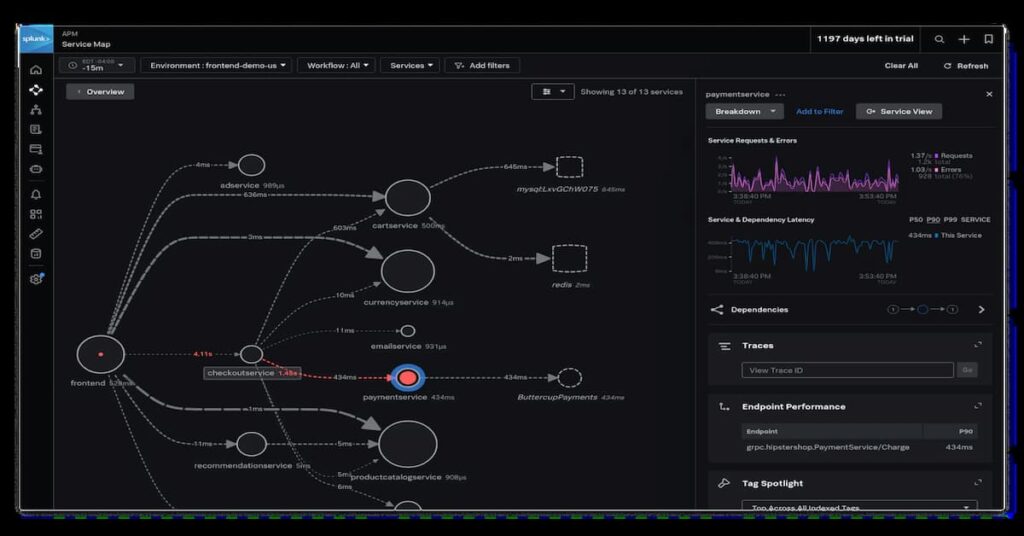
Splunk Observability Cloud: Splunk Observability Cloud is known for SaaS-based observability across infrastructure, applications, user experience, and synthetic monitoring. It includes Splunk Infrastructure Monitoring, Splunk APM, Splunk RUM, Splunk Synthetic Monitoring, and related troubleshooting workflows. It is best positioned for teams that want real-time visibility across cloud-native systems and already value the Splunk ecosystem. Splunk describes Observability Cloud as a SaaS platform for real-time metrics, traces, and logs.
Multi-Agent Support
CubeAPM: Provides broad multi-agent support and is designed to work with heterogeneous telemetry sources. It supports OpenTelemetry collectors natively and can ingest metrics, logs, and traces from Prometheus, as well as existing vendor agents such as Datadog, New Relic, and Elastic. This allows teams to consolidate telemetry into a single backend without rewriting instrumentation or running parallel observability stacks during migration.
Amazon CloudWatch: Offers limited multi-agent support and is primarily designed to work with AWS-native tooling. Telemetry is typically collected using the CloudWatch Agent, AWS SDKs, or service-level integrations that automatically emit metrics and logs. OpenTelemetry is supported as an ingestion path into CloudWatch metrics and logs, and tracing is handled separately through AWS X-Ray. This model works well when workloads stay inside AWS, but it becomes restrictive when teams operate in mixed environments or want to standardize on a single agent strategy across clouds and platforms.
Splunk Observability Cloud: Provides broad multi-agent support and is built to ingest data from a wide range of sources. It supports OpenTelemetry collectors, Splunk Universal Forwarders, custom agents, and integrations with third-party tools. This flexibility allows teams to collect logs, metrics, and traces from heterogeneous environments including on-prem systems, multiple clouds, and legacy infrastructure. As a result, Splunk is often used as a central aggregation layer where different agents and telemetry pipelines coexist rather than being fully standardized.
MELT Support
CubeAPM: Supports full MELT observability through a unified OpenTelemetry-native pipeline that ingests and correlates metrics, events, logs, and traces in a single backend. All signals share common context, allowing engineers to investigate issues across services without switching tools or losing correlation between telemetry types, which is especially important in distributed systems.
Amazon CloudWatch: Provides native support for metrics and logs generated by AWS services, with events and alarms tightly integrated into the AWS control plane. Distributed tracing is supported indirectly through AWS X-Ray, which operates as a separate service and requires additional configuration to correlate traces with logs and metrics. While CloudWatch can participate in a MELT-style workflow, signal correlation is largely AWS-centric and less unified compared to platforms designed around a single observability data model.
Splunk Observability Cloud: Supports full MELT across metrics, events, logs, and traces within a single analytics platform. Telemetry from different sources can be ingested and correlated using common metadata and search queries. This allows teams to move from high-level signals, such as metric anomalies, to detailed log and trace analysis without switching tools. MELT correlation is one of Splunk’s core strengths, especially in complex environments where signals originate from many systems.
Deployment Option
CubeAPM: Runs inside the customer’s cloud or VPC using a self-hosted or BYOC model while remaining vendor-managed. This gives teams control over data residency and network boundaries without taking on operational overhead for scaling, upgrades, or maintenance, and setup is centered around deploying OpenTelemetry collectors rather than multiple proprietary agents.
Amazon CloudWatch: Delivered as a fully managed service within Amazon Web Services and requires minimal setup for AWS-native resources. Most AWS services emit metrics and logs automatically, and additional data can be collected using the CloudWatch Agent or service integrations. Because it is tightly coupled with the AWS control plane, there is no separate infrastructure to deploy or maintain. This makes CloudWatch easy to adopt, but it also means observability workflows are shaped by AWS defaults and are harder to extend beyond the AWS ecosystem.
Splunk Observability Cloud: Splunk Observability Cloud is SaaS. Teams send telemetry to Splunk Observability Cloud using the Splunk Distribution of the OpenTelemetry Collector, APIs, native integrations, and product-specific instrumentation.
Pricing: Approximate Cost for Small, Mid-Sized & Large Teams
*All pricing comparisons are calculated using standardized Small/Medium/Large team profiles defined in our internal benchmarking sheet, based on fixed log, metrics, trace, and retention assumptions. Actual pricing may vary by usage, region, and plan structure. Please confirm current pricing with each vendor.
*An APM host is a host that is actively generating trace data, and an Infra host is any physical or virtual OS instance that you monitor with any observability tool.
Below is a cost comparison for small, mid-sized, and large teams.
| Approx. Cost for Teams | Small (~30 APM Hosts) | Mid-sized (~125 APM Hosts) | Large (~250 APM Hosts) |
| CubeAPM | $2,080 | $7,200 | $15,200 |
| Amazon CloudWatch | $5,343 | $15,637 | $30,018 |
| Splunk | $2,290 | $8,625 | $17,750 |
Teams usually begin to feel the cost differences between CloudWatch and Splunk once observability usage moves past basic monitoring and into sustained production workloads. As telemetry volume grows with steady traffic, higher log verbosity, distributed tracing, and an increasing number of services, observability spend becomes more sensitive to how data is generated and retained rather than just how many hosts are running.
At this stage, costs are no longer driven by early-stage experimentation but by operational behavior. Frequent incidents, longer investigations, and high-cardinality logs can significantly increase ingestion and storage usage. For many teams, observability shifts from a relatively predictable tooling expense to a variable cost that requires active controls around sampling, retention, and forecasting to avoid unexpected spend.
What This Comparison Reveals at Scale
At small team sizes, the cost difference between Amazon CloudWatch and Splunk is relatively modest. Both platforms remain affordable when telemetry volume, service count, and query frequency are limited. At this stage, pricing rarely drives decision-making on its own.
As teams move into mid-sized environments, the gap begins to widen. Ingestion volume grows faster than host count, and observability usage expands beyond basic monitoring into investigations, dashboards, and historical analysis. This is where pricing models start to reflect real operational behavior rather than theoretical usage.
At a large scale, the difference becomes more pronounced. Higher data volumes, longer investigations, and increased reliance on logs and traces compound costs. Even when host counts grow predictably, telemetry growth does not. This comparison shows that cost sensitivity increases sharply at scale, and teams often reassess platforms based on how pricing behaves under sustained production load rather than initial entry cost.
In practice, teams use comparisons like this to understand not just which tool is cheaper today, but which pricing model remains predictable as systems grow in complexity and observability becomes mission-critical.
CubeAPM: Cost for Small, Medium, and Large Teams
CubeAPM follows an ingestion-based pricing model where observability cost scales with the volume of telemetry processed. Pricing is tied to data ingestion rather than user count, enabled features, or the number of monitored hosts, which makes spend more closely reflect actual telemetry usage.
Pricing overview:
- Telemetry ingestion is priced at $0.15 per GB across logs, metrics, and traces
Using consistent workload assumptions across environments, estimated monthly costs typically fall into the following ranges:
- Small teams (~30 APM hosts): $2,080
- Mid-sized teams (~125 APM hosts): $7,200
- Large teams (~250 APM hosts): $15,200
Because CubeAPM supports self-hosted and BYOC deployments, telemetry data remains within the customer’s infrastructure. This allows teams to scale observability usage predictably without additional charges tied to retention, access, or feature tiers.
Amazon CloudWatch: Cost for Small, Medium, and Large Teams
Amazon CloudWatch follows a usage-based pricing model where costs are driven by metrics, logs ingestion, API requests, alarms, and storage. Pricing scales with telemetry volume rather than fixed team size, which means costs increase as observability coverage expands.
Pricing details:
- Application Observability: $0.15/GB over 30TB
- Metrics: $0.02 for over 1,000,000 metrics
Based on comparable production workloads, the approximate monthly costs are:
- Small teams (~30 APM hosts): $5,343
- Mid-sized teams (~125 APM hosts): $15,637
- Large teams (~250 APM hosts): $30,018
Because CloudWatch pricing is tightly coupled to AWS services, costs tend to scale predictably with infrastructure growth inside AWS. However, increased log volume, higher-resolution metrics, and longer retention periods can materially impact spend as systems grow in complexity.
Splunk Observability Cloud: Cost for Small, Medium, and Large Teams
Splunk uses a data-ingestion–driven pricing model where costs are primarily based on the volume of telemetry data processed. Pricing is influenced by ingestion rates, retention limits, and the specific observability products enabled.
Pricing details:
- Infra: $15 per host/month
- App & Infra: $60 per host/month
- End-to-End: $75 per host/month
Based on comparable production workloads, the approximate monthly costs are:
- Small teams (~30 APM hosts): $2,290
- Mid-sized teams (~125 APM hosts): $8,625
- Large teams (~250 APM hosts): $17,750
As teams scale, Splunk costs often grow faster than host count alone, especially in log-heavy or incident-prone environments. Pricing behavior is closely tied to how much telemetry is retained and analyzed rather than how many services are monitored.
Sampling Strategy
CubeAPM: Uses context-aware smart sampling to control telemetry volume while preserving high-value signals. Sampling decisions are made based on request characteristics such as errors, latency, and service behavior rather than fixed rates applied blindly at ingestion time. This allows CubeAPM to retain traces and logs that are most useful for investigations while aggressively reducing low-signal noise, helping teams manage data growth without manually tuning complex sampling rules as traffic and system complexity increase.
Amazon CloudWatch: Supports head-based, tail-based, and adaptive sampling through AWS X-Ray and the AWS Distro for OpenTelemetry. Head-based sampling uses fixed or parent-based rates decided at request start, while tail-based sampling evaluates complete traces before retention. AWS X-Ray’s adaptive sampling dynamically adjusts rates to capture anomalies and reduce volume during normal traffic. These options provide flexibility, but sampling configuration is spread across X-Ray and OpenTelemetry components and remains tightly coupled to AWS tooling.
Splunk: Supports sampling strategies through its OpenTelemetry ingestion pipeline. The Splunk Distribution of the OpenTelemetry Collector can apply probabilistic sampling at the collector level, allowing teams to reduce trace volume before it reaches storage and analytics. This gives flexibility to control data flow based on trace attributes or percentage rates. Sampling decisions are configured in the collector or client libraries rather than through a centralized Splunk APM dashboard, and teams can also opt to collect all traces for full fidelity analysis.
Data Retention and Storage
CubeAPM: Provides unlimited data retention by design, with telemetry stored in customer-controlled infrastructure when deployed in self-hosted or BYOC environments. Because retention is not enforced through plan limits or feature tiers, teams can keep historical logs, metrics, and traces for audits, long-term trend analysis, and post-incident reviews without retention-driven trade-offs, while still controlling storage policies within their own cloud or storage systems.
Amazon CloudWatch: Retention differs across logs and metrics. For logs, retention is configured at the log group level and can range from 1 day to 10 years or be left unset for indefinite storage. Retention policies can be changed at any time, and older data is automatically deleted once it exceeds the configured period. Logs can also be exported to Amazon S3 for long-term archival or compliance needs.
Splunk: Enforces fixed retention periods that vary by signal type. Metrics are retained for up to 13 months, while traces are typically retained for 8 days. Retention limits are defined at the platform level, and extending retention usually requires plan upgrades or additional cost. This approach supports short-term operational analysis but can restrict long-term investigations and historical comparisons across traces.
Support Channels and Response Time
CubeAPM: Provides support through email and Slack, with response times typically under 10 minutes for active issues. Support is handled directly by engineers familiar with the platform’s architecture and telemetry pipelines, which helps reduce escalation delays during production incidents. This model prioritizes fast feedback and practical resolution over ticket-based workflows, especially when systems are under operational pressure.
Amazon CloudWatch: support is provided through AWS Premium Support plans rather than a standalone CloudWatch support channel. Customers on the Enterprise Support plan receive 24/7 access to cloud support engineers via web case, phone, and chat with response time targets as low as 15 minutes for critical issues. On the Business Support plan, critical issues typically receive a response within 30 minutes, while general support cases are handled within longer target windows based on severity. AWS defines response time targets rather than strict SLAs, and support availability scales with support tier.
Splunk: Tiered support programs with clearly defined response time objectives based on issue priority and support plan. Response times are governed by SLAs rather than best-effort targets. For Priority 1 issues, Premium Support targets an initial response within 30 minutes, while Standard Support targets a response within 2 hours. For lower-severity Priority 4 issues, Premium Support targets a response within 1 business day, while Standard Support targets up to 2 business days. Support is delivered through web cases, phone, and access to Splunk’s support portal, with higher tiers offering faster response times and more proactive engagement.
How Teams Evaluate CloudWatch and Splunk Observability Cloud at Scale
As teams scale, observability evaluations shift from feature coverage to how platforms behave under sustained load and operational pressure. What works in early stages often breaks once telemetry volume, service count, and incident frequency increase.
Teams using Amazon CloudWatch tend to evaluate how well it supports cross-service correlation, historical analysis, and consistent workflows across metrics, logs, and traces. Its tight AWS integration simplifies operations, but limitations around unified querying and long-term retention often become more visible at scale.
Teams evaluating Splunk Observability Cloud focus on analytics depth and multi-environment visibility while closely examining how ingestion volume, retention limits, and pricing behave as data grows. At scale, cost predictability and operational overhead become central concerns.
In both cases, mature teams prioritize how observability systems perform during incidents, how sampling affects visibility, and whether retention policies support audits and post-incident analysis. These factors typically drive platform reassessment more than individual features.
Amazon CloudWatch vs Splunk vs CubeAPM: Use Cases
Choose CubeAPM if:
- You need full-stack observability across metrics, logs, and traces in a single, unified backend
- You need native OpenTelemetry support without relying on proprietary agents
- You need to ingest telemetry from multiple existing agents such as OpenTelemetry, Prometheus, Datadog, New Relic, or Elastic during gradual migration
- You need control over data residency and compliance by running observability inside your own cloud or VPC
- You need predictable observability behavior as telemetry volume grows across distributed systems
- You need fast, engineer-led support during production incidents without long escalation chains
Choose Amazon CloudWatch if:
- You need native visibility across AWS services without additional tooling
- You need out-of-the-box metrics, logs, and alarms with minimal setup
- You need tight integration with AWS-managed services such as EC2, Lambda, RDS, ECS, and EKS
- You need a fully managed monitoring service aligned with AWS operational workflows
Choose Splunk Observability Cloud if:
- You want SaaS observability for infrastructure, applications, RUM, synthetics, and incident troubleshooting.
- You want to use Splunk’s OpenTelemetry collector distribution.
- You already use Splunk Cloud Platform or Splunk Enterprise for logs and want Log Observer Connect.
- You need real-time infrastructure and APM visibility across cloud-native systems.
- You are comfortable with host-based and usage-based subscription models.
Conclusion
Amazon CloudWatch, Splunk, and CubeAPM reflect three different approaches to observability as systems scale. CloudWatch is designed around native AWS integration and operational simplicity for AWS-centric environments. Splunk is built for large-scale analytics, deep search, and cross-environment correlation where observability data is treated as a primary analytics asset. CubeAPM focuses on OpenTelemetry-native ingestion, unified signal correlation, and customer-controlled deployment.
At scale, the differences between these platforms become less about individual features and more about architecture, data handling, and operational behavior. Sampling models, retention policies, deployment choices, and support response times increasingly shape how effective and sustainable observability remains in production. Teams evaluating these platforms tend to focus on how each system behaves under sustained load, during incidents, and as telemetry volume grows beyond early assumptions.
Choosing between CloudWatch, Splunk, and CubeAPM ultimately depends on where systems run, how observability data is used, and how much control teams need over telemetry pipelines and data lifecycle as complexity increases.
Disclaimer: The information in this article reflects the latest details available at the time of publication and may change as technologies and products evolve.
FAQs: CloudWatch vs Splunk
1. What is the main difference between CloudWatch, Splunk Observability Cloud, and CubeAPM?
CloudWatch is AWS-native monitoring. Splunk Observability Cloud is a SaaS observability platform for infrastructure, APM, RUM, synthetics, and troubleshooting. CubeAPM is an OpenTelemetry-native observability platform with self-hosted or BYOC deployment and ingestion-based pricing.
2. Is Splunk Observability Cloud self-hosted?
No. Splunk Observability Cloud is SaaS. Splunk Enterprise can be self-hosted, but that is a different Splunk product. Splunk Observability Cloud sends telemetry to Splunk’s cloud service through collectors, APIs, and integrations.
3. How much does Splunk Observability Cloud cost?
Splunk’s public pricing lists Infrastructure at $15/host/month, App & Infra at $60/host/month, and End-to-End at $75/host/month, billed annually. Real cost can change with usage-based features, custom metrics, containers, RUM sessions, synthetics, and overages.
4. How long does Splunk Observability Cloud retain traces?
Splunk APM keeps all raw traces for 8 days. Traces viewed in the Splunk APM UI can be retained for up to 13 months through extended trace retention.
5. Does Splunk Observability Cloud support OpenTelemetry?
Yes. Splunk provides the Splunk Distribution of the OpenTelemetry Collector to receive, process, and export metrics, traces, logs, and metadata into Splunk Observability Cloud.