









LogicMonitor review articles often focus on its hybrid infrastructure monitoring strengths, but the bigger question in 2026 is how well it fits modern observability needs. LogicMonitor is one of the better-known vendors in the observability space. Its SaaS-based platform, LM Envision, is built to monitor hybrid environments from one place.
In September 2025, the company introduced a new pricing model based on Hybrid Units and three platform packages: Essentials, Advanced, and Signature.
In December 2025, it also announced its acquisition of Catchpoint. These updates make 2026 a good time to review what LogicMonitor offers, how its pricing works, and where it fits best.
In this review, we look at LogicMonitor’s core features, architecture, pricing model, main pros and cons, and the alternatives teams should also consider.
Disclaimer: This review is an independent editorial analysis based on publicly available LogicMonitor documentation, pricing pages, and product materials, supplemented by verified user reviews from G2, Gartner Peer Insights, TrustRadius, and Capterra at the time of writing. Pricing, feature availability, packaging, and deployment options may change; readers should verify current details directly with LogicMonitor before making purchasing or implementation decisions.
What Is LogicMonitor?
Platform Overview
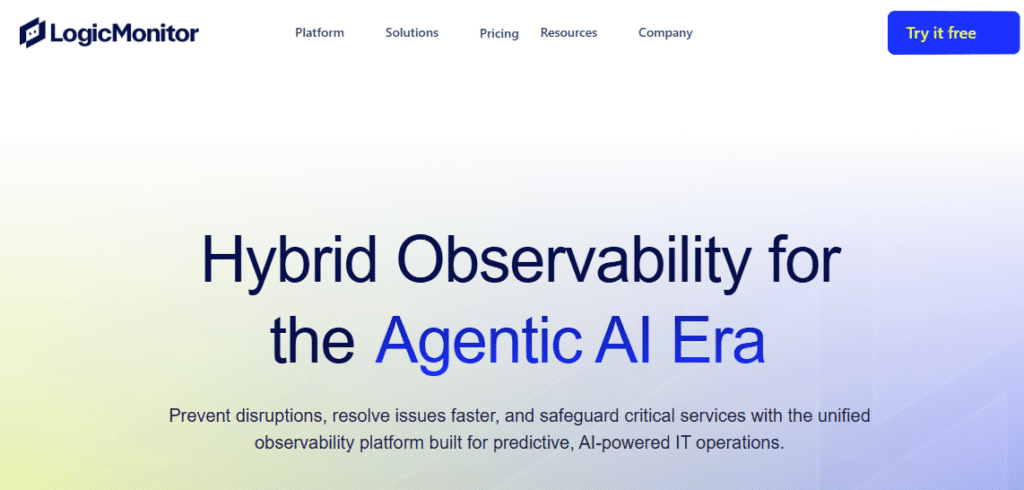
LogicMonitor is a SaaS-based hybrid observability platform. Its core product, LM Envision, provides unified monitoring across on-premises servers, network devices, cloud infrastructure, containers, applications, and logs all through a single management portal.
The platform is purpose-built for two primary audiences:
- IT Operations and NOC teams at mid-to-large enterprises that need full-environment visibility across hybrid infrastructure without managing their own monitoring server clusters.
- Managed Service Providers (MSPs) that monitor multiple client environments simultaneously and need multi-tenant portals, client-segmented dashboards, and breadth of device coverage.
LogicMonitor uses a collector-based architecture. Collectors are deployed inside the customer environment and use supported methods such as SNMP, WMI, JMX, and API-based collection to gather monitoring data, which is then sent to LogicMonitor’s SaaS platform for analysis and visualization.
In September 2025, LogicMonitor introduced a new pricing model based on Hybrid Units. In December 2025, it also announced its acquisition of Catchpoint. Together, those updates help explain how LogicMonitor is positioning the platform in 2026.
LogicMonitor’s Market Positioning in 2026
The infrastructure monitoring market has three rough tiers in 2026:
On one side are legacy on-premise tools, SolarWinds, Nagios, and Zabbix, that give teams full control and lower licensing costs but require significant engineering effort to scale and maintain. On the other hand are developer-centric full-stack observability platforms like Datadog, Dynatrace, and New Relic that excel at APM and distributed tracing but can feel over-engineered for pure infrastructure operations teams.
LogicMonitor occupies the middle: a commercially supported, SaaS-delivered platform that prioritizes hybrid infrastructure breadth, fast onboarding via auto-discovery, and AI-driven noise reduction for operations teams who need to manage large, heterogeneous environments without building and tuning everything from scratch.
It is particularly strong for:
- Mixed environments spanning on-premise and multi-cloud
- Teams that have outgrown SolarWinds or legacy network monitoring tools
- MSPs managing client infrastructure at scale
- IT ops teams struggling with alert fatigue from fragmented monitoring stacks
Key Features of LogicMonitor
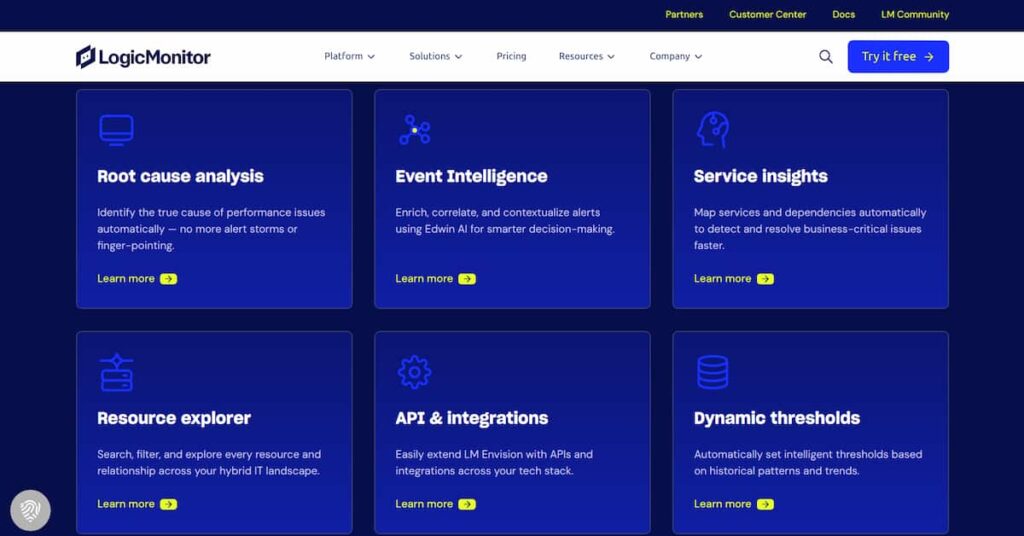
LogicMonitor’s foundational capability is monitoring the full breadth of hybrid IT, including physical servers, virtual machines, network switches, storage arrays, cloud workloads (AWS, Azure, GCP), Kubernetes containers, and SaaS applications from a single platform. It ships with more than 3,000 out-of-the-box integrations and monitoring modules, covering hundreds of vendors and technologies. New resources are discovered automatically through Active Discovery and Netscan, continuously scanning your environment and adding newly found devices without manual intervention.
Edwin AI is LogicMonitor’s native AI and machine learning engine. It applies unsupervised ML to correlate alerts, detect anomalies, identify root causes, and suppress redundant alert floods. LogicMonitor says its correlation and thresholding can reduce alert noise by up to 97% when consolidating fragmented monitoring environments onto LM Envision. The Advanced and Signature tiers also unlock Edwin AI Agent, which automates triage through runbooks, surfaces resolutions from past incidents, and reduces escalations across NOC teams.
LM Logs is included across all three platform packages. It provides real-time log ingestion, full-text search, and log-to-metric correlation, allowing engineers to pivot directly from an alert into the log stream without switching tools. Current support materials reference 7-day and yearly retention plans. The tight coupling of logs and infrastructure metrics in a single interface is a practical differentiator for operations teams investigating incidents.
LogicMonitor builds and continuously updates maps of relationships between monitored resources, servers, services, cloud components, and network devices. When a fault occurs, topology maps help teams understand blast radius, identify upstream root causes, and suppress downstream alert cascades that would otherwise drown operations teams in noise.
Available on the Signature tier, this capability integrates Catchpoint’s global network of synthetic monitoring agents to provide visibility into DNS performance, CDN behavior, BGP routing, ISP path health, and public web performance. This is one of LogicMonitor’s clearest differentiators in 2026. Most competing infrastructure platforms do not natively monitor external Internet path dependencies.
The Signature tier includes a multi-cloud Cost Optimization module that provides cloud billing visibility across AWS, Azure, and GCP, surfaces AI-powered spend reduction recommendations; and enables budget management workflows. As cloud costs become a boardroom-level concern for most enterprises, this capability adds measurable business value beyond pure performance monitoring.
LogicMonitor supports multi-tenant deployments natively. MSPs can manage multiple client environments from a single portal with per-client segmentation, customizable dashboards, role-based access controls, and optional white-labeling. MSPs receive the same package structure as enterprise customers.
LogicMonitor’s alerting system supports ML-driven dynamic thresholds that adapt to real-time trends (reducing false positives from seasonal or cyclical patterns), escalation chains with acknowledgment workflows, multi-channel delivery (SMS, email, Slack, PagerDuty, ServiceNow), and alert suppression rules for known maintenance windows.
Available in the Signature tier, bidirectional ServiceNow integration provides real-time service health, alert routing, and automated CMDB updates, eliminating the configuration drift that plagues organizations managing large device inventories manually.
How LogicMonitor Works: Architecture, Deployment, and Scale
Collectors
LogicMonitor uses a collector-based architecture. Its Collector runs on a Windows or Linux host inside the customer environment and gathers monitoring data from devices and services. LogicMonitor documents support for collection methods such as SNMP, WMI, JMX, JDBC, and API-based collection where supported.
Collectors send data to the LogicMonitor platform through an outgoing encrypted connection. LogicMonitor’s documentation supports the point that the platform uses outbound collector communication rather than requiring LogicMonitor to open inbound connections into the customer environment.
Collectors can be used for:
- Discovering devices through Active Discovery and related discovery workflows.
- Polling metrics on defined collection intervals.
- Running some checks and collection tasks from inside the monitored environment.
- Forwarding data into the LogicMonitor platform, including logs where LM Logs is used.
Multiple Collectors can be deployed for load distribution, segmentation, and resilience. LogicMonitor documents Collector Groups, failover support, and performance tuning for larger environments.
SaaS Management Plane
Monitoring data is sent to LogicMonitor’s cloud platform, where it is stored, processed, visualized, and used for alerting and analysis. This supports the general point that customers do not operate a full self-hosted monitoring backend for the platform itself.
Within the SaaS platform:
- Metrics are stored and displayed through dashboards and related views.
- Alerting is evaluated through thresholds, anomaly-based logic, and escalation workflows.
- Edwin AI is part of LogicMonitor’s broader AI-driven observability and correlation story.
- Log data can be indexed and analyzed through LM Logs.
Because the management plane is SaaS-delivered, telemetry is processed through LogicMonitor’s infrastructure. That makes deployment easier than a self-hosted stack, but it can matter for teams with strict data residency requirements. LogicMonitor separately offers federal/GovCloud positioning for qualifying public-sector use cases.
Deployment Models
A simpler and safer way to present this section is:
- Standard SaaS: Collectors run inside the customer environment, while the main LogicMonitor platform is cloud-hosted and managed by LogicMonitor. This is the standard deployment model for most customers.
What Are LogicMonitor’s Plan Tiers?
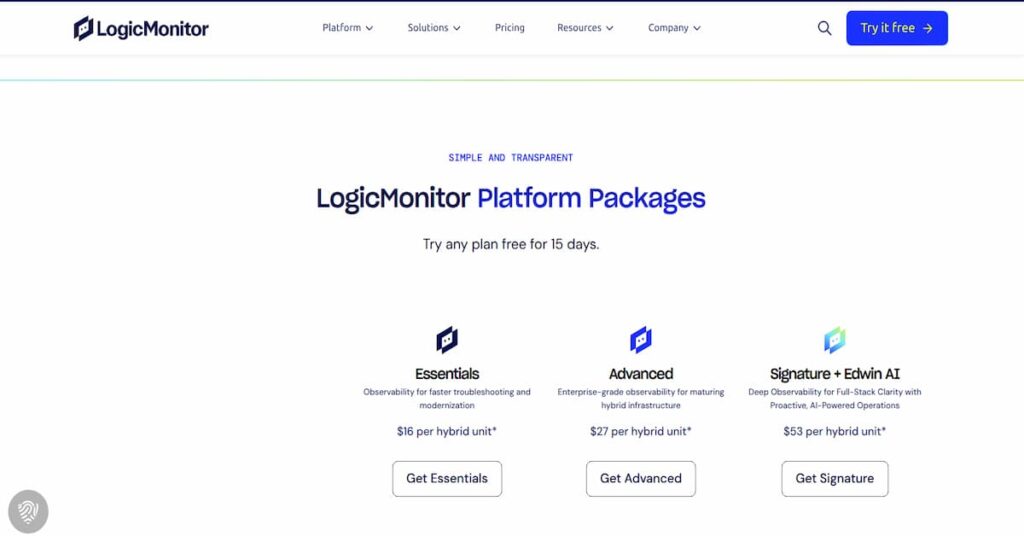
LogicMonitor moved to a package-based pricing model in September 2025. The company now sells LM Envision through three main packages built around Hybrid Units: Essentials, Advanced, and Signature.
What Is a Hybrid Unit?
A Hybrid Unit is LogicMonitor’s current billing unit. LogicMonitor says one Hybrid Unit can represent:
- One monitored device
- One IaaS instance
- Five wireless access points
- Seven PaaS resources
That model is meant to make pricing more flexible across mixed environments, instead of using different billing rules for each infrastructure type.
Plan Tiers
- Starting price: $16 per Hybrid Unit per month, billed annually.
- Positioned for faster troubleshooting and infrastructure modernization.
- LogicMonitor’s pricing page shows LM Logs as included in every package.
- Starting price: $27 per Hybrid Unit per month, billed annually.
- Positioned for maturing hybrid infrastructure and broader enterprise observability needs.
- LogicMonitor’s September 2025 announcement tied Advanced and Signature more directly to Edwin AI and broader service intelligence capabilities.
- Starting price: $53 per Hybrid Unit per month, billed annually.
- Positioned as the highest package, with Edwin AI bundled into the tier on the pricing page.
- LogicMonitor’s pricing page also associates Signature with higher-end capabilities such as ServiceNow CMDB and Multi-Cloud Cost Optimization.
Essentials
| Attribute | Details |
|---|---|
| Price | $16 per Hybrid Unit/month (billed annually) |
| Best For | Small to mid-sized teams, up to ~1,000 devices, needing core hybrid monitoring |
| Included | Infrastructure monitoring, LM Logs (7-day retention), basic dashboards, dynamic alert thresholds, Active Discovery, Netscan, standard support |
| Not Included | LM Uptime, SaaS Monitoring, Cost Optimization, ServiceNow CMDB, Edwin AI Agent, Data Publisher |
Advanced
| Attribute | Details |
|---|---|
| Price | $27 per Hybrid Unit/month (billed annually) |
| Best For | Growing enterprises with maturing hybrid infrastructure needing broader observability |
| Included | Everything in Essentials, plus LM Uptime, Dynamic Service Insights, Data Publisher (metric streaming), Enhanced Support |
| Not Included | SaaS Monitoring, Cost Optimization, ServiceNow CMDB integration, Edwin AI Agent (available as add-on) |
Signature
| Attribute | Details |
|---|---|
| Price | $53 per Hybrid Unit/month (billed annually) |
| Best For | Large, complex enterprises needing full-stack visibility, proactive AIOps, and enterprise integrations |
| Included | Everything in Advanced, plus SaaS Monitoring, Multi-Cloud Cost Optimization, ServiceNow CMDB integration, Edwin AI (full AIOps), Internet Stack monitoring (via Catchpoint), Premier Support |
All tiers include a 15-day free trial and a test sandbox of up to 10% of paid capacity.
How Much Does LogicMonitor Really Cost?
LogicMonitor’s public starting prices are $16, $27, and $53 per Hybrid Unit per month for Essentials, Advanced, and Signature. LogicMonitor also says one Hybrid Unit can represent 1 monitored device, 1 IaaS instance, 7 PaaS resources, or 5 wireless access points.
Assumptions used in the examples
- These are directional list-price examples based on LogicMonitor’s public starting prices.
- Hybrid Units are calculated using LogicMonitor’s published conversion model: 1 device = 1 Hybrid Unit, 1 IaaS instance = 1 Hybrid Unit, 7 PaaS resources = 1 Hybrid Unit, and 5 wireless access points = 1 Hybrid Unit.
- These examples do not include negotiated discounts, premium support changes, add-on capacity, overage charges, professional services, or custom contract terms. LogicMonitor says actual pricing can vary by purchase volume, contract terms, and additional usage.
- These examples also do not model extra LM Logs usage, retention overages, or any usage billed above reserved commitment.
Scenario 1: Traditional infrastructure-heavy environment
Assumptions
- 500 on-prem monitored devices
- 100 cloud IaaS instances
- 70 cloud PaaS resources
- 50 wireless access points
Hybrid Unit estimate
- On-prem devices: 500 HU
- IaaS: 100 HU
- PaaS: 70 ÷ 7 = 10 HU
- Wireless APs: 50 ÷ 5 = 10 HU
- Total: 620 Hybrid Units
Disclaimer: These figures are directional estimates for editorial comparison only. They are based on LogicMonitor’s public starting prices and published Hybrid Unit conversion model. They are not official quotes, and actual pricing may vary based on contract length, purchase volume, add-ons, discounts, support terms, and any overage charges defined in the final order form.
| Package | Monthly cost | Annual cost |
| Essentials | $9,920 | $119,040 |
| Advanced | $16,740 | $200,880 |
| Signature | $32,860 | $394,320 |
What this shows
A device-heavy environment is the most expensive shape under LogicMonitor’s model because on-prem devices and IaaS resources convert 1:1 into Hybrid Units.
Scenario 2: Growing team with a cloud and PaaS-heavy environment
Situation: Consider a growing team running a more cloud-focused environment. The setup includes 150 on-prem monitored devices, 150 cloud IaaS instances, 700 cloud PaaS resources, and 200 wireless access points. Under LogicMonitor’s Hybrid Unit model, these resources do not convert 1:1 into billing units. LogicMonitor says one Hybrid Unit can represent one monitored device, one IaaS instance, seven PaaS resources, or five wireless access points.
Why teams at this size consider LogicMonitor
- Hybrid visibility: LogicMonitor positions LM Envision as a hybrid observability platform for on-prem, cloud, and multi-cloud environments.
- Easier resource discovery: NetScans can periodically look for and automatically discover devices in the network, which helps reduce manual monitoring setup.
- More adaptive alerting: LogicMonitor’s Dynamic Thresholds use machine learning to auto-adjust thresholds and help reduce false positives.
- Better noise reduction: LogicMonitor says LM Envision is built to reduce alert noise, and Edwin AI adds event correlation and enrichment across the platform.
- Logs in the same platform: LM Logs is part of LogicMonitor’s broader platform, which helps teams investigate logs without relying fully on a separate logging tool.
Assumptions
- 150 on-prem monitored devices
- 150 cloud IaaS instances
- 700 cloud PaaS resources
- 200 wireless access points
Hybrid Unit estimate
- On-prem devices: 150 HU
- IaaS: 150 HU
- PaaS: 700 ÷ 7 = 100 HU
- Wireless APs: 200 ÷ 5 = 40 HU
- Total: 440 Hybrid Units
Disclaimer: These figures are directional estimates for editorial comparison only. They are based on LogicMonitor’s public starting prices and published Hybrid Unit conversion model. They are not official quotes, and actual pricing may vary based on contract length, purchase volume, add-ons, discounts, support terms, and any overage charges defined in the final order form.
| Package | Monthly cost | Annual cost |
| Essentials | $7,040 | $84,480 |
| Advanced | $11,880 | $142,560 |
| Signature | $23,320 | $279,840 |
These totals are based on LogicMonitor’s public starting prices of $16, $27, and $53 per Hybrid Unit per month for Essentials, Advanced, and Signature.
What this scenario shows
- This is the kind of environment where LogicMonitor’s Hybrid Unit model looks more favorable on paper because a large PaaS footprint does not grow linearly in billable units.
- The pricing model can look more efficient than raw resource count suggests, since seven PaaS resources count as one Hybrid Unit and five wireless access points count as one Hybrid Unit.
- Discovery and alerting automation matter more at this stage because cloud-heavy environments change faster and are harder to manage manually.
- Even in a more favorable resource mix, public list pricing still rises quickly once teams move from Essentials into Advanced or Signature.
Scenario 3: Mid-Sized Enterprise Managing 800 Hybrid Resources
Situation: Consider a mid-sized enterprise with a regional IT operations team managing a mix of on-prem and cloud infrastructure. The environment includes physical servers and network devices in two data centers, AWS and Azure instances, a Kubernetes-based application environment, and wireless infrastructure across office locations. In total, the organization monitors about 800 resources. Under LogicMonitor’s Hybrid Unit model, those resources do not map directly to billing units because different resource types convert at different rates.
Why teams at this size consider LogicMonitor
- Alert consolidation: LogicMonitor supports dynamic thresholds and Edwin AI-based alert correlation, which are designed to reduce noisy alert streams and improve signal quality for operations teams.
- Auto-discovery: LogicMonitor supports Active Discovery and NetScans, which help teams find resources and automatically discover devices in the environment.
- Multi-environment visibility: LogicMonitor positions LM Envision as a hybrid observability platform for on-prem, cloud, and multi-cloud environments.
- Replacing legacy tools: This is a common evaluation pattern for teams trying to consolidate fragmented monitoring coverage, though this point is best framed as editorial analysis rather than a direct vendor claim.
Estimating Hybrid Units for an 800-resource environment
Using LogicMonitor’s published Hybrid Unit conversion model, an 800-resource environment could map like this:
| Resource type | Count | Hybrid Units |
| On-prem servers and network devices | 300 | 300 |
| Cloud IaaS instances | 200 | 200 |
| Cloud PaaS resources | 210 | 30 |
| Wireless access points | 100 | 20 |
| Total | 810 resources | 550 |
This is the main pricing point of the Hybrid Unit model: environments with more PaaS resources and wireless infrastructure may end up with fewer billable units than their raw resource count suggests.
Estimated cost by tier at 550 Hybrid Units
Disclaimer: These figures are directional estimates for editorial comparison only. They are based on LogicMonitor’s public starting prices and published Hybrid Unit conversion model. They are not official quotes, and actual pricing may vary based on contract length, purchase volume, add-ons, discounts, support terms, and any overage charges defined in the final order form.
| Tier | Monthly cost | Annual cost before discounts |
| Essentials ($16/unit) | $8,800 | $105,600 |
| Advanced ($27/unit) | $14,850 | $178,200 |
| Signature ($53/unit) | $29,150 | $349,800 |
What this scenario shows
- LogicMonitor’s pricing model becomes more meaningful once a hybrid environment reaches this size.
- NetScans and other discovery features can reduce the manual effort of keeping resource inventory current.
- Dynamic thresholds and Edwin AI can help make alerting more manageable by adapting to change and reducing noise.
- LM Logs adds log investigation inside the same platform, which can reduce the need to switch between tools during incidents.
- At this point, the real decision is less about monitoring capability and more about cost.
- As Hybrid Unit counts grow, public list pricing can rise quickly before discounts, add-ons, or overages are factored in.
What Actually Drives LogicMonitor Costs
Understanding LogicMonitor pricing requires looking at what determines the size of your bill beyond the package rate.
The composition of your monitored environment, including the mix of on-premise devices, cloud IaaS, cloud PaaS, and wireless, directly determines how many Hybrid Units are consumed and, therefore, your monthly subscription cost. Cloud PaaS-heavy environments convert at 7:1, making them significantly cheaper per resource than on-premise device-heavy environments at 1:1.
The gap between Essentials ($16/unit) and Signature ($53/unit) is substantial , about 3.3×. The decision between tiers hinges on whether specific Signature capabilities (ServiceNow CMDB, Cost Optimization, Internet Stack monitoring, and full Edwin AI) are operational requirements or aspirational features. Over-purchasing tier capability that goes unused is a common source of budget waste in LogicMonitor deployments.
LM Logs is included in all tiers, but log retention beyond the base period incurs additional cost. High-volume application logging, verbose microservices, security event logs, or compliance-driven long-retention requirements can meaningfully increase the total bill. Teams should model log volumes carefully before committing to a tier.
LogicMonitor is typically sold on annual contracts. Multi-year commitments can yield significant discounts. Presenting competitive alternatives (Cubeapm, Datadog, SolarWinds, Dynatrace) during evaluation and renewal negotiations is the most reliable mechanism for securing discounts, with Vendr data suggesting 25–35% reductions are achievable for informed buyers.
Standard support is included in all packages. Enhanced and Premier Support, which provide faster response SLAs and dedicated technical account management, carry additional costs and should be factored into the total cost of ownership.
Hidden Costs Buyers Should Plan For
LogicMonitor’s list pricing is only part of the budget. In real deals, extra charges around setup, support, growth, and renewal terms can change the total cost more than buyers expect. Third-party procurement benchmarks also suggest that these items are often where first-year and renewal costs move the most.
Initial setup can become a real cost center, especially in larger or more customized environments. Buyers may need help with onboarding, configuration, deployment planning, integration setup, or environment tuning.
Common third-party benchmarks suggest:
- Basic onboarding often add to the annual costs
- More complex rollouts with custom integrations or heavier implementation work can increase costs
- Ongoing professional services may add further cost if the deployment needs deeper customization
In practice, this means the first-year bill can be noticeably higher than the platform subscription alone.
Standard support may be enough for some teams, but larger organizations often want faster response times, more hands-on support, or stronger service commitments.
- Enhanced support can add additional costs annually
- Premium SLA terms or priority escalation paths may be bundled into larger contracts or sold separately
This is one of those costs that can look optional during evaluation but become important once the platform is production-critical.
One of the biggest pricing risks is growth beyond the scope of the original contract. If the monitored environment expands faster than expected, buyers may face overage charges or a mid-contract adjustment.
Training is easy to overlook during budgeting, but it can matter if the team needs faster adoption or deeper product knowledge.
Market benchmarks suggest:
- Advanced workshops, certifications, or tailored enablement can add costs depending on scope
- Some larger contracts may include credits or bundled training value, but it should not be assumed
For teams rolling out LogicMonitor across multiple operators or clients, this can become a meaningful part of the total rollout cost.
LogicMonitor includes many integrations, but that does not mean every environment is plug-and-play. Teams with unusual tools, custom workflows, or deeper ITSM requirements may still need extra implementation work.
Potential extra costs here can include:
- Custom connector work
- API-heavy deployment support
- Professional services for integration design or ongoing maintenance
This matters most in more complex enterprise environments where the monitoring platform has to fit into existing operational workflows.
The starting quote is not the whole story. Multi-year value depends heavily on what happens at renewal and whether annual price increases are written into the contract.
Is LogicMonitor the right fit for your team?
LogicMonitor works best in environments where the following conditions are true:
- Hybrid infrastructure at scale: Organizations running a meaningful mix of on-premise and cloud infrastructure, particularly those with legacy network devices and modern cloud workloads in the same environment.
- MSP operations: Teams managing multiple client environments from a single portal with per-client segmentation, breadth of device coverage, and client-facing dashboards.
- Alert fatigue reduction: IT operations or NOC teams overwhelmed by alert noise from fragmented monitoring stacks who need AI-driven correlation to reduce noise and accelerate incident response.
- Tool consolidation: Organizations currently running multiple monitoring tools (SolarWinds for network, Datadog for cloud, and separate log management) who want to consolidate onto a single commercial platform.
- Mid-to-large enterprise IT ops: Teams with defined IT operations functions, NOC workflows, and budget for commercial monitoring tooling.
- Small businesses or startups where per-unit economics don’t justify the subscription cost versus open-source or simpler alternatives.
- Developer-first teams where APM, distributed tracing, and code-level performance profiling are the primary use case Datadog or Dynatrace are more natural fits.
- Strict data residency requirements: Telemetry must stay within your own infrastructure and cannot flow through a third-party SaaS backend.
- Budget-constrained teams looking for full-stack observability at lower cost on-premise-deployable platforms may offer a better TCO.
LogicMonitor in Context: Hybrid Monitoring vs. Full-Stack Observability
Modern engineering and IT operations teams rely on multiple telemetry signals to understand system health. Infrastructure monitoring tools like LogicMonitor focus on metrics, which include device health, network performance, cloud resource utilization, and, increasingly, logs. Full-stack observability platforms go further by correlating metrics, logs, and distributed traces to provide deep visibility into application performance across complex microservices architectures.
Understanding where LogicMonitor fits in this spectrum helps teams decide what it covers well and what it doesn’t.
Infrastructure-Centric Architecture vs. Unified Telemetry Platforms
LogicMonitor follows an infrastructure-centric architecture. Its Collectors poll devices and services for health and performance metrics, and LM Logs adds log ingestion on top of that. This design is excellent for infrastructure operations:
- Monitoring network device health and performance
- Tracking cloud resource utilization and cost
- Correlating infrastructure events to identify root causes of outages
- Providing MSPs with breadth of device coverage across client environments
Full observability platforms take a broader approach, combining the following:
- Metrics for system performance
- Distributed traces that follow requests across microservices
- Logs for full event context
By correlating all three signals, engineers can diagnose latency, trace request failures, and understand service dependencies at the code level, something infrastructure-focused tools like LogicMonitor don’t natively provide.
Feature Scope Comparison
| Feature | LogicMonitor | CubeAPM |
|---|---|---|
| Infrastructure metrics monitoring | Yes | Yes |
| Cloud resource monitoring | Yes | Yes |
| Network device monitoring | Yes | Yes |
| Log management | Yes (LM Logs) | Yes |
| Application Performance Monitoring (APM) | Limited | Yes |
| Distributed tracing | No | Yes |
| Real User Monitoring (RUM) | No | Yes |
| Synthetic monitoring | Yes (via Catchpoint, Signature) | Yes |
| Cost Optimization | Yes (Signature) | Yes (smart sampling) |
| Deployment | SaaS only | On-premise / your cloud |
| Data residency | Telemetry flows to LogicMonitor SaaS | Stays in your own infrastructure |
LogicMonitor excels when metrics and logs from hybrid infrastructure are the primary operational signal. Platforms like CubeAPM are better suited when teams additionally need distributed tracing, code-level APM, and full data sovereignty.
LogicMonitor Alternatives: How Does LogicMonitor Compares to Competitors
How does LogicMonitor compare to CubeAPM?
| Pricing component | LogicMonitor | CubeAPM |
| Pricing model | Per Hybrid Unit/month | Per GB ingested |
| Current public starting price | Essentials: $16/HU/month; Advanced: $27/HU/month; Signature: $53/HU/month | Starts at $0.15/GB |
| What drives cost most | Hybrid Unit count, package tier, support/add-ons, contract terms | GB ingested plus self-hosted infrastructure cost |
| Cost predictability | More predictable for mixed infrastructure monitoring | High |
| Best fit from a pricing angle | IT ops teams focused on hybrid infrastructure breadth | Teams that want full-stack observability, ingestion-based pricing, and stronger data control |
How does LogicMonitor compare to Datadog?
Datadog is the dominant full-stack observability platform for cloud-native and developer-centric organizations. It covers infrastructure monitoring, APM, distributed tracing, logs, RUM, synthetics, and security in one platform. Infrastructure monitoring starts at approximately $15/host/month, but costs escalate steeply with log ingestion volume and custom metrics at scale.
| Pricing component | LogicMonitor | Datadog |
| Pricing model | Per Hybrid Unit/month | Per host + usage-based |
| Current public starting price | Essentials: $16/HU/month; Advanced: $27/HU/month; Signature: $53/HU/month | Infrastructure Monitoring Pro starts at about $15/host/month |
| What drives cost most | Hybrid Unit count, package tier, support/add-ons, contract terms | Host count, logs, APM usage, indexed spans, custom metrics, retention, and enabled products |
| Cost predictability | More predictable for mixed infrastructure environments | Less predictable once more usage-based products are enabled |
| Best fit from a pricing angle | IT ops teams that want a simpler infrastructure-led pricing model | Teams that want broader cloud-native observability and can manage variable spend |
How does LogicMonitor compare to New Relic?
| Pricing component | LogicMonitor | New Relic |
| Pricing model | Per Hybrid Unit/month | Ingest-based + user/platform pricing |
| Current public starting price | Essentials: $16/HU/month; Advanced: $27/HU/month; Signature: $53/HU/month | Pricing is mainly driven by data ingest and user/platform access |
| What drives cost most | Hybrid Unit count, package tier, support/add-ons, contract terms | Data volume, user tiers, retention, and enabled products |
| Cost predictability | More predictable for infrastructure-led environments | Can vary more as ingest grows |
| Best fit from a pricing angle | Teams that want infrastructure-led pricing | Teams comfortable with ingest-led pricing and broader platform packaging |
How does LogicMonitor compare to Dynatrace?
Dynatrace is a full-stack AI-driven observability platform with strong code-level APM, infrastructure monitoring, and AIOps. Its AI engine (Davis) is widely regarded as more mature than Edwin AI for application-layer root cause analysis. Dynatrace pricing is typically higher than LogicMonitor, and it is better suited to organizations where application performance is the central concern rather than infrastructure operations.
| Pricing component | LogicMonitor | Dynatrace |
| Pricing model | Per Hybrid Unit/month | Host-based and usage-based, depending on scope |
| Current public starting price | Essentials: $16/HU/month; Advanced: $27/HU/month; Signature: $53/HU/month | Pricing is usually tied to host size, monitoring scope, and additional platform usage |
| What drives cost most | Hybrid Unit count, package tier, support/add-ons, contract terms | Host size, deployment scale, product mix, and additional usage |
| Cost predictability | More predictable for hybrid infrastructure monitoring | Can become more layered as scope expands |
| Negotiation tendency | Multi-year deals can materially reduce list pricing | Discounting is common, but full-stack contracts can still stay expensive |
| Best fit from a pricing angle | Teams that want a simpler package model for hybrid monitoring | Teams that want broader AI-driven observability and can handle more pricing complexity |
How does LogicMonitor compare to Solarwinds?
| Pricing component | LogicMonitor | SolarWinds |
| Pricing model | Per Hybrid Unit/month | Per node/month for current SolarWinds Monitoring & Observability pricing |
| Current public starting price | Essentials: $16/HU/month; Advanced: $27/HU/month; Signature: $53/HU/month | Starts at $7/node/month |
| What drives cost most | Hybrid Unit count, package tier, support/add-ons, and contract terms | Node count, selected SolarWinds products/modules, deployment size, and support/maintenance choices |
| Cost predictability | Easier to model once the monitored resource mix is known | Can look cheaper at entry level, but total cost can rise as teams add modules or expand scope |
| Best fit from a pricing angle | Teams that want a SaaS-delivered hybrid monitoring platform with current public package pricing | Teams that want a more traditional infrastructure monitoring model and are comfortable managing platform scope more tightly |
How does LogicMonitor compare to Zenoss?
| Pricing component | LogicMonitor | Zenoss |
| Pricing model | Per Hybrid Unit/month | Enterprise quote-based pricing |
| Current public starting price | Essentials: $16/HU/month; Advanced: $27/HU/month; Signature: $53/HU/month | No clean public starting price listed |
| What drives cost most | Hybrid Unit count, package tier, support/add-ons, and contract terms | Enterprise scope, integration needs, support expectations, and negotiated commercial terms |
| Cost predictability | Easier to estimate from public pricing | Harder to estimate from public information because buyers usually need a direct quote |
| Best fit from a pricing angle | Teams that want current public package pricing and easier upfront cost modeling | Larger organizations already comfortable with custom enterprise procurement and quote-led buying |
How does LogicMonitor compare to PRTG?
| Pricing component | LogicMonitor | PRTG |
| Pricing model | Per Hybrid Unit/month | Sensor-based / tier-based monitoring pricing, depending on edition |
| Current public starting price | Essentials: $16/HU/month; Advanced: $27/HU/month; Signature: $53/HU/month | Free edition available for up to 100 sensors; paid pricing depends on sensor tier and edition |
| What drives cost most | Hybrid Unit count, package tier, support/add-ons, and contract terms | Number of sensors, monitoring depth per device, and edition choice |
| Cost predictability | More predictable once the monitored resource mix is known | Can be predictable in smaller environments, but total cost depends heavily on sensor planning |
| Best fit from a pricing angle | Teams that want hybrid infrastructure packaged into one pricing framework | Smaller or mid-sized teams that are comfortable tracking sensor counts and keeping scope controlled |
LogicMonitor vs CubeAPM: Infrastructure Monitoring vs. Unified On-Premise Observability
LogicMonitor and CubeAPM address different layers of operational visibility and reflect different architectural philosophies. LogicMonitor is a SaaS-delivered platform optimized for hybrid infrastructure monitoring and IT operations. CubeAPM is an on-premise observability platform optimized for full-stack telemetry, including traces, metrics, logs, and RUM, running entirely inside your own infrastructure.
LogicMonitor’s Collector-based architecture is built for breadth: polling hundreds of device types, cloud APIs, and SaaS services with minimal agent deployment. Its strength is comprehensive coverage of infrastructure health across heterogeneous environments.
CubeAPM is built on OpenTelemetry-native instrumentation designed for depth: capturing distributed traces, correlating application performance signals with infrastructure metrics and logs, and giving development teams full context for performance investigation, all without data leaving your cloud.
LogicMonitor’s primary operational signal is infrastructure metrics, augmented by log ingestion through LM Logs. Correlation happens across infrastructure layers: Edwin AI links events across devices, cloud services, and network components.
CubeAPM correlates across the full telemetry stack, linking distributed traces (individual request flows) to infrastructure metrics to log events. This enables teams to answer questions like “which microservice call is causing this latency spike and what does the infrastructure look like at that moment,” which infrastructure-only monitoring cannot answer.
LogicMonitor is SaaS-only (with GovCloud availability announced for 2026). All monitoring telemetry flows through LogicMonitor’s cloud infrastructure. This is the right model for organizations comfortable with SaaS data routing and wanting to avoid managing monitoring backend infrastructure.
CubeAPM runs entirely on-premise within your own cloud or data center. No observability data leaves your infrastructure. This is the right model for organizations with strict data sovereignty requirements, regulated industries, or security policies that prohibit routing telemetry through third-party SaaS.
Conclusion
LogicMonitor is still a strong option for hybrid infrastructure monitoring in 2026, especially for teams that need broad coverage across on-prem and cloud environments. Its strengths are clear: wide integration coverage, solid discovery features, AI-assisted alert reduction, and strong support for MSP and IT operations use cases.
At the same time, it is not the right fit for every team. Pricing can climb quickly as Hybrid Unit counts grow, the platform remains SaaS-based, and teams focused more on APM, tracing, or stricter data control may find better alignment elsewhere.
Overall, LogicMonitor makes the most sense for organizations that care more about infrastructure breadth and operational visibility than deep application-level observability. Before buying, it is worth modeling your actual Hybrid Unit usage and comparing it with a few serious alternatives.
FAQs
1. What is LogicMonitor?
LogicMonitor is a SaaS-based hybrid observability platform (LM Envision) used to monitor on-premises servers, network devices, cloud infrastructure, containers, applications, and SaaS services from a single portal. It is widely used by enterprise IT operations teams and managed service providers.
2. What does LogicMonitor cost in 2026?
LogicMonitor’s 2026 package pricing starts at $16/Hybrid Unit/month (Essentials), $27/Hybrid Unit/month (Advanced), and $53/Hybrid Unit/month (Signature), billed annually. Real-world annual contracts average approximately $36,000 based on Vendr transaction data, with large enterprise contracts reaching $150,000–$500,000+. A 15-day free trial is available on all tiers.
3. What is a Hybrid Unit in LogicMonitor pricing?
A Hybrid Unit is LogicMonitor’s billing abstraction. One Hybrid Unit equals 1 on-premise device, 1 cloud IaaS resource, 7 cloud PaaS resources, or 5 wireless access points. This model makes cloud PaaS-heavy environments significantly cheaper per monitored resource than on-premise device-heavy environments.
4. Is LogicMonitor worth the cost?
For mid-to-large enterprises with complex hybrid environments, broad device coverage requirements, MSP operations, or significant alert fatigue, most users find LogicMonitor cost-justified. For smaller teams, developer-centric organizations, or those needing full APM and tracing capabilities, the cost-benefit ratio may favor alternatives.
5. What are the main LogicMonitor alternatives?
The main alternatives are CubeAPM (on-premise, full-stack observability with data residency); Datadog (cloud-native, APM-first, broad observability); Dynatrace (full-stack AI-driven, strong APM); SolarWinds NPM (network-device-centric, lower cost); Paessler PRTG (small teams, affordable); Zabbix/Nagios (open source, flexible).
6. How is LogicMonitor rated by users?
LogicMonitor holds a 4.4-star rating on Gartner Peer Insights from 179 verified reviews. Common positives include ease of deployment, monitoring breadth, and AI-driven alerting. Common criticisms include cost, UI inconsistency, and advanced configuration complexity.
7. Can LogicMonitor monitor cloud infrastructure?
Yes, LogicMonitor monitors cloud IaaS resources (AWS EC2, Azure VM, GCP), cloud PaaS resources (Kubernetes, Lambda, managed databases), and SaaS applications (Salesforce, Zoom, Slack). The Signature tier adds multi-cloud cost visibility and spending optimization recommendations.