










The main difference between Sentry, Coralogix, and CubeAPM is how they handle deployment, retention, and pricing at scale. Sentry offers full-stack monitoring with a focus on application errors. Coralogix offers full-stack observability with streama architecture to reduce costs. CubeAPM delivers OpenTelemetry-native full-stack observability with flexible deployment, unlimited retention, and predictable pricing.
As teams transition to microservices and Kubernetes, these differences become increasingly important. SaaS-only deployment limits data residency options. Fixed retention windows restrict long-term analysis and audits. Usage-based pricing makes observability costs hard to forecast.
In this guide, we compare Sentry vs Coralogix vs CubeAPM across deployment models, data retention, pricing, and other observability features.
Sentry vs Coralogix vs CubeAPM Comparison
| Features | CubeAPM | Sentry | Coralogix |
| Known for | OpenTelemetry-native full-stack observability + predictable pricing | Full-stack observability and application reliability | Full-stack observability with Streama architecture |
| Multi-Agent Support | Yes (OTel, New Relic, Datadog, Elastic) | Limited (OTel, Prometheus) | Limited (OTel, Prometheus) |
| MELT Support | Full MELT | Full MELT | Full MELT |
| Setup | Self-hosted but vendor-managed | SaaS & Self-hosted | SaaS only |
| Pricing | Ingestion-based pricing of $0.15/GB | Team: $26/month Business: $80/month | Logs: $0.42/GB Traces: $0.16/GB Metrics: $0.05/GB |
| Sampling Strategy | Smart sampling (95% compression) | Head + Dynamic | Head + Tail-based + Conditional Error Sampling |
| Log Retention | Infinite Retention | Developer: 90 days | Infinite retention |
| Support TAT | < 10 minutes | No details | Within minutes |
Sentry vs Coralogix vs CubeAPM: Feature-by-feature breakdown
Known for
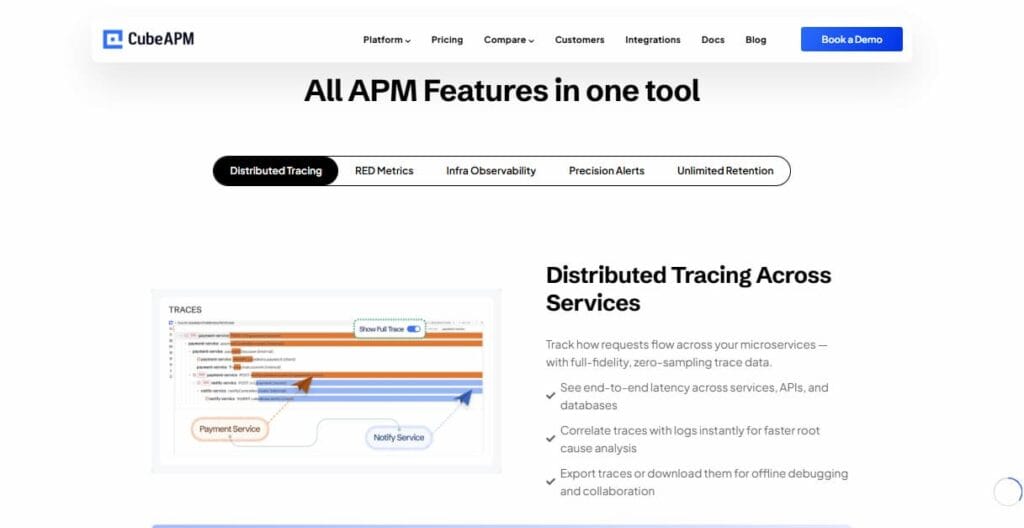
CubeAPM: Known for OpenTelemetry-native full-stack observability that runs inside the customer’s own cloud or infrastructure but is vendor-managed. It unifies metrics, events, logs, traces, Real User Monitoring (RUM), synthetic monitoring, and error tracking in a single platform, with unlimited retention and predictable ingestion-based pricing. Teams typically adopt CubeAPM when data control, cost predictability, and end-to-end correlation are critical at scale.
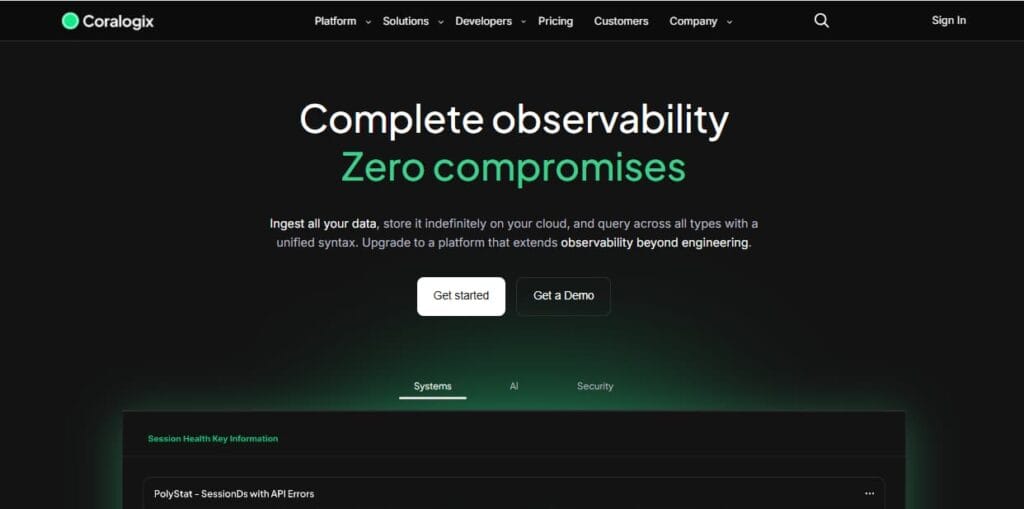
Coralogix: Known for full-stack observability with strong in-stream data processing capabilities. Its Streama architecture, TCO Optimizer, and tiered pipelines allow teams to process telemetry before indexing, helping reduce costs while retaining full data fidelity. Coralogix is commonly used by organizations running large-scale workloads that prefer a SaaS-managed observability platform with cost optimization controls.
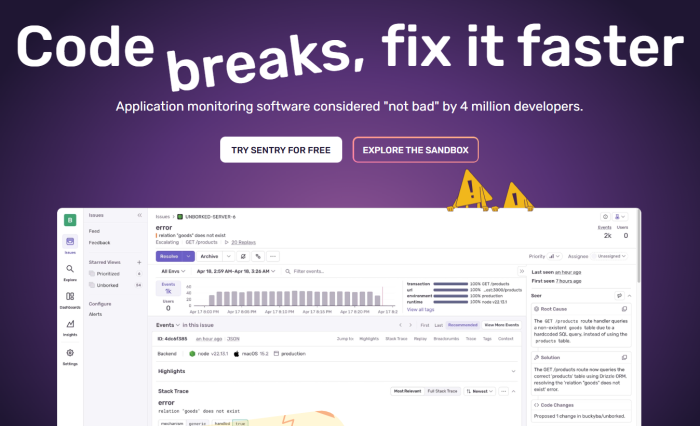
Sentry: Known for full-stack monitoring with a strong emphasis on application reliability, performance, and release health. It combines error tracking, tracing, and performance insights to help teams understand how code changes affect user experience. Sentry is widely used by engineering and product teams focused on fast debugging and release confidence.
Multi-Agent Support
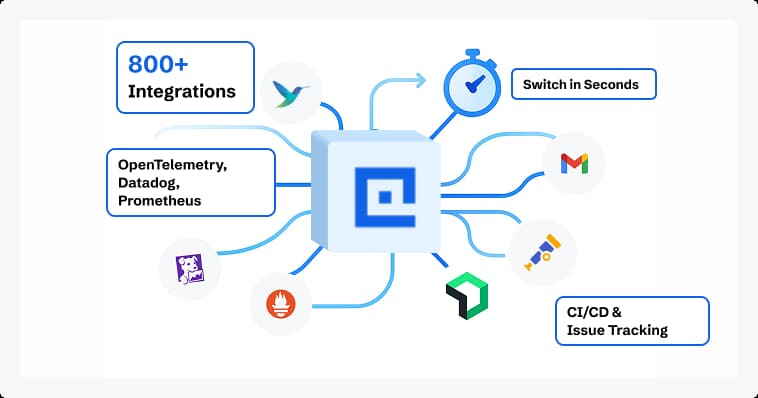
CubeAPM: Offers broad multi-agent support by design. Teams can ingest data using native OpenTelemetry collectors while continuing to use existing vendor agents such as Datadog, New Relic, Elastic, and Prometheus during migration. This makes CubeAPM well-suited for hybrid environments where replacing agents immediately is not practical.
Coralogix: Offers limited multi-agent support. It supports OpenTelemetry, Fluent Bit, and Prometheus-based ingestion. However, there is no public documentation confirming native support for vendor-specific agents such as Datadog or New Relic.
Sentry: Offers limited multi-agent support and relies primarily on OpenTelemetry instrumentation and its language-specific SDKs. It supports OpenTelemetry-based tracing and context propagation at the application level.
MELT Support (Metrics, Events, Logs, Traces)
CubeAPM: Provides full MELT support in a single unified backend. Metrics, events, logs, and traces are collected and correlated natively through OpenTelemetry, so teams can pivot from a trace to the exact logs and metrics behind it without switching tools. This is built for high-volume microservices, Kubernetes, and distributed systems troubleshooting.
Coralogix: Offers full MELT support and processes telemetry in-stream using Streama architecture, the TCO Optimizer, and tiered pipelines. This helps teams filter, enrich, and route data before indexing, which is useful for controlling cost without losing visibility across metrics, logs, and traces in a SaaS-only model.
Sentry: Supports MELT signals with emphasis on application reliability and performance monitoring. It combines errors, tracing, and performance insights with supporting context from metrics and logs tied to application behavior. It is best suited for teams that want deep application-level visibility and release health context.
Deployment Model

CubeAPM: Deployed self-hosted or in a BYOC setup inside the customer’s own cloud or on-prem environment. The platform is vendor-managed, so teams retain full control over where telemetry lives without taking on day-to-day operational overhead. This model works well for organizations with strict data residency, security, or compliance requirements.
Coralogix: Delivered as a SaaS-only platform. Telemetry is processed and stored in Coralogix-managed infrastructure, which simplifies setup and scaling but limits deployment flexibility for teams that need observability data to remain fully within their own environment.
Sentry: Supports both SaaS and self-hosted deployments. The SaaS offering is optimized for fast onboarding, while the self-hosted option requires teams to manage infrastructure, scaling, and upgrades themselves, which can add operational overhead at larger scales.
Pricing: Approximate Cost for Small, Mid-Sized & Large Teams
*All pricing comparisons are calculated using standardized Small/Medium/Large team profiles defined in our internal benchmarking sheet, based on fixed log, metrics, trace, and retention assumptions. Actual pricing may vary by usage, region, and plan structure. Please confirm current pricing with each vendor.
*An APM host is a host that is actively generating trace data, and an Infra host is any physical or virtual OS instance that you monitor with any observability tool.
Below is a cost comparison for small, mid-sized, and large teams.
| Approx. Cost for Teams | Small(~30 APM Hosts) | Mid-sized (~125 APM Hosts) | Large(~250 APM Hosts) |
| CubeAPM | $2,080 | $7,200 | $15,200 |
| Sentry | $3,560 | $12,100 | $32,400 |
| Coralogix | $4,090 | $13,200 | $29,000 |
Teams usually begin noticing these cost differences once telemetry volume and retention needs increase beyond early-stage usage, particularly in Kubernetes and microservice environments.
Teams switching to CubeAPM save roughly 45% compared to Coralogix and about 40% compared to Sentry for mid-sized environments.
CubeAPM: Cost for Small, Medium, and Large Teams
CubeAPM prices observability based on the volume of telemetry ingested, rather than user count, host count, or feature tiers. This approach aligns cost with actual system activity and avoids pricing spikes as teams add services, developers, or environments.
Pricing is based on a simple ingestion model:
- $0.15 per GB of telemetry data
Using comparable workloads as a baseline, estimated monthly costs break down as follows:
- Small teams (~30 APM hosts): $2,080
- Mid-sized teams (~125 APM hosts): $7,200
- Large teams (~250 APM hosts): $15,200
Because CubeAPM runs in a self-hosted or BYOC setup, all observability data remains within the customer’s own environment. This allows teams to increase retention, expand coverage, and support audits or long-term analysis without incurring additional fees tied to storage duration or access limits.
Sentry: Cost for Small, Medium, and Large Teams
Sentry uses a tiered subscription model. Pricing is influenced by the volume of telemetry data ingested, which means overall spend can increase as teams scale or observability coverage expands.
Sentry’s core pricing components include:
- Team plan: $26 per month
- Business plan: $80 per month
- Log ingestion: $0.50 per GB
Based on comparable workloads and team sizes, typical monthly costs are estimated as:
- Small teams (~30 APM hosts): $3,560
- Mid-sized teams (~125 APM hosts): $12,100
- Large teams (~250 APM hosts): $32,400
Because pricing grows with data volume, Sentry can be cost-effective for smaller, application-focused teams but becomes less predictable for larger organizations with expanding logs, traces, and metrics.
Coralogix: Cost for Small, Medium, and Large Teams
Coralogix uses a pricing model where costs are driven by the volume of telemetry ingested across logs, traces, and metrics. Pricing scales with data volume and pipeline configuration.
Core pricing components include:
- Logs: $0.42 per GB
- Traces: $0.16 per GB
- Metrics: $0.05 per GB
Based on comparable workloads and team sizes, estimated monthly costs are:
- Small teams (~30 APM hosts): $4,090
- Mid-sized teams (~125 APM hosts): $13,200
- Large teams (~250 APM hosts): $29,000
While Coralogix offers unlimited retention, overall spend increases with ingestion volume and data processing complexity, since all telemetry flows through Coralogix-managed SaaS infrastructure.
Sampling Strategy
This distinction becomes more apparent during production incidents where logs, traces, and metrics must be correlated under high traffic.
CubeAPM: Uses context-aware smart sampling that automatically prioritizes high-value telemetry such as errors, latency spikes, and key transactions while reducing the volume of less critical data. This helps teams keep observability costs under control without losing signal quality across distributed systems.
Coralogix: Supports both head-based sampling (deciding at the start of a request) and tail sampling (deciding after traces are complete) when using OpenTelemetry collectors, giving teams flexibility in how they reduce trace volume before ingestion. Coralogix also offers conditional error sampling in its RUM SDK to capture a subset of sessions that include errors.
Sentry: Uses a head-based sampling approach at the SDK level with options for static sampling rates (e.g., traces_sample_rate) and dynamic sampling logic via a custom sampler function. The sampling decision is made when transactions are created and propagates downstream. Dynamic sampling lets teams adjust rates programmatically based on attributes such as environment or transaction name.
Data Retention
CubeAPM: Offers unlimited data retention by design. Because CubeAPM runs in a self-hosted or BYOC setup, all logs, traces, metrics, and events are stored in the customer’s own environment. This allows teams to retain observability data for audits, long-term trend analysis, and post-incident reviews without time-based limits or retention surcharges.
Coralogix: Offers infinite data retention. Retention is not time-capped, and teams can keep historical telemetry indefinitely while controlling costs through in-stream processing, tiered pipelines, and indexing policies. However, all data is processed and stored within Coralogix-managed SaaS infrastructure.
Sentry: Applies fixed retention periods based on plan and data type. For logs, default retention is 30 days across plans. For errors, retention is 30 days on the Developer plan and 90 days on the Team and Business plans. This model works well for short-term debugging and release analysis, but limits long-term historical visibility unless data is exported externally.
Support Channels & TAT
CubeAPM: Provides direct support through real-time channels such as email, Slack, and WhatsApp, with response times typically measured in minutes. This model is designed for production environments where fast incident response directly impacts uptime and MTTR.
Coralogix: Offers 24/7 support through in-app chat and email. According to Coralogix’s published support policy, initial response times are within minutes, with incident resolution timelines defined by severity levels. This makes Coralogix suitable for teams that require rapid vendor response within a SaaS support model.
Sentry: Provides support primarily through email and ticket-based channels, with Slack access available. However, Sentry does not publicly document guaranteed response times, and support speed varies by plan and issue severity.
How Teams Evaluate These Platforms at Scale
When teams compare platforms like Sentry, Coralogix, and CubeAPM, evaluation criteria typically evolve as systems grow in complexity and telemetry volume increases. Early-stage decisions are often driven by fast onboarding, developer experience, and immediate visibility into errors or logs. As workloads scale, however, teams place greater emphasis on how costs behave over time, how retention policies can be adjusted, and how well logs, metrics, and traces can be correlated during production incidents.
At this stage, teams tend to look beyond feature checklists and focus on operational questions: how pricing scales with ingestion, whether high-cardinality telemetry can be controlled without losing visibility, and how much ownership they retain over data pipelines and deployment models. Platforms that offer clearer cost predictability, flexible retention controls, and alignment with modern telemetry standards are often favored once observability becomes a long-term operational concern rather than a short-term debugging tool.
Sentry vs Coralogix vs CubeAPM: Use Cases
Choose CubeAPM if:
- You want full-stack observability across metrics, logs, traces, RUM, and synthetic monitoring in one OpenTelemetry-native platform.
- You run Kubernetes or microservices and need end-to-end tracing with strong signal correlation to reduce MTTR.
- You need predictable, ingestion-based pricing that scales with telemetry volume, not users or hosts.
- You require unlimited data retention for audits, compliance, or long-term performance analysis.
- You operate in regulated or data-sensitive environments and need self-hosted or BYOC deployment with full data control.
Choose Sentry if:
- You want full-stack monitoring with a strong focus on application reliability, errors, and release health.
- You are a developer-heavy team prioritizing fast debugging and visibility into code-level issues.
- You prefer SDK-based instrumentation with minimal setup overhead.
- You mainly need short- to medium-term data retention for release and performance analysis.
- You are comfortable with SaaS-first deployment and user-based pricing models.
Choose Coralogix if:
- You want full-stack observability delivered as a fully managed SaaS platform.
- You handle large telemetry volumes and want to control costs using in-stream processing with Streama architecture and tiered pipelines.
- You need unlimited data retention without managing your own storage infrastructure.
- You want fine-grained control over data routing, indexing, and processing policies.
- You prefer vendor-managed operations with defined SLAs and rapid support response times.
Conclusion
Sentry and Coralogix both provide full-stack observability, but they are optimized for different needs, with trade-offs around pricing models, data retention, and deployment control.
CubeAPM is better suited for teams that want predictable pricing, unlimited retention, and OpenTelemetry-native observability running inside their own cloud or infrastructure.
Disclaimer: The information in this article reflects the latest details available at the time of publication and may change as technologies and products evolve.
FAQ
1. What is the main difference between Sentry, Coralogix, and CubeAPM
Sentry focuses on application reliability and release health, Coralogix delivers SaaS-based full-stack observability with in-stream cost controls, and CubeAPM provides OpenTelemetry-native full-stack observability with self-host or BYOC deployment and predictable pricing.
2. Which tool is best for full-stack observability?
CubeAPM and Coralogix are better for end-to-end observability across metrics, logs, and traces, while Sentry is strongest at application-level monitoring and debugging.
3. How do pricing models between Sentry, Coralogix, and CubeAPM differ?
Sentry uses user-based plans with usage limits, Coralogix prices by telemetry type and volume, and CubeAPM uses a single ingestion-based model across all signals.
4. Which tool is better for long-term data retention
CubeAPM and Coralogix offer unlimited retention. CubeAPM stores data in the customer’s environment, while Coralogix retains data in its SaaS platform. Sentry applies fixed retention limits by plan.
5. Which tool works best with OpenTelemetry
CubeAPM is OpenTelemetry-native and supports multi-agent setups. Coralogix supports OpenTelemetry ingestion through managed pipelines. Sentry supports OpenTelemetry mainly at the SDK and application level.