









The main difference between CubeAPM, Elastic Observability, and SigNoz lies in OpenTelemetry adoption, operational overhead, and cost predictability.
Elastic Observability and SigNoz deliver solid full-stack monitoring, but require managing ClickHouse and the Elastic Stack, and costs can rise as telemetry scales. CubeAPM offers a unified OpenTelemetry-native platform that is self-hosted but vendor-managed, with predictable pricing that is approximately 55% cheaper than SigNoz and about 59% cheaper than Elastic Observability.
In this article, we compare CubeAPM, Elastic Observability, and SigNoz in terms of operations and cost, and explore why teams often choose CubeAPM.
SigNoz vs Elastic Observability vs CubeAPM: Feature Comparison
| Features | CubeAPM | SigNoz | Elastic Observability |
| Known for | Unified native OpenTelemetry and predictable pricing. | OpenTelemetry-native, open-source observability | Powerful search and analytics on the Elastic Stack |
| Multi-Agent Support | Yes (OTel, New Relic, Datadog, Elastic) | Partial (OTel) | Partial (OTel) |
| MELT Support | Full MELT | Full MELT | Full MELT |
| Setup | Self-hosted but vendor-managed | SaaS & Self-hosted | SaaS & Self-hosted |
| Pricing | Ingestion-based pricing of $0.15/GB | Logs:$0.3/GB Traces: $0.3/GB Metrics: $0.1/mil samples | Starts at $99/month for Standard |
| Sampling Strategy | Smart sampling | Head + Tail-based | Head + Tail-based |
| Log Retention | Infinite Retention | Logs: 15 days Metrics: 30 days | Logs: 7 days Metrics: 1 day |
| Support TAT | < 10 minutes | No details | 1hr to 1 day |
SigNoz vs Elastic Observability vs CubeAPM: Feature-by-Feature Breakdown
Known For
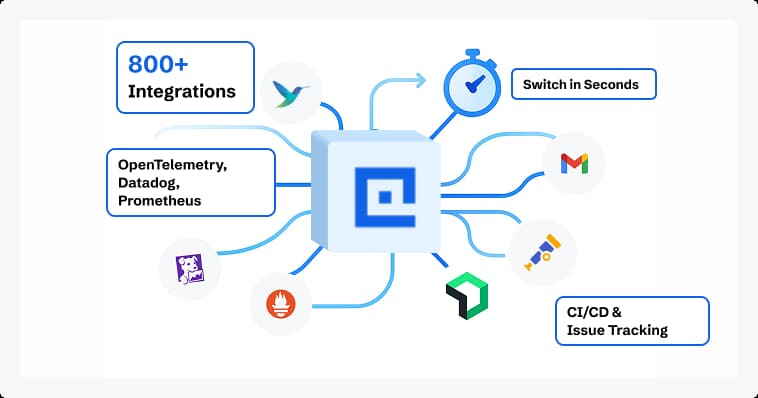
CubeAPM: CubeAPM is known for delivering unified metrics, logs, and traces through an OpenTelemetry-native platform with predictable pricing. It focuses on reducing operational overhead while giving teams full visibility across modern cloud and Kubernetes environments.
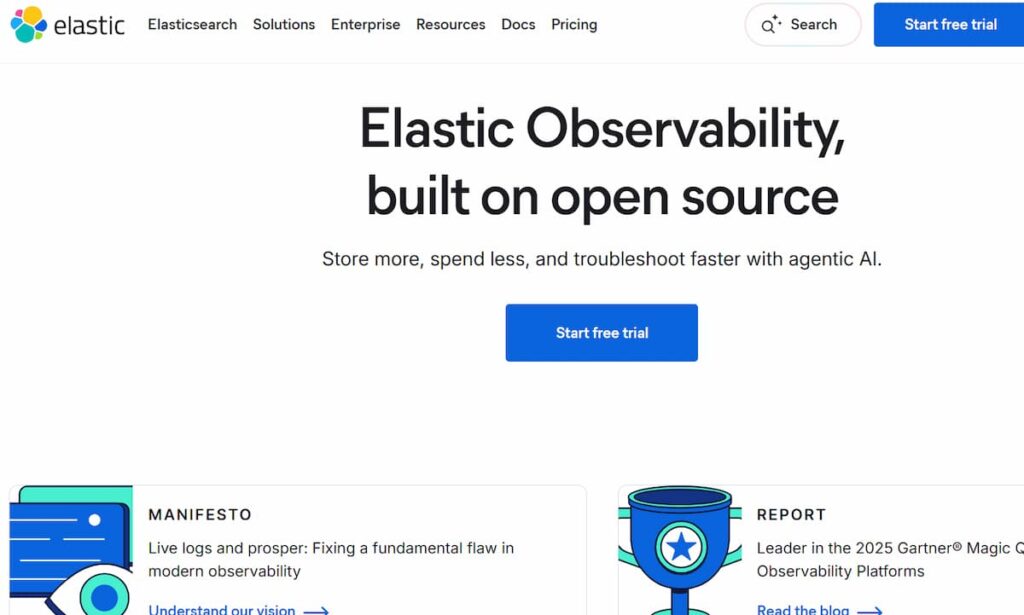
Elastic Observability: Elastic Observability is known for its powerful search, analytics, and visualization capabilities built on the Elastic Stack. It is commonly used by teams that need deep querying and flexible dashboards across large volumes of observability data.
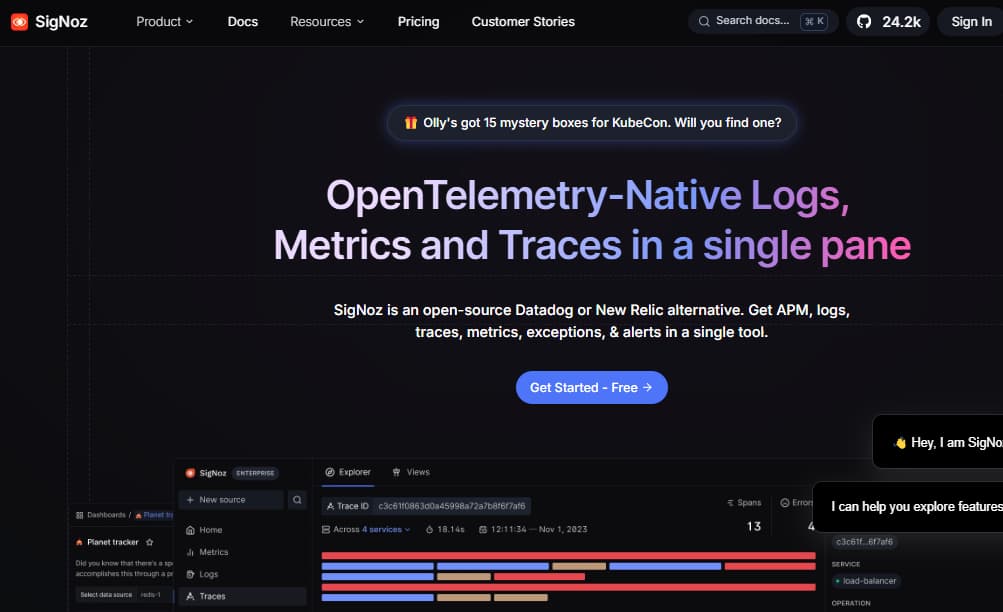
SigNoz: SigNoz is known for its open-source, OpenTelemetry-native approach to observability. It provides a unified view of metrics, logs, and traces using a single backend, appealing to teams that prefer self-hosted and community-driven solutions.
Multi-Agent Support
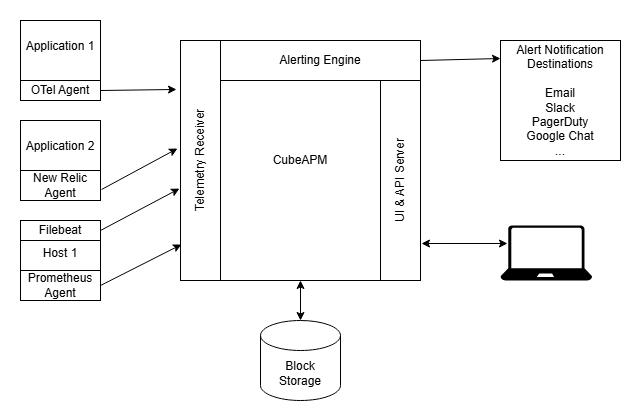
CubeAPM: CubeAPM supports mixed instrumentation by accepting telemetry from OpenTelemetry, Prometheus, Datadog, New Relic, and Elastic agents. This allows teams to switch platforms without immediately re-instrumenting services, making migrations smoother and less time-intensive.
SigNoz: SigNoz is fully OpenTelemetry-based. It ingests OTLP signals through the OTel Collector and supports open protocols like Jaeger or Zipkin.
Elastic Observability: Elastic Observability natively supports ingesting traces, metrics, and logs via the OpenTelemetry Protocol (OTLP) using Elastic APM Server or a managed OTLP endpoint. This means you can send OpenTelemetry-formatted data directly into Elastic without conversion.
MELT Support
CubeAPM: CubeAPM provides comprehensive MELT coverage, encompassing metrics, events, logs, and traces, alongside APM, infrastructure, database monitoring, RUM, and synthetic tests, all on a single platform. All signals are connected, making it easy to trace issues across the stack without switching tools.
SigNoz: SigNoz provides MELT support through OpenTelemetry for metrics, logs, and traces, with events derived from telemetry data. All signals rely on a ClickHouse backend, which still requires ongoing management and scaling.
Elastic Observability: Elastic Observability supports MELT by unifying metrics, logs, traces, and events on the Elastic Stack, enabling deep cross-signal analysis. However, running and scaling a self-managed cluster adds operational overhead.
Deployment & Setup
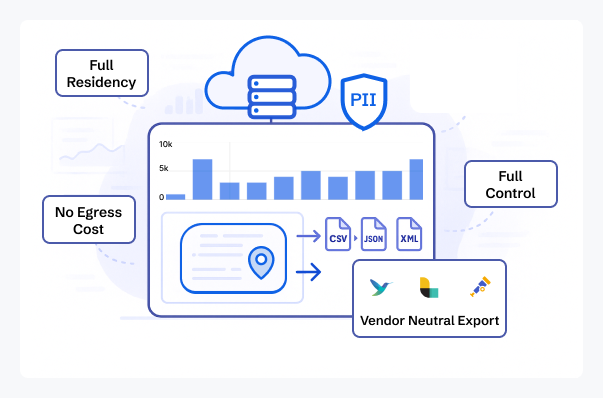
CubeAPM: CubeAPM runs inside your cloud or on-prem environment while the vendor manages upgrades, scaling, and maintenance. This provides you with full data residency and compliance, eliminating the need to manage observability infrastructure yourself.
SigNoz: SigNoz can be self-hosted using Docker or Helm, or SaaS on the SigNoz cloud. Self-hosting gives flexibility but requires teams to manage ClickHouse storage, retention settings, and OTel collector pipelines as data grows.
Elastic Observability: Elastic Observability can be deployed as a managed SaaS on Elastic Cloud or as a self-managed Elastic Stack. While self-managed deployments offer full control, they require internal resources and expertise to operate and maintain the stack, making them more demanding than the managed option.
Pricing: Approximate Cost for Small, Mid-Sized & Large Teams
Transparent pricing makes a significant difference in how observability scales, especially once teams start handling multi-terabyte telemetry. Below is an estimated comparison for small, mid-sized, and large engineering organizations based on verified vendor pricing and average monthly ingestion patterns.
*All pricing comparisons are calculated using standardized Small/Medium/Large team profiles defined in our internal benchmarking sheet, based on fixed log, metrics, trace, and retention assumptions. Actual pricing may vary by usage, region, and plan structure. Please confirm current pricing with each vendor.
*An APM host is a host that is actively generating trace data, and an Infra host is any physical or virtual OS instance that you monitor with any observability tool.
| Approx. Cost for Teams | Small(~30 APM Hosts) | Mid(~125 APM Hosts) | Large(~250 APM Hosts) |
| CubeAPM | $2,080 | $7,200 | $15,200 |
| SigNoz | $4,600 | $16,000 | $34,000 |
| Elastic Observability | $4,550 | $17,435 | $35,370 |
These estimates demonstrate how CubeAPM’s simple ingestion-based approach remains predictable as telemetry increases, while SigNoz Cloud and Elastic’s models scale more aggressively at higher data volumes.
CubeAPM: Cost for Small, Medium & Large Teams
CubeAPM uses a straightforward $0.15/GB ingestion model with no host, user, or feature-based charges. Based on this pricing, here are the cost estimates that teams of different sizes might expect when using CubeAPM:
- Small teams (~30 hosts): $2,080 / month
- Mid-sized teams (~125 hosts): $7,200 / month
- Large teams (~250 hosts): $15,200 / month
Because retention is unlimited, cost does not increase with stored data. This makes CubeAPM a strong fit for organizations ingesting several terabytes per month and looking for predictable month-on-month bills.
SigNoz: Cost for Small, Medium & Large Teams
SigNoz Cloud starts with a base fee and charges primarily on usage, around $0.30 per GB for logs and traces and $0.10 per million metric samples. Self-hosted deployments remove licensing fees but shift expenses to storage and Kubernetes infrastructure.
- Small teams (~30 hosts): $4,600 / month
- Mid-sized teams (~125 hosts): $16,000 / month
- Large teams (~250 hosts): $34,000 / month
SigNoz works well for developers wanting open-source flexibility; however, for the SaaS option, costs grow quickly as ingestion and retention requirements expand.
Elastic Observability: Cost for Small, Medium & Large Teams
Elastic Observability pricing on Elastic Cloud is usage-based and measured by data volume, including data ingested and retained. Costs vary with how much telemetry you send and store, and Elastic offers tiered serverless pricing where ingest and retention are billed per GB.
- Small teams (~30 hosts): ~$4,500–$4,800 / month
- Mid-sized teams (~125 hosts): ~$17,000 / month
- Large teams (~250 hosts): ~$35,000+ / month
Elastic’s flexibility is strong, but bills fluctuate based on retention windows, making long-term forecasting harder.
Sampling Strategy
CubeAPM: CubeAPM uses a Smart Sampling engine that applies ~95% compression while keeping error, latency, and anomaly-related traces. It reduces noise automatically and preserves context-rich spans, giving teams complete visibility without large ingestion spikes.
SigNoz: SigNoz supports both head-based and tail-based sampling through the OpenTelemetry Collector. Head-based sampling reduces data at ingestion time, while tail-based sampling evaluates complete traces before deciding what to retain, helping teams balance visibility and cost as telemetry volumes grow.
Elastic Observability: Elastic Observability supports both head-based and tail-based sampling. Head-based sampling makes the sampling decision at the start of a transaction to reduce ingest volume early, while tail-based sampling evaluates completed traces and applies rules to retain high-value data such as errors or slow transactions, helping teams balance visibility and cost.
Data Retention

CubeAPM: CubeAPM stores all telemetry directly in your cloud or on-prem environment, allowing unlimited retention with no additional vendor fees. Because retention is tied to your own storage, teams can keep logs, traces, and metrics for as long as they wish.
SigNoz: SigNoz applies fixed retention limits by data type in its cloud offering. Logs and traces are retained for 15 days, while metrics are retained for 1 month by default. Extending retention beyond these limits increases overall cost, and self-hosted deployments shift retention responsibility to the underlying storage and infrastructure.
Elastic Observability: Elastic Observability uses index lifecycle management policies to control data retention. By default, metrics are retained for 1 day and logs for 7 days, though teams can adjust these settings. Increasing retention raises storage usage, while high data volumes may require shorter retention to manage resource consumption.
Support Channel & TAT
CubeAPM: CubeAPM provides direct access to engineers through Slack, WhatsApp, and email. Response times are typically under a few minutes, making it reliable during incident investigations or production outages.
SigNoz: SigNoz offers support through email, Slack, and GitHub community channels. While this provides flexibility and open collaboration, there are no publicly documented response-time guarantees or formal TATs, especially for the open-source and lower-tier plans.
Elastic Observability: Support starts with paid plans. Base (Gold) support includes phone and web support with target response times such as urgent issues within 4 business hours, high priority within 1 business day, and normal issues within 2 business days. Higher tiers provide 24/7 support, with enhanced plans targeting 1-hour responses for urgent issues and premium plans targeting 30-minute responses.
Which Tool Is Best for You? Why Teams Choose CubeAPM
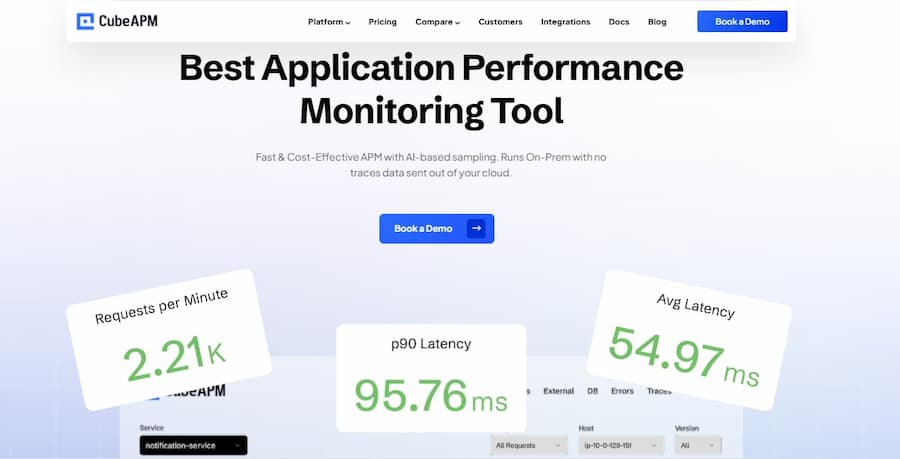
CubeAPM is often selected by engineering teams that need full OpenTelemetry-native observability with strong data ownership and predictable costs. It brings metrics, events, logs, and traces together in one backend across APM, infrastructure, RUM, and synthetic monitoring, removing the need to stitch multiple tools together or manage layered licensing.
Benefits of Choosing CubeAPM
- Predictable Pricing: One straightforward model at $0.15 per GB ingested, with no extra user, host, or feature charges, making it easy to budget at any scale.
- Context-Aware Sampling: Smart sampling keeps important traces such as errors, latency, and anomalies while cutting noise by up to 95%, improving efficiency without sacrificing detail.
- Unified MELT Visibility: All telemetry types, including metrics, events, logs, and traces, appear in a single, correlated interface for faster investigation and root-cause analysis.
- Bring Your Own Cloud (BYOC): Deploy directly in your own cloud or on-prem environment, ensuring full data control and meeting strict compliance.
- Unlimited Retention: Store observability data for as long as needed inside your own storage, ideal for SLA reviews, audits, and historical performance insights.
- Multi-Agent Compatibility: Works with OpenTelemetry, Prometheus, Datadog, New Relic, and Elastic agents, making migrations smooth and low effort.
- Open APIs: Full API-first design allows teams to query, export, automate, or integrate telemetry without hitting premium tiers or paywalls.
SigNoz vs Elastic Observability vs CubeAPM: Use Cases
Choose CubeAPM if:
- You need full MELT observability, including APM, logs, infrastructure, database monitoring, RUM, and synthetics in one OpenTelemetry-native platform.
- You want predictable pricing with a simple ingestion rate instead of mixed billing models such as hosts, users, retention, or credits.
- You operate in compliance-heavy environments and need data stored inside your own cloud using BYOC or self-hosted deployments.
- You want multi-agent support so migrations from Datadog, New Relic, or Elastic are seamless.
- You value fast support with direct access to engineers during incidents.
Choose SigNoz if:
- You want an open-source, OTel-only observability stack you can self-host and customize.
- Your team is comfortable managing ClickHouse, OTel collectors, storage tuning, and retention policies.
- You are building observability for modern microservices and Kubernetes-first environments.
- You prefer a developer-focused tool with a transparent OSS ecosystem.
Choose Elastic Observability if:
- You already rely on Elasticsearch for logs or security and want to extend it to APM, RUM, and synthetics.
- You need strong search and ML-based analytics for high-volume log and metric workloads.
- You want a mature ecosystem with many integrations and dashboards.
Conclusion
SigNoz and Elastic Observability both offer strong OpenTelemetry pipelines, but their cost structures and operational overhead increase as data grows. CubeAPM solves these challenges with unified MELT visibility, predictable per-GB pricing, smart sampling, and full control through self-hosting or BYOC deployments. For teams that want reliable performance, long-term retention, and lower total cost, CubeAPM delivers the most balanced observability experience.
Disclaimer: The information in this article reflects the latest details available at the time of publication and may change as technologies and products evolve.
FAQs
1. What is the main difference between CubeAPM, Elastic Observability, and SigNoz?
The main difference lies in operational overhead and pricing. Elastic Observability and SigNoz require managing backend infrastructure such as Elasticsearch or ClickHouse, while CubeAPM offers a vendor-managed, OpenTelemetry-native platform with simpler operations and predictable pricing.
2. Do all three platforms support OpenTelemetry?
Yes. SigNoz and CubeAPM are fully OpenTelemetry-native, while Elastic Observability supports OpenTelemetry ingestion alongside its own Elastic agents.
3. Which tool is easiest to operate at scale?
CubeAPM is typically easier to operate because it removes the need to manage databases and scaling internally. Elastic Observability and SigNoz offer flexibility but require more in-house resources, especially for managing backends like ClickHouse as data volumes grow.
4. Why do teams choose CubeAPM over Elastic Observability or SigNoz?
Teams often choose CubeAPM to avoid managing Elasticsearch or ClickHouse while still keeping data inside their own cloud. Its vendor-managed, OpenTelemetry-native model reduces operational effort and delivers more predictable costs at scale.
5. Is CubeAPM suitable for large-scale and enterprise environments?
Yes. CubeAPM is designed for high-volume observability in Kubernetes and cloud-native environments, offering unified MELT visibility, multi-agent support, long-term retention, and enterprise-grade support without complex pricing tiers.