








Honeycomb has established itself as a robust observability platform with a powerful query engine, high-cardinality tracing, and signature BubbleUp debugger for root cause analysis. As observability needs evolve across platforms, common concerns with Honeycomb include a steep learning curve and costs that scale with high-cardinality data.
CubeAPM stands out as the most capable alternative. It offers full MELT coverage—including traces, logs, metrics, RUM, synthetics, infra monitoring, and error tracking—alongside smart sampling that captures the most meaningful data while reducing ingestion costs by up to 80%. It supports on-prem and BYOC deployments, offers native OpenTelemetry support, and charges $0.15/GB with zero per-user fees.
In this article, we break down the top 8 alternatives to Honeycomb in 2025, comparing tools based on observability coverage, OpenTelemetry support, cost transparency, deployment flexibility, and real-world usability.
Top 8 Honeycomb Alternatives
- CubeAPM
- SigNoz
- Datadog
- Dynatrace
- Splunk AppDynamics
- New Relic
- Better Stack
- Uptrace
APM Tools Comparison: Sumo Logic vs CubeAPM vs Others (2025)
| Tool | *Pricing(Small, Mid, Large) | OTEL Native | Support TAT | Deployment Option |
| CubeAPM | Small: $2,080; Mid: $7,200 Large: $15,200 | Yes | Within minutes | Self-hosted |
| Honeycomb | Small: $3,000; Mid: $8,100 Large: $17,200 | Yes | 2hrs to 1day | SaaS and Self-hosted |
| SigNoz | Small: $4,600; Mid: $16,000 Large: $34,000 | Yes | Not available | SaaS and Self-hosted |
| New Relic | Small: $9,366; Mid: $32,115; Large: $70,220 | *No | 2hrs to days | SaaS only |
| Uptrace | Small: $1,695; Mid: $5,600 Large: $12,500 | Yes | Not available | SaaS and Self-hosted |
| Datadog | Small: $8,185; Mid: $27,475 Large: $59,050 | *No | <2hrs-48hrs | SaaS only |
| Dynatrace | Small: $7,740; Mid: $21,850; Large: $46,000 | *No | 4hrs to days | SaaS and Self-hosted |
| Splunk AppDynamics | Small: $2,650; Mid: $9,825; Large: $20,150 | *No | 2hrs to days | SaaS and Self-hosted |
| Better Stack | Small: $5,723; Mid: $20,550 Large: $43,350 | *No | Within hours | SaaS only |
*All pricing comparisons are calculated using standardized Small/Medium/Large team profiles defined in our internal benchmarking sheet, based on fixed log, metrics, trace, and retention assumptions. Actual pricing may vary by usage, region, and plan structure. Please confirm current pricing with each vendor.
*OTEL Sources: Datadog uses proprietary SDKs; Dynatrace uses collectors; Splunk AppDynamics uses collectors; Sumo Logic uses collectors, Better Stack uses collectors.
Why Look for Honeycomb Alternatives?
Here are the key reasons why modern DevOps, SRE, and platform teams are looking beyond Honeycomb in 2025:
1. High Costs At Scale
Pricing is based on event volume, which can escalate with high-cardinality data. Honeycomb’s pricing model is based on the volume of events ingested, which may seem straightforward—but in practice, it can be highly volatile. As systems scale, event volume doesn’t just grow linearly; it spikes with high-cardinality dimensions like user IDs, session tokens, regions, or request paths. This means even a single query across those fields can generate a massive spike in cost.
Honeycomb Cost for Mid-Sized Company
Honeycomb uses an event-based pricing model, starting at $130/month for 100 million events.
Event Ingestion(per million and TB): $2, 600 ($130 x 20)
Total Monthly data ingestion (GB): $4,500 ($0.10 x 45, 000)
Observability data out cost (charged by cloud provider): $4,500 ($0.10 x 45,000)
Total: $11,600
CubeAPM Cost for Mid-Sized Company
CubeAPM, by contrast, offers flat, usage-based pricing at $0.15/GB, with no per-user charges or feature-based upsells.
Total Monthly data ingestion (GB): $6,750 (45,000 x $0.15)
Observability data out cost (charged by cloud provider): $450 (45,000 x $0.01)
Total: $7,200
So while Honeycomb’s event pricing may appear simple, it becomes expensive at scale and hard to predict. CubeAPM’s all-in-one model offers over 40% cost savings, predictable billing, and complete observability without the fine print
2. Steep Learning Curve for New Teams
Honeycomb is built for developers who love to interact with their data. It has a steep learning curve as mastering the query builder, columnar data model, and service graphs takes significant time and training. For fast-moving teams or those unfamiliar with Honeycomb’s paradigms, this can be a major adoption barrier.
3. Lack of Built-in Aggregation / Roll-ups
Some reviewers note that Honeycomb “only does timeseries, no roll ups or longer aggregation,” which makes it less suitable for long-term business-metric reporting or aggregated dashboards.
“It *only* does timeseries, no roll ups or longer aggregation. They have good reasons for this, but it does mean for business metric reporting, you still need something else” (G2)
4. Limited in-product Quota/Usage management
Users express a desire for more control over quotas — namely to control data ingestion, retention and manage how much gets stored vs sampled.
“I would love to be able to have more control in-product around quota management. It’s solveable by using Refinery, but not as convenient as being able to fine-tune it as part of the SaaS offering.” (G2)
Criteria for Suggesting Honeycomb Alternatives
When evaluating alternatives to Honeycomb, we focused on tools that address its biggest limitations: cost unpredictability, partial observability, lack of deployment flexibility, and limited ecosystem maturity. Based on market trends, real user reviews, and platform comparisons, here are the six criteria we used to shortlist stronger, production-grade alternatives:
1. Smart Sampling & Signal Optimization
With growing telemetry volumes, static sampling rules aren’t enough. We looked for platforms that support context-aware, dynamic sampling—based on latency spikes, error codes, or traffic anomalies—to help teams retain relevant data without overspending.
2. Transparent Pricing
We favored tools with flat, usage-based pricing models over per-event or cardinality-based billing. CubeAPM offers 60–75% cost savings with a simpler, all-inclusive billing model.
3. Ease of Use & Enterprise Readiness
Tools with easy onboarding, intuitive UI, built-in alerting, and fast support response times stood out. Enterprise-readiness was measured via SLAs, incident support, and platform maturity. While Honeycomb is powerful, users frequently report a steep learning curve.
4. Rich Ecosystem & Native Integrations
Modern teams operate across a diverse stack—from Kubernetes and AWS to CI/CD pipelines and third-party APIs. Platforms with a large, actively maintained integration ecosystem scored higher.
Honeycomb Overview
Known For
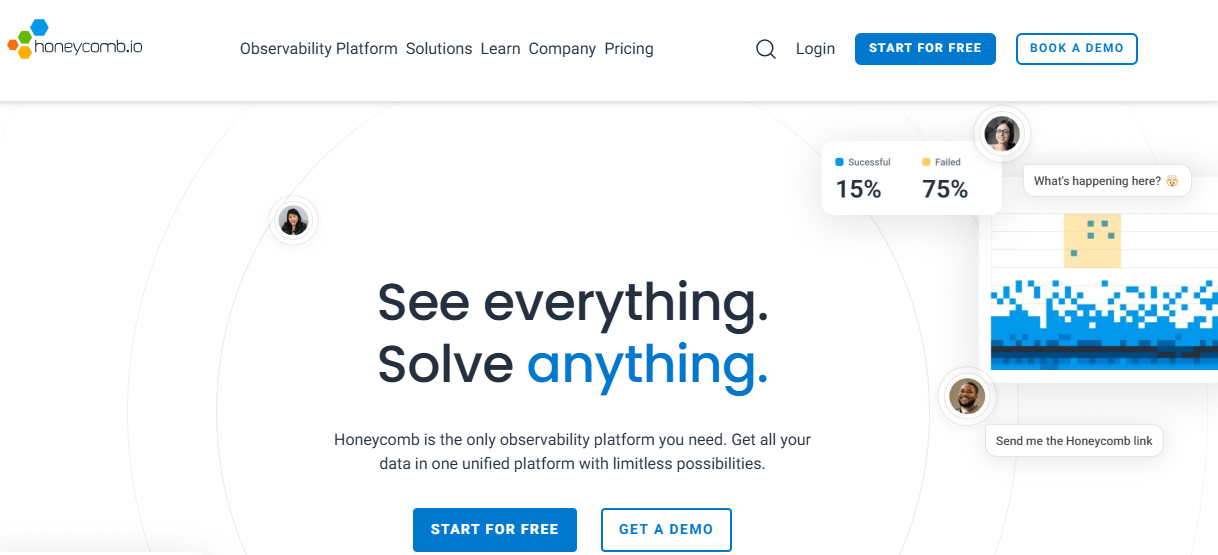
Honeycomb is best known for its high-cardinality trace analysis and interactive debugging capabilities tailored for complex, distributed systems. Designed for engineering teams navigating microservices and dynamic environments, Honeycomb provides powerful query-driven visualizations that help uncover patterns, anomalies, and outliers across millions of trace events—making it a go-to tool for root cause analysis and understanding service-level behavior at scale.
Standout Features
- Native OTEL Support: Honeycomb offers native integration with OpenTelemetry, allowing teams to ingest standardized telemetry data without vendor lock-in. This ensures flexibility and compatibility across diverse environments while enabling easy instrumentation across services.
- BubbleUp Debugger: A powerful visual tool that automatically surfaces anomalies in high-cardinality fields, helping engineers quickly pinpoint the root cause of issues without writing complex queries.
- Columnar Query Engine: Honeycomb’s custom-built columnar engine is optimized for structured, event-based telemetry, enabling high-speed, flexible querying at scale—even in environments with millions of spans.
Key Features
- High-Cardinality Event Support: Handles millions of unique field combinations—ideal for dynamic metadata like user IDs, sessions, or geographic segments.
- Custom Query Builder: Honeycomb uses a SQL-like interface to enable fine-grained slicing/dicing of telemetry data for interactive debugging.
- Service Map & Trace Spans Explorer: Visualizations for service-to-service call flows and deep inspection of individual spans and attributes.
- Frontend SDKs (RUM): Recently added support for Real User Monitoring via JavaScript SDKs, though this requires manual setup and lacks out-of-the-box UX metrics.
- Basic Alerting & SLOs: Provides alerting based on derived columns or thresholds. More suited for debugging than real-time operational monitoring.
Pros
- Excellent for debugging high-cardinality production issues
- Fast query performance even across billions of events
- Ideal for event-driven architectures and async systems
- Integrates well with OpenTelemetry pipelines
Cons
- Missing features, users desire more in-product control over quota management
- Steep learning curve for new users unfamiliar with Honeycomb’s data model
- Expensive, especially when data volumes grow
Best For
- DevOps and SRE teams focused on trace-level debugging
- Use cases involving microservices, high-cardinality data, and asynchronous systems
- Organizations that already manage logging/infra separately and want a tracing-first workflow
Pricing & Customer Reviews
- Free Tier: 20 million events/month
- Pro Tier: $130/month per 100 million events
- G2 Rating: 4.7/5
Most users praise its power and speed for debugging. Common complaints include the lack of full-stack support, steep learning curve, and difficulty forecasting costs.
Top 8 Honeycomb Alternatives
1. CubeAPM
Known For
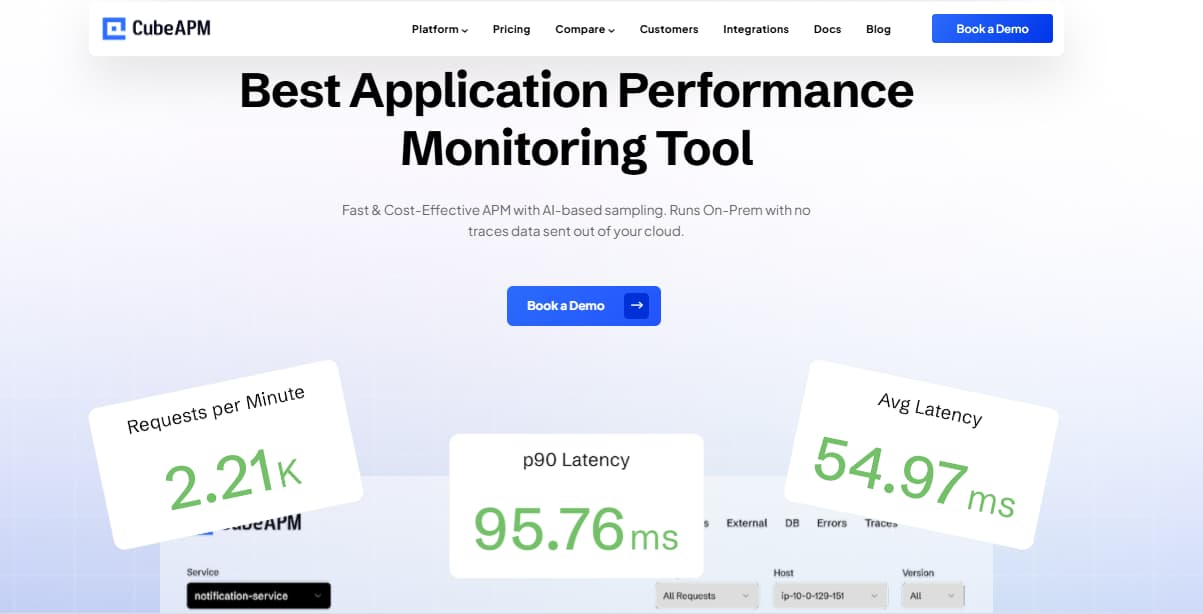
CubeAPM is a modern observability platform purpose-built for teams seeking end-to-end visibility, efficient cost control, and data residency compliance—all through a native OpenTelemetry pipeline. Unlike cloud-only incumbents, it offers flexible hosting , high-volume performance, and transparent pricing without per-user limitations.
Key Features
- Adaptive Smart Sampling: Prioritizes critical traces like error spikes and latency outliers, while reducing noise—allowing teams to retain meaningful data without ballooning ingestion costs.
- Unified MELT Stack: Provides a fully integrated experience across metrics, events, logs, and traces—alongside native support for RUM and synthetic testing.
- Instant Infrastructure Observability: Built-in metrics collection for Kubernetes, cloud infrastructure, and Linux systems with no third-party plugins required.
- Flexible Hosting Models: Deploy CubeAPM in your own cloud or on-prem to maintain data control and meet compliance requirements like GDPR or HIPAA.
- Wide Integration Support: Seamlessly compatible with OpenTelemetry, Prometheus, Datadog agents, and Elastic exporters.
Standout Features
- Smart sampling reduces costs by intelligently filtering low-value traces.
- Self-hosting avoids public cloud egress fees and enables full data residency.
- Transparent pricing includes unlimited users—no licensing surprises.
- Easy migration tools for Datadog, New Relic, and Uptrace—up and running in under an hour.
- Responsive Slack-based support channel with sub-5-minute TAT.
Pros
- Up to 80% lower TCO compared to Datadog and New Relic.
- Full observability: traces, metrics, logs, RUM, synthetics, and infra coverage.
- Pricing is usage-based with no charge per seat or team member.
- Enterprise-ready support and fast troubleshooting from core engineering.
Cons
- Not suited for teams looking for off-prem solutions.
- Strictly an observability platform and does not support cloud security management
Best For
- DevOps and platform teams looking to cut observability costs without losing visibility.
- Engineering teams needing OpenTelemetry-native observability with data localization.
Pricing & Customer Reviews
- Pricing: Starts at $0.15 per GB of ingestion
- Rating: 4.7/5 (based on demo feedback, early adopter reviews, and pilot programs)
CubeAPM vs Honeycomb
CubeAPM provides a complete observability platform—spanning logs, metrics, frontend performance, synthetic testing, and infra monitoring. CubeAPM also includes smart sampling (absent in Honeycomb) and supports self-hosting, making it a stronger fit for cost-sensitive or compliance-heavy teams that need full-stack visibility out of the box.
2. SigNoz

Known For
SigNoz is a developer-friendly, OpenTelemetry-native observability platform designed to offer full MELT (Metrics, Events, Logs, Traces) coverage with the flexibility of open-source deployment. It’s widely favored for its modern UX, ClickHouse-backed analytics engine, and seamless self-hosted or cloud deployment options.
Key Features
- Native OpenTelemetry Integration: SigNoz is built ground-up to work with OpenTelemetry SDKs and supports Prometheus metrics, enabling vendor-agnostic telemetry collection across distributed systems.
- Complete MELT Stack: Distributed Tracing with service maps and latency insights; log ingestion with filter and search, and infrastructure metrics via Prometheus exporters
- Deployment Flexibility: Teams can deploy SigNoz using Docker or Helm on Kubernetes. For those looking to reduce infrastructure management, SigNoz also offers a hosted cloud version.
- Custom Dashboards and Querying: Comes with preconfigured dashboards and allows advanced querying through ClickHouse’s SQL-like interface, blending performance and customizability.
Standout Features
- Transparent, open-source roadmap via GitHub
- ClickHouse-based backend for high-speed analytics
- Unified view of logs, metrics, and traces
- Community Slack and open documentation for troubleshooting
- Support for tail-based sampling in OTEL pipelines
Pros
- Fully OTEL-compliant and free of vendor lock-in
- Active open-source community (20,000+ GitHub stars)
- Smooth self-hosting with Docker and Helm options
- Single-pane visibility for MELT telemetry
- Managed cloud plan available for faster go-live
Cons
- Managing ClickHouse memory usage is time-consuming
- Operational complexity, especially for managing the stacks
- The UI, while functional, might feel cluttered
Best For
- DevOps and SRE teams exploring open-source observability stacks
- Startups and mid-sized companies looking to avoid vendor lock-in
- Engineering teams already familiar with ClickHouse or self-managed telemetry stacks
Pricing & Customer Reviews:
- Self-hosted: Free
- For SigNoz SaaS:
- Logs: $0.3/GB ingested
- Traces: $0.3/GB ingested
- Metrics: $0.1/mil samples
- G2 Rating: 4.5/5
Users applaud its UI and open-source ethos, but note operational overhead, especially when managing ClickHouse
SigNoz vs Honeycomb
Honeycomb is optimized for high-cardinality trace debugging in SaaS environments and fast querying, but at a higher cost, especially when scaling. SigNoz, while lacking some of Honeycomb’s advanced debugging features, offers full MELT support, OpenTelemetry-native ingest, and flexible self-hosting. For teams prioritizing cost control and open-source transparency, SigNoz is a strong Honeycomb alternative.
3. Datadog
Known For
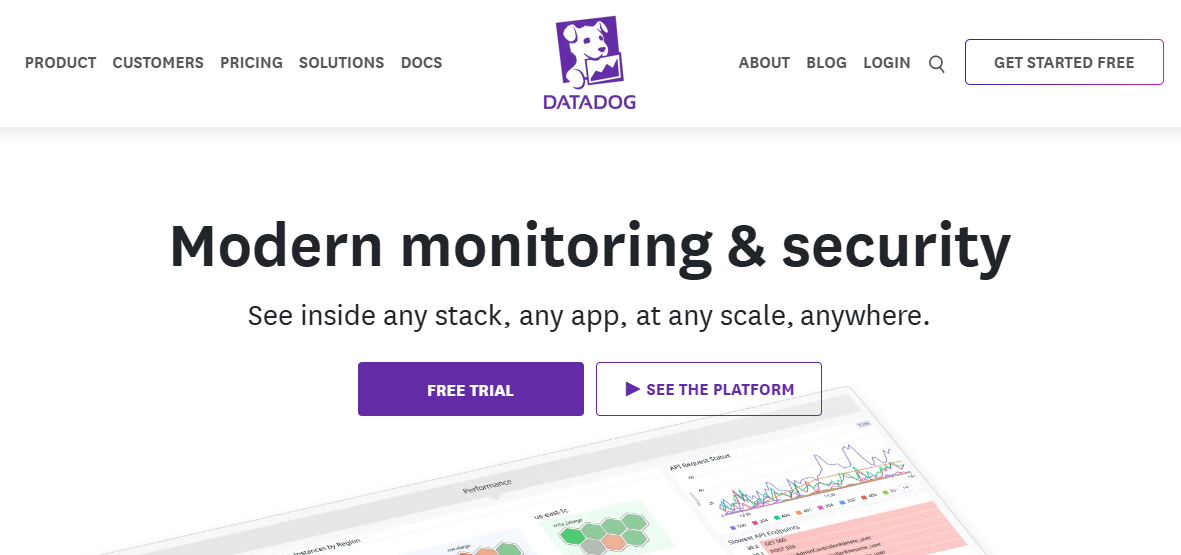
Datadog is a well-established observability and monitoring platform widely used across cloud-native, enterprise, and DevOps environments. Known for its extensive out-of-the-box integrations, Datadog brings together logs, infrastructure metrics, application traces, and security insights into a single, SaaS-based interface.
Key Features
- Infrastructure Monitoring at Scale: Real-time insights into host, container, and cloud infrastructure using Datadog agents and prebuilt dashboards.
- Distributed APM Tracing: Captures service-to-service interactions and latency across APIs, databases, and external systems.
- Centralized Log Aggregation: Enables log ingestion, full-text search, and correlation through features like Live Tail and archive scanning.
- Cloud Security & Compliance Monitoring: Monitors for vulnerabilities, misconfigurations, and access violations across your cloud workloads.
- Synthetic and Real User Monitoring (RUM): Includes browser-based session tracking and synthetic tests for simulating user flows and performance validation.
Standout Features
- Over +900 native integrations, including Kubernetes, AWS, Azure, GitHub, and Jenkins.
- AI-based “Watchdog” engine detects anomalies, latency spikes, and traffic shifts.
- All observability domains—logs, infra, APM, RUM, security—accessible from a single control plane.
- Scales effectively for global deployments and enterprise workloads.
Pros
- Broad feature set spanning observability and security.
- Prebuilt dashboards, anomaly detection, and alerting for quick setup.
- Ideal for multi-cloud environments and large-scale infrastructure.
- Rich ecosystem and community support.
Cons
- Costs escalate quickly with scale due to separate charges per GB, per host, and per feature module.
- Steep learning curve, which impedes onboarding
- Complex intial setup
Best For
- Enterprises with large budgets seeking a comprehensive, all-in-one monitoring solution.
- Teams needing deep integrations and centralized dashboards across all layers of infrastructure and applications.
Pricing & Customer Reviews:
- APM (Pro Plan): starting at $35/host/month
- Infra Monitoring (Pro Plan): starting at $15/host/month
- Rating: 4.4/5 on G2
Users consistently praise Datadog for its breadth and polish, but often flag concerns about unpredictable pricing, billing complexity, and steep learning curve.
Datadog vs Honeycomb
Datadog offers a more complete observability and security suite—with logs, metrics, RUM, and cloud security tools. However, Datadog lacks smart sampling and cost transparency. Many teams using Honeycomb for traces eventually hit similar cost ceilings in Datadog when trying to scale to full-stack coverage. CubeAPM, in contrast, delivers the same breadth as Datadog with smart sampling, flat pricing, and OpenTelemetry-first design—making it a more sustainable long-term option for modern engineering teams.
4. Dynatrace
Known For
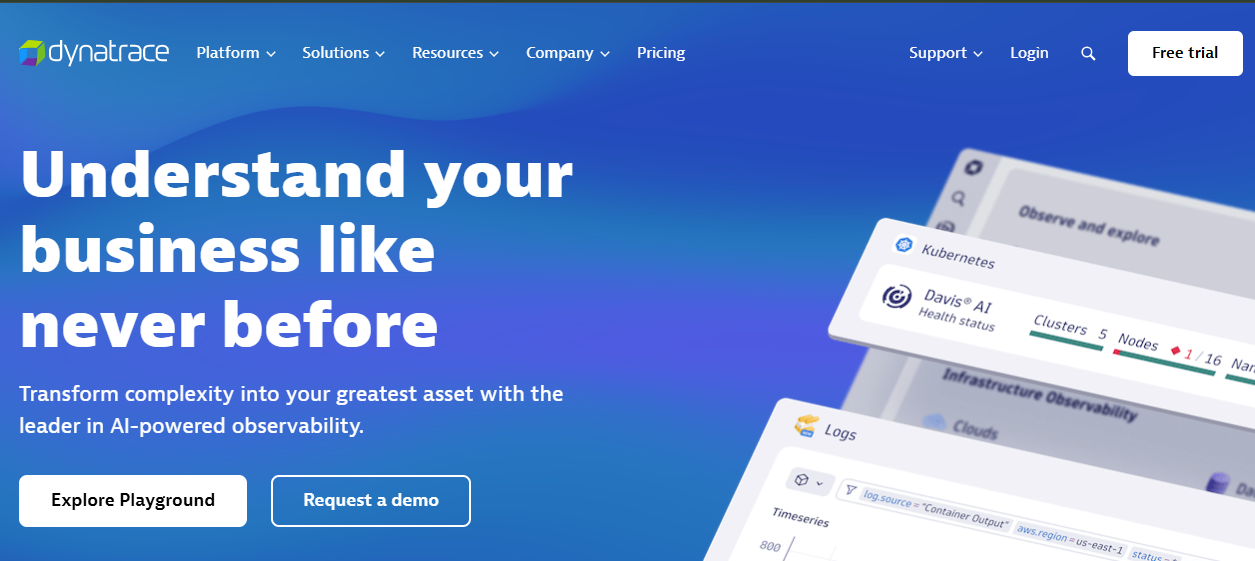
Dynatrace is an enterprise observability and automation platform built for large-scale, high-complexity environments. It’s particularly known for its AI-powered root cause detection and zero-config auto-discovery—making it a preferred choice for enterprises running massive hybrid cloud stacks.
Key Features
- Davis® AI Engine: Anomaly detection, issue correlation, and root cause analysis powered by machine learning—automatically surfaces incidents without manual alerting logic.
- End-to-End Monitoring: Unified visibility across infrastructure, backend services, frontend performance, and third-party APIs—including RUM and synthetics.
- Automatic Topology Mapping: Auto-detects service relationships, dependencies, and traffic flows—eliminating the need for manual instrumentation.
- Log Management: Ingests logs from across environments, enabling context-rich troubleshooting alongside traces and metrics.
- Application-Level Insights: Provides deep diagnostics into runtime performance across JVM, .NET, Node.js, and other environments.
Standout Features
- Complete observability coverage with AI-driven correlation of logs, metrics, traces, and user experience.
- No manual setup needed—services, containers, and code paths are auto-discovered in real time.
- Ties business KPIs directly to technical metrics for real impact measurement.
- Also offers application security analysis to flag vulnerabilities and compliance risks.
Pros
- Intelligent automation and predictive alerting significantly reduce manual configuration.
- Deep tracing and diagnostic tools built for enterprise-grade monitoring.
- Real-time anomaly detection across highly dynamic, distributed systems.
- Excellent for hybrid and multicloud architectures.
Cons
- High pricing tiers, especially when using AI, log indexing, or security features.
- Expensive, making it challenging for smaller teams
- Complex configuration adds operational overhead
- Overwhelming UI, which might hinder smooth usability
Best For
- Large enterprises managing thousands of services and requiring automated, AI-powered observability.
- Teams that want insight into not just what broke—but why it broke—across cloud and on-prem deployments.
Pricing & Customer Reviews
- Full-Stack Monitoring: $58 /month/8 GiB host
- Infra Monitoring: $29/month/8 GiB host
- G2 Rating: 4.4/5
Users appreciate Dynatrace’s automation and diagnostic depth, but often point to its rigid pricing model and steep learning curve as drawbacks.
Dynatrace vs Honeycomb
Dynatrace delivers far more automation, dependency discovery, and AI-driven insights than Honeycomb—but at a significantly higher cost. While Honeycomb lacks Dynatrace’s automation, service mapping, and business-context monitoring. However, Dynatrace’s lack of native OpenTelemetry support and closed architecture can be a dealbreaker for teams seeking flexibility and vendor-neutral ingest.
5. Splunk AppDynamics
Known For
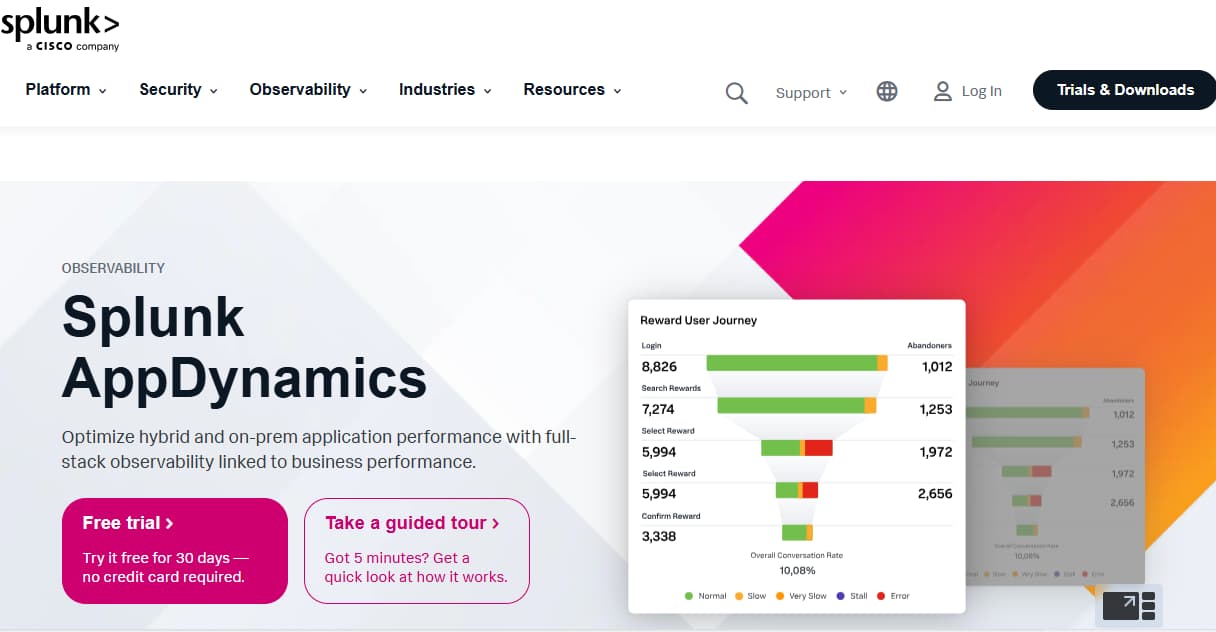
Splunk AppDynamics—born out of Cisco’s APM offering and now part of the broader Splunk ecosystem—focuses on tying application performance to business impact. It’s tailored for enterprises that require deep diagnostics of transactional workflows and full-stack visibility tied to KPIs, especially in traditional or hybrid environments.
Key Features
- Business Transaction Tracing: Monitors end-to-end execution paths of business-critical workflows—spanning services, databases, and infrastructure layers.
- Application Performance Monitoring (APM): Provides detailed code-level insights, performance baselines, and anomaly detection across app components.
- Infrastructure Awareness: Visualizes how server, container, and cloud performance affects application behavior in real time.
- Custom Dashboards & SLA Rules: Enables SLA-based alerting and business-aligned dashboards for both technical and executive stakeholders.
- Synthetic Monitoring: Simulates user interactions across web journeys to detect regressions and outages before users experience them.
Standout Features
- Business-application linkage helps prioritize issues that impact revenue or user satisfaction.
- Prebuilt health rules and SLA violation tracking embedded into monitoring workflows.
- Visual code traces across tiers, functions, and service layers for Java, .NET, PHP, and Node.js apps.
- Now enhanced with Splunk’s logging and infrastructure monitoring modules for broader context.
Pros
- Exceptional diagnostics for complex, layered applications.
- Useful for correlating technical issues with user or business impact.
- SLA-driven alerting and dashboards designed for cross-functional teams.
- Integrates naturally into enterprises already using Splunk’s logging and SIEM tools.
Cons
- Initial configuration can be heavy—especially for custom instrumentation.
- Total cost of ownership can spike when bundling APM, infra, synthetics, and logging modules.
- UI can feel dated and rigid compared to newer platforms like CubeAPM or Grafana.
Best For
- Enterprise IT and engineering teams managing complex Java/.NET workloads.
- Organizations looking to tie app performance directly to business KPIs and SLAs.
Pricing & Customer Reviews
- APM: starting at $33/month/CPU core
- Infrastructure Monitoring: $6/month/CPU core
- G2 Review Rating: 4.3/5
Users value its diagnostic depth and SLA features, but frequently mention the complexity of setup and high overall cost when deploying across the full stack.
Splunk AppDynamics vs Honeycomb
AppDynamics delivers much deeper insight into business transactions and application internals than Honeycomb, but falls short in flexibility, and it’s not OTEL native. Honeycomb is a more agile and fluid observability platform, while AppDynamics is a better fit for large teams managing critical, legacy-heavy environments. For teams wanting the depth of diagnostics with modern standards and lower cost, CubeAPM offers the best of both worlds—with full MELT coverage, smart sampling, and a frictionless, self-hosted option that’s easier to deploy and scale.
6. New Relic
Known For
New Relic is a cloud-based observability platform offering a full suite of telemetry tools under a unified dashboard. Recognized for its usage-based pricing model and its Telemetry Data Platform (TDP), it provides engineers with real-time insights across application performance, infrastructure health, logs, RUM, and synthetic monitoring—all accessible via its custom query language, NRQL.
Key Features
- Comprehensive MELT Monitoring: Supports metrics, events, logs, traces, frontend performance, synthetics, and error tracking—streamlined into a single UI.
- Telemetry Data Platform (TDP): Acts as a centralized ingestion and analytics engine for OpenTelemetry, Prometheus, and New Relic agents.
- Customizable Dashboards with NRQL: Enables real-time querying and visualization using New Relic Query Language—ideal for tailored reporting.
- Frontend and Mobile Performance Tracking: Includes RUM for browser analytics and SDKs for mobile telemetry across iOS and Android.
Standout Features
- Unified platform for full-stack telemetry with deep frontend and mobile visibility.
- Allows ingestion from third-party tools and protocols including OTEL and Prometheus.
- High-quality alerting and SLO management integrated into workflows.
- Extensive language support with auto-instrumentation options.
Pros
- End-to-end visibility across the entire software lifecycle.
- Seamless ingestion from both New Relic agents and open telemetry pipelines.
- Strong RUM and synthetic monitoring capabilities built in.
- Dashboards and alerts highly customizable via NRQL.
Cons
- Pricing can escalate quickly—charges by GB ingested and per user license.
- Users find the learning curve steep
- Initial setup and configuration is quite complex
Best For
- Mid-size and enterprise teams looking for a quick-start observability solution.
- Organizations comfortable with cloud-only deployments and usage-based billing.
Pricing & Customer Reviews:
- Free Tier: 100GB/month ingested
- Data Ingestion (Pro plan): $0.40/GB ingested beyond the free 100GB limit
- Usaged Pricing (Pro Plan): $349/user for full platform user
- G2 Rating: 4.4/5
Users appreciate the UI and broad telemetry support, but frequently mention concerns about pricing complexity, vendor lock-in, and data locality restrictions.
New Relic vs Honeycomb
Both New Relic and Honeycomb are SaaS-first observability platforms, but they differ in approach. New Relic offers a broader feature set—including frontend, infra, logs, and synthetics—while Honeycomb is a full-stack observability platform that unifies telemetry and delivers fast queries. However, New Relic’s high per-user cost and usage-based billing can quickly add up. For teams wanting OpenTelemetry-native ingest, full-stack coverage, and on-premise flexibility, CubeAPM provides a more scalable and cost-efficient option—especially for engineering orgs wary of surprise bills or vendor lock-in.
7. Better Stack
Known For
Better Stack (formerly Better Uptime) blends log aggregation with uptime and incident monitoring in a visually polished, developer-friendly platform. It’s popular with engineering teams who want fast, minimal setup for monitoring APIs, websites, and services without the complexity of full APM suites.
Key Features
- Uptime and Health Checks: Monitors endpoints using HTTP, ping, port, and SSL checks—alongside alert policies and on-call rotations.
- Built-In Log Monitoring: Offers structured log ingestion, real-time querying, and retention management with a SQL-like search syntax.
- Incident Management & Escalation: Provides status pages, alert routing, incident timelines, and native integrations with Slack, Teams, and email.
- Custom Dashboards: Clean, modern interface with markdown-based dashboards ideal for status communication or public visibility.
- Developer-Centric Workflows: Git-based alert configuration and YAML support make it easy to manage via code.
Standout Features
- Extremely polished UI and fast onboarding—ideal for small teams.
- Combines uptime, logging, and alerting into one platform.
- Free tier includes generous limits for basic monitoring and logging needs.
- Public and private status pages for incident transparency.
Pros
- Simple to deploy with little learning curve.
- Great for monitoring web services, APIs, and external uptime.
- Built-in alerting and logging reduce the need for multiple tools.
- Well-suited for early-stage teams or startups.
Cons
- Users find it expensive, particularly for startups
- Users have reported missing features such a outgoing webhooks
- Users find the limited features restrictive, especially for advanced needs
Best For
- Solo developers, frontend teams, and early-stage startups who want simple monitoring without the overhead of full observability platforms.
- Teams replacing Pingdom or combining lightweight logging and uptime tools.
Pricing & Customer Reviews
- Free tier available for personal projects
- Logs: $0.15/GB
- Metrics: $7.50, 2TB included
- Errors: $0.000075/exception
- G2 Rating: 4.6/5
Users love the modern UI and ease of use, but note the lack of backend observability features as a trade-off.
Better Stack vs Honeycomb
BetterStack and Honeycomb serve very different purposes. BetterStack is built for uptime and incident alerting with log visibility. CubeAPM delivers traces, infra monitoring, RUM, and synthetics in a single, OpenTelemetry-native platform with flexible pricing and enterprise support.
8. Uptrace

Known For
Lightweight, OpenTelemetry-native tracing and metrics with self-hosted flexibility. Uptrace appeals to small teams seeking low-cost, vendor-neutral observability that they can run within their own infrastructure.
Key Features
- End-to-end distributed tracing via OpenTelemetry
- Prometheus integration for infra-level metrics
- SQL-based querying on traces using ClickHouse
- Self-hosted deployment options (Docker/K8s)
- Minimal alerting and dashboarding for essential monitoring
Standout Features
- Seamless OpenTelemetry ingestion with no proprietary agent dependencies
- ClickHouse-powered trace analysis with SQL-like queries
- Lightweight UI for core diagnostics and span inspection
- Basic Prometheus-compatible metric ingestion
- Low-overhead Docker-based deployment for custom setups
Pros
- Fully OTEL-native and vendor-agnostic
- Cost-effective for low-volume environments
- Runs entirely on your infrastructure — no data leaves your network
- Integrates cleanly with existing Prometheus setups
Cons
- No built-in support for RUM or synthetic monitoring
- Limited dashboarding experience compared to Grafana or CubeAPM.
- High operational overhead to manage ClickHouse, OTEL Collector, and configs.
Best For
- Engineering teams with in-house observability expertise
- Startups looking for a self-hosted, OTEL-native tracing tool
- Teams focused on trace debugging over full MELT stack
Pricing & Customer Reviews
- Traces and Logs: starts at $0.08 per GB
- Metrics: starts at $0.001 per series
- ProductHunt Rating: 4.8 / 5
Uptrace vs Honeycomb
Both platforms are OTEL-focused, but Honeycomb offers stronger debugging tools, and hosted simplicity—ideal for production-grade environments. Uptrace is better suited for smaller teams who want total control and don’t need advanced UX or frontend observability. CubeAPM sits in the middle, offering full MELT coverage, compliance-ready hosting, and smart sampling with predictable pricing.
Conclusion: Choosing the Right Honeycomb Alternative
As observability stacks mature, engineering teams are demanding more than just trace visualization and high-cardinality querying. While Honeycomb remains strong in exploratory debugging and event-level analysis, its SaaS-only model, unpredictable event-based pricing, and limited full-stack coverage make it less viable for teams seeking comprehensive observability and cost control at scale.
Why CubeAPM Leads the Pack
CubeAPM offers a modern, OpenTelemetry-native alternative that’s purpose-built for both depth and scale. With flat $0.15/GB pricing, support for full MELT observability (metrics, logs, traces, synthetics, RUM), smart sampling, and on-prem hosting, CubeAPM empowers teams to achieve 60–80% cost savings while retaining data control. Its developer-first experience, fast dashboards, and responsive Slack-based support make it ideal for startups and enterprises alike.
Whether you’re scaling past Honeycomb’s pricing model or looking for unified visibility across your stack, CubeAPM delivers a future-ready, cost-efficient, and compliance-friendly observability path forward.
Disclaimer: The information in this article reflects the latest details available at the time of publication and may change as technologies and products evolve.
FAQs
1. What are the best Honeycomb alternatives for full-stack observability?
Top Honeycomb alternatives like CubeAPM, Datadog, and Dynatrace offer broader MELT (Metrics, Events, Logs, Traces) coverage out of the box. While Honeycomb excels at high-cardinality trace analysis, these platforms provide deeper visibility into frontend performance (via RUM), simulate user journeys with synthetics, and include infrastructure metrics—making them more suitable for unified observability.
2. Why are engineering teams switching from Honeycomb to other APM tools?
Teams often move away from Honeycomb due to pricing unpredictability, limited log and infra visibility, and lack of built-in real user monitoring. Tools like CubeAPM address these gaps by offering flat-rate pricing, built-in MELT support, and smart sampling that prioritizes critical signals without overspending. Others like New Relic or Coralogix also appeal to teams needing all-in-one observability.
3. Is there a Honeycomb alternative that supports on-premise deployment?
Yes—CubeAPM is one of the few OpenTelemetry-native tools that offers full on-prem support with real-time MELT ingestion. This is ideal for teams in regulated industries or those requiring control over data residency. Unlike Honeycomb, which is SaaS-only, alternatives like Uptrace and Signoz also provide self-hosting options for greater deployment flexibility.
4. What should I look for in a Honeycomb replacement?
A good Honeycomb alternative should offer smart sampling, predictable pricing, native support for RUM and synthetics, and seamless OTEL integration. Platforms like CubeAPM stand out with Slack-based support, unlimited users, and real-time dashboards. If you’re scaling observability across microservices, alternatives like Datadog or Coralogix may offer broader ecosystem integrations.
5. How do Honeycomb alternatives handle high-cardinality data more efficiently?
While Honeycomb uses tail-based sampling and columnar storage, tools like CubeAPM enhance this with context-aware smart sampling, capturing anomalies like 5xx spikes or slow endpoints without flooding storage. Some platforms also process telemetry locally—reducing latency and cost compared to cloud-only systems. This is especially useful for teams ingesting billions of events per month.