










Sentry is still one of the most popular tools for application error tracking. It gives engineering teams SDKs, issue grouping, stack traces, performance monitoring, session replay, and release tracking in one platform.
But Sentry is not always the easiest fit when teams need predictable pricing, strict data control, or a lighter self-hosted setup. Its current self-hosted docs list 4 CPU cores, 16 GB RAM plus 16 GB swap, and 20 GB disk as minimum requirements, with 32 GB RAM recommended.
This guide compares the best self-hosted Sentry alternatives for 2026, including CubeAPM, GlitchTip, SigNoz, Grafana OSS, OpenObserve, Highlight.io, Uptrace, and OneUptime.
🔑 Key Takeaways
- CubeAPM is best for self-hosted, vendor-managed observability.
- GlitchTip is the simplest lightweight Sentry-style replacement.
- SigNoz is best for OpenTelemetry-native observability.
- Grafana OSS works best if your team already uses Grafana, Loki, Tempo, or Prometheus.
- OpenObserve is a bigger open-source backend for logs, metrics, traces, RUM, and errors.
- Highlight.io is strongest for frontend errors and session replay.
- Uptrace is useful for teams moving from Sentry workflows to OpenTelemetry.
- OneUptime is best when monitoring, incidents, status pages, and observability need to live together.
Sentry Self-Hosted Alternatives at a Glance
| Tool | Self-hosted option | Error tracking approach | Best for |
| CubeAPM | Yes, vendor-managed | Errors linked with traces, logs, metrics, and APM | Self-hosted observability without backend ops |
| GlitchTip | Yes | Sentry-compatible error tracking | Lightweight Sentry replacement |
| SigNoz | Yes | Exceptions with OpenTelemetry traces, logs, and metrics | Full open-source observability |
| Grafana OSS | Yes | Faro, Loki, Tempo, and Prometheus/Grafana | Existing Grafana users |
| OpenObserve | Yes | Frontend errors, RUM, logs, metrics, and traces | Larger open-source observability backend |
| Highlight.io | Yes | Errors tied to session replay | Frontend debugging |
| Uptrace | Yes | OpenTelemetry APM with error context | Sentry-to-OpenTelemetry migration |
| OneUptime | Yes | Errors with monitoring and incident workflows | Monitoring plus incident response |
Why Teams Look for Self-Hosted Sentry Alternatives
Event-based pricing can be hard to forecast when traffic, logs, traces, replays, or duplicate errors grow quickly. A single noisy deployment can consume far more telemetry than expected.
Errors may include stack traces, URLs, request metadata, user identifiers, payload fragments, and environment details. Teams in regulated industries often prefer to keep that data inside their own infrastructure.
Self-hosting Sentry is possible, but it is not lightweight. The current minimum requirement is 16 GB RAM plus 16 GB swap, with 32 GB RAM recommended.
OpenTelemetry helps teams avoid proprietary SDK lock-in. Tools like CubeAPM, SigNoz, Grafana Tempo, OpenObserve, Uptrace, and OneUptime fit better when teams want portable telemetry.
Best Sentry Self-Hosted Alternatives
1. CubeAPM
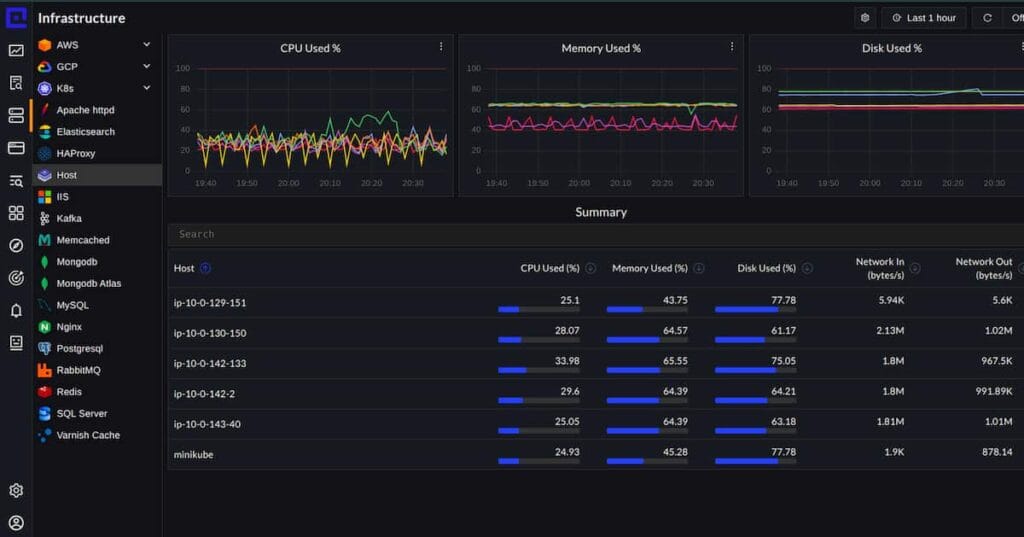
CubeAPM is best for teams that want self-hosted observability without managing the backend themselves. It is not open source, but it is vendor-managed, self-hosted, OpenTelemetry-native, and built for predictable observability cost.
Best for: Self-hosted APM + error context without backend ops.
Pricing: $0.15/GB ingested; no per-user or per-host fees.
Error tracking approach: Errors linked with traces, logs, metrics, and APM data.
| Pros | Cons |
| Fast dashboards | Not suited for teams looking for on-prem solution |
| Strong support | Strictly an observability platform and does not support cloud security management |
| Easy setup | |
| Predictable pricing |
2. GlitchTip
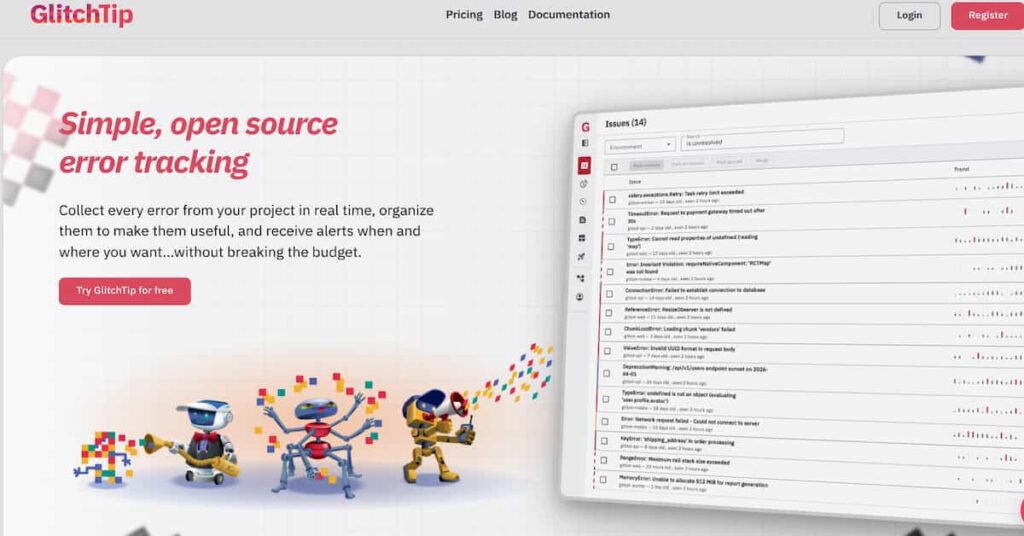
GlitchTip is the simplest Sentry-style alternative for teams that want lightweight self-hosted error tracking. It supports Sentry client SDKs, so migration can be easier than re-instrumenting applications.
Best for: Lightweight Sentry-compatible error tracking.
Pricing: Self-hosted is free; hosted Free plan includes up to 1,000 events/month; Small hosted plan is $15/month for up to 100,000 events/month.
Error tracking approach: Sentry-compatible SDK ingestion and issue tracking.
| Pros | Cons |
| Sentry SDK compatible | Steep learning curve |
| Free self-hosted | Self-hosted adds operational overhead |
| Simple to run | |
| Uptime checks included |
3. SigNoz
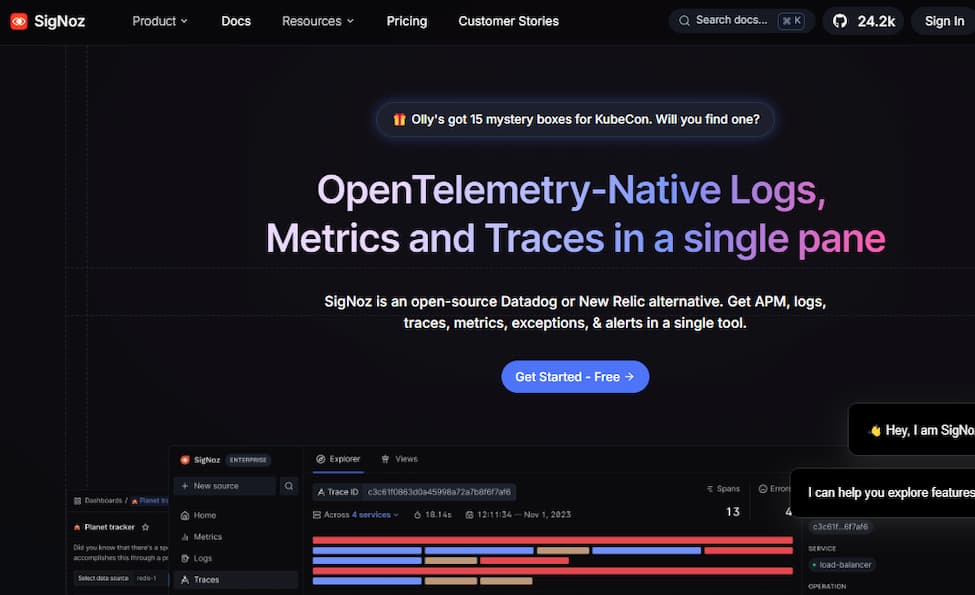
SigNoz is an OpenTelemetry-native observability platform for logs, metrics, traces, exceptions, dashboards, and alerts. It is stronger than a pure error tracker when teams need service-level debugging context.
Best for: OpenTelemetry-native observability.
Pricing: Self-hosted is free; Cloud starts at $49/month with $49 usage credit. Logs and traces are $0.30/GB after included usage.
Error tracking approach: Exceptions correlated with traces, logs, and metrics.
| Pros | Cons |
| OTel-native | Setup effort |
| Logs + traces + metrics | Steep learning curve |
| Good for microservices | Complex initial setup |
| No per-seat pricing | Self-hosting needs ops |
4. Grafana OSS
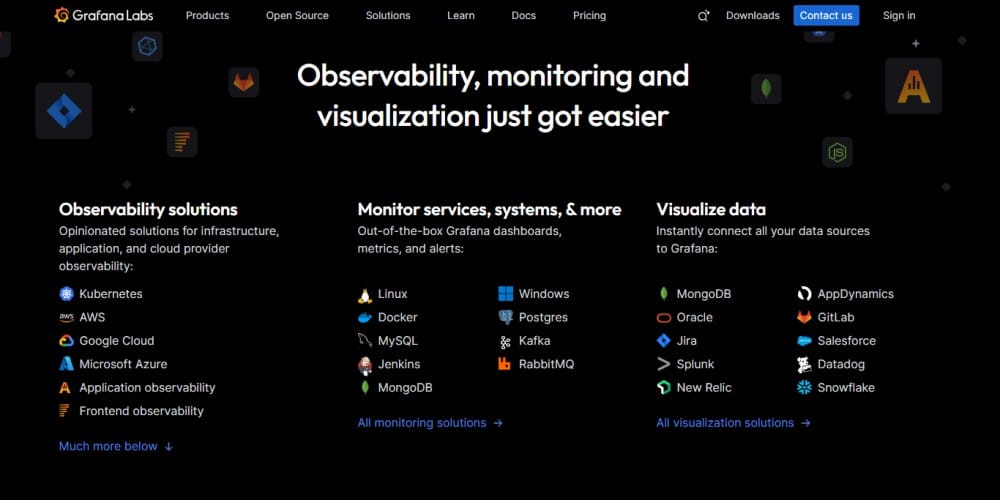
Grafana OSS is not a direct Sentry clone, but it is one of the strongest open-source observability ecosystems. With Faro, Loki, Tempo, Prometheus, and Grafana dashboards, teams can build frontend error monitoring and observability workflows.
Best for: Teams already using Grafana OSS.
Pricing: OSS stack is free to self-host; Grafana Cloud Pro starts at $19/month plus usage. Grafana Application Observability lists $0.025 per host-hour, with telemetry charged separately.
Error tracking approach: Faro for frontend errors, Loki for logs, Tempo for traces, and Prometheus/Mimir for metrics.
| Pros | Cons |
| Great dashboards | Complex initial setup |
| Huge ecosystem | Self-hosted adds operational overhead |
| Many data sources | Learning curve |
| Strong visuals |
5. OpenObserve
OpenObserve is the bigger open-source replacement for smaller error-only tools. It covers logs, metrics, traces, RUM, frontend monitoring, and error tracking in one backend.
Best for: Larger open-source observability backend.
Pricing: Self-hosted option available; OpenObserve Cloud lists $0.50/GB ingestion with no per-seat or per-host fees.
Error tracking approach: Frontend errors, RUM, logs, metrics, and traces.
| Pros | Cons |
| Broad telemetry coverage | Steep learning curve |
| No per-seat fees | Upgrade effort |
| Good cost model | UI can improve |
| Self-hosted option | Docs gaps reported |
6. Highlight.io
Highlight.io is strongest for frontend and product teams that need error monitoring tied to user sessions. It helps engineers see what the user did before the error happened, not just the stack trace.
Best for: Frontend errors + session replay.
Pricing: Free plan is $0/month with 500 monthly sessions; Pay-as-you-go starts at $50/month; Business starts at $800/month; self-hosted Enterprise starts at $3,000/month.
Error tracking approach: Browser errors tied to session replay, logs, and traces.
| Pros | Cons |
| Session replay | Steep learning curve |
| Good UX debugging | Cost rises fast |
| AI error grouping | Self-hosted adds operational overhead |
| Logs + traces included |
7. Uptrace
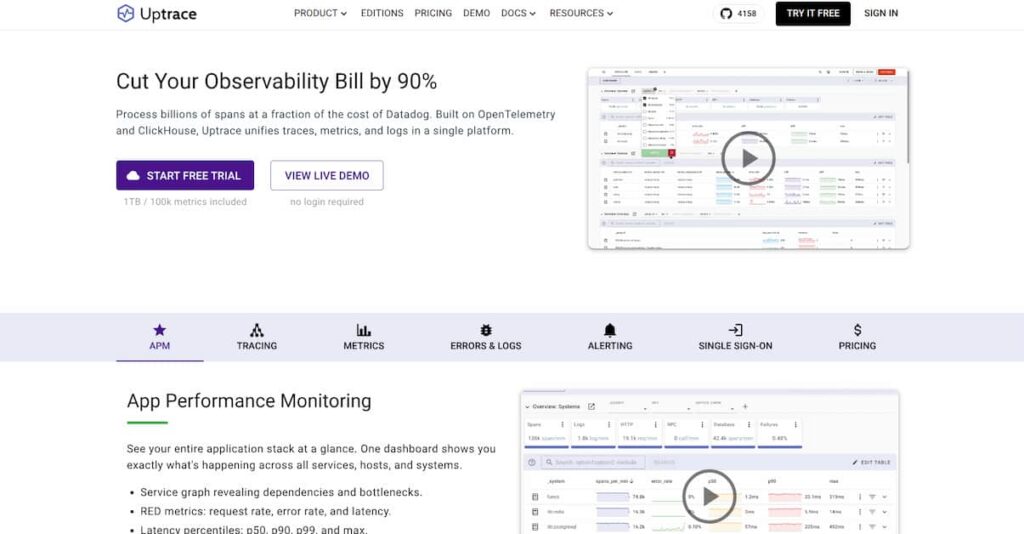
Uptrace is an OpenTelemetry-native APM platform for traces, metrics, logs, and errors. It is useful for teams moving from Sentry-style monitoring toward OpenTelemetry-based observability.
Best for: Sentry-to-OpenTelemetry migration.
Pricing: Self-hosted Community is free; self-hosted Starter is $39/month for up to 50 GB/day. Uptrace says self-hosted pricing is edition-based, not per-GB.
Error tracking approach: OpenTelemetry APM with error context and Sentry-style migration support.
| Pros | Cons |
| OTel-native | Self-hosted adds operational overhead |
| Free self-hosted tier | Pricing varies by edition |
| Strong trace context | Needs OTel setup, adding operational overhead |
| Flat self-hosted tiers | Steep learning curve |
8. OneUptime
OneUptime is broader than Sentry because it combines monitoring, status pages, incidents, on-call, logs, metrics, traces, and exceptions. It fits teams that want reliability workflows and observability together.
Best for: Monitoring + incident response + observability.
Pricing: Self-hosted is free; SaaS Free is $0; Growth is $22/month; Scale is $99/month; telemetry ingest is $0.10/GB.
Error tracking approach: Errors connected with monitoring, alerts, incidents, traces, and status workflows.
| Pros | Cons |
| All-in-one platform | Steep learning curve |
| Free self-hosted | Self-hosted adds operational overhead |
| Status pages included | Complex initial setup |
| Incident workflows | Can feel heavy |
How to Choose the Right Sentry Self-Hosted Alternative
Choose CubeAPM if you want self-hosted but vendor-managed
CubeAPM is the best fit when your team wants telemetry inside its own infrastructure but does not want to manage the observability backend alone. It is vendor-managed, so it gives the ccnvenience of a SaaS platform.
Choose GlitchTip if you want the easiest Sentry-style migration
GlitchTip is the cleanest option when you already use Sentry SDKs and want a lightweight self-hosted replacement.
Choose SigNoz if you want OpenTelemetry-native observability
SigNoz is a stronger fit when you want logs, metrics, traces, exceptions, dashboards, and alerts in one open-source platform.
Choose Grafana OSS if you already use the Grafana ecosystem
Grafana OSS makes sense when your team already runs Grafana dashboards, Prometheus, Loki, Tempo, Mimir, or OpenTelemetry Collector.
Choose OpenObserve if you want a bigger open-source backend
OpenObserve is better when you want logs, metrics, traces, RUM, frontend monitoring, and error tracking together.
Choose Highlight.io if frontend debugging is the priority
Highlight.io is strongest when frontend errors need to be connected with session replay and user behavior.
Choose Uptrace if you are moving toward OpenTelemetry
Uptrace works well when your team wants OpenTelemetry-native APM but still needs a path away from Sentry-style workflows.
Choose OneUptime if you want monitoring plus incident response
OneUptime is useful when you want observability, uptime monitoring, status pages, incidents, and on-call workflows in one platform.
📌 Monitor More Than Just Errors with CubeAPM
Self-hosted error tracking tells you what broke. CubeAPM helps show why it broke.
With CubeAPM, teams get OpenTelemetry-native APM, distributed tracing, logs, infrastructure metrics, alerts, and error context inside their own infrastructure. That gives engineering teams the control of self-hosting without the operational burden of maintaining a complex observability backend.
This matters when an error is only the symptom. The root cause may be a slow database query, a failing dependency, a Kubernetes issue, or a latency spike that started before the exception appeared.
CubeAPM is a strong fit for teams that want predictable pricing, vendor-managed self-hosting, and deeper production debugging than standalone error tracking can provide.
Conclusion
Sentry remains a strong error tracking platform, but it is not the only practical choice. Teams looking for a Sentry self-hosted alternative usually want better cost control, stronger data ownership, lighter operations, or broader OpenTelemetry-native observability.
GlitchTip is the simplest lightweight Sentry-style replacement. SigNoz, Grafana OSS, OpenObserve, Uptrace, and OneUptime are better when teams want logs, metrics, traces, RUM, and exceptions in one observability workflow. Highlight.io is strongest for frontend teams that need session replay and browser context.
CubeAPM deserves the first position because it solves a different but important problem. It is not open source, but it gives teams self-hosted, vendor-managed, OpenTelemetry-native observability with predictable cost and deeper debugging context than standalone error tracking.
Disclaimer: Features, pricing, deployment requirements, and review scores can change over time. Verify current details on each vendor’s official documentation and review profiles before making a purchase or deployment decision.
FAQs
1. What is the best self-hosted Sentry alternative?
CubeAPM is the best option if you want self-hosted observability with vendor-managed operations, OpenTelemetry support, and APM context. GlitchTip is the easiest option if you only want a lightweight Sentry-compatible error tracker.
2. Is Sentry self-hosted lightweight?
No. Sentry’s current self-hosted deployment requirements include 4 CPU cores, 16 GB RAM plus 16 GB swap, and 20 GB disk, with 32 GB RAM recommended.
3. Is CubeAPM open source?
No. CubeAPM is proprietary. Its advantage is that it is self-hosted, vendor-managed, OpenTelemetry-native, and priced predictably at $0.15/GB.
4. Can GlitchTip use existing Sentry SDKs?
Yes. GlitchTip is compatible with Sentry client SDKs, which makes migration easier for teams already instrumented with Sentry.
5. Is Grafana OSS a direct Sentry replacement?
Not directly. Grafana OSS is a composable observability stack. With Grafana Faro, Loki, Tempo, Prometheus or Mimir, and OpenTelemetry, teams can build frontend error monitoring, logs, traces, metrics, and dashboards.