







OpenTelemetry and Splunk are two names that come up constantly in observability conversations, but they are solving different parts of the same problem. OpenTelemetry is an open-source, vendor-neutral framework for collecting traces, metrics, and logs. Splunk is a commercial platform that ingests, indexes, and helps you analyze that data once it arrives.
Comparing them head-to-head is genuinely useful because many teams are wondering: do we instrument with OpenTelemetry and route data to Splunk, or do we use Splunk’s own agents? Could we drop Splunk entirely and use a lighter backend? And what does CubeAPM, a self-hosted, OpenTelemetry-native APM, bring to the picture?
This guide cuts through the positioning and gives you a practical answer.
🔑 Key Takeaways
- OpenTelemetry is a collection standard, not an observability platform. It needs a backend to store and visualize data.
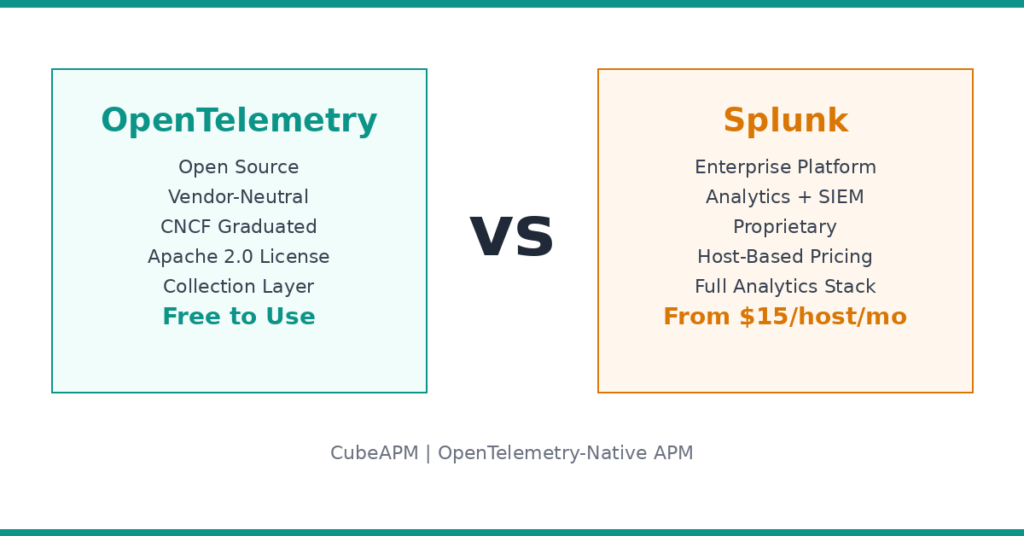
- Splunk is a full analytics and SIEM platform. Splunk Observability Cloud uses host-based pricing starting at $15/host/month (Starter tier).
- The most common architecture combines both: OpenTelemetry Collector for instrumentation and data routing, Splunk for analytics.
- OpenTelemetry is licensed under Apache 2.0 and reached CNCF Graduated status in May 2026.
- For teams that want OpenTelemetry-native APM without Splunk’s cost, CubeAPM is a self-hosted alternative worth evaluating.
- Vendor lock-in is the clearest reason to adopt OpenTelemetry first, then choose your backend later.
OpenTelemetry vs Splunk: A Visual Overview
What Is OpenTelemetry?
OpenTelemetry (OTel) is a CNCF project that gives you a unified, vendor-neutral SDK and wire protocol (OTLP) for emitting traces, metrics, and logs from your applications and infrastructure. It merged OpenTracing and OpenCensus in 2019, reached CNCF Incubating status in 2021, and graduated in May 2026.
The three core components you work with are:
- OpenTelemetry API and SDK: language-level libraries for instrumenting your code (Java, Python, Go, .NET, Node.js, Ruby, and more).
- OpenTelemetry Collector: a standalone agent and pipeline process that receives, transforms, and exports telemetry to any backend.
- OTLP (OpenTelemetry Line Protocol): the standard wire protocol for transmitting telemetry data.
OpenTelemetry does not store your data, visualize it, or alert on it. It is the collection and shipping layer. Everything downstream including storage, query, and dashboards, is handled by whatever backend you point your Collector at.
What Is Splunk?
Splunk is a commercial data platform best known for its machine data search and analytics. The product family relevant to observability is Splunk Observability Cloud, which bundles infrastructure monitoring, application performance monitoring (APM), real user monitoring (RUM), synthetic monitoring, and log observer into one SaaS platform.
Splunk also runs a major SIEM product (Splunk Enterprise Security) and the self-hosted Splunk Enterprise, but those are separate licensing concerns from its observability suite.
Splunk has been a top contributor to the OpenTelemetry project itself, maintaining a Splunk Distribution of the OpenTelemetry Collector that comes pre-configured for Splunk Observability Cloud. In other words, Splunk actively encourages OpenTelemetry adoption because it wants OTel data flowing into its platform.
Key Differences Between OpenTelemetry and Splunk
The table below covers the fundamental points of comparison.
| Aspect | OpenTelemetry | Splunk Observability Cloud |
|---|---|---|
| Type | Instrumentation + collection standard | Full commercial observability platform |
| License | Apache 2.0 (CNCF Graduated) | Proprietary SaaS |
| Cost | Free to use; backend costs vary | From $15/host/month (Starter tier) |
| Storage/Query | None built-in; backend-dependent | Built-in indexing, SPL query language |
| Dashboards | Requires separate tool (e.g., Grafana) | Native dashboards and AI-driven insights |
| Vendor lock-in | None; backend-switchable | Tied to Splunk ecosystem |
| Alerting | Via backend (e.g., Prometheus AlertManager) | Native, real-time alerts included |
| SIEM capability | Not applicable | Available via Splunk Enterprise Security (add-on) |
| Self-hosted option | Yes (Collector runs anywhere) | Splunk Enterprise; Observability Cloud is SaaS |
| Trace-log correlation | Automatic via SDK | Requires explicit configuration |
| Community | CNCF, 100+ vendor contributors | Splunk-owned, large enterprise user base |
How the Architecture Works
OpenTelemetry-Only Stack
A pure OpenTelemetry setup instruments your application with OTel SDKs, runs a Collector, and exports OTLP data to an open-source or commercial backend.
Common backends include:
- CubeAPM, self-hosted, OpenTelemetry-native APM with traces, metrics, and service maps.
- Grafana + Tempo + Prometheus, open-source stack for traces and metrics.
- Jaeger or Zipkin, trace storage.
- Any OTLP-compatible cloud backend.
This approach keeps costs low, avoids lock-in, and gives you full control. The tradeoff is operational overhead managing the backends yourself.
Splunk-Only Stack
Splunk provides its own agents (Universal Forwarder for logs, Splunk APM agents for tracing). These route everything into Splunk Observability Cloud. You get dashboards, ML-powered anomaly detection, and SPL out of the box. The downside: switching backends later means re-instrumenting your entire codebase.
OpenTelemetry + Splunk (The Most Common Setup)
Most enterprise teams combine both. You instrument with OpenTelemetry SDKs and run the Splunk Distribution of the OTel Collector, which ships data to Splunk Observability Cloud via Splunk’s HTTP Event Collector (HEC) or OTLP ingest endpoint. This gives you vendor-neutral instrumentation today, while keeping Splunk’s analytics for as long as you need it.
A key benefit of this architecture: you can add cost routing logic in the OTel Collector to send debug logs to cheap object storage while routing errors and traces to Splunk, meaningfully cutting your Splunk ingest bill.
Cost Comparison
OpenTelemetry
OpenTelemetry itself is free. The cost comes from the backend you pair it with. Running CubeAPM or Grafana on your own infrastructure means paying for the data ingested.
Splunk Observability Cloud
Splunk Observability Cloud uses a host-based pricing model across three tiers:
- Starter: $15 per host/month
- Growth: $60 per host/month
- Enterprise: $75 per host/month
Data ingest costs apply separately for logs and custom metrics beyond included allowances. Large-scale deployments at 500 GB/day and above can run into hundreds of thousands of dollars annually. Splunk Enterprise (self-hosted) uses a separate GB/day ingest pricing model.
When to Use OpenTelemetry vs Splunk
Choose OpenTelemetry as Your Core Instrumentation Layer When:
- You want to avoid vendor lock-in and keep the option to switch backends.
- You are instrumenting a greenfield service and want to follow the industry standard.
- You need multi-backend routing — for example, traces to CubeAPM, logs to Loki, security events to a SIEM.
- Your team is comfortable managing backend infrastructure.
Choose Splunk (or Splunk + OTel) When:
- Your team already has Splunk expertise and SPL query knowledge.
- You have security and compliance requirements that Splunk Enterprise Security handles well.
- You need enterprise-grade support SLAs and professional services.
- Real-time ML-powered anomaly detection and built-in dashboards are a priority.
When OpenTelemetry and CubeAPM Make More Sense Than Splunk:
If you are running a self-hosted stack and primarily need distributed tracing, service dependency maps, and infrastructure metrics, CubeAPM is a purpose-built OpenTelemetry-native APM platform that eliminates per-host or per-GB fees entirely. You instrument once with OTel SDKs, point your Collector at CubeAPM, and get a full APM experience without a Splunk contract.
OpenTelemetry vs Splunk for Log Management
Splunk’s strongest card is its Search Processing Language (SPL) for log analytics. Teams with years of SPL queries and correlation searches built on Splunk have a real switching cost.
OpenTelemetry handles log collection through the filelog receiver in the Collector, which tails log files, parses JSON or regex patterns, and can multiline-merge stack traces. It supports structured logging via the OTel Logging SDK, which automatically injects trace context (trace ID and span ID) into every log record — a significant advantage for debugging distributed systems.
For pure log search and SIEM use cases, Splunk wins. For application log management where you want trace-log correlation out of the box, OpenTelemetry’s SDK-level integration is cleaner. A practical architecture: collect everything via OTel Collector, route security logs to Splunk and application logs to a cheaper backend like Loki or CubeAPM.
🚀 Try CubeAPM — OpenTelemetry-Native APM
If you already use OpenTelemetry, CubeAPM connects in minutes. Get distributed tracing, service maps, and infrastructure metrics in a single self-hosted platform — no per-GB fees, no vendor lock-in.
→ Book a Demo Today
Conclusion
OpenTelemetry and Splunk are not direct competitors. OpenTelemetry is the instrumentation and transport layer; Splunk is the analytics destination. The question is rarely “OpenTelemetry or Splunk” and more often “which backend should my OpenTelemetry data go to?”
If Splunk’s analytics, SIEM capabilities, or enterprise support are important to you, use the Splunk Distribution of the OpenTelemetry Collector to instrument with OTel and export to Splunk. You keep the flexibility of open instrumentation while retaining Splunk’s power.
If cost control, self-hosting, and an OpenTelemetry-native experience matter more, tools like CubeAPM give you full APM functionality on top of OTel without per-GB fees or proprietary lock-in.
⚠️ DisclaimerPricing figures and product details in this article reflect publicly available information as of June 2026. Splunk Observability Cloud pricing varies by tier and commitment level; always request a current quote directly from Splunk. OpenTelemetry is an open-source CNCF project and its licensing terms are set by the community. Verify all details against official sources before making purchasing decisions.
FAQs
1. Can OpenTelemetry replace Splunk?
Not entirely. OpenTelemetry handles data collection and transport but does not include storage, query, alerting, or dashboards. To replace Splunk, you would pair OpenTelemetry with a backend like CubeAPM (for APM) and possibly a separate log analytics tool. For security/SIEM use cases, Splunk Enterprise Security has no direct open-source equivalent with the same breadth.
2. What is the Splunk Distribution of the OpenTelemetry Collector?
It is a pre-configured, Splunk-supported build of the OpenTelemetry Collector that includes default settings optimized for Splunk Observability Cloud and Splunk Infrastructure Monitoring. It supports automatic trace instrumentation and routes data via OTLP or Splunk’s HTTP Event Collector (HEC). Source: splunk.com/en_us/products/opentelemetry.html
3. How much does Splunk Observability Cloud cost?
Splunk Observability Cloud is priced per monitored host, with three tiers: Starter at $15/host/month, Growth at $60/host/month, and Enterprise at $75/host/month (all require annual commitment). Additional data ingest costs apply for logs and custom metrics beyond the included allowance. Enterprise-scale deployments can exceed $400,000 per year when including full ingest volumes.
4. Is OpenTelemetry free?
Yes. OpenTelemetry is licensed under Apache 2.0 and is free to use. There are no licensing fees for the SDKs or Collector. Costs arise from the backend you choose to send data to — whether that is a cloud service, self-hosted infrastructure, or a managed APM product.
5. What is the best way to use OpenTelemetry with Splunk?
The recommended approach is to instrument your applications with OpenTelemetry language SDKs, run the Splunk Distribution of the OpenTelemetry Collector on your hosts, and configure it to export traces to Splunk APM and metrics to Splunk Infrastructure Monitoring via OTLP. Use the Collector’s filter and routing processors to send only high-value data to Splunk, reducing ingest costs. This gives you vendor-neutral instrumentation today and keeps your options open for the future.