










Redis clusters introduce monitoring challenges that single-instance Redis does not. You need visibility across every shard and node simultaneously: memory pressure on individual nodes, replication lag between primaries and replicas, slot distribution across the cluster, command latency per shard, keyspace hit ratios, eviction rates, and failover events. A monitoring gap on any one of these can mean undetected latency spikes, silent data evictions, or replication failures that surface only when users are already affected.
As documented on Redis’s observability tutorials, the INFO command is the foundation of Redis monitoring: it exposes sections for server state, connected clients, memory, replication, CPU, cluster topology, and keyspace statistics. Every monitoring tool in this guide either scrapes INFO directly or collects those metrics through OpenTelemetry or the Prometheus exposition format.
This guide covers the best Redis cluster monitoring tools in 2026, with features verified from each tool’s own documentation and website.
Key Takeaways
- Redis cluster monitoring requires tracking metrics at three levels: cluster topology (slot distribution, node health), individual shard performance (memory, CPU, latency), and database-level KPIs (cache hit rate, eviction rate, replication lag).
- According to Redis’s own observability playbook, the recommended alert threshold for memory is 80% utilization, and an adequately provisioned Redis database should report average latency below 1 millisecond.
- CubeAPM is the most cost-predictable full-stack option: OpenTelemetry-native Redis monitoring with infrastructure and APM in one self-hosted platform at $0.15/GB ingested with no per-host or per-node fees.
- The Prometheus redis_exporter by oliver006 is the most widely used open-source solution for Redis cluster metric collection. It supports Redis Cluster node auto-discovery and Valkey.
- RedisInsight (v3.4.2 as of April 2026) is Redis’s own free GUI tool, providing cluster topology visualization, slow log analysis, and memory analysis alongside data browsing.
- Grafana Cloud provides out-of-the-box Redis monitoring dashboards that work on top of Prometheus and the redis_exporter, with a free tier covering basic use cases.
- Datadog provides the most mature enterprise Redis monitoring, with out-of-the-box dashboards for Redis OSS, Redis Enterprise, Redis Cloud, Redis Sentinel, and Azure Managed Redis (integration launched May 2026).
What metrics matter most for Redis cluster monitoring?
Before comparing tools, it is worth establishing what you actually need to observe in a Redis cluster. The Redis Software observability playbook identifies the following as the essential monitoring dimensions.
- Cluster-level: node health and availability, slot distribution across nodes, failover events, and synchronization status for Active-Active (geo-distributed) deployments.
- Shard-level: memory utilization (alert at 80% for non-caching workloads), CPU usage across shards and proxies, network throughput, and connection counts.
- Database-level KPIs: read and write latency (target below 1ms average), cache hit rate (keyspace_hits divided by total keyspace lookups), key eviction rate, replication offset lag between primary and replica shards, and connected client counts.
- Slow log: Redis’s built-in SLOWLOG tracks commands exceeding a configurable latency threshold. Per the Redis latency monitoring documentation, slow log analysis is the primary tool for identifying hot keys and inefficient command patterns at the cluster level.
1. CubeAPM
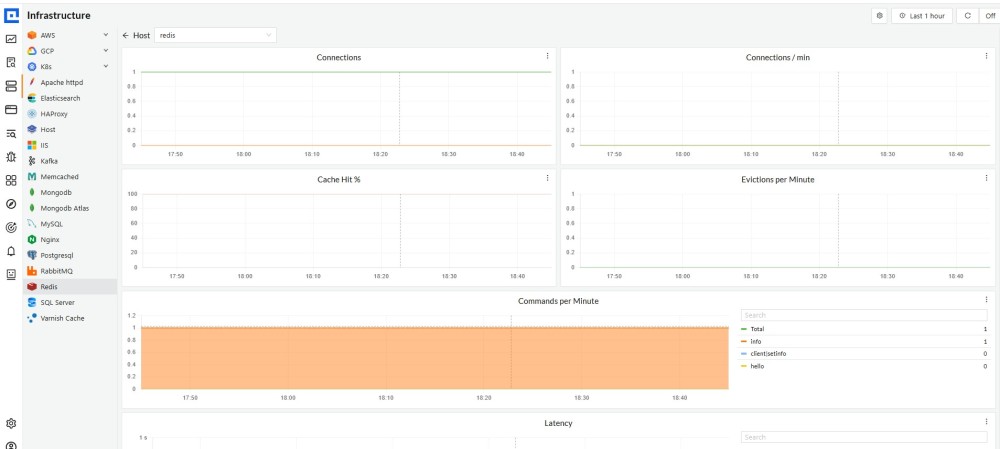
CubeAPM is a self-hosted, OpenTelemetry-native APM and infrastructure monitoring platform that supports Redis cluster monitoring alongside full application observability. It lists Redis as a supported infrastructure component alongside MySQL, Kafka, Elasticsearch, Nginx, and others.
Features
- Redis metrics collected via the OpenTelemetry Collector’s Redis receiver or redis_exporter; sample configurations available at CubeAPM’s sample infra monitoring repository
- Tracks memory utilization, eviction rates, cache hit ratio, latency, replication lag, and keyspace statistics across cluster nodes
- Correlates Redis performance metrics with application traces: connect a slow Redis command to the application trace that triggered it
- Full MELT observability (Metrics, Events, Logs, Traces) in a single platform; Redis metrics appear alongside APM data for your services
- Self-hosted inside your VPC; telemetry data never leaves your infrastructure
- Supports monitoring Redis on bare metal, VMs, Kubernetes, and Docker Compose environments
Pricing: $0.15/GB of data ingested. No per-host, per-node, per-container, or per-user fees. Redis cluster monitoring costs are determined purely by the volume of metrics and traces ingested, not by node count.
Limitations: CubeAPM requires self-hosting and infrastructure management. It is not open-source. Redis monitoring is part of its broader infrastructure monitoring capability; it does not have the depth of Redis-specific tooling that RedisInsight provides for interactive cluster browsing or key-level memory analysis.
Best for: Teams that want Redis cluster monitoring tightly correlated with APM traces and infrastructure metrics in a single self-hosted platform, with predictable ingestion-based pricing that does not scale with Redis cluster node count.
2. Prometheus redis_exporter + Grafana
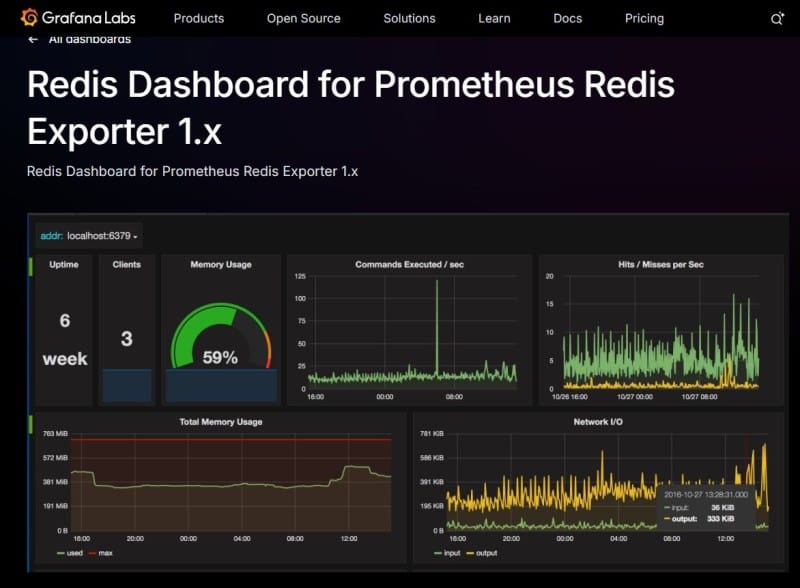
The most widely deployed open-source Redis monitoring stack is the prometheus/redis_exporter by oliver006 paired with Grafana dashboards. It is the community standard for Prometheus-based Redis metric collection.
Features
- Exposes all Redis INFO section metrics as Prometheus metrics on port 9121
- Supports Redis Cluster node auto-discovery via the /discover-cluster-nodes endpoint, usable directly in Prometheus http_sd_configs to automatically scrape all cluster nodes
- Supports Valkey 9.x, 8.x, and 7.x alongside Redis versions
- Supports Redis Sentinel metrics for failover monitoring
- Key-level memory analysis using server-side Lua scripts and SCAN cursors to prevent blocking Redis’s single-threaded execution
- TLS support, optional role label appending per node (primary/replica), and optional client list scraping
- Kubernetes deployment examples included in the README
Grafana Redis dashboards: Grafana provides out-of-the-box Redis monitoring through its Redis monitoring solution page. Multiple community Redis dashboards are available in the Grafana dashboard marketplace, including the Redis Dashboard for Prometheus redis_exporter 1.x, one of the most downloaded Redis dashboards, covering memory, CPU, latency, hit rate, connections, and keyspace metrics. The Grafana Redis Application plugin provides additional Redis-specific panels and CLI access within Grafana.
Pricing:
- redis_exporter: Free; MIT license
- Grafana self-hosted: Free; core components (Loki, Mimir, Tempo) are AGPLv3 licensed
- Grafana Cloud Free: $0; includes 10,000 active metric series, 50 GB logs and traces, 14-day retention
- Grafana Cloud Pro: $19/month platform fee, then $6.50/1,000 active metric series (13-month retention) and $0.50/GB for logs and traces (30-day retention)
Limitations: This stack requires assembling three components (redis_exporter, Prometheus, Grafana), managing retention and scaling for each, and building or importing dashboards. There is no built-in APM correlation between Redis performance and the application traces generating Redis commands. Alert configuration requires Grafana Alerting setup on top of Prometheus rules.
Best for: Teams already running Prometheus and Grafana who want to add Redis cluster visibility without a new vendor, and teams comfortable operating a multi-component observability stack.
3. RedisInsight
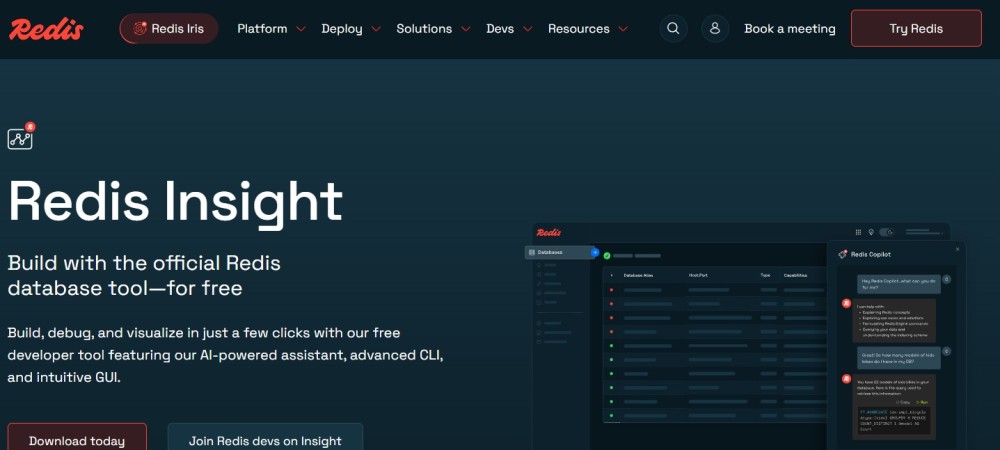
RedisInsight is the official free GUI tool for Redis, built and maintained by Redis Ltd. It is not a time-series metrics monitoring tool in the same sense as Prometheus, but it is the most capable tool for cluster topology visualization, interactive debugging, and memory analysis of Redis data structures.
Features
- Auto-discovery of databases in Redis Software Cluster and Redis Cloud Flexible plans
- Cluster topology browser: connect to any Redis Open Source cluster, Sentinel-managed deployment, or managed cloud Redis instance
- Azure Managed Redis support with Entra ID (OAuth) passwordless authentication, added in v3.2.0 (February 2026)
- Slow log analysis: view and filter slow commands across cluster nodes
- Memory analysis: identify large keys, memory usage per key pattern, and serialization overhead
- Profiler: live view of commands being executed against the connected Redis instance
- Workbench: interactive command editor with Redis command syntax hints and module support (JSON, Search, TimeSeries, and others)
- Data browsing and editing for all Redis data structures
- Available as a desktop application (Windows, macOS, Linux) and as a Docker image
The latest version as of June 2026 is v3.4.2 (April 2026), confirmed on the RedisInsight release notes page.
Pricing: Free. RedisInsight is free for all users with no plan restrictions. The source code is available on GitHub.
Limitations: RedisInsight is a GUI for exploration and debugging, not a time-series monitoring platform. It does not maintain historical metrics, does not send alerts, and does not integrate with incident management workflows. For ongoing cluster health monitoring and alerting, it complements but does not replace a metrics-based tool.
Best for: Redis developers and operators who want to browse cluster data, analyze memory usage, investigate slow logs, and run commands interactively, as a complement to a metrics-based monitoring stack.
4. Datadog
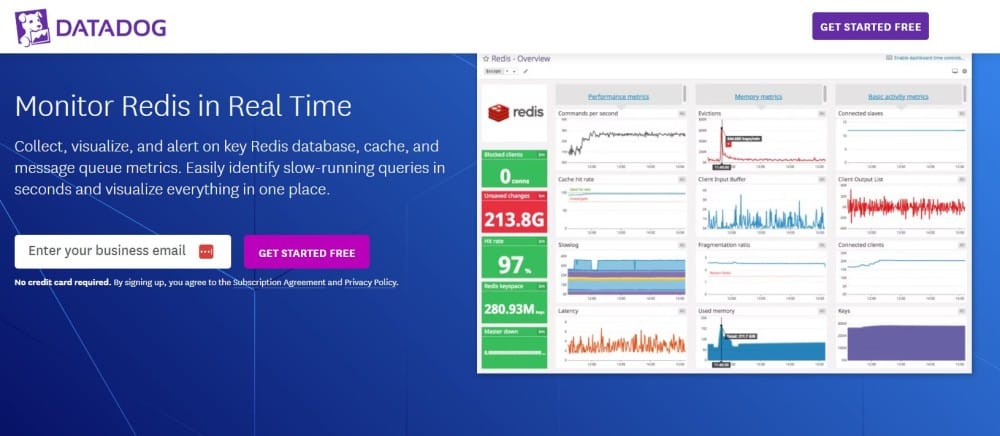
Datadog is the leading enterprise observability platform for Redis cluster monitoring, with first-party integrations for Redis OSS, Redis Enterprise, Redis Cloud, Redis Sentinel, and, as of May 2026, Azure Managed Redis.
Features
- Redis check included in the Datadog Agent package: no additional installation needed
- Out-of-the-box dashboards covering latency, memory utilization, cache hit rate, connected clients, eviction rate, and replication metrics
- Redis Enterprise integration (updated November 2024, replacing the deprecated legacy integration): exposes Enterprise-specific KPIs, including multi-tenancy, tiered storage, and active-active cluster replication metrics
- Cluster Top View dashboard for Redis Enterprise: visualizes per-database health across the full cluster
- Alert configuration: recommended alert at 80% memory threshold; alerting on ops/sec spikes, eviction events, and replication failures
- Redis Sentinel integration for failover state monitoring
- Log collection from Redis alongside metrics and APM traces for correlated troubleshooting
- Azure Managed Redis integration (May 2026): agentless monitoring via the Azure integration, with out-of-the-box dashboards and monitors
Pricing:
- Infrastructure Monitoring Pro: $15/host/month (annual). Redis monitoring is included as part of infrastructure monitoring with no additional per-integration cost.
- APM (standalone): $36/host/month (annual). APM Pro: $41/host/month. APM Enterprise: $47/host/month.
- Log ingestion and other products are priced separately; see Datadog’s pricing page for current rates.
Limitations: Datadog’s per-host pricing makes costs scale directly with Redis cluster node count. A Redis cluster with 20 nodes costs 20 host licenses for infrastructure monitoring. Datadog has no free self-hosted option; all monitoring requires data leaving your infrastructure to Datadog’s SaaS.
Best for: Enterprise teams that need a managed, zero-infrastructure Redis monitoring platform with the broadest coverage of Redis deployment types, including Redis Enterprise, Redis Cloud, and managed cloud variants.
5. Redis Software built-in monitoring
For teams running Redis Software (formerly Redis Enterprise Software), built-in monitoring is available directly through the Cluster Manager UI and REST API without any additional tooling.
Features
- Real-time metrics for clusters, nodes, databases, and shards from the Cluster Manager UI
- Alert configuration for node, cluster, and database events, including high memory usage, high throughput, and replication failures
- Prometheus scraping endpoint (v2, GA as of Redis Software 8.0) at https://<IP>:8070/v2 for integration with external monitoring tools including Grafana and Datadog
- Integration guides for Prometheus/Grafana and Datadog are available directly from redis.io
- Active-Active synchronization dashboard for monitoring geo-distributed cluster replication health
- Shard placement visibility and memory/performance dashboards per database
Pricing: Included with Redis Software licensing. Redis Software is a commercial product; pricing is not published and requires contacting Redis sales.
Limitations: Only applicable to Redis Software (self-managed enterprise Redis) and Redis Cloud deployments. Teams running open-source Redis or Valkey cannot use this built-in monitoring system.
Best for: Existing Redis Software customers who want cluster health visibility through the Cluster Manager UI with Prometheus export built in, and who use the v2 Prometheus endpoint to feed metrics into Grafana or Datadog.
Comparison table
| Tool | Type | Redis Cluster support | APM correlation | Self-hosted | Free tier | Pricing model |
| CubeAPM | Self-hosted APM + infra monitoring | Yes (via OTel Collector) | Yes | Yes | No | $0.15/GB ingested |
| Prometheus redis_exporter + Grafana | Open-source collector + visualization | Yes (node auto-discovery) | No | Yes | Yes (fully free) | Infrastructure costs only |
| RedisInsight | Official Redis GUI | Yes (cluster topology browser) | No | Yes (desktop app) | Yes (fully free) | Free |
| Datadog | Enterprise SaaS observability | Yes (OSS, Enterprise, Cloud, Sentinel, Azure) | Yes | No | No | $15/host/month (infra) |
| Redis Software built-in | Enterprise Redis native monitoring | Yes (RS clusters only) | No | Yes (RS only) | Included with RS license | Commercial (contact sales) |
Which Redis cluster monitoring tool should you choose?
- Choose CubeAPM if you want Redis cluster monitoring correlated with full application APM traces and infrastructure metrics in a single self-hosted platform, with pricing that scales on data volume rather than Redis node count.
- Choose Prometheus redis_exporter + Grafana if you are already running Prometheus and Grafana and want to add Redis cluster monitoring without a new vendor or agent. It is the most widely deployed open-source Redis monitoring stack and supports cluster node auto-discovery natively.
- Choose RedisInsight for interactive cluster exploration, slow log analysis, memory key inspection, and data browsing. It is free, officially maintained by Redis Ltd., and the most capable tool for debugging Redis data and commands directly. Use it alongside a metrics-based tool, not instead of one.
- Choose Datadog if your team needs managed, zero-infrastructure Redis monitoring across multiple Redis deployment types (OSS, Enterprise, Cloud, Sentinel, Azure) with deep correlation between Redis metrics, logs, and APM traces, and your organization is willing to pay for Datadog’s per-host pricing model.
- Choose Redis Software built-in monitoring if you are already a Redis Software customer and want cluster health visibility through the Cluster Manager UI with Prometheus export capability built in.
Summary
Redis cluster monitoring is not a single-tool problem. Most production teams end up using at least two: a time-series collection tool (Prometheus redis_exporter or a platform like Datadog or CubeAPM) for ongoing health monitoring and alerting, and RedisInsight for interactive debugging and cluster exploration. The right combination depends on whether you prefer managed SaaS or self-hosted infrastructure, whether you need Redis monitoring integrated with APM traces, and how your costs scale as cluster node count grows.
For teams that want Redis cluster metrics, application traces, and infrastructure health in one self-hosted platform without per-node pricing, CubeAPM provides OpenTelemetry-native full-stack monitoring at $0.15/GB ingested.
| Tool | Best for | Free | Self-hosted |
| CubeAPM | APM + Redis infra correlation, no per-node fees | No | Yes |
| Prometheus redis_exporter + Grafana | Prometheus-native teams, open-source stack | Yes | Yes |
| RedisInsight | Interactive cluster exploration and debugging | Yes | Yes (desktop) |
| Datadog | Enterprise managed monitoring, widest Redis type coverage | No | No |
| Redis Software built-in | Redis Software customers, Prometheus export built in | Included with RS | Yes (RS only) |
Disclaimer: Features and pricing are verified from official vendor documentation as of June 2026, including Redis’s observability docs, redis_exporter’s GitHub repository, Grafana’s Redis monitoring page and Grafana’s pricing page, Datadog’s Redis integration docs and Datadog’s pricing page, and CubeAPM’s infrastructure monitoring docs. Always verify current pricing and feature availability directly with each vendor before making purchasing decisions.
Also read:
9 Best Monitoring Tools for Cloud Databases in 2026
Best Security Monitoring Tools for Kubernetes Clusters in 2026
Best Cloud Security Monitoring Tools for Cloud Environments in 2026