



The main difference between SigNoz, Honeycomb, and CubeAPM lies in how each platform handles scale, cost control, and operational responsibility as observability data grows.
SigNoz and Honeycomb are both capable observability platforms, but their default retention periods are limited, and extending them increases costs as data volumes grow. CubeAPM provides comprehensive MELT observability with predictable pricing and unlimited retention, at approximately 55% lower cost than SigNoz and about 38% lower cost than Honeycomb.
In this article, we compare SigNoz vs Honeycomb vs CubeAPM across pricing models, data retention, and MELT observability.
SigNoz vs Honeycomb vs CubeAPM: Feature Comparison
| Features | CubeAPM | SigNoz | Honeycomb |
| Known for | Unified OpenTelemetry-native observability with predictable pricing | OpenTelemetry-first, open-source observability | High-cardinality, event-driven tracing |
| Multi-Agent Support | Yes (OTel, New Relic, Datadog, Elastic) | Limited (OTel) | Limited (OTel) |
| MELT Support | Full MELT | Full MELT | Full MELT |
| Setup | Self-hosted but vendor-managed | SaaS & Self-hosted | SaaS & Self-hosted |
| Pricing | Ingestion-based pricing of $0.15/GB | Logs: $0.3/GB Traces: $0.3/GB Metrics: $0.1/mil samples | Free: 20M event volume/month Pro: $130/month Enterprise: Custom |
| Sampling Strategy | Smart sampling | Head + Tail-based | Head + Tail-based |
| Log Retention | Infinite Retention | 15 days | 60 days |
| Support TAT | < 10 minutes | No details | 2hrs to 1 day |
SigNoz vs. Honeycomb vs. CubeAPM: A feature-by-feature breakdown
Known for
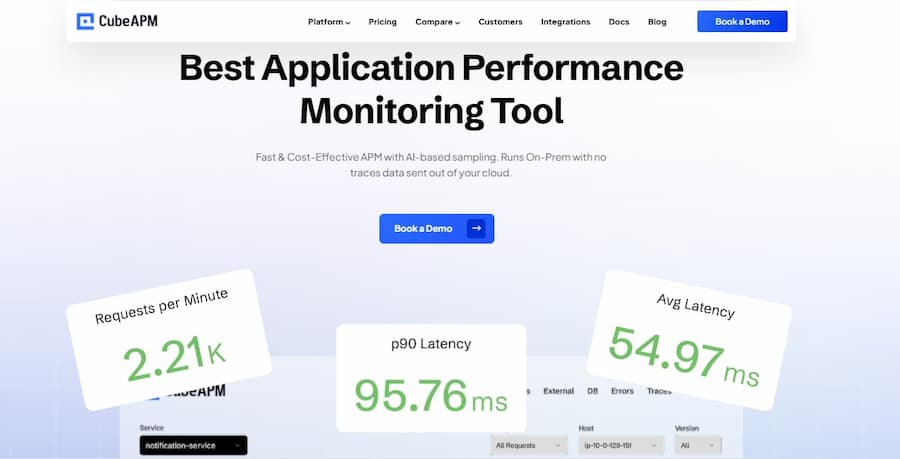
CubeAPM: Known for delivering complete MELT observability with predictable pricing and unlimited retention, while running inside the customer’s own cloud or on-prem environment. It is designed for teams that need full-stack visibility, strict data control, and cost predictability as telemetry scales.
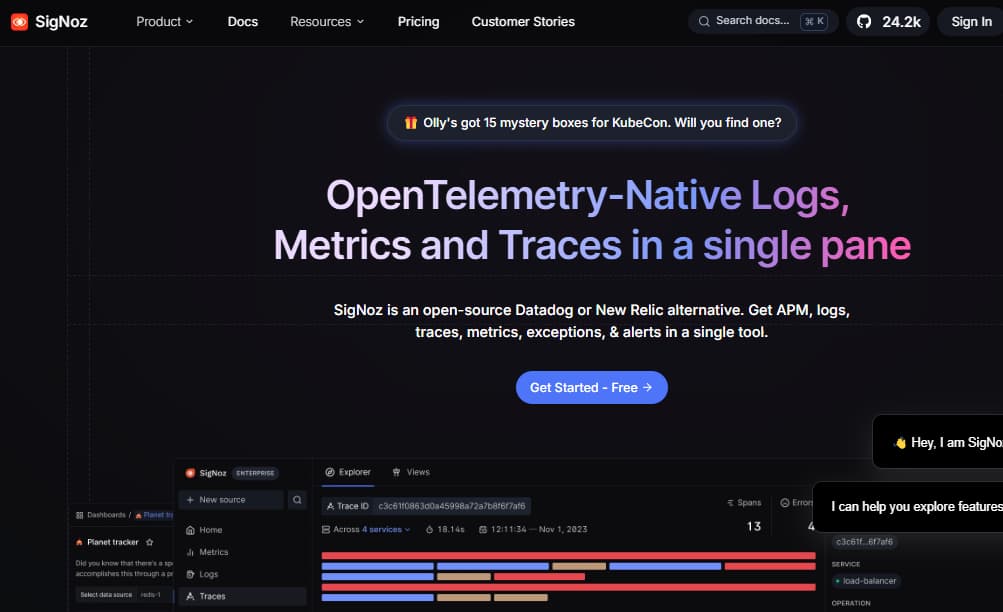
SigNoz: Known for its OpenTelemetry-native, open-source approach to observability. It provides logs, metrics, and traces on a unified backend and is commonly adopted by teams that want to build directly on OpenTelemetry and manage their observability stack.

Honeycomb: Known for event-driven observability with strong support for distributed tracing, metrics, logs, service maps, SLOs, and OpenTelemetry pipelines. It is often chosen by teams that value fast, exploratory debugging and high-cardinality analysis through a managed platform.
Multi-Agent Support
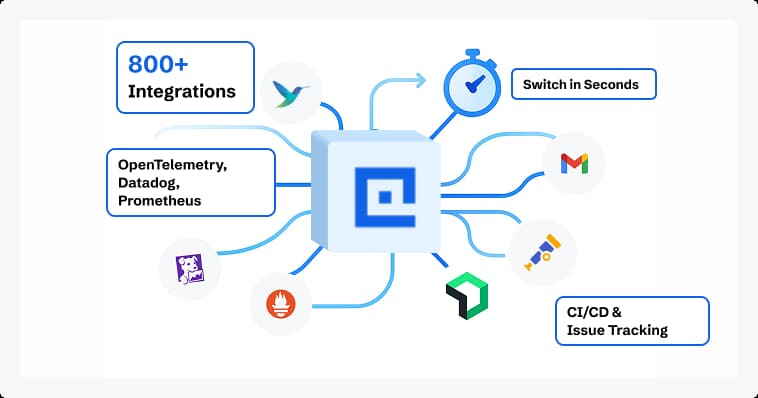
CubeAPM: Designed to ingest telemetry from multiple agent ecosystems at the same time, including OpenTelemetry, Prometheus-based exporters, and agents from Datadog, New Relic, and Elastic. This lets teams transition gradually instead of re-instrumenting applications.
SigNoz: Primarily built around OpenTelemetry for instrumentation and ingestion. Based on publicly available documentation, SigNoz emphasizes OpenTelemetry SDKs and collectors as the standard way to send telemetry into the platform.
Honeycomb: Centres its ingestion model on OpenTelemetry, along with its own SDKs and event formats. Public documentation focuses on OpenTelemetry-based pipelines rather than native ingestion from third-party vendor agents.
MELT Coverage (Metrics, Events, Logs, Traces)
CubeAPM: Provides full MELT observability by unifying metrics, events, logs, and traces within a single platform. All signals are designed to work together, allowing teams to correlate infrastructure behavior, application performance, and distributed traces during troubleshooting and performance analysis.
SigNoz: Supports full MELT observability through its OpenTelemetry-native architecture. Metrics, logs, and traces are collected and analyzed using a common OpenTelemetry pipeline, giving teams end-to-end visibility across services and infrastructure.
Honeycomb: Supports full MELT observability with metrics, logs, and traces ingested via OpenTelemetry-based instrumentation. This enables teams to observe distributed systems holistically while using a consistent telemetry standard across their environments.
Deployment Option
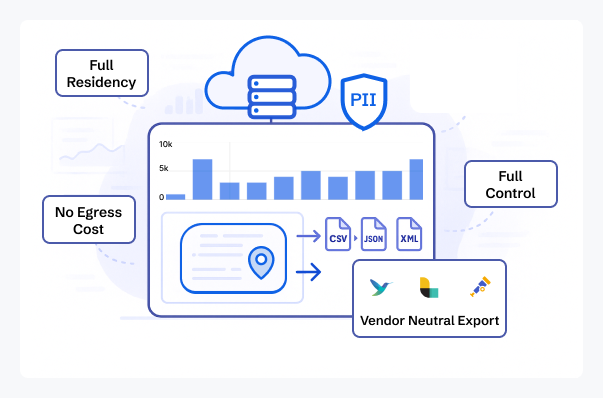
CubeAPM: Deployed inside the customer’s own cloud or on-prem environment using a self-hosted or BYOC model, while being managed by the vendor. This allows teams to retain full control over data placement without taking on the day-to-day operational burden typically associated with running observability infrastructure at scale.
SigNoz: Supports both SaaS and self-hosted deployment options. The self-hosted setup provides full data control, but it relies on ClickHouse as the storage backend, which requires provisioning, scaling, and ongoing tuning for performance and reliability in production environments. This introduces additional operational responsibility for teams running the self-hosted option at scale.
Honeycomb: Offers a managed SaaS deployment as well as a private cloud option. In private cloud or self-managed setups, customers are responsible for provisioning infrastructure, managing upgrades, and handling scaling and operational tasks, while Honeycomb provides the software and platform components.
Pricing: Approximate Cost for Small, Mid-Sized & Large Teams
*All pricing comparisons are calculated using standardized Small/Medium/Large team profiles defined in our internal benchmarking sheet, based on fixed log, metrics, trace, and retention assumptions. Actual pricing may vary by usage, region, and plan structure. Please confirm current pricing with each vendor.
*An APM host is a host that is actively generating trace data, and an Infra host is any physical or virtual OS instance that you monitor with any observability tool.
Below is a cost comparison for small, mid-sized, and large teams.
| Approx. Cost for Teams | Small(~30 APM Hosts) | Mid-sized (~125 APM Hosts) | Large(~250 APM Hosts) |
| CubeAPM | $2,080 | $7,200 | $15,200 |
| SigNoz | $4,600 | $16,000 | $34,000 |
| Honeycomb | $3,900 | $11,600 | $24,200 |
Teams switching to CubeAPM save roughly 55% compared to SigNoz and about 38% compared to Honeycomb for mid-sized environments.
CubeAPM: Cost for Small, Medium, and Large Teams
CubeAPM uses a simple, predictable ingestion-based pricing model with no user-based, host-based, or feature-based charges.
Pricing details:
- Ingestion pricing of $0.15 per GB
Based on comparable production workloads, the approximate monthly costs are:
- Small teams (~30 APM hosts): $2,080
- Mid-sized teams (~125 APM hosts): $7,200
- Large teams (~250 APM hosts): $15,200
Because CubeAPM supports self-hosted and BYOC deployment, all telemetry remains inside the customer’s cloud, enabling predictable cost scaling without additional charges for retention.
SigNoz: Cost for Small, Medium, and Large Teams
SigNoz follows a usage-based pricing model, with costs driven by data ingestion.
Pricing details:
- Logs: $0.3/GB
- Traces: $0.3/GB
- Metrics: $0.1/mil samples
Based on comparable production workloads, the approximate monthly costs are:
- Small teams (~30 APM hosts): $4,600
- Mid-sized teams (~125 APM hosts): $16,000
- Large teams (~250 APM hosts): $34,000
As telemetry volume grows or retention is extended, overall spend increases accordingly.
Honeycomb: Cost for Small, Medium, and Large Teams
Honeycomb uses a usage-based pricing model primarily driven by event volume and data retention.
Pricing details:
- Free: 20M event volume/month
- Pro: $130/month
- Enterprise: Custom
Based on comparable production workloads, the approximate monthly costs are:
- Small teams (~30 APM hosts): $3,900
- Mid-sized teams (~125 APM hosts): $11,600
- Large teams (~250 APM hosts): $24,200
As teams retain more data or analyze higher event volumes over time, monthly costs scale accordingly.
Sampling Strategy
CubeAPM: Supports smart, context-aware sampling designed to reduce telemetry volume without losing critical signals. Sampling decisions prioritize errors, anomalies, and high-latency traces automatically, helping teams control costs while maintaining full observability across metrics, logs, events, and traces.
SigNoz: Supports both head-based and tail-based sampling using OpenTelemetry-compatible configurations. Teams can apply head-based sampling at the application level using probabilistic samplers or configure tail-based sampling at the collector level to retain traces based on latency, errors, attributes, or custom rules.
Honeycomb: Supports both head-based and tail-based sampling. Head-based sampling is typically applied using deterministic or probabilistic methods early in the trace lifecycle, while tail-based sampling is handled through Honeycomb Refinery. Refinery enables dynamic, rules-based, and throughput-aware sampling, allowing teams to make sampling decisions after traces are complete and better preserve important events.
Data Retention

CubeAPM: Offers unlimited retention for metrics, logs, events, and traces without additional pricing tiers. This enables teams to preserve historical telemetry for long-term analysis, trend detection, capacity planning, and compliance reporting without incurring higher storage costs.
SigNoz: Applies limited default retention, with logs retained for 15 days, traces kept for up to 30 days, and metrics stored for about one month. Extending these windows increases costs, since higher retention settings raise per-GB ingestion pricing. For example, increasing log retention from 15 days to 30 days can raise pricing from roughly $0.3/GB to about $0.4/GB, significantly increasing spend as data volumes scale.
Honeycomb: Provides a 60-day retention window for telemetry data on its plans, meaning raw data ages out after this period. While users can work around this with custom archiving solutions using external storage (for example, exporting to S3 via OpenTelemetry pipelines for longer-term storage), raw telemetry data in the platform itself is typically not retained beyond the 60-day window.
Support Channel and TAT
CubeAPM: Provides support through email, Slack, and WhatsApp, with response times typically under 10 minutes for active support channels, helping teams resolve production issues quickly.
SigNoz: Offers support via email, Slack, and GitHub. There is no publicly documented SLA or guaranteed turnaround time, and response times can vary depending on the support channel and plan.
Honeycomb: Provides tiered support with defined response targets. For critical issues, the lowest target response time is 1 hour, while non-critical requests can have response times of up to 2 business days, depending on the support plan.
Which Tool Is Best for You? Why Brands Choose CubeAPM
Benefits of Choosing CubeAPM
- Full Data Sovereignty: All telemetry remains within your cloud, helping teams meet data residency and compliance requirements.
- Unified MELT Visibility: Metrics, events, logs, and traces are available in one platform, reducing context switching during troubleshooting.
- Predictable Pricing: A single ingestion-based pricing of $0.15/GB model keeps observability costs stable as data volume increases.
- Unlimited Retention: Historical telemetry can be retained long term without retention becoming a separate cost driver.
- Smart Sampling Efficiency: Sampling reduces data volume while preserving critical signals such as errors and latency spikes.
- Multi-agent Compatibility: Supports multiple agent ecosystems, allowing teams to migrate without re-instrumenting existing services.
- API access: All observability data is accessible through APIs without additional charges.
- Real-Time Support: Slack and WhatsApp access provides fast responses for production issues.
SigNoz vs Honeycomb vs CubeAPM: Use Cases
Choose CubeAPM if:
- You need full MELT observability across applications, infrastructure, and microservices in one platform
- You want predictable costs as telemetry scales, without pricing tied to users, hosts, or retention extensions
- You are migrating from existing APM tools and want to reuse current instrumentation across multiple agent ecosystems
- You run production-critical workloads and need fast, real-time support to reduce MTTR
Choose SigNoz if:
- You want an OpenTelemetry-native observability platform built on open standards
- You are comfortable standardizing fully on OpenTelemetry for instrumentation and ingestion
- You prefer the option to self-host and manage the observability backend yourself
Choose Honeycomb if:
- You focus on high-cardinality tracing and event-driven debugging for distributed systems
- You want strong support for OpenTelemetry pipelines and modern tracing workflows
- You prioritize deep trace analysis and fast debugging over long-term data retention
Disclaimer: The information in this article reflects the latest details available at the time of publication and may change as technologies and products evolve.
Conclusion
SigNoz and Honeycomb are strong observability tools for OpenTelemetry-native and tracing-focused teams. CubeAPM stands out by combining full MELT observability, predictable pricing, unlimited retention, and self-hosted or BYOC deployment, making it the most practical choice for teams running production workloads at scale.
FAQs
1. What is the main difference between SigNoz, Honeycomb, and CubeAPM?
The main difference is how each platform approaches deployment, pricing, and long-term scalability. SigNoz emphasizes an OpenTelemetry-native, open-source model; Honeycomb focuses on event-driven observability and tracing workflows; and CubeAPM delivers full MELT observability with predictable pricing and flexible self-hosted or BYOC deployment.
2. Do SigNoz, Honeycomb, and CubeAPM all support OpenTelemetry?
Yes, all three platforms support OpenTelemetry for collecting metrics, logs, and traces, making them suitable for teams adopting open observability standards.
3. Which tool is easier to migrate to from an existing APM setup?
CubeAPM is easier to migrate to because it supports multiple agent ecosystems, allowing teams to transition incrementally without rewriting existing instrumentation. SigNoz and Honeycomb are better suited for teams starting fresh with OpenTelemetry.
4. Which platform is better for long-term troubleshooting and historical analysis?
CubeAPM is better suited for long-term analysis because it supports unlimited retention without forcing teams to delete older data. SigNoz and Honeycomb typically require managing or extending retention as data grows.
5. Which platform is better for long-term observability at scale?
CubeAPM is better suited for long-term observability at scale due to its unified MELT coverage, predictable pricing model, and ability to retain data without forcing trade-offs as telemetry volume grows.