









The main difference between SigNoz, Dynatrace, and CubeAPM is how each platform balances observability depth, operational overhead, and cost as systems scale.
SigNoz and Dynatrace are both strong observability platforms. At scale, Dynatrace’s host-based pricing increases costs, while SigNoz requires teams to manage the ClickHouse backend, adding a layer of complexity. CubeAPM addresses both with full MELT observability, predictable pricing, and a self-hosted, vendor-managed model.
In this article, we compare SigNoz vs Dynatrace vs CubeAPM across pricing, deployment, and observability capabilities.
SigNoz vs Dynatrace vs CubeAPM: Comparison Table
| Features | CubeAPM | SigNoz | Dynatrace |
| Known for | Unified OpenTelemetry-native with predictable pricing | OpenTelemetry-native observability with SaaS and self-hosted options | Enterprise-grade automated observability |
| Multi-Agent Support | Yes (OTel, New Relic, Datadog, Elastic) | Partial (OTel) | Partial (OTel) |
| MELT Support | Full MELT | Full MELT | Full MELT |
| Setup | Self-hosted but vendor-managed | SaaS & Self-hosted | SaaS & Self-hosted |
| Pricing | Ingestion-based pricing of $0.15/GB | Logs:$0.3/GB Traces: $0.3/GB Metrics: $0.1/mil samples | Full-Stack: $58/mo/ 8 GiB host* |
| Sampling Strategy | Smart sampling | Head + Tail-based | Head + Tail + Partial trace sampling |
| Log Retention | Infinite Retention | 15 days | 35 days |
| Support TAT | < 10 minutes | No details | 30 minutes to 4 days |
SigNoz vs Dynatrace vs CubeAPM: Feature-by-Feature Breakdown
Known For
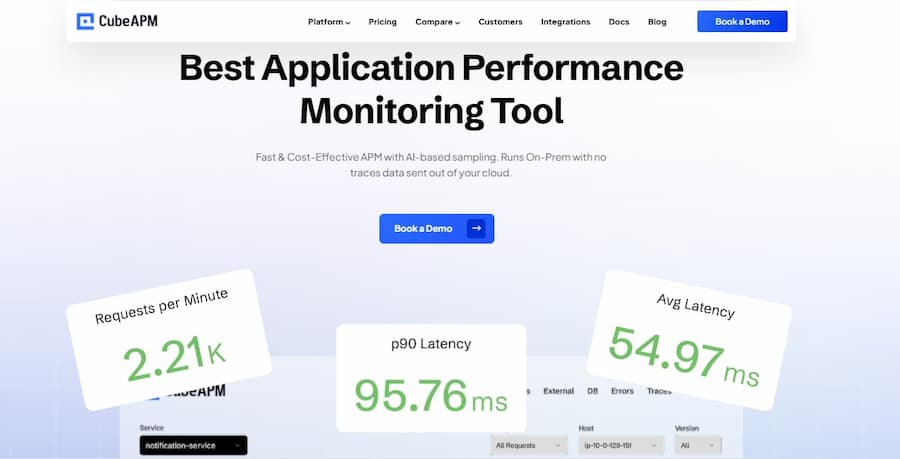
CubeAPM: Known for OpenTelemetry-native full-stack observability with a self-hosted, vendor-managed deployment model. It combines unified MELT visibility, predictable ingestion-based pricing, unlimited retention, and robust data residency control for teams that want to scale without incurring operational burdens.
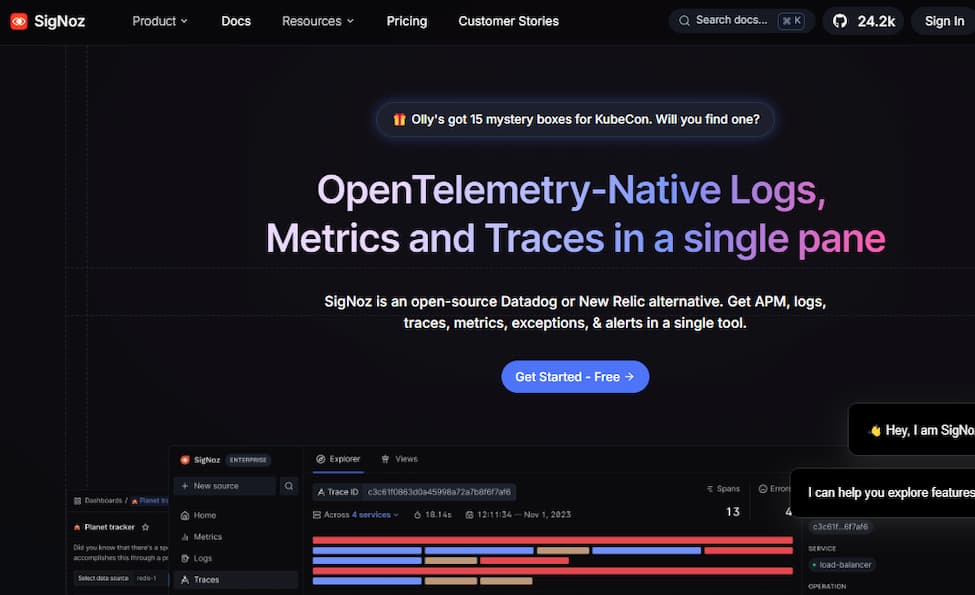
SigNoz: known for its OpenTelemetry-native, open-source observability platform. It offers strong support for traces, metrics, and logs, making it a popular choice for teams adopting OpenTelemetry-first instrumentation.
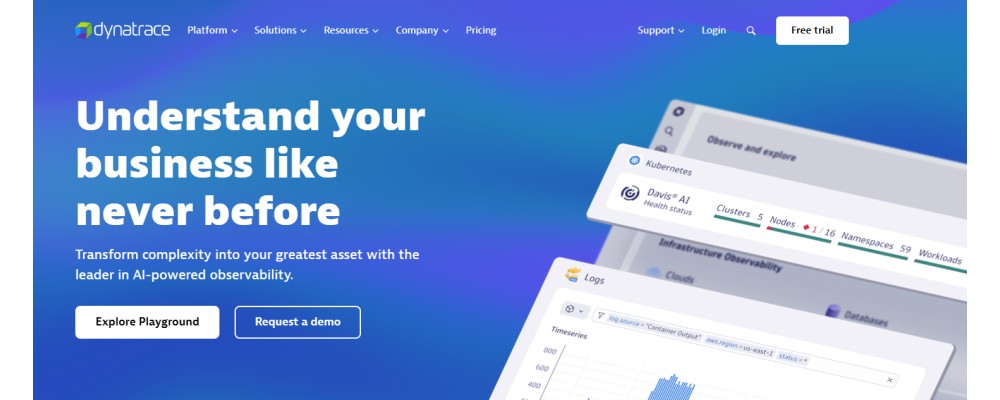
Dynatrace: Enterprise-grade observability with advanced automation and AI-driven insights. It delivers deep visibility across applications and infrastructure through a fully managed SaaS platform and a self-hosted option.
Multi-Agent Support
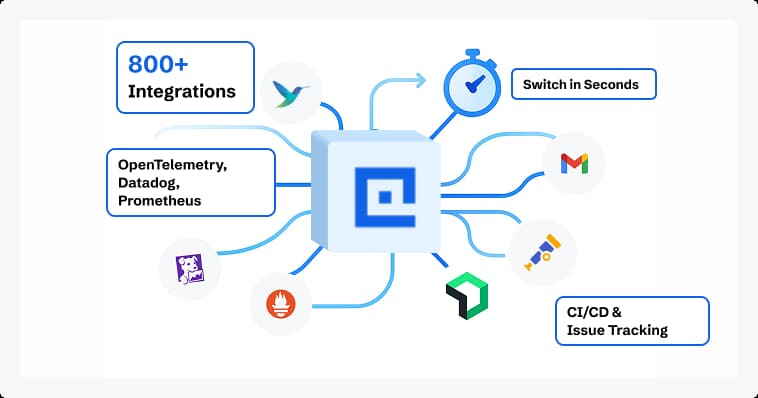
CubeAPM: Provides proper multi-agent support, allowing teams to ingest telemetry from OpenTelemetry as well as existing agents from Datadog, New Relic, and Elastic. This makes CubeAPM well-suited for mixed environments and gradual migrations without requiring re-instrumentation of workloads.
SigNoz: Supports OpenTelemetry-based instrumentation and ingestion using OpenTelemetry collectors and language SDKs. It is designed around the OpenTelemetry ecosystem, making it a strong fit for teams standardizing entirely on OTel pipelines.
Dynatrace: Provides native support for ingesting OpenTelemetry data alongside its proprietary OneAgent, allowing teams to use standard OpenTelemetry SDKs and collector pipelines directly with the Dynatrace platform.
MELT Coverage (Metrics, Events, Logs, Traces)
CubeAPM: Provides full MELT observability by unifying metrics, events, logs, and traces in a single OpenTelemetry-native backend. All signals are correlated by default, enabling end-to-end visibility across applications, infrastructure, and distributed services without requiring multiple tools.
SigNoz: Supports MELT observability using OpenTelemetry collectors to ingest metrics, logs, and traces. These signals can be explored together within the SigNoz platform, making it suitable for teams adopting an OpenTelemetry-first observability approach.
Dynatrace: Supports full MELT observability across applications and infrastructure using its proprietary data model and OneAgent. Metrics, logs, traces, and events are correlated within the platform, with OpenTelemetry data supported as an ingestion supported.
Deployment Model
CubeAPM: Deployed inside the customer’s own cloud or on-prem environment and is fully vendor-managed. This gives teams full data control and compliance benefits without the day-to-day operational burden of running observability infrastructure.
SigNoz: Supports both SaaS and Self-hosted options. In self-hosted setups, teams are responsible for operating and scaling the ClickHouse backend, including storage management, upgrades, and performance tuning.
Dynatrace: Offers both SaaS and a self-hosted option through Dynatrace Managed, allowing organizations to run the platform within their own infrastructure if needed. This provides greater control over data residency while still benefiting from Dynatrace’s monitoring and analytics capabilities.
Pricing: Approximate Cost for Small, Mid-Sized & Large Teams
*All pricing comparisons are calculated using standardized Small/Medium/Large team profiles defined in our internal benchmarking sheet, based on fixed log, metrics, trace, and retention assumptions. Actual pricing may vary by usage, region, and plan structure. Please confirm current pricing with each vendor.
*An APM host is a host that is actively generating trace data, and an Infra host is any physical or virtual OS instance that you monitor with any observability tool.
Below is a cost comparison for small, mid-sized, and large teams.
| Approx. Cost for Teams | Small(~30 APM Hosts) | Mid-sized (~125 APM Hosts) | Large(~250 APM Hosts) |
| CubeAPM | $2,080 | $7,200 | $15,200 |
| SigNoz | $4,600 | $16,000 | $34,000 |
| Dynatrace | $7,740 | $21,850 | $46,000 |
Across small, mid-sized, and large teams, CubeAPM delivers approximately 55% lower costs than SigNoz and 67–73% lower costs than Dynatrace, based on standardized team benchmarks.
CubeAPM: Cost for Small, Medium, and Large Teams
CubeAPM follows a single ingestion-based pricing model that stays consistent across logs, metrics, and traces.
Pricing reference:
- Telemetry ingestion: $0.15 per GB
Using standardized production workload assumptions, estimated monthly costs break down as:
- Small teams (~30 APM hosts): $2,080
- Mid-sized teams (~125 APM hosts): $7,200
- Large teams (~250 APM hosts): $15,200
Because CubeAPM runs inside the customer’s own cloud through self-hosted or BYOC deployments, telemetry data never leaves the environment. This avoids SaaS data transfer charges and supports predictable cost scaling over time.
SigNoz: Cost for Small, Medium, and Large Teams
SigNoz uses usage-based pricing, with separate charges for logs, traces, and metrics. Each telemetry type has default retention limits, and overall costs scale with ingestion volume and retention settings.
Pricing by telemetry type:
- Logs: $0.30 per GB ingested, 15 days retention
- Traces: $0.30 per GB ingested, 15 days retention
- Metrics: $0.10 per million samples, 1 month retention
- Platform fee starts at $49 per month.
Based on comparable production workloads and team sizes, the approximate monthly costs are:
- Small teams (~30 APM hosts): $4,600
- Mid-sized teams (~125 APM hosts): $16,000
- Large teams (~250 APM hosts): $34,000
Costs generally increase as telemetry ingestion grows and retention is extended.
Dynatrace: Cost for Small, Medium, and Large Teams
Dynatrace uses host-based pricing, with different rates depending on the level of monitoring enabled. Pricing scales based on the number of monitored hosts and the selected monitoring tier.
Pricing by monitoring type:
- FoundatDiscoverycovery: $7 per host per month
- Infrastructure Monitoring: $29 per host per month
- Full-Stack Monitoring: $58 per host per month (per 8 GiB host)
Based on comparable production workloads and team sizes, the approximate monthly costs are:
- Small teams (~30 APM hosts): $7,740
- Mid-sized teams (~125 APM hosts): $21,850
- Large teams (~250 APM hosts): $46,000
As host counts and monitored workloads increase, Dynatrace costs generally scale in proportion to infrastructure growth, which increases cost as usage grows.
Sampling Strategy
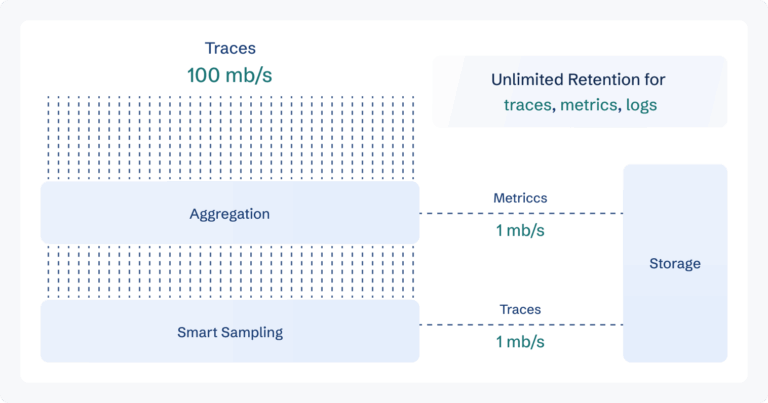
CubeAPM: Uses smart, context-aware sampling to reduce telemetry volume while preserving high-value data. The platform automatically prioritizes important signals such as errors, high-latency traces, and anomalous behavior, helping teams control ingestion costs without losing critical visibility.
SigNoz: Supports both head-based and tail-based sampling through OpenTelemetry collectors. Sampling rules are configured at the collector level, giving teams flexibility to decide which traces are retained as traffic scales.
Dynatrace: Supports head-based sampling, tail-based sampling, and partial trace sampling. Partial trace sampling allows Dynatrace to retain only the most relevant portions of a trace, reducing data volume while preserving diagnostic value, with sampling decisions applied within its proprietary telemetry pipeline.
Data Retention
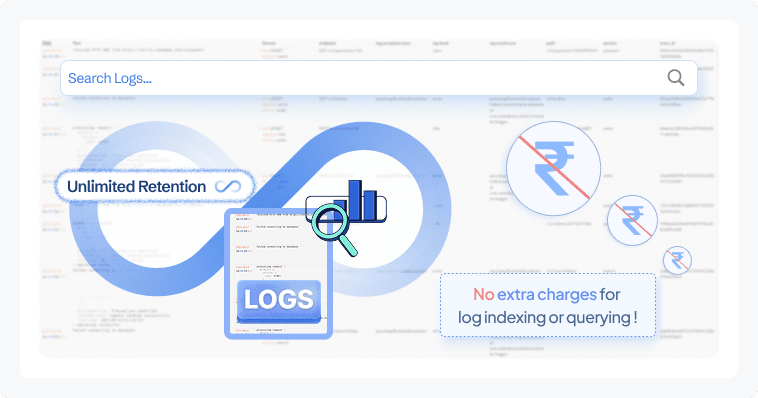
CubeAPM: Supports unlimited data retention, with all telemetry stored inside the customer’s own cloud or on-prem environment. Retention is not tied to pricing tiers, allowing teams to keep historical logs, metrics, and traces for long-term analysis without additional platform charges.
SigNoz: Retention is capped by default. Log data is kept for roughly 15 days, traces for up to 30 days, and metrics for about one month. When teams extend these limits, costs increase accordingly. For example, increasing log retention to 30 days raises ingestion pricing from about $0.30 per GB to roughly $0.40 per GB, which can significantly drive up costs as data volumes grow.
Dynatrace: Retention varies by data type. Classic distributed traces are stored for 10 days, while many service, RUM, and session metrics are available for 35 days. Log retention in the Grail data lake can be configured from short windows up to long-term retention based on bucket settings, and metrics powered by Grail can be retained for around 15 months.
Support Channels & Response Time (TAT)
CubeAPM: Provides direct access to support through Slack, email, and WhatsApp. Based on internal support operations, typical response times are under 10 minutes, making it suitable for teams running production and business-critical workloads.
SigNoz: Offers support through Slack, email, and GitHub for the open-source edition. While these channels are publicly documented, SigNoz does not publish official response-time guarantees.
Dynatrace: Provides support through Slack and email, with response times defined by severity level. According to Dynatrace’s published support policy, critical issues typically receive an initial response within 30 minutes, while lower-severity cases may have response times of up to 2 business days.
SigNoz vs Dynatrace vs CubeAPM: Which Tool Is Best for You?
Teams evaluating observability platforms often look for a balance between visibility, control, and cost. CubeAPM is frequently chosen because it removes common trade-offs teams face as telemetry volume and system complexity grow.
Why Teams Choose CubeAPM
- Predictable cost structure: CubeAPM follows a single ingestion-based pricing model, charged per GB of data ingested. There are no additional fees tied to users, hosts, or feature tiers, which makes it easier for teams to plan and scale observability spend over time.
- Intelligent data reduction: The platform applies real-time, context-aware sampling that emphasizes high-impact signals such as errors, slow requests, and anomalies.
- Unified visibility across signals: Metrics, events, logs, and traces are analyzed together in one correlated view. This unified approach reduces context switching and helps teams move from detection to root cause faster.
- Flexible, long-term retention: Observability data can be retained as long as required using customer-managed storage.
- Multi-Agent Support: CubeAPM works with widely used agents and standards, including OpenTelemetry, Prometheus, Datadog, New Relic, and Elastic. This makes migrations simpler and avoids the need to re-instrument applications.
- API Access: All collected data is accessible through open APIs, allowing teams to query, export, and integrate observability data into other tools and workflows without feature restrictions.
SigNoz vs Dynatrace vs CubeAPM: Use Cases
Choose CubeAPM if
- You need full MELT observability in a single, correlated platform.
- You want predictable ingestion-based pricing that scales with data volume, not hosts or users.
- You require strict data residency with telemetry stored in your own cloud or on-prem environment.
- You want self-hosted observability without managing infrastructure or day-2 operations.
- You need long-term or unlimited data retention for audits and historical analysis.
Choose SigNoz if
- You prefer an OpenTelemetry-native, open-source observability platform.
- You are comfortable running and scaling the backend components yourself.
- You want flexibility to customize observability pipelines and storage.
- You are adopting OpenTelemetry across services from the start.
- You prioritize transparency and control over tooling internals.
Choose Dynatrace if
- You need enterprise-grade observability with advanced automation and AI-driven insights.
- You want a largely hands-off, managed observability experience.
- You operate large environments where autoDiscoverycovery is critical.
- You prefer integrated monitoring across applications and infrastructure.
- You are comfortable with host-based pricing and tiered plans.
Conclusion
SigNoz and Dynatrace are strong observability platforms, each suited to different use cases. SigNoz favors OpenTelemetry-first teams comfortable managing their own backend, while Dynatrace focuses on enterprise automation with host-based pricing.
CubeAPM combines full MELT observability, predictable ingestion-based pricing, and self-hosted deployment without operational overhead, making it a practical choice for teams that want scale, control, and cost clarity.
Disclaimer: The information in this article reflects the latest details available at the time of publication and may change as technologies and products evolve.
FAQs
1. How does CubeAPM reduce observability costs at scale?
CubeAPM uses a single ingestion-based pricing model and smart sampling, helping teams cut observability spend significantly compared to host-based or multi-tier pricing models.
2. Why do teams switch from Dynatrace to CubeAPM?
Teams move from Dynatrace to CubeAPM to gain clearer cost predictability as environments scale. CubeAPM’s ingestion-based pricing avoids the rapid cost growth that can come with host-based models in large or dynamic systems.
3. Which platform between SigNoz, Dynatrace, and CubeAPM is easier to scale?
CubeAPM is easier to scale because pricing is tied to data ingestion rather than hosts. SigNoz and Dynatrace both scale observability differently, but teams often find CubeAPM simpler to forecast and manage as data volume increases.
4. Does CubeAPM offer the same depth of observability as SigNoz and Dynatrace?
Yes. CubeAPM provides full MELT observability, covering metrics, events, logs, and traces in a single, correlated platform, with a simpler pricing model.
5. Is CubeAPM a good alternative for teams outgrowing SigNoz or Dynatrace?
Yes. CubeAPM is commonly adopted by teams that have outgrown SigNoz’s self-managed setup or Dynatrace’s cost structure and want a more balanced approach to full-stack observability at scale.