






SigLens positioned itself as a 100x more efficient alternative to Splunk with a promise of single binary simplicity, full OpenTelemetry support, and the ability to process 8 TB per day on a laptop. In January 2026, the project was officially archived. The GitHub repository remains available in read-only mode under Apache 2.0, and the codebase can still be forked or self-hosted by teams willing to maintain it independently. According to the CNCF 2024 Annual Survey, 87% of organizations now use logs as a primary observability signal, but most struggle with storage costs and query performance at scale. SigLens addressed both problems with aggressive columnar compression and a microservice reference architecture for distributed tracing and metrics.
This guide covers SigLens pricing, core features, licensing, deployment, and what the archival means for teams evaluating it today. We also compare SigLens to active alternatives like CubeAPM, OpenObserve, Grafana Loki, and Splunk.
What Is SigLens?
SigLens was an open-source observability database built from the ground up to handle logs, metrics, and traces in a single binary with zero external dependencies. It ingested data via OpenTelemetry, Elastic, Splunk HEC, Loki, FluentD, FluentBit, and Logstash. Queries ran in Splunk SPL or SQL. The architecture prioritized storage efficiency through columnar compression, claimed to deliver 100x better efficiency than Splunk and 1025x faster search than Elasticsearch in benchmark tests published by the SigLens team.
The project targeted platform teams frustrated by Splunk licensing costs, Elasticsearch cluster maintenance overhead, or Grafana Loki query latency. SigLens required no cluster coordination, no Kafka dependency, and no separate time series database. Everything ran in one binary that scaled from laptop testing to petabyte-scale deployments.
Archival status: As of January 2026, SigLens is no longer actively maintained. The repository is archived, and the license was changed to Apache 2.0 to enable forks. Teams can still deploy SigLens from the archived codebase, but there will be no official updates, bug fixes, or support from the original maintainers.
SigLens Pricing Model
SigLens itself had no licensing fees. The software was open source and free to use. The total cost of ownership came entirely from infrastructure: compute, storage, and network transfer to run the SigLens binary on your own servers or cloud instances.
Infrastructure cost breakdown for self-hosted deployment:
For a production-ready setup ingesting 10 TB per day with 30-day retention and 3-node high availability, estimated infrastructure costs on AWS were approximately $2,800 to $3,500 per month. This assumes EC2 instances (c6i.2xlarge or similar), EBS storage with IOPS provisioning, and cross-availability-zone data transfer. Actual costs vary by region, instance family, and storage tier.
Managed SigLens via Elestio:
Elestio offered fully managed SigLens starting at $11 per month for small workloads. Production-scale deployments with automated backups, SSL, monitoring, and updates ranged from $150 to $800 per month depending on ingestion volume and retention. Elestio handled installation, patching, and Day 2 operations. As of April 2026, Elestio still lists SigLens as available, but support may be limited given the archival.
Pricing based on publicly available information as of April 2026. Enterprise discounts and custom contracts are not reflected here.
SigLens Features and Capabilities
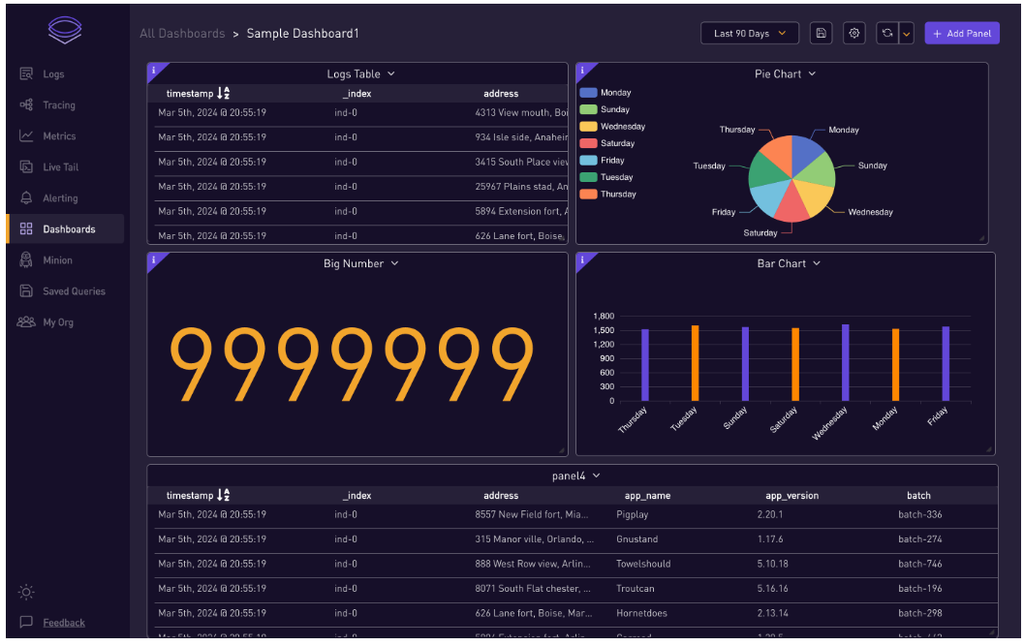
SigLens delivered a focused observability stack covering logs, metrics, and distributed traces with no external dependencies.
Core features:
- Multi-protocol ingestion: Native support for OpenTelemetry, Elastic Bulk API, Splunk HEC, Loki, Prometheus remote write, FluentD, FluentBit, Logstash, and S3/SQS/SNS event sources
- Dual query languages: SPL (Splunk Processing Language) for log search and SQL for structured queries over metrics and traces
- Single binary deployment: No cluster coordinator, no Kafka, no separate TSDB; one binary handled all signal types
- Columnar storage with aggressive compression: SigLens used a proprietary columnar format optimized for log data with typical compression ratios of 10:1 to 30:1
- High cardinality support: Full-text search with wildcard and regex, field extraction from log lines, and derived fields usable in later pipeline stages
- Distributed tracing: Native OpenTelemetry trace ingestion with service graphs, span search, and trace-to-log correlation
- Alerting and dashboards: Built-in alerting on any query result, webhook integrations, and Grafana-compatible visualization layer
What SigLens did not include:
- Real user monitoring (RUM)
- Synthetic monitoring
- Infrastructure metrics collector; required external agents like Prometheus Node Exporter or OTEL Collector
- Anomaly detection or AIOps features
- Multi-tenancy or role-based access control in the open source version
SigLens vs. Splunk: Benchmark Claims
The SigLens team published benchmark results claiming substantial performance and cost advantages over Splunk. In a 24-hour test ingesting 1 PB of data, SigLens required 32 EC2 instances compared to an estimated 3,000 instances for Splunk, Elasticsearch, or Grafana Loki under equivalent load. Search queries on indexed data completed in under 2 seconds for datasets up to 100 TB.
Benchmark context: These figures came from the SigLens team and were not independently verified by third parties. Real-world performance depends heavily on query patterns, data cardinality, compression ratio, and hardware configuration. A production deployment ingesting 10 TB per day with complex regex queries and long retention may see different results.
The architectural advantage came from eliminating cluster coordination overhead and using a columnar storage engine tuned specifically for log data. Splunk’s indexed bucket model and Elasticsearch’s inverted index both carry higher per-event storage and query costs at scale.
SigLens Deployment and Architecture
SigLens ran as a single statically compiled Go binary with embedded storage. Deployment options included bare metal servers, VMs, Docker containers, or Kubernetes via a Helm chart. High availability required running multiple SigLens instances behind a load balancer with shared object storage (S3 or compatible) for durability.
Kubernetes deployment:
The SigLens Helm chart deploys a StatefulSet with persistent volume claims for local storage and an optional S3 backend for long-term retention. Ingestion endpoints are exposed via LoadBalancer or Ingress. Typical production setup: 3 replicas, 16 vCPU and 32 GB RAM per pod, 1 TB local NVMe for hot data, S3 for cold storage beyond 7 days.
Data retention and tiering:
SigLens supported automatic data tiering from local disk to S3 based on age or query frequency. Hot data (last 7 days) stayed on NVMe for sub-second query response. Warm data (8–30 days) moved to S3 with higher query latency. Cold data (beyond 30 days) remained searchable but required a full S3 scan.
Migration path:
Teams migrating from Splunk or Elastic could reuse existing log shippers (FluentBit, Logstash, Filebeat) by reconfiguring output endpoints. SigLens spoke Splunk HEC and Elastic Bulk API natively, so no code changes were needed. Historical data required backfill from S3 or replay from Kafka if available.
SigLens Licensing: Apache 2.0
SigLens was originally licensed under a more restrictive open source license. In January 2026, as part of the archival announcement, the license changed to Apache 2.0. This means anyone can fork, modify, and distribute SigLens without restriction, including for commercial use.
What Apache 2.0 enables:
- Full source code access and modification rights
- No obligation to contribute changes back upstream
- Commercial forks and managed service offerings allowed
- Patent grant from original contributors
Risks of using archived software:
While the Apache 2.0 license removes legal barriers, the archival introduces operational risk. No official security patches, no bug fixes, no compatibility updates for new OpenTelemetry versions or Kubernetes API changes. Teams adopting SigLens today must be prepared to maintain it independently or wait for a community fork to emerge.
CubeAPM: A Managed Alternative for Self-Hosted Observability
CubeAPM provides full-stack observability, APM, logs, traces, infrastructure, RUM, and synthetics deployed inside your own cloud or on-premises with vendor management. Unlike SigLens, which required full DIY operations, CubeAPM handles Day 2 tasks like upgrades, patches, and scaling while keeping all telemetry data within your environment.
CubeAPM for log management:
- Ingestion: Native support for OpenTelemetry, Logstash, FluentBit, Elastic, and Splunk HEC; same multi-protocol flexibility as SigLens
- Storage and retention: Unlimited retention with no cold storage fees; $0.20/GB pricing covers all signal types
- Search: Full-text search with high-cardinality filters, regex, and keyword include/exclude; comparable query speed to SigLens on datasets up to 50 TB
- Correlation: Automatic trace-to-log linking, service-level log filtering, and adjacent log view for faster root cause analysis
- Deployment: Runs in your VPC or data center with zero data egress; no telemetry leaves your infrastructure
Cost comparison: SigLens vs. CubeAPM for 10 TB/month:
| Aspect | SigLens (self-hosted) | CubeAPM (self-hosted, vendor-managed) |
| Monthly ingestion | 10 TB: $2,800–$3,500 | 10 TB Infrastructure cost included in platform fee |
| Data ingestion fee | $0 (OSS) | $2,000 ($0.20/GB) for 10 TB |
| Ops burden | Full DIY | Vendor managed |
| Security patches | None (archived) | Vendor provided |
| Total monthly cost | $2,800–$3,500 + eng time | $2,000 |
This estimate models a production-ready setup with high availability. A smaller or simpler deployment may cost significantly less.
CubeAPM fits teams that want the data control and compliance benefits of self-hosting without the operational burden of maintaining a DIY observability stack. For teams already running or evaluating SigLens, CubeAPM offers a migration path that preserves the self-hosted model while eliminating Day 2 ops overhead.
Other SigLens Alternatives
OpenObserve:
Open source, Rust-based, designed for cost efficiency with aggressive compression. Ingests via OpenTelemetry, Elastic, and Splunk HEC. Storage model similar to SigLens: local disk plus S3 for long-term retention. Active development, smaller community than SigLens had at peak. Managed cloud option available. Estimated infrastructure cost for 10 TB/month: $1,800–$2,500. OpenObserve lacks trace correlation depth and alerting maturity compared to SigLens.
For more detail, see OpenObserve pricing and review.
Grafana Loki:
Purpose-built for logs, integrates natively with Prometheus and Grafana. Does not index log content, only metadata labels – trades query flexibility for lower storage cost. Ingestion via Promtail, FluentBit, or OpenTelemetry. Free and open source. Estimated infrastructure cost for 10 TB/month: $1,800–$2,400. Loki query performance degrades on high cardinality labels or full text regex searches, which SigLens handled better.
Splunk:
Enterprise log analytics with SIEM, security workflows, and deep integrations across 1,000+ data sources. Splunk Cloud pricing starts at $0.15/GB for ingest-only plans, but most production deployments pay $0.50 to $1.20/GB after licensing, search head costs, and indexer overhead. For 10 TB/month, expect $18,000 to $22,000/month. Splunk offers mature alerting, dashboards, and compliance reporting that SigLens did not match, but at 5x to 10x the cost.
Elasticsearch with Elastic APM:
Powerful for log search if you already run the ELK stack. Requires cluster coordination, JVM tuning, and shard management — higher ops burden than SigLens. Elastic Cloud Hosted starts at $99/month for standard plans, scales to $5,000+ for production workloads. Self-hosted infrastructure cost for 10 TB/month: $3,000–$4,500. Elasticsearch beats SigLens on ecosystem maturity, plugin availability, and Kibana visualization options, but loses on single binary simplicity.
What the SigLens Archival Means for Users
Teams currently running SigLens in production face a decision: continue using the archived codebase, migrate to a maintained alternative, or wait for a community fork to stabilize.
Risks of continuing with archived SigLens:
- No security patches for newly discovered CVEs
- No compatibility updates for OpenTelemetry spec changes, Kubernetes API deprecations, or cloud provider API evolution
- No bug fixes for edge cases discovered after January 2026
- Community support will fade as contributors move to other projects
Migration considerations:
If you are currently on SigLens and need to move, prioritize tools with OpenTelemetry ingestion compatibility to minimize agent reconfiguration. Most SigLens alternatives support the same ingest protocols: Fluent Bit, Logstash, Splunk HEC, so log shipper changes are minimal. Dashboard and alert migration requires manual work, as SigLens used SPL and SQL while alternatives like Loki use LogQL, and CubeAPM uses its own query syntax.
Community fork potential:
The Apache 2.0 license enables anyone to fork SigLens and continue development. As of April 2026, no major fork has emerged. If a well-backed fork materializes with active maintainers, it could become a viable option again. Until then, SigLens should be considered unsupported software.
Conclusion
SigLens delivered a compelling vision: single binary simplicity, aggressive storage efficiency, and full OpenTelemetry support without cluster coordination complexity. Its archival in January 2026 removed a promising open source alternative from active consideration, but the Apache 2.0 license leaves the door open for forks or internal maintenance by teams with the resources to support it.
For teams evaluating SigLens today, the question is not whether it was technically capable – benchmarks and user reports suggest it was – but whether adopting archived software fits your risk tolerance and operational capacity. Most production teams will be better served by actively maintained alternatives like CubeAPM for self-hosted managed observability, Grafana Loki for lightweight log aggregation, or OpenObserve for open-source cost efficiency with ongoing development.
Disclaimer: The information in this article reflects the latest details available at the time of publication and may change as technologies and products evolve. Features, pricing, and plan limits can change over time. Always verify the latest information directly with the vendor before making purchasing or deployment decisions.
Frequently Asked Questions
Is SigLens free to use?
Yes. SigLens is open source under Apache 2.0 with no licensing fees. The total cost of ownership comes from infrastructure: compute, storage, and network resources to run the SigLens binary on your own servers or cloud instances.
How is SigLens licensed?
SigLens is licensed under Apache 2.0 as of January 2026. This allows anyone to use, modify, and distribute the software, including for commercial purposes, without restriction.
What are the key features of SigLens?
SigLens provides multi-protocol ingestion (OpenTelemetry, Splunk HEC, Elastic, Loki, Prometheus), dual query languages (SPL and SQL), single binary deployment, columnar storage with aggressive compression, distributed tracing, and built-in alerting and dashboards.
Why was SigLens archived?
The SigLens team announced the archival in January 2026 without providing a detailed reason. The repository remains available in read-only mode, and the license was changed to Apache 2.0 to enable forks.
Can I still deploy SigLens in production?
Yes, but with caution. The archived codebase remains functional and can be deployed, but there will be no official security patches, bug fixes, or compatibility updates. Teams must be prepared to maintain it independently.
What is the best alternative to SigLens?
CubeAPM offers similar self-hosted deployment with vendor-managed operations, full OpenTelemetry support, and predictable pricing at $0.20/GB. Grafana Loki and OpenObserve are strong open-source alternatives for teams comfortable with DIY operations.
How does SigLens compare to Splunk on cost?
SigLens infrastructure cost for 10 TB per month is approximately $2,800 to $3,500. Splunk Cloud for the same volume typically costs $18,000 to $22,000 per month. SigLens eliminates licensing fees but requires full self-management.