








The main difference between Sentry, Datadog, and CubeAPM is in data retention, deployment options, and how pricing scales with usage. Sentry delivers full-stack observability with advanced application error tracking. Datadog offers enterprise-grade SaaS-based observability. CubeAPM provides OTEL-native full-stack observability and predictable ingestion-based pricing.
As teams move to microservices and Kubernetes, these differences matter more. Deployment flexibility affects where data lives. Retention policies shape long-term analysis while pricing models determine cost predictability.
This article compares Sentry vs Datadog vs CubeAPM across deployment, pricing, retention, and real-world use cases.
Sentry vs Datadog vs CubeAPM Comparison
Teams usually start comparing tools like Sentry and Datadog after production scale is reached, when incident frequency increases, data volumes grow, and observability costs or blind spots become harder to justify. What works well for debugging or infrastructure monitoring early on often breaks down once systems become distributed and traffic becomes unpredictable.
| Features | CubeAPM | Sentry | Datadog |
| Known for | OpenTelemetry-native full-stack observability + predictable pricing | Full-stack observability and application reliability | Broad SaaS-based observability across infra, apps, and cloud |
| Multi-Agent Support | Yes (OTel, New Relic, Datadog, Elastic) | Limited (OTel, Prometheus) | Limited (OTel, Prometheus) |
| MELT Support | Full MELT | Full MELT | Full MELT |
| Setup | Self-hosted but vendor-managed | SaaS & Self-hosted | SaaS only |
| Pricing | Ingestion-based pricing of $0.15/GB | Team: $26/month Business: $80/month | APM Pro: $35/host/month Infra Pro: $15/host/month |
| Sampling Strategy | Smart sampling (95% compression) | Head + Dynamic | Head + Tail-based |
| Log Retention | Infinite Retention | Developer: 90 days | 15 days |
| Support TAT | < 10 minutes | No details | 30mins to 2 days |
Sentry vs Datadog vs CubeAPM: Feature-by-Feature Breakdown
Known for
CubeAPM: Known for full-stack observability across metrics, events, logs, and traces in a single OpenTelemetry-native platform. It runs as self-hosted or BYOC but is vendor-managed, so teams keep data in their own cloud without operational overhead. CubeAPM combines APM, infrastructure monitoring, logs, error tracking, RUM, and synthetic monitoring with predictable ingestion-based pricing and unlimited retention.
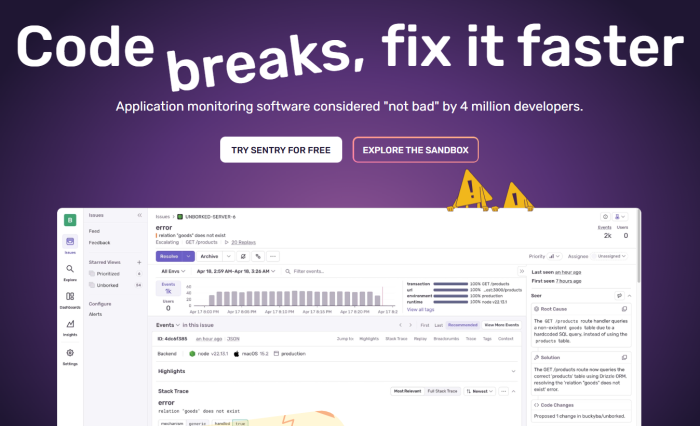
Sentry: Known for developer-focused error tracking and application performance monitoring. It captures crashes, exceptions, and slow transactions with code-level context, release awareness, and user impact. Sentry is commonly used by frontend, backend, and mobile teams focused on debugging and release quality.
Datadog: Known for broad SaaS-based observability across infrastructure, applications, and cloud services. It provides distributed tracing, log analytics, dashboards, synthetic monitoring, and real user monitoring in a centralized platform. Datadog is widely adopted by teams operating large-scale cloud and hybrid environments.
Multi-agent Support
CubeAPM: Supports OpenTelemetry collectors natively and can ingest data from Prometheus, as well as existing Datadog, New Relic, and Elastic agents. This allows teams to bring in metrics, logs, and traces from different sources and standardize them in one backend without re-instrumenting workloads.
Sentry: Supports OpenTelemetry for distributed tracing and integrates with Prometheus-style metrics through OpenTelemetry pipelines. It also uses its proprietary SDKs for error and performance data, while OpenTelemetry enables standards-based tracing ingestion.
Datadog: Supports OpenTelemetry ingestion for traces, metrics, and logs, alongside its native Datadog Agent. Teams can use OpenTelemetry collectors to send telemetry directly into Datadog while continuing to use supported integrations.
MELT support (Metrics, Events, Logs, Traces)
CubeAPM: Supports full MELT in one platform, so metrics, events, logs, and traces can be ingested and correlated in a single backend. CubeAPM also supports log ingestion from multiple agents, including OpenTelemetry, Loki, Vector, Fluent/Logstash, and more.
Sentry: Supports metrics, traces, and logs in the Sentry platform, so teams can connect signals in context with errors and performance debugging. Their docs include a metrics quickstart, and their logs product page describes viewing logs alongside errors and traces.
Datadog: Supports metrics, logs, traces, and events across the Datadog platform, with integrated products for APM, log management, infrastructure monitoring, and more. Datadog also supports OpenTelemetry ingestion as part of its observability stack.
Deployment options
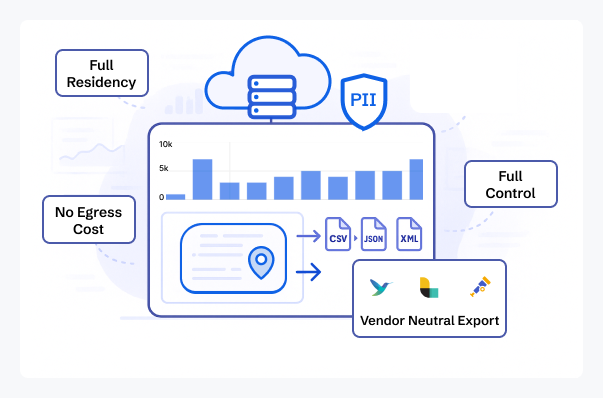
CubeAPM: Offered as a vendor-managed platform that runs inside the customer’s cloud, VPC, or private network. This gives teams full control over where telemetry data resides while eliminating operational overhead for scaling, upgrades, and maintenance. Because telemetry remains in the customer’s environment, there are no unpredictable egress fees for data movement, and compliance requirements around data residency are easier to meet.
Sentry: Offers both SaaS and self-hosted options. For teams that need full control, Sentry offers a self-hosted option, but running Sentry in your own infrastructure requires managing upgrades, scaling, and handling security patches and backups, which introduces operational overhead for teams without dedicated platform engineering resources.
Datadog: Delivered mainly as a SaaS observability platform. All telemetry is processed in Datadog’s infrastructure, and customers send data over the internet or private links. While this reduces local operational burden, it can introduce data egress costs, especially for high-volume environments that must move large volumes of telemetry out of their cloud environment.
Pricing: Approximate Cost for Small, Mid-Sized & Large Teams
*All pricing comparisons are calculated using standardized Small/Medium/Large team profiles defined in our internal benchmarking sheet, based on fixed log, metrics, trace, and retention assumptions. Actual pricing may vary by usage, region, and plan structure. Please confirm current pricing with each vendor.
*An APM host is a host that is actively generating trace data, and an Infra host is any physical or virtual OS instance that you monitor with any observability tool.
Below is a cost comparison for small, mid-sized, and large teams.
| Approx. Cost for Teams | Small(~30 APM Hosts) | Mid-sized (~125 APM Hosts) | Large(~250 APM Hosts) |
| CubeAPM | $2,080 | $7,200 | $15,200 |
| Sentry | $3,560 | $12,100 | $32,400 |
| Datadog | $8,185 | $27,475 | $59,050 |
Teams switching to CubeAPM see cost savings of around 40% versus Sentry and 70%+ versus Datadog for mid-sized environments.
CubeAPM: Cost for Small, Medium, and Large Teams
CubeAPM uses a single ingestion-based pricing model that applies across logs, metrics, traces, and events. There are no per-user, per-host, or feature-based charges, and data retention is included.
Pricing is based on a simple ingestion model:
- $0.15 per GB of telemetry data
Based on comparable workloads and team sizes, estimated monthly costs are:
- Small teams (~30 APM hosts): $2,080
- Mid-sized teams (~125 APM hosts): $7,200
- Large teams (~250 APM hosts): $15,200
Because pricing scales linearly with data ingestion, costs remain predictable as environments grow in size and complexity.
Sentry: Pricing for Small, Medium, and Large Teams
Sentry uses a tiered subscription model combined with usage-based charges. Monthly cost is influenced by two main factors: the number of users on the account and the volume of telemetry data processed. As teams grow or expand observability coverage, spend typically increases across both dimensions.
Sentry’s pricing:
- Team: $26/month
- Business: $80/month
Based on comparable workloads and team sizes, estimated monthly costs are:
- Small teams (~30 APM hosts): $3,560
- Mid-sized teams (~125 APM hosts): $12,100
- Large teams (~250 APM hosts): $32,400
This model can work well for smaller, application-focused teams, but costs become less predictable as user counts, data volume, and monitoring scope expand.
Datadog: Cost for Small, Medium, and Large Teams
Datadog uses a usage-based pricing model across its observability products, including infrastructure monitoring, APM, logs, and user experience monitoring. Costs are influenced by the number of monitored hosts, the volume of logs and traces ingested, and which products are enabled.
Datadog uses a host-based pricing:
- APM Pro: $35/host/month
- Infra Pro: $15/host/month
Based on comparable workloads and team sizes, estimated monthly costs are:
- Small teams (~30 APM hosts): $8,185
- Mid-sized teams (~125 APM hosts): $27,475
- Large teams (~250 APM hosts): $59,050
This pricing model works well for teams that want broad SaaS-based observability with minimal setup, but cost forecasting can become challenging as data volume and platform usage scale.
Sampling strategy
CubeAPM: Uses context-aware smart sampling that evaluates requests based on signals such as errors and latency before deciding what to retain. Sampling decisions are applied automatically to prioritize high-value traces while reducing low-signal noise, helping teams control ingestion volume without manually tuning rules.
Sentry: Uses head-based sampling, where the sampling decision is made at the start of a transaction and propagated to downstream services. Sentry also supports dynamic sampling, allowing teams to adjust sampling rates based on attributes such as transaction name, environment, or whether an error occurred, so important requests are captured more frequently.
Datadog: Supports both head-based and tail-based sampling. Head-based sampling reduces volume early by sampling at request start, while tail-based sampling evaluates completed traces and retains those with errors or high latency. This allows teams to choose different sampling strategies depending on workload and cost requirements.
Data retention

CubeAPM: Provides unlimited data retention by design. Logs, metrics, traces, and events are stored in the customer’s own cloud or storage, so retention is not constrained by plan limits or add-on pricing. This allows teams to keep long-term historical data for audits, trend analysis, and incident reviews without additional cost.
Sentry: Applies data retention based on subscription plan and data type. According to Sentry’s documentation, errors are retained for 30 days on the Developer plan and 90 days on Team and Business plans, while logs are retained for 30 days across plans. Other data types, such as transactions, session replays, and uptime checks, also have fixed retention windows that vary by plan. Retention can be extended only by upgrading plans.
Datadog: Uses fixed retention periods that vary by product. For APM traces, Datadog retains indexed spans for 15 days by default, with longer retention available on higher plans. Logs retention typically starts at 15 days and can be extended to 30 days or more as a paid add-on. Retention duration directly impacts cost, especially for high-volume log and trace data.
Support channels and response times
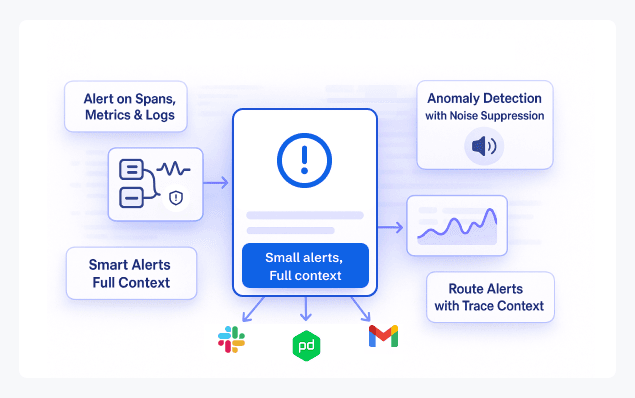
CubeAPM: Provides direct support through Slack and WhatsApp, with access to the core engineering team. Support is available in real time, and response times are typically measured in minutes. This model is designed for teams running production workloads that need fast feedback during incidents rather than ticket-based escalation.
Sentry: Offers support primarily through email, ticket-based channels, and Slack. While Sentry provides extensive documentation and guides, official response-time guarantees are not publicly specified.
Datadog: Provides tiered support plans with defined response-time targets. Standard support includes email and chat, with response times ranging from under 30 minutes for business-critical issues to under 48 hours for general issues. Premier support offers 24×7 coverage, chat, phone support, and faster response times, with costs tied to a percentage of monthly spend.
How Teams Evaluate Sentry & Datadog Platforms at Scale
As teams scale beyond early-stage workloads, evaluating observability platforms becomes less about individual features and more about structural trade-offs. At this stage, teams typically expand their evaluation beyond a single vendor and review alternative observability platforms across a few recurring dimensions: cost predictability, data ownership, operational overhead, and how well the system behaves during incidents.
Tools like Sentry are often chosen for focused error tracking and developer workflows, while Datadog is commonly adopted for its broad ecosystem and deep infrastructure visibility. However, as telemetry volume grows, teams frequently re-evaluate alternatives how pricing models, retention policies, and sampling behavior impact long-term scalability.
Platforms designed around ingestion-based pricing, customer-controlled storage, and OpenTelemetry-native pipelines such as CubeAPM are typically evaluated by teams looking to reduce cost volatility and gain clearer visibility into how telemetry is processed at scale. The right choice ultimately depends on whether a team prioritizes convenience, ecosystem depth, or long-term cost and operational control.
Sentry vs Datadog vs CubeAPM: Use Cases
Choose CubeAPM if
- You need full-stack observability across metrics, events, logs, and traces in one platform
- You want predictable ingestion-based pricing without per-user or per-host fees
- You operate in environments that require data residency or BYOC deployment
- You rely on OpenTelemetry, Prometheus, or mixed agents and want smooth migration
- You need unlimited retention, API-first access, and fast human support for production systems
Choose Sentry if
- Your primary focus is developer productivity and fast debugging of application errors
- You want strong visibility into crashes, exceptions, and performance regressions
- You rely on language SDKs with deep code-level context and release tracking
- You value session replay and user-impact analysis for frontend or mobile apps
- You prefer a quick-to-adopt SaaS tool centered on application health
Choose Datadog if
- You need broad SaaS-based observability across infrastructure, applications, and cloud services
- You want a large ecosystem of integrations and managed monitoring features
- You operate complex cloud or hybrid environments at scale
- You require advanced dashboards, alerting, and correlation across products
- You prefer a fully managed platform with tiered enterprise support options
Disclaimer: The information in this article reflects the latest details available at the time of publication and may change as technologies and products evolve.
Conclusion
Choosing between observability platforms such as Sentry, Datadog, and newer ingestion-based alternatives depends less on feature checklists and more on how systems behave at scale. As telemetry volume increases, the hidden trade-offs around sampling, retention, and pricing models become more visible often during incidents or periods of rapid growth.
Teams evaluating these platforms should focus on how observability systems degrade under pressure, how predictable costs remain as workloads scale, and how much visibility they retain into their own telemetry pipelines. A clear understanding of these factors helps ensure observability remains a reliable source of truth rather than an additional source of operational risk.
Disclaimer: The information in this article reflects the latest details available at the time of publication and may change as technologies and products evolve.
FAQs
1. What is the main difference between Sentry, Datadog, and CubeAPM?
Sentry focuses on application errors and performance debugging. Datadog provides broad SaaS-based observability across infrastructure, applications, and cloud services. CubeAPM delivers full-stack observability with self-host or BYOC deployment and predictable ingestion-based pricing.
2. Which tool is best for full-stack observability?
CubeAPM and Datadog both support full-stack observability across metrics, logs, traces, and events. CubeAPM provides this in a single OpenTelemetry-native platform with unlimited retention, while Datadog delivers it through multiple integrated SaaS products.
3. Which tool offers the most flexibility in deployment options?
CubeAPM offers self-hosted or BYOC deployment while remaining vendor-managed, giving teams control over data location without operational overhead. Sentry offers both SaaS and self-hosted options, while Datadog is primarily delivered as a SaaS platform.
4. Do all three tools support OpenTelemetry?
Yes. Sentry supports OpenTelemetry for distributed tracing, Datadog supports OpenTelemetry ingestion alongside its platform, and CubeAPM is OpenTelemetry-native across metrics, logs, traces, and events.
5. Which platform is better for teams with data residency or compliance requirements?
CubeAPM is often preferred by teams with strict data residency or compliance needs because it runs inside the customer’s cloud while remaining vendor-managed. Sentry and Datadog are primarily SaaS-based, with self-hosting available in Sentry’s case but requiring additional operational effort.