









The main difference between Sentry, Splunk AppDynamics, and CubeAPM is the deployment model and cost scaling. Sentry focuses on application errors and release performance, and Splunk AppDynamics delivers enterprise APM, while CubeAPM offers OpenTelemetry-native APM, self-hosted observability with predictable ingestion-based pricing.
As systems scale across microservices and Kubernetes, many teams struggle with fragmented telemetry, short retention windows, and pricing models that grow with users or hosts. These limitations often slow root-cause analysis and make observability harder to operate at scale.
In this article, we compare Sentry vs Splunk AppDynamics vs CubeAPM across deployment models, observability depth, pricing scalability, and suitability for modern distributed systems.
Sentry vs Splunk AppDynamics vs CubeAPM Comparison
Teams usually start comparing tools like Sentry and Splunk AppDynamics after production scale is reached, when incident frequency increases, data volumes grow, and observability costs or blind spots become harder to justify.
| Features | CubeAPM | Sentry | Splunk AppDynamics |
| Known for | OpenTelemetry-native full-stack observability + predictable pricing | Developer-focused error tracking and release health | Deep enterprise APM and transaction tracing |
| Multi-Agent Support | Yes (OTel, New Relic, Datadog, Elastic) | Limited (OTel, Prometheus) | Limited (OTel, Prometheus) |
| MELT Support | Full MELT | Full MELT | Full MELT |
| Setup | Self-hosted but vendor-managed | SaaS & Self-hosted | SaaS and Self-hosted |
| Pricing | Ingestion-based pricing of $0.15/GB | Team: $26/month Business: $80/month | APM: $33/month/CPU core Infra: $6/month/CPU core |
| Sampling Strategy | Smart sampling (95% compression) | Head + Dynamic | Head + Tail + session-based |
| Log Retention | Infinite Retention | Developer: 90 days | 8 days |
| Support TAT | < 10 minutes | No details | 30mins to 1 day |
Sentry vs Splunk AppDynamics vs CubeAPM: Feature-by-Feature Breakdown
Known for
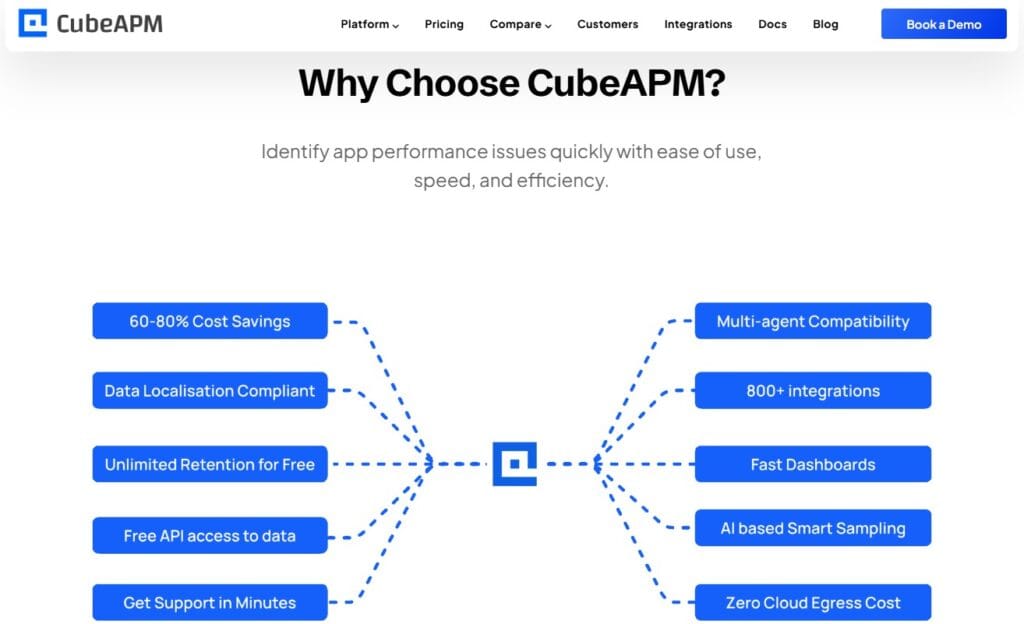
CubeAPM: Known for OpenTelemetry-native, full-stack observability that brings metrics, events, logs, and traces into a single backend. CubeAPM is built for teams that need predictable cost scaling, self-hosted or BYOC deployment, unlimited retention, and end-to-end correlation across microservices, infrastructure, and user experience.
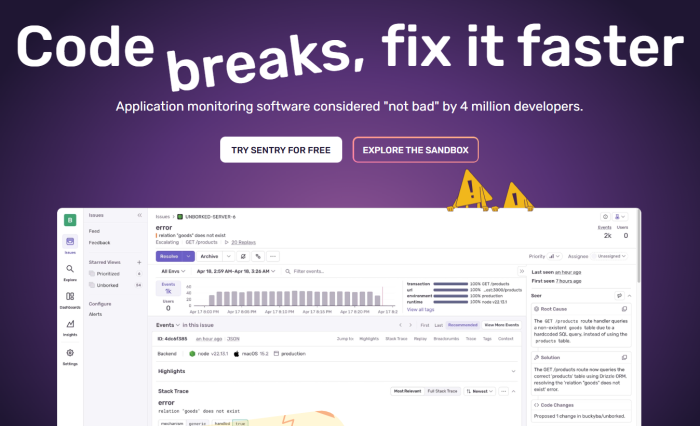
Sentry: Known for developer-first error tracking and application performance monitoring. Sentry is widely used to identify exceptions, crashes, and regressions during development and releases, with a strong focus on code-level visibility.
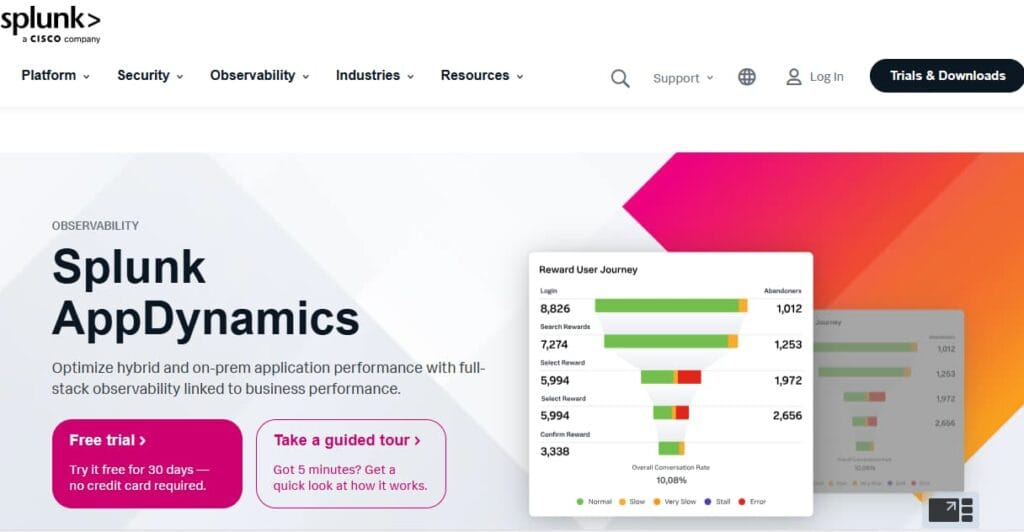
Splunk AppDynamics: Known for deep enterprise APM, transaction tracing, and application topology mapping. AppDynamics is commonly used in large, complex environments where centralized control and detailed performance analytics are prioritized, often alongside broader Splunk enterprise tooling.
Multi-agent support
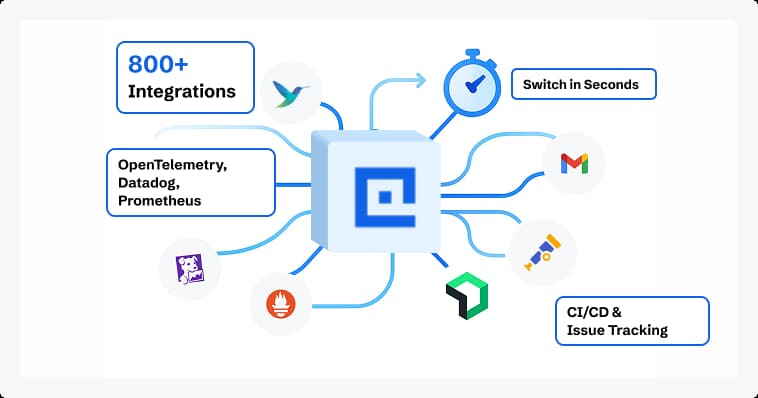
CubeAPM: Supports multi-agent ingestion by accepting telemetry from OpenTelemetry as well as selected vendor agents. This includes agents from ecosystems such as New Relic, Datadog, and Elastic, based on supported ingestion formats. This approach allows teams to migrate incrementally, keeping existing instrumentation in place while consolidating telemetry into a single backend.
Sentry: Offers limited multi-agent support. Sentry integrates with OpenTelemetry so that applications instrumented with OpenTelemetry SDKs can send trace data to Sentry, and Sentry’s SDKs can also generate trace context consistent with OpenTelemetry. This means telemetry from OpenTelemetry instrumented code can be captured by Sentry’s performance monitoring.
Splunk AppDynamics: Splunk AppDynamics provides support for receiving OpenTelemetry trace data via an OpenTelemetry-compatible ingestion path. Customers can deploy an OpenTelemetry Collector to send standard OTLP traces into AppDynamics for analysis alongside AppDynamics data.
Deployment model and data residency
CubeAPM: Deployed in a self-hosted or BYOC model, where the platform runs inside the customer’s own cloud or infrastructure. This allows teams to keep telemetry data within their environment, which is often required for data residency, security, or regulatory reasons. Platform operations such as upgrades and maintenance are handled by the vendor, reducing day-to-day operational overhead.
Sentry: Offers both SaaS and self-hosted options. A self-hosted option exists, but it requires teams to manage infrastructure, scaling, and upgrades themselves. In practice, most teams use the hosted service for simplicity, with data stored in Sentry-managed environments.
Splunk AppDynamics: Supports SaaS and self-hosted options. On-prem deployments give organizations control over data location but typically involve higher operational complexity and longer setup cycles compared to managed SaaS offerings.
Pricing: Approximate Cost for Small, Mid-Sized & Large Teams
*All pricing comparisons are calculated using standardized Small/Medium/Large team profiles defined in our internal benchmarking sheet, based on fixed log, metrics, trace, and retention assumptions. Actual pricing may vary by usage, region, and plan structure. Please confirm current pricing with each vendor.
*An APM host is a host that is actively generating trace data, and an Infra host is any physical or virtual OS instance that you monitor with any observability tool.
Below is a cost comparison for small, mid-sized, and large teams.
| Approx. Cost for Teams | Small (~30 APM Hosts) | Mid-sized (~125 APM Hosts) | Large (~250 APM Hosts) |
| CubeAPM | $2,080 | $7,200 | $15,200 |
| Sentry | $3,560 | $12,100 | $32,400 |
| Splunk APM | $2,290 | $8,625 | $17,750 |
As observability deployments mature, teams often describe a noticeable shift in how they experience cost and operational pressure. What initially feels like a straightforward monitoring setup gradually becomes harder to reason about as telemetry volume grows, new services are added, and retention needs expand. Engineers start spending more time tuning sampling, pruning data, or justifying spend during reviews, while finance teams ask for clearer forecasts. At this stage, observability is no longer just a tooling decision, but an ongoing operational concern that influences how teams design systems, respond to incidents, and plan long-term growth.
Based on the cost comparison above, teams using CubeAPM typically spend about 40% less than Sentry and 15–20% less than Splunk AppDynamics at mid-sized scale, with the gap widening further as environments grow and telemetry volumes increase.
CubeAPM: Cost for Small, Medium, and Large Teams
CubeAPM uses a single ingestion-based pricing model that applies uniformly across logs, metrics, traces, and events. There are no per-user, per-host, or feature-based charges, and data retention is included.
Pricing is based on a simple ingestion rate:
- $0.15 per GB of telemetry data
Based on comparable workloads and team sizes, estimated monthly costs are:
- Small teams (~30 APM hosts): $2,080
- Mid-sized teams (~125 APM hosts): $7,200
- Large teams (~250 APM hosts): $15,200
Because pricing scales linearly with data ingestion rather than hosts or users, costs remain predictable as environments grow in size and complexity.
Sentry: Cost for Small, Medium, and Large Teams
Sentry uses a tiered, usage-based pricing model that combines per-user plans with event and trace volume limits. Costs typically increase as team size grows and as applications generate more errors, traces, and performance data.
Sentry’s pricing:
- Team: $26/month
- Business: $80/month
Based on comparable workloads and team sizes, estimated monthly costs are:
- Small teams (~30 APM hosts): $3,560
- Mid-sized teams (~125 APM hosts): $12,100
- Large teams (~250 APM hosts): $32,400
Sentry’s pricing model aligns well with developer-focused teams monitoring application errors and performance. However, as environments scale, costs tend to rise due to higher event volumes and plan upgrades needed to retain sufficient data.
Splunk AppDynamics: Cost for Small, Medium, and Large Teams
Splunk AppDynamics follows an enterprise licensing model, typically based on monitored hosts, agents, and selected modules. Pricing is usually contract-driven and varies by deployment size and configuration.
Pricing details:
- AppDynamics APM: $33/month/CPU core
- AppDynamics Infra: $6/month/CPU core
Based on comparable workloads and team sizes, estimated monthly costs are:
- Small teams (~30 APM hosts): $2,290
- Mid-sized teams (~125 APM hosts): $8,625
- Large teams (~250 APM hosts): $17,750
This model suits organizations that need deep application performance monitoring and are comfortable with enterprise contracts. Costs generally increase as host counts and monitored services expand..
Sampling strategy
CubeAPM: Uses a context-aware sampling approach designed to retain traces that are most relevant for analysis, such as those associated with errors, high latency, or anomalous behavior, while reducing overall telemetry volume. Sampling decisions are applied after telemetry is correlated, which helps preserve useful diagnostic data as traffic scales.
Sentry: Uses a head-based sampling model, where the decision to sample a transaction is made at the start of a request and then propagated downstream. In addition, Sentry offers dynamic sampling rules that allow teams to adjust sampling rates based on attributes such as transaction name, environment, or outcome. This enables more control over which transactions are kept, but sampling decisions still occur early in the request lifecycle.
Splunk AppDynamics: Supports tail-based and head-based sampling through its OpenTelemetry Collector distribution. With this approach, traces are evaluated after completion, allowing sampling decisions to consider factors like latency, errors, or specific attributes. This can help retain higher-value traces, but it requires additional collector configuration and processing overhead.
Data retention
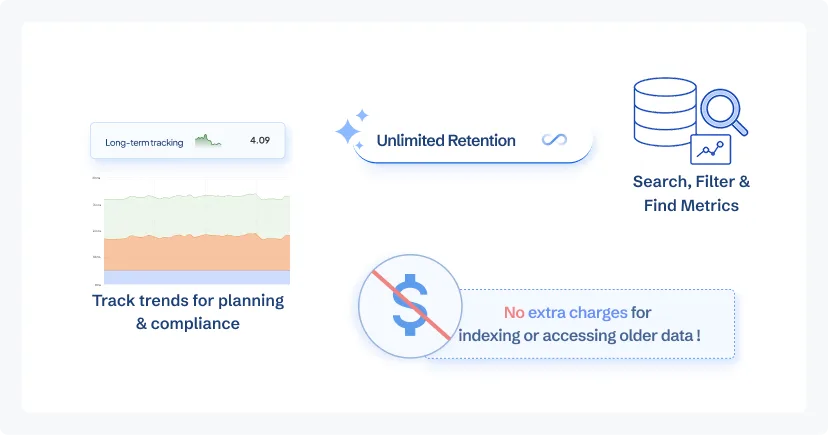
CubeAPM: Offers unlimited data retention at no extra cost. Retention is not tied to plan tiers, time limits, or storage add-ons. Because CubeAPM is deployed in a self-hosted or BYOC model, teams retain logs and errors for as long as they need without paying additional fees as data ages.
Sentry: Applies data retention limits based on plan tier. Error data is retained for 30 days on lower tiers and up to 90 days on higher tiers, while logs are typically retained for 30 days. Extending retention requires plan upgrades or higher usage spend, which increases cost as historical data needs grow.
Splunk AppDynamics: Applies retention limits that depend on deployment and licensing. In Splunk’s SaaS-based observability offerings, logs are typically retained for around 30 days, traces for approximately 8 days, and metrics for up to 13 months by default. Extending these retention periods requires higher-tier licenses, additional storage, or enterprise agreements, increasing total cost as retention needs grow.
Support channels and TAT
CubeAPM: Provides direct support access through shared communication channels such as Slack and WhatsApp. Support interactions are handled by the engineering team, enabling real-time discussion during incidents rather than relying solely on ticket-based workflows.
Sentry: Offers support through email, Slack for certain plans, documentation, and community forums. While multiple support channels are available depending on the plan, Sentry does not publish guaranteed response times or formal turnaround SLAs, and response speed varies based on plan level and support queue volume.
Splunk AppDynamics: Splunk AppDynamics support is structured around severity levels (P1–P4) and the selected support program. Under Premium Support, P1 (critical production outage) cases have a 30-minute target response time with 24/7 x 365 availability. P2 issues target a 1-hour response, and P3 cases target a 4-hour response. Under Standard Support, P1 response time is 2 hours, P2 is 1 business day, and P3 is 2 business days. Response commitments, update cadence, and workaround timelines vary by support tier, with Premium offering faster response targets and continuous coverage compared to Standard plans.
How teams evaluate These Platforms at scale
When teams compare Sentry, Splunk AppDynamics, and CubeAPM, the evaluation lens changes as architectures mature and telemetry volumes rise. Early adoption is often driven by fast onboarding and immediate insights, but at scale the discussion shifts toward long-term cost behavior, data retention constraints, and how much operational control the platform allows.
In production environments with sustained traffic, distributed services, and high-cardinality telemetry, teams increasingly focus on how pricing reacts to growing ingestion, whether retention can be extended without disproportionate cost increases, and how much visibility they maintain into their own telemetry pipelines. Platforms that offer clearer cost predictability and flexible deployment models tend to be favored once observability becomes a core operational dependency rather than an experimental tool.
Sentry vs Splunk AppDynamics vs CubeAPM: Use Cases
Choose CubeAPM if
- You want predictable observability costs that scale with telemetry volume instead of users, hosts, or feature tiers.
- You need unlimited data retention at no extra cost for audits, long-term analysis, or compliance requirements.
- You are standardizing on OpenTelemetry and want an OpenTelemetry-native platform without vendor lock-in.
- You prefer a self-hosted or BYOC deployment to keep all telemetry data inside your own cloud or infrastructure.
- You operate distributed, Kubernetes, or microservices-based systems and need unified visibility across metrics, logs, traces, and events to reduce MTTR.
Choose Sentry if
- You are primarily focused on tracking application errors, crashes, and exceptions at the code level.
- You want quick setup with minimal infrastructure management for development and release workflows.
- Your teams are frontend-, backend-, or mobile-heavy and prioritize application performance visibility over full-stack observability.
- You are comfortable with plan-based data retention limits and usage-driven pricing as workloads grow.
- You need strong developer tooling for release health, regressions, and error triage rather than infrastructure correlation.
Choose Splunk AppDynamics if
- You operate large, complex enterprise environments that require deep transaction tracing and application topology mapping.
- You need formal enterprise support SLAs with defined response-time guarantees.
- Your organization is already invested in the broader Splunk ecosystem.
- You can accommodate enterprise licensing, contract-based pricing, and longer onboarding cycles.
- You monitor hybrid or legacy architectures where centralized control and detailed APM analytics are a priority.
Choosing the right platform based on scope and scale
Each platform serves a distinct purpose. Sentry fits teams focused on developer-centric error tracking, Splunk AppDynamics targets enterprise application performance monitoring with formal SLAs, and CubeAPM is often evaluated by teams seeking unified observability with more predictable cost behavior as telemetry grows.
Instead of relying on feature checklists alone, teams should consider how pricing, data retention, and operational ownership evolve over time, especially as observability becomes a long-term operational requirement rather than a short-term tooling choice.
Disclaimer: The information in this article reflects the latest details available at the time of publication and may change as technologies and products evolve.
FAQs
1. How do Sentry, Splunk AppDynamics, and CubeAPM differ in data retention?
Data retention varies by model. Sentry and Splunk AppDynamics apply retention limits based on plan or license, and extending retention typically increases cost. CubeAPM offers unlimited data retention at no extra cost in self-hosted or BYOC deployments.
2. Which tool offers more control over where observability data is stored?
Deployment options differ. Sentry is primarily SaaS with a self-hosted option that requires customer management. Splunk AppDynamics supports SaaS, on-prem, and hybrid deployments depending on license. CubeAPM runs self-hosted or in the customer’s cloud, giving direct control over data location.
3. How do pricing models scale as telemetry volume grows?
Sentry and Splunk AppDynamics pricing is tied to plans, licenses, or contracts, and costs generally rise as usage, retention, or scope increases. CubeAPM pricing is based on data ingested, which keeps cost scaling directly tied to telemetry volume.
4. Do all three tools support OpenTelemetry?
Yes, all three support OpenTelemetry, but in different ways. Sentry and Splunk AppDynamics support OpenTelemetry ingestion alongside their existing models, while CubeAPM is designed as an OpenTelemetry-native backend.
5. Which tool is better suited for long-term observability data analysis?
Tools with plan- or license-based retention limits are typically used for shorter-term analysis unless retention is expanded at additional cost. CubeAPM’s unlimited retention model makes long-term analysis possible without retention-driven cost increases.