










Oodle.ai positions itself as AI-native observability built for teams debugging AI agents, LLMs, and high-cardinality workloads where legacy tools built around dashboards and fixed compute struggle. According to CNCF’s 2024 Annual Survey, 42% of organizations now run AI/ML workloads in production, up from 28% in 2023, and traditional APM tools were not designed for this shift. Oodle claims to solve this by separating storage and compute, running queries on serverless functions, and enabling plain English debugging directly from Cursor, Claude, or Slack.
This guide covers Oodle.ai’s pricing model, feature set, architecture, real-world deployment models, and how it compares to legacy observability platforms like Datadog and self-hosted alternatives like CubeAPM. Pricing figures are sourced from Oodle.ai’s official pricing page and competitor public rate cards as of early 2026.
What Is Oodle.ai?
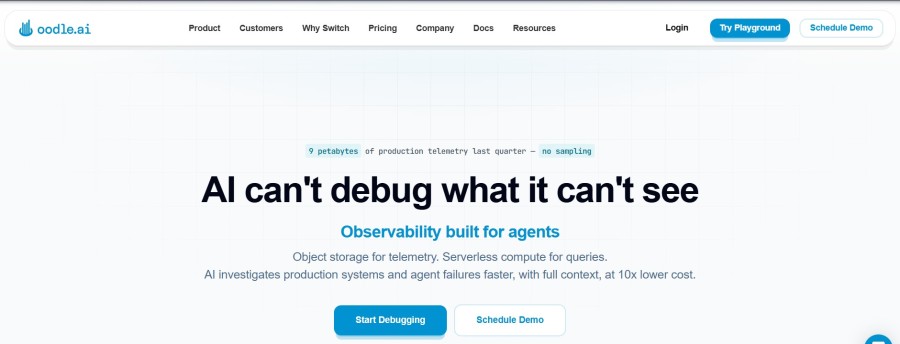
Oodle.ai is a managed observability platform that uses a serverless architecture to separate storage and compute for logs, metrics, and traces. Unlike legacy APM tools that run always-on indexing pipelines and fixed compute clusters, Oodle stores telemetry directly on S3-compatible object storage and spins up serverless query execution only when you run a query. This model is designed to reduce cost, eliminate infrastructure overhead, and enable full-fidelity telemetry without sampling.
The platform targets engineering teams running AI agents, microservices at scale, and high-cardinality workloads where sampling drops important signals and dashboard-based observability cannot keep up with the speed of AI-driven debugging.
Oodle’s architecture differs from traditional observability stacks in three key ways. First, telemetry is written directly to object storage with no indexing pipelines. Second, queries run on lambdas that scale instantly and shut down after execution. Third, the platform supports natural language queries from AI coding tools like Cursor and Claude, treating debugging as a conversation rather than a dashboard session.
The team behind Oodle includes engineers who built Amazon S3, DynamoDB, Rubrik, and Snowflake. The product launched publicly in 2024 and claims production deployments handling 20TB+ logs per day and 4M+ AI agent traces daily.
Core Architecture: Serverless + S3
Oodle’s architecture separates storage and compute. Telemetry flows to S3 or S3-compatible storage. No indexing. No fixed clusters. When you query, serverless compute processes the data and returns results. Pricing is based solely on the volume of data ingested and how long it’s retained. There’s no separate charge for running queries. Serverless compute is part of the architecture, not a billing dimension.
Traditional observability platforms run always-on indexing pipelines and keep compute running even when no one is querying. That drives higher costs. Oodle’s serverless model eliminates that overhead without passing query costs on to the customer.
The trade-off is architectural rather than financial: queries that scan large time ranges or high-cardinality data can take longer to return, since cold data isn’t pre-indexed. Oodle uses caching to speed up repeat queries, but this affects latency, not your bill.
Deployment Models
Oodle offers three deployment options:
Fully Managed: Oodle manages everything. Telemetry flows to Oodle’s infrastructure. Storage lives in Oodle’s S3 buckets. Fastest setup. No infrastructure burden. Best for teams that want zero ops overhead.
BYOC (Bring Your Own Cloud): Oodle processes your data but storage lives in your S3 buckets. You own telemetry at rest. Oodle runs the query layer. Best for teams with data ownership or compliance requirements who still want managed observability.
Self-Hosted: Full Oodle stack runs in your VPC. No data leaves your network. Best for regulated industries, air-gapped environments, or teams with strict data residency mandates.
All three models are SOC 2 Type II, ISO 27001, and GDPR compliant according to Oodle’s security documentation.
Oodle.ai Pricing Model
Oodle.ai uses a single-dimension pricing model: cost per GB of telemetry ingested. Unlike Datadog or New Relic, there are no per-host fees, per-user seats, or separate charges for logs vs. metrics vs. traces.
From Oodle.ai’s pricing page:
- Logs: $0.30 per GB ingested
- Traces: $0.30 per GB ingested
- Metrics: $2.00 per 1,000 active time series (ATS) (billed hourly)
Because pricing is graduated across bands, the effective rate drops as ingest volume grows.
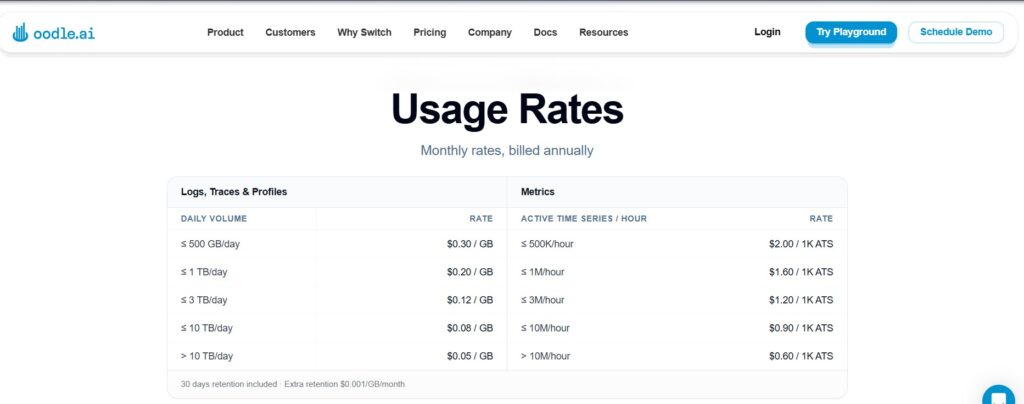
Retention: 30 days included at no extra charge. Additional retention beyond 30 days billed at $0.001 per GB-month.
Cost Scenario: 100GB Logs + 50GB Traces + 500K Active Time Series
Assumptions: 100GB logs per day, 50GB traces per day, 500K active time series sampled every 60 seconds, 30-day retention.
- Logs: 100GB/day × 30 days = 3,000GB × $0.30/GB = $900/month
- Traces: 50GB/day × 30 days = 1,500GB × $0.30/GB = $450/month
- Metrics: 500K active time series × $2.00 per 1,000 ATS = $1,000/month
- Retention (included): 30 days included. No additional storage cost for standard retention.
Total Oodle cost: ~$2,350/month
Comparison to Datadog: Same workload on Datadog at public rates (100GB logs, 50GB traces, 500K metrics, 30-day retention): Logs: 100GB × 30 = 3,000GB × $0.10/GB ingest + indexing ~$1.70/M events = ~$5,100 Traces: 50GB × 30 = 1,500GB × ~$1.70/M spans = ~$2,550 Metrics: 500K active series × ~$0.05/series = ~$25,000 Datadog total: ~$32,650/month before any host-based fees, add-ons, or discounts.
Comparison to Datadog: Datadog prices logs and traces on a two-part model – a flat ingestion fee plus a separate per-event indexing fee that scales with retention. At 30-day retention, per Datadog’s published pricing, log ingestion runs $0.10/GB and indexing runs $2.50 per million events; trace indexing at 30-day retention runs $2.50 per million spans. It also charges for custom-metric overage and per-host charges for Infrastructure and APM ($15/host and $31/host respectively, requiring both). The same 100GB logs/day + 50GB traces/day + 500K time series workload roughly comes down to:
- Logs: 100GB/day × 30 days = 3,000GB. Ingestion at $0.10/GB = $300/month. At the standard conversion of 1 million events per GB, that’s 3,000 million events; indexing all of it at the 30-day rate of $2.50/million events = $7,500/month. Logs total: ~$7,800/month.
- Metrics: 500,000 custom metrics at $0.05/metric/month overage (beyond the per-host free allotment) = $25,000/month.
- Traces: 1,500GB/month at $0.10/GB ingestion = $150/month minimum, plus indexed-span overage charges that depend on average span size – a figure Datadog doesn’t publish, and our calculator takes as manual input rather than deriving from GB, so we’re not stating a precise number here.
Logs and metrics alone already total ~$32,800/month, before traces, before Infrastructure ($15–18/host) and APM ($31–36/host) fees (both billed per host, which this GB-based workload doesn’t specify), and before any enterprise discount. This puts it far above Oodle’s ~$2,350/month for the equivalent workload.
This estimate models a specific workload profile. Your actual costs will vary based on data volume, event size, retention period, and feature usage.
Key Features
AI-Native Debugging
Oodle integrates with Cursor, Claude Code, and Slack to enable plain English debugging. Instead of writing PromQL or Lucene queries, you ask: “Why did API latency spike at 3 pm?” The AI surfaces traces, logs, and metrics in context.
This only works if the underlying data is full fidelity. Sampling breaks this. If the slow trace was sampled out, the AI cannot find it. Oodle’s serverless architecture makes storing everything economically viable.
Full-Fidelity Telemetry
Oodle stores 100% of telemetry by default. No sampling. No dropped spans. This is critical for AI agent observability where low-frequency failures matter and high-cardinality signals are the norm.
Sampling exists because legacy observability tools make storing everything too expensive. Oodle’s S3-backed architecture changes that economics. Storage is cheap. Compute scales to zero when not querying.
Native OTel and Multi-Agent Support
Oodle supports OpenTelemetry, Prometheus, Elastic, Datadog, and New Relic agents with no code changes. Dashboards and alerts import with one click. PromQL, Lucene, and OTel queries work immediately.
Migration from Datadog or Grafana typically takes 2–4 weeks according to Oodle’s customer stories. Teams run both systems in parallel until confident, then cut over.
Grafana-Native UI
Oodle provides a native Grafana UI for metrics dashboards and alerts, a familiar log explorer with full-text search, and OTel-compatible trace views. Your existing queries work without translation.
Unlimited Retention by Default
30 days included. Additional retention billed at $0.001/GB-month. No rehydration fees. No archive tiers. All data remains queryable at the same speed.
Legacy tools charge separately for long-term retention or require rehydration workflows that can take hours. Oodle treats retention as storage cost only.
Pros
Cost predictability: Single billing dimension makes cost forecasting straightforward. No surprise charges from new hosts, users, or feature add-ons.
No sampling: Full-fidelity telemetry catches edge cases and rare failures that sampled systems miss. Critical for AI agent debugging.
Serverless architecture: Zero infrastructure overhead. No clusters to size, upgrade, or maintain. Oodle manages everything.
AI-native workflows: Debugging from Cursor or Slack instead of dashboards fits how teams already work with LLMs in production.
Fast migration: Multi-agent compatibility and one-click dashboard import reduce migration risk. Teams report going live in under a month.
Data ownership options: BYOC and self-hosted models give data residency and compliance control without sacrificing managed observability.
Cons
Fully managed only for most teams: The self-hosted option exists but is not the default path. Teams that require air-gapped deployment face longer onboarding.
Newer platform: Oodle launched publicly in 2024. The product is mature enough for production (multiple enterprise deployments documented) but lacks the ecosystem depth of Datadog or the community size of Grafana.
No built-in alerting AI: Oodle supports alerts but does not include autonomous anomaly detection or AIOps-style auto-remediation. Alerts are query-based with manual threshold configuration.
Limited third-party integrations: Oodle integrates with Slack, PagerDuty, and common CI/CD tools but does not yet match Datadog’s 700+ integrations or Grafana’s plugin ecosystem.
Oodle.ai vs. Datadog
Datadog is the incumbent enterprise observability platform. Oodle is the challenger built for AI-native workflows and cost efficiency.
Pricing model: Datadog uses per-host, per-feature, per-user pricing. A 50-host cluster running Infrastructure Pro ($15/host) and APM ($31/host, which requires Infrastructure Pro) runs at least $2,300/month before logs, custom metrics, synthetics, or RUM are added. Oodle, by contrast, charges $0.30/GB for both logs and traces, and $2.00 per 1,000 active time series/month for metrics. No host fees. No user seats. No query or compute charges.
At 100GB logs/day with 30-day retention, Datadog’s log costs alone (ingestion plus indexing) run into the thousands per month before host fees are added. Oodle’s cost for the same volume is ~$900. Layering in Datadog’s per-host charges and custom-metric overages widens the gap further.
Architecture: Datadog always runs on-demand indexing and compute. Oodle separates storage and compute, running queries on lambdas. Datadog’s model works well for teams that query constantly. Oodle works better for teams with spiky query patterns or who want to store everything without indexing overhead.
AI debugging: Oodle integrates AI debugging into Cursor and Slack as a first-class feature. Datadog added AI Analyst in 2025, but it is an add-on that requires separate enablement.
Deployment: Datadog is SaaS only. Oodle offers fully managed, BYOC, and self-hosted. For regulated industries or data-sovereign teams, Oodle’s BYOC or self-hosted models are the only viable path.
Ecosystem: Datadog has 700+ integrations and a decade of community-built dashboards. Oodle is OpenTelemetry native and Prometheus compatible, so standard exporters work, but the pre-built content library is smaller.
Best for: Datadog is best for large enterprises with complex, multi-cloud environments who need maximum integration breadth and are less sensitive to cost. Oodle is best for teams debugging AI agents, operating at large scale with cost constraints, or requiring data residency without DIY infrastructure.
Oodle.ai vs. CubeAPM
CubeAPM: CubeAPM is a self-hosted observability platform that runs inside your VPC or on-prem, combining APM, logs, infrastructure monitoring, and RUM with predictable $0.20/GB pricing and unlimited retention. Like Oodle, CubeAPM targets teams that want full-fidelity telemetry without SaaS data egress or unpredictable pricing. Unlike Oodle, CubeAPM is optimized for teams that prefer a traditional APM interface over AI-native debugging workflows.
Pricing: CubeAPM charges $0.20/GB for all telemetry types – logs, traces, metrics. Oodle uses tiered pricing starting at $0.30/GB for logs and traces, plus $2.00 per 1,000 active time series/month for metrics (see rates above).
For the same 100GB logs/day + 50GB traces/day workload, CubeAPM costs ~$900/month; Oodle costs ~$1,350/month for logs and traces alone (add ~$1,000/month if 500K active time series metrics are included, bringing Oodle’s full three-signal total to ~$2,350/month). CubeAPM is cheaper at list rates for this workload.
Deployment: Both offer self-hosted and BYOC models. CubeAPM’s default is self-hosted with vendor-managed upgrades and support. Oodle’s default is fully managed SaaS with BYOC as an option. If you require data to never leave your infrastructure, both work. CubeAPM is built self-hosted first. Oodle is built SaaS first with self-hosted as an enterprise add-on.
AI debugging: Oodle integrates AI debugging as a core feature. CubeAPM supports OpenTelemetry and standard query languages but does not include AI-native debugging from Cursor or Claude.
Retention: CubeAPM includes unlimited retention at no extra charge. Oodle includes 30 days and charges $0.001/GB-month for additional retention. For teams storing 100TB with 90-day retention, CubeAPM’s all-in pricing saves over Oodle’s storage surcharge.
Best for: CubeAPM is best for teams that want predictable ingestion-based pricing, unlimited retention, and full data sovereignty without requiring AI debugging workflows. Oodle is best for teams debugging AI agents, LLMs, or high-cardinality workloads where AI-native workflows and serverless architecture justify the higher blended rate.
Both platforms avoid the per-host, per-user, per-feature pricing that makes Datadog and New Relic bills unpredictable at scale. CubeAPM optimizes for cost and retention. Oodle optimizes for AI-native debugging and serverless scalability.
For more on how CubeAPM compares to legacy APM platforms, see CubeAPM as a Datadog alternative and CubeAPM as a New Relic alternative.
Who Should Use Oodle.ai?
Oodle fits teams with specific observability pain points that legacy tools do not address well.
Teams debugging AI agents in production: If you run LLMs, AI agents, or autonomous systems where failure modes are unpredictable and high-cardinality signals matter, Oodle’s full-fidelity telemetry and AI-native debugging workflows are purpose-built for this.
Engineering teams with spiky query patterns: If you query observability data intermittently, during incidents, post-deploy checks, or weekly retrospectives, serverless query execution saves money over always-on compute.
Platform teams replacing Elastic or Datadog due to cost: If your Elastic cluster has become expensive to operate or your Datadog bill scales unpredictably with traffic, Oodle’s single-dimension pricing and serverless architecture eliminate both problems.
Regulated industries requiring BYOC or self-hosted: If HIPAA, GDPR, or data residency mandates rule out SaaS-only tools, Oodle’s BYOC and self-hosted models give managed observability inside your perimeter.
Teams migrating from Datadog or Grafana: Oodle’s multi-agent compatibility and one-click dashboard import reduce migration friction. Teams report parallel-run migrations completing in 2–4 weeks.
Oodle is less suited for teams that need maximum third-party integrations, prefer dashboard-centric workflows over AI debugging, or run environments where query frequency is constant and serverless compute costs would exceed fixed-cluster economics.
Conclusion
Oodle.ai reimagines observability architecture for the AI era by separating storage and compute, enabling full-fidelity telemetry without indexing overhead, and integrating debugging directly into AI coding tools. The serverless model reduces cost for log-heavy and metric-heavy workloads compared to Datadog or New Relic, and the single-dimension pricing eliminates the host-based, user-seat, and feature-add-on charges that make legacy APM bills unpredictable.
The platform works best for teams debugging AI agents, operating at large scale with cost constraints, or requiring data residency with managed observability. Teams that prefer dashboard-centric workflows, need extensive third-party integrations, or run constant query loads may find a better fit with CubeAPM, Grafana, or SigNoz depending on deployment preference and budget.
For teams evaluating Oodle against alternatives, the decision usually comes down to three factors: whether AI-native debugging workflows justify the cost delta over cheaper self-hosted options like CubeAPM, whether serverless query execution fits your query patterns better than fixed compute, and whether data residency or compliance requirements rule out SaaS-only tools.
Disclaimer: The information in this article reflects the latest details available at the time of publication and may change as technologies and products evolve. Features, pricing, and plan limits can change over time. Always verify the latest information directly with the vendor before making purchasing or deployment decisions.
Frequently Asked Questions
What is Oodle.ai pricing based on?
Oodle.ai charges $0.30/GB for ingested logs and traces, and $2 per 1,000 active time series for metrics (billed hourly). Pricing is based solely on data volume and retention. There’s no charge for queries or compute. 30 days of retention is included at no extra charge. Additional retention beyond 30 days is billed at $0.001 per GB-month. No per-host fees, no per-user seats.
Does Oodle.ai support OpenTelemetry?
Yes. Oodle is OpenTelemetry native and also supports Prometheus, Elastic, Datadog, and New Relic agents. Existing dashboards and alerts import with one click. PromQL, Lucene, and OTel queries work immediately without translation.
Can Oodle.ai run on-prem or in my VPC?
Yes. Oodle offers three deployment models: fully managed SaaS, BYOC where storage lives in your S3 buckets, and fully self-hosted where the entire stack runs in your VPC. All three models are SOC 2 Type II and ISO 27001 compliant.
How does Oodle.ai compare to Datadog on cost?
Oodle charges $0.30/GB for logs and traces, and $2.00 per 1,000 active time series/month for metrics, with no host or user fees and no query/compute charges. Datadog charges per host, per user, and per feature with separate ingestion and indexing fees. At 100GB logs/day, 50GB traces/day, and 500K active time series, Oodle costs ~$2,350/month. Datadog costs ~$32,650/month at list rates before discounts.
What makes Oodle.ai AI-native?
Oodle integrates debugging directly into AI coding tools like Cursor, Claude Code, and Slack. You ask questions in plain English instead of writing PromQL or Lucene queries. The platform stores full-fidelity telemetry so the AI can surface the exact trace, log, or metric that explains an issue.
Does Oodle.ai support custom retention periods?
Yes. 30 days of retention is included at no extra charge. You can extend retention beyond 30 days and pay $0.001 per GB-month for additional storage. All data remains queryable at the same speed regardless of age.
How long does migration to Oodle.ai take?
Teams report completing migrations from Datadog or Grafana in 2–4 weeks. Oodle supports running both systems in parallel during migration. Dashboards and alerts import with one click. No code changes required for agents.