




The main difference between Honeycomb, New Relic, and CubeAPM is how each platform approaches observability ownership and scale.
Honeycomb focuses on exploratory debugging through high-cardinality events and developer-driven analysis. New Relic is a fully managed SaaS observability platform optimized for convenience and broad coverage.
CubeAPM is a self-hosted, OpenTelemetry-native observability platform built for predictable pricing, data control, and running observability inside your own infrastructure. In practice, this comparison is less about individual features and more about philosophy.
In this article, we’ll compare architecture, deployment, sampling, pricing, and real-world use cases across Honeycomb vs New Relic vs CubeAPM.
Honeycomb vs New Relic vs CubeAPM Comparison
This comparison is based on official vendor documentation, pricing pages, and product docs, along with hands-on evaluation and internal benchmarking. Feature availability, pricing, and support details reflect publicly stated information and may vary by plan or deployment model.
| Feature | CubeAPM | Honeycomb | New Relic |
| Known for | Unified MELT, native OTEL, self-hosting, cost predictability | Event-driven tracing, exploratory debugging | Full-stack APM, service maps, advanced analytics |
| Multi-Agent Support | Yes (OTel, New Relic, Datadog, Elastic, etc.) | Limited (OTel, Honeytail, Honeycomb SDKs) | Yes (New Relic Agent, OTel, Prometheus) |
| MELT Support | Full MELT coverage | MELT coverage | Full MELT coverage |
| Deployment | Self-hosted with vendor-managed | SaaS; private cloud (Enterprise) | SaaS-only |
| Pricing | Ingestion-based: $0.15/GB | Free; Pro: $130/month per 100M events; Enterprise: Custom | Free 100 GB/month; beyond: $0.40/GB. Per-user license: $49-$349/month |
| Sampling Strategy | Smart sampling, automated, context-aware | Head-based, tail-based, sample rate adjustment | Adaptive head-based & tail-based |
| Data Retention | Unlimited Retention | 60 days by default; extra for longer retention | 30d for logs/events; add-on retention |
| Support Channel & TAT | Slack, WhatsApp; response in minutes | Community Slack: email, in-app portal; SLA: 1 business days in Pro | Community, docs, ticket-based; TAT: 2d to 2 hrs, 1 hr (priority) |
Honeycomb vs New Relic vs CubeAPM: Feature Breakdown
Known For
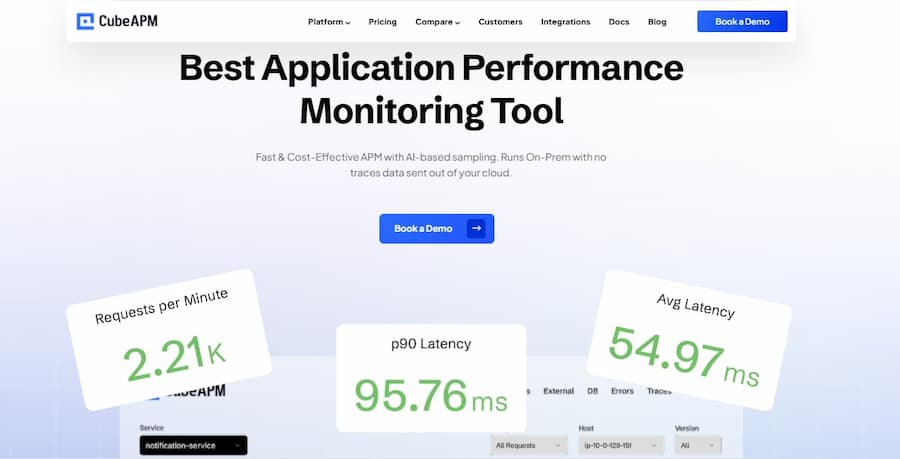
CubeAPM is an OpenTelemetry-native full-stack observability and APM platform that consolidates metrics, logs, traces, infrastructure, real user monitoring, synthetics, and error tracking into a single platform that can run inside customer-controlled infrastructure or VPC, with predictable pricing and unlimited retention.
Honeycomb is designed to help engineering teams uncover and analyze high-cardinality event data and deeply understand system behavior through exploratory querying and observability. The platform emphasizes the ability to ask arbitrary questions about production systems and dive into rich, structured events for debugging modern distributed architectures.
New Relic is a full-stack observability platform that provides comprehensive visibility into applications, infrastructure, real-user experience, logs, and metrics in a unified interface. Official New Relic docs describe it as a tool for monitoring and troubleshooting across the entire software stack, from backend services to frontend interaction.
Multi-Agent Support
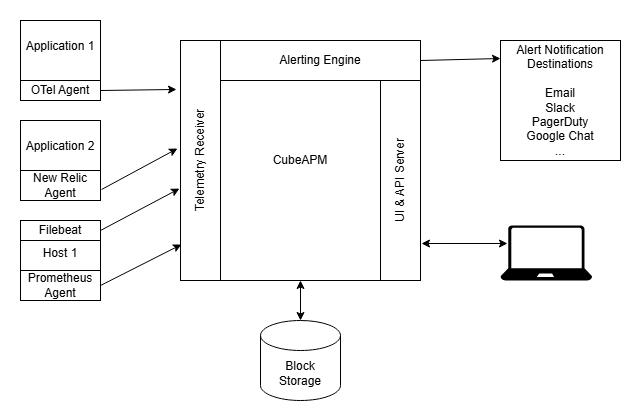
CubeAPM is designed to work with a wide range of agent ecosystems. It natively supports the OpenTelemetry Protocol (OTLP) and can also receive telemetry from existing instrumentation provided by other agents (including New Relic and others), enabling teams to reuse or incrementally migrate instrumentation without being locked into a single proprietary agent. The CubeAPM docs describe how integrating OpenTelemetry agents is a core part of setup.
Honeycomb accepts telemetry from multiple sources via OpenTelemetry SDKs and the OpenTelemetry Collector, meaning teams can send traces, metrics, and logs instrumented with standard OTLP-compatible tools directly into Honeycomb. In addition, Honeytail, Honeycomb’s official log ingestion tool, allows structured log streams to be shipped into the platform as observability events (and Honeytail itself is maintained as part of Honeycomb’s supported tooling). This approach ensures flexibility while aligning with open standards.
New Relic provides a broad set of native agents for languages and environments (Java, .NET, Node.js, Python, Go, Ruby, PHP, etc.) to collect application telemetry and send it into the New Relic backend, and it also supports OpenTelemetry SDKs and collectors so telemetry instrumented with OTLP can be ingested and correlated within the same observability UI.
MELT Support
CubeAPM supports full MELT by ingesting and correlating metrics, logs, traces, and events in a single OpenTelemetry native backend. Telemetry is collected via OTLP and compatible integrations, allowing engineers to move between metrics, traces, logs, and related context within the same platform during analysis and troubleshooting.
Honeycomb supports metrics, logs, and traces by modeling all telemetry as structured events. Data is ingested primarily through OpenTelemetry and Honeytail, and users analyze different signals by querying and slicing event data rather than separate signal-specific stores.
New Relic natively supports metrics, events, logs, and traces as first-class data types. These signals are collected through New Relic agents or OpenTelemetry and can be queried and correlated together within the New Relic platform.
Deployment
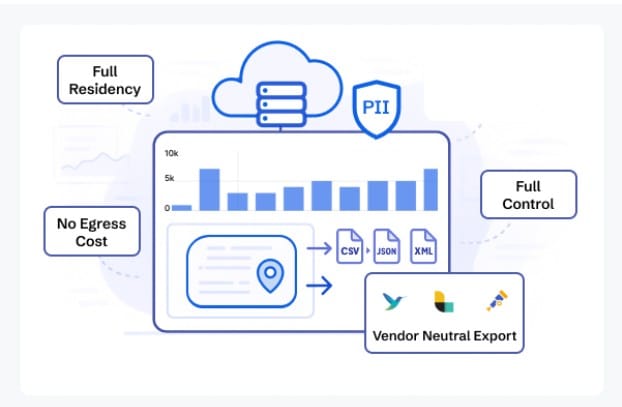
CubeAPM supports self-hosted deployment inside customer-controlled infrastructure via BYOC or on-premises. The platform can be fully self-hosted and vendor-managed while still running within the customer’s environment, ensuring telemetry data remains local. This model supports OpenTelemetry-based ingestion and is suited for teams with data residency, security, or compliance requirements.
Honeycomb is primarily delivered as a cloud-hosted SaaS platform. Official documentation also describes a Private Cloud option for enterprise customers, where Honeycomb can be deployed within the customer’s cloud account and operated either by Honeycomb or by the customer. Telemetry ingestion is handled through OpenTelemetry and Honeycomb-supported tools.
New Relic is provided as a SaaS-only platform. According to New Relic documentation, customers install agents or configure OpenTelemetry exporters, while all data storage and processing occurs in New Relic-managed infrastructure. This deployment model minimizes infrastructure management for customers but requires reliance on the hosted service.
Pricing for Small, Mid, and Large Teams
To summarize the pricing:
*All pricing comparisons are calculated using standardized Small/Medium/Large team profiles defined in our internal benchmarking sheet, based on fixed log, metrics, trace, and retention assumptions. Actual pricing may vary by usage, region, and plan structure. Please confirm current pricing with each vendor.
| Approx. cost for teams (size) | Small (~30) | Mid-Sized (~125) | Large (~250) |
| CubeAPM | $2,080 | $7,200 | $15,200 |
| New Relic | $7,896 | $25,990 | $57,970 |
| Honeycomb | $3,900 | $11,600 | $24,200 |
CubeAPM Costs in Detail
CubeAPM uses an ingestion-based pricing model. According to CubeAPM’s official site, pricing starts at $0.15 per GB of ingested telemetry, with no per-user or per-host licensing fees. This model applies uniformly across metrics, logs, and traces, and includes unlimited data retention, making costs predictable as telemetry volume scales.
- Small teams (~ 30): $2,080
- Mid-sized teams (~ 125): $7,200
- Large teams (~250): $15,200
New Relic Cost in Detail
New Relic offers a usage-based SaaS pricing model. Official pricing documentation states that New Relic includes a free tier with 100 GB per month, after which data ingestion is charged at approximately $0.40 per GB, alongside optional per-user licenses ranging from $49 to $349 per user per month, depending on role and access level. Extended retention and advanced features may require additional add-ons.
- Small teams: $7,896
- Mid-size teams: $25,990
- Large teams: $57,970
Honeycomb Cost in Detail
Honeycomb follows an event-based pricing model. Based on Honeycomb’s official pricing page, the Free plan includes 20 million events per month, the Pro plan starts at $130 per month for 100 million events and scales up to higher event volumes, and the Enterprise plan is custom priced. Pricing is based on event volume rather than hosts or users.
- Small teams: $3,900
- Mid-size teams: $11,600
- Large teams: $24,200
As systems mature, pricing differences usually surface when telemetry volume increases due to higher request throughput, longer trace depth, or growth in the number of services and dependencies. This is common in environments with sustained traffic, fine-grained logging, or high-cardinality dimensions introduced by microservices and OTel instrumentation. At this stage, observability often transitions from a static tooling cost to a variable, data-driven expense that must be monitored alongside ingestion rates, retention policies, and sampling behavior.
Sampling Strategy

CubeAPM uses a smart, automated sampling approach designed to reduce data volume while preserving operationally important signals. According to CubeAPM documentation, sampling decisions are context-aware and take into account factors such as errors and latency, allowing higher-value traces to be retained while reducing overall ingestion volume. Sampling is applied centrally rather than relying solely on application-side configuration.
Honeycomb supports both head-based and tail-based sampling. Official Honeycomb documentation explains that head sampling is configured in OpenTelemetry SDKs, while tail sampling is performed using Honeycomb Refinery, which evaluates complete traces using dynamic, deterministic, rules-based, or throughput-based policies. Honeycomb also preserves and applies sample rate adjustments so aggregates and counts remain statistically correct when sampled data is queried.
New Relic supports multiple sampling mechanisms depending on the data source. According to New Relic documentation, agents primarily apply adaptive head-based sampling, while tail-based sampling is available through features such as Infinite Tracing or via OpenTelemetry collectors. Sampling behavior varies by agent, configuration, and feature tier.
Data Retention
CubeAPM provides unlimited data retention across telemetry types. According to CubeAPM’s official site and documentation, metrics, logs, traces, and related observability data can be retained without time limits or retention-based pricing tiers, allowing teams to keep historical data for audits, long-term analysis, and incident review.
Honeycomb retains telemetry data for 60 days by default across plans. Official Honeycomb documentation states that events older than the retention window are automatically deleted, and longer-term storage typically requires exporting data outside the platform rather than extending in-place retention.
New Relic applies time-based retention policies that vary by data type. According to New Relic documentation, logs and events are commonly retained for around 30 days by default, with extended retention available through paid add-ons or higher-tier plans, depending on the data category.
Support Channels and TAT
CubeAPM provides direct support access as part of its managed offering. Customers can reach the core engineering team through Slack and WhatsApp, with response times typically measured in minutes for active issues. This model emphasizes engineer-led, real-time support rather than ticket-only workflows.
Honeycomb offers support through an in-app support portal and email, supported by documentation, a community Slack workspace, and Honeycomb Academy. Official support documentation states that Pro plan customers receive an initial response within 1 business days, while Enterprise customers have faster response targets, typically within 2 business hours, during business hours.
New Relic provides support via documentation, community forums, and ticket-based support. According to New Relic’s official support and pricing documentation, standard support response times range from up to 2 business days, enhanced support tiers offer responses within 2 hours, and priority or mission-critical plans target response times of around one hour.
How Teams Typically Decide Between Honeycomb, New Relic, and Self-Hosted Observability
In practice, teams do not choose between Honeycomb, New Relic, and self-hosted platforms like CubeAPM based on features alone. The decision usually emerges from cross-functional constraints around scale, cost behavior, and data control as systems grow more complex.
Who is involved
Engineering teams evaluate instrumentation flexibility, query performance, sampling behavior, and how easily telemetry can be correlated across services. Finance teams focus on how observability costs scale with ingestion volume, retention, and usage patterns over time. Security and compliance teams assess data residency, access controls, auditability, and whether telemetry must remain inside a specific cloud or region.
What questions block decisions
Common blockers include uncertainty around how costs evolve with sustained traffic, how much sampling can be applied without losing critical signals, and whether retention limits will impact incident reviews or audits. Teams also question how difficult it will be to migrate instrumentation later, especially when moving between proprietary agents and OpenTelemetry-based pipelines.
Why comparisons alone aren’t enough
At scale, observability tools stop behaving like interchangeable products and start behaving like infrastructure components. Feature checklists rarely capture operational realities such as telemetry growth, cross-team access patterns, or long-term compliance needs. As a result, teams often make decisions based on how well a platform aligns with their architecture, operating model, and tolerance for external dependencies rather than on surface-level feature parity.
Honeycomb vs New Relic vs CubeAPM: Use Cases
Each of these platforms fits different operational needs depending on architecture, scale, and ownership expectations. The use cases below reflect how teams typically evaluate and adopt these tools in practice.
Choose CubeAPM if:
CubeAPM fits teams that want observability to behave like owned infrastructure rather than a metered SaaS service.
- You need a self-hosted or on-prem deployed observability platform for strict data residency, security, or regulatory requirements, based on customer deployments and product documentation.
- You rely on OpenTelemetry and want an OpenTelemetry-native backend that supports existing agents, enabling incremental migration without re-instrumenting services.
- You operate distributed systems or microservices and need end-to-end tracing across services with context-aware sampling to reduce mean time to resolution during incidents, based on demo and sales data.
- You want predictable, ingestion-based pricing that scales linearly with telemetry volume, without per-user or per-host licensing.
- You require unlimited data retention for audits, long-term performance analysis, or post-incident reviews without negotiating higher retention tiers.
- You run Java-heavy workloads such as Spring Boot, JVM-based microservices, or legacy Java applications and need deep APM visibility into latency, exceptions, and service dependencies using OpenTelemetry instrumentation.
- You want a lightweight, easy-to-deploy full-stack observability setup that covers APM, logs, metrics, infra, RUM, synthetics, and error tracking in a single platform.
Choose Honeycomb if:
Honeycomb is well suited for teams that prioritize deep debugging and exploratory analysis over long-term data retention.
- You focus on high-cardinality observability and want to ask ad-hoc questions about production behavior using structured events, based on Honeycomb’s platform design and documentation.
- You are comfortable modeling telemetry as events and tuning sampling strategies using OpenTelemetry and Honeycomb Refinery to manage data volume.
- You want strong trace-centric workflows for understanding complex distributed systems and request flows.
- You prefer an event-based pricing model where cost is tied to event volume rather than hosts or users, based on Honeycomb’s official pricing.
- Your team is primarily engineering-driven and values investigative tooling over predefined dashboards and reports.
Choose New Relic if:
New Relic works well for teams that want a broad, managed SaaS observability platform with minimal infrastructure ownership.
- You want quick onboarding with native agents and out-of-the-box dashboards across applications, infrastructure, logs, and user experience, based on New Relic documentation.
- You prefer a fully managed SaaS model where the vendor handles storage, scaling, and upgrades.
- You operate in environments where data residency and backend hosting constraints are less restrictive.
- You need extensive ecosystem integrations and a mature UI for cross-team visibility across engineering, SRE, and operations.
- You are comfortable with usage-based pricing combined with per-user licensing and plan-specific feature tiers, based on New Relic’s published pricing and support plans.
Conclusion
Teams evaluating New Relic and Honeycomb often encounter trade-offs as systems scale, whether it’s cost variability tied to usage, retention limits, or reliance on SaaS-only deployment models. These constraints tend to surface once telemetry volumes grow, and observability becomes a core operational dependency.
CubeAPM offers full-stack observability with self-hosted or VPC deployment, OTel-native ingestion, predictable pricing, and unlimited retention. This approach aligns observability with infrastructure ownership while still reducing operational overhead and MTTR.
For teams seeking control, cost clarity, and long-term scalability, CubeAPM represents a practical path forward. Book a free demo to see how CubeAPM fits your observability goals.
Disclaimer: The information in this article reflects the latest details available at the time of publication and may change as technologies and products evolve.
FAQs
1. Can Honeycomb, New Relic, and CubeAPM run together during evaluation or migration?
Yes. All three platforms support OpenTelemetry ingestion, which allows teams to run them in parallel during evaluation or phased migration. Many teams duplicate telemetry temporarily using OpenTelemetry exporters to compare cost behavior, data fidelity, and workflows before committing to a single platform.
2. How difficult is it to migrate instrumentation between these tools?
Migration complexity depends on how instrumentation is implemented. Teams already using OpenTelemetry generally experience lower friction when moving between Honeycomb, New Relic, and CubeAPM. Proprietary agents or custom SDKs may require additional reconfiguration, especially when transitioning away from vendor-specific features.
3. Do these platforms differ in how far back engineers can investigate issues?
Yes. Retention policies directly affect how much historical data can be queried. Platforms with shorter default retention are often optimized for near-term debugging, while longer retention enables trend analysis, regression detection, audits, and compliance investigations without exporting data elsewhere.
4. How does observability cost forecasting differ between Honeycomb, New Relic, and CubeAPM?
Cost forecasting varies by pricing model. Event-based and usage-based SaaS pricing can fluctuate with traffic patterns, cardinality, and retention choices. Platforms with predictable, ingestion-based pricing are often easier to forecast once telemetry volume stabilizes, based on internal usage patterns.
5. Which platform is easier for new engineers to ramp up on?
Ease of onboarding depends on team background and tooling familiarity. Platforms with predefined dashboards and guided workflows can feel easier initially, while event-centric or self-hosted platforms may require a deeper understanding of instrumentation, sampling, and queries. Over time, many teams prioritize flexibility and control over initial simplicity.