









The main difference between Grafana, Sumo Logic, and CubeAPM comes down to how they deliver observability and who owns the backend.
Grafana focuses on visualization across multiple data sources, while Sumo Logic provides a fully managed SaaS for analytics and observability. As usage grows, both can introduce added complexity or rising costs. CubeAPM instead unifies logs, metrics, and traces in a single OpenTelemetry-native platform with managed self-hosting and predictable pricing.
In this comparison, we break down how Grafana, Sumo Logic, and CubeAPM differ in architecture, cost, and operational effort, and why CubeAPM offers a simpler path to full-stack observability.
Grafana vs Sumo Logic vs CubeAPM — Comparison Table
| Features | CubeAPM | Grafana | Sumo Logic |
| Known For | Full-Stack OpenTelemetry-native | End-to-end visualization with OTel-native ingestion | Cloud-native analytics and SIEM |
| Multi-Agent Support | Yes (OTel, New Relic, Datadog, Elastic) | Grafana (OTLP, Prometheus) | Partial (Sumo Logic OTel Collector) |
| MELT Support | Full MELT coverage | Full MELT coverage | Full MELT coverage |
| Setup | Self-hosted but vendor-managed | SaaS & Self-hosted | SaaS only |
| Pricing | Ingestion-based pricing of $0.15/GB | Logs: $0.50/GB Traces:$0.50/GB | Estimated $3.14/TB scanned |
| Sampling Strategy | Smart sampling | Tail + Head-based | Tail-based + Probabilistic |
| Log Retention | Infinite Retention | Free Plan: 15-day Pro Plan: 30-day | Normalized Logs: 90 Security Signals: 2 years |
| Support TAT | <10 mins | 2hrs to 6hrs | 1hr to 1day |
Grafana vs Sumo Logic vs CubeAPM: Feature-by-Feature Breakdown
Multi-Agent Support
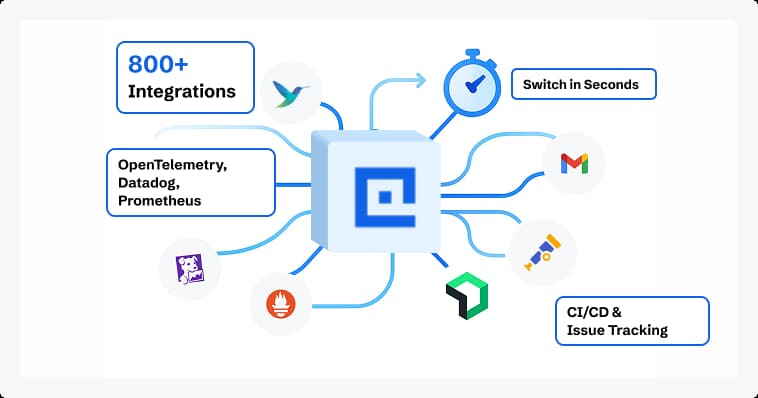
CubeAPM: CubeAPM supports multiple agents including OpenTelemetry, Prometheus, Datadog, New Relic, and Elastic, making migration straightforward. Its unified ingestion maps traces, logs, and metrics automatically, enabling faster onboarding for DevOps and SRE teams.
Grafana: Grafana integrates widely through plug-ins such as Prometheus, InfluxDB, StatsD, and Loki. However, it often requires manual configuration of backends. For teams already managing open-source telemetry, it’s highly flexible but demands engineering time for upkeep.
Sumo Logic: Sumo Logic uses the Sumo OTel Collector to gather logs, metrics, and traces. While effective for its own ecosystem, integrations with other vendor agents such as New Relic or Datadog is limited.
MELT Support (Metrics, Events, Logs, Traces)
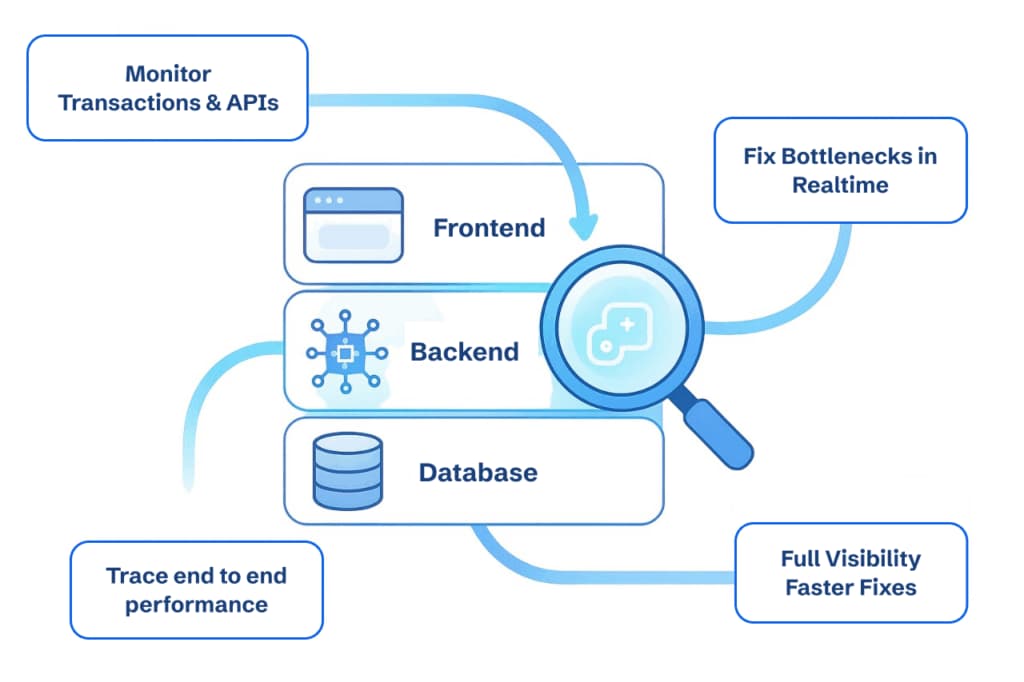
CubeAPM: Delivers end-to-end MELT coverage natively — metrics, logs, traces, and events within a single backend. Teams can correlate application latency, system errors, and real user sessions instantly, reducing mean-time-to-resolution (MTTR). Its event correlation engine connects telemetry streams for deeper root cause analysis.
Grafana: Provides full MELT through the LGTM stack using Loki for logs, Tempo for traces, and Mimir for metrics. While powerful for visualization, it requires multiple components with separate configuration and scaling, making it best suited for teams already running open-source telemetry pipelines.
Sumo Logic: Covers logs, metrics, and traces out of the box, and extends to events through its SIEM module. It offers strong analytics and anomaly detection.
Deployment Options

CubeAPM: Supports both SaaS and Bring-Your-Own-Cloud (BYOC) options, giving teams full control of where data resides. It’s built for enterprises with strict compliance needs—data never leaves your infrastructure, ensuring adherence to regulations. Setup remains lightweight since it’s vendor-managed post-deployment.
Grafana: Available in SaaS or Self-hosted. The self-hosted LGTM stack provides full control but adds DevOps overhead for scaling and maintenance.
Sumo Logic: Sumo Logic is a SaaS-only platform with no self-hosted or on-prem deployment option. Because telemetry must be sent to Sumo Logic’s cloud, teams can also incur cloud egress costs from providers like AWS or GCP, especially at scale, which adds to the overall observability spend beyond the platform’s usage-based pricing.
Pricing: Approximate Cost for Small, Mid-Sized & Large Teams
*Disclaimer: Pricing comparisons are based on standardized Small/Medium/Large team profiles defined in our internal benchmarking sheet. Actual costs may vary by usage, region, and plan. Please verify current pricing with each vendor.
An APM host is a host that is actively generating traces data and an Infra host is any physical or virtual OS instance that you monitor with any observability tool.
Cost for Small Teams (~30):
- CubeAPM: $2,080/month
- Grafana: $3,870/month
- Sumo Logic: $4,641/month
Cost for Mid-Sized Teams (~125):
- CubeAPM: $7,200/month
- Grafana: $11,875/month
- Sumo Logic: $16,065/month
Cost for Large Teams (~250):
- CubeAPM: $15,200/month
- Grafana: $26,750/month
- Sumo Logic: $33,915/month
These figures highlight the significant savings achieved with CubeAPM’s unified, ingestion-based model compared to Grafana’s modular and Sumo Logic’s credit-based pricing systems.
CubeAPM Cost for Small, Medium & Large Teams
CubeAPM operates on a flat ingestion-based model of $0.15 / GB across logs, metrics, and traces, with no additional charges for users, retention, or integrations.:
- Small teams (~30): $2,080/month
- Mid-sized teams (~125): $7,200/month
- Large teams (~250): $15,200/month
This predictable pricing makes CubeAPM ideal for startups and enterprises managing multi-terabyte ingestion each month.
Grafana Cloud: Cost for Small, Medium & Large Teams
Grafana’s modular model combines platform, logs, and traces pricing:
- Pro Plan: $19/month base,
- Logs: $0.50/GB ingested
- Traces: 0.50/GB ingested
- APM: $0.04/host-hour for APM.
Estimated costs for teams:
- Small teams (~30): $3,870/month
- Mid-sized teams (~125): $11,875/ month
- Large teams (~250): $26,750/month
While flexible for smaller environments, costs rise sharply once telemetry exceeds a few terabytes due to its separate per-GB billing for each component.
Sumo Logic: Cost for Small, Medium & Large Teams
Sumo Logic’s credit-based system averages $0.25 / credit.
- Small teams (~30): $4,641/month
- Mid-sized teams (~125): $16,065/month
- Large teams (~250): $33,915/month
Its flexible but complex model makes forecasting difficult, especially when data volume, retention, or analytics usage fluctuates.
Sampling Strategy

CubeAPM: Implements Smart Sampling with 95% compression and context-aware logic. It retains only latency-heavy, error-prone, or high-value traces while filtering out noise. This results in massive storage savings and faster queries, making it ideal for microservices generating millions of spans per minute.
Grafana: Grafana supports head-based sampling, which decides sampling at request start, and tail-based sampling, which evaluates complete traces to keep high-value data like slow or failed requests.
Sumo Logic: Sumo Logic supports tail-based sampling to evaluate complete traces, along with probabilistic sampling to control data volume by sampling a percentage of telemetry.
Data Retention
CubeAPM: Provides unlimited retention in self-hosted or BYOC modes with no additional cost. Teams can maintain months or years of data for compliance and performance baselines. It’s ideal for regulated industries needing secure, historical observability data.
Grafana: Grafana Cloud data retention varies by plan and data type. The Free plan includes 14 days of retention for metrics, logs, traces, profiles, and k6 test data. The Pro plan extends retention to 13 months for metrics and 30 days for logs, traces, profiles, and k6 data. Enterprise plans offer custom retention periods across all data types based on contract requirements.
Sumo Logic: Sumo Logic retention varies by data type. Normalized Logs are retained for 90 days by default, while Security Signals have a longer retention period of up to 2 years, reflecting their use in security investigations and compliance workflows.
Support Channel & Response Time
Quality support directly affects incident response and uptime reliability.
CubeAPM: Provides direct Slack and WhatsApp access to core engineers, ensuring live responses within minutes. Customers report near real-time troubleshooting and proactive guidance during onboarding and production incidents.
Grafana: Grafana provides support via email, ticketing, and Slack. Paid plans include 24/7 support with typical response times of about 2 business hours for P1, 4 hours for P2, and 6 hours for P3, while Enterprise plans offer faster SLAs, with P1 responses as low as 30 minutes.
Sumo Logic: Sumo Logic offers support via its web portal and email, with phone support on higher tiers. Response times vary by plan: P1 issues are handled within 1 hour, P2 within 4 hours, while lower-priority cases take 1 to 2 business days, with Premium plans providing faster responses.
Known For
CubeAPM: Known for OpenTelemetry-native full-stack observability, predictable pricing, and unlimited retention. Its self-host and BYOC model caters to teams demanding compliance, transparency, and cost control.
Grafana: Renowned for its visualization and dashboarding strengths, especially when paired with open-source telemetry tools like Prometheus and Loki. Favored by DevOps engineers seeking full customization.
Sumo Logic: Recognized for log analytics, security monitoring, and cloud-native SIEM capabilities. Suited for teams that value analytics automation and centralized monitoring without managing infrastructure.
Which Tool Is Best for You? Why Brands Choose CubeAPM

Unlike traditional tools that separate logging, tracing, and infrastructure monitoring, CubeAPM delivers unified MELT observability in a single OpenTelemetry-native platform. It’s built for teams that need cost predictability, deployment flexibility, and enterprise-grade data controls.
Benefits of Choosing CubeAPM
- Unified MELT Observability: One backend for Metrics, Events, Logs, and Traces—no fragmented pipelines or integrations.
- Transparent pricing: Pay a simple $0.15 / GB for all telemetry data with no extra costs for users, features, or retention.
- Smart Sampling Efficiency: Intelligent, context-based sampling with up to 95 % compression, retaining critical latency and error traces.
- Unlimited Retention: Keep telemetry data for as long as you need at no additional cost—ideal for SLA tracking and audit readiness.
- Data Sovereignty & Compliance: Run CubeAPM inside your own cloud or on-premise to meet requirements.
- Multi-Agent Compatibility: Fully compatible with OpenTelemetry, Prometheus, Datadog, New Relic, and Elastic agents for smooth migration.
- Real-Time Support: Direct access to engineers via Slack or WhatsApp—responses in minutes, not days.
- Faster Troubleshooting: Cross-correlate logs, metrics, and traces in one view to reduce mean-time-to-resolution (MTTR) by over 40%.
- Optimized for Modern Architectures: Designed for microservices, Kubernetes, and hybrid-cloud deployments with low overhead and high scalability.
CubeAPM gives modern DevOps and SRE teams the confidence to scale observability without worrying about unpredictable costs or limited data access. It’s the only platform combining full-stack visibility, self-hosting control, and real-time collaboration support under one transparent model.
Grafana vs Sumo Logic vs CubeAPM: Use Cases
Choose CubeAPM if:
- You want full-stack MELT in one OpenTelemetry-native platform (logs, metrics, traces, RUM, synthetics).
- You need predictable $0.15/GB pricing, unlimited retention, and BYOC/self-host for strict compliance.
- You want smart sampling (≈95% compression), minute-level Slack/WhatsApp support, and lower MTTR/costs.
Choose Grafana if:
- You need real-time dashboards and visualization for Prometheus, InfluxDB, or Loki metrics.
- You want a hosted dashboard layer for small teams and can accept rising costs as Loki/Tempo/Mimir usage scales.
- You prefer open-source flexibility and can maintain separate backends for logs, traces, and metrics.
Choose Sumo Logic if:
- You want a cloud-native analytics and SIEM platform for log intelligence and security monitoring.
- You need centralized anomaly detection and compliance dashboards and are okay with credit-based billing complexity.
- You prefer fully managed SaaS over self-hosted control or data-residency customization.
Conclusion
Grafana excels in visualization, and Sumo Logic delivers strong analytics, but Grafana rely on multi-tool setups that increase overhead, while Sumo Logic can be costly at scale.
CubeAPM simplifies observability with one lightweight, OpenTelemetry-native platform that scales easily across modern infrastructures.
For teams seeking unified visibility, faster troubleshooting, and full control over their data, CubeAPM is the smarter, future-ready choice.
Disclaimer: The information in this article reflects the latest details available at the time of publication and may change as technologies and products evolve.
1. What is the main difference between Grafana, Sumo Logic, and CubeAPM
Grafana focuses on visualization and dashboards, Sumo Logic is a SaaS-based analytics and observability platform, while CubeAPM provides unified, full-stack observability built natively on OpenTelemetry with managed self-hosting and predictable pricing.
2. Does Sumo Logic support self-hosting like CubeAPM
No. Sumo Logic is SaaS-only, meaning telemetry must be sent to its cloud. CubeAPM runs inside your own cloud or on-prem environment, giving teams full control over data, retention, and compliance
3. Which option is more cost-effective at scale
CubeAPM is generally more cost-predictable due to its ingestion-based pricing with no per-user or retention add-ons. Grafana Cloud and Sumo Logic use usage-based SaaS pricing, which can increase significantly as telemetry volume grows.
4. Which platform is best for OpenTelemetry-first teams
CubeAPM is OpenTelemetry native by design, making it ideal for teams standardizing on OTEL. Grafana and Sumo Logic support OpenTelemetry, but typically as part of broader or more complex pipelines rather than a single unified backend.
5. Is CubeAPM a better alternative to Grafana and Sumo Logic
CubeAPM is a strong alternative for teams that want unified logs, metrics, and traces in a single platform with full data ownership. Unlike Grafana, it does not require managing multiple backends, and unlike Sumo Logic, it avoids variable usage-based costs.